
National Assessment of the Visual Impact of Wind
- Slides: 42
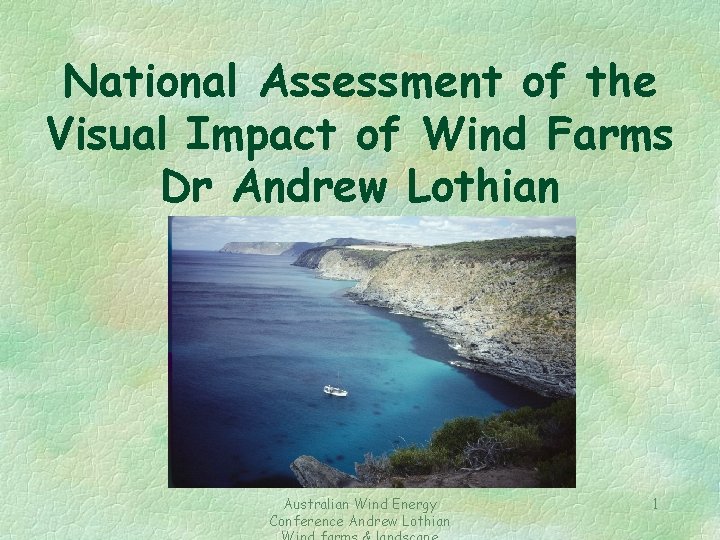
National Assessment of the Visual Impact of Wind Farms Dr Andrew Lothian Australian Wind Energy Conference Andrew Lothian 1
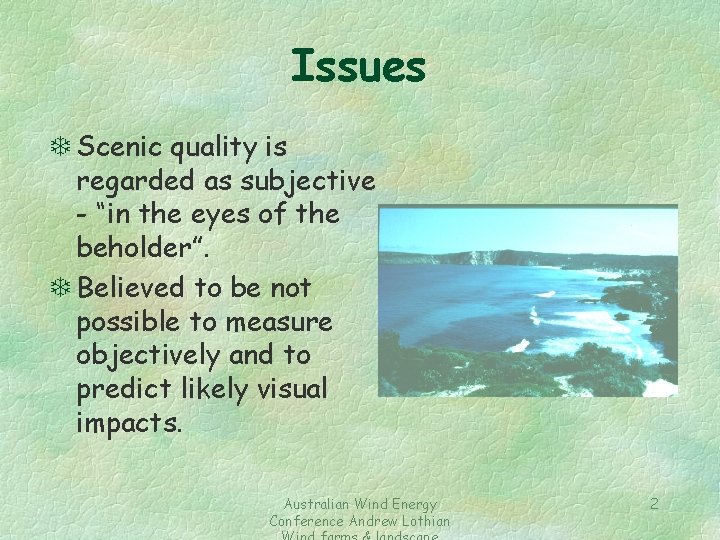
Issues T Scenic quality is regarded as subjective - “in the eyes of the beholder”. T Believed to be not possible to measure objectively and to predict likely visual impacts. Australian Wind Energy Conference Andrew Lothian 2
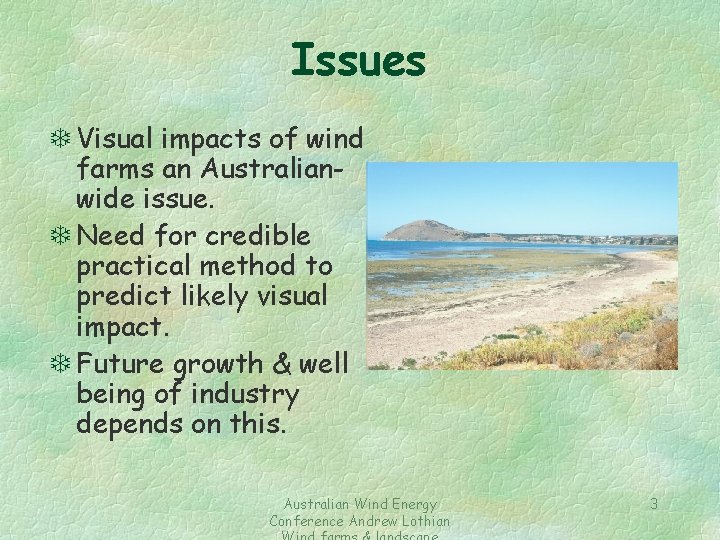
Issues T Visual impacts of wind farms an Australianwide issue. T Need for credible practical method to predict likely visual impact. T Future growth & well being of industry depends on this. Australian Wind Energy Conference Andrew Lothian 3
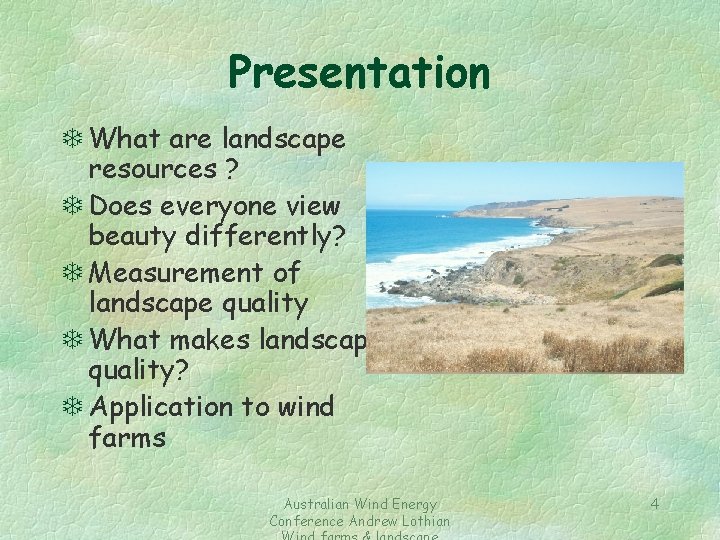
Presentation T What are landscape resources ? T Does everyone view beauty differently? T Measurement of landscape quality T What makes landscape quality? T Application to wind farms Australian Wind Energy Conference Andrew Lothian 4
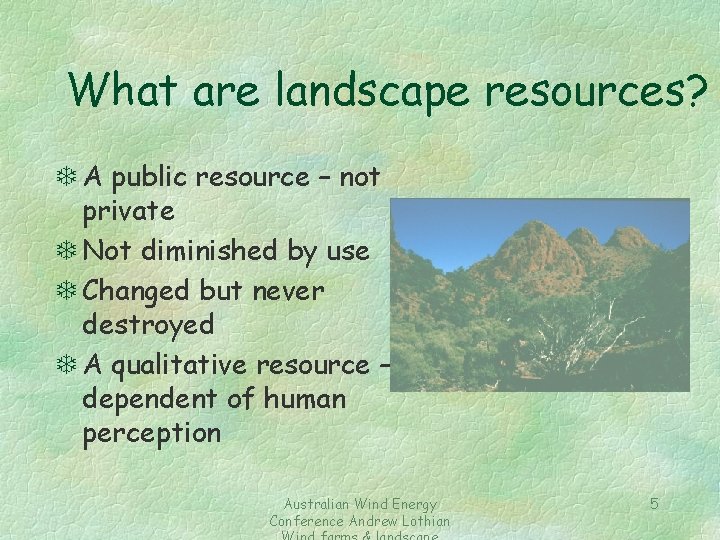
What are landscape resources? T A public resource – not private T Not diminished by use T Changed but never destroyed T A qualitative resource – dependent of human perception Australian Wind Energy Conference Andrew Lothian 5
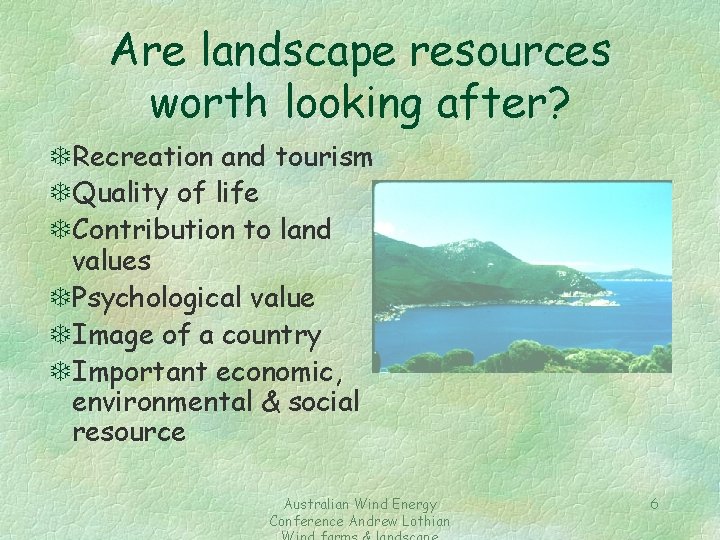
Are landscape resources worth looking after? TRecreation and tourism TQuality of life TContribution to land values TPsychological value TImage of a country TImportant economic, environmental & social resource Australian Wind Energy Conference Andrew Lothian 6
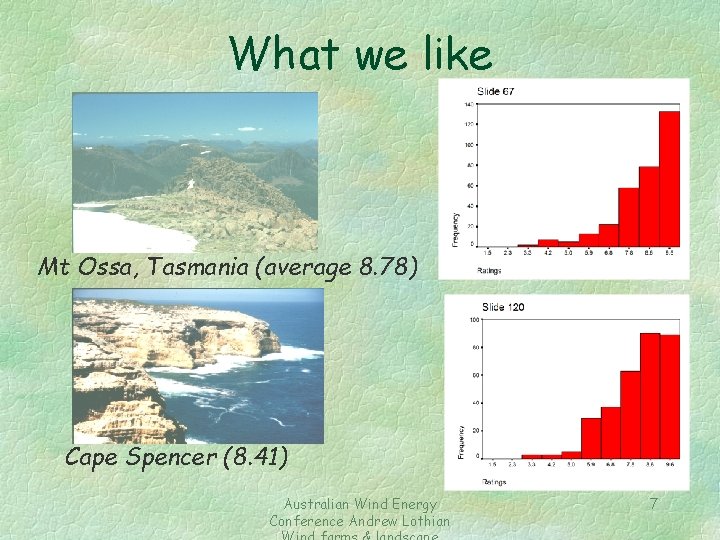
What we like Mt Ossa, Tasmania (average 8. 78) Cape Spencer (8. 41) Australian Wind Energy Conference Andrew Lothian 7
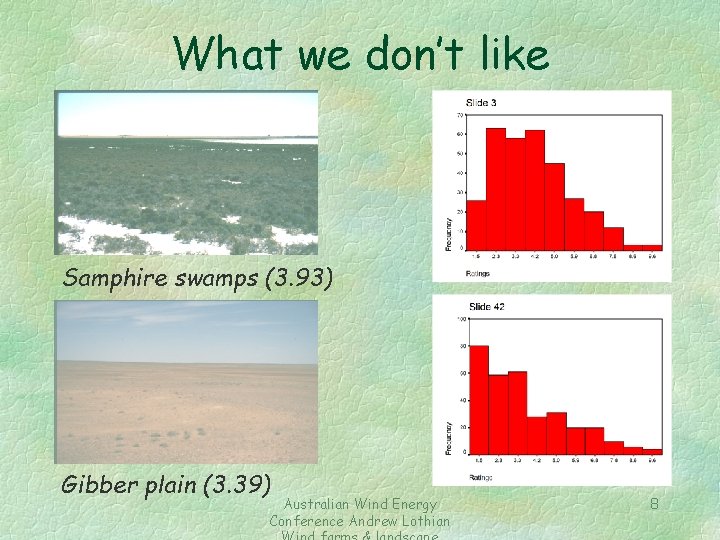
What we don’t like Samphire swamps (3. 93) Gibber plain (3. 39) Australian Wind Energy Conference Andrew Lothian 8
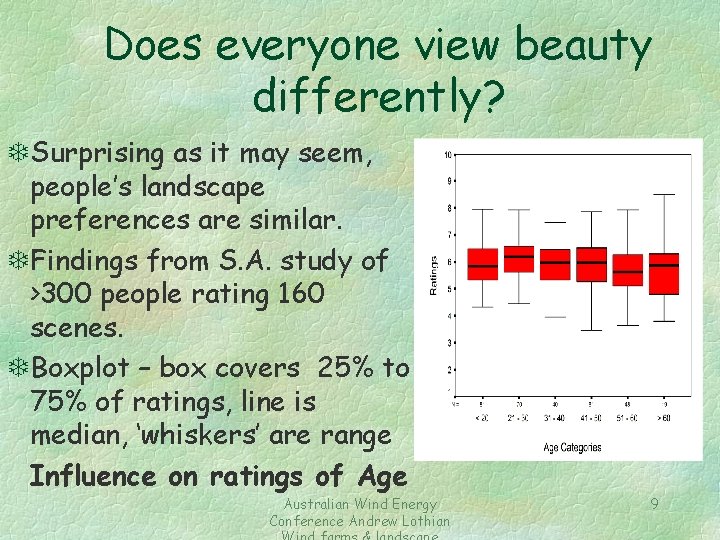
Does everyone view beauty differently? TSurprising as it may seem, people’s landscape preferences are similar. TFindings from S. A. study of >300 people rating 160 scenes. TBoxplot – box covers 25% to 75% of ratings, line is median, ‘whiskers’ are range Influence on ratings of Age Australian Wind Energy Conference Andrew Lothian 9
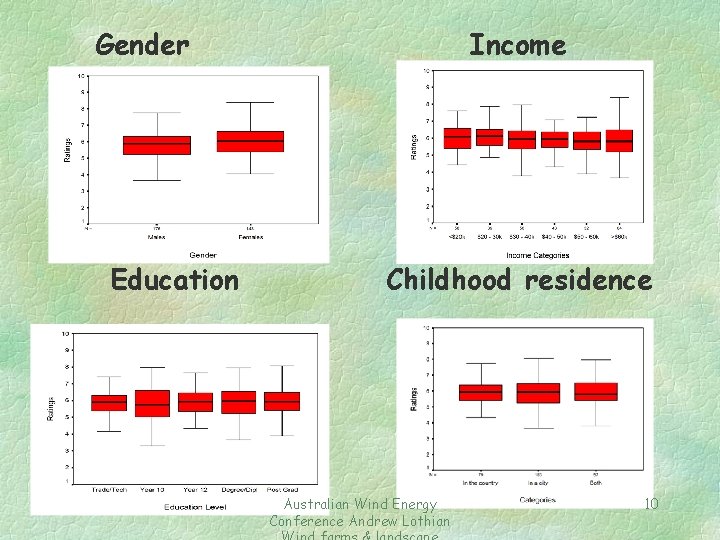
Gender Education Income Childhood residence Australian Wind Energy Conference Andrew Lothian 10
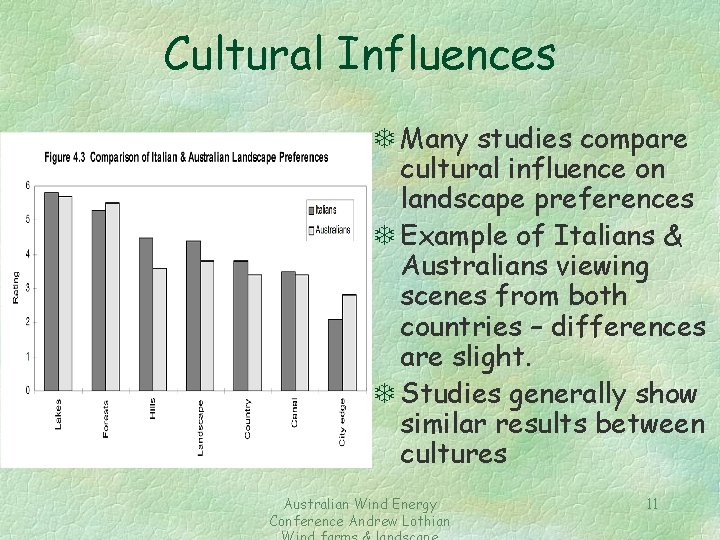
Cultural Influences T Many studies compare cultural influence on landscape preferences T Example of Italians & Australians viewing scenes from both countries – differences are slight. T Studies generally show similar results between cultures Australian Wind Energy Conference Andrew Lothian 11
The literature and my South Australian research indicates – The similarities in people’s landscape preferences are far greater than the differences Beauty is in the eyes of the beholder – but everyone’s eyes are similar This similarity in preferences provides the basis for assessing landscape quality Australian Wind Energy Conference Andrew Lothian 12
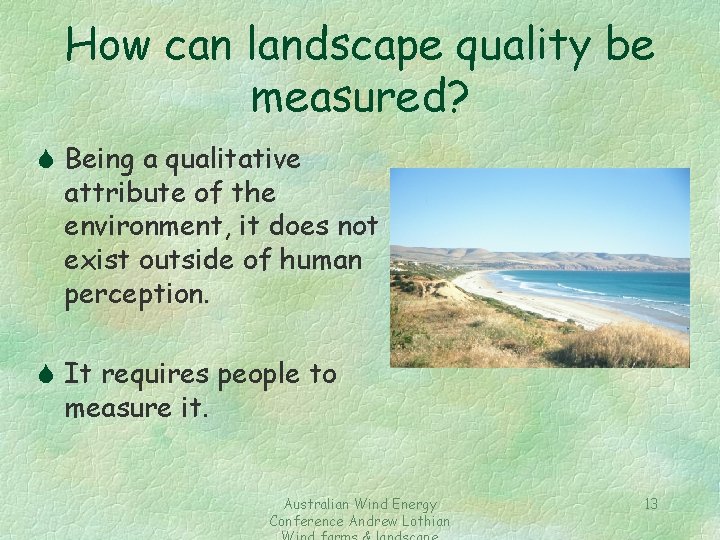
How can landscape quality be measured? S Being a qualitative attribute of the environment, it does not exist outside of human perception. S It requires people to measure it. Australian Wind Energy Conference Andrew Lothian 13
Expert landscape appraisals T Studies have found that landscape appraisals by experts (e. g. landscape architects) tend to differ from the community. T Sinclair-Thomas Matrix commonly used classifies scenic quality, scale of development, zone of visual impact, & degree of visual modification. Scorings are added together. T Scorings are ordinal ranks, cannot add them (like adding A, B, C). T We view landscapes holistically, not as parts. T Results inform but do not necessarily correspond with community preferences. Australian Wind Energy Conference Andrew Lothian 14
Science of Psychophysics S A branch of psychology that provides approach to measuring landscape quality S Developed by Gustav Fechner (1801 -87) S Measures effect of stimuli (eg noise, taste, sight) on the brain S Based on people being reasonably consistent in making choices among options. A person’s landscape preferences do not change widely S Group preferences follow normal bell curve distribution; means represents true value Australian Wind Energy Conference Andrew Lothian 15
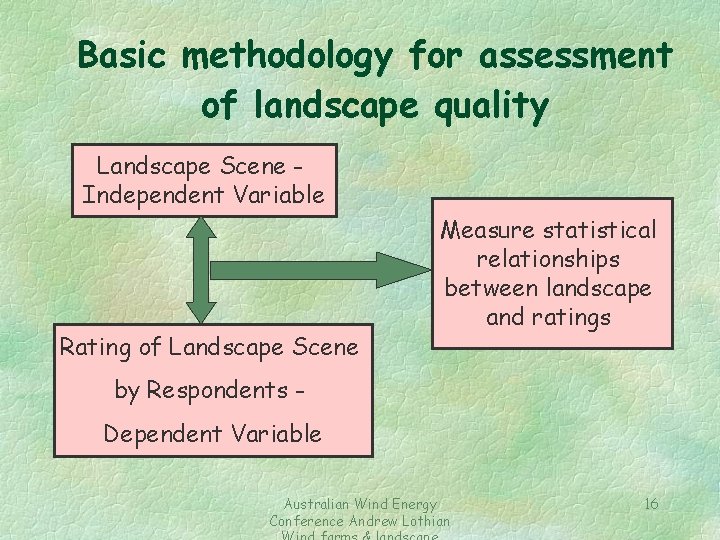
Basic methodology for assessment of landscape quality Landscape Scene Independent Variable Rating of Landscape Scene Measure statistical relationships between landscape and ratings by Respondents Dependent Variable Australian Wind Energy Conference Andrew Lothian 16
Key requirements T Colour photographs – sufficient number to cover area and range of features T Standardised format, 50 mm lens, non-artistic composition, good lateral & foreground context to scenes, single landscape unit, use typical representative scenes – avoid unusual T 10 point rating scale (1 – low, 10 - high) T 300 minimum raters, adults, broadly representative of community Australian Wind Energy Conference Andrew Lothian 17
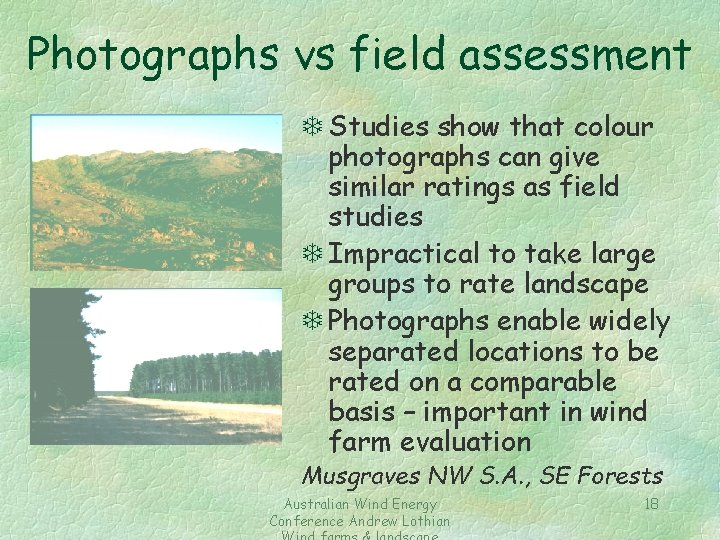
Photographs vs field assessment T Studies show that colour photographs can give similar ratings as field studies T Impractical to take large groups to rate landscape T Photographs enable widely separated locations to be rated on a comparable basis – important in wind farm evaluation Musgraves NW S. A. , SE Forests Australian Wind Energy Conference Andrew Lothian 18
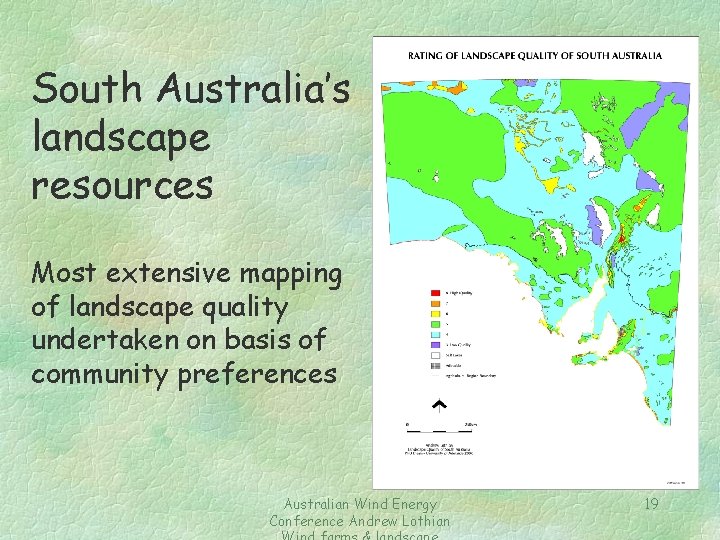
South Australia’s landscape resources Most extensive mapping of landscape quality undertaken on basis of community preferences Australian Wind Energy Conference Andrew Lothian 19
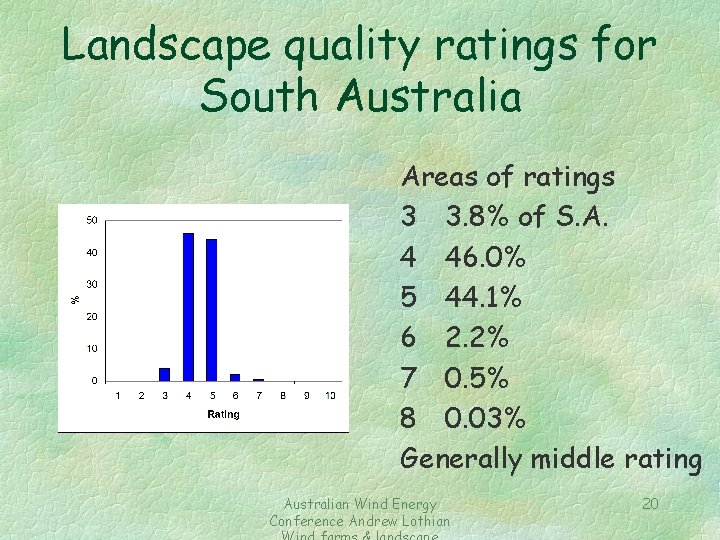
Landscape quality ratings for South Australia Areas of ratings 3 3. 8% of S. A. 4 46. 0% 5 44. 1% 6 2. 2% 7 0. 5% 8 0. 03% Generally middle rating Australian Wind Energy Conference Andrew Lothian 20
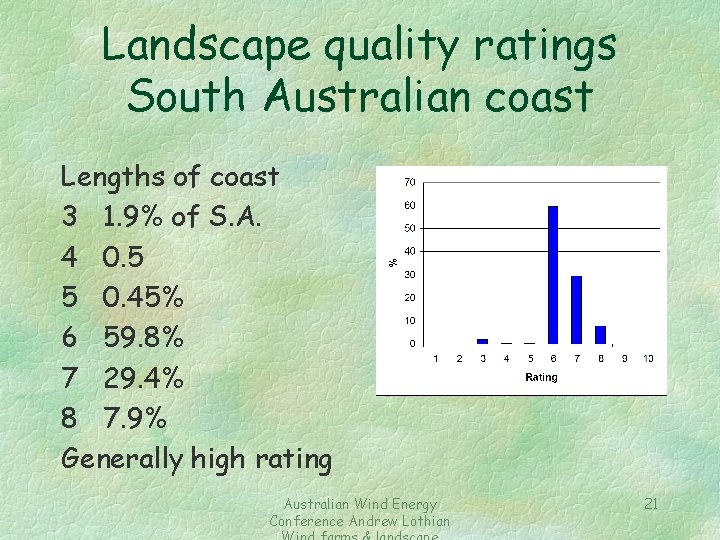
Landscape quality ratings South Australian coast Lengths of coast 3 1. 9% of S. A. 4 0. 5 5 0. 45% 6 59. 8% 7 29. 4% 8 7. 9% Generally high rating Australian Wind Energy Conference Andrew Lothian 21
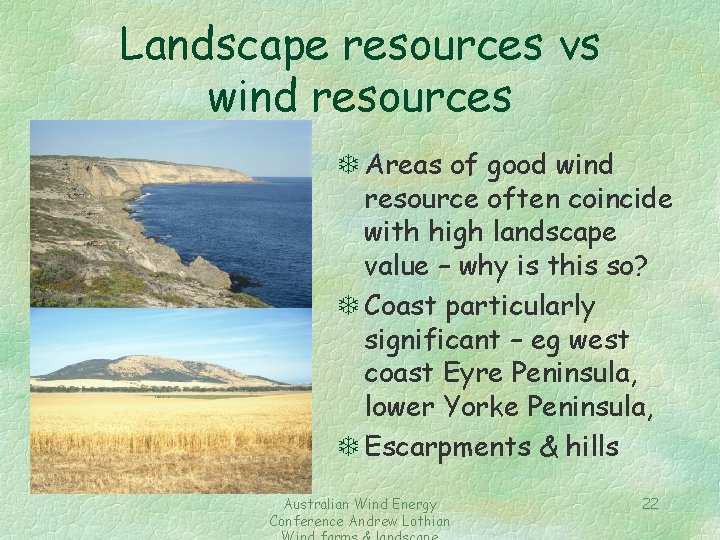
Landscape resources vs wind resources T Areas of good wind resource often coincide with high landscape value – why is this so? T Coast particularly significant – eg west coast Eyre Peninsula, lower Yorke Peninsula, T Escarpments & hills Australian Wind Energy Conference Andrew Lothian 22
Wind farms and landscape TUnderstanding what factors make landscape quality is important in understanding the visual impact of wind farms and how to minimise this impact TFollowing findings are from South Australian study TResults are broadly applicable to Australian Wind Energy Conference Andrew Lothian 23
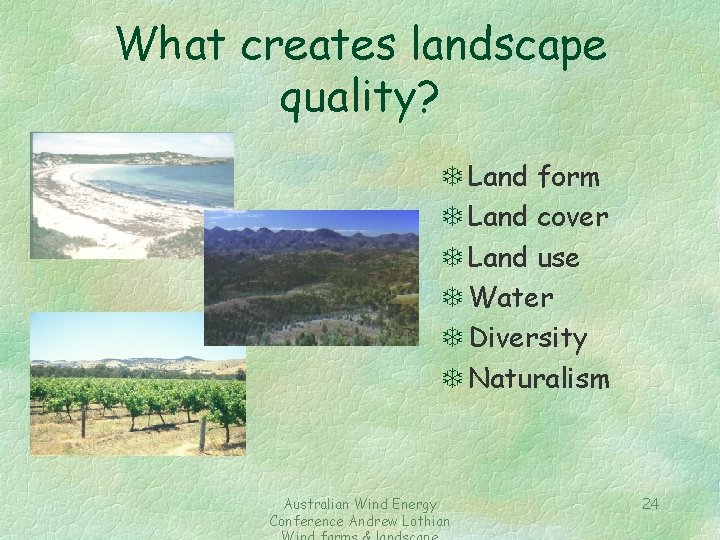
What creates landscape quality? T Land form T Land cover T Land use T Water T Diversity T Naturalism Australian Wind Energy Conference Andrew Lothian 24
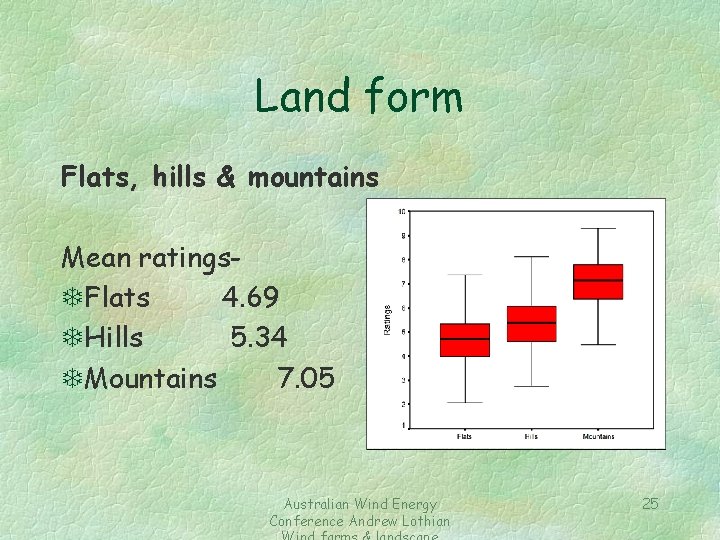
Land form Flats, hills & mountains Mean ratings. TFlats 4. 69 THills 5. 34 TMountains 7. 05 Australian Wind Energy Conference Andrew Lothian 25
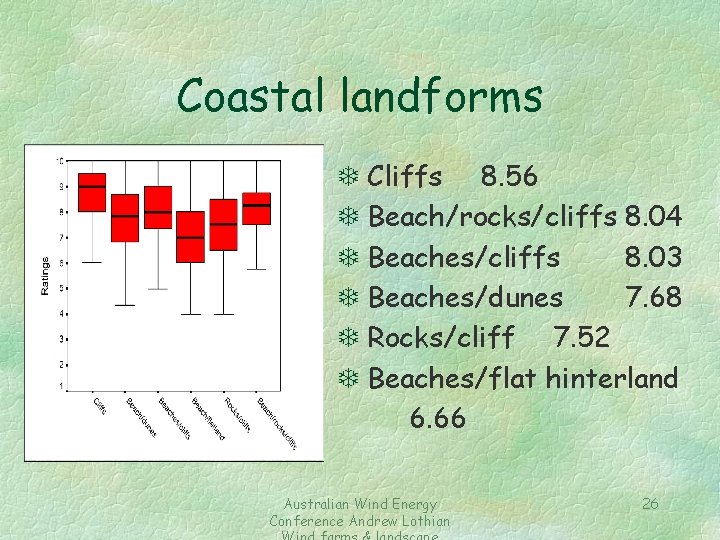
Coastal landforms T Cliffs 8. 56 T Beach/rocks/cliffs 8. 04 T Beaches/cliffs 8. 03 T Beaches/dunes 7. 68 T Rocks/cliff 7. 52 T Beaches/flat hinterland 6. 66 Australian Wind Energy Conference Andrew Lothian 26
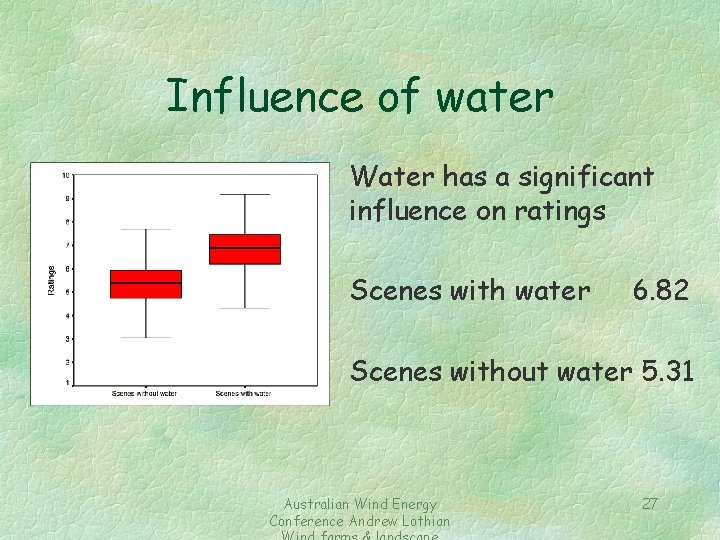
Influence of water Water has a significant influence on ratings Scenes with water 6. 82 Scenes without water 5. 31 Australian Wind Energy Conference Andrew Lothian 27
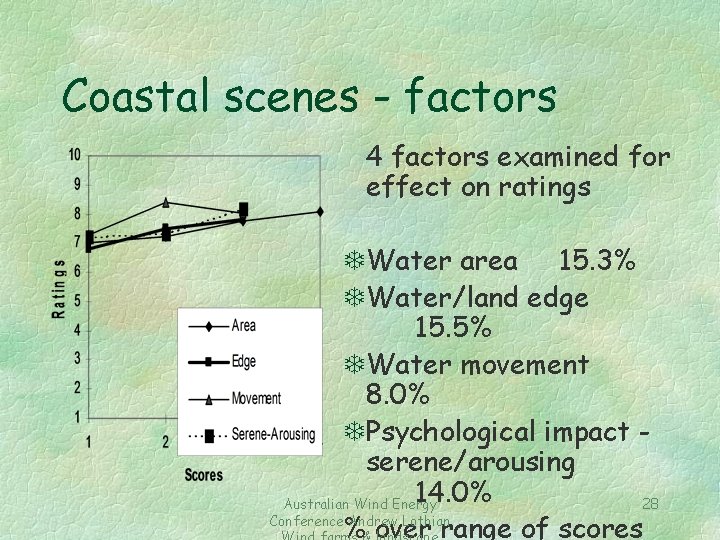
Coastal scenes - factors 4 factors examined for effect on ratings TWater area 15. 3% TWater/land edge 15. 5% TWater movement 8. 0% TPsychological impact serene/arousing 14. 0% Australian Wind Energy 28 Conference Andrew Lothian % over range of scores
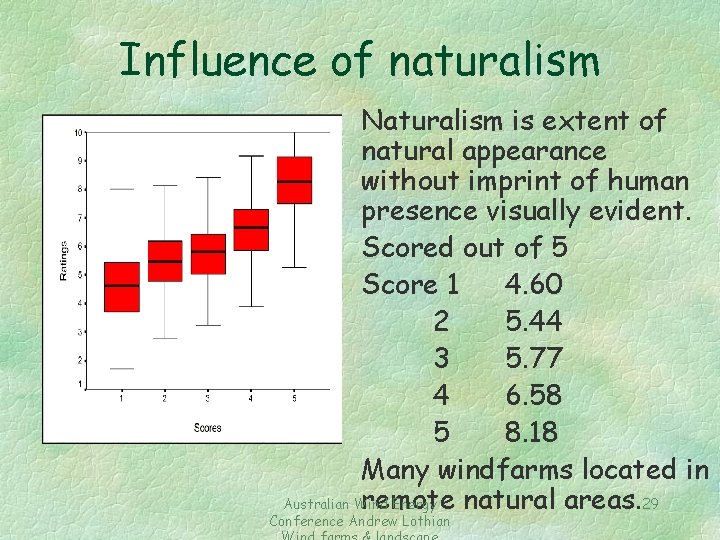
Influence of naturalism Naturalism is extent of natural appearance without imprint of human presence visually evident. Scored out of 5 Score 1 4. 60 2 5. 44 3 5. 77 4 6. 58 5 8. 18 Many windfarms located in Australian Wind Energy remote natural areas. 29 Conference Andrew Lothian
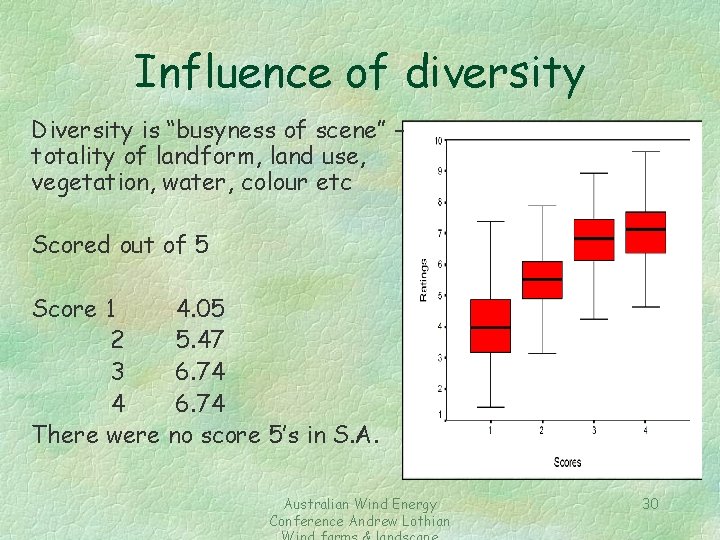
Influence of diversity Diversity is “busyness of scene” – totality of landform, land use, vegetation, water, colour etc Scored out of 5 Score 1 4. 05 2 5. 47 3 6. 74 4 6. 74 There were no score 5’s in S. A. Australian Wind Energy Conference Andrew Lothian 30
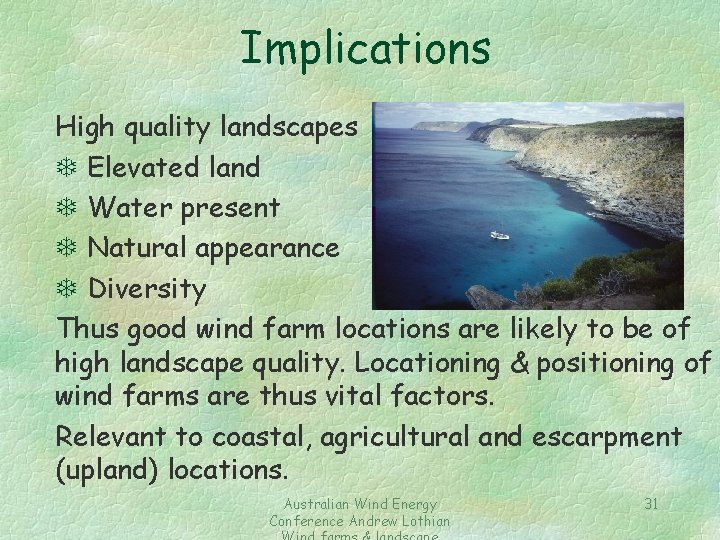
Implications High quality landscapes T Elevated land T Water present T Natural appearance T Diversity Thus good wind farm locations are likely to be of high landscape quality. Locationing & positioning of wind farms are thus vital factors. Relevant to coastal, agricultural and escarpment (upland) locations. Australian Wind Energy Conference Andrew Lothian 31
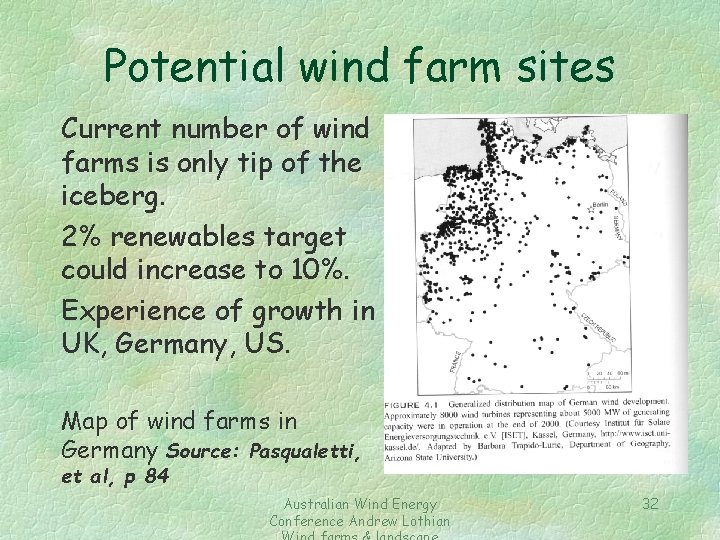
Potential wind farm sites Current number of wind farms is only tip of the iceberg. 2% renewables target could increase to 10%. Experience of growth in UK, Germany, US. Map of wind farms in Germany Source: Pasqualetti, et al, p 84 Australian Wind Energy Conference Andrew Lothian 32
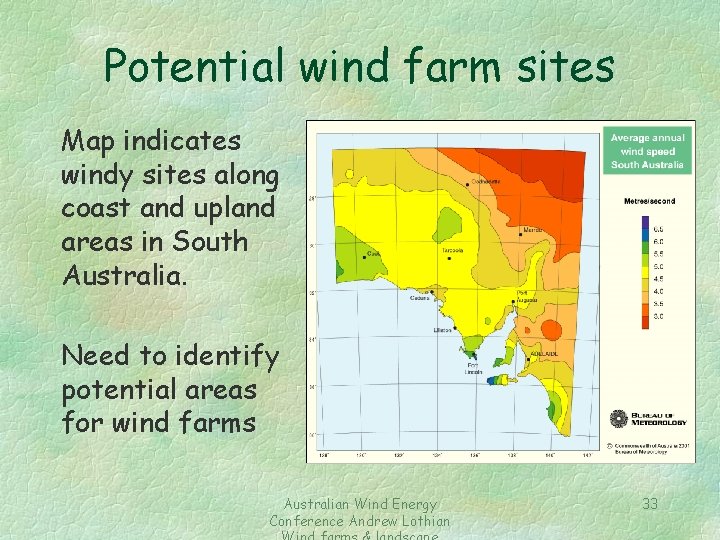
Potential wind farm sites Map indicates windy sites along coast and upland areas in South Australia. Need to identify potential areas for wind farms Australian Wind Energy Conference Andrew Lothian 33
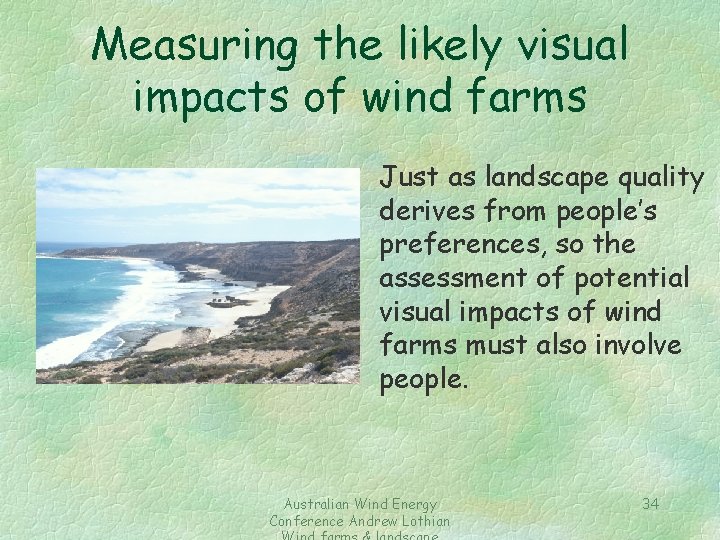
Measuring the likely visual impacts of wind farms Just as landscape quality derives from people’s preferences, so the assessment of potential visual impacts of wind farms must also involve people. Australian Wind Energy Conference Andrew Lothian 34
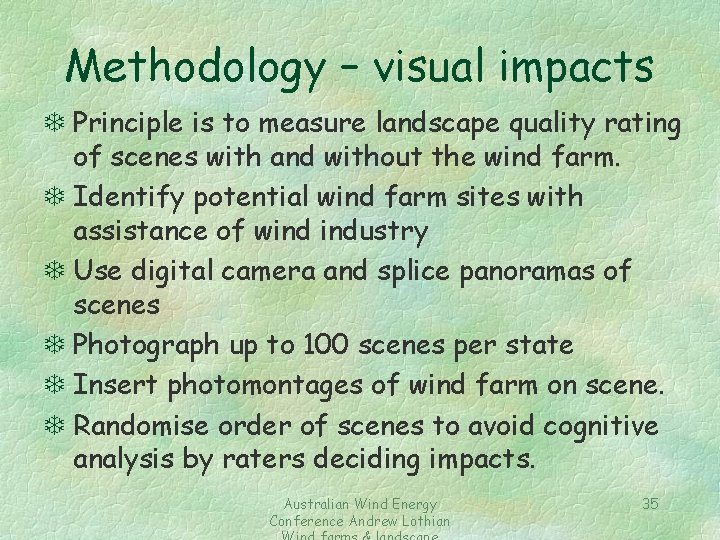
Methodology – visual impacts T Principle is to measure landscape quality rating of scenes with and without the wind farm. T Identify potential wind farm sites with assistance of wind industry T Use digital camera and splice panoramas of scenes T Photograph up to 100 scenes per state T Insert photomontages of wind farm on scene. T Randomise order of scenes to avoid cognitive analysis by raters deciding impacts. Australian Wind Energy Conference Andrew Lothian 35
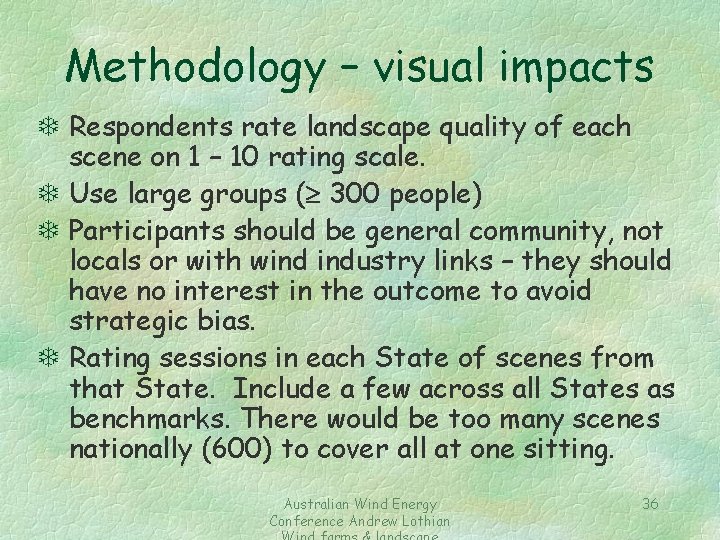
Methodology – visual impacts T Respondents rate landscape quality of each scene on 1 – 10 rating scale. T Use large groups ( 300 people) T Participants should be general community, not locals or with wind industry links – they should have no interest in the outcome to avoid strategic bias. T Rating sessions in each State of scenes from that State. Include a few across all States as benchmarks. There would be too many scenes nationally (600) to cover all at one sitting. Australian Wind Energy Conference Andrew Lothian 36
Consistency of results T The findings are likely to be consistent across States for similar landscapes – eg similar ratings for coastal cliffs. T This is because it the characteristics of the scenes determine ratings, not the location. The results are therefore transferable. T State ratings are important for ownership and relevance for guidelines Australian Wind Energy Conference Andrew Lothian 37
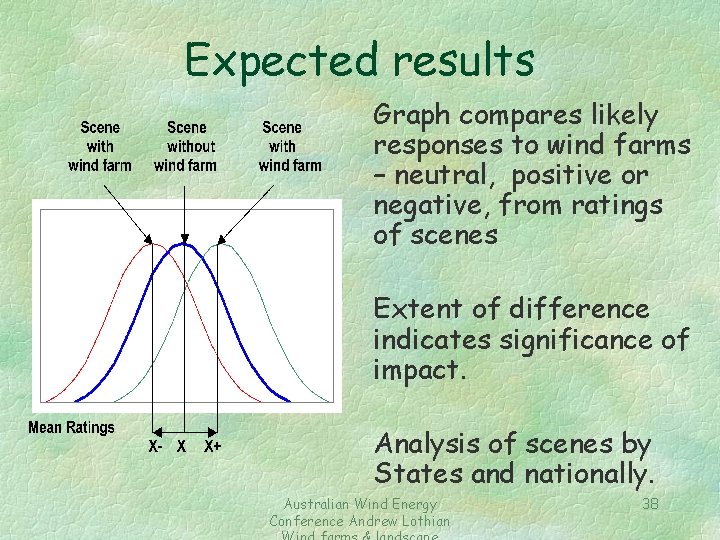
Expected results Graph compares likely responses to wind farms – neutral, positive or negative, from ratings of scenes Extent of difference indicates significance of impact. Analysis of scenes by States and nationally. Australian Wind Energy Conference Andrew Lothian 38
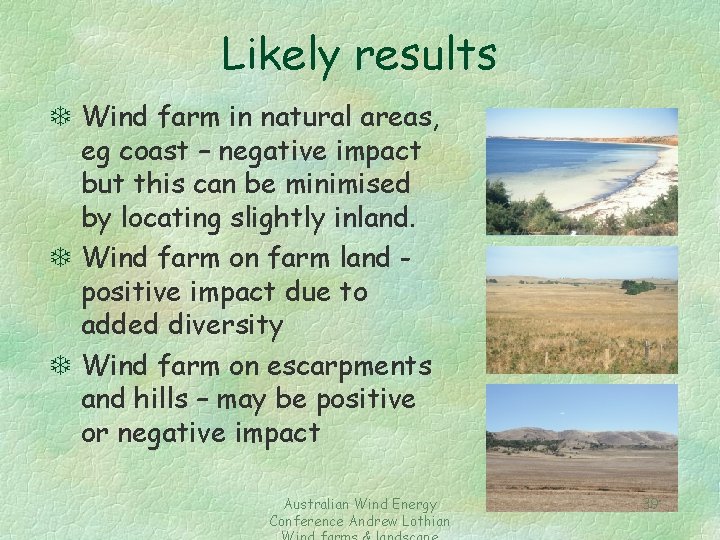
Likely results T Wind farm in natural areas, eg coast – negative impact but this can be minimised by locating slightly inland. T Wind farm on farm land positive impact due to added diversity T Wind farm on escarpments and hills – may be positive or negative impact Australian Wind Energy Conference Andrew Lothian 39
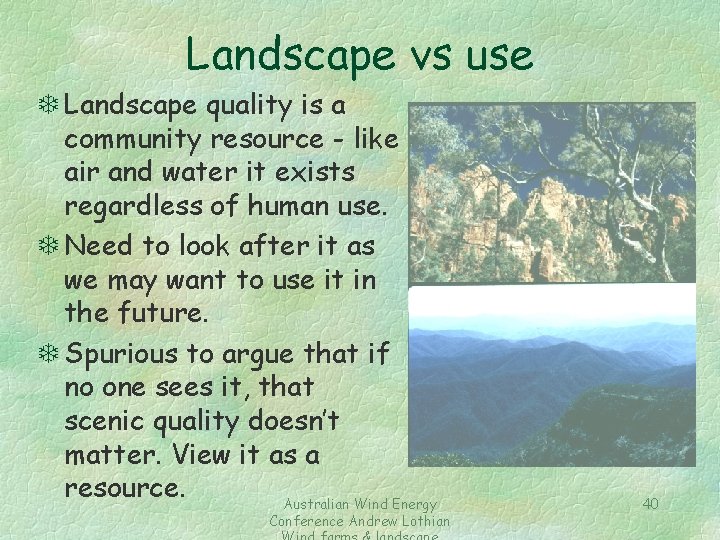
Landscape vs use T Landscape quality is a community resource - like air and water it exists regardless of human use. T Need to look after it as we may want to use it in the future. T Spurious to argue that if no one sees it, that scenic quality doesn’t matter. View it as a resource. Australian Wind Energy Conference Andrew Lothian 40
Use of Results T Ratings will provide detailed understanding of human perception of the visual impacts of wind farms. T This will provide basis for predicting likely community responses to wind farm proposals and indicate locations of acceptable visual impact. T State by State appraisals will provide basis for development of planning guidelines covering location, positioning and management for wind farm developers and planning authorities. Australian Wind Energy Conference Andrew Lothian 41
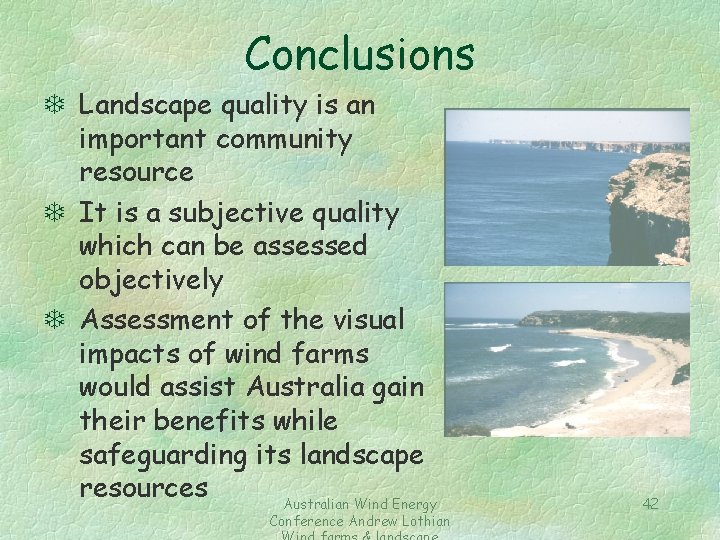
Conclusions T Landscape quality is an important community resource T It is a subjective quality which can be assessed objectively T Assessment of the visual impacts of wind farms would assist Australia gain their benefits while safeguarding its landscape resources Australian Wind Energy Conference Andrew Lothian 42