
National Analytical Management Program NAMP Savannah River National

- Slides: 52
National Analytical Management Program (NAMP) Savannah River National Laboratory U. S. Department of Energy Savannah River National Analytical Management Program Analytical Services Program (ASP) Workshop September 15, 2015 Cecilia Di. Prete, Savannah River National Laboratory Berta Oates, CBFO Technical Assistance Contractor, Portage, Inc.
2 Outline of Talking Points • History and Mission • Organizational Structure • Integrated Consortium of Laboratory Networks (ICLN) • Environmental Response Laboratory Network (ERLN) Coordination Office • Radiological Response Laboratory Network (RRLN) • NAMP Initiatives within Subcommittees • Collaborations and Strategic Partnerships • Questions and Answers
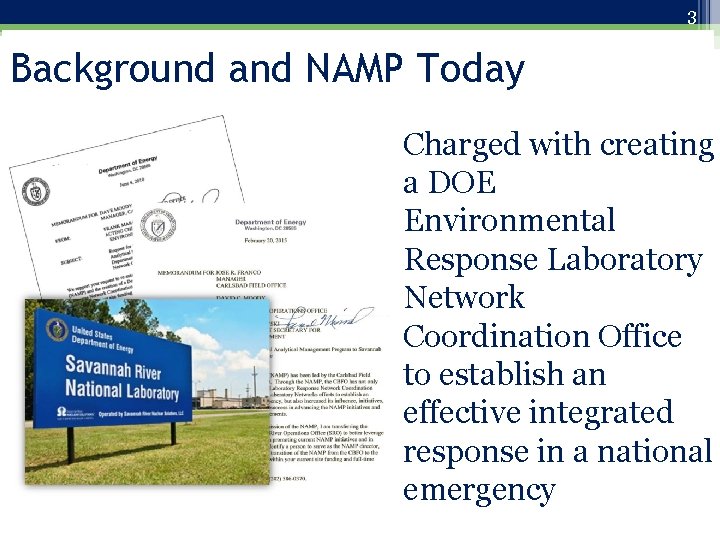
3 Background and NAMP Today Charged with creating a DOE Environmental Response Laboratory Network Coordination Office to establish an effective integrated response in a national emergency
4 NAMP Mission • Work to serve as a focal point to coordinate analytical resources within the DOE complex • Help other agencies and organizations gain access to analytical capabilities and expertise within participating laboratories – Create DOE Environmental Response Laboratory Network Coordination Office – Support the need to maintain and expand analytical capabilities • Promote training and education
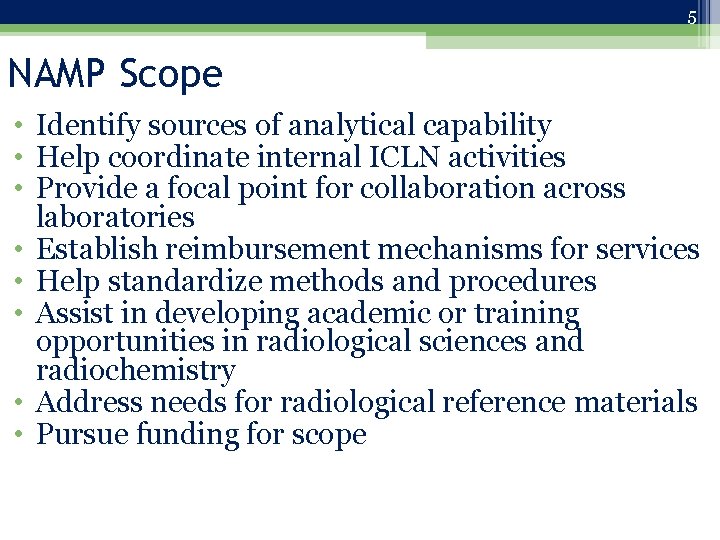
5 NAMP Scope • Identify sources of analytical capability • Help coordinate internal ICLN activities • Provide a focal point for collaboration across laboratories • Establish reimbursement mechanisms for services • Help standardize methods and procedures • Assist in developing academic or training opportunities in radiological sciences and radiochemistry • Address needs for radiological reference materials • Pursue funding for scope
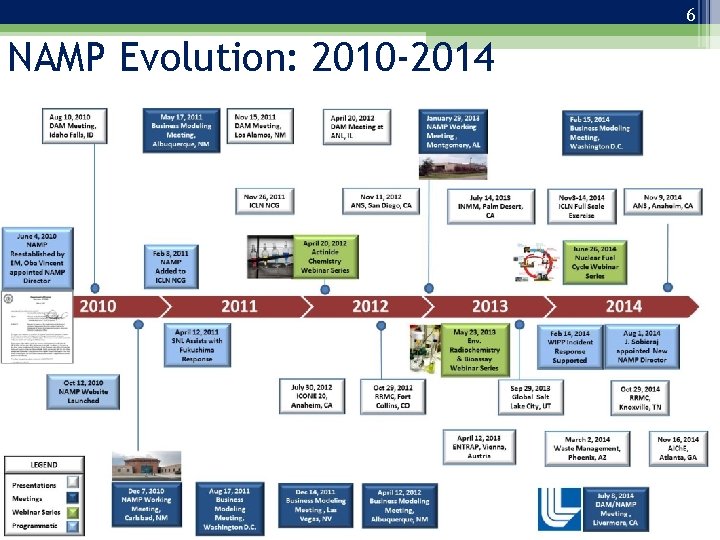
6 NAMP Evolution: 2010 -2014
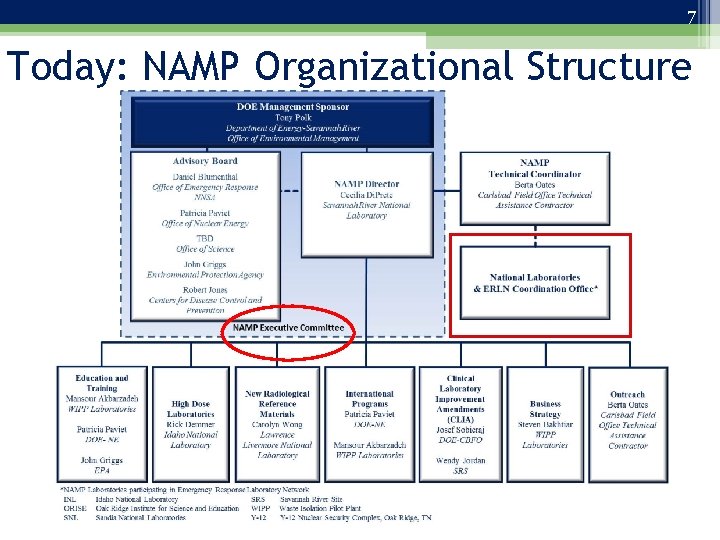
7 Today: NAMP Organizational Structure
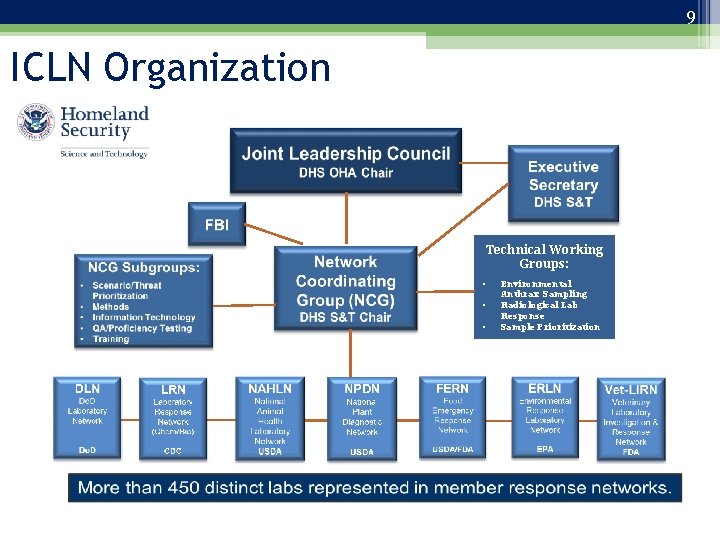
8 Integrated Consortium of Laboratory Networks (ICLN) • Established 2005 • Signed MOA between 10 federal agencies, including EPA and DOE • Renewed 2012 • Provides a nation-wide integrated system of laboratory networks
9 ICLN Organization Technical Working Groups: • • • Environmental Anthrax Sampling Radiological Lab Response Sample Prioritization
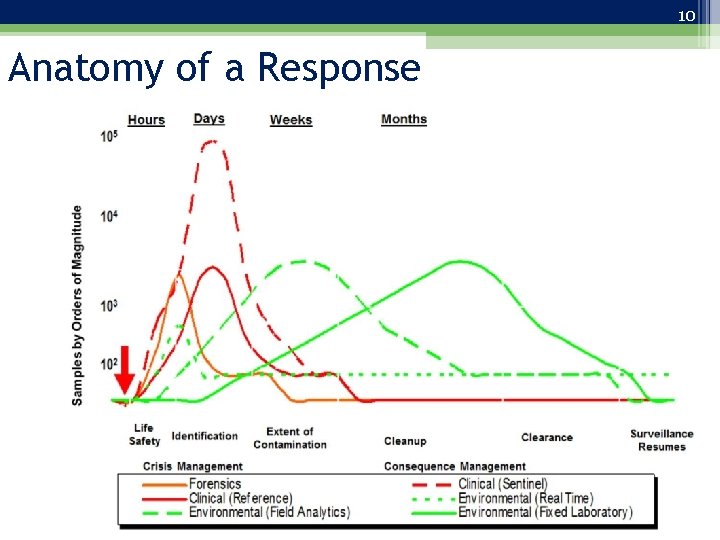
10 Anatomy of a Response
11 Why is the ICLN Important? Provides efficient coordination of analytical laboratory services for Chemical/Biological/Radiological incidents • inter-network strategic and operational planning • identification of accountabilities • communication and information sharing • resource optimization • response coordination
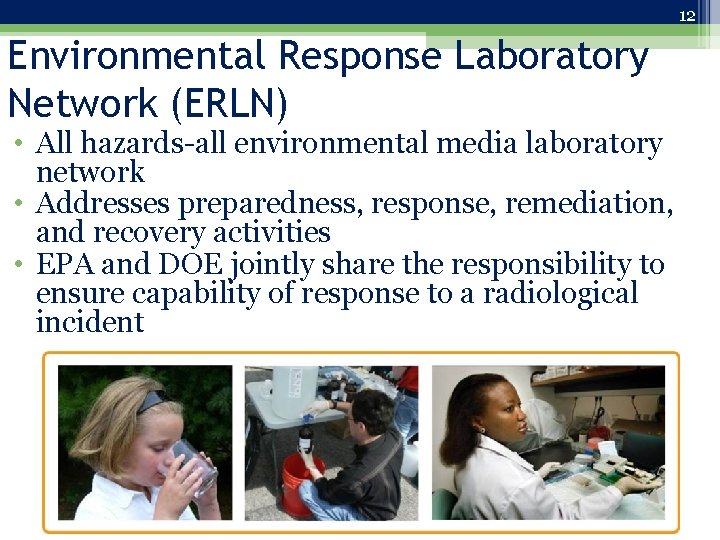
12 Environmental Response Laboratory Network (ERLN) • All hazards-all environmental media laboratory network • Addresses preparedness, response, remediation, and recovery activities • EPA and DOE jointly share the responsibility to ensure capability of response to a radiological incident
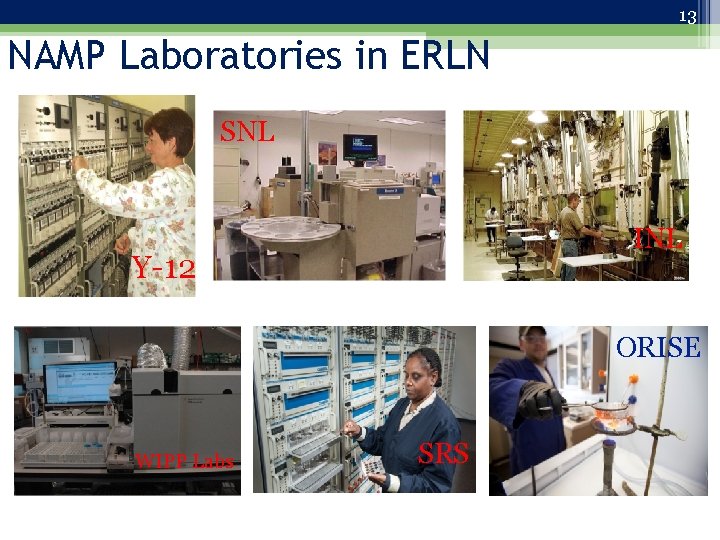
13 NAMP Laboratories in ERLN SNL INL Y-12 ORISE WIPP Labs SRS
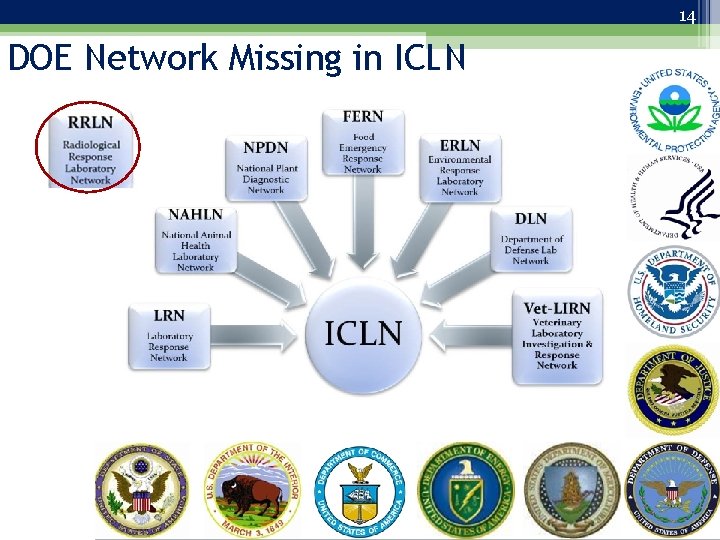
14 DOE Network Missing in ICLN
The Need for a Radiological Response Laboratory Network (RRLN) 15 • Difficulty reaching to DOE Laboratories for support (independent entities) • Current ICLN laboratory capacity is not sufficient • Flexibility in directing resources for emergency response • PREPARE DOE National Laboratories to respond assist in a nuclear incident • Capability to accept and analyze high activity radiological samples (unique DOE infrastructure) • DOE National Laboratories bring: – Largest analytical capacity – Technical expertise – Unique capabilities (R&D mission) – Largest laboratory infrastructure
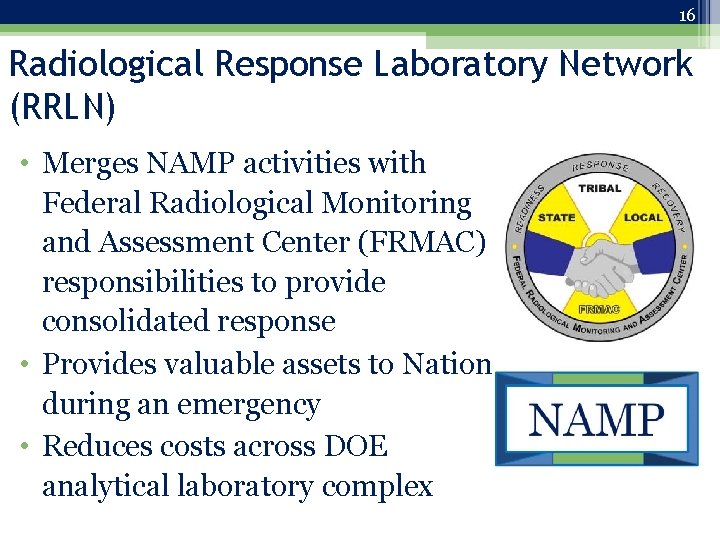
16 Radiological Response Laboratory Network (RRLN) • Merges NAMP activities with Federal Radiological Monitoring and Assessment Center (FRMAC) responsibilities to provide consolidated response • Provides valuable assets to Nation during an emergency • Reduces costs across DOE analytical laboratory complex
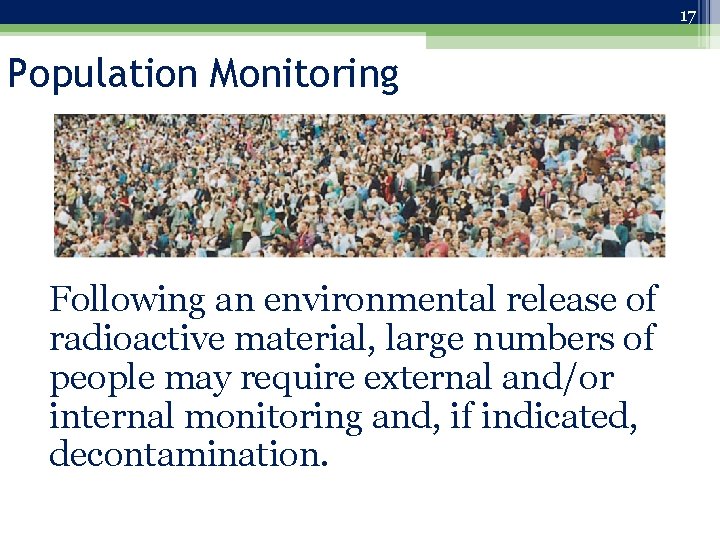
17 Population Monitoring Following an environmental release of radioactive material, large numbers of people may require external and/or internal monitoring and, if indicated, decontamination.
18 Clinical Laboratory Improvement Amendments (CLIA) Subcommittee • Significant gap between the Nation’s radiobioassay capabilities and capacity and those that would be needed to respond to a potential radiological terrorist attack or nuclear incident • NAMP CLIA subcommittee established to provide surge capacity • CLIA Compliance within NAMP laboratories will allow for expansion of services to CDC and State Public Health Laboratories • Goal is to have signed interagency (i. e. DOE / CDC) Memorandum of Understanding
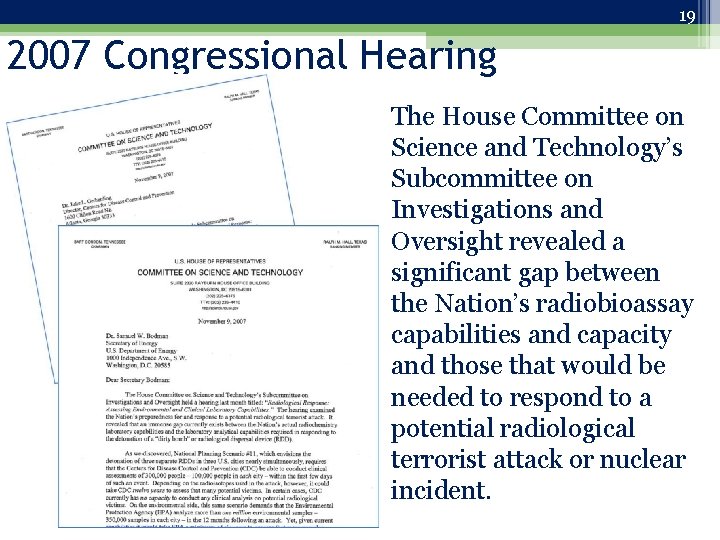
19 2007 Congressional Hearing The House Committee on Science and Technology’s Subcommittee on Investigations and Oversight revealed a significant gap between the Nation’s radiobioassay capabilities and capacity and those that would be needed to respond to a potential radiological terrorist attack or nuclear incident.
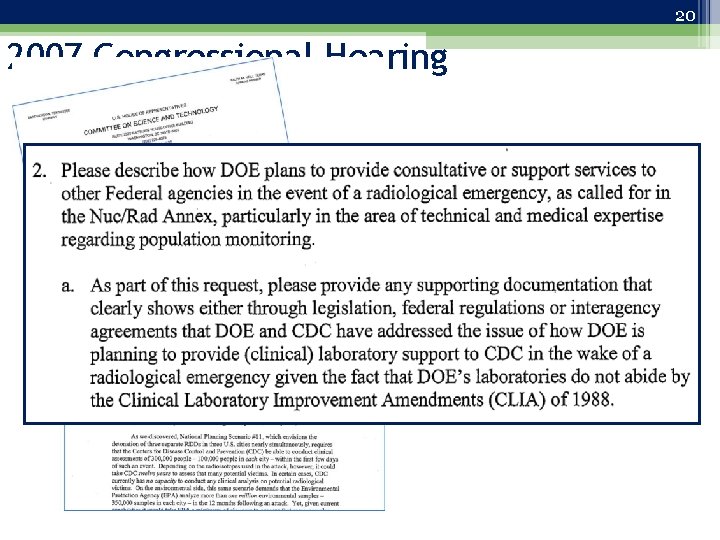
20 2007 Congressional Hearing
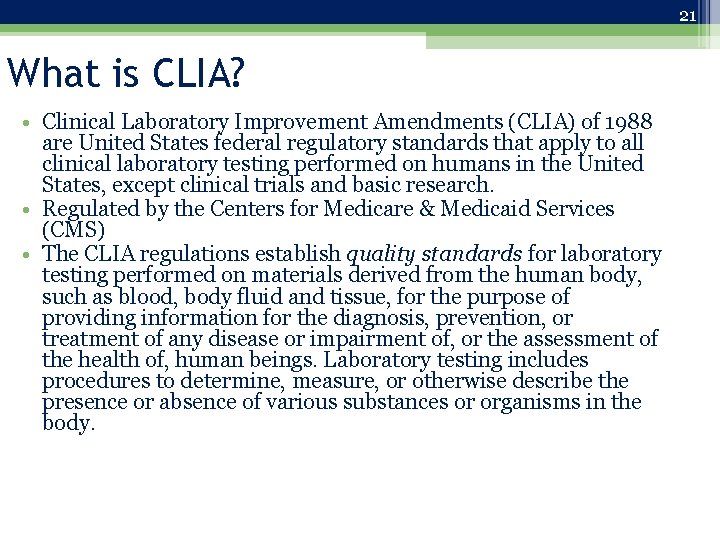
21 What is CLIA? • Clinical Laboratory Improvement Amendments (CLIA) of 1988 are United States federal regulatory standards that apply to all clinical laboratory testing performed on humans in the United States, except clinical trials and basic research. • Regulated by the Centers for Medicare & Medicaid Services (CMS) • The CLIA regulations establish quality standards for laboratory testing performed on materials derived from the human body, such as blood, body fluid and tissue, for the purpose of providing information for the diagnosis, prevention, or treatment of any disease or impairment of, or the assessment of the health of, human beings. Laboratory testing includes procedures to determine, measure, or otherwise describe the presence or absence of various substances or organisms in the body.
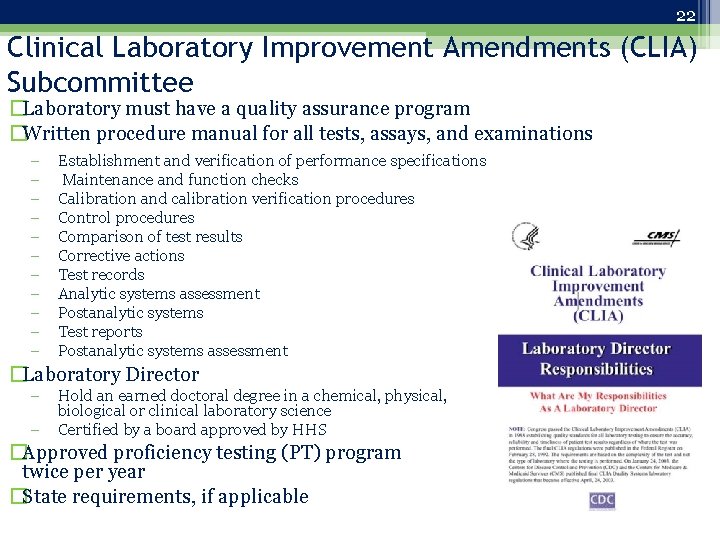
22 Clinical Laboratory Improvement Amendments (CLIA) Subcommittee �Laboratory must have a quality assurance program �Written procedure manual for all tests, assays, and examinations - Establishment and verification of performance specifications Maintenance and function checks Calibration and calibration verification procedures Control procedures Comparison of test results Corrective actions Test records Analytic systems assessment Postanalytic systems Test reports Postanalytic systems assessment �Laboratory Director - Hold an earned doctoral degree in a chemical, physical, biological or clinical laboratory science Certified by a board approved by HHS �Approved proficiency testing (PT) program twice per year �State requirements, if applicable
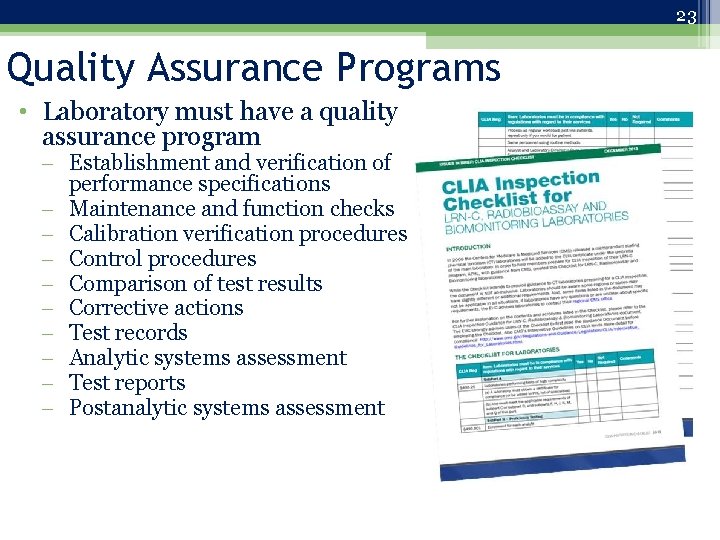
23 Quality Assurance Programs • Laboratory must have a quality assurance program - Establishment and verification of performance specifications - Maintenance and function checks - Calibration verification procedures - Control procedures - Comparison of test results - Corrective actions - Test records - Analytic systems assessment - Test reports - Postanalytic systems assessment
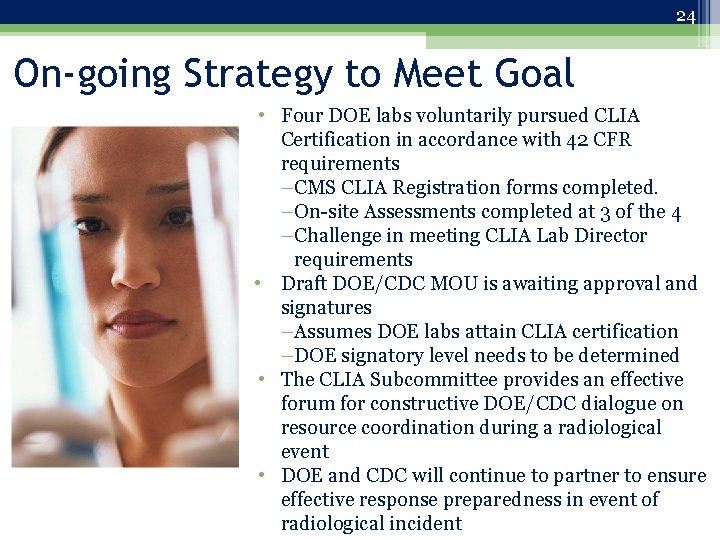
24 On-going Strategy to Meet Goal • Four DOE labs voluntarily pursued CLIA Certification in accordance with 42 CFR requirements –CMS CLIA Registration forms completed. –On-site Assessments completed at 3 of the 4 –Challenge in meeting CLIA Lab Director requirements • Draft DOE/CDC MOU is awaiting approval and signatures –Assumes DOE labs attain CLIA certification –DOE signatory level needs to be determined • The CLIA Subcommittee provides an effective forum for constructive DOE/CDC dialogue on resource coordination during a radiological event • DOE and CDC will continue to partner to ensure effective response preparedness in event of radiological incident
25 High Dose Laboratories Subcommittee • Develop an integrated structure for moderate, highlevel, and hot cell radiological laboratories • Capacity needed for highly radioactive samples – “ground zero” of an RDD – nuclear accident • Shielded cells and remote analytical capabilities must be available and coordinated
26 New Radiological Reference Materials • Lack of reference materials with activity levels and diverse matrices to support consequence management and recovery • Everyone agrees we need reference materials – Method development – Method verification – Method validation – PT testing – Exercises • Focus on getting the message heard in high places 26
27 PT Studies: Multi-agency Benefits • Provides a measure of laboratory performance • Encourages laboratories to improve performance • Provides an opportunity for laboratories to compare methods • Allows an opportunity to practice processes
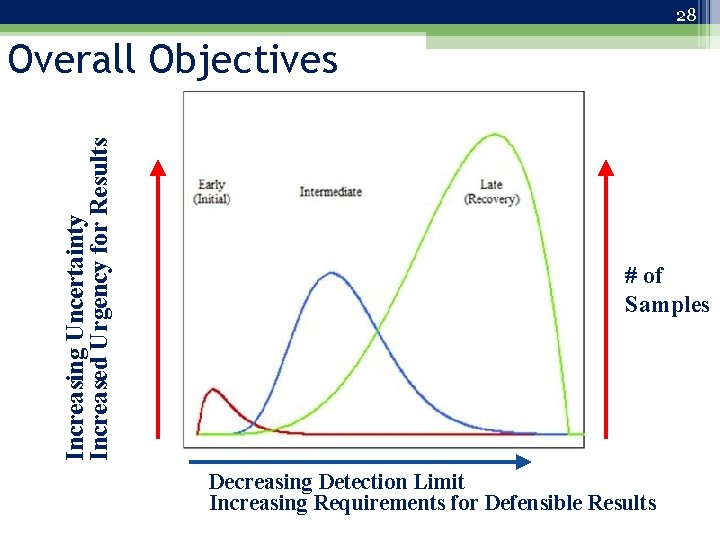
28 Increasing Uncertainty Increased Urgency for Results Overall Objectives # of Samples Decreasing Detection Limit Increasing Requirements for Defensible Results
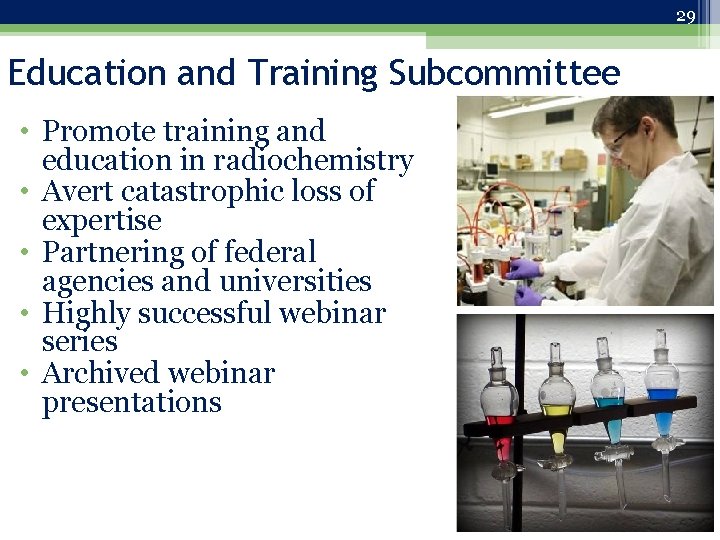
29 Education and Training Subcommittee • Promote training and education in radiochemistry • Avert catastrophic loss of expertise • Partnering of federal agencies and universities • Highly successful webinar series • Archived webinar presentations 29
30 Partnerships
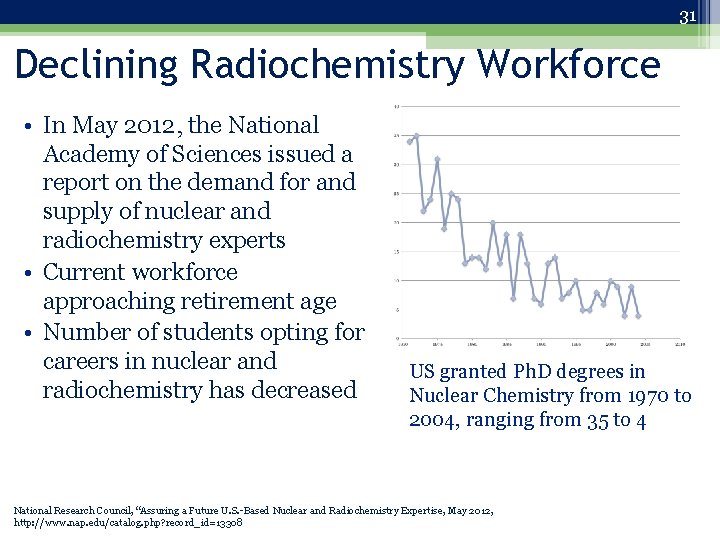
31 Declining Radiochemistry Workforce • In May 2012, the National Academy of Sciences issued a report on the demand for and supply of nuclear and radiochemistry experts • Current workforce approaching retirement age • Number of students opting for careers in nuclear and radiochemistry has decreased US granted Ph. D degrees in Nuclear Chemistry from 1970 to 2004, ranging from 35 to 4 National Research Council, “Assuring a Future U. S. -Based Nuclear and Radiochemistry Expertise, May 2012, http: //www. nap. edu/catalog. php? record_id=13308
32 Faculty Base Concerns • 2008: 46 active faculty identified – Across 20 universities – Producing 114 Ph. D’s – 7 universities were “singlets” – 5 universities were “doublets” – Largest program was Washington State University, with 6 faculty in nuclear chemistry program 2012 Findings – Faculty base was extremely vulnerable – Little or no undergraduate curricula – Programs with only one faculty were unsustainable – Funding was limited and unpredictable – Data sources for tracking the academic health of the field are poor or missing – Specific programs were helping, but not fast enough National Research Council, “Assuring a Future U. S. -Based Nuclear and Radiochemistry Expertise, May 2012, http: //www. nap. edu/catalog. php? record_id=13308
Ensuring Future Workforce via NAMP Webinars Issues and Challenges • Aging facilities within the DOE complex • Declining workforce • Few universities teaching radiochemistry • Lack of professors • Lack of facilities for training Radiochemistry Webinars • Promote radiochemistry education • Introduce radiochemistry to a new audience • Advance the knowledge of personnel in the discipline Audience • • • Managers Technicians Students Regulators Health Physicists • Quality Assurance Officers • Chemists 33
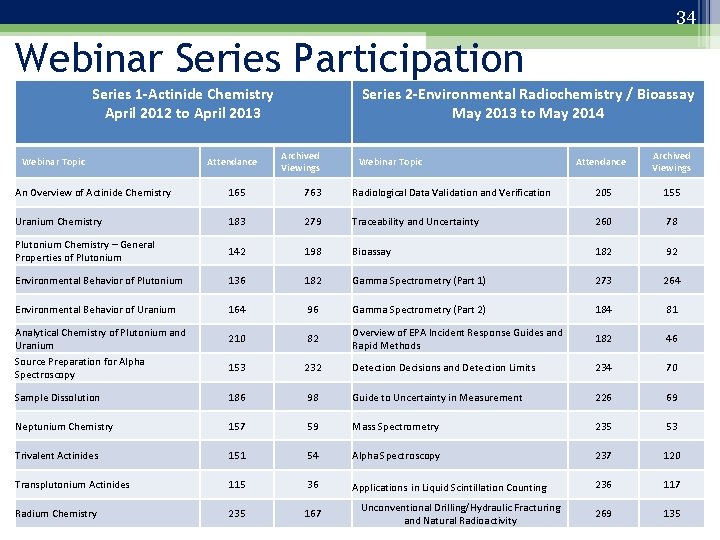
34 Webinar Series Participation Series 1 -Actinide Chemistry April 2012 to April 2013 Webinar Topic Attendance Series 2 -Environmental Radiochemistry / Bioassay May 2013 to May 2014 Archived Viewings Webinar Topic Attendance Archived Viewings An Overview of Actinide Chemistry 165 763 Radiological Data Validation and Verification 205 155 Uranium Chemistry 183 279 Traceability and Uncertainty 260 78 Plutonium Chemistry – General Properties of Plutonium 142 198 Bioassay 182 92 Environmental Behavior of Plutonium 136 182 Gamma Spectrometry (Part 1) 273 264 Environmental Behavior of Uranium 164 96 Gamma Spectrometry (Part 2) 184 81 210 82 Overview of EPA Incident Response Guides and Rapid Methods 182 46 153 232 Detection Decisions and Detection Limits 234 70 Sample Dissolution 186 98 Guide to Uncertainty in Measurement 226 69 Neptunium Chemistry 157 59 Mass Spectrometry 235 53 Trivalent Actinides 151 54 Alpha Spectroscopy 237 120 Transplutonium Actinides 115 36 Applications in Liquid Scintillation Counting 236 117 Radium Chemistry 235 167 269 135 Analytical Chemistry of Plutonium and Uranium Source Preparation for Alpha Spectroscopy Unconventional Drilling/Hydraulic Fracturing and Natural Radioactivity
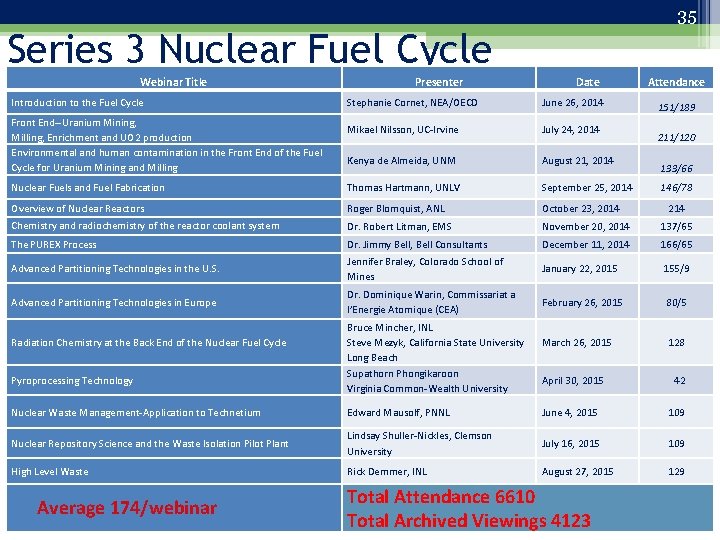
35 Series 3 Nuclear Fuel Cycle Webinar Title Introduction to the Fuel Cycle Presenter Date Attendance Stephanie Cornet, NEA/OECD June 26, 2014 Mikael Nilsson, UC-Irvine July 24, 2014 Kenya de Almeida, UNM August 21, 2014 Nuclear Fuels and Fuel Fabrication Thomas Hartmann, UNLV September 25, 2014 Overview of Nuclear Reactors Roger Blomquist, ANL October 23, 2014 Chemistry and radiochemistry of the reactor coolant system Dr. Robert Litman, EMS November 20, 2014 137/65 The PUREX Process Dr. Jimmy Bell, Bell Consultants December 11, 2014 166/65 Advanced Partitioning Technologies in the U. S. Jennifer Braley, Colorado School of Mines January 22, 2015 155/9 Advanced Partitioning Technologies in Europe Dr. Dominique Warin, Commissariat a l’Energie Atomique (CEA) February 26, 2015 80/5 March 26, 2015 128 Front End--Uranium Mining, Milling, Enrichment and UO 2 production Environmental and human contamination in the Front End of the Fuel Cycle for Uranium Mining and Milling Radiation Chemistry at the Back End of the Nuclear Fuel Cycle Pyroprocessing Technology Bruce Mincher, INL Steve Mezyk, California State University Long Beach Supathorn Phongikaroon Virginia Common-Wealth University April 30, 2015 151/189 211/120 133/66 146/78 214 42 Nuclear Waste Management-Application to Technetium Edward Mausolf, PNNL June 4, 2015 109 Nuclear Repository Science and the Waste Isolation Pilot Plant Lindsay Shuller-Nickles, Clemson University July 16, 2015 109 High Level Waste Rick Demmer, INL August 27, 2015 129 Average 174/webinar Total Attendance 6610 Total Archived Viewings 4123
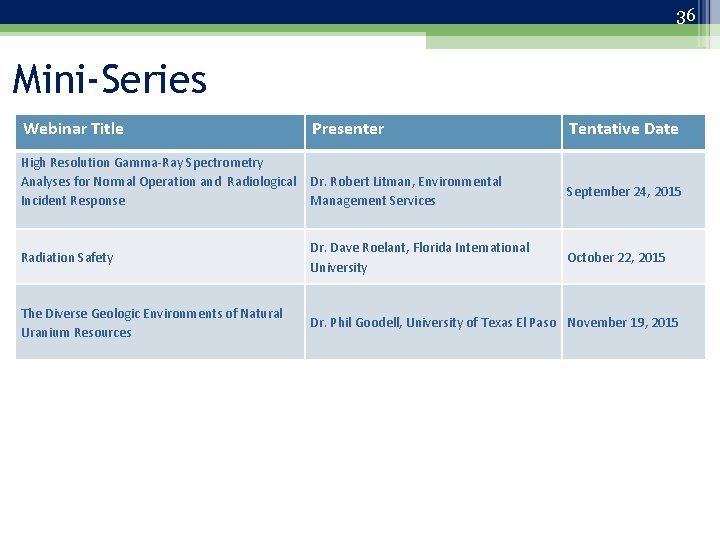
36 Mini-Series Webinar Title Presenter Tentative Date High Resolution Gamma-Ray Spectrometry Analyses for Normal Operation and Radiological Incident Response Dr. Robert Litman, Environmental Management Services September 24, 2015 Radiation Safety Dr. Dave Roelant, Florida International University October 22, 2015 The Diverse Geologic Environments of Natural Uranium Resources Dr. Phil Goodell, University of Texas El Paso November 19, 2015
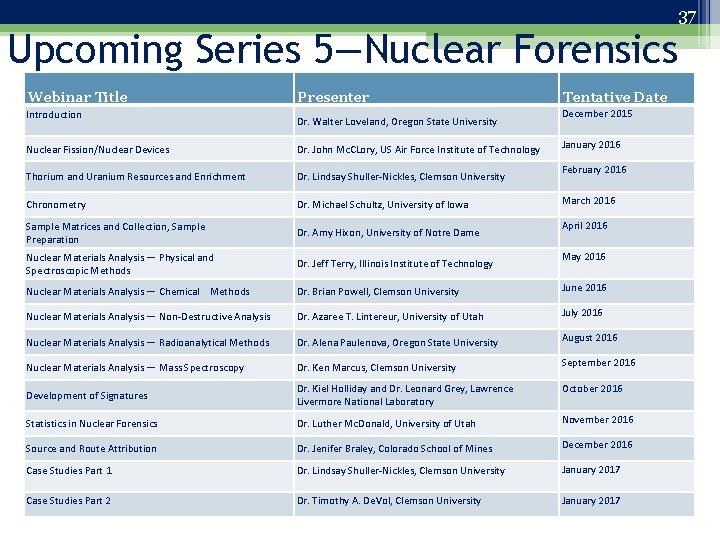
37 Upcoming Series 5—Nuclear Forensics Webinar Title Introduction Presenter Dr. Walter Loveland, Oregon State University Tentative Date December 2015 January 2016 Nuclear Fission/Nuclear Devices Dr. John Mc. CLory, US Air Force Institute of Technology Thorium and Uranium Resources and Enrichment Dr. Lindsay Shuller-Nickles, Clemson University Chronometry Dr. Michael Schultz, University of Iowa Sample Matrices and Collection, Sample Preparation Dr. Amy Hixon, University of Notre Dame Nuclear Materials Analysis — Physical and Spectroscopic Methods Dr. Jeff Terry, Illinois Institute of Technology Nuclear Materials Analysis — Chemical Methods Dr. Brian Powell, Clemson University June 2016 Nuclear Materials Analysis — Non-Destructive Analysis Dr. Azaree T. Lintereur, University of Utah July 2016 Nuclear Materials Analysis — Radioanalytical Methods Dr. Alena Paulenova, Oregon State University August 2016 Nuclear Materials Analysis — Mass Spectroscopy Dr. Ken Marcus, Clemson University September 2016 Development of Signatures Dr. Kiel Holliday and Dr. Leonard Grey, Lawrence Livermore National Laboratory October 2016 Statistics in Nuclear Forensics Dr. Luther Mc. Donald, University of Utah November 2016 Source and Route Attribution Dr. Jenifer Braley, Colorado School of Mines December 2016 Case Studies Part 1 Dr. Lindsay Shuller-Nickles, Clemson University January 2017 Case Studies Part 2 Dr. Timothy A. De. Vol, Clemson University January 2017 February 2016 March 2016 April 2016 May 2016
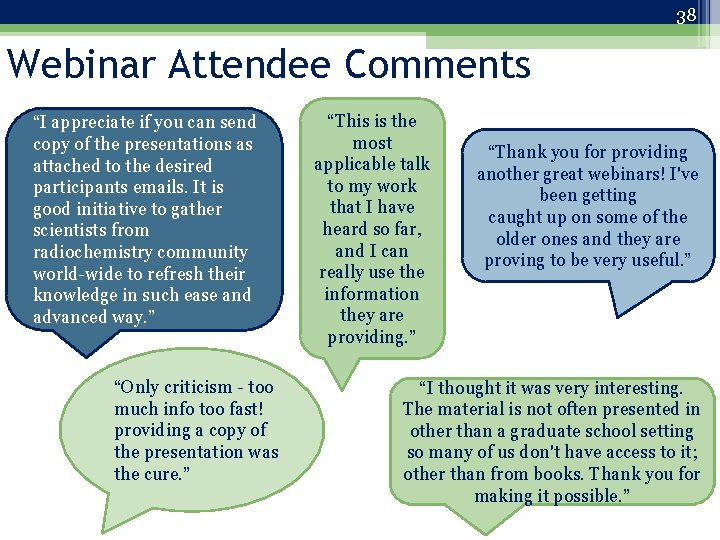
38 Webinar Attendee Comments “I appreciate if you can send copy of the presentations as attached to the desired participants emails. It is good initiative to gather scientists from radiochemistry community world-wide to refresh their knowledge in such ease and advanced way. ” “Only criticism - too much info too fast! providing a copy of the presentation was the cure. ” “This is the most applicable talk to my work that I have heard so far, and I can really use the information they are providing. ” “Thank you for providing another great webinars! I've been getting caught up on some of the older ones and they are proving to be very useful. ” “I thought it was very interesting. The material is not often presented in other than a graduate school setting so many of us don't have access to it; other than from books. Thank you for making it possible. ”
39 International Programs • Promote radiochemistry and nuclear chemistry curriculum development • Committed to foster an international environment for nuclear science and education • International education opportunities in radiochemistry and nuclear chemistry through student and staff exchanges
40 NAMP’s Outreach • • Since 2010, the NAMP organization has significantly increased its influence, initiatives, and membership NAMP has established proof of concept and serves with NNSA as DOE’s liaison with DHS, EPA, CDC and other agencies
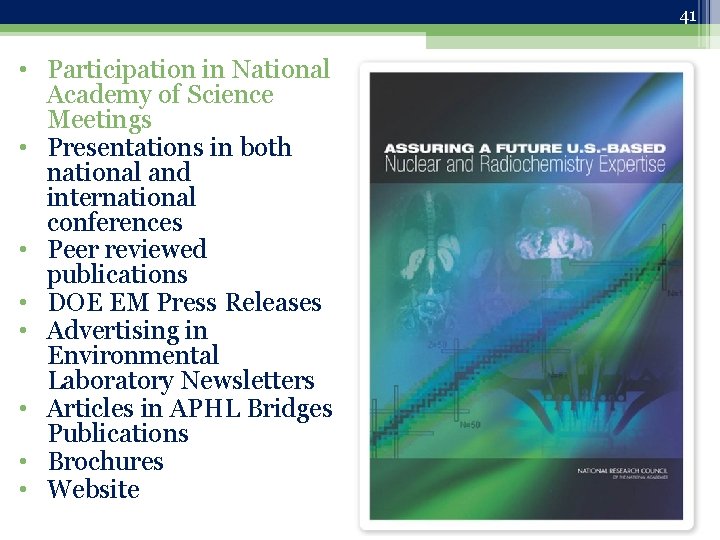
41 • Participation in National Academy of Science Meetings • Presentations in both national and international conferences • Peer reviewed publications • DOE EM Press Releases • Advertising in Environmental Laboratory Newsletters • Articles in APHL Bridges Publications • Brochures • Website
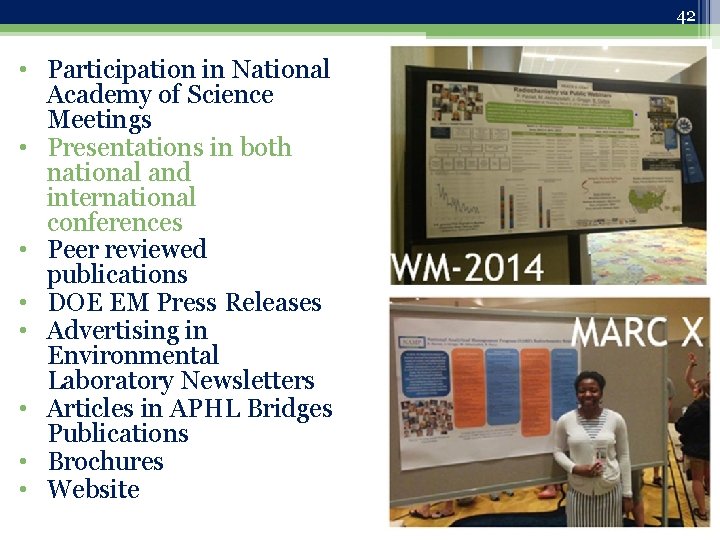
42 • Participation in National Academy of Science Meetings • Presentations in both national and international conferences • Peer reviewed publications • DOE EM Press Releases • Advertising in Environmental Laboratory Newsletters • Articles in APHL Bridges Publications • Brochures • Website
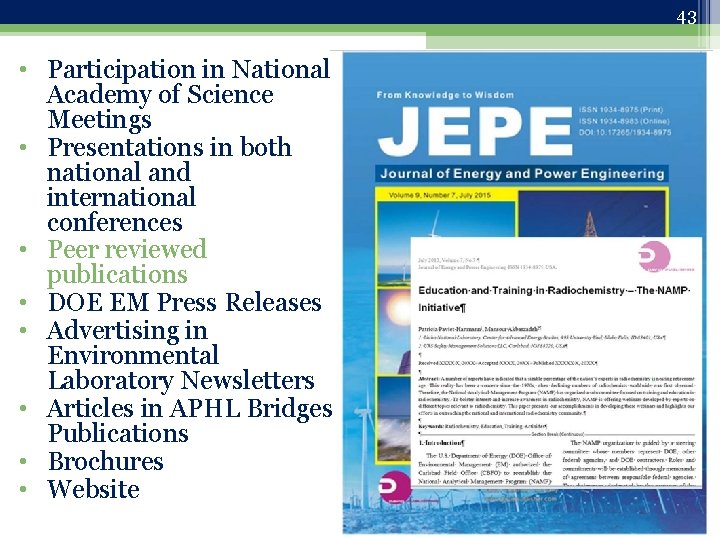
43 • Participation in National Academy of Science Meetings • Presentations in both national and international conferences • Peer reviewed publications • DOE EM Press Releases • Advertising in Environmental Laboratory Newsletters • Articles in APHL Bridges Publications • Brochures • Website
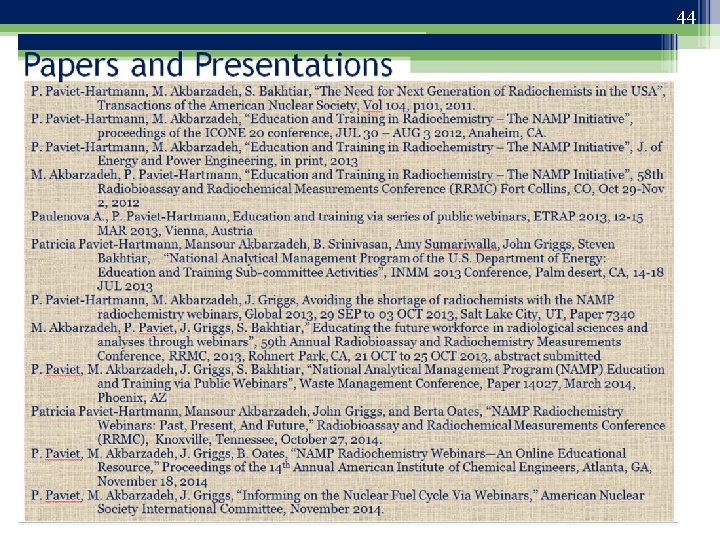
44 • Participation in National Academy of Science Meetings • Presentations in both national and international conferences • Peer reviewed publications • DOE EM Press Releases • Advertising in Environmental Laboratory Newsletters • Articles in APHL Bridges Publications • Brochures • Website
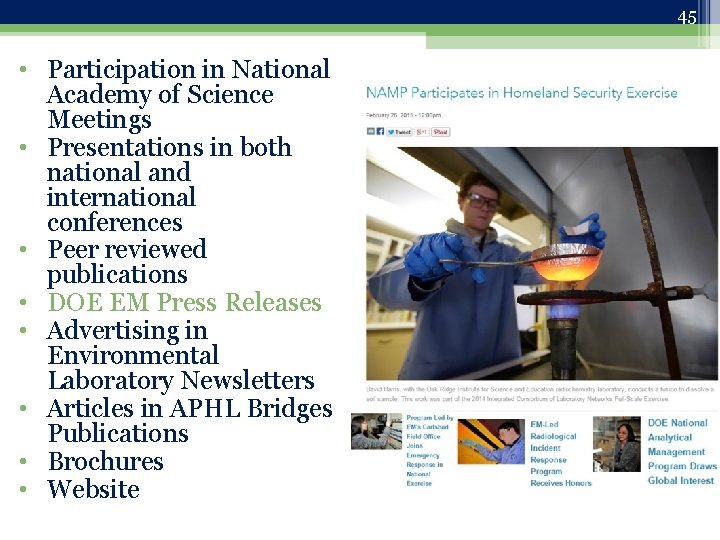
45 • Participation in National Academy of Science Meetings • Presentations in both national and international conferences • Peer reviewed publications • DOE EM Press Releases • Advertising in Environmental Laboratory Newsletters • Articles in APHL Bridges Publications • Brochures • Website
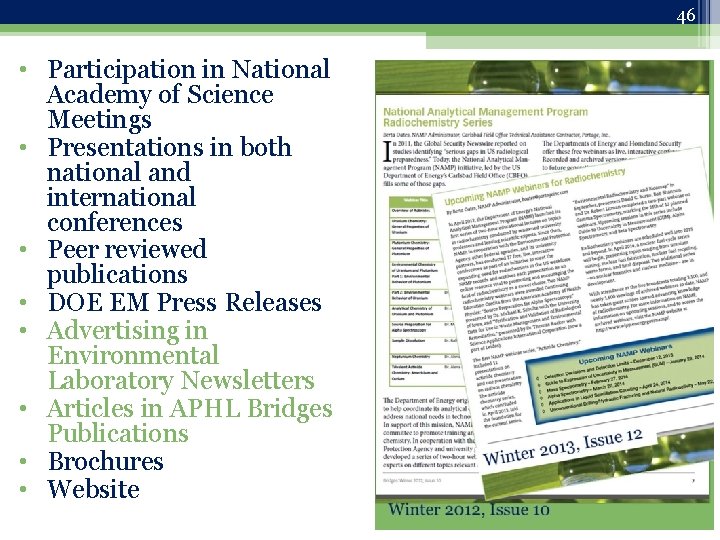
46 • Participation in National Academy of Science Meetings • Presentations in both national and international conferences • Peer reviewed publications • DOE EM Press Releases • Advertising in Environmental Laboratory Newsletters • Articles in APHL Bridges Publications • Brochures • Website
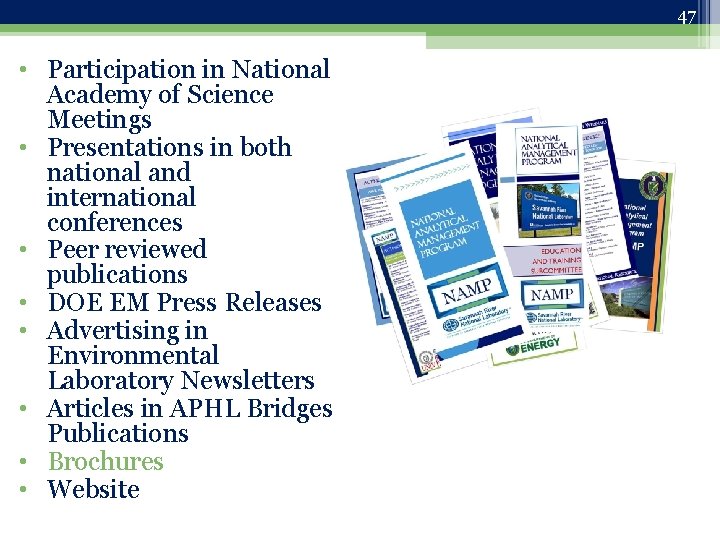
47 • Participation in National Academy of Science Meetings • Presentations in both national and international conferences • Peer reviewed publications • DOE EM Press Releases • Advertising in Environmental Laboratory Newsletters • Articles in APHL Bridges Publications • Brochures • Website
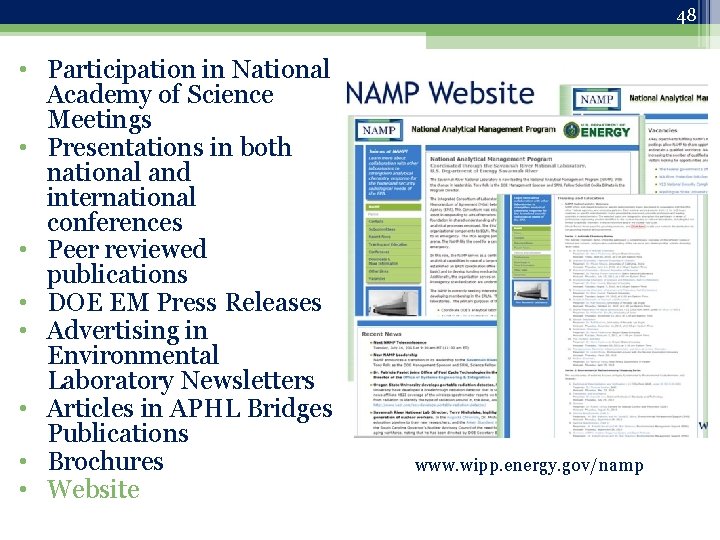
48 • Participation in National Academy of Science Meetings • Presentations in both national and international conferences • Peer reviewed publications • DOE EM Press Releases • Advertising in Environmental Laboratory Newsletters • Articles in APHL Bridges Publications • Brochures • Website www. wipp. energy. gov/namp
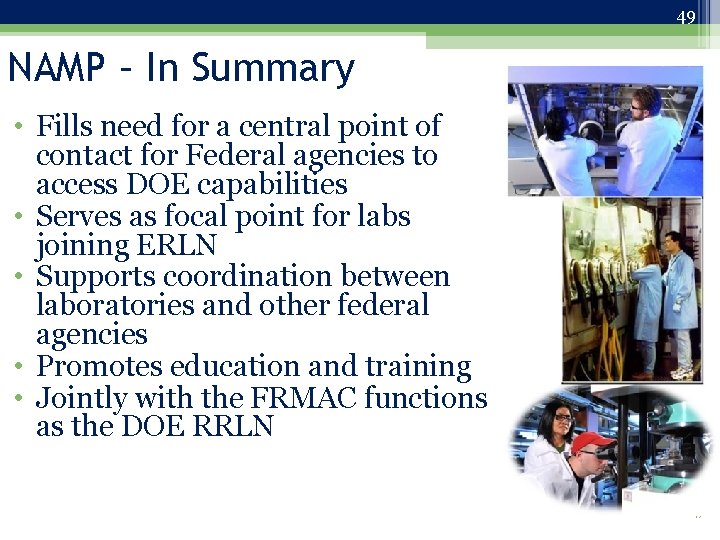
49 NAMP – In Summary • Fills need for a central point of contact for Federal agencies to access DOE capabilities • Serves as focal point for labs joining ERLN • Supports coordination between laboratories and other federal agencies • Promotes education and training • Jointly with the FRMAC functions as the DOE RRLN 49
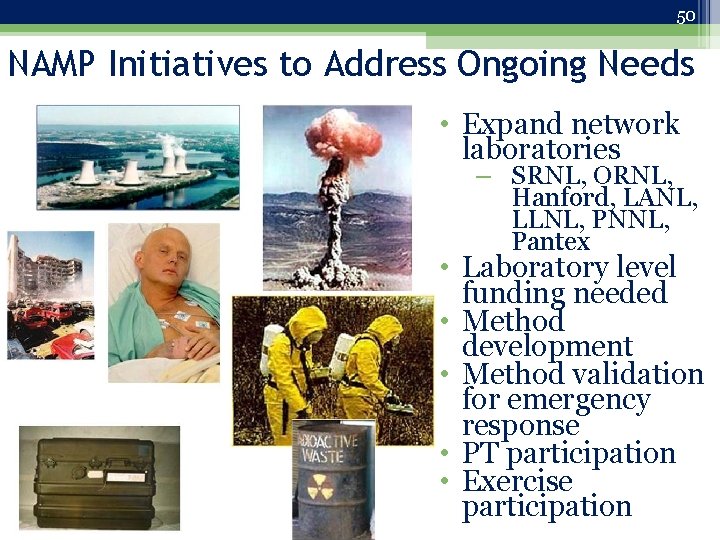
50 NAMP Initiatives to Address Ongoing Needs • Expand network laboratories – SRNL, ORNL, Hanford, LANL, LLNL, PNNL, Pantex • Laboratory level funding needed • Method development • Method validation for emergency response • PT participation • Exercise participation
51 The Future of NAMP • Continue to work with the roadmap that currently exists, with a focused effort on – Funding – Strategic partnerships – Productive communication 51
52 Questions Cecilia Di. Prete NAMP Director 803 -725 -5314 c. diprete@srnl. doe. gov Berta Oates Technical Coordinator 801 -782 -5179 boates@portageinc. com Visit the NAMP website at: www. wipp. energy. gov/namp