
National Agriculture crop and livestock Insurance Scheme NAIS

- Slides: 17
National Agriculture (crop and livestock) Insurance Scheme (NAIS) 19 th April 2014 I Kigali, Rwanda
Objective – National Agriculture Insurance Scheme (NAIS*) At the scheme design level the following objectives should be met v To provide insurance coverage and financial support to the farmers in the event of failure of any of the notified crop and livestock as a result of natural calamities, pests and diseases v To improve access to financial (lending) institutions and ensure flow of credit to the agriculture sector and thereby encouraging farmer to adopt innovative and modern agricultural practices
Cont’ v To allow banks to expand their lending portfolio to agriculture sector without increasing default risk v To make effective use of Government subsidies v To provide standard insurance contracts and lay down procedures and principles for the operation of agriculture insurance, to ensure centralized and standardized loss adjustment activities
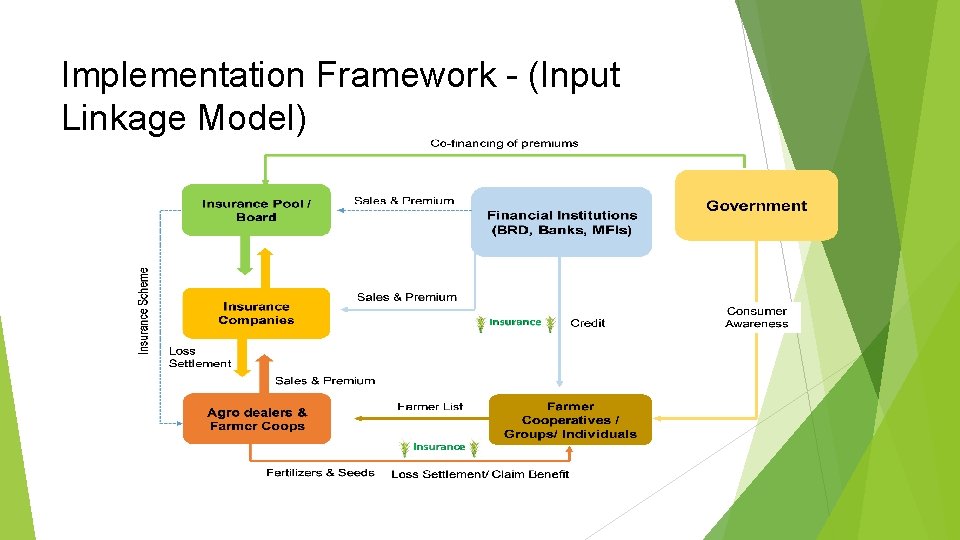
Implementation Framework - (Input Linkage Model)
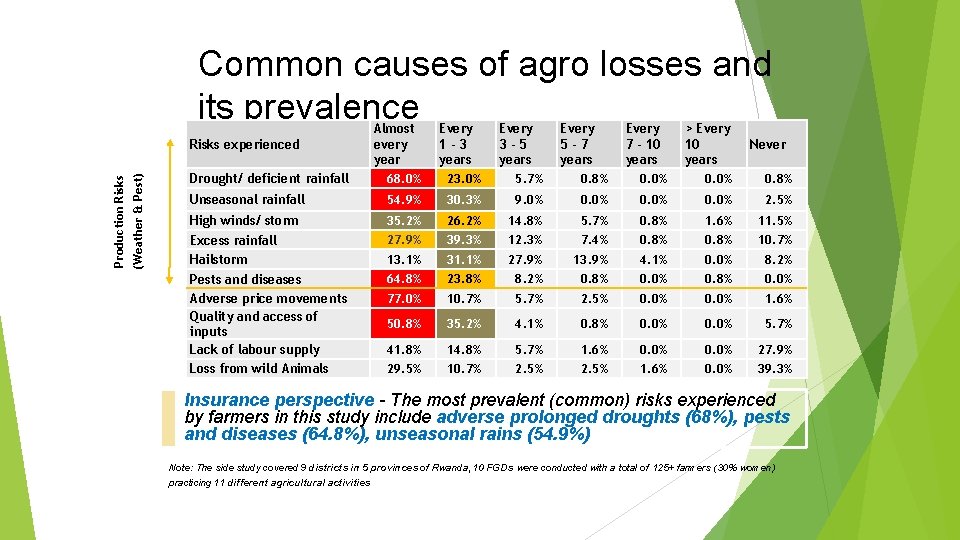
Common causes of agro losses and its prevalence Almost every year 68. 0% Every 1 -3 years 23. 0% Every 3 -5 years 5. 7% Every 5 -7 years 0. 8% Every 7 - 10 years 0. 0% > Every 10 years 0. 0% Unseasonal rainfall 54. 9% 30. 3% 9. 0% 0. 0% 2. 5% High winds/ storm Excess rainfall Hailstorm Pests and diseases Adverse price movements Quality and access of inputs Lack of labour supply Loss from wild Animals 35. 2% 26. 2% 14. 8% 5. 7% 0. 8% 1. 6% 11. 5% 27. 9% 39. 3% 12. 3% 7. 4% 0. 8% 10. 7% 13. 1% 31. 1% 27. 9% 13. 9% 4. 1% 0. 0% 8. 2% 64. 8% 23. 8% 8. 2% 0. 8% 0. 0% 77. 0% 10. 7% 5. 7% 2. 5% 0. 0% 1. 6% 50. 8% 35. 2% 4. 1% 0. 8% 0. 0% 5. 7% 41. 8% 14. 8% 5. 7% 1. 6% 0. 0% 27. 9% 29. 5% 10. 7% 2. 5% 1. 6% 0. 0% 39. 3% (Weather & Pest) Production Risks experienced Drought/ deficient rainfall Never 0. 8% Insurance perspective - The most prevalent (common) risks experienced by farmers in this study include adverse prolonged droughts (68%), pests and diseases (64. 8%), unseasonal rains (54. 9%) Note: The side study covered 9 districts in 5 provinces of Rwanda, 10 FGDs were conducted with a total of 125+ farmers (30% women) practicing 11 different agricultural activities
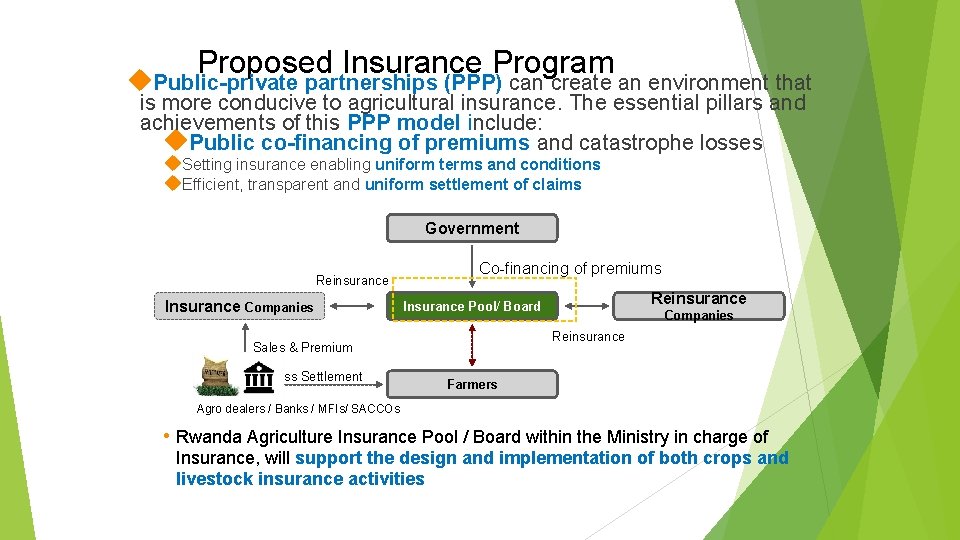
Proposed Insurance Program Public-private partnerships (PPP) can create an environment that is more conducive to agricultural insurance. The essential pillars and achievements of this PPP model include: Public co-financing of premiums and catastrophe losses Setting insurance enabling uniform terms and conditions Efficient, transparent and uniform settlement of claims Government Reinsurance Insurance Companies Co-financing of premiums Companies Reinsurance Sales & Premium Loss Settlement Reinsurance Insurance Pool/ Board Farmers Agro dealers / Banks / MFIs/ SACCOs • Rwanda Agriculture Insurance Pool / Board within the Ministry in charge of Insurance, will support the design and implementation of both crops and livestock insurance activities
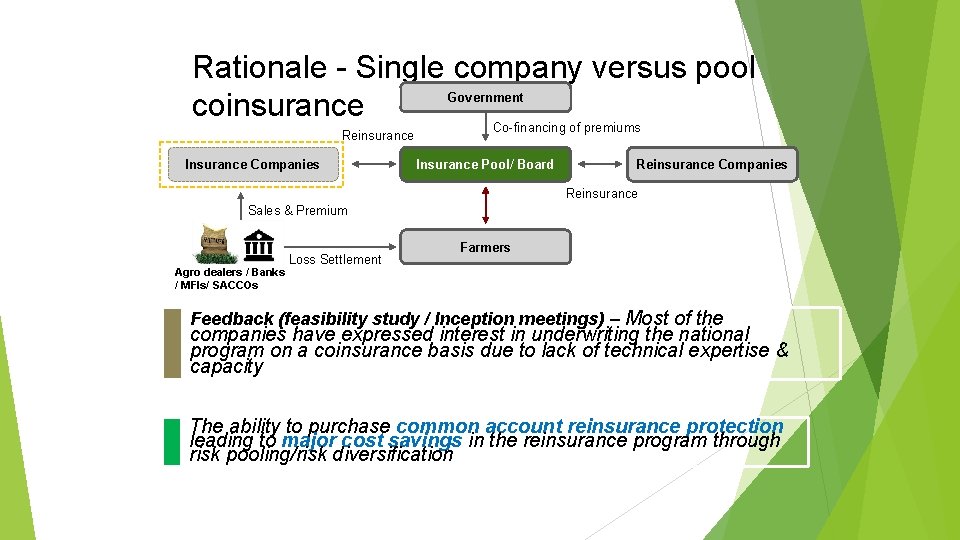
Rationale - Single company versus pool Government coinsurance Co-financing of premiums Reinsurance Insurance Companies Insurance Pool/ Board Reinsurance Companies Reinsurance Sales & Premium Agro dealers / Banks / MFIs/ SACCOs Loss Settlement Farmers Feedback (feasibility study / Inception meetings) – Most of the companies have expressed interest in underwriting the national program on a coinsurance basis due to lack of technical expertise & capacity The ability to purchase common account reinsurance protection leading to major cost savings in the reinsurance program through risk pooling/risk diversification
Cont’ v Economies of scale; initial program cost (e. g. consumer education, setting up process, operating systems) are either taken up by the Govt. or shared amongst the coinsurers likely to be more sustainable v The ability for the pool coinsurers to retain a much higher level of risk than if one company is appointed to underwrite the business v The ability to purchase common account reinsurance protection leading to major cost savings in the reinsurance program through risk pooling/risk diversification
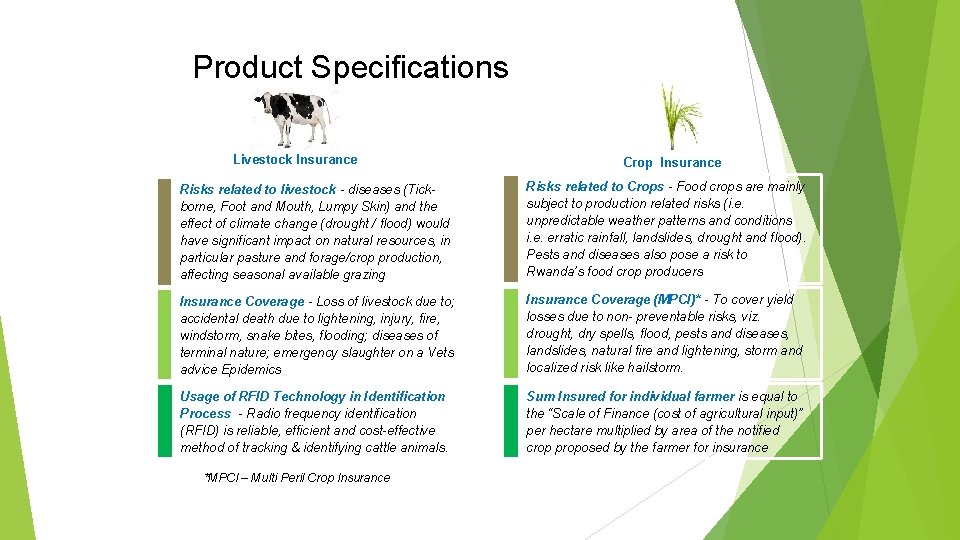
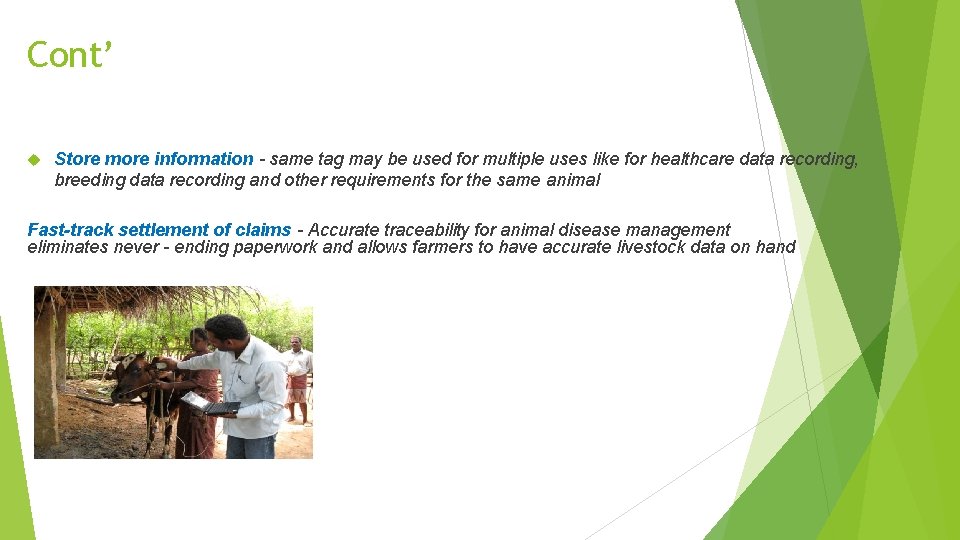
Product Specifications Livestock Insurance Crop Insurance Risks related to livestock - diseases (Tickborne, Foot and Mouth, Lumpy Skin) and the effect of climate change (drought / flood) would have significant impact on natural resources, in particular pasture and forage/crop production, affecting seasonal available grazing Risks related to Crops - Food crops are mainly subject to production related risks (i. e. unpredictable weather patterns and conditions i. e. erratic rainfall, landslides, drought and flood). Pests and diseases also pose a risk to Rwanda’s food crop producers Insurance Coverage - Loss of livestock due to; accidental death due to lightening, injury, fire, windstorm, snake bites, flooding; diseases of terminal nature; emergency slaughter on a Vets advice Epidemics Insurance Coverage (MPCI)* - To cover yield losses due to non- preventable risks, viz. drought, dry spells, flood, pests and diseases, landslides, natural fire and lightening, storm and localized risk like hailstorm. Usage of RFID Technology in Identification Process - Radio frequency identification (RFID) is reliable, efficient and cost-effective method of tracking & identifying cattle animals. Sum Insured for individual farmer is equal to the “Scale of Finance (cost of agricultural input)” per hectare multiplied by area of the notified crop proposed by the farmer for insurance *MPCI – Multi Peril Crop Insurance
National Agriculture Insurance Scheme (NAIS) – Livestock Insurance (Phase - I) Tentative Launch Date – June 2018
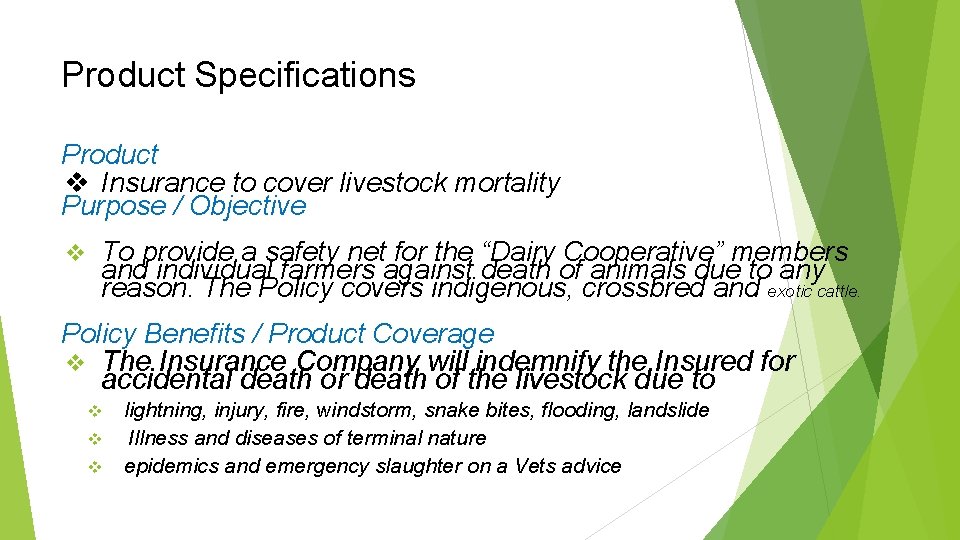
Product Specifications Product v Insurance to cover livestock mortality Purpose / Objective v To provide a safety net for the “Dairy Cooperative” members and individual farmers against death of animals due to any reason. The Policy covers indigenous, crossbred and exotic cattle. Policy Benefits / Product Coverage v The Insurance Company will indemnify the Insured for accidental death or death of the livestock due to lightning, injury, fire, windstorm, snake bites, flooding, landslide v Illness and diseases of terminal nature v epidemics and emergency slaughter on a Vets advice v
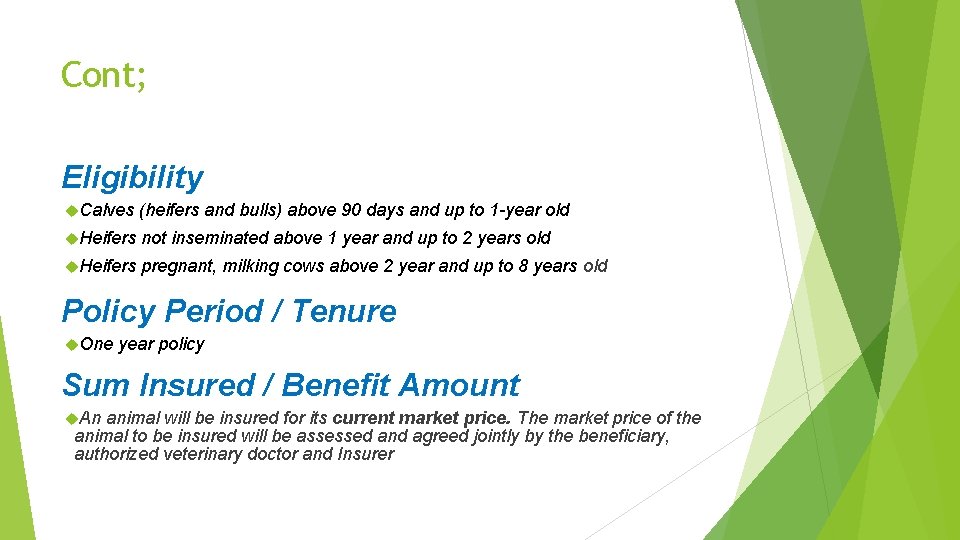
Cont; Eligibility Calves (heifers and bulls) above 90 days and up to 1 -year old Heifers not inseminated above 1 year and up to 2 years old Heifers pregnant, milking cows above 2 year and up to 8 years old Policy Period / Tenure One year policy Sum Insured / Benefit Amount An animal will be insured for its current market price. The market price of the animal to be insured will be assessed and agreed jointly by the beneficiary, authorized veterinary doctor and Insurer
Advantages – RFID* technology On the spot cover issued in real time, which means the farmers gets cover on his cattle the very minute he pays the premium Less premium rate is charged because the transaction costs are kept in check, and through the integration of RFID technology platform, information of each livestock is centrally monitored Unique individual identifier - enables fast and error free recording of tag numbers and immediate recording of cattle details in electronic form
Cont’ Store more information - same tag may be used for multiple uses like for healthcare data recording, breeding data recording and other requirements for the same animal Fast-track settlement of claims - Accurate traceability for animal disease management eliminates never - ending paperwork and allows farmers to have accurate livestock data on hand
Cont’ v Holds a small amount of unique data – a serial number or other unique attribute of the cattle v The data can be read from a distance – no contact or even line of sight necessary
Possible Impact through Livestock Insurance Improve the livelihoods (notably cash incomes, food security, nutrition, resilience to shocks) of beneficiaries Strengthen the dairy co-operatives in the district to support value chain improvements and the inclusion of improved breeds and other dairy farming inputs and equipment’s Increase access to financial institutions and credit in the livestock space Create employment/ self employment at farm level as well as in the rest of the dairy value chain Increased access to health care facilities (e. g. vaccination) and improved animal health
Thank You