
National Aeronautics and Space Administration Jet Propulsion Laboratory
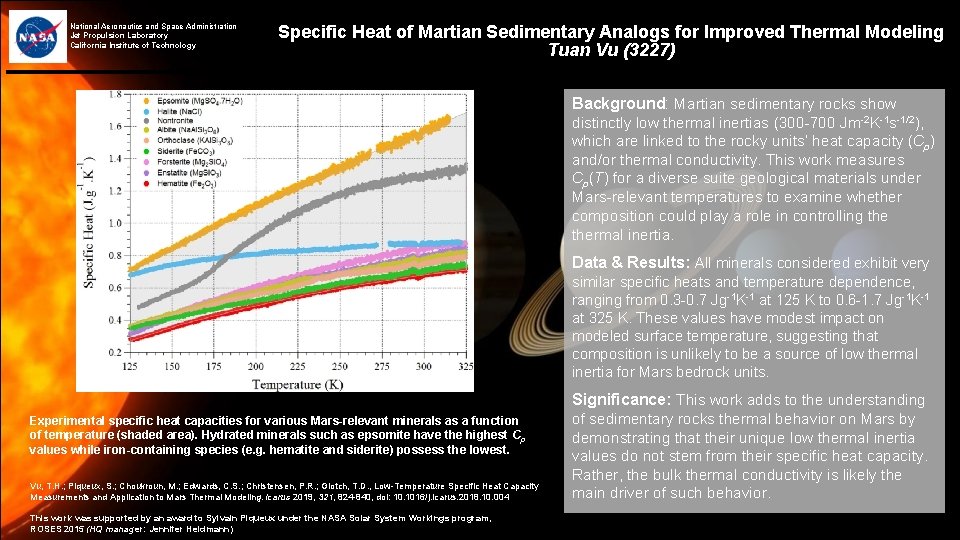
National Aeronautics and Space Administration Jet Propulsion Laboratory California Institute of Technology Specific Heat of Martian Sedimentary Analogs for Improved Thermal Modeling Tuan Vu (3227) Background: Martian sedimentary rocks show distinctly low thermal inertias (300 -700 Jm-2 K-1 s-1/2), which are linked to the rocky units’ heat capacity (Cp) and/or thermal conductivity. This work measures Cp(T) for a diverse suite geological materials under Mars-relevant temperatures to examine whether composition could play a role in controlling thermal inertia. Data & Results: All minerals considered exhibit very similar specific heats and temperature dependence, ranging from 0. 3 -0. 7 Jg-1 K-1 at 125 K to 0. 6 -1. 7 Jg-1 K-1 at 325 K. These values have modest impact on modeled surface temperature, suggesting that composition is unlikely to be a source of low thermal inertia for Mars bedrock units. Experimental specific heat capacities for various Mars-relevant minerals as a function of temperature (shaded area). Hydrated minerals such as epsomite have the highest Cp values while iron-containing species (e. g. hematite and siderite) possess the lowest. Vu, T. H. ; Piqueux, S. ; Choukroun, M. ; Edwards, C. S. ; Christensen, P. R. ; Glotch, T. D. , Low-Temperature Specific Heat Capacity Measurements and Application to Mars Thermal Modeling. Icarus 2019, 321, 824 -840, doi: 10. 1016/j. icarus. 2018. 10. 004 This work was supported by an award to Sylvain Piqueux under the NASA Solar System Workings program, ROSES 2015 (HQ manager: Jennifer Heldmann) Significance: This work adds to the understanding of sedimentary rocks thermal behavior on Mars by demonstrating that their unique low thermal inertia values do not stem from their specific heat capacity. Rather, the bulk thermal conductivity is likely the main driver of such behavior.
- Slides: 1