
National Aeronautics and Space Administration Habitation Systems An
National Aeronautics and Space Administration Habitation Systems An HEOMD SBIR Topic Presenter: Daniel Barta MD: HEOMD Date: 06/27/2017 I N N O V A T I O N SMALL BUSINESS | INNOVATION P A R T N E R S H I P RESEARCH (SBIR) & SMALL | C O M M E R C I A L I Z A T I O N BUSINESS TECHNOLOGY TRANSFER (STTR)
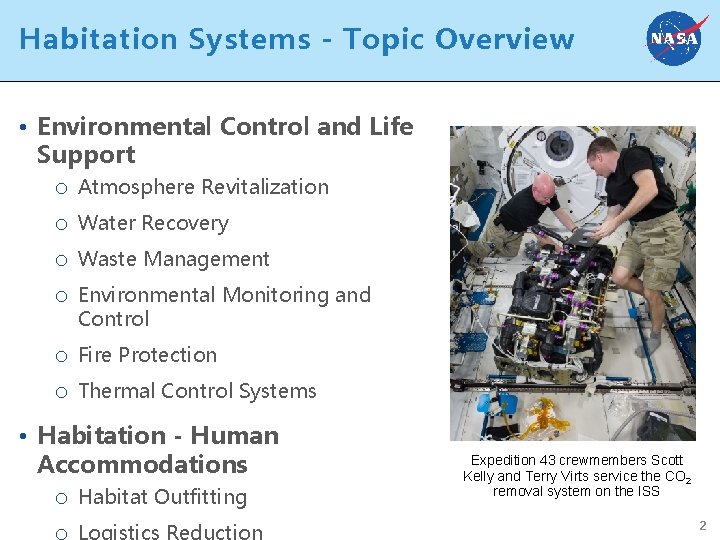
Habitation Systems - Topic Overview • Environmental Control and Life Support o Atmosphere Revitalization o Water Recovery o Waste Management o Environmental Monitoring and Control o Fire Protection o Thermal Control Systems • Habitation - Human Accommodations o Habitat Outfitting Expedition 43 crewmembers Scott Kelly and Terry Virts service the CO 2 removal system on the ISS 2
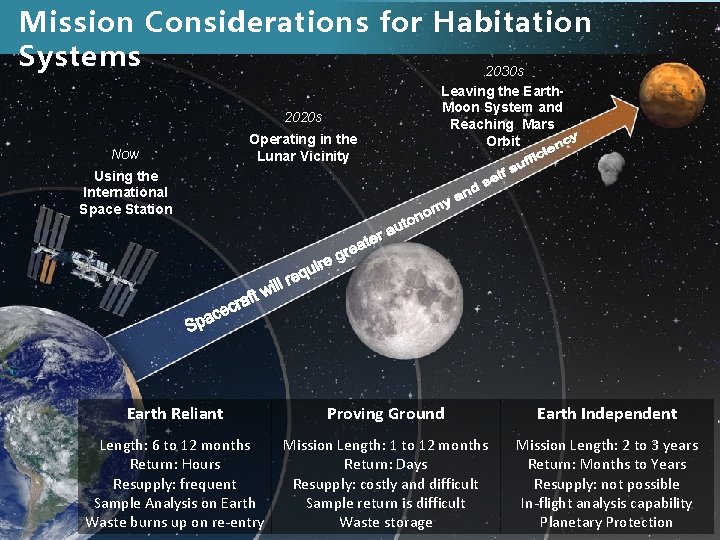
Mission Considerations for Habitation Systems 2030 s Leaving the Earth. Moon System and Reaching Mars Orbit 2020 s Operating in the Lunar Vicinity Now Using the International Space Station Earth Reliant Proving Ground Earth Independent Length: 6 to 12 months Return: Hours Resupply: frequent Sample Analysis on Earth Waste burns up on re-entry Mission Length: 1 to 12 months Return: Days Resupply: costly and difficult Sample return is difficult Waste storage Mission Length: 2 to 3 years Return: Months to Years Resupply: not possible In-flight analysis capability Planetary Protection
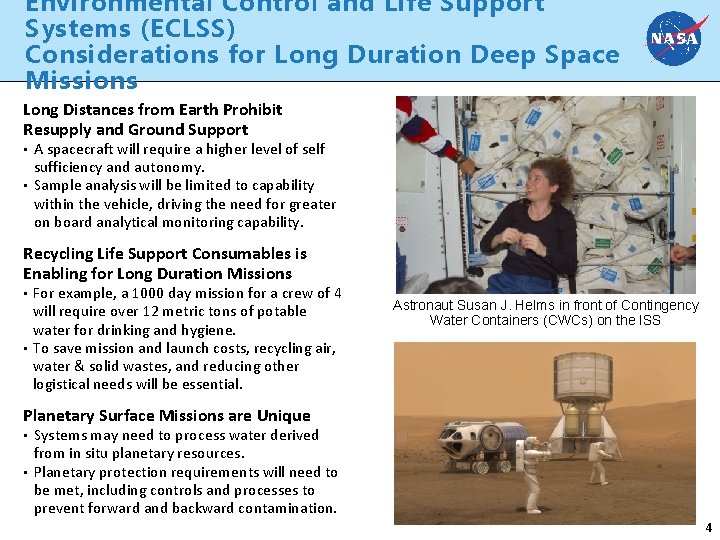
Environmental Control and Life Support Systems (ECLSS) Considerations for Long Duration Deep Space Missions Long Distances from Earth Prohibit Resupply and Ground Support A spacecraft will require a higher level of self sufficiency and autonomy. • Sample analysis will be limited to capability within the vehicle, driving the need for greater on board analytical monitoring capability. • Recycling Life Support Consumables is Enabling for Long Duration Missions For example, a 1000 day mission for a crew of 4 will require over 12 metric tons of potable water for drinking and hygiene. • To save mission and launch costs, recycling air, water & solid wastes, and reducing other logistical needs will be essential. • Astronaut Susan J. Helms in front of Contingency Water Containers (CWCs) on the ISS Planetary Surface Missions are Unique Systems may need to process water derived from in situ planetary resources. • Planetary protection requirements will need to be met, including controls and processes to prevent forward and backward contamination. • 4

Environmental Control and Life Support (ECLSS) • Environmental Control and Life Support (ECLSS) contains many subsystems with common interfaces, interdependencies and synergies. 5

ISS Regenerative ECLSS: The Point of Departure for an Exploration ECLSS • ISS ECLSS is not fully “closed”, i. e. , not all consumables are fully recycled Waste Brine 6

ISS ECLSS is not fully “closed” Notional Mass Balance, Crew of 3, One Year Mission • There are opportunities for improvements – Improved sorbents and catalysts for trace contaminants – New technologies for water recovery from wastewater brines – New technologies for water recovery from solid waste – On board environmental monitoring for water and wastewater – Simpler, more robust, serviceable subsystems and processors 7
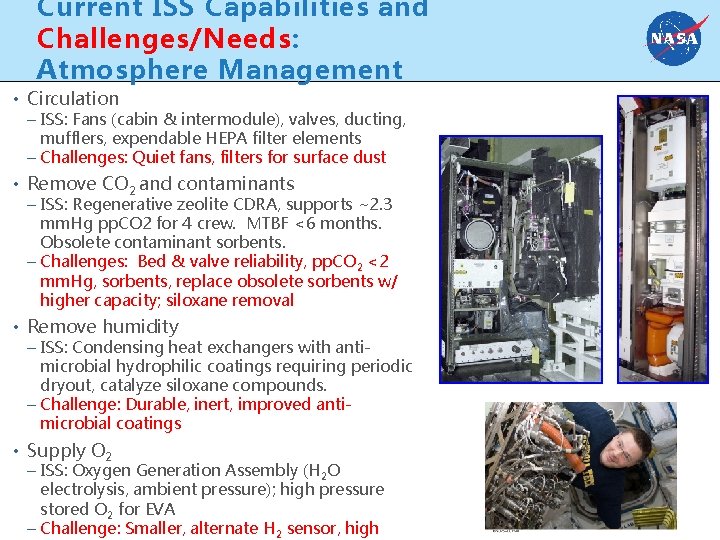
Current ISS Capabilities and Challenges/Needs: Atmosphere Management • Circulation – ISS: Fans (cabin & intermodule), valves, ducting, mufflers, expendable HEPA filter elements – Challenges: Quiet fans, filters for surface dust • Remove CO 2 and contaminants – ISS: Regenerative zeolite CDRA, supports ~2. 3 mm. Hg pp. CO 2 for 4 crew. MTBF <6 months. Obsolete contaminant sorbents. – Challenges: Bed & valve reliability, pp. CO 2 <2 mm. Hg, sorbents, replace obsolete sorbents w/ higher capacity; siloxane removal • Remove humidity – ISS: Condensing heat exchangers with antimicrobial hydrophilic coatings requiring periodic dryout, catalyze siloxane compounds. – Challenge: Durable, inert, improved antimicrobial coatings • Supply O 2 – ISS: Oxygen Generation Assembly (H 2 O electrolysis, ambient pressure); high pressure stored O 2 for EVA – Challenge: Smaller, alternate H 2 sensor, high
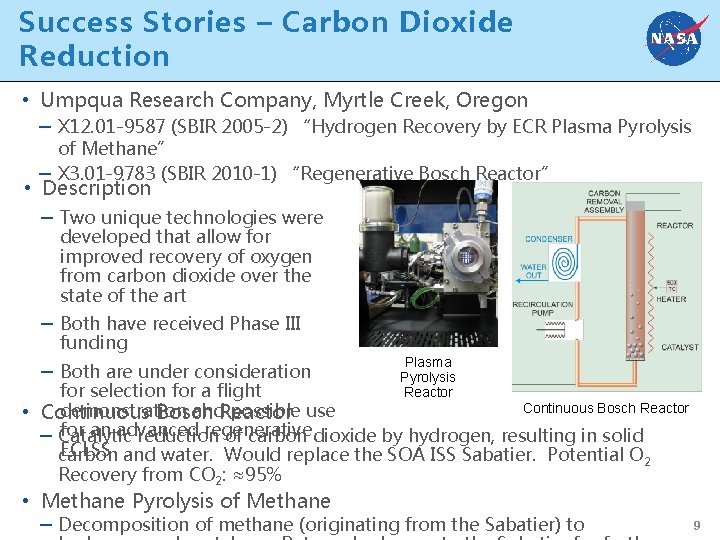
Success Stories – Carbon Dioxide Reduction • Umpqua Research Company, Myrtle Creek, Oregon – X 12. 01 -9587 (SBIR 2005 -2) “Hydrogen Recovery by ECR Plasma Pyrolysis – of Methane” X 3. 01 -9783 (SBIR 2010 -1) “Regenerative Bosch Reactor” • Description – Two unique technologies were developed that allow for improved recovery of oxygen from carbon dioxide over the state of the art – Both have received Phase III funding – Both are under consideration Plasma Pyrolysis Reactor for selection for a flight Continuous Bosch Reactor demonstration and. Reactor possible use • Continuous Bosch for an advanced regenerative – Catalytic reduction of carbon dioxide by hydrogen, resulting in solid ECLSS carbon and water. Would replace the SOA ISS Sabatier. Potential O 2 Recovery from CO 2: ≈95% • Methane Pyrolysis of Methane – Decomposition of methane (originating from the Sabatier) to 9

Current ISS Capabilities and Challenges/Needs: Water Management • Water Storage & Biocide – ISS: Bellows tanks, collapsible bags, iodine for microbial control – Challenges: Common silver biocide with onorbit dosing, dormancy survival • Urine Processing – ISS: Urine Processing Assembly (vapor compression distillation), currently recovers 85% of water (brine is stored for disposal) – Challenges: 85 -90% recovery (expected with alt pretreat formulation just implemented); • Water Processing reliability; recovery of urine brine – ISS: water. Water Processor Assembly (filtration, adsorption, ion exchange, catalytic oxidation, gas/liquid membrane separators), 100% recovery, 0. 11 lbs consumables + limited life hw/lb water processed. – Challenges: Reliability (ambient temp,

Success Stories - Ionomer Water Processor for Water Recovery from Brines • Paragon Space Development Corporation, Tucson, Arizona – X 3. 01 -9280 (SBIR 2010 -1) “Employing Ionomer Membrane Technology to Extract Water from Brine” (SBIR 2010 -2) “Ionomer-membrane Water Processor System Design and EDU Demonstration” • NASA’s Problem – Production of brine wastewater by the ISS Urine Processor Assembly results in a considerable loss of water on a yearly basis. – The brine is highly toxic. – Consumable containers Flight hardware concept. Hardware delivery is expected in November 2018, with a flight demonstration in 2019. are used to dispose of the • Paragon’s brine, which. Solution: adds – significant Membraneconsumable pair forms a bag or bladder to contain brine and transmit mass. water vapor – Cabin air sweep gas delivers recovered water vapor to cabin where it enters the cabin condensing heat exchanger and the vehicle water processing system 11
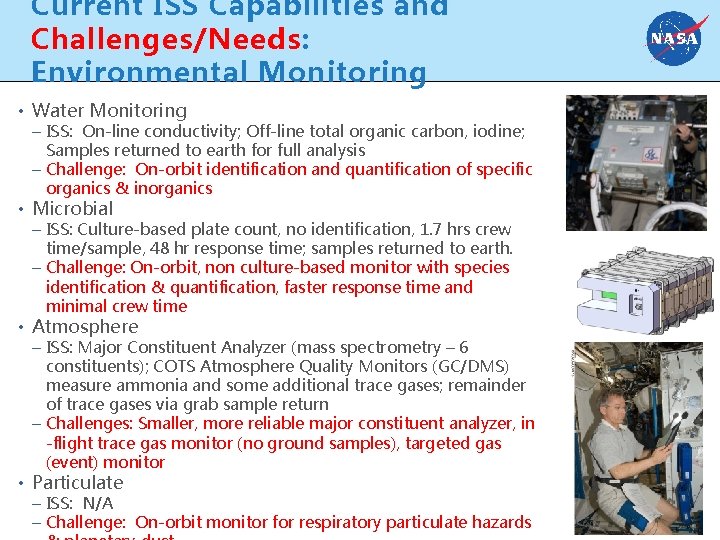
Current ISS Capabilities and Challenges/Needs: Environmental Monitoring • Water Monitoring – ISS: On-line conductivity; Off-line total organic carbon, iodine; Samples returned to earth for full analysis – Challenge: On-orbit identification and quantification of specific organics & inorganics • Microbial – ISS: Culture-based plate count, no identification, 1. 7 hrs crew time/sample, 48 hr response time; samples returned to earth. – Challenge: On-orbit, non culture-based monitor with species identification & quantification, faster response time and minimal crew time • Atmosphere – ISS: Major Constituent Analyzer (mass spectrometry – 6 constituents); COTS Atmosphere Quality Monitors (GC/DMS) measure ammonia and some additional trace gases; remainder of trace gases via grab sample return – Challenges: Smaller, more reliable major constituent analyzer, in -flight trace gas monitor (no ground samples), targeted gas (event) monitor • Particulate – ISS: N/A – Challenge: On-orbit monitor for respiratory particulate hazards
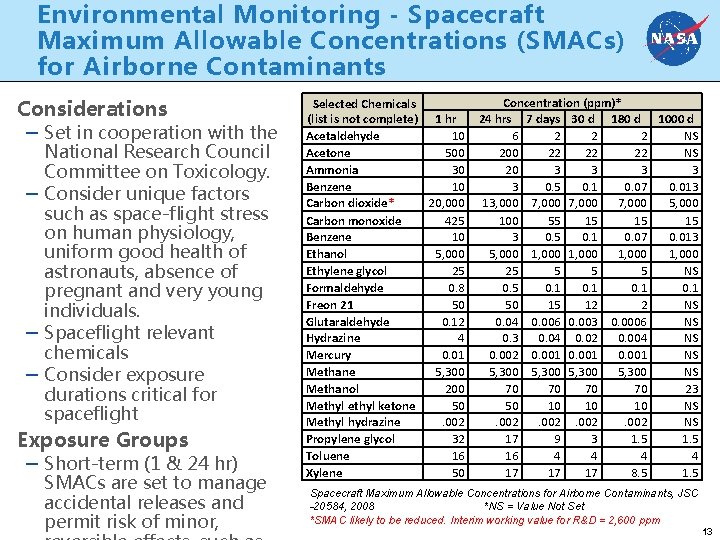
Environmental Monitoring - Spacecraft Maximum Allowable Concentrations (SMACs) for Airborne Contaminants Considerations – Set in cooperation with the – – – National Research Council Committee on Toxicology. Consider unique factors such as space-flight stress on human physiology, uniform good health of astronauts, absence of pregnant and very young individuals. Spaceflight relevant chemicals Consider exposure durations critical for spaceflight Exposure Groups – Short-term (1 & 24 hr) SMACs are set to manage accidental releases and permit risk of minor, Selected Chemicals (list is not complete) 1 hr Acetaldehyde 10 Acetone 500 Ammonia 30 Benzene 10 Carbon dioxide* 20, 000 Carbon monoxide 425 Benzene 10 Ethanol 5, 000 Ethylene glycol 25 Formaldehyde 0. 8 Freon 21 50 Glutaraldehyde 0. 12 Hydrazine 4 Mercury 0. 01 Methane 5, 300 Methanol 200 Methyl ketone 50 Methyl hydrazine. 002 Propylene glycol 32 Toluene 16 Xylene 50 Concentration (ppm)* 24 hrs 7 days 30 d 180 d 1000 d 6 2 2 2 NS 200 22 22 22 NS 20 3 3 3 0. 5 0. 1 0. 07 0. 013 13, 000 7, 000 5, 000 100 55 15 15 15 3 0. 5 0. 1 0. 07 0. 013 5, 000 1, 000 25 5 NS 0. 5 0. 1 50 15 12 2 NS 0. 04 0. 006 0. 003 0. 0006 NS 0. 3 0. 04 0. 02 0. 004 NS 0. 002 0. 001 NS 5, 300 NS 70 70 23 50 10 10 10 NS. 002 NS 17 9 3 1. 5 16 4 4 17 17 17 8. 5 1. 5 Spacecraft Maximum Allowable Concentrations for Airborne Contaminants, JSC -20584, 2008 *NS = Value Not Set *SMAC likely to be reduced. Interim working value for R&D = 2, 600 ppm 13
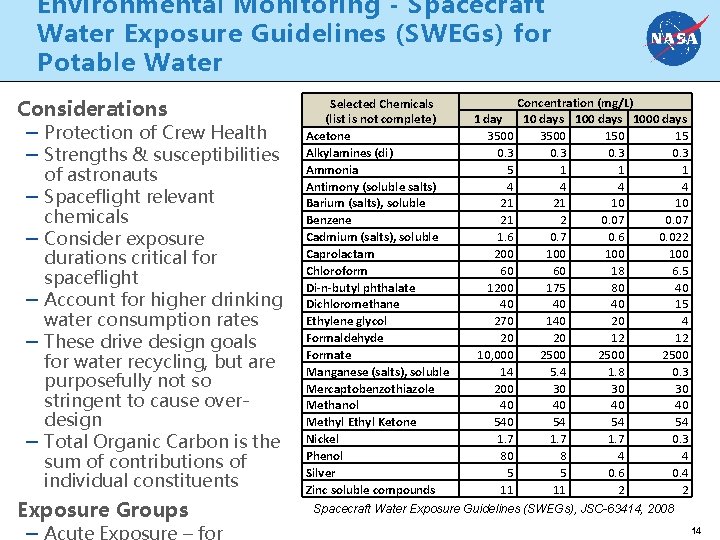
Environmental Monitoring - Spacecraft Water Exposure Guidelines (SWEGs) for Potable Water Considerations – Protection of Crew Health – Strengths & susceptibilities – – – of astronauts Spaceflight relevant chemicals Consider exposure durations critical for spaceflight Account for higher drinking water consumption rates These drive design goals for water recycling, but are purposefully not so stringent to cause overdesign Total Organic Carbon is the sum of contributions of individual constituents Exposure Groups Selected Chemicals (list is not complete) Acetone Alkylamines (di) Ammonia Antimony (soluble salts) Barium (salts), soluble Benzene Cadmium (salts), soluble Caprolactam Chloroform Di-n-butyl phthalate Dichloromethane Ethylene glycol Formaldehyde Formate Manganese (salts), soluble Mercaptobenzothiazole Methanol Methyl Ethyl Ketone Nickel Phenol Silver Zinc soluble compounds Concentration (mg/L) 1 day 10 days 1000 days 3500 150 15 0. 3 5 1 1 1 4 4 21 21 10 10 21 2 0. 07 1. 6 0. 7 0. 6 0. 022 200 100 100 60 60 18 6. 5 1200 175 80 40 40 15 270 140 20 4 20 20 12 12 10, 000 2500 14 5. 4 1. 8 0. 3 200 30 30 30 40 40 54 54 54 1. 7 0. 3 80 8 4 4 5 5 0. 6 0. 4 11 11 2 2 Spacecraft Water Exposure Guidelines (SWEGs), JSC-63414, 2008 14
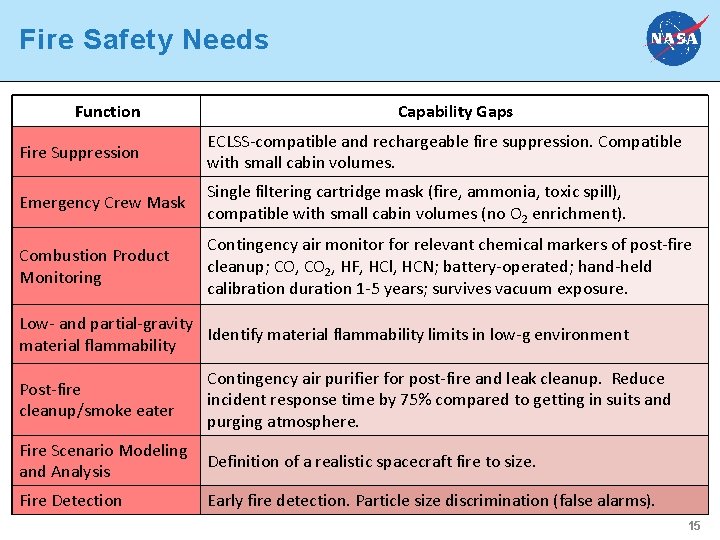
Fire Safety Needs Function Capability Gaps Fire Suppression ECLSS-compatible and rechargeable fire suppression. Compatible with small cabin volumes. Emergency Crew Mask Single filtering cartridge mask (fire, ammonia, toxic spill), compatible with small cabin volumes (no O 2 enrichment). Combustion Product Monitoring Contingency air monitor for relevant chemical markers of post-fire cleanup; CO, CO 2, HF, HCl, HCN; battery-operated; hand-held calibration duration 1 -5 years; survives vacuum exposure. Low- and partial-gravity Identify material flammability limits in low-g environment material flammability Post-fire cleanup/smoke eater Contingency air purifier for post-fire and leak cleanup. Reduce incident response time by 75% compared to getting in suits and purging atmosphere. Fire Scenario Modeling and Analysis Definition of a realistic spacecraft fire to size. Fire Detection Early fire detection. Particle size discrimination (false alarms). 15
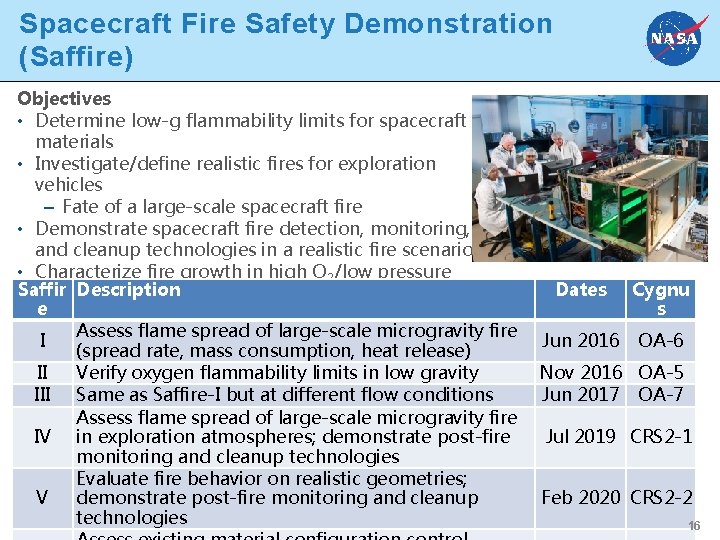
Spacecraft Fire Safety Demonstration (Saffire) Objectives • Determine low-g flammability limits for spacecraft materials • Investigate/define realistic fires for exploration vehicles – Fate of a large-scale spacecraft fire • Demonstrate spacecraft fire detection, monitoring, and cleanup technologies in a realistic fire scenario • Characterize fire growth in high O 2/low pressure Saffir Description atmospheres e • Provide data to validate models of realistic Assessfire flame spread of large-scale microgravity fire spacecraft I (spread rate, mass consumption, heat release) II Verify oxygen flammability limits in low gravity III Same as Saffire-I but at different flow conditions Assess flame spread of large-scale microgravity fire IV in exploration atmospheres; demonstrate post-fire monitoring and cleanup technologies Evaluate fire behavior on realistic geometries; V demonstrate post-fire monitoring and cleanup technologies Dates Cygnu s Jun 2016 OA-6 Nov 2016 OA-5 Jun 2017 OA-7 Jul 2019 CRS 2 -1 Feb 2020 CRS 2 -2 16
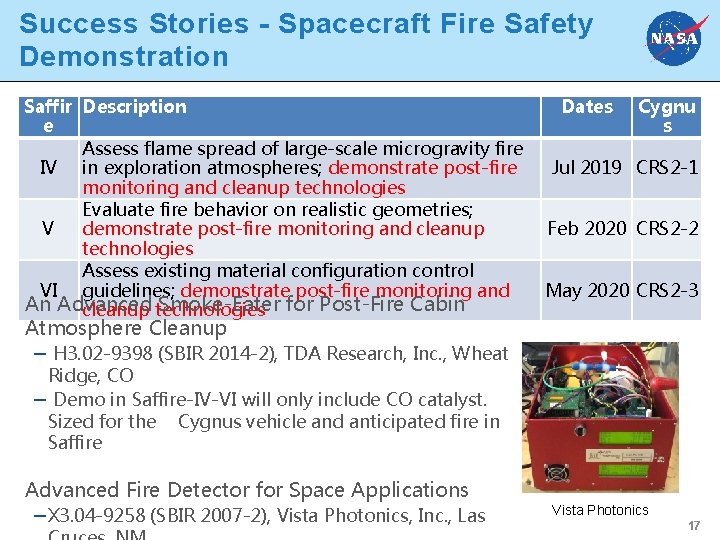
Success Stories - Spacecraft Fire Safety Demonstration Saffir Description e Assess flame spread of large-scale microgravity fire IV in exploration atmospheres; demonstrate post-fire monitoring and cleanup technologies Evaluate fire behavior on realistic geometries; V demonstrate post-fire monitoring and cleanup technologies Assess existing material configuration control VI guidelines; demonstrate post-fire monitoring and An Advanced Smoke-Eater for Post-Fire Cabin cleanup technologies Dates Cygnu s Jul 2019 CRS 2 -1 Feb 2020 CRS 2 -2 May 2020 CRS 2 -3 Atmosphere Cleanup – H 3. 02 -9398 (SBIR 2014 -2), TDA Research, Inc. , Wheat Ridge, CO – Demo in Saffire-IV-VI will only include CO catalyst. Sized for the Cygnus vehicle and anticipated fire in Saffire Advanced Fire Detector for Space Applications – X 3. 04 -9258 (SBIR 2007 -2), Vista Photonics, Inc. , Las Vista Photonics 17
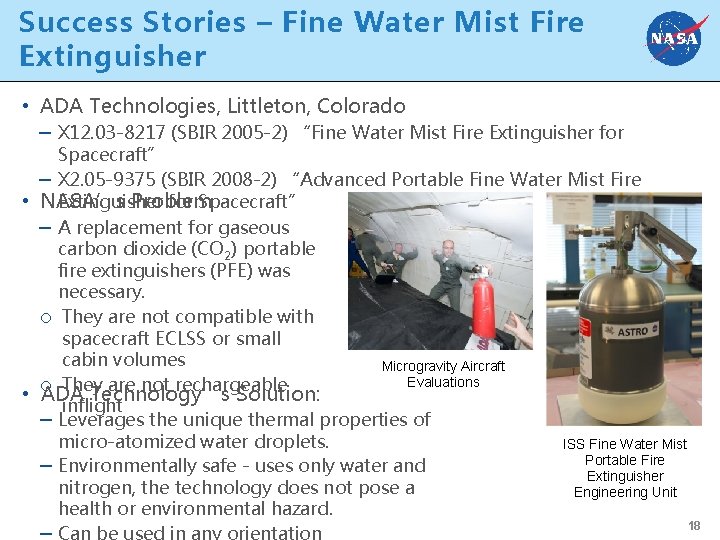
Success Stories – Fine Water Mist Fire Extinguisher • ADA Technologies, Littleton, Colorado – X 12. 03 -8217 (SBIR 2005 -2) “Fine Water Mist Fire Extinguisher for Spacecraft” – X 2. 05 -9375 (SBIR 2008 -2) “Advanced Portable Fine Water Mist Fire Extinguisher for Spacecraft” • NASA’s Problem – A replacement for gaseous carbon dioxide (CO 2) portable fire extinguishers (PFE) was necessary. o They are not compatible with spacecraft ECLSS or small cabin volumes Microgravity Aircraft Evaluations o They are not rechargeable • ADA Technology’s Solution: inflight – Leverages the unique thermal properties of micro-atomized water droplets. ISS Fine Water Mist Portable Fire – Environmentally safe - uses only water and Extinguisher nitrogen, the technology does not pose a Engineering Unit health or environmental hazard. 18 – Can be used in any orientation
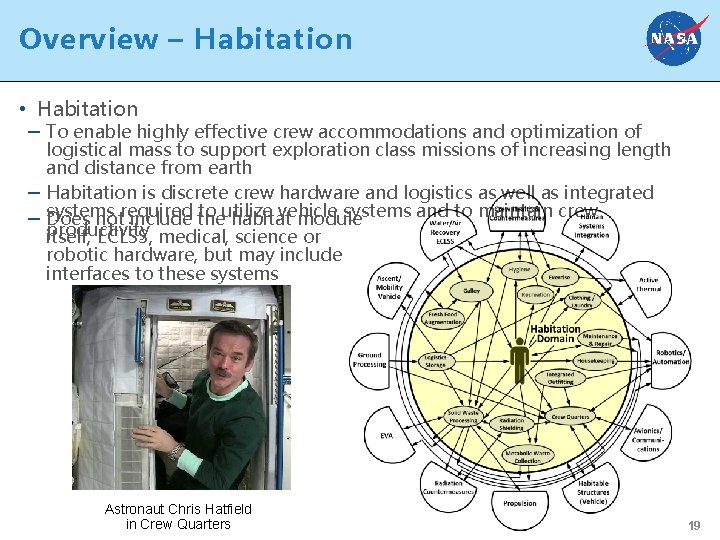
Overview – Habitation • Habitation – To enable highly effective crew accommodations and optimization of – – logistical mass to support exploration class missions of increasing length and distance from earth Habitation is discrete crew hardware and logistics as well as integrated systems to utilize vehicle systems and to maintain crew Does notrequired include the habitat module productivity itself, ECLSS, medical, science or robotic hardware, but may include interfaces to these systems Astronaut Chris Hatfield in Crew Quarters 19
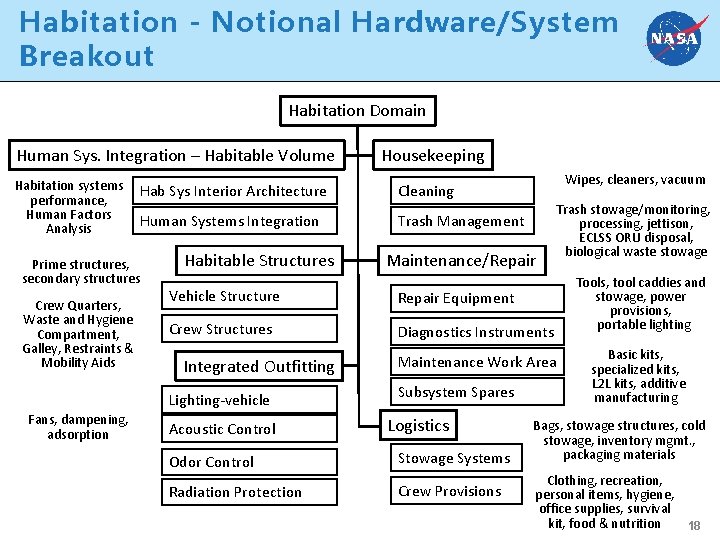
Habitation - Notional Hardware/System Breakout Habitation Domain Human Sys. Integration – Habitable Volume Habitation systems performance, Human Factors Analysis Hab Sys Interior Architecture Cleaning Human Systems Integration Trash Management Prime structures, secondary structures Crew Quarters, Waste and Hygiene Compartment, Galley, Restraints & Mobility Aids Habitable Structures Wipes, cleaners, vacuum Maintenance/Repair Vehicle Structure Repair Equipment Crew Structures Diagnostics Instruments Integrated Outfitting Lighting-vehicle Fans, dampening, adsorption Housekeeping Acoustic Control Trash stowage/monitoring, processing, jettison, ECLSS ORU disposal, biological waste stowage Maintenance Work Area Subsystem Spares Logistics Odor Control Stowage Systems Radiation Protection Crew Provisions Tools, tool caddies and stowage, power provisions, portable lighting Basic kits, specialized kits, L 2 L kits, additive manufacturing Bags, stowage structures, cold stowage, inventory mgmt. , packaging materials Clothing, recreation, personal items, hygiene, office supplies, survival kit, food & nutrition 18
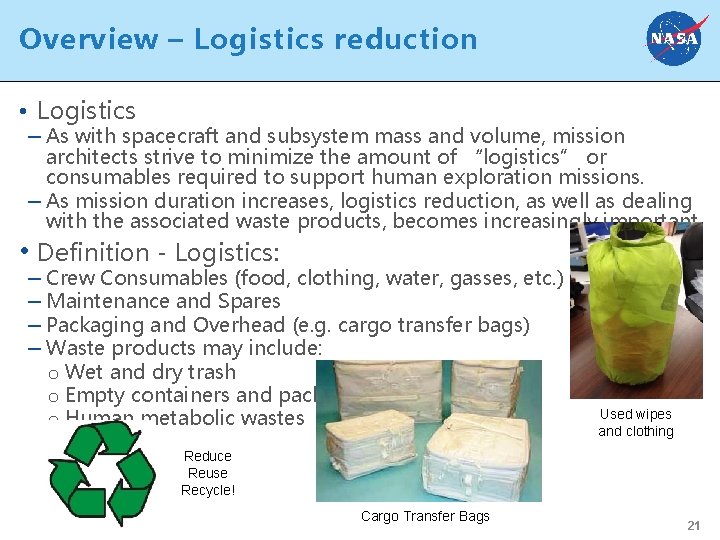
Overview – Logistics reduction • Logistics – As with spacecraft and subsystem mass and volume, mission architects strive to minimize the amount of “logistics” or consumables required to support human exploration missions. – As mission duration increases, logistics reduction, as well as dealing with the associated waste products, becomes increasingly important. • Definition - Logistics: – Crew Consumables (food, clothing, water, gasses, etc. ) – Maintenance and Spares – Packaging and Overhead (e. g. cargo transfer bags) – Waste products may include: o Wet and dry trash o Empty containers and packaging o Human metabolic wastes Used wipes and clothing Reduce Reuse Recycle! Cargo Transfer Bags 21
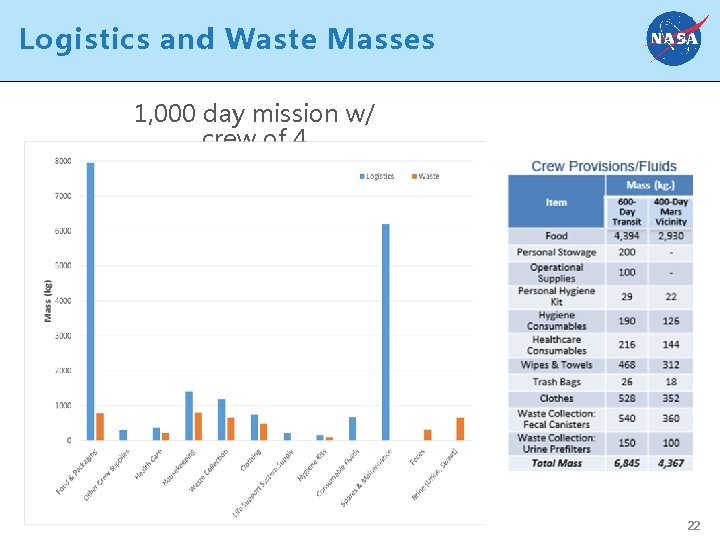
Logistics and Waste Masses 1, 000 day mission w/ crew of 4 22
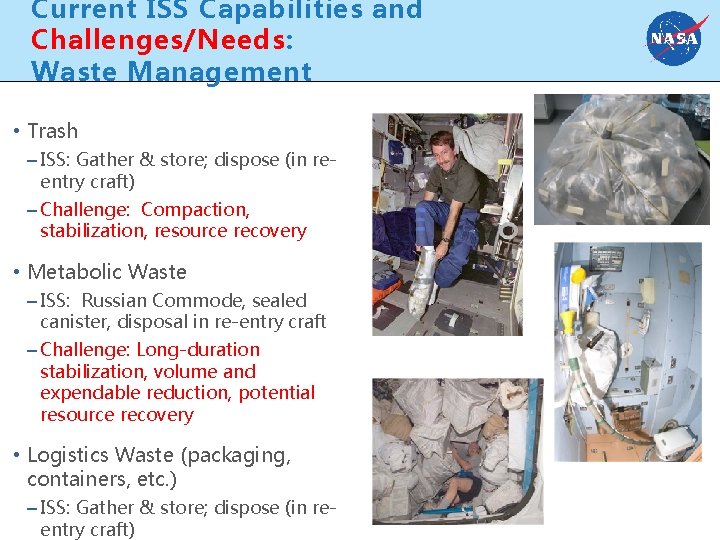
Current ISS Capabilities and Challenges/Needs: Waste Management • Trash – ISS: Gather & store; dispose (in reentry craft) – Challenge: Compaction, stabilization, resource recovery • Metabolic Waste – ISS: Russian Commode, sealed canister, disposal in re-entry craft – Challenge: Long-duration stabilization, volume and expendable reduction, potential resource recovery • Logistics Waste (packaging, containers, etc. ) – ISS: Gather & store; dispose (in reentry craft)
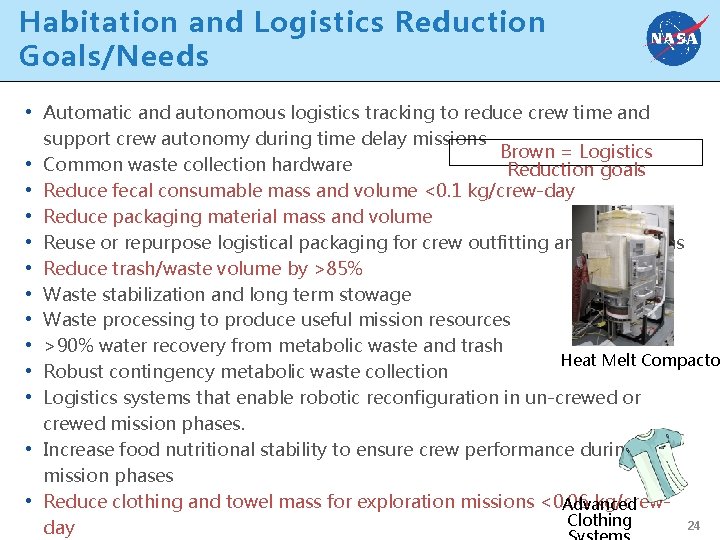
Habitation and Logistics Reduction Goals/Needs • Automatic and autonomous logistics tracking to reduce crew time and • • • support crew autonomy during time delay missions Brown = Logistics Common waste collection hardware Reduction goals Reduce fecal consumable mass and volume <0. 1 kg/crew-day Reduce packaging material mass and volume Reuse or repurpose logistical packaging for crew outfitting and crew items Reduce trash/waste volume by >85% Waste stabilization and long term stowage Waste processing to produce useful mission resources >90% water recovery from metabolic waste and trash Heat Melt Compactor Robust contingency metabolic waste collection Logistics systems that enable robotic reconfiguration in un-crewed or crewed mission phases. Increase food nutritional stability to ensure crew performance during mission phases Reduce clothing and towel mass for exploration missions <0. 06 kg/crew. Advanced Clothing 24 day
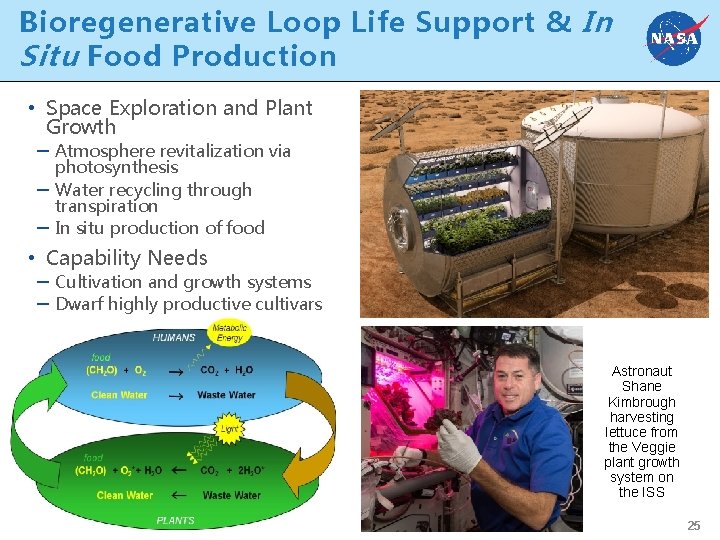
Bioregenerative Loop Life Support & In Situ Food Production • Space Exploration and Plant Growth – Atmosphere revitalization via – photosynthesis Water recycling through transpiration In situ production of food – • Capability Needs – Cultivation and growth systems – Dwarf highly productive cultivars – Nutrient recycling and reusable – media Greenhouse films and efficient lighting Astronaut Shane Kimbrough harvesting lettuce from the Veggie plant growth system on the ISS 25
Guidance for SBIR Solicitation Responses • Technical content in the solicitation will vary year to year. Different technical areas may be combined into a single subtopic. A technical area may rotate year to year and be skipped. • Check the subtopic descriptions carefully. A proposal must address content requested in the current solicitation to be considered for award, otherwise it may be judged non-responsive. • The proposed research and development plan should focus on the core technology or innovation. Don’t dilute the effort building commonly available supporting hardware. • Show an understanding of the state of the art. Objectively state the advantages of the proposed technology over it. Include estimates for – Focus should bethermal to demonstrate proof of concept and feasibility mass, power, volume and requirements. of the technical approach. • Spend adequate time building the requested summary charts. These are Focusand on ifquestions that need to general be answered and risks thatvalue. used by –NASA poorly written or too they have limited need to be addressed to develop a more informed Phase II • Phase I proposal with reduced technical risk. – Contracts should lead to development and evaluation of • Phase II – prototype breadboard hardware for delivery to NASA. Consider NASA safety and other standards in design and fabrication of the hardware intended for delivery to NASA. Delivered hardware needs to meet pressure systems, oxygen 26
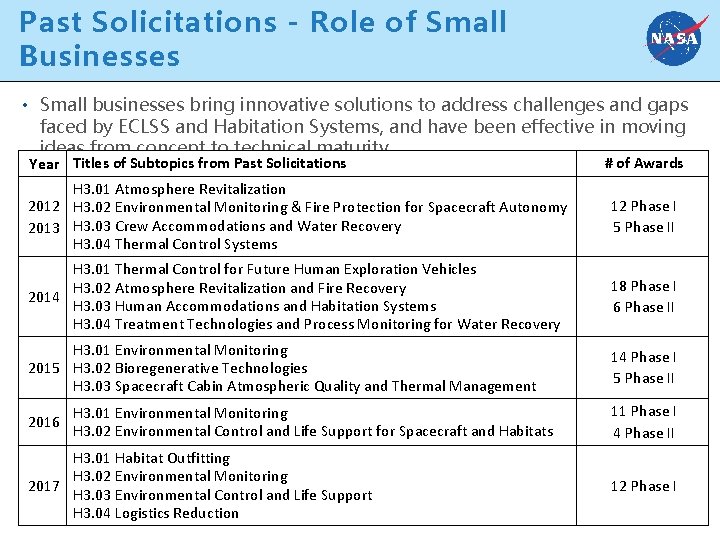
Past Solicitations - Role of Small Businesses • Small businesses bring innovative solutions to address challenges and gaps faced by ECLSS and Habitation Systems, and have been effective in moving ideas from concept to technical maturity. Year Titles of Subtopics from Past Solicitations # of Awards H 3. 01 Atmosphere Revitalization 2012 H 3. 02 Environmental Monitoring & Fire Protection for Spacecraft Autonomy 2013 H 3. 03 Crew Accommodations and Water Recovery H 3. 04 Thermal Control Systems 12 Phase I 5 Phase II H 3. 01 Thermal Control for Future Human Exploration Vehicles H 3. 02 Atmosphere Revitalization and Fire Recovery 2014 H 3. 03 Human Accommodations and Habitation Systems H 3. 04 Treatment Technologies and Process Monitoring for Water Recovery 18 Phase I 6 Phase II H 3. 01 Environmental Monitoring 2015 H 3. 02 Bioregenerative Technologies H 3. 03 Spacecraft Cabin Atmospheric Quality and Thermal Management 14 Phase I 5 Phase II 2016 H 3. 01 Environmental Monitoring H 3. 02 Environmental Control and Life Support for Spacecraft and Habitats H 3. 01 Habitat Outfitting H 3. 02 Environmental Monitoring 2017 H 3. 03 Environmental Control and Life Support H 3. 04 Logistics Reduction 11 Phase I 4 Phase II 12 Phase I
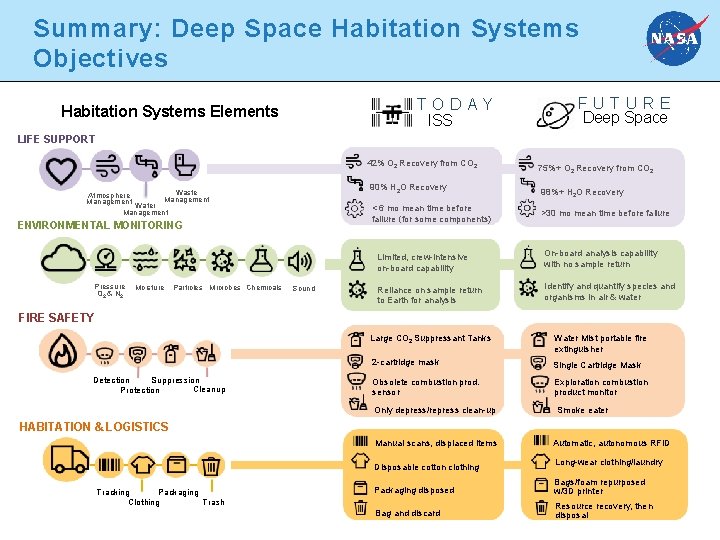
Summary: Deep Space Habitation Systems Objectives TODAY ISS Habitation Systems Elements FUTURE Deep Space LIFE SUPPORT 42% O 2 Recovery from CO 2 90% H 2 O Recovery Waste Atmosphere Management Water Management < 6 mo mean time before failure (for some components) ENVIRONMENTAL MONITORING Pressure O 2 & N 2 Moisture Particles Microbes Chemicals Sound 75%+ O 2 Recovery from CO 2 98%+ H 2 O Recovery >30 mo mean time before failure Limited, crew-intensive on-board capability On-board analysis capability with no sample return Reliance on sample return to Earth for analysis Identify and quantify species and organisms in air & water FIRE SAFETY Detection Suppression Cleanup Protection Large CO 2 Suppressant Tanks Water Mist portable fire extinguisher 2 -cartridge mask Single Cartridge Mask Obsolete combustion prod. sensor Exploration combustion product monitor Only depress/repress clean-up Smoke eater HABITATION & LOGISTICS Manual scans, displaced items Disposable cotton clothing Tracking Packaging Trash Clothing Automatic, autonomous RFID Long-wear clothing/laundry Packaging disposed Bags/foam repurposed w/3 D printer Bag and discard Resource recovery, then disposal
Resources • NASA SBIR/STTR 2017 Program Solicitation SBIR Research Topics by Focus Area – https: //sbir. nasa. gov/solicit/58007/detail? data=ch 9&s=58000 • ECLSS and Habitation Systems – Schneider, W. , et. al. (2016) “NASA Environmental Control and Life – – Support (ECLS) Technology Development and Maturation for Exploration: 2015 to 2016 Overview”, 46 th International Conference on Environmental Systems, Paper # ICES-2016 -40 Anderson, Molly S. , et. al. (2017) “NASA Environmental Control and Life Support (ECLS) Technology Development and Maturation for Exploration: 2016 to 2017 Overview”, 47 th International Conference on Environmental Systems, Paper # ICES-2017 -226 Anderson, Molly S. , Ewert, Michael K. , Keener, John F. , Wagner, Sandra A. (2015) “Life Support Baseline Values and Assumptions Document” NASA/TP-2015– 218570 • Trace Contaminant Exposure Guidelines – https: //www. nasa. gov/feature/exposure-guidelines-smacs-swegs – John T. James and J. Torin Mc. Coy (2008) “Spacecraft Water Exposure 29
Acknowledgements • Gary Ruff, NASA Glenn Research Center • Molly Anderson, Mike Ewert and Jim Broyan, NASA Johnson Space Center • Robyn Gatens and Jitendra Joshi, NASA Headquarters • Walter Schneider, NASA Marshall Space Flight Center • Laura Kelsey and Barry Finger, Paragon Space Development Corporation • William Michalek and Ray Wheeler, Umpqua Research Company 30
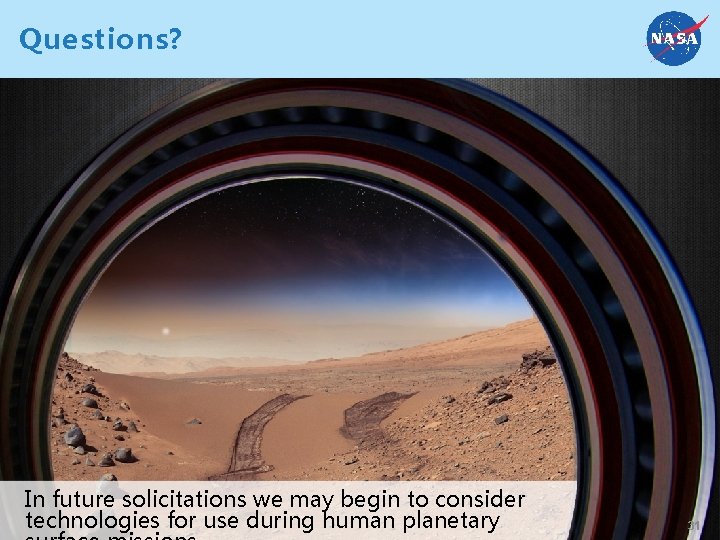
Questions? In future solicitations we may begin to consider technologies for use during human planetary 31
- Slides: 31