
National Aeronautics and Space Administration Dryden Flight Research

- Slides: 31
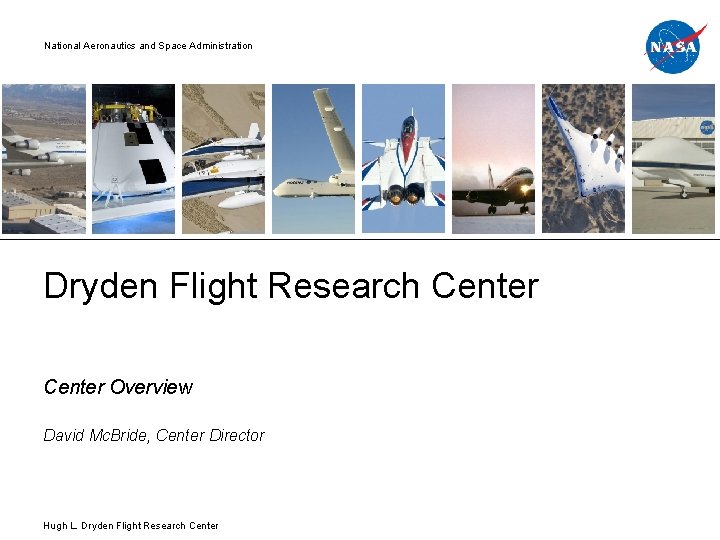
National Aeronautics and Space Administration Dryden Flight Research Center Overview David Mc. Bride, Center Director Hugh L. Dryden Flight Research Center
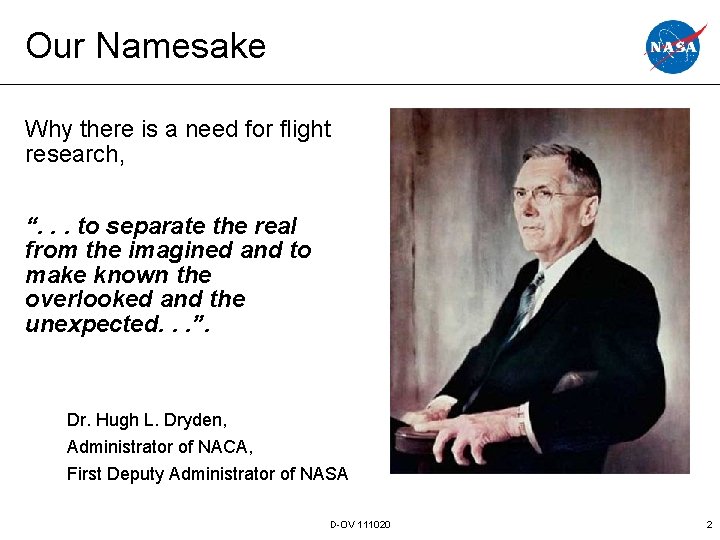
Our Namesake Why there is a need for flight research, “. . . to separate the real from the imagined and to make known the overlooked and the unexpected. . . ”. Dr. Hugh L. Dryden, Administrator of NACA, First Deputy Administrator of NASA D-OV 111020 2
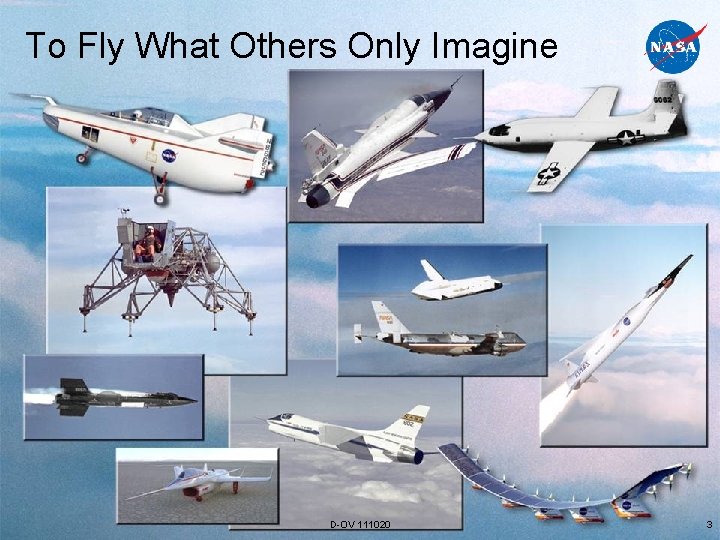
To Fly What Others Only Imagine D-OV 111020 3
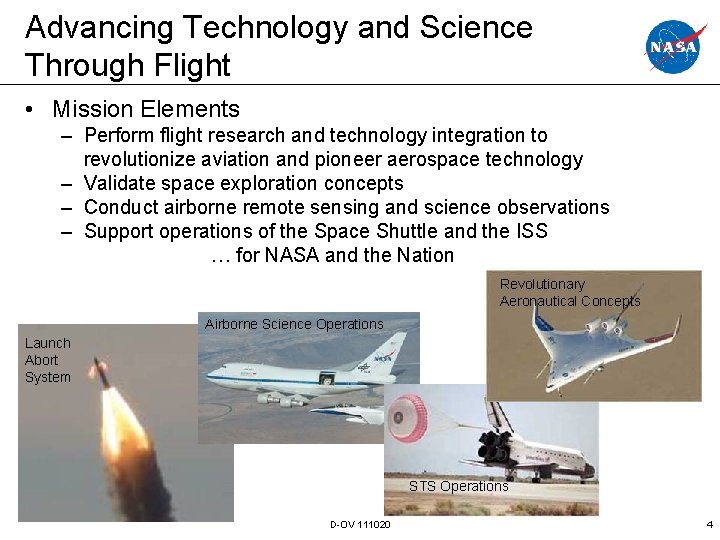
Advancing Technology and Science Through Flight • Mission Elements – Perform flight research and technology integration to revolutionize aviation and pioneer aerospace technology – Validate space exploration concepts – Conduct airborne remote sensing and science observations – Support operations of the Space Shuttle and the ISS … for NASA and the Nation Revolutionary Aeronautical Concepts Airborne Science Operations Launch Abort System STS Operations D-OV 111020 4
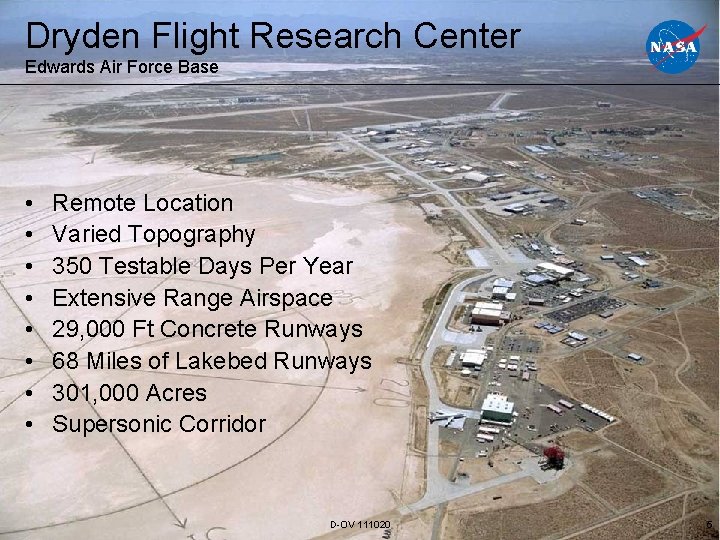
Dryden Flight Research Center Edwards Air Force Base • • Remote Location Varied Topography 350 Testable Days Per Year Extensive Range Airspace 29, 000 Ft Concrete Runways 68 Miles of Lakebed Runways 301, 000 Acres Supersonic Corridor D-OV 111020 5
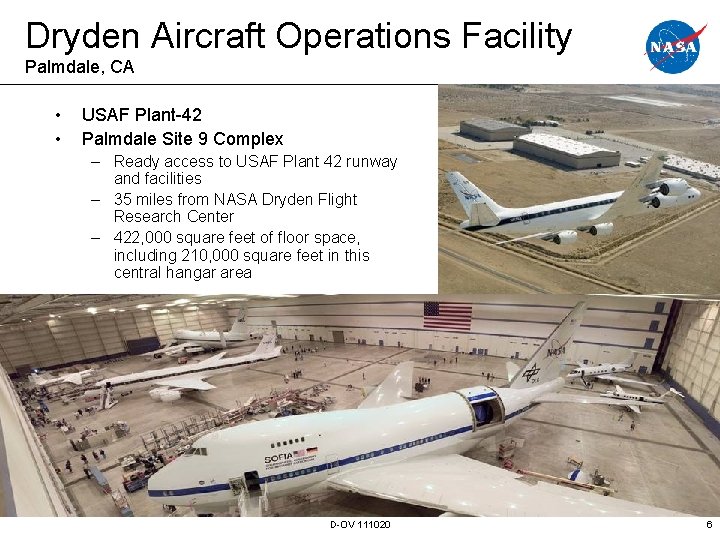
Dryden Aircraft Operations Facility Palmdale, CA • • USAF Plant-42 Palmdale Site 9 Complex – Ready access to USAF Plant 42 runway and facilities – 35 miles from NASA Dryden Flight Research Center – 422, 000 square feet of floor space, including 210, 000 square feet in this central hangar area D-OV 111020 6
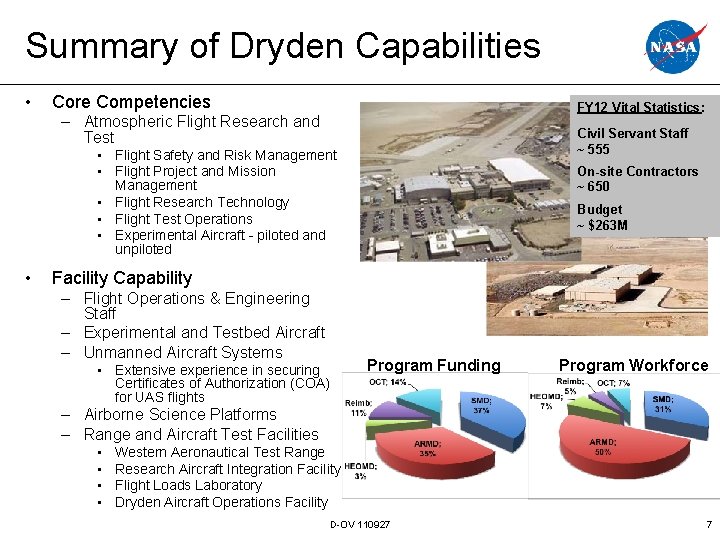
Summary of Dryden Capabilities • Core Competencies FY 12 Vital Statistics: – Atmospheric Flight Research and Test Civil Servant Staff ~ 555 • Flight Safety and Risk Management • Flight Project and Mission Management • Flight Research Technology • Flight Test Operations • Experimental Aircraft - piloted and unpiloted • On-site Contractors ~ 650 Budget ~ $263 M Facility Capability – Flight Operations & Engineering Staff – Experimental and Testbed Aircraft – Unmanned Aircraft Systems • Extensive experience in securing Certificates of Authorization (COA) for UAS flights Program Funding Program Workforce – Airborne Science Platforms – Range and Aircraft Test Facilities • • Western Aeronautical Test Range Research Aircraft Integration Facility Flight Loads Laboratory Dryden Aircraft Operations Facility D-OV 110927 7
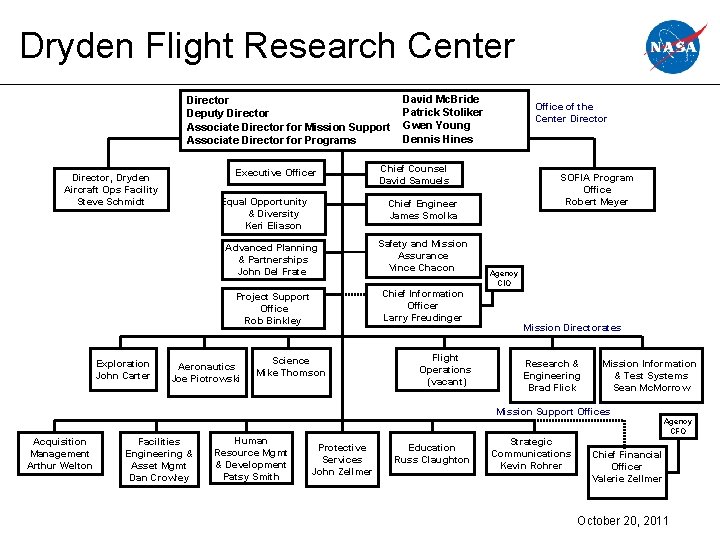
Dryden Flight Research Center Director Deputy Director Associate Director for Mission Support Associate Director for Programs Executive Officer Director, Dryden Aircraft Ops Facility Steve Schmidt Exploration John Carter Equal Opportunity & Diversity Keri Eliason David Mc. Bride Patrick Stoliker Gwen Young Dennis Hines Chief Counsel David Samuels SOFIA Program Office Robert Meyer Chief Engineer James Smolka Advanced Planning & Partnerships John Del Frate Safety and Mission Assurance Vince Chacon Project Support Office Rob Binkley Chief Information Officer Larry Freudinger Aeronautics Joe Piotrowski Office of the Center Director Science Mike Thomson Flight Operations (vacant) Agency CIO Mission Directorates Research & Engineering Brad Flick Mission Information & Test Systems Sean Mc. Morrow Mission Support Offices Acquisition Management Arthur Welton Facilities Engineering & Asset Mgmt Dan Crowley Human Resource Mgmt & Development Patsy Smith Protective Services John Zellmer Education Russ Claughton Strategic Communications Kevin Rohrer Agency CFO Chief Financial Officer Valerie Zellmer October 20, 2011
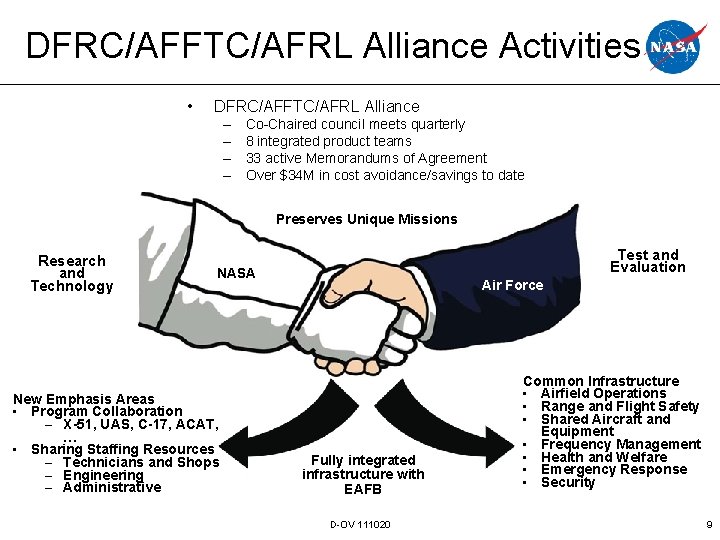
DFRC/AFFTC/AFRL Alliance Activities • DFRC/AFFTC/AFRL Alliance – – Co-Chaired council meets quarterly 8 integrated product teams 33 active Memorandums of Agreement Over $34 M in cost avoidance/savings to date Preserves Unique Missions Research and Technology Test and Evaluation NASA New Emphasis Areas • Program Collaboration – X-51, UAS, C-17, ACAT, … • Sharing Staffing Resources – Technicians and Shops – Engineering – Administrative Air Force Fully integrated infrastructure with EAFB D-OV 111020 Common Infrastructure • Airfield Operations • Range and Flight Safety • Shared Aircraft and Equipment • Frequency Management • Health and Welfare • Emergency Response • Security 9
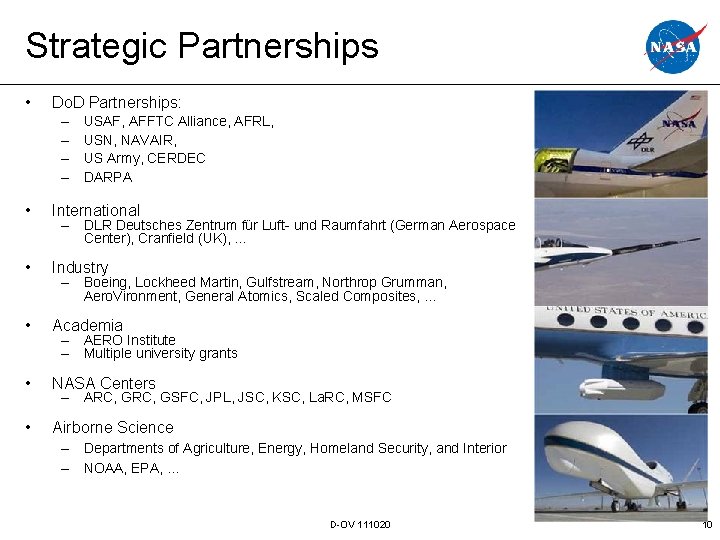
Strategic Partnerships • Do. D Partnerships: – – USAF, AFFTC Alliance, AFRL, USN, NAVAIR, US Army, CERDEC DARPA • International • Industry • Academia • NASA Centers • Airborne Science – DLR Deutsches Zentrum für Luft- und Raumfahrt (German Aerospace Center), Cranfield (UK), … – Boeing, Lockheed Martin, Gulfstream, Northrop Grumman, Aero. Vironment, General Atomics, Scaled Composites, … – AERO Institute – Multiple university grants – ARC, GSFC, JPL, JSC, KSC, La. RC, MSFC – Departments of Agriculture, Energy, Homeland Security, and Interior – NOAA, EPA, … D-OV 111020 10
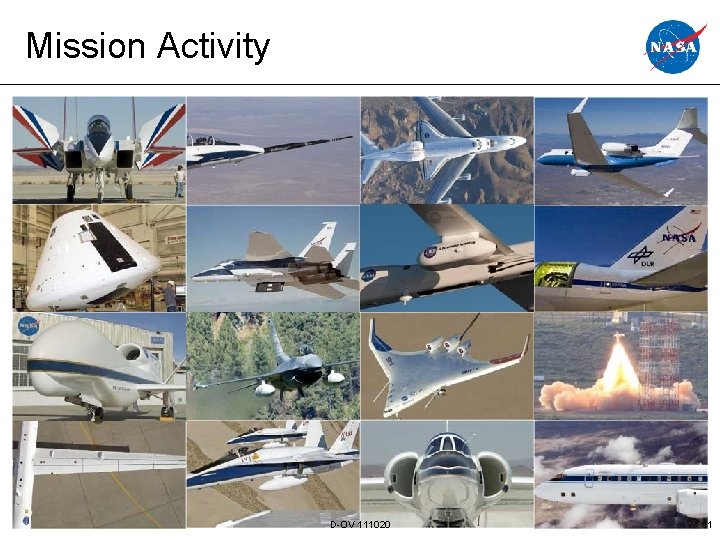
Mission Activity D-OV 111020 11
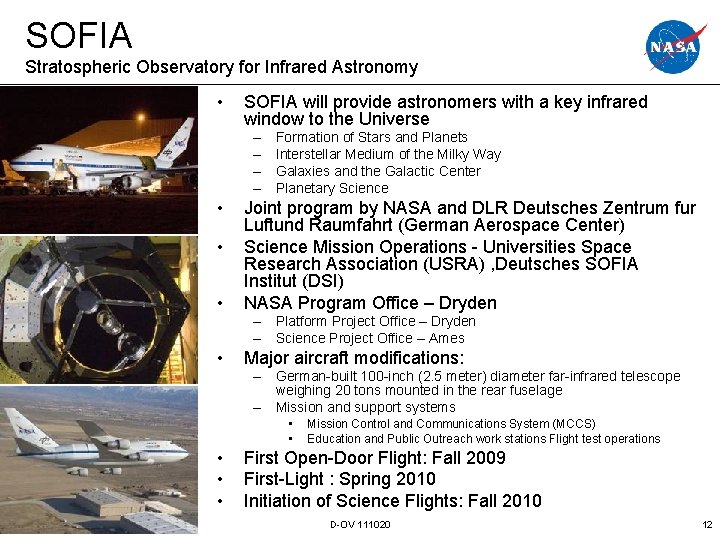
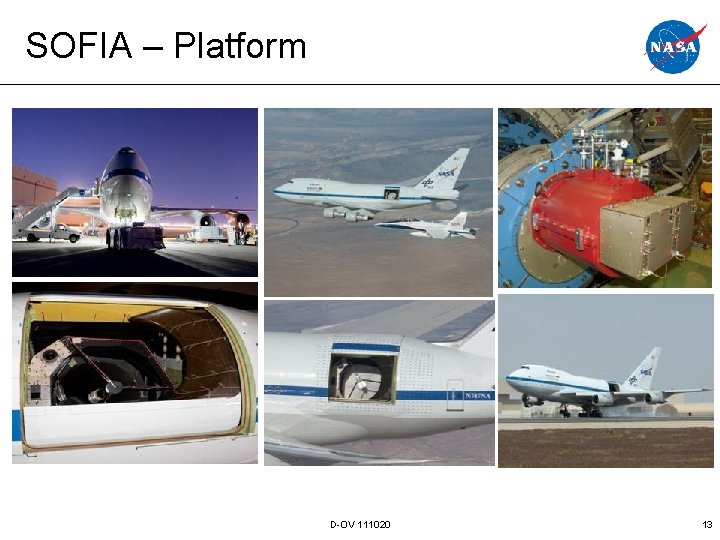
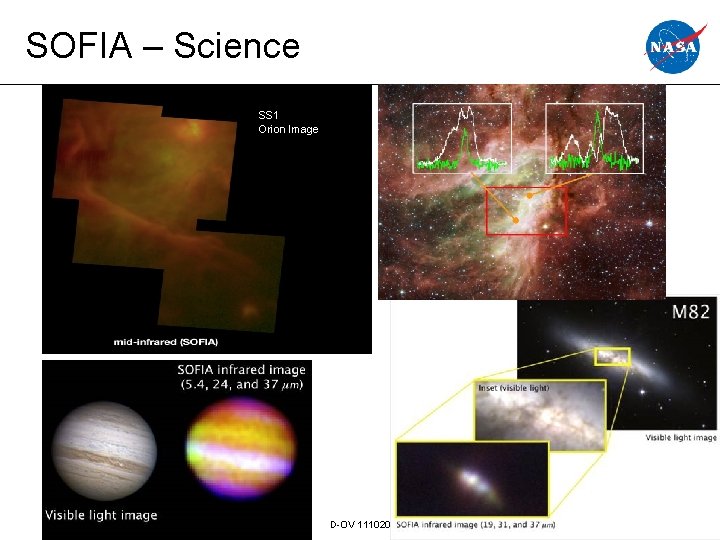
SOFIA Stratospheric Observatory for Infrared Astronomy • SOFIA will provide astronomers with a key infrared window to the Universe – – • • • Formation of Stars and Planets Interstellar Medium of the Milky Way Galaxies and the Galactic Center Planetary Science Joint program by NASA and DLR Deutsches Zentrum fur Luftund Raumfahrt (German Aerospace Center) Science Mission Operations - Universities Space Research Association (USRA) , Deutsches SOFIA Institut (DSI) NASA Program Office – Dryden – Platform Project Office – Dryden – Science Project Office – Ames • Major aircraft modifications: – German-built 100 -inch (2. 5 meter) diameter far-infrared telescope weighing 20 tons mounted in the rear fuselage – Mission and support systems • • • Mission Control and Communications System (MCCS) Education and Public Outreach work stations Flight test operations First Open-Door Flight: Fall 2009 First-Light : Spring 2010 Initiation of Science Flights: Fall 2010 D-OV 111020 12
SOFIA – Platform D-OV 111020 13
SOFIA – Science SS 1 Orion Image D-OV 111020 14
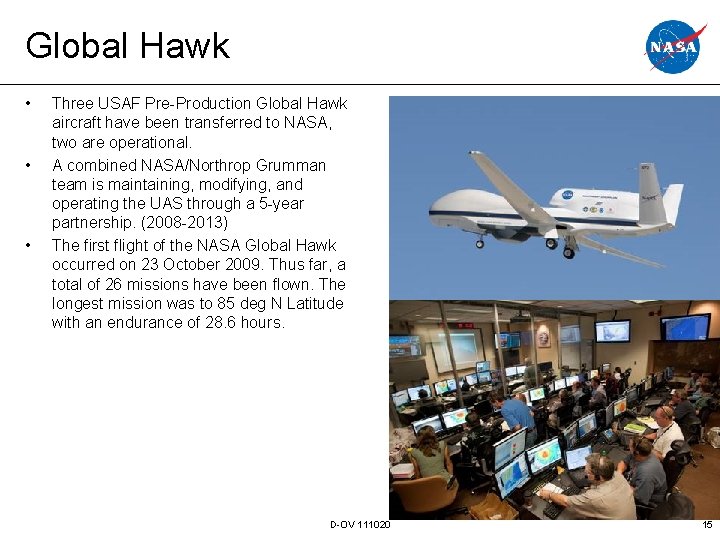
Global Hawk • • • Three USAF Pre-Production Global Hawk aircraft have been transferred to NASA, two are operational. A combined NASA/Northrop Grumman team is maintaining, modifying, and operating the UAS through a 5 -year partnership. (2008 -2013) The first flight of the NASA Global Hawk occurred on 23 October 2009. Thus far, a total of 26 missions have been flown. The longest mission was to 85 deg N Latitude with an endurance of 28. 6 hours. D-OV 111020 15
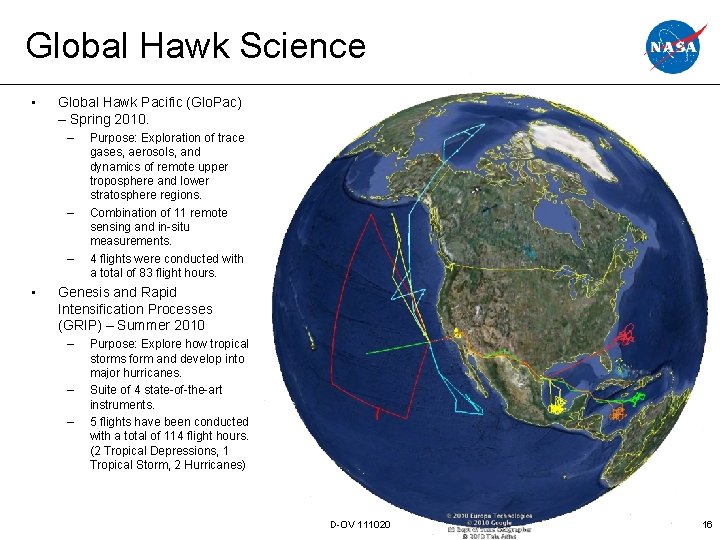
Global Hawk Science • Global Hawk Pacific (Glo. Pac) – Spring 2010. – – – • Purpose: Exploration of trace gases, aerosols, and dynamics of remote upper troposphere and lower stratosphere regions. Combination of 11 remote sensing and in-situ measurements. 4 flights were conducted with a total of 83 flight hours. Genesis and Rapid Intensification Processes (GRIP) – Summer 2010 – – – Purpose: Explore how tropical storms form and develop into major hurricanes. Suite of 4 state-of-the-art instruments. 5 flights have been conducted with a total of 114 flight hours. (2 Tropical Depressions, 1 Tropical Storm, 2 Hurricanes) D-OV 111020 16
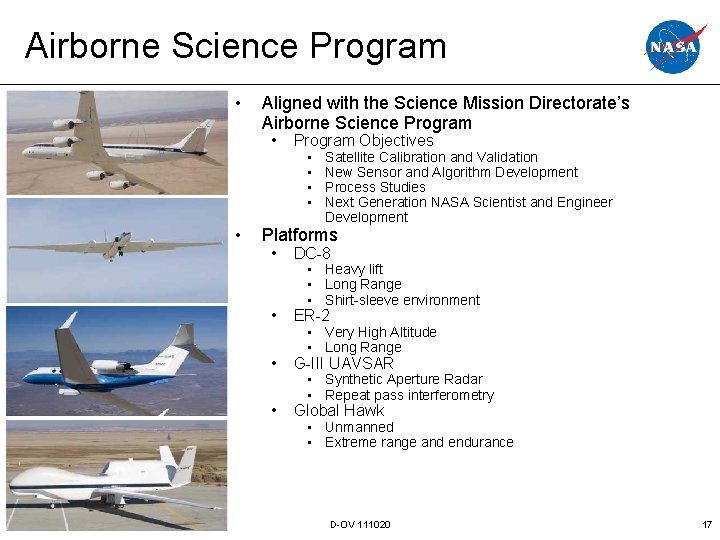
Airborne Science Program • Aligned with the Science Mission Directorate’s Airborne Science Program • • Program Objectives • • Satellite Calibration and Validation New Sensor and Algorithm Development Process Studies Next Generation NASA Scientist and Engineer Development Platforms • DC-8 • ER-2 • G-III UAVSAR • Global Hawk • Heavy lift • Long Range • Shirt-sleeve environment • Very High Altitude • Long Range • Synthetic Aperture Radar • Repeat pass interferometry • Unmanned • Extreme range and endurance D-OV 111020 17
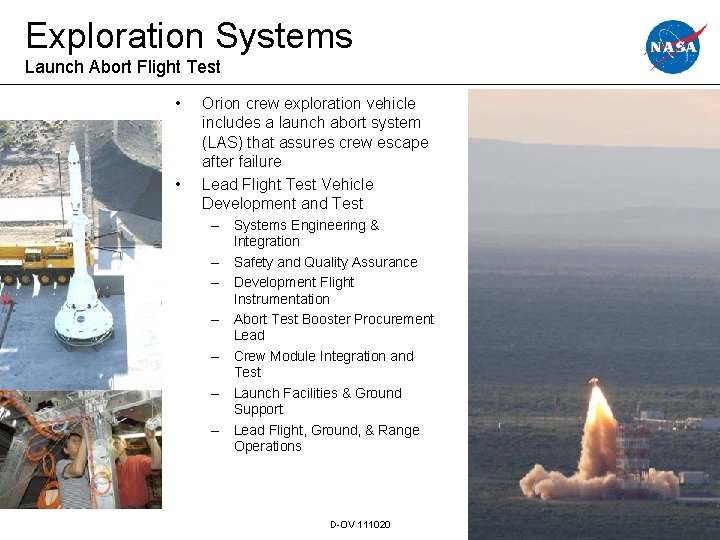
Exploration Systems Launch Abort Flight Test • • Orion crew exploration vehicle includes a launch abort system (LAS) that assures crew escape after failure Lead Flight Test Vehicle Development and Test – Systems Engineering & Integration – Safety and Quality Assurance – Development Flight Instrumentation – Abort Test Booster Procurement Lead – Crew Module Integration and Test – Launch Facilities & Ground Support – Lead Flight, Ground, & Range Operations D-OV 111020 18
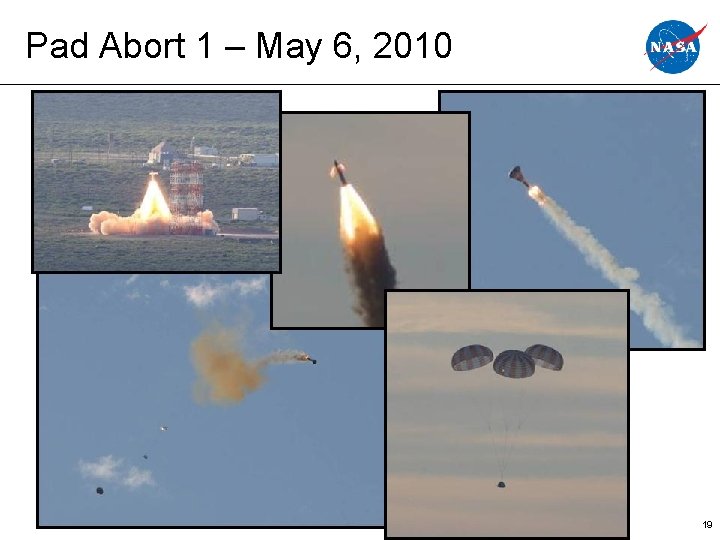
Pad Abort 1 – May 6, 2010 D-OV 111020 19
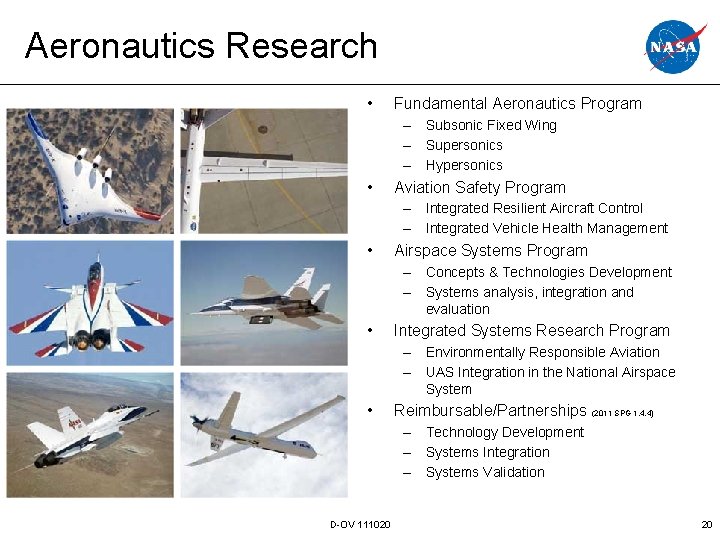
Aeronautics Research • Fundamental Aeronautics Program – Subsonic Fixed Wing – Supersonics – Hypersonics • Aviation Safety Program – Integrated Resilient Aircraft Control – Integrated Vehicle Health Management • Airspace Systems Program – Concepts & Technologies Development – Systems analysis, integration and evaluation • Integrated Systems Research Program – Environmentally Responsible Aviation – UAS Integration in the National Airspace System • Reimbursable/Partnerships (2011 SPG 1. 4. 4) – Technology Development – Systems Integration – Systems Validation D-OV 111020 20
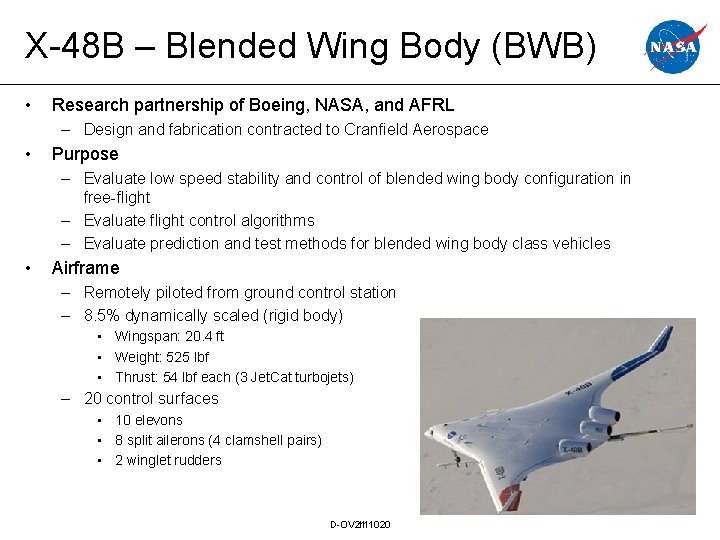
X-48 B – Blended Wing Body (BWB) • Research partnership of Boeing, NASA, and AFRL – Design and fabrication contracted to Cranfield Aerospace • Purpose – Evaluate low speed stability and control of blended wing body configuration in free-flight – Evaluate flight control algorithms – Evaluate prediction and test methods for blended wing body class vehicles • Airframe – Remotely piloted from ground control station – 8. 5% dynamically scaled (rigid body) • Wingspan: 20. 4 ft • Weight: 525 lbf • Thrust: 54 lbf each (3 Jet. Cat turbojets) – 20 control surfaces • 10 elevons • 8 split ailerons (4 clamshell pairs) • 2 winglet rudders D-OV 21 111020
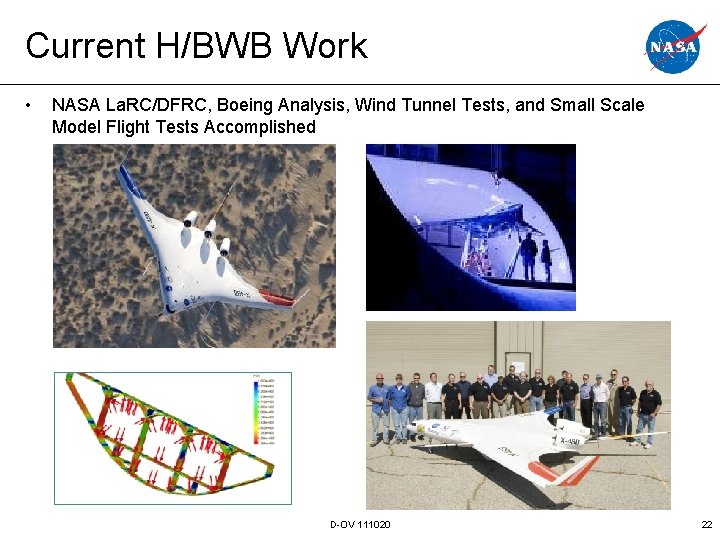
Current H/BWB Work • NASA La. RC/DFRC, Boeing Analysis, Wind Tunnel Tests, and Small Scale Model Flight Tests Accomplished D-OV 111020 22
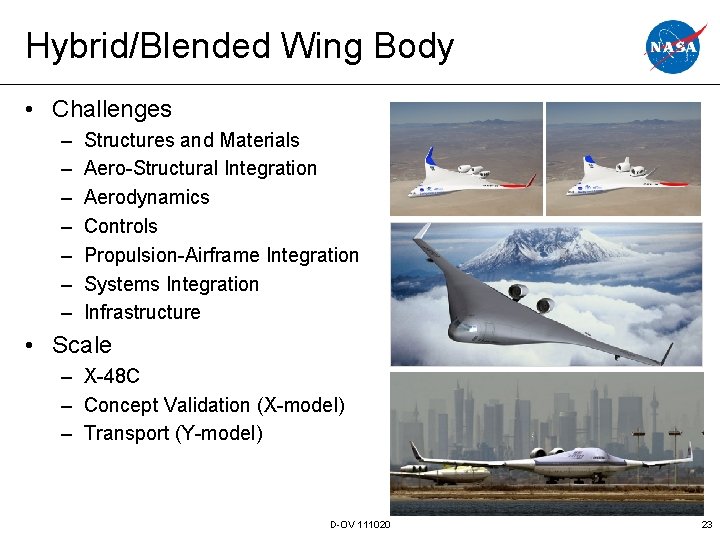
Hybrid/Blended Wing Body • Challenges – – – – Structures and Materials Aero-Structural Integration Aerodynamics Controls Propulsion-Airframe Integration Systems Integration Infrastructure • Scale – X-48 C – Concept Validation (X-model) – Transport (Y-model) D-OV 111020 23
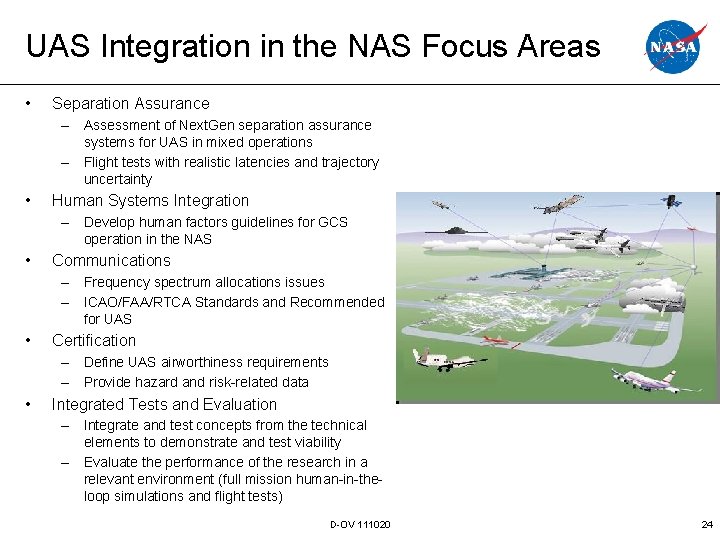
UAS Integration in the NAS Focus Areas • Separation Assurance – Assessment of Next. Gen separation assurance systems for UAS in mixed operations – Flight tests with realistic latencies and trajectory uncertainty • Human Systems Integration – Develop human factors guidelines for GCS operation in the NAS • Communications – Frequency spectrum allocations issues – ICAO/FAA/RTCA Standards and Recommended for UAS • Certification – Define UAS airworthiness requirements – Provide hazard and risk-related data • Integrated Tests and Evaluation – Integrate and test concepts from the technical elements to demonstrate and test viability – Evaluate the performance of the research in a relevant environment (full mission human-in-theloop simulations and flight tests) D-OV 111020 24
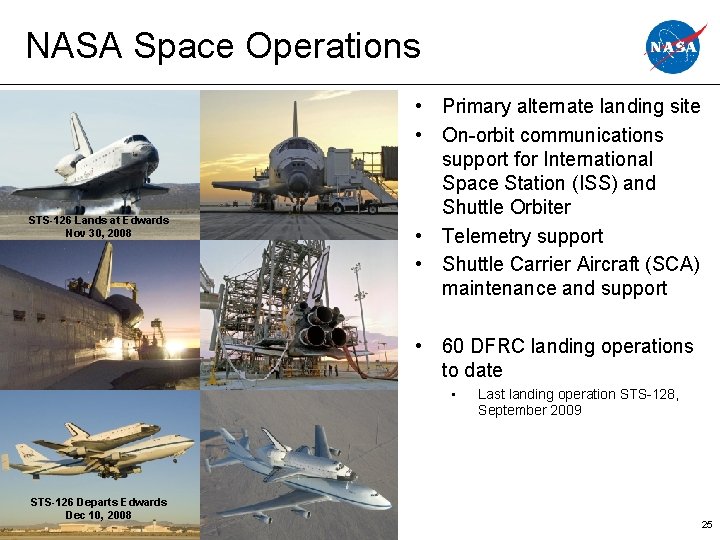
NASA Space Operations • Primary alternate landing site • On-orbit communications support for International Space Station (ISS) and Shuttle Orbiter • Telemetry support • Shuttle Carrier Aircraft (SCA) maintenance and support STS-126 Lands at Edwards Nov 30, 2008 • 60 DFRC landing operations to date • STS-126 Departs Edwards Dec 10, 2008 D-OV 111020 Last landing operation STS-128, September 2009 25
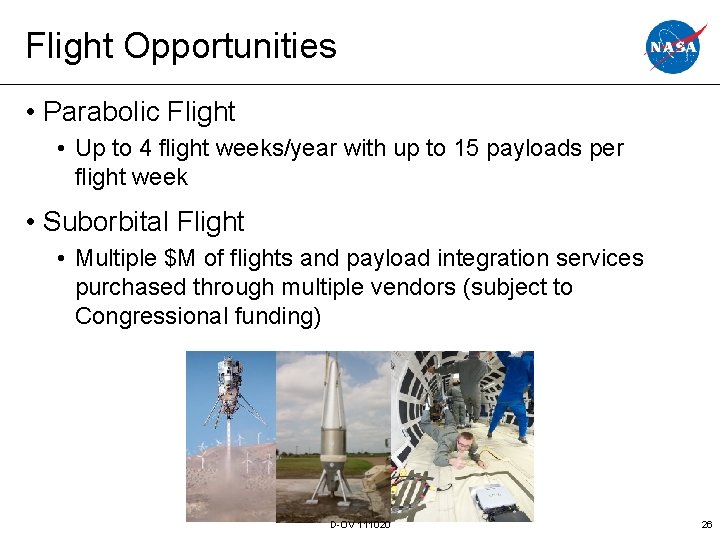
Flight Opportunities • Parabolic Flight • Up to 4 flight weeks/year with up to 15 payloads per flight week • Suborbital Flight • Multiple $M of flights and payload integration services purchased through multiple vendors (subject to Congressional funding) D-OV 111020 26
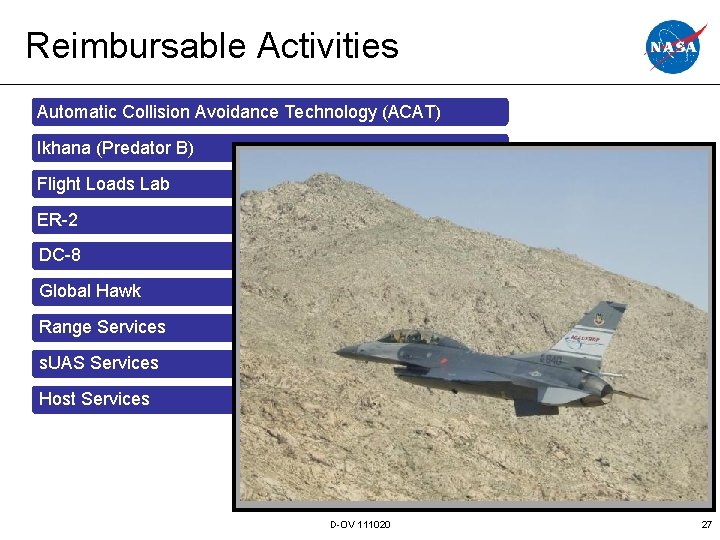
Reimbursable Activities Automatic Collision Avoidance Technology (ACAT) Ikhana (Predator B) Flight Loads Lab ER-2 DC-8 Global Hawk Range Services s. UAS Services Host Services D-OV 111020 27
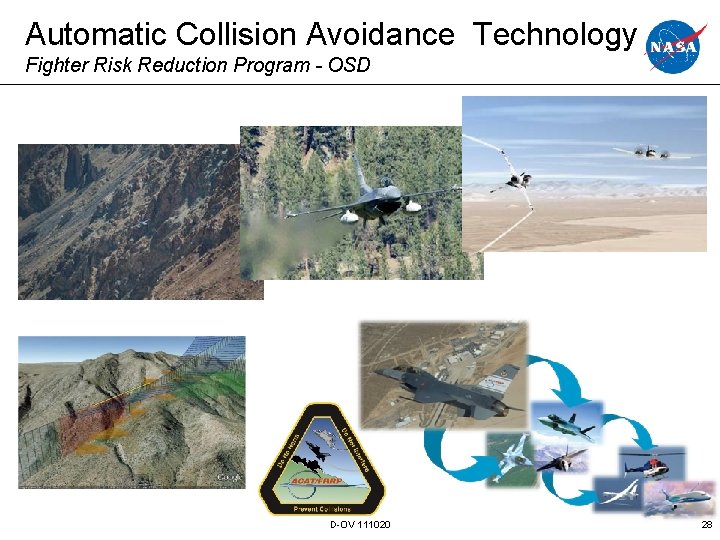
Automatic Collision Avoidance Technology Fighter Risk Reduction Program - OSD D-OV 111020 28
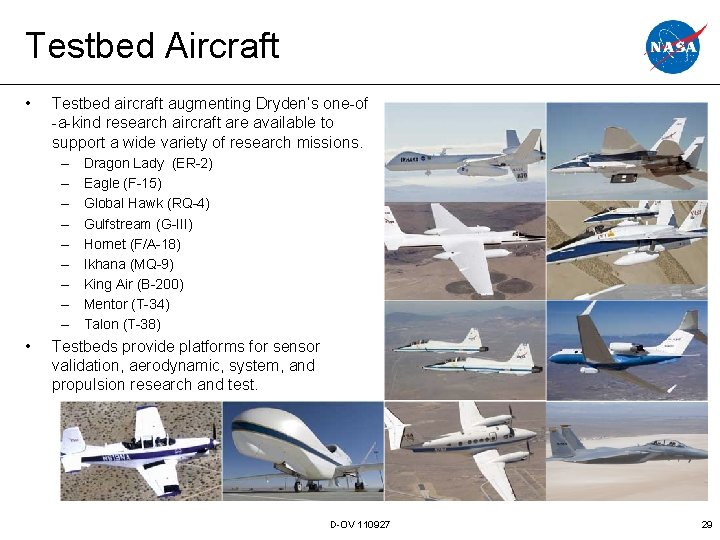
Testbed Aircraft • Testbed aircraft augmenting Dryden’s one-of -a-kind research aircraft are available to support a wide variety of research missions. – – – – – • Dragon Lady (ER-2) Eagle (F-15) Global Hawk (RQ-4) Gulfstream (G-III) Hornet (F/A-18) Ikhana (MQ-9) King Air (B-200) Mentor (T-34) Talon (T-38) Testbeds provide platforms for sensor validation, aerodynamic, system, and propulsion research and test. D-OV 110927 29
Questions? D-OV 111020 30
D-OV 111020 31