
NATIONAL ACADEMY OF SCIENCES OF UKRAINE EXPLOSIVE CLADDING
- Slides: 16
NATIONAL ACADEMY OF SCIENCES OF UKRAINE EXPLOSIVE CLADDING OF BRITTLE REFRACTORY METALS The E. O. Paton Electric Welding Institute (PWI) 3 D Metalforming 1
EXPLOSIVE CLADDING OF BRITTLE REFRACTORY METALS 1. Title Explosive Cladding of Brittle Refractory Metals S. Yu. Illarionov, L. D. Dobrushin, S. D. Ventsev, H. D. Groeneveld 2. Speaker Ing. Sergei ILLARIONOV The E. O. Paton Electric Welding Institute (PWI) of NAS of Ukraine Department on Welding, Cutting and Treatment of Metals by Explosion 11 Bozhenko Str. , Kiev, 03680, Ukraine Tel. /fax: +380 -44 -205 -25 -53 E-mail: sergei. illarionov@outlook. com 2
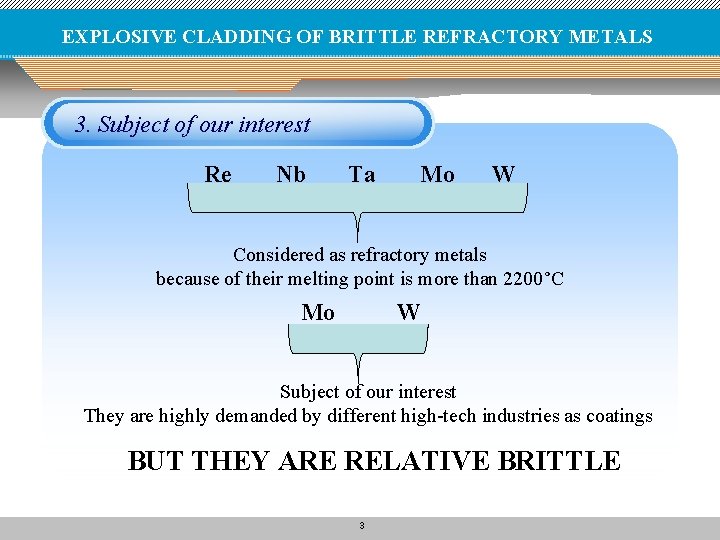
EXPLOSIVE CLADDING OF BRITTLE REFRACTORY METALS 3. Subject of our interest Re Nb Ta Mo W Considered as refractory metals because of their melting point is more than 2200°C Mo W Subject of our interest They are highly demanded by different high-tech industries as coatings BUT THEY ARE RELATIVE BRITTLE 3
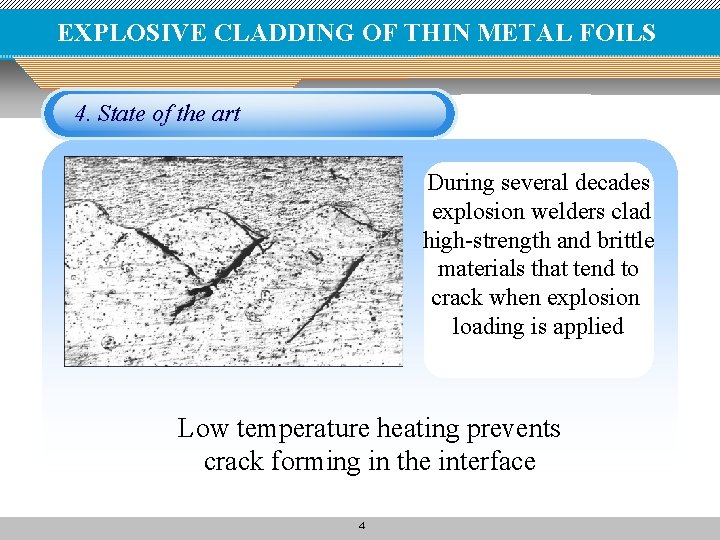
EXPLOSIVE CLADDING OF THIN METAL FOILS 4. State of the art During several decades explosion welders clad high-strength and brittle materials that tend to crack when explosion loading is applied Low temperature heating prevents crack forming in the interface 4
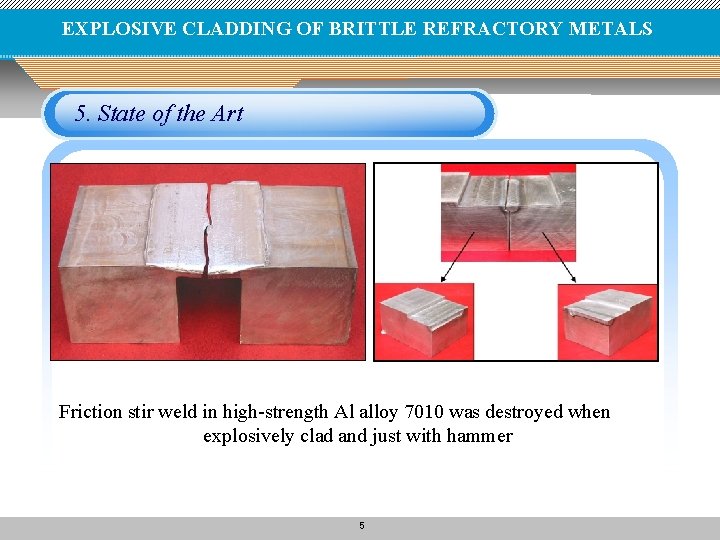
EXPLOSIVE CLADDING OF BRITTLE REFRACTORY METALS 5. State of the Art Friction stir weld in high-strength Al alloy 7010 was destroyed when explosively clad and just with hammer 5
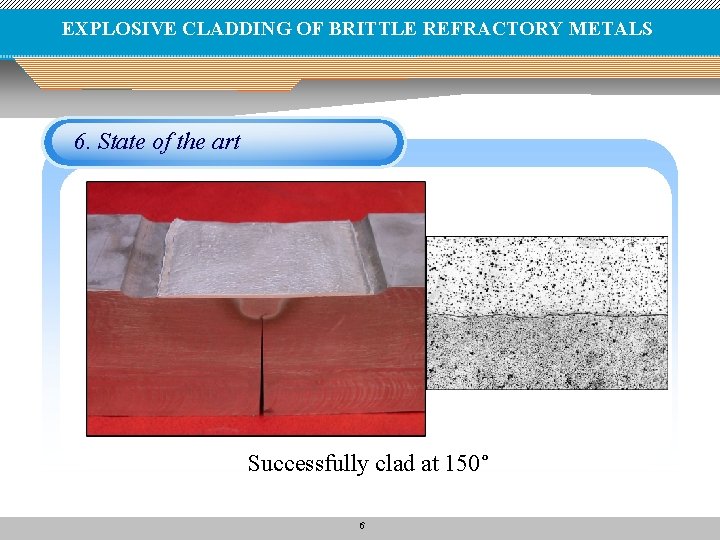
EXPLOSIVE CLADDING OF BRITTLE REFRACTORY METALS 6. State of the art Successfully clad at 150° 6
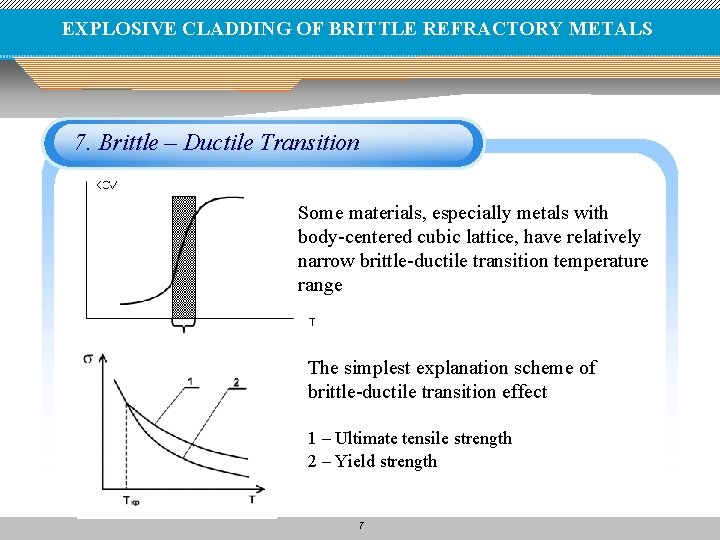
EXPLOSIVE CLADDING OF BRITTLE REFRACTORY METALS 7. Brittle – Ductile Transition Some materials, especially metals with body-centered cubic lattice, have relatively narrow brittle-ductile transition temperature range The simplest explanation scheme of brittle-ductile transition effect 1 – Ultimate tensile strength 2 – Yield strength 7
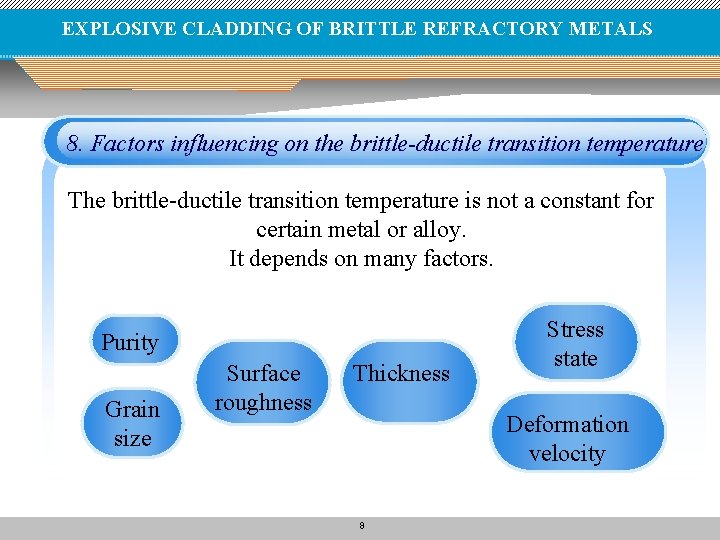
EXPLOSIVE CLADDING OF BRITTLE REFRACTORY METALS 8. Factors influencing on the brittle-ductile transition temperature The brittle-ductile transition temperature is not a constant for certain metal or alloy. It depends on many factors. Purity Grain size Surface roughness Thickness Stress state Deformation velocity 8
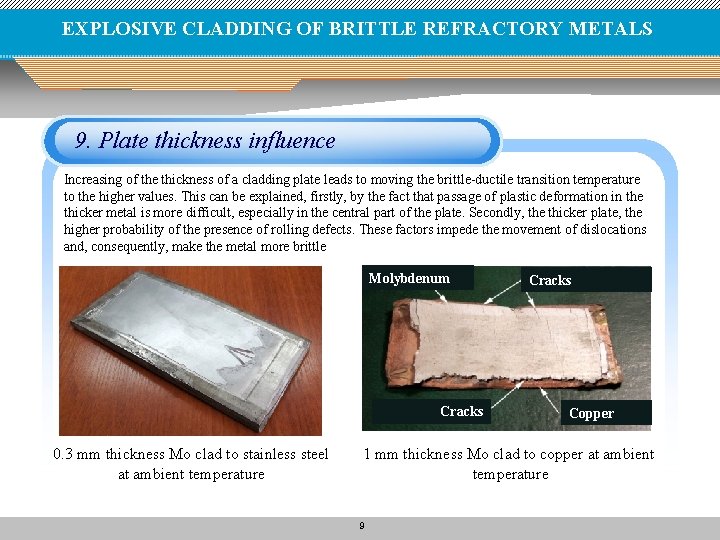
EXPLOSIVE CLADDING OF BRITTLE REFRACTORY METALS 9. Plate thickness influence Increasing of the thickness of a cladding plate leads to moving the brittle-ductile transition temperature to the higher values. This can be explained, firstly, by the fact that passage of plastic deformation in the thicker metal is more difficult, especially in the central part of the plate. Secondly, the thicker plate, the higher probability of the presence of rolling defects. These factors impede the movement of dislocations and, consequently, make the metal more brittle Molybdenum Cracks 0. 3 mm thickness Mo clad to stainless steel at ambient temperature Cracks Copper 1 mm thickness Mo clad to copper at ambient temperature 9
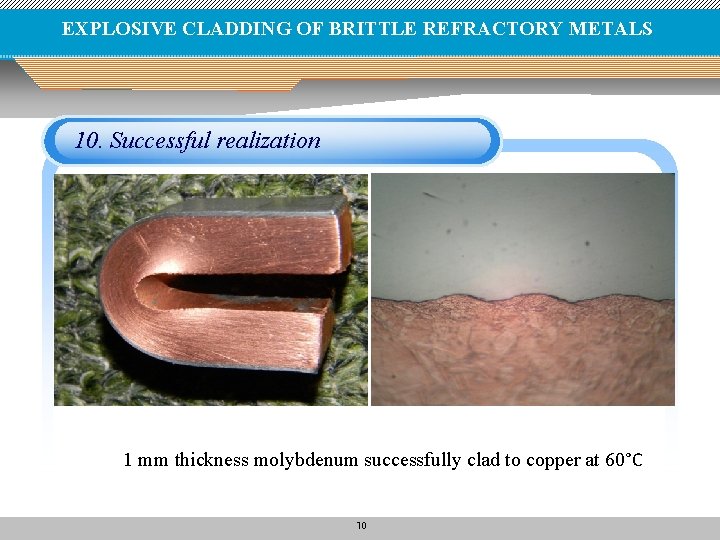
EXPLOSIVE CLADDING OF BRITTLE REFRACTORY METALS 10. Successful realization 1 mm thickness molybdenum successfully clad to copper at 60°C 10
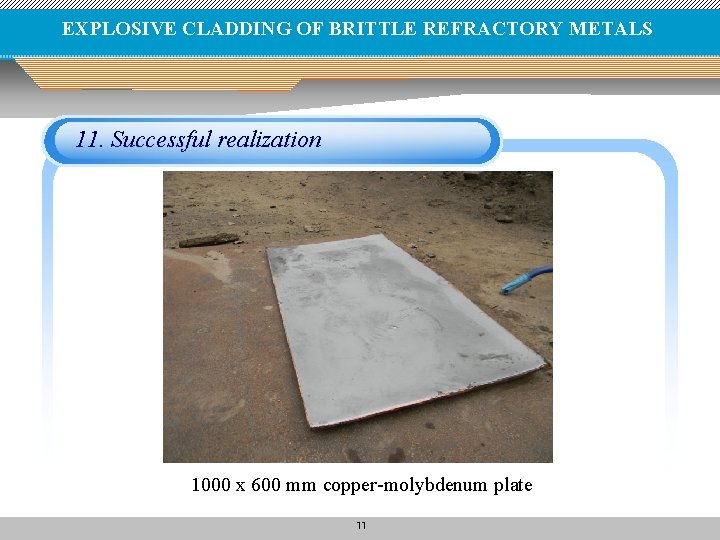
EXPLOSIVE CLADDING OF BRITTLE REFRACTORY METALS 11. Successful realization 1000 x 600 mm copper-molybdenum plate 11
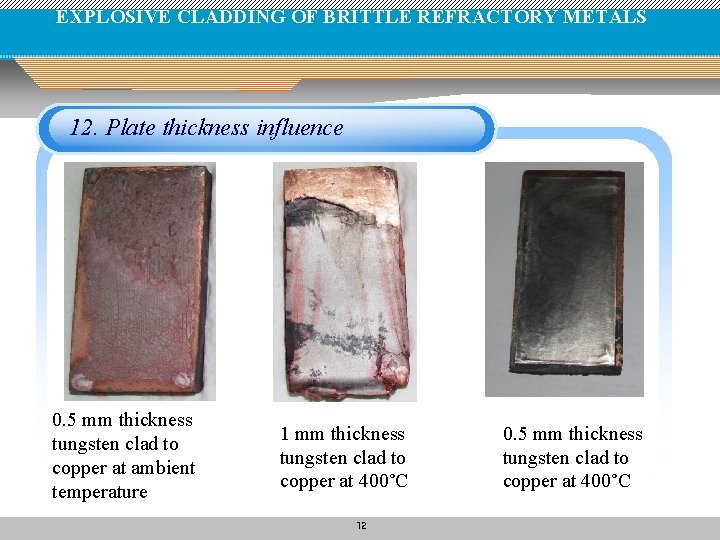
EXPLOSIVE CLADDING OF BRITTLE REFRACTORY METALS 12. Plate thickness influence 0. 5 mm thickness tungsten clad to copper at ambient temperature 1 mm thickness tungsten clad to copper at 400°C 12 0. 5 mm thickness tungsten clad to copper at 400°C
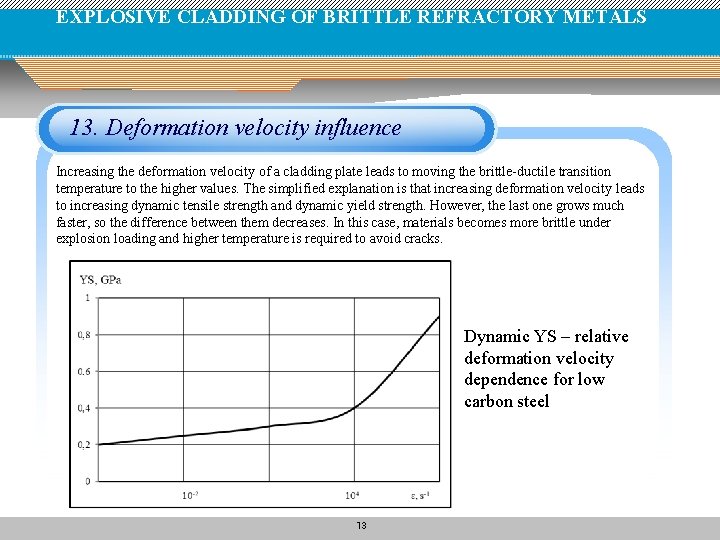
EXPLOSIVE CLADDING OF BRITTLE REFRACTORY METALS 13. Deformation velocity influence Increasing the deformation velocity of a cladding plate leads to moving the brittle-ductile transition temperature to the higher values. The simplified explanation is that increasing deformation velocity leads to increasing dynamic tensile strength and dynamic yield strength. However, the last one grows much faster, so the difference between them decreases. In this case, materials becomes more brittle under explosion loading and higher temperature is required to avoid cracks. Dynamic YS – relative deformation velocity dependence for low carbon steel 13
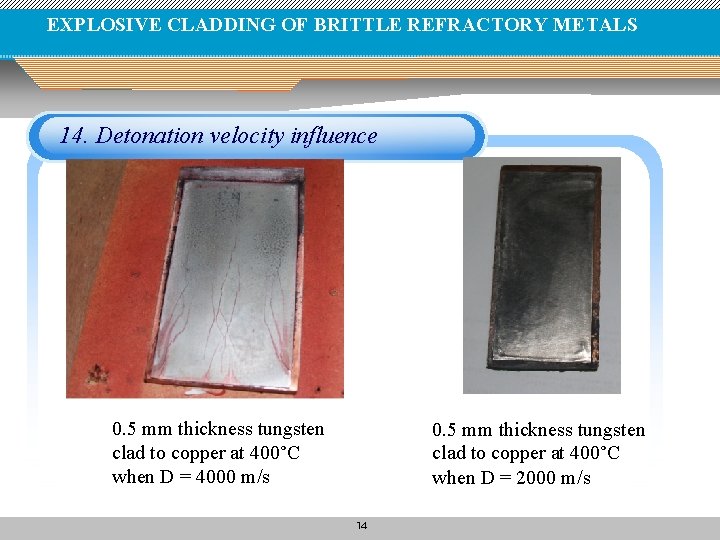
EXPLOSIVE CLADDING OF BRITTLE REFRACTORY METALS 14. Detonation velocity influence 0. 5 mm thickness tungsten clad to copper at 400°C when D = 4000 m/s 0. 5 mm thickness tungsten clad to copper at 400°C when D = 2000 m/s 14
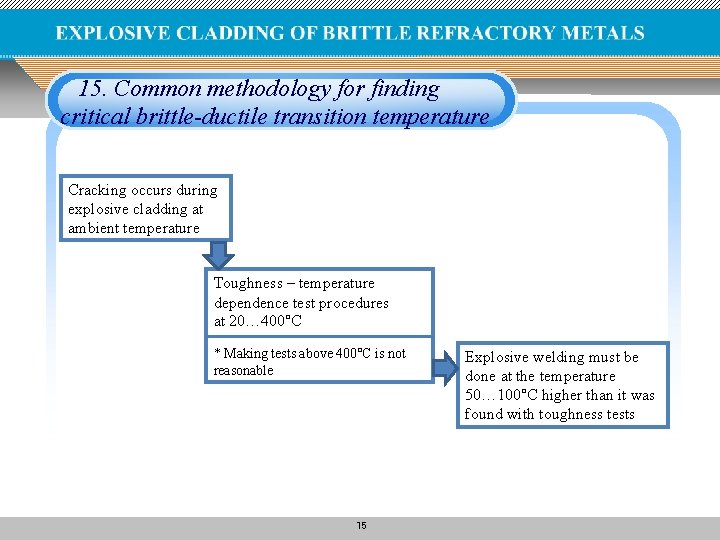
15. Common methodology for finding critical brittle-ductile transition temperature Cracking occurs during explosive cladding at ambient temperature Toughness – temperature dependence test procedures at 20… 400°C * Making tests above 400°C is not reasonable 15 Explosive welding must be done at the temperature 50… 100°C higher than it was found with toughness tests
THANKS FOR YOUR ATTENTION! 16