
National 5 Physics Assignment November 2019 Overview of

National 5 Physics Assignment November 2019

Overview of National 5 course assessment Component Question Paper 2· 5 hours Assignment Marks Scaled Marks 25 Multiple choice 25 110 Contribution to Course Award 80% Extended response 75 20 25 20%
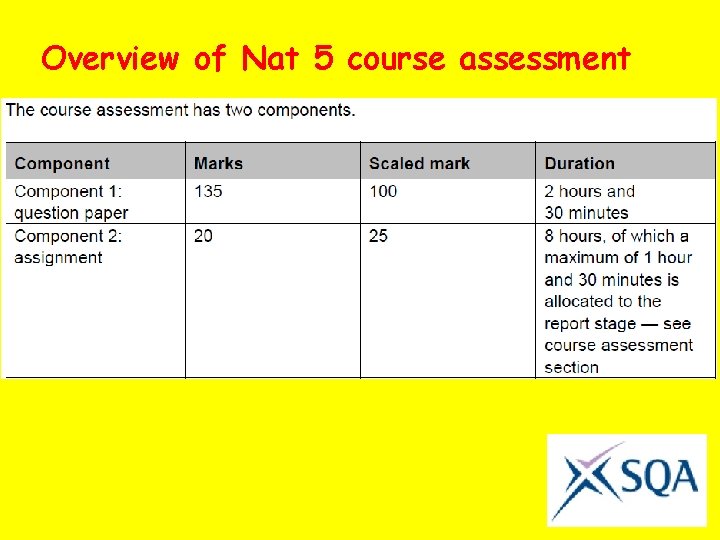
Overview of Nat 5 course assessment
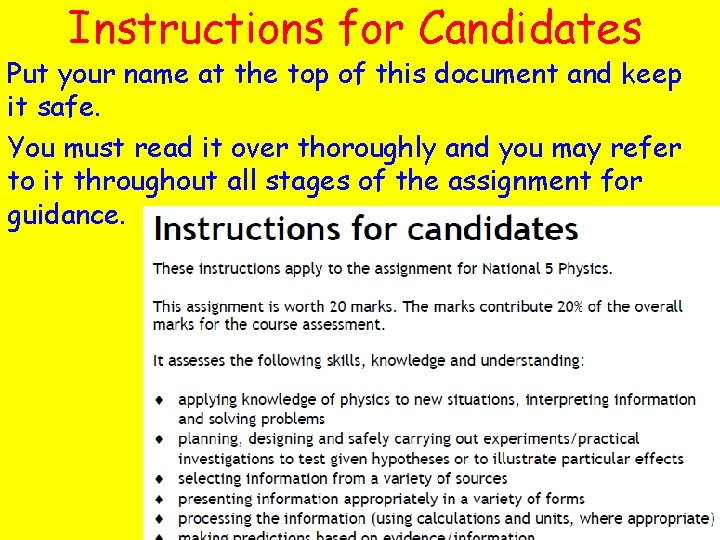
Instructions for Candidates Put your name at the top of this document and keep it safe. You must read it over thoroughly and you may refer to it throughout all stages of the assignment for guidance.
What you are expected to do: In this assignment you have to investigate a topic in physics by doing research. Your research involves gathering data from an experiment and comparative data from internet/literature sources. In addition, you may gather extracts about the underlying physics from internet/literature sources.

You then produce a report on your investigation. Your report is not marked at any point by your teacher or lecturer. It is sent to SQA for marking. Your assignment has two stages: • research • report
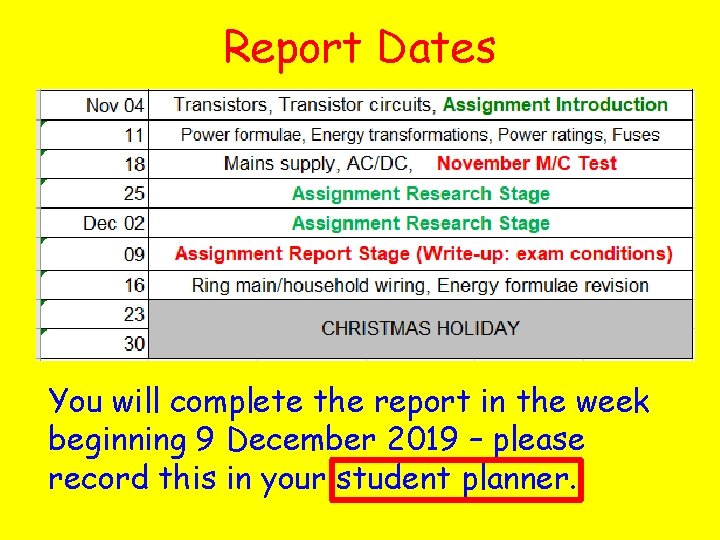
Report Dates You will complete the report in the week beginning 9 December 2019 – please record this in your student planner.
Research stage Choosing your topic You need to choose a relevant topic in physics to investigate. Your topic must be agreed with your teacher.
Deciding your aim Once you have chosen your topic you need to decide what the aim of your investigation is. Remember that you need to do an experiment and find data to compare with your experimental results. Your teacher will provide advice on the suitability of your aim in terms of safety and availability of resources. They will not assess your aim.
Experimental research When choosing your experiment, remember it must allow measurements to be taken. When carrying out your experiment, you must either work on your own or as part of a small group. If you are working as part of a small group, you must take an active part.
Make sure you take a sufficient number of measurements over a wide enough range to meet the aim of your investigation. You must repeat measurements. Your raw experimental data may be tabulated. However tables must not have additional blank or pre-populated columns for mean and derived values. You will use your raw experimental data during the report stage.
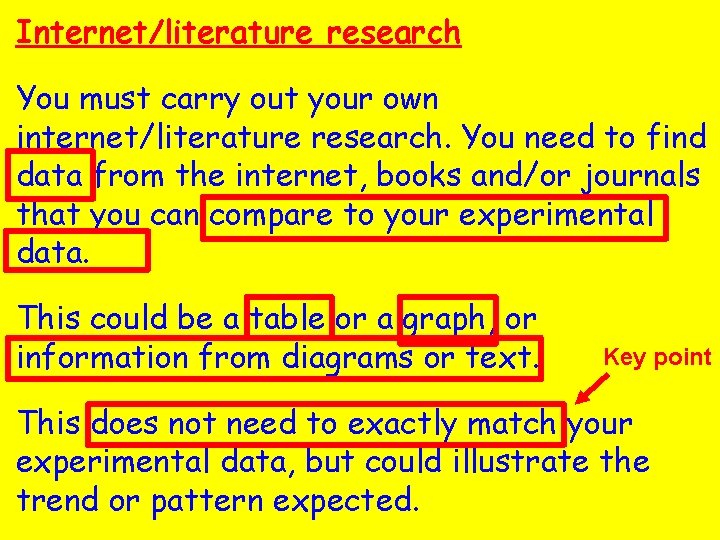
Internet/literature research You must carry out your own internet/literature research. You need to find data from the internet, books and/or journals that you can compare to your experimental data. This could be a table or a graph, or information from diagrams or text. Key point This does not need to exactly match your experimental data, but could illustrate the trend or pattern expected.
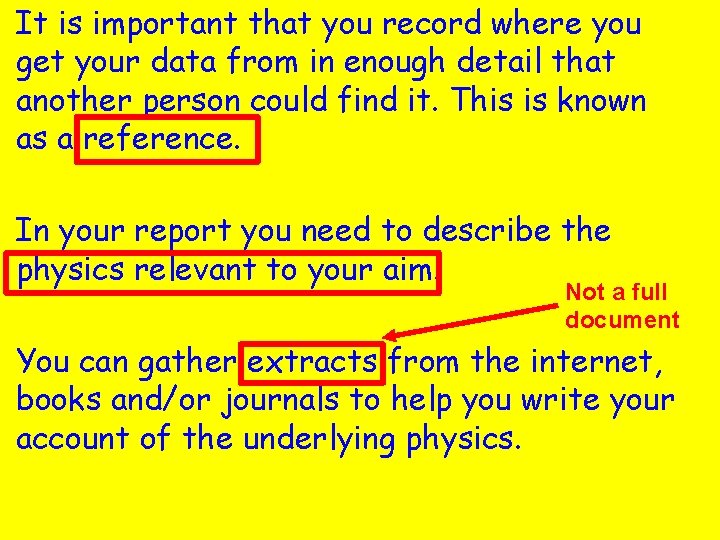
It is important that you record where you get your data from in enough detail that another person could find it. This is known as a reference. In your report you need to describe the physics relevant to your aim. Not a full document You can gather extracts from the internet, books and/or journals to help you write your account of the underlying physics.
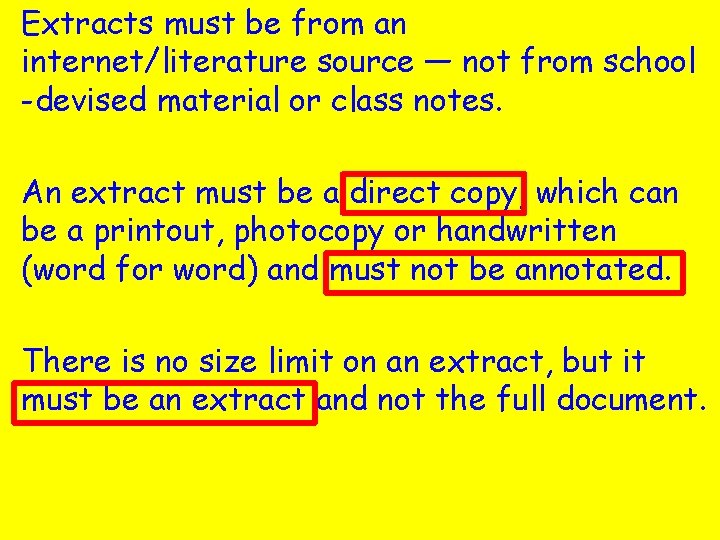
Extracts must be from an internet/literature source — not from school -devised material or class notes. An extract must be a direct copy, which can be a printout, photocopy or handwritten (word for word) and must not be annotated. There is no size limit on an extract, but it must be an extract and not the full document.
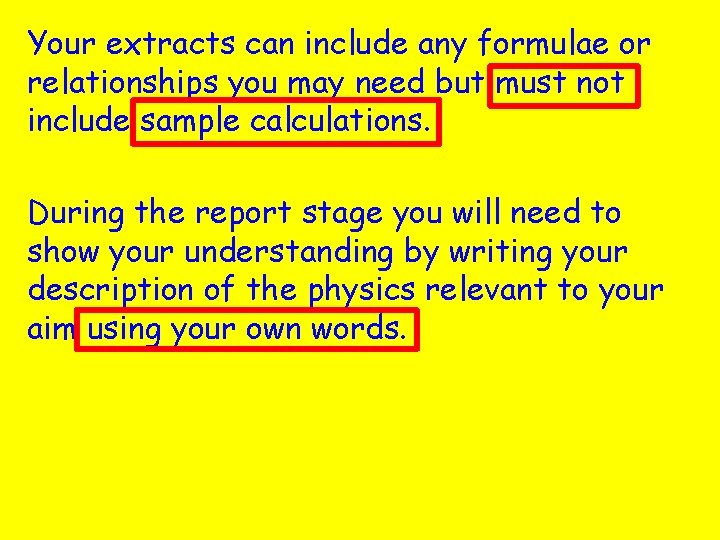
Your extracts can include any formulae or relationships you may need but must not include sample calculations. During the report stage you will need to show your understanding by writing your description of the physics relevant to your aim using your own words.
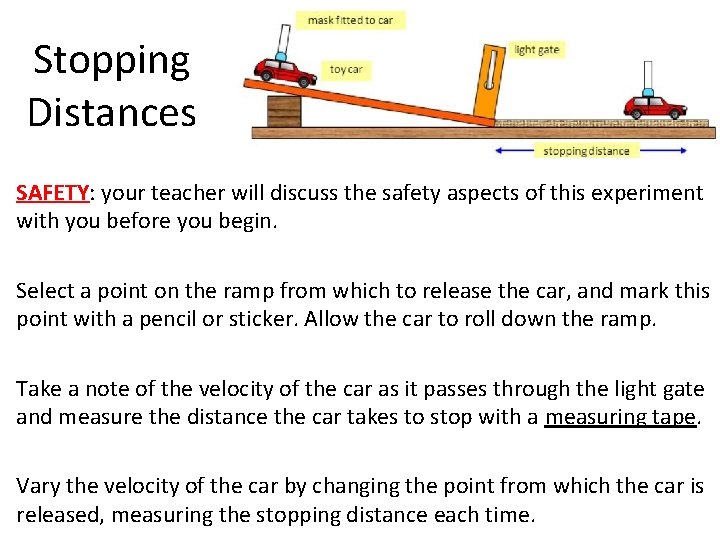
Stopping Distances SAFETY: your teacher will discuss the safety aspects of this experiment with you before you begin. Select a point on the ramp from which to release the car, and mark this point with a pencil or sticker. Allow the car to roll down the ramp. Take a note of the velocity of the car as it passes through the light gate and measure the distance the car takes to stop with a measuring tape. Vary the velocity of the car by changing the point from which the car is released, measuring the stopping distance each time.
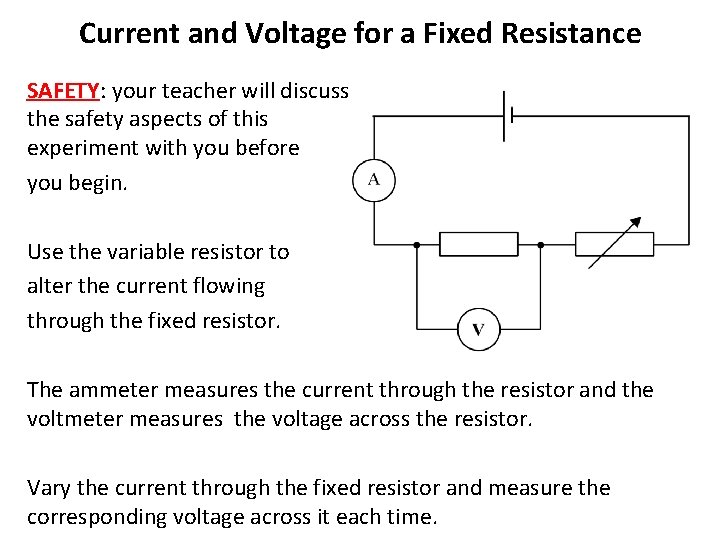
Current and Voltage for a Fixed Resistance SAFETY: your teacher will discuss the safety aspects of this experiment with you before you begin. Use the variable resistor to alter the current flowing through the fixed resistor. The ammeter measures the current through the resistor and the voltmeter measures the voltage across the resistor. Vary the current through the fixed resistor and measure the corresponding voltage across it each time.
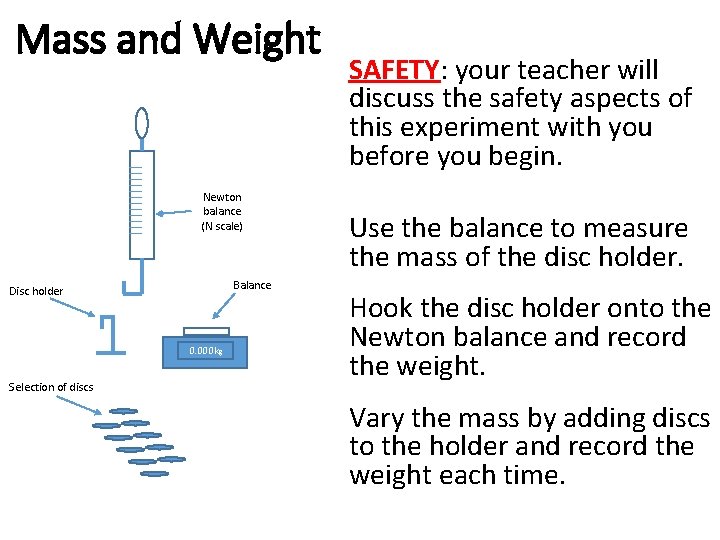
Mass and Weight Newton balance (N scale) Balance Disc holder 0. 000 kg Selection of discs SAFETY: your teacher will discuss the safety aspects of this experiment with you before you begin. Use the balance to measure the mass of the disc holder. Hook the disc holder onto the Newton balance and record the weight. Vary the mass by adding discs to the holder and record the weight each time.
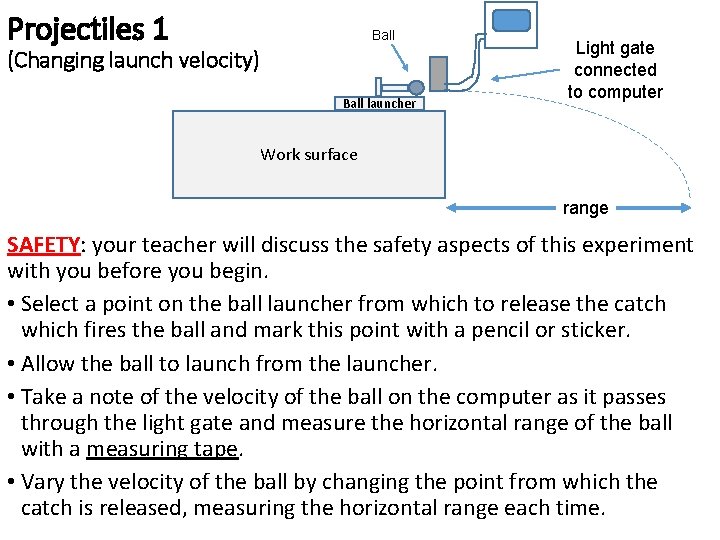
Projectiles 1 Ball (Changing launch velocity) Ball launcher Light gate connected to computer Work surface range SAFETY: your teacher will discuss the safety aspects of this experiment with you before you begin. • Select a point on the ball launcher from which to release the catch which fires the ball and mark this point with a pencil or sticker. • Allow the ball to launch from the launcher. • Take a note of the velocity of the ball on the computer as it passes through the light gate and measure the horizontal range of the ball with a measuring tape. • Vary the velocity of the ball by changing the point from which the catch is released, measuring the horizontal range each time.
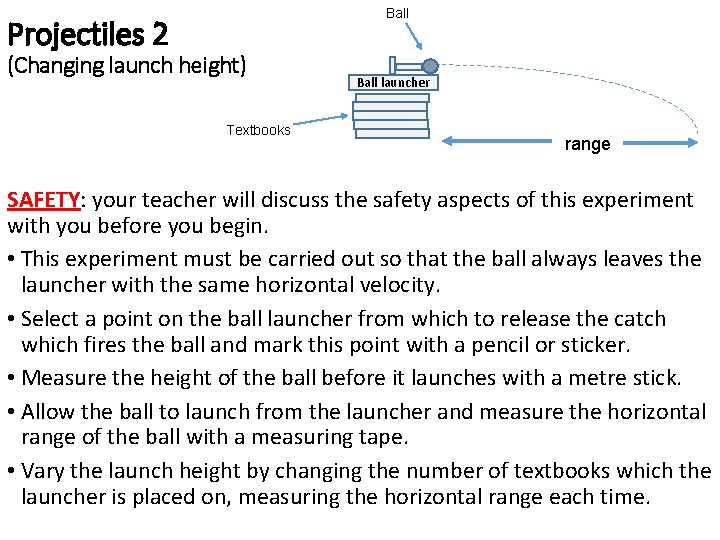
Ball Projectiles 2 (Changing launch height) Textbooks Ball launcher range SAFETY: your teacher will discuss the safety aspects of this experiment with you before you begin. • This experiment must be carried out so that the ball always leaves the launcher with the same horizontal velocity. • Select a point on the ball launcher from which to release the catch which fires the ball and mark this point with a pencil or sticker. • Measure the height of the ball before it launches with a metre stick. • Allow the ball to launch from the launcher and measure the horizontal range of the ball with a measuring tape. • Vary the launch height by changing the number of textbooks which the launcher is placed on, measuring the horizontal range each time.
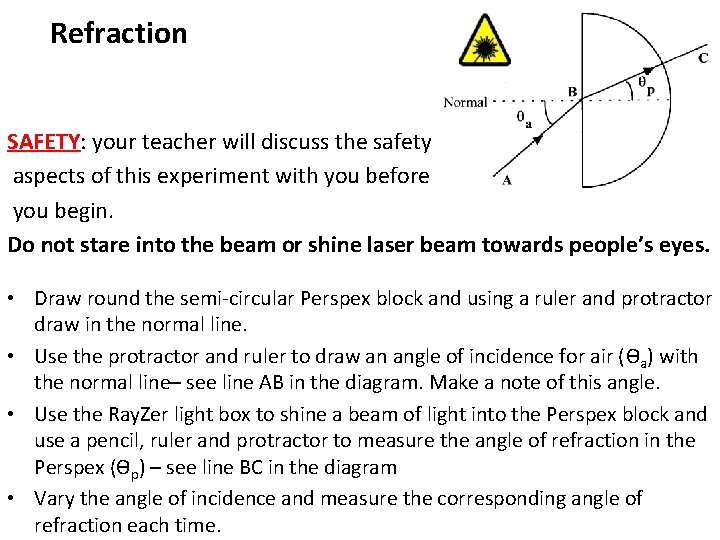
Refraction SAFETY: your teacher will discuss the safety aspects of this experiment with you before you begin. Do not stare into the beam or shine laser beam towards people’s eyes. • Draw round the semi-circular Perspex block and using a ruler and protractor draw in the normal line. • Use the protractor and ruler to draw an angle of incidence for air (ϴa) with the normal line– see line AB in the diagram. Make a note of this angle. • Use the Ray. Zer light box to shine a beam of light into the Perspex block and use a pencil, ruler and protractor to measure the angle of refraction in the Perspex (ϴp) – see line BC in the diagram • Vary the angle of incidence and measure the corresponding angle of refraction each time.
Report Stage The report must be all your own work. When producing your report, you are supervised by your teacher at all times. You have 1 hour and 30 minutes to complete your report (split over several periods). Your teacher or lecturer cannot provide you with feedback or tell you how to improve your report.
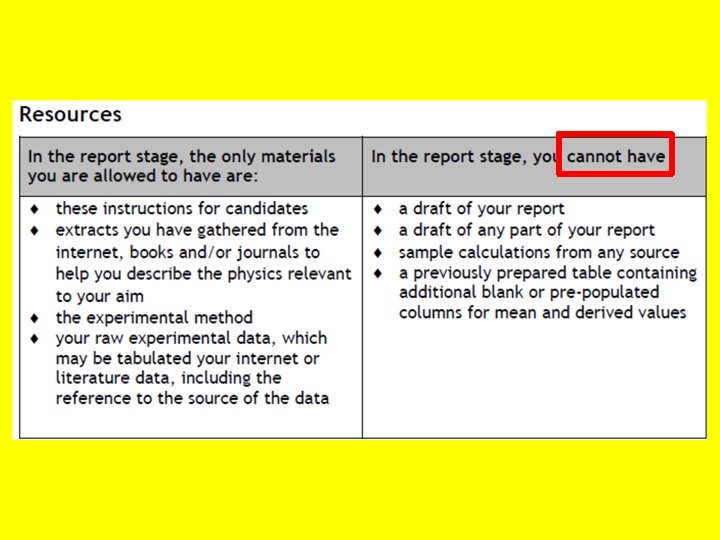
Candidate notes or annotations of any description are not permitted. You must not have access to a previously prepared draft of a report or any part of a report. In addition, you must not have access to the internet or the assignment marking instructions during the report stage.
Mobile telephones are not allowed and must be left in bags placed at the front of the classroom. Your teacher will check that the materials you present to be used in the report stage fit the criteria above.
Examination conditions You will: – be given a maximum of 1. 5 hours to complete your report under strict exam conditions; – not be given feedback or advice for improvement during the reporting stage; – not be given an opportunity to redraft a report following the completion of the report stage. There will be no access to e-mail, the internet or mobile ‘phones.
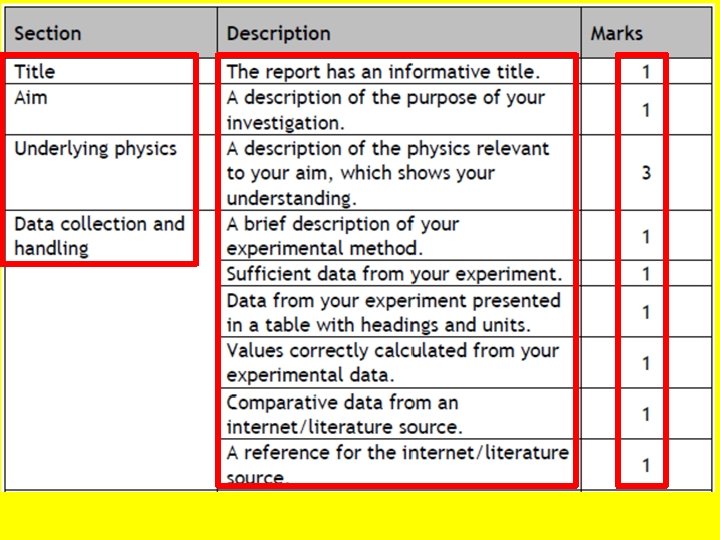
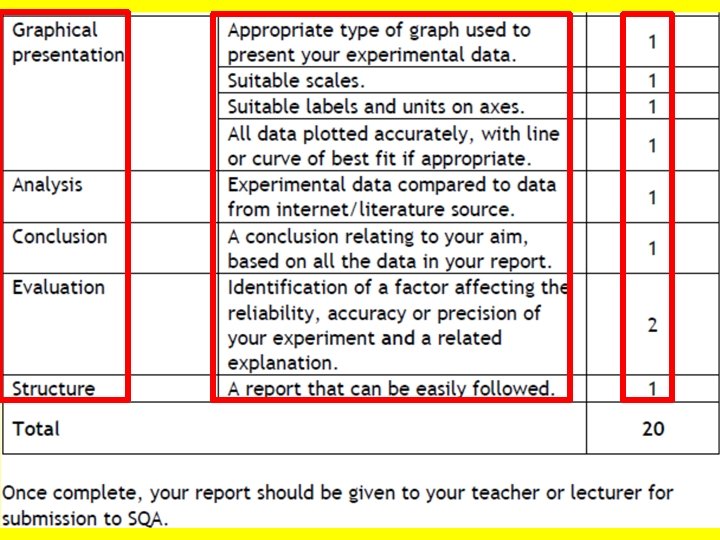
Guidance on producing the report See pages 24, 25 and 26 of Instructions for candidates document. Make sure that you thoroughly read this document several times at home to ensure you understand what required for the assignment.
- Slides: 29