
National 5 Folio National 5 Folio n Your
- Slides: 14
+ National 5 Folio
+ National 5 Folio n Your Folio consists of two essays. n Each essay is marked out of 15. n If your essay has too many technical errors it will fail and receive a maximum of 6. n One essay is Personal/Creative and the other is (broadly) Discursive. n Each essay has a limit of 1000 words.
+ Personal/Creative n Some pupils know from previous experience which is their strongest type of essay and decide based on this. n Some pupils attempt both. It is a good idea to try this if you have the time as a broad range of writing can sometimes allow you to produce your best work. n A good personal essay is creative – you should include imagery (similes, metaphors…) to describe real places and people. n A good story should feel personal because we feel the characters and situations are believable.
+ Personal n A personal essay at National 5 level must contain reflection. You are trying to express your experience of the world as a young adult. n Difficult experiences often produce strong emotions, but strong emotions badly expressed will not produce a good essay. n Your essay should focus on one event, idea or concept. n You do not have to write about a personal incident. You could write an insightful essay about how you feel about ‘embarrassment’, ‘regret’ or ‘guilt’. Stronger candidates may want to consider trying this.
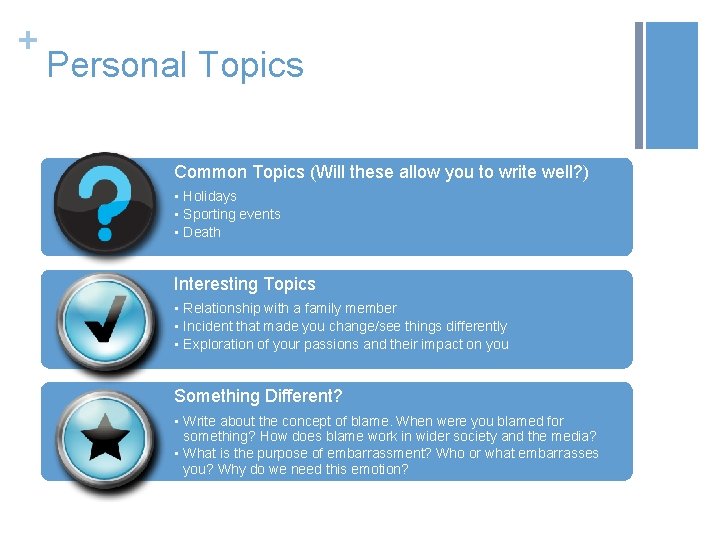
+ Personal Topics Common Topics (Will these allow you to write well? ) • Holidays • Sporting events • Death Interesting Topics • Relationship with a family member • Incident that made you change/see things differently • Exploration of your passions and their impact on you Something Different? • Write about the concept of blame. When were you blamed for something? How does blame work in wider society and the media? • What is the purpose of embarrassment? Who or what embarrasses you? Why do we need this emotion?
+ Creative n Creative work has to show a control of language to reveal characterisation, setting and plot development. This is not easy. n Pupils who read and who have previously written stories are more likely to succeed in this essay. n Avoid using plots that lean heavily on things you have seen in tv shows or films. n Be prepared to work on various drafts independently if working on a creative essay. n The most effective stories are moving because the reader can relate to them or believe in them. If your story contains too many characters and fabulous settings it will not sound authentic.
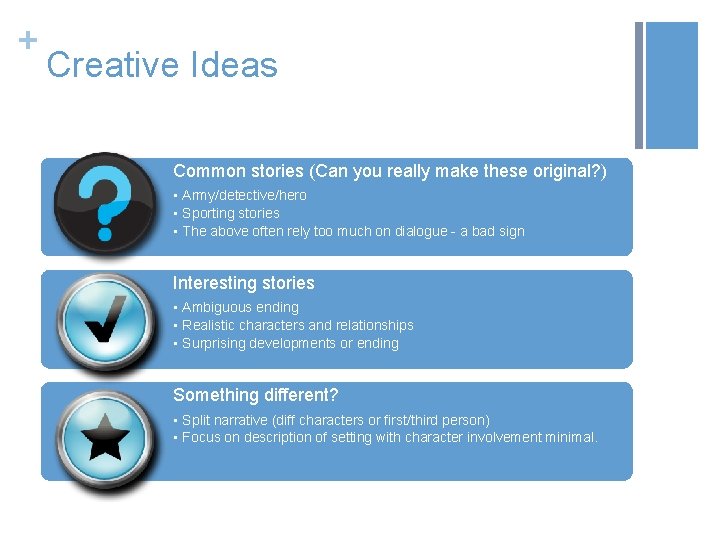
+ Creative Ideas Common stories (Can you really make these original? ) • Army/detective/hero • Sporting stories • The above often rely too much on dialogue - a bad sign Interesting stories • Ambiguous ending • Realistic characters and relationships • Surprising developments or ending Something different? • Split narrative (diff characters or first/third person) • Focus on description of setting with character involvement minimal.
+ Personal/Creative - Tips n Do create an interesting opening that does not reveal too much. n Use a variety of appropriate similes and metaphors. Experiment with these before completing a final draft. n Vary your sentences. Effective manipulation of punctuation is the sign of a strong candidate. n Think carefully about structure. Use flash backs or start your story at an unusual point for impact. n Ensure that your resolution is interesting and that your piece ends that way for a reason. n You can make your ending link to your opening for a circular feel. n Work on more than one idea. Fluency and a broad range of work leads to good writing, not a 10 th redraft of an average essay. n Share your work with your peers and discuss strengths/areas for improvement.
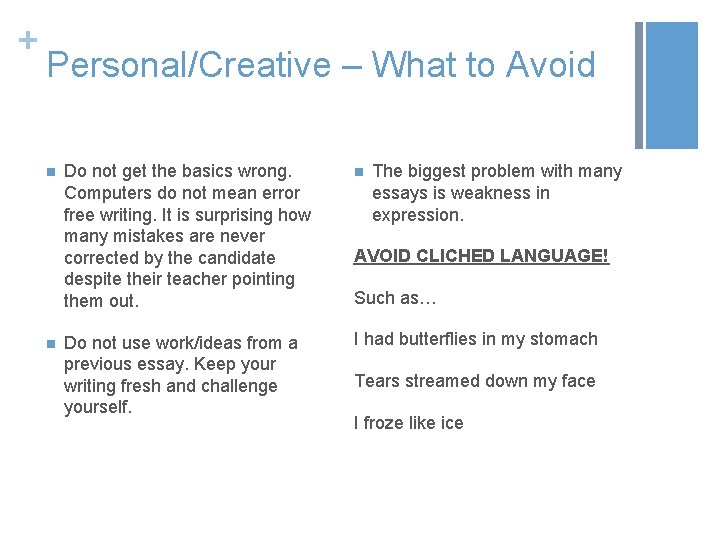
+ Personal/Creative – What to Avoid n n The biggest problem with many essays is weakness in expression. Do not get the basics wrong. Computers do not mean error free writing. It is surprising how many mistakes are never corrected by the candidate despite their teacher pointing them out. n Do not use work/ideas from a previous essay. Keep your writing fresh and challenge yourself. I had butterflies in my stomach AVOID CLICHED LANGUAGE! Such as… Tears streamed down my face I froze like ice
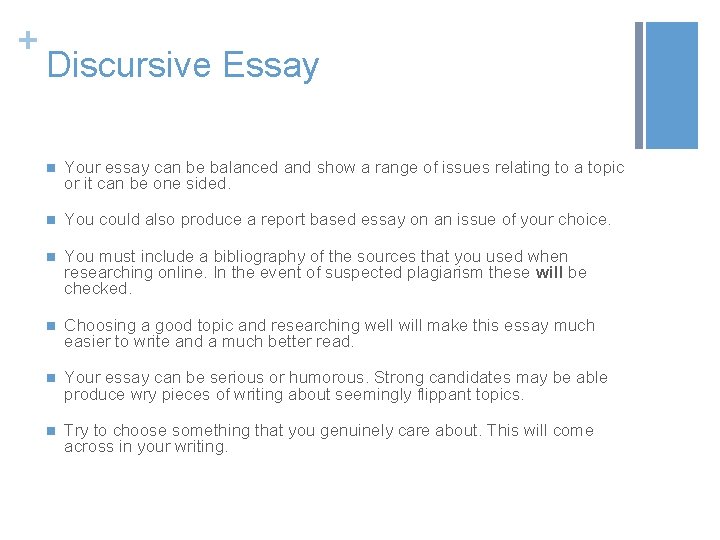
+ Discursive Essay n Your essay can be balanced and show a range of issues relating to a topic or it can be one sided. n You could also produce a report based essay on an issue of your choice. n You must include a bibliography of the sources that you used when researching online. In the event of suspected plagiarism these will be checked. n Choosing a good topic and researching well will make this essay much easier to write and a much better read. n Your essay can be serious or humorous. Strong candidates may be able produce wry pieces of writing about seemingly flippant topics. n Try to choose something that you genuinely care about. This will come across in your writing.
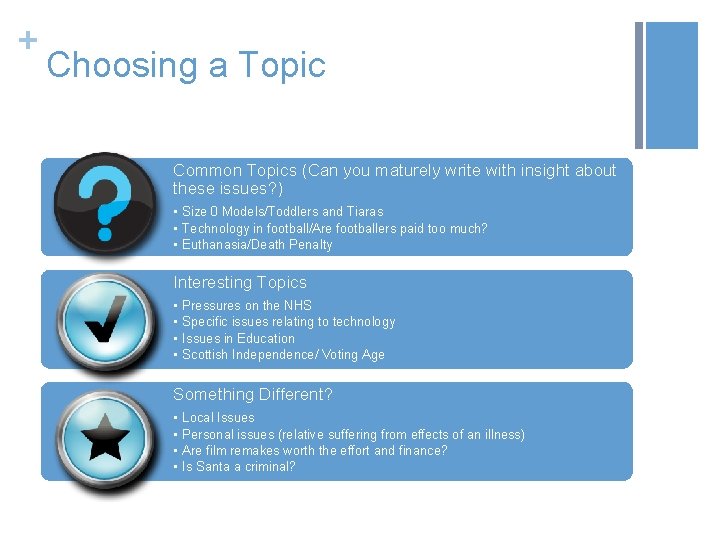
+ Choosing a Topic Common Topics (Can you maturely write with insight about these issues? ) • Size 0 Models/Toddlers and Tiaras • Technology in football/Are footballers paid too much? • Euthanasia/Death Penalty Interesting Topics • • Pressures on the NHS Specific issues relating to technology Issues in Education Scottish Independence/ Voting Age Something Different? • • Local Issues Personal issues (relative suffering from effects of an illness) Are film remakes worth the effort and finance? Is Santa a criminal?
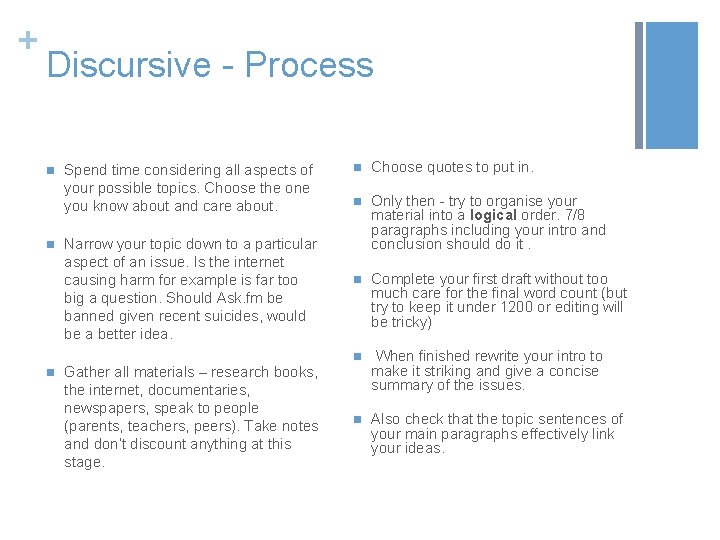
+ Discursive - Process n n n Spend time considering all aspects of your possible topics. Choose the one you know about and care about. Narrow your topic down to a particular aspect of an issue. Is the internet causing harm for example is far too big a question. Should Ask. fm be banned given recent suicides, would be a better idea. Gather all materials – research books, the internet, documentaries, newspapers, speak to people (parents, teachers, peers). Take notes and don’t discount anything at this stage. n Choose quotes to put in. n Only then - try to organise your material into a logical order. 7/8 paragraphs including your intro and conclusion should do it. n Complete your first draft without too much care for the final word count (but try to keep it under 1200 or editing will be tricky) n When finished rewrite your intro to make it striking and give a concise summary of the issues. n Also check that the topic sentences of your main paragraphs effectively link your ideas.
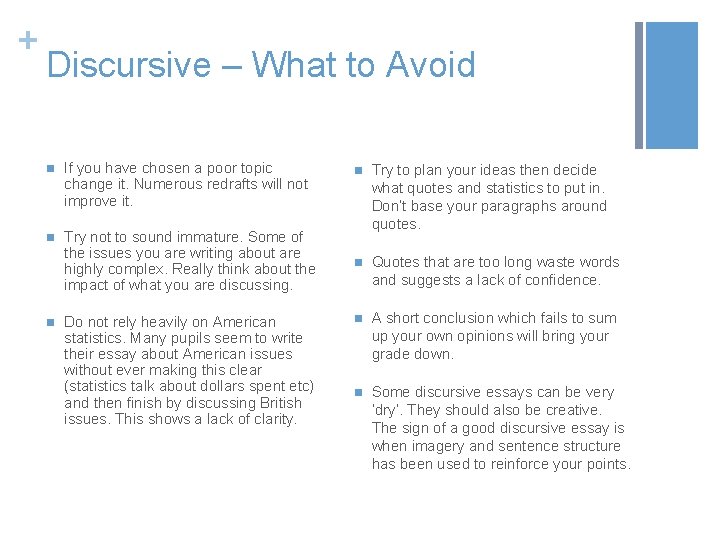
+ Discursive – What to Avoid n If you have chosen a poor topic change it. Numerous redrafts will not improve it. n Try not to sound immature. Some of the issues you are writing about are highly complex. Really think about the impact of what you are discussing. n Do not rely heavily on American statistics. Many pupils seem to write their essay about American issues without ever making this clear (statistics talk about dollars spent etc) and then finish by discussing British issues. This shows a lack of clarity. n Try to plan your ideas then decide what quotes and statistics to put in. Don’t base your paragraphs around quotes. n Quotes that are too long waste words and suggests a lack of confidence. n A short conclusion which fails to sum up your own opinions will bring your grade down. n Some discursive essays can be very ‘dry’. They should also be creative. The sign of a good discursive essay is when imagery and sentence structure has been used to reinforce your points.
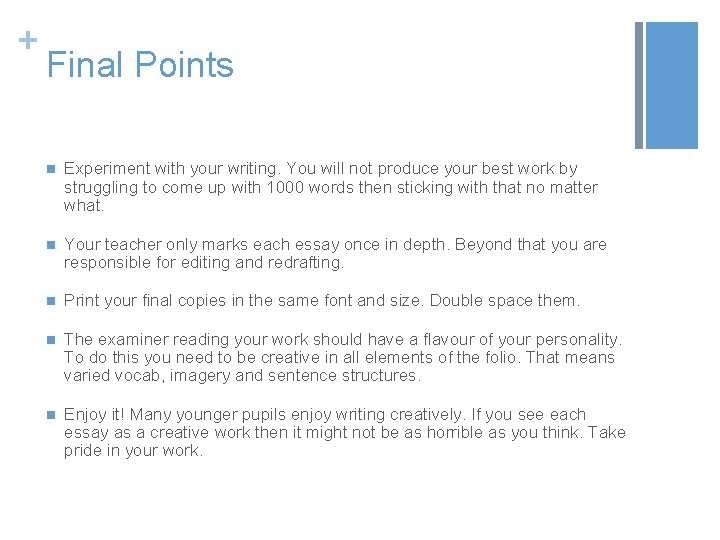
+ Final Points n Experiment with your writing. You will not produce your best work by struggling to come up with 1000 words then sticking with that no matter what. n Your teacher only marks each essay once in depth. Beyond that you are responsible for editing and redrafting. n Print your final copies in the same font and size. Double space them. n The examiner reading your work should have a flavour of your personality. To do this you need to be creative in all elements of the folio. That means varied vocab, imagery and sentence structures. n Enjoy it! Many younger pupils enjoy writing creatively. If you see each essay as a creative work then it might not be as horrible as you think. Take pride in your work.