
National 5 Biology Unit 1 Cell Biology KA
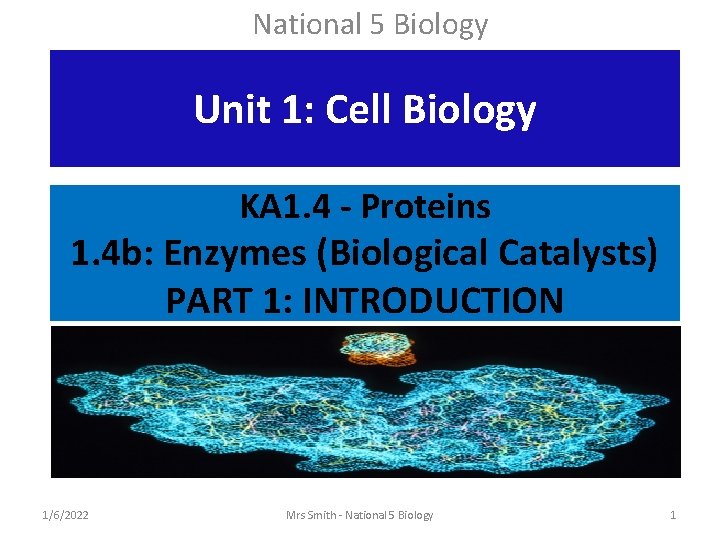
National 5 Biology Unit 1: Cell Biology KA 1. 4 - Proteins 1. 4 b: Enzymes (Biological Catalysts) PART 1: INTRODUCTION 1/6/2022 Mrs Smith - National 5 Biology 1
Learning Intentions In today’s lesson you will be learning about enzymes. By the end of this lesson you should aim know: • Enzymes are proteins and are made by all living cells. • What is meant by the phrase ‘enzymes are biological catalysts? e. g. Enzymes speed up cellular reactions 1/6/2022 Mrs Smith - National 5 Biology 2
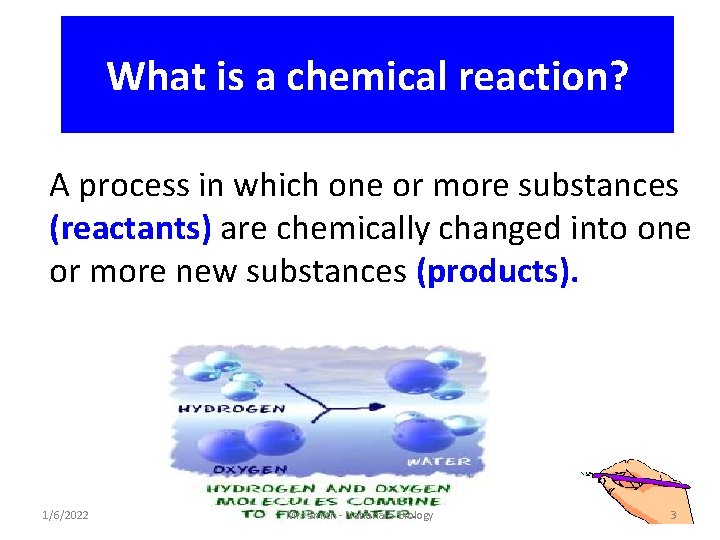
What is a chemical reaction? A process in which one or more substances (reactants) are chemically changed into one or more new substances (products). 1/6/2022 Mrs Smith - National 5 Biology 3
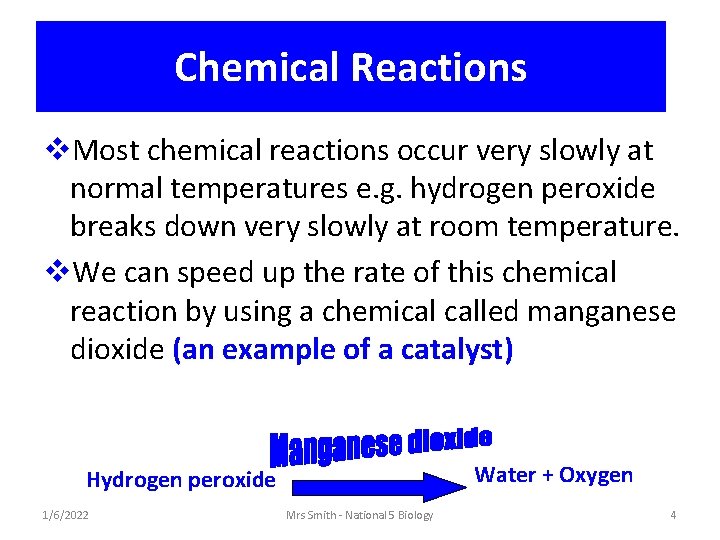
Chemical Reactions v. Most chemical reactions occur very slowly at normal temperatures e. g. hydrogen peroxide breaks down very slowly at room temperature. v. We can speed up the rate of this chemical reaction by using a chemical called manganese dioxide (an example of a catalyst) Water + Oxygen Hydrogen peroxide 1/6/2022 Mrs Smith - National 5 Biology 4

Watch this 1/6/2022 Mrs Smith - National 5 Biology 5

Experiment: Effect of catalyst on the breakdown of hydrogen peroxide • TUBE A - The bubbles forming in the froth are found to relight a glowing splint. This shows that oxygen is being released during the breakdown of hydrogen peroxide. • TUBE B (CONTROL) – The breakdown is so slow that no oxygen can be detected. • CONCLUSION: Manganese dioxide has increased the rate of the chemical reaction. Without the catalyst the chemical reaction would proceed very slowly. – NOTE – The manganese dioxide remains unchanged by the experiment. 1/6/2022 Mrs Smith - National 5 Biology 6
Biological Catalysts • Since living things cannot tolerate the high temperatures needed to make chemical reactions proceed at a rapid rate, they use catalysts. • Biological catalysts are called ENZYMES which are made of PROTEIN. • Enzymes are made by all living things. 1/6/2022 Mrs Smith - National 5 Biology 7
The Importance of Biological Catalysts (ENZYMES) v v 1/6/2022 Enzymes speed up the rate of ALL biochemical reactions yet remain unchanged in the process. Enzymes lower the energy that is needed for a reaction to take place. They also allow biochemical reactions to proceed rapidly at the relatively low temperatures (5 -40 o. C) needed by living cells to function properly. Without enzymes important biological processes like respiration and photosynthesis would proceed too slowly to maintain life. Mrs Smith - National 5 Biology 8
How many chemical reactions happen in our body? Since we have about 200 trillion cells and each one performs millions of chemical reactions, the total number of chemical reactions in the human body is about 400 billion per second every second of your life. That's 4 times the amount of stars in our galaxy which is a mere 100 billion 1/6/2022 Mrs Smith - National 5 Biology 9
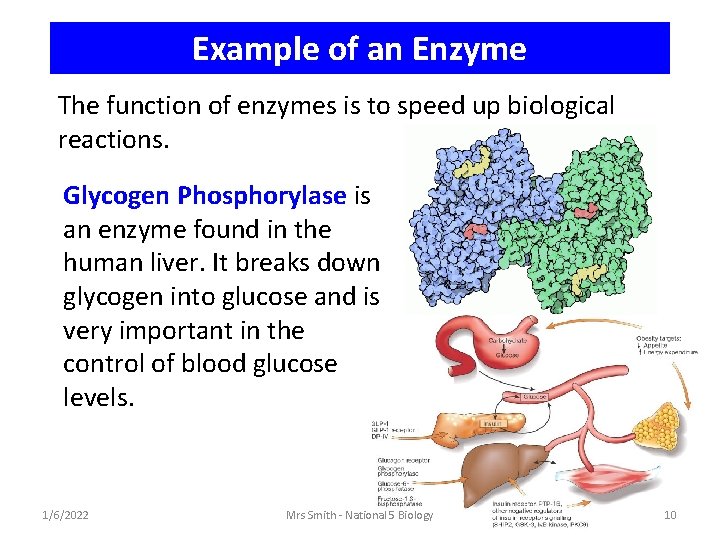
Example of an Enzyme The function of enzymes is to speed up biological reactions. Glycogen Phosphorylase is an enzyme found in the human liver. It breaks down glycogen into glucose and is very important in the control of blood glucose levels. 1/6/2022 Mrs Smith - National 5 Biology 10
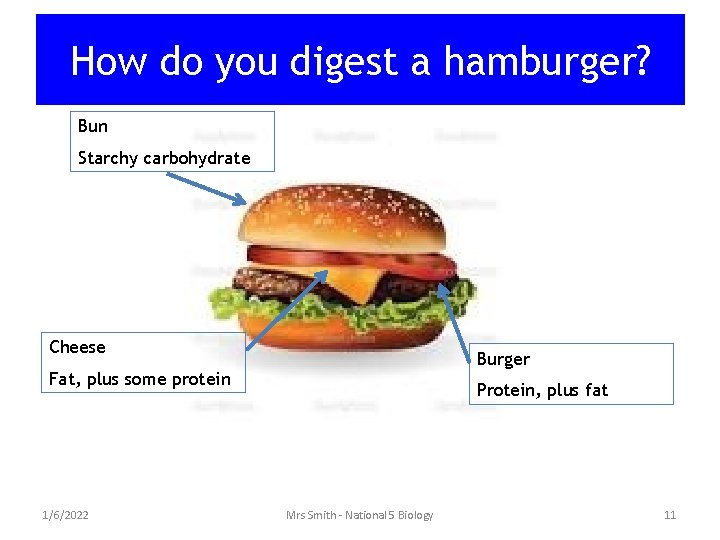
How do you digest a hamburger? Bun Starchy carbohydrate Cheese Burger Fat, plus some protein 1/6/2022 Protein, plus fat Mrs Smith - National 5 Biology 11
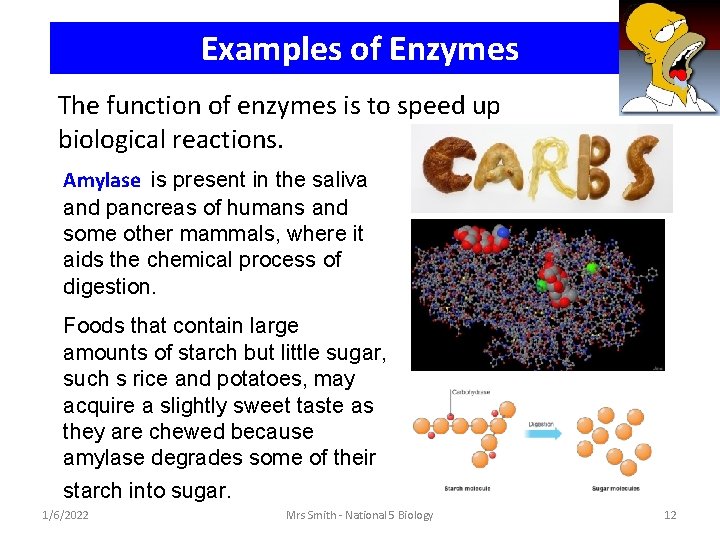
Examples of Enzymes The function of enzymes is to speed up biological reactions. Amylase is present in the saliva and pancreas of humans and some other mammals, where it aids the chemical process of digestion. Foods that contain large amounts of starch but little sugar, such s rice and potatoes, may acquire a slightly sweet taste as they are chewed because amylase degrades some of their starch into sugar. 1/6/2022 Mrs Smith - National 5 Biology 12
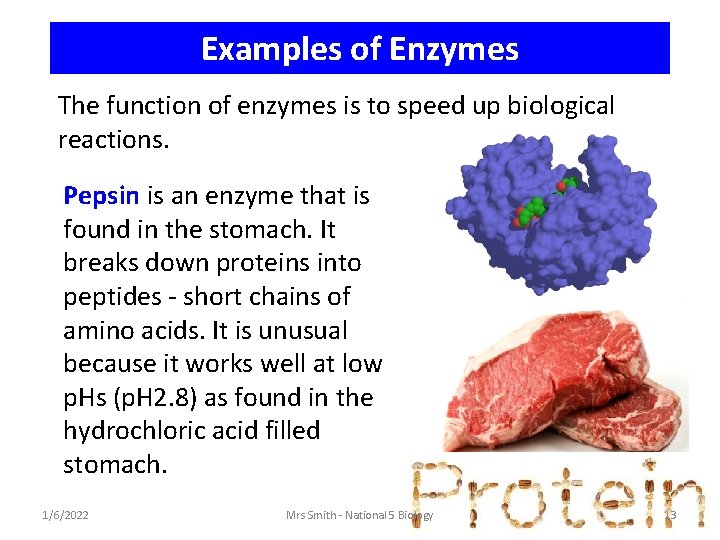
Examples of Enzymes The function of enzymes is to speed up biological reactions. Pepsin is an enzyme that is found in the stomach. It breaks down proteins into peptides - short chains of amino acids. It is unusual because it works well at low p. Hs (p. H 2. 8) as found in the hydrochloric acid filled stomach. 1/6/2022 Mrs Smith - National 5 Biology 13
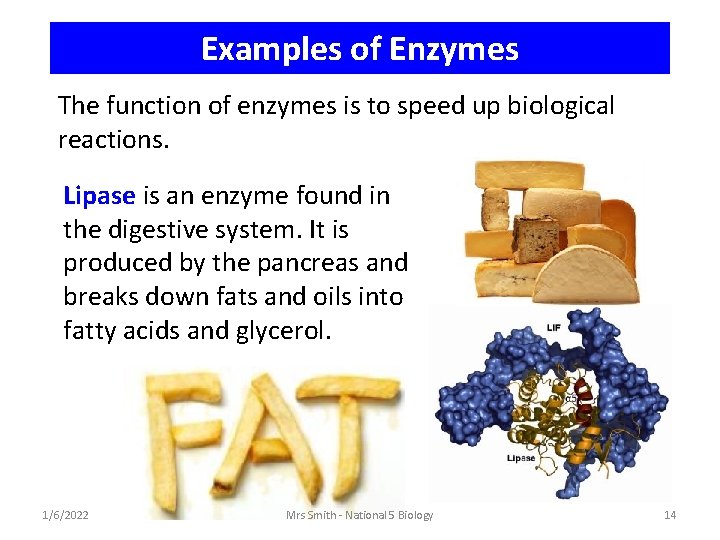
Examples of Enzymes The function of enzymes is to speed up biological reactions. Lipase is an enzyme found in the digestive system. It is produced by the pancreas and breaks down fats and oils into fatty acids and glycerol. 1/6/2022 Mrs Smith - National 5 Biology 14
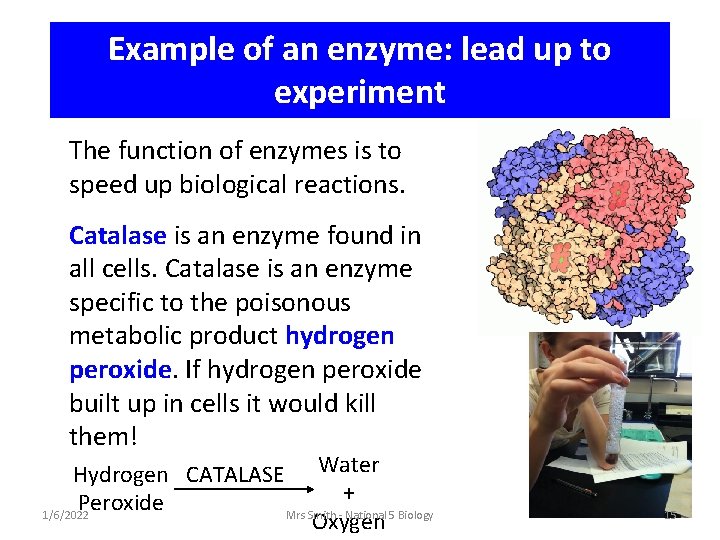
Example of an enzyme: lead up to experiment The function of enzymes is to speed up biological reactions. Catalase is an enzyme found in all cells. Catalase is an enzyme specific to the poisonous metabolic product hydrogen peroxide. If hydrogen peroxide built up in cells it would kill them! Hydrogen CATALASE Water + Peroxide 1/6/2022 Mrs Smith - National 5 Biology Oxygen 15
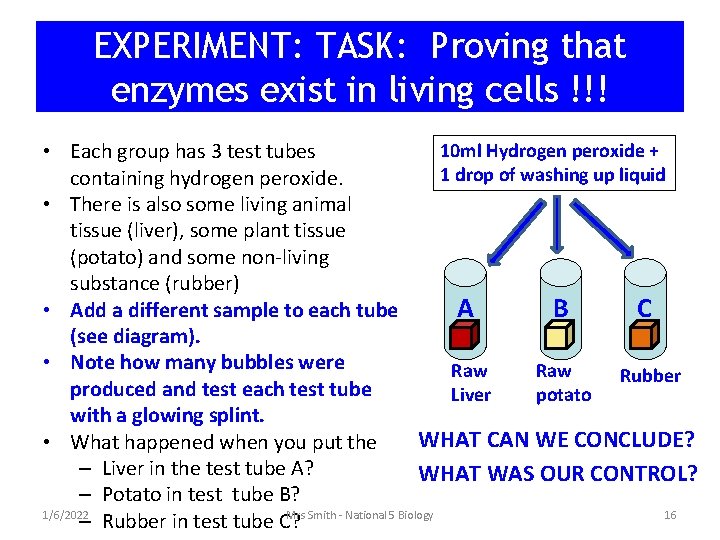
EXPERIMENT: TASK: Proving that enzymes exist in living cells !!! 10 ml Hydrogen peroxide + • Each group has 3 test tubes 1 drop of washing up liquid containing hydrogen peroxide. • There is also some living animal tissue (liver), some plant tissue (potato) and some non-living substance (rubber) • Add a different sample to each tube A B C (see diagram). • Note how many bubbles were Raw Rubber produced and test each test tube Liver potato with a glowing splint. WHAT CAN WE CONCLUDE? • What happened when you put the – Liver in the test tube A? WHAT WAS OUR CONTROL? – Potato in test tube B? 1/6/2022 Mrs Smith - National 5 Biology 16 – Rubber in test tube C?
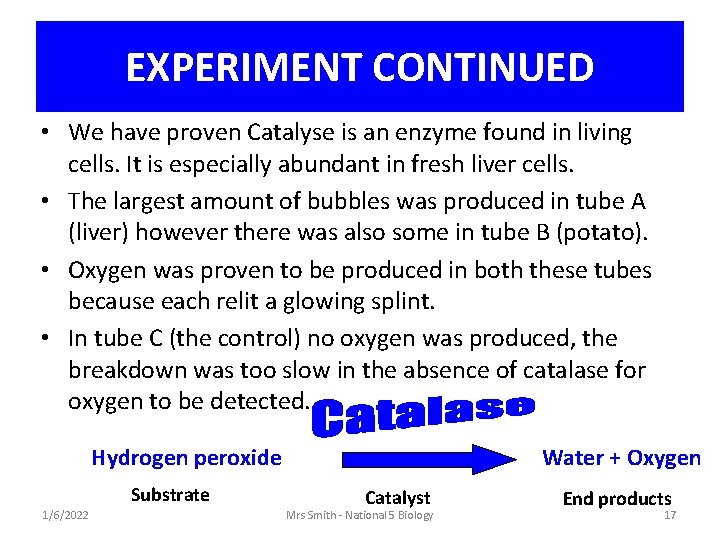
EXPERIMENT CONTINUED • We have proven Catalyse is an enzyme found in living cells. It is especially abundant in fresh liver cells. • The largest amount of bubbles was produced in tube A (liver) however there was also some in tube B (potato). • Oxygen was proven to be produced in both these tubes because each relit a glowing splint. • In tube C (the control) no oxygen was produced, the breakdown was too slow in the absence of catalase for oxygen to be detected. Hydrogen peroxide Substrate 1/6/2022 Water + Oxygen Catalyst Mrs Smith - National 5 Biology End products 17
Task answer these: Catalase experiment questions 1. Which tissue contained catalase? 2. What did you see when liver was added to hydrogen peroxide? 3. Which gas was given off? 4. What was the other product, that we couldn’t see? 5. Did catalase speed up the breakdown of hydrogen peroxide? 1/6/2022 Mrs Smith - National 5 Biology 18
National 5 Biology Unit 1: Cell Biology Key area 1. 4: Proteins 1. 4 b: Enzymes PART 2: Mechanism of Action/Specificity 1/6/2022 Mrs Smith - National 5 Biology 19
Learning Intentions In today’s lesson you will be learning about the mechanism of enzyme action and enzyme specificity. By the end of this lesson you should aim to: • Understand why the shape of an enzyme is important • What happens at the active site of an enzyme and how this relates to specificity of an enzyme? • Define the terms active site, substrate, enzymesubstrate complex, product, degradation and synthesis • Give a named example of a degradation reaction • Give a named example of a synthesis reaction • 1/6/2022 Complete a practical experiment to determine Mrs Smith - National 5 Biology 20
Mechanism of action. . . How do enzymes work? The molecules involved in a chemical reaction in a cell are Substrate Enzyme Product 1/6/2022 The substrate is the molecule the enzyme is to act upon. The enzyme will either break the substrate down into smaller new products or the enzyme will build the substrate up into a larger new product. The enzyme can act on only one type of substance – It SUBSTRATE. The biological catalyst that speeds up the reaction whilst remaining unchanged. Enzymes work by lowering the activation energy that is needed for the reaction to take place. The substance(s) produced Mrs Smith - National 5 Biology 21
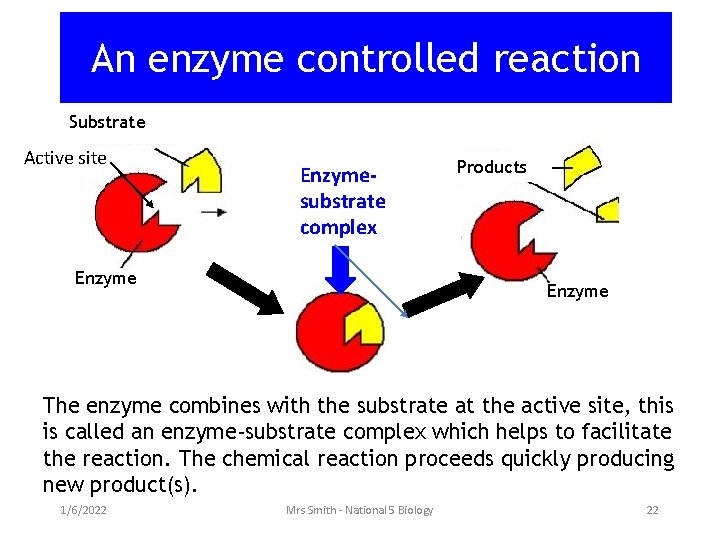
An enzyme controlled reaction Substrate Active site Enzymesubstrate complex Enzyme Products Enzyme The enzyme combines with the substrate at the active site, this is called an enzyme-substrate complex which helps to facilitate the reaction. The chemical reaction proceeds quickly producing new product(s). 1/6/2022 Mrs Smith - National 5 Biology 22
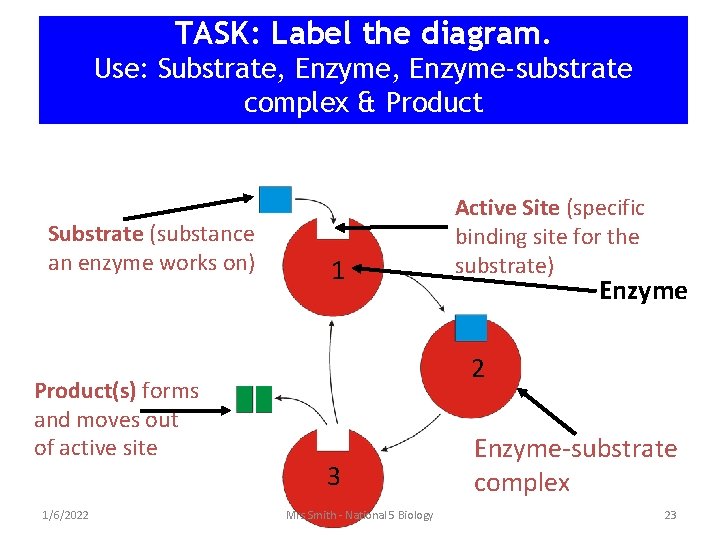
TASK: Label the diagram. Use: Substrate, Enzyme-substrate complex & Product Substrate (substance an enzyme works on) Product(s) forms and moves out of active site 1/6/2022 1 Active Site (specific binding site for the substrate) Enzyme 2 3 Mrs Smith - National 5 Biology Enzyme-substrate complex 23
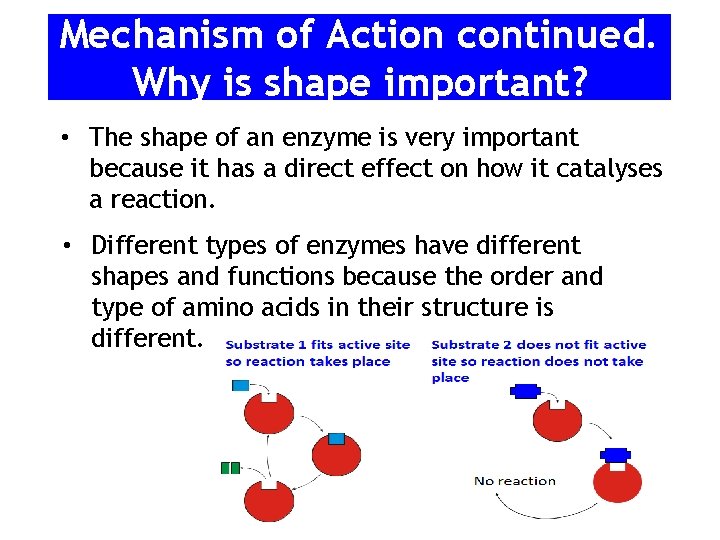
Mechanism of Action continued. Why is shape important? • The shape of an enzyme is very important because it has a direct effect on how it catalyses a reaction. • Different types of enzymes have different shapes and functions because the order and type of amino acids in their structure is different.
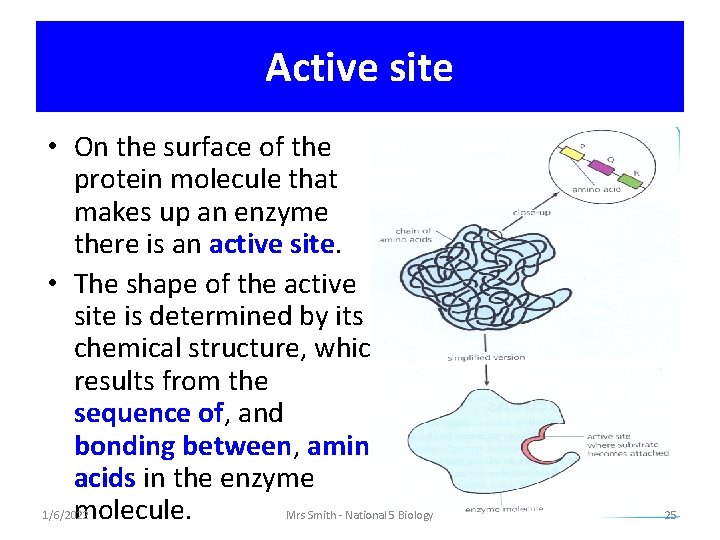
Active site • On the surface of the protein molecule that makes up an enzyme there is an active site. • The shape of the active site is determined by its chemical structure, which results from the sequence of, and bonding between, amino acids in the enzyme molecule. 1/6/2022 Mrs Smith - National 5 Biology 25
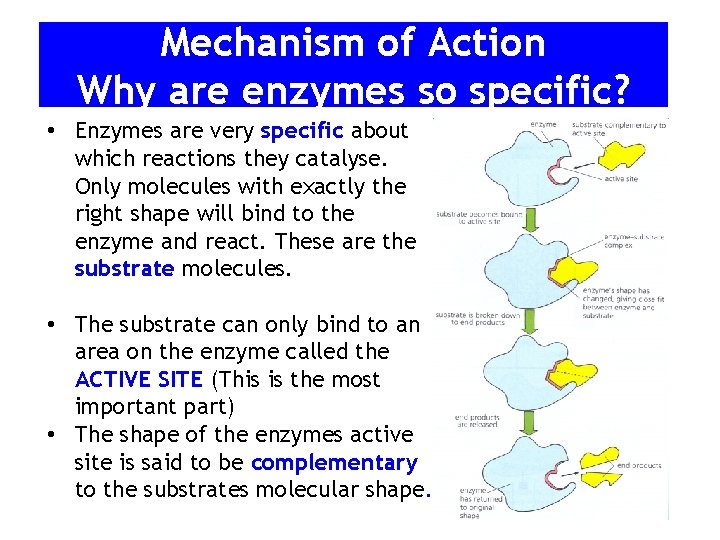
Mechanism of Action Why are enzymes so specific? • Enzymes are very specific about which reactions they catalyse. Only molecules with exactly the right shape will bind to the enzyme and react. These are the substrate molecules. • The substrate can only bind to an area on the enzyme called the ACTIVE SITE (This is the most important part) • The shape of the enzymes active site is said to be complementary to the substrates molecular shape.
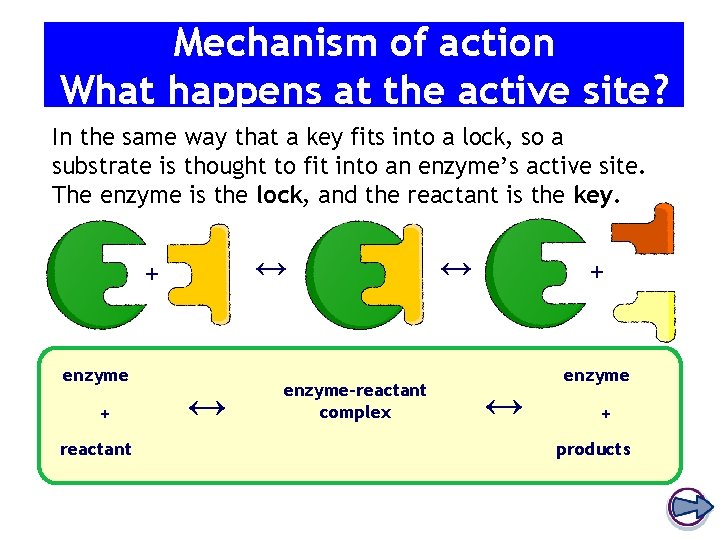
Mechanism of action What happens at the active site? In the same way that a key fits into a lock, so a substrate is thought to fit into an enzyme’s active site. The enzyme is the lock, and the reactant is the key. ↔ + enzyme + reactant ↔ enzyme-reactant complex ↔ + ↔ enzyme + products

There is 2 types of enzyme reaction. 1. Breakdown reactions = Degradation reactions The substrate is broken down into 2 or more new products as shown below. 2. Build-up reactions = Synthesis Reactions The substrates are built-up into a larger new product as shown below.
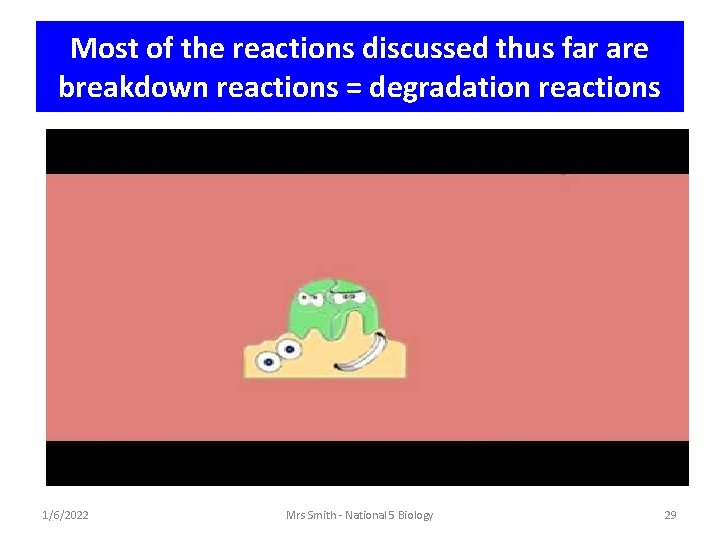
Most of the reactions discussed thus far are breakdown reactions = degradation reactions 1/6/2022 Mrs Smith - National 5 Biology 29
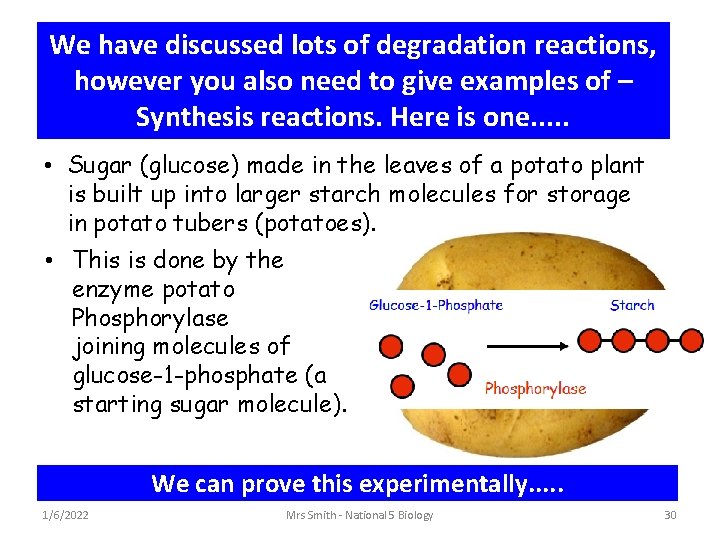
We have discussed lots of degradation reactions, however you also need to give examples of – Synthesis reactions. Here is one. . . • Sugar (glucose) made in the leaves of a potato plant is built up into larger starch molecules for storage in potato tubers (potatoes). • This is done by the enzyme potato Phosphorylase joining molecules of glucose-1 -phosphate (a starting sugar molecule). We can prove this experimentally. . . 1/6/2022 Mrs Smith - National 5 Biology 30
Experiment Aim: • To investigate the effect of potato phosphorylase on glucose-1 phosphate. 1/6/2022 Apparatus • Potato extract (potato Phosphorylase enzyme) • Glucose-1 -phosphate • Water • 3 droppers • Iodine solution • Dimple tile • Stopwatch • Brown and dark blue pencil. Mrs Smith - National 5 Biology 31
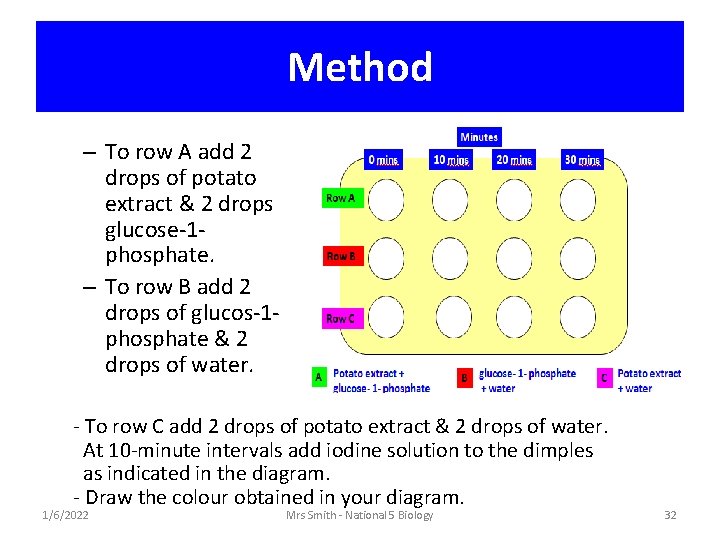
Method – To row A add 2 drops of potato extract & 2 drops glucose-1 phosphate. – To row B add 2 drops of glucos-1 phosphate & 2 drops of water. - To row C add 2 drops of potato extract & 2 drops of water. At 10 -minute intervals add iodine solution to the dimples as indicated in the diagram. - Draw the colour obtained in your diagram. 1/6/2022 Mrs Smith - National 5 Biology 32
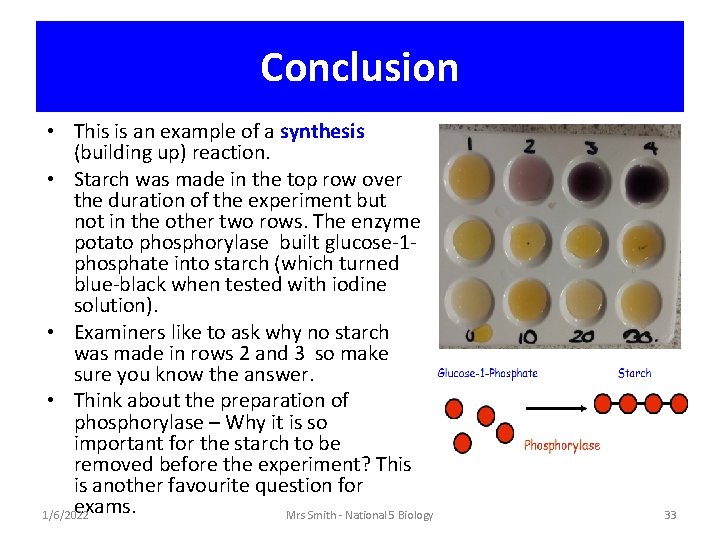
Conclusion • This is an example of a synthesis (building up) reaction. • Starch was made in the top row over the duration of the experiment but not in the other two rows. The enzyme potato phosphorylase built glucose-1 phosphate into starch (which turned blue-black when tested with iodine solution). • Examiners like to ask why no starch was made in rows 2 and 3 so make sure you know the answer. • Think about the preparation of phosphorylase – Why it is so important for the starch to be removed before the experiment? This is another favourite question for exams. 1/6/2022 Mrs Smith - National 5 Biology 33
National 5 Biology Unit 1: Cell Biology Key area 1. 4: Proteins 1. 4 b: Enzymes PART 3: Proving Enzyme Specificity 1/6/2022 Mrs Smith - National 5 Biology 34
Learning Intentions In today’s lesson you will be learning how to investigate enzyme specificity. By the end of this lesson you should aim to: • Design an experiment to show enzymes are specific. • Cnsider what makes a fair test 1/6/2022 Mrs Smith - National 5 Biology 35
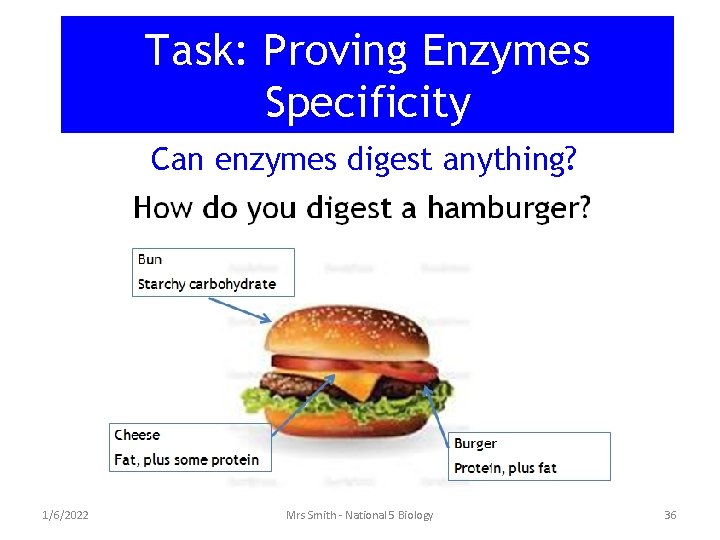
Task: Proving Enzymes Specificity Can enzymes digest anything? 1/6/2022 Mrs Smith - National 5 Biology 36
Enzymes, substrates and products • We have 3 enzymes: amylase, protease and lipase. • We have 3 substrates: protein, starch and fat. • We can test for three things: glucose, peptides, and acids. 1/6/2022 Mrs Smith - National 5 Biology 37
Your challenge • Design an experiment to answer the question: Which enzyme breaks down which substrate? 1/6/2022 Mrs Smith - National 5 Biology 38
Hints • We will use egg whites as protein, starch solution for starch, and cream as fat. • What do protein, starch and fat break down into? • How can we test for the products? 1/6/2022 Mrs Smith - National 5 Biology 39
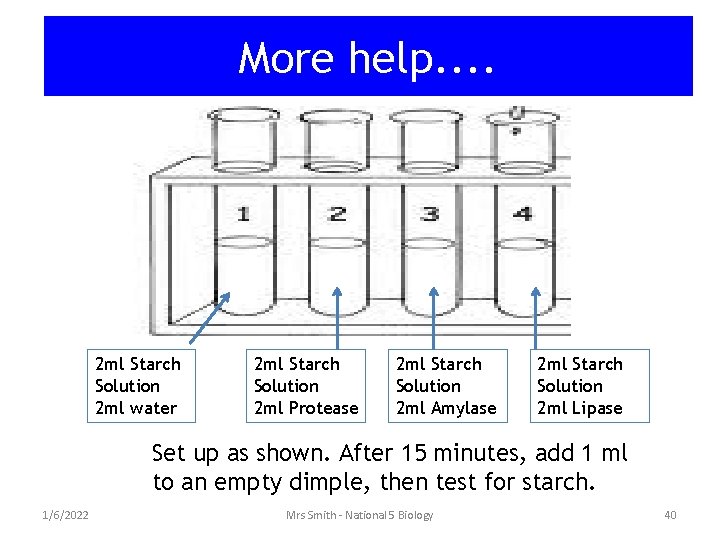
More help. . 2 ml Starch Solution 2 ml water 2 ml Starch Solution 2 ml Protease 2 ml Starch Solution 2 ml Amylase 2 ml Starch Solution 2 ml Lipase Set up as shown. After 15 minutes, add 1 ml to an empty dimple, then test for starch. 1/6/2022 Mrs Smith - National 5 Biology 40
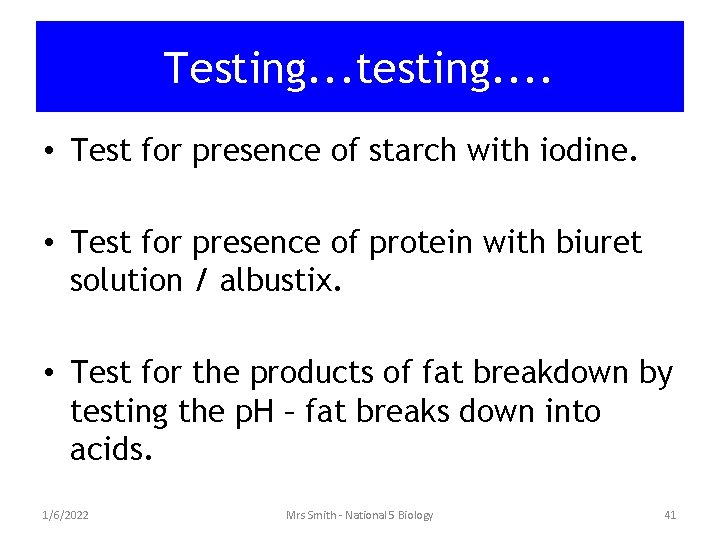
Testing. . . testing. . • Test for presence of starch with iodine. • Test for presence of protein with biuret solution / albustix. • Test for the products of fat breakdown by testing the p. H – fat breaks down into acids. 1/6/2022 Mrs Smith - National 5 Biology 41
What else? • Think about your experiment carefully. • Have you made sure it’s fair? • Does it prove what enzymes do? • What conditions would the enzymes work best at? 1/6/2022 Mrs Smith - National 5 Biology 42
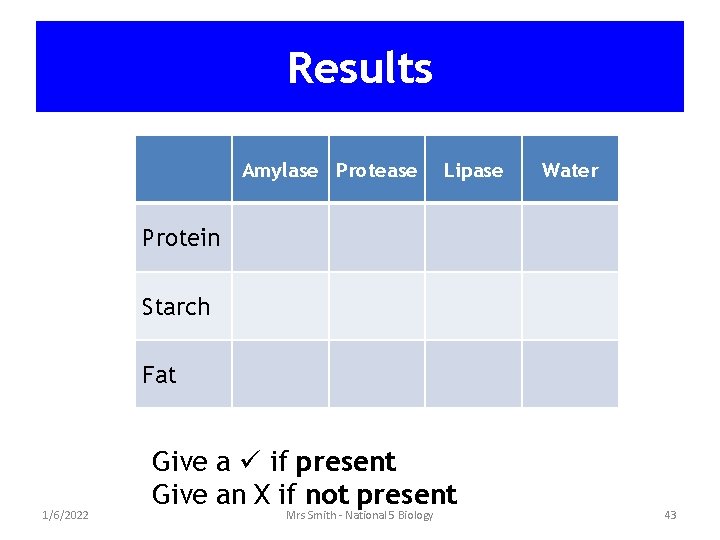
Results Amylase Protease Lipase Water Protein Starch Fat 1/6/2022 Give a if present Give an X if not present Mrs Smith - National 5 Biology 43
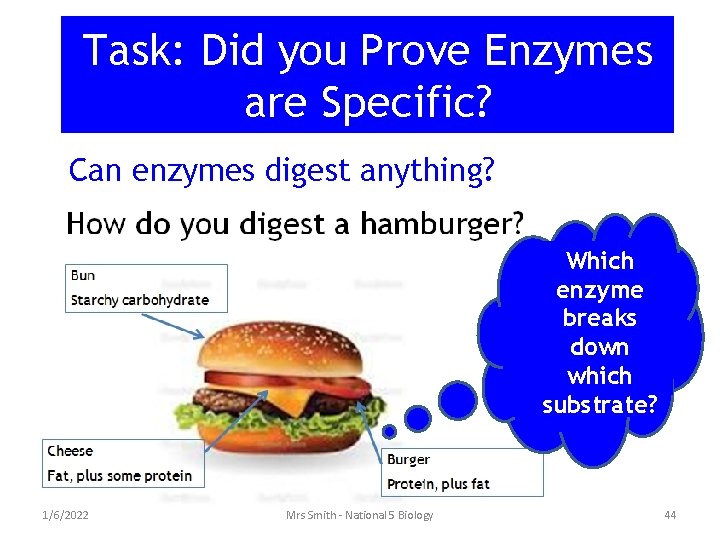
Task: Did you Prove Enzymes are Specific? Can enzymes digest anything? Which enzyme breaks down which substrate? 1/6/2022 Mrs Smith - National 5 Biology 44
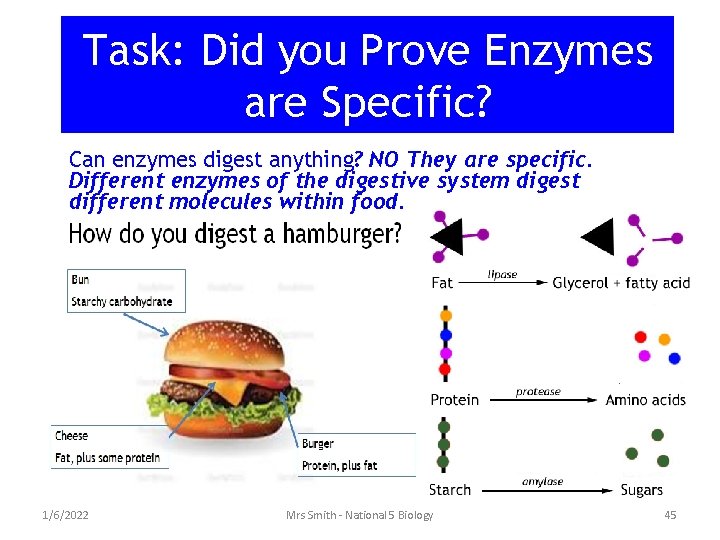
Task: Did you Prove Enzymes are Specific? Can enzymes digest anything? NO They are specific. Different enzymes of the digestive system digest different molecules within food. 1/6/2022 Mrs Smith - National 5 Biology 45
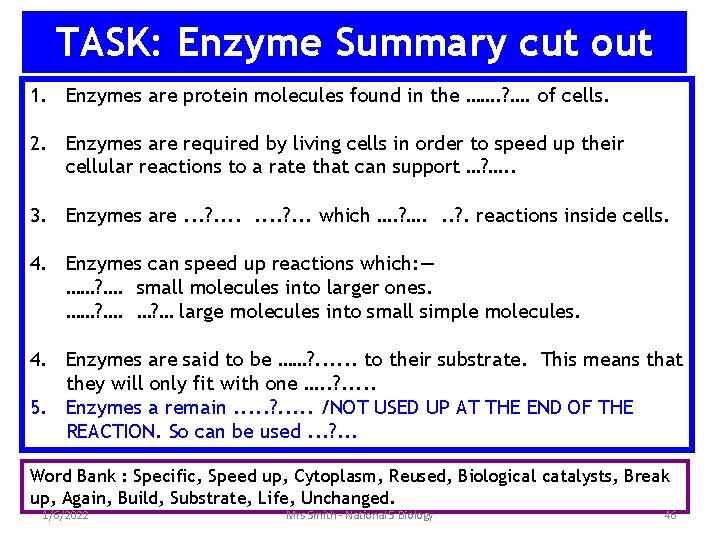
TASK: Enzyme Summary cut out 1. Enzymes are protein molecules found in the ……. ? …. of cells. 2. Enzymes are required by living cells in order to speed up their cellular reactions to a rate that can support …? …. . 3. Enzymes are. . . ? . . . which …. ? …. . . ? . reactions inside cells. 4. Enzymes can speed up reactions which: — ……? …. small molecules into larger ones. ……? … large molecules into small simple molecules. 4. Enzymes are said to be ……? . . . to their substrate. This means that they will only fit with one …. . ? . . . 5. Enzymes a remain. . . ? . . . /NOT USED UP AT THE END OF THE REACTION. So can be used. . . ? . . . Word Bank : Specific, Speed up, Cytoplasm, Reused, Biological catalysts, Break up, Again, Build, Substrate, Life, Unchanged. 1/6/2022 Mrs Smith - National 5 Biology 46
TASKS: Enzyme Challenge • Write a short paragraph describing how the “lock and key” theory of enzymes works. AND / OR • Make a video describing how the “lock and key” theory of enzymes works. • It should include: – A model of a named enzyme, its substrate and the products. A written or spoken explanation of what’s happening. 1/6/2022 Mrs Smith - National 5 Biology 47
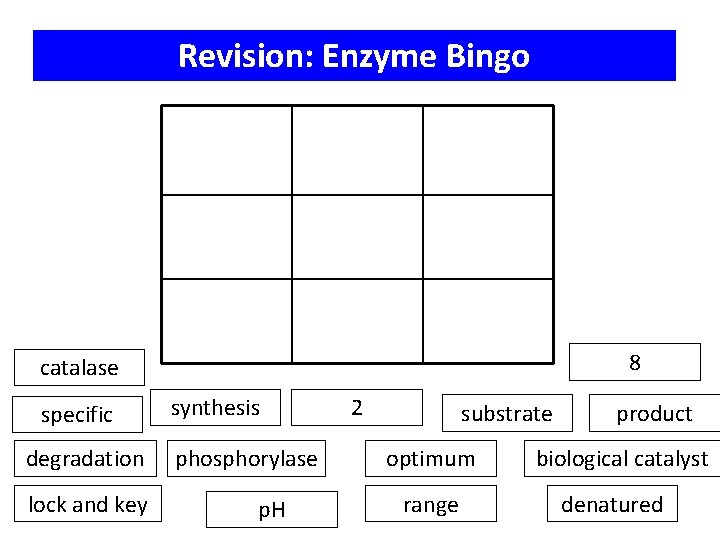
Revision: Enzyme Bingo 8 catalase specific degradation lock and key synthesis phosphorylase p. H 2 substrate optimum range product biological catalyst denatured
- Slides: 48