
National 5 Biology Cell Structure Mr G Davidson
National 5 Biology Cell Structure Mr G Davidson

Cellular Structure • Cells are the living units from which all organisms are made. • Simple organisms have only one cell and are unicellular, e. g. bacteria. • Other organisms have many cells working together and are multicellular, e. g. humans. Saturday, September 26, 2020 Mr G Davidson 2
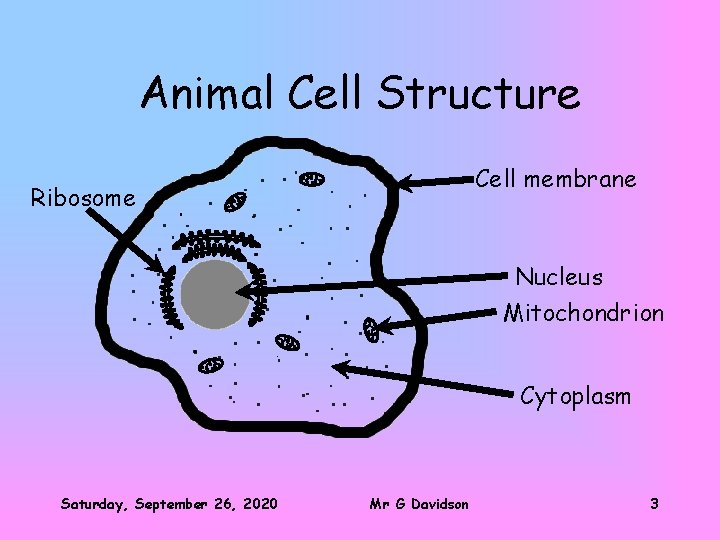
Animal Cell Structure Cell membrane Ribosome Nucleus Mitochondrion Cytoplasm Saturday, September 26, 2020 Mr G Davidson 3
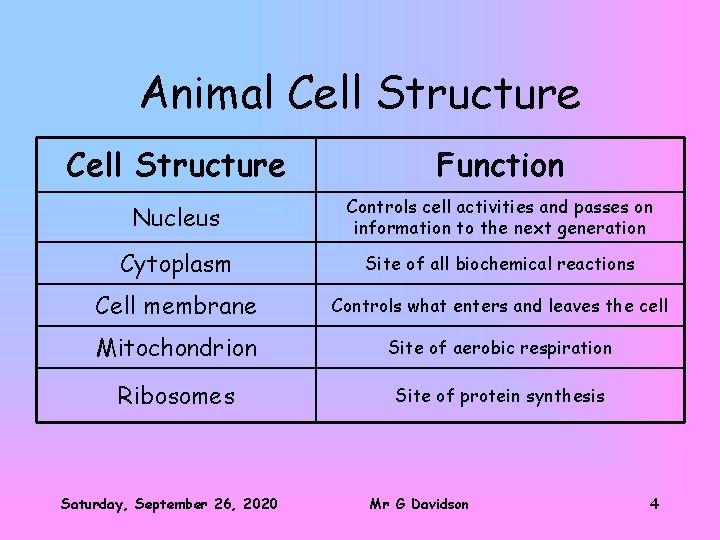
Animal Cell Structure Function Nucleus Controls cell activities and passes on information to the next generation Cytoplasm Site of all biochemical reactions Cell membrane Controls what enters and leaves the cell Mitochondrion Site of aerobic respiration Ribosomes Site of protein synthesis Saturday, September 26, 2020 Mr G Davidson 4
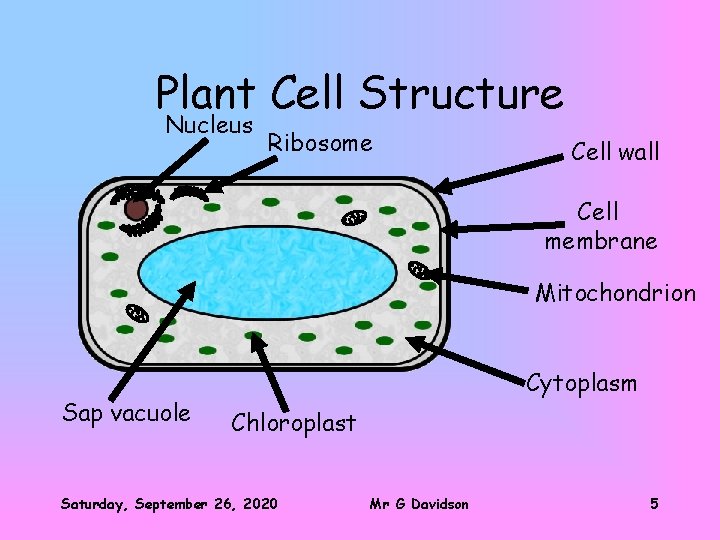
Plant Cell Structure Nucleus Ribosome Cell wall Cell membrane Mitochondrion Sap vacuole Cytoplasm Chloroplast Saturday, September 26, 2020 Mr G Davidson 5
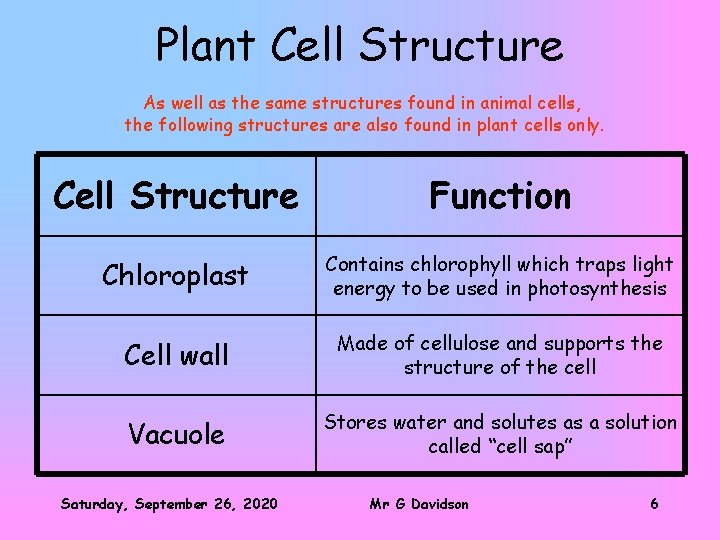
Plant Cell Structure As well as the same structures found in animal cells, the following structures are also found in plant cells only. Cell Structure Function Chloroplast Contains chlorophyll which traps light energy to be used in photosynthesis Cell wall Made of cellulose and supports the structure of the cell Vacuole Stores water and solutes as a solution called “cell sap” Saturday, September 26, 2020 Mr G Davidson 6
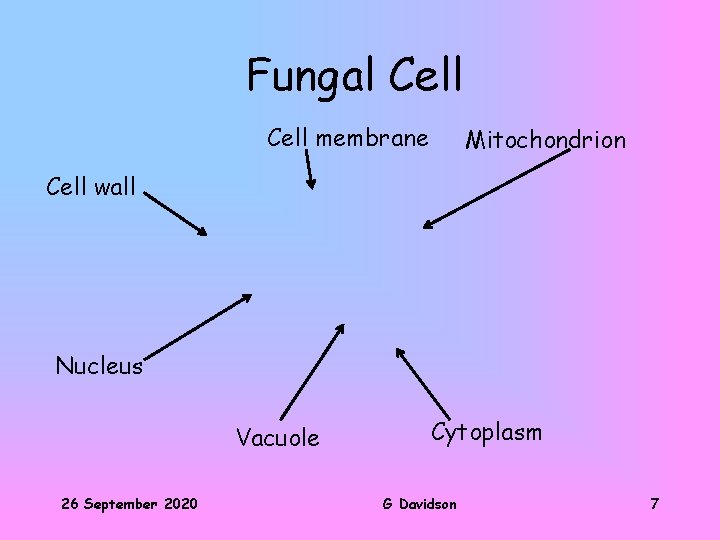
Fungal Cell membrane Mitochondrion Cell wall Nucleus Vacuole 26 September 2020 Cytoplasm G Davidson 7
Fungal Cell Structure • An example of a unicellular fungus is yeast. • It has structures in common with both animal and plant cells. • These structures carry out the same functions. 26 September 2020 G Davidson 8
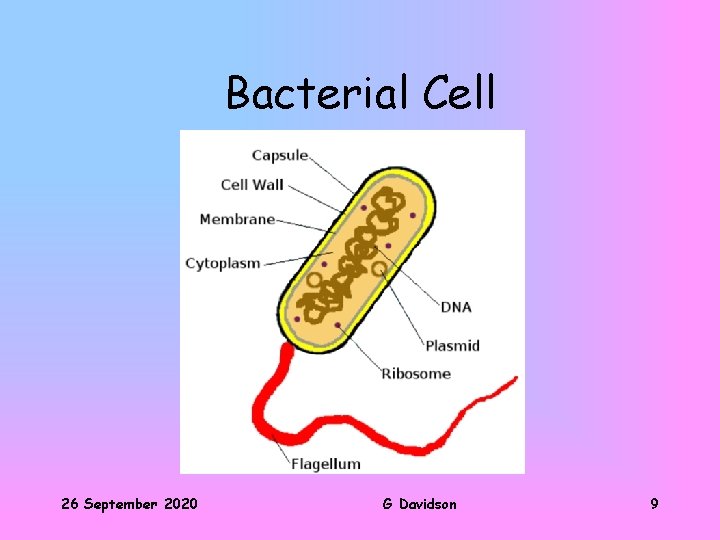
Bacterial Cell 26 September 2020 G Davidson 9
Bacterial Cell Structure • Bacterial cells can be all different shapes. • The structures within the bacterial cell are much the same as animal cells. • The main difference is a lack of a nucleus. • Bacterial cells have plasmids which are circular rings of DNA as well as a large circular DNA. • The cell wall is different from a plant cell wall in that it is kind of slimy. Saturday, September 26, 2020 Mr G Davidson 10

Cell Sizes • Cells cannot be seen without the aid of a microscope. • They are so small that we used units called micrometres(μm) or microns to measure them. • There are 1000 microns in 1 millimetre. 26 September 2020 G Davidson 11
Cell Sizes • We can estimate the sizes of cells by knowing the diameter of the field of view. • e. g. if the field of view is 2 mm which is 2000μm, and there are 8 cells stretching from one side to the other, then each cell must be 250μm. (2000/8) 26 September 2020 G Davidson 12
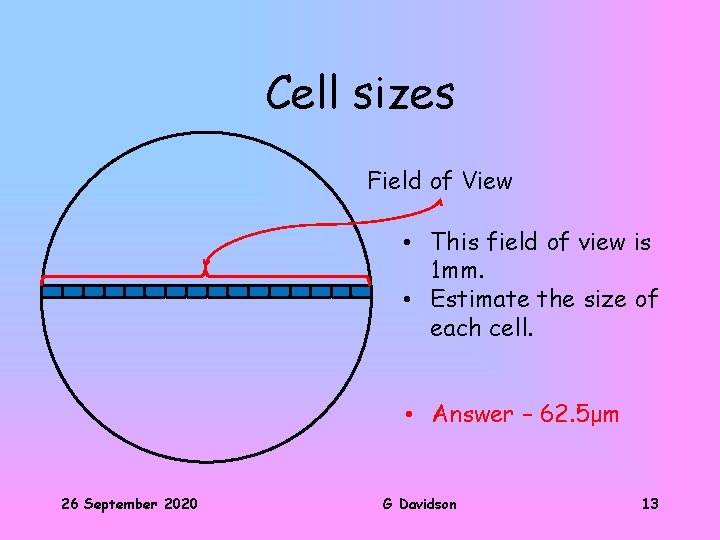
Cell sizes Field of View • This field of view is 1 mm. • Estimate the size of each cell. • Answer – 62. 5μm 26 September 2020 G Davidson 13
Cell Sizes • We can magnify the size of the cells using the lenses on the microscope. • Total magnification = eyepiece x objective • e. g. if the objective lens is x 20 and the eyepiece is x 10, then the total magnification will be x 200. • If we increase the magnification of the microscope the number of cells we see in the field of view decreases. 26 September 2020 G Davidson 14
- Slides: 14