
Nathaniel Hawthorne Nathaniel Hawthorne 1804 1864 Born in
Nathaniel Hawthorne
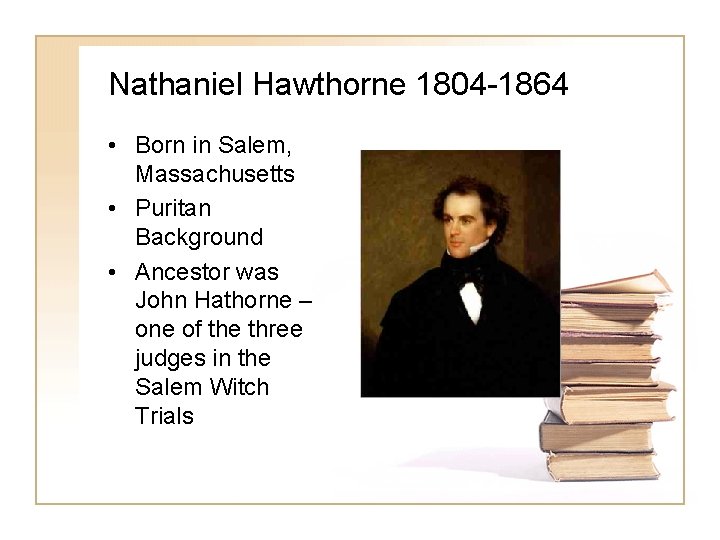
Nathaniel Hawthorne 1804 -1864 • Born in Salem, Massachusetts • Puritan Background • Ancestor was John Hathorne – one of the three judges in the Salem Witch Trials
Hawthorne’s Background • Began writing after college at Bowdion College in Maine • Spent many years in seclusion – starving artist • Held many jobs including writer, publisher, working at a custom house, and consul in England
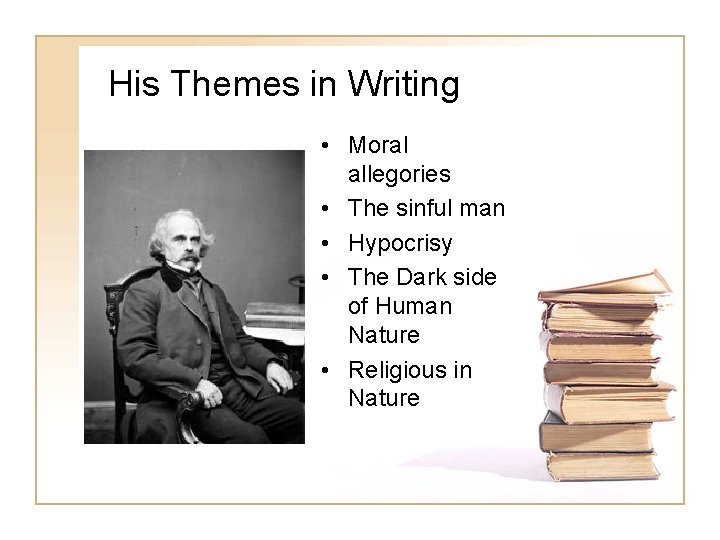
His Themes in Writing • Moral allegories • The sinful man • Hypocrisy • The Dark side of Human Nature • Religious in Nature
His Most Famous Works • Novels – The House of Seven Gables – The Scarlet Letter • Short Stories – – “The Minister’s Black Veil” “Young Goodman Brown” “The Great Stone Face” “ The Birthmark”
“The Birthmark” • His first short stories were published in Twice Told Tales (1837). • Published from his collection Mosses From an Old Manse. • The Scarlet Letter, 1850, put him on the map as a writer. .
Who were the Puritans? • Wanted a “pure” church – No candles – No Images – No stained glass windows • Rejected the “showy” church of England • Led very somber lives governed solely by a strict interpretation of the Bible • No “nonsense” – dancing, gambling, drama, etc
Basic Beliefs of the Puritan Church • Jesus Christ is the Son of God – died on the cross for all everyone’s sins • The whole Bible is the word of God and it is to be followed to the letter. • The belief that these ideas are fact are known as a person’s faith
Basic Beliefs of the Puritan Church • Faith is what is necessary to get into heaven. • If you don’t go to heaven you go to hell. • Sins, as defined by the Bible, are to be avoided at cut of life • A catechism is a book that is used to teach basic principles of the church
• His puritan background seems to be reflected in the sense that much of his writing deals with questions about human morals and the faults of humankind. • Positivism- a popular movement during this time that believed that all of life’s mysteries can be solved through scientific inquiry.
• In the story, he challenges whether or not we should tamper with nature and conduct scientific inquiries without considering consequences manner. • Science is worshiped in this story, but this is seen as problematic.
Genre- Dark Romanticism • A sub-genera of romanticism that was a reaction to the transcendental movement of the 19 th. C. • Notable writers include Edgar Allan Poe, Nathaniel Hawthorne, and Herman Melville
• These writers saw transcendental beliefs as too optimistic and egotistical. Characteristics of dark romantics: • They do not see perfection is an innate quality of mankind
• People are seen as capable of sin and self-destruction. • People are not seen as inherently wise. • Nature is seen as an important spiritual force. • Focuses on the failures of mankind in an attempt to make changes.
• Perverse or evil moral choices. • Undefined guilt
• http: //www. newworldencyclo pedia. org/entry/Dark_romanti cism
- Slides: 16