
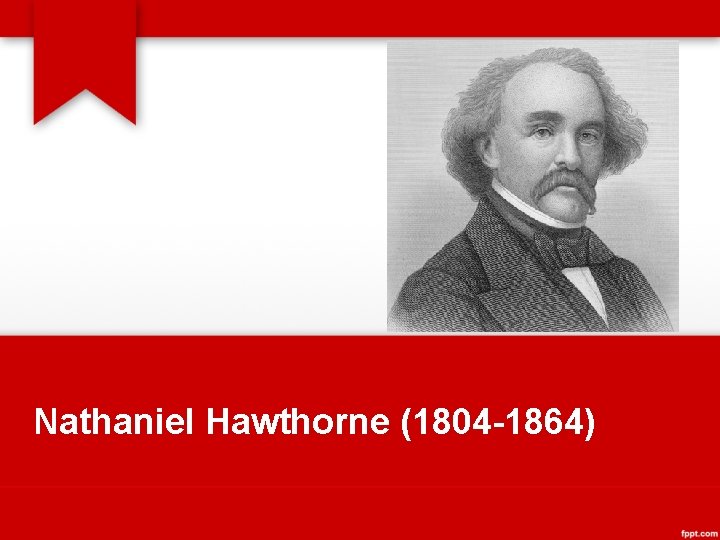
Nathaniel Hawthorne 1804 1864 His Life Nathaniel Hawthorne

- Slides: 28
Nathaniel Hawthorne (1804 -1864)
His Life • Nathaniel Hawthorne was born on July 4, 1804, in Salem, Massachusetts - the perfect contradiction of time and place for a man who truly defines the dark side of America. • He grew up during a pretty cool time in American history. • In spite of being a descendant of John Hathorne, a wellknown judge who sent quite a few innocent people to their death during the Salem witch trials, Hawthorne (who changed the spelling of his name to distance himself from his ancestors) had some pretty famous college friends, like poet Henry Wadsworth Longfellow and future president Franklin Pierce.
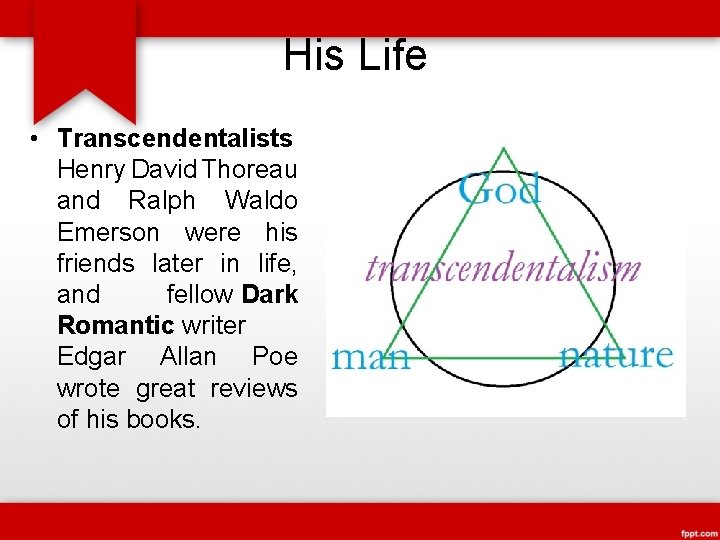
His Life • Transcendentalists Henry David Thoreau and Ralph Waldo Emerson were his friends later in life, and fellow Dark Romantic writer Edgar Allan Poe wrote great reviews of his books.
His Life • In spite of his status among the famous and being very handsome, Hawthorne was terribly shy. • In fact, we probably wouldn't know anything about him if he were writing during our lifetime. • Most of what we do know about his life is what was recovered from his diaries after his death. • In fact, he was so shy that he didn't even want anyone to know when he published his first novel Fanshawe in 1828. • He published it anonymously.
His Life • While working as a weigher (mázsáló) and gauger at the Boston Custom House, Hawthorne wrote several short stories including what are now some of his most well-known works: 'Young Goodman Brown' and 'The Minister's Black Veil. ' • These were published in various periodicals, but in 1837, he published the stories into a collection called Twice-Told Tales. • While this brought him local recognition, it was not enough to make a living.
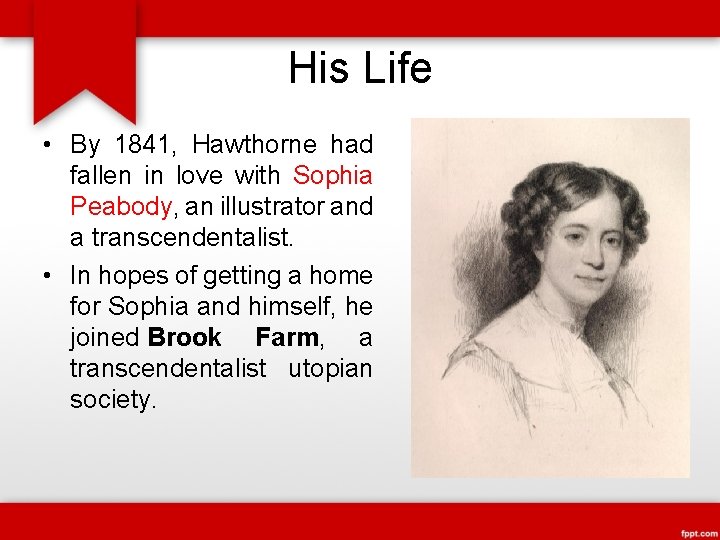
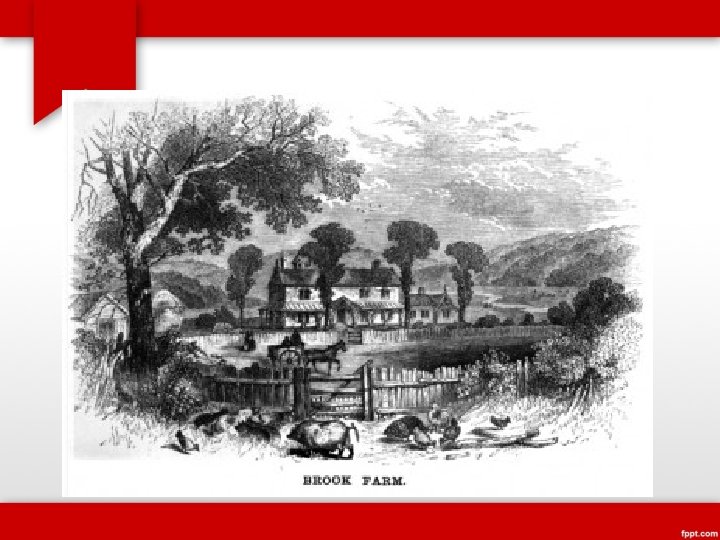
His Life • By 1841, Hawthorne had fallen in love with Sophia Peabody, an illustrator and a transcendentalist. • In hopes of getting a home for Sophia and himself, he joined Brook Farm, a transcendentalist utopian society.
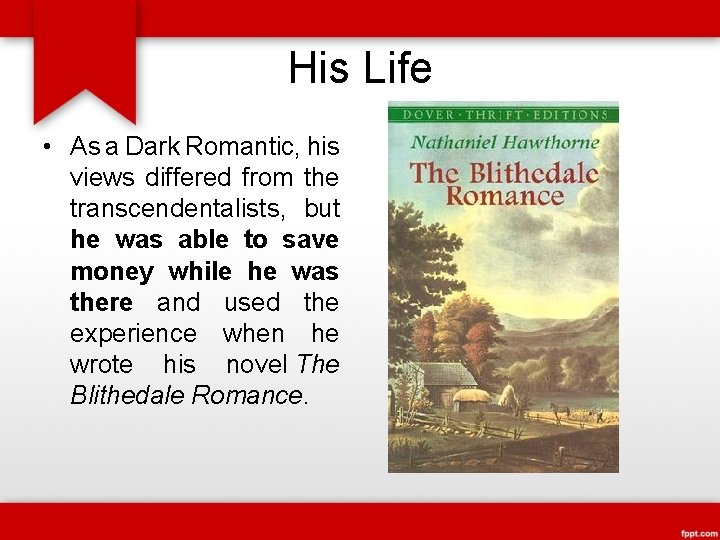
His Life • As a Dark Romantic, his views differed from the transcendentalists, but he was able to save money while he was there and used the experience when he wrote his novel The Blithedale Romance.
His Life • In 1842, Hawthorne and Sophia were married and moved to Concord. • They both were pretty shy and stayed to themselves. • Eventually though, Hawthorne took a job at the Salem Custom House as a surveyor. • He found the job to be horribly boring and wrote to Longfellow to complain that as much as he wanted to write, the Custom House job was causing sort of a mental-block. • Much like many today, his job put food on the table but was totally unfulfilling.
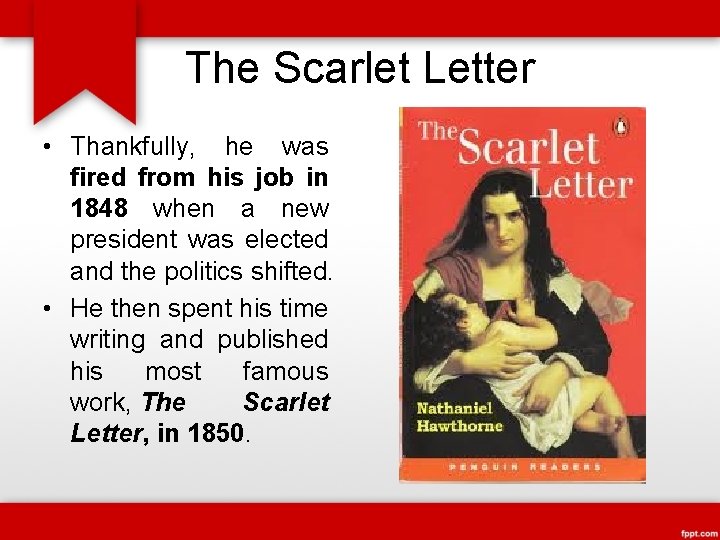
The Scarlet Letter • Thankfully, he was fired from his job in 1848 when a new president was elected and the politics shifted. • He then spent his time writing and published his most famous work, The Scarlet Letter, in 1850.
His Life • Over the next few years, the Hawthorne family moved from Concord and back to find themselves again in the midst of some of the greatest historical figures of the time. • Ralph Waldo Emerson and Henry David Thoreau were now Hawthorne's neighbors, and his relationship with Franklin Pierce led him to write a biography of the man who was to be president. • Hawthorne was given the position of United States consul in Liverpool when Pierce was elected, which allowed the family to tour France and Italy.
His Life • Hawthorne died on May 19, 1864, after returning to America, meeting new President Abraham Lincoln, and witnessing the beginning of the American Civil War. • He is buried in the now-famous Sleepy Hollow Cemetery in Concord, like many of the other important Americans from his time. • His wife Sophia continued to publish his works until her death in 1871.
His Works • To really understand Nathaniel Hawthorne's literature, it's best to understand that he was a Dark Romantic in the midst of a bunch of transcendentalists. • Transcendentalists like Emerson and Thoreau believed that society, including organized religion, was killing the individual's pure soul. • To the transcendentalist, people and nature were inherently good, if they were being self-reliant and if each person was true to him or herself. • They believed in utopian societies, where each person embraces their individual strength and contributes to the betterment of the community.
His Works • This is in contrast to the Dark Romantic who believed that humans had a dark side. • Hawthorne had seen the dark side of humanity and believed it lay in everyone. • From his point of view, people needed things like guilt or sin to learn how to be themselves, and there wasn't much room for that in utopian society. • Eventually, he began to write against transcendentalism.
His Works • His novel, The Blithedale Romance is a fictional story based on his time living in the utopian community Brook Farm. • The characters in the story, who are supposed to be changing the world with their endeavors, end up being rather egotistical, which leads to tragedy. • This illustrates that the dark side of the human mind does exist in everyone, no matter how much we may try to suppress it.
His Works • In fact, Hawthorne's experiences fueled many of his stories. • Because of his dark, Puritan ancestry, Hawthorne, who was quite embarrassed by his heritage, spent a good deal of time studying the Puritan beliefs. • He used his own family's past to influence his themes. • Rather than mimic the Puritan point of view in his works, he sought to use their style of allegory, where the characters and objects in a story represent something else in order to teach a lesson, in order to show the hypocrisy, sin, and corruption that was rampant as a result of their religious beliefs.
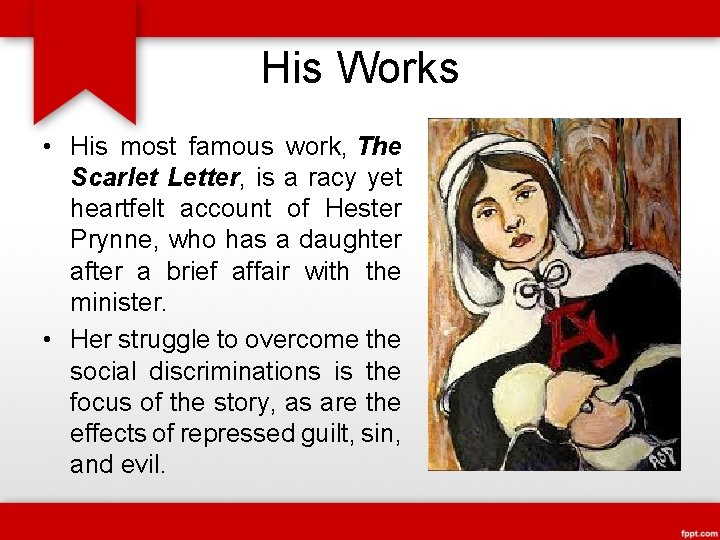
His Works • His most famous work, The Scarlet Letter, is a racy yet heartfelt account of Hester Prynne, who has a daughter after a brief affair with the minister. • Her struggle to overcome the social discriminations is the focus of the story, as are the effects of repressed guilt, sin, and evil.
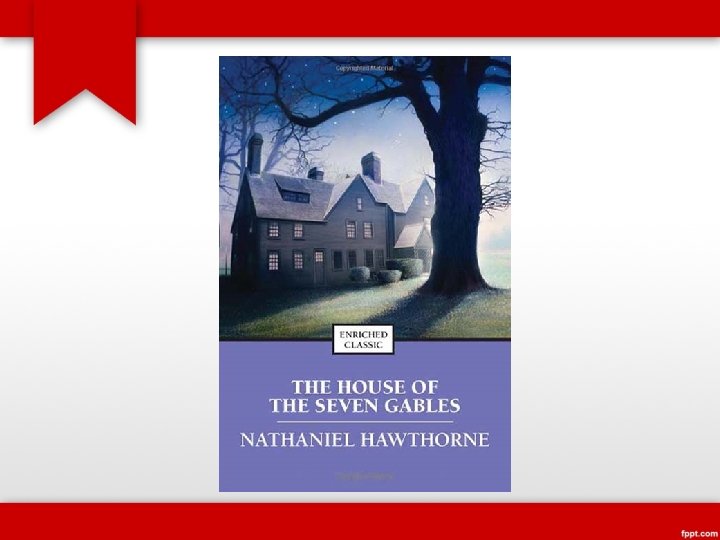
His Worky • Another of his novels, The House of Seven Gables, was also heavily influenced by Hawthorne's Puritan obsession and deals with hypocrisy and selfrighteousness. • It is the story of the Pyncheon family, who were cursed generations before by a man that one of the ancestors had accused of being a witch - obviously a connection to Hawthorne's own life. • The curse is lifted only when two decedents of the accused and the accuser unite to solve the sort of mystery surrounding the house.
Style • Hawthorne's writing style goes hand-in-hand with his gloomy themes and stories. • As a Dark Romantic, it's no surprise that he used symbols and metaphors to teach lessons. • His focus on the psychological is also typical of the Dark Romantic style, which he used to illustrate themes of sin, guilt, and hypocrisy. • All-in-all, if it's a story that somehow shows the faults of Puritan ideology, it's probably Hawthorne. • But beyond the literary techniques he imposes, Hawthorne's writing style is also known for extremely long, drawn-out sentences.
Example • In my native town of Salem, at the head of what, half a century ago, in the days of old King Derby, was a bustling wharf, --but which is now burdened with decayed wooden warehouses, and exhibits few or no symptoms of commercial life; except, perhaps, a bark or brig, half-way down its melancholy length, discharging hides; or, nearer at hand, a Nova Scotia schooner, pitching out her cargo of firewood, --at the head, I say, of this dilapidated wharf, which the tide often overflows, and along which, at the base and in the rear of the row of buildings, the track of many languid years is seen in a border of unthrifty grass, --here, with a view from its front windows adown this not very enlivening prospect, and thence across the harbour, stands a spacious edifice of brick. '
Style • Yes, that is one sentence from 'The Custom House, ' the introduction to The Scarlet Letter - one of the longest sentences ever! • Think of it as if you're sitting on the porch with an elderly fellow who has very few visitors. You can sort of see his eyes glaze over as he tells you his tale in an almost stream-of-consciousness form. • Not all of Hawthorne's sentences are that long or so elaborately punctuated, but he does like descriptions and eloquent language.
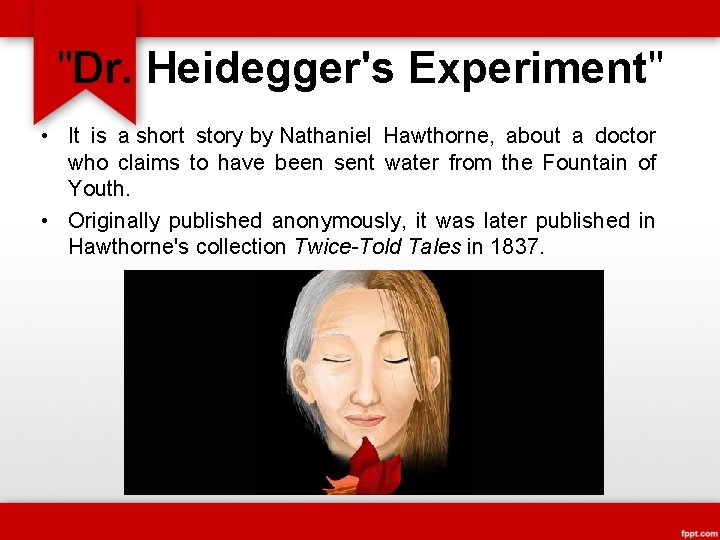
"Dr. Heidegger's Experiment" • It is a short story by Nathaniel Hawthorne, about a doctor who claims to have been sent water from the Fountain of Youth. • Originally published anonymously, it was later published in Hawthorne's collection Twice-Told Tales in 1837.
"Dr. Heidegger's Experiment" • The story begins with old Dr. Heidegger inviting four elderly friends over to his rather eerie study: Colonel Killigrew, Mr. Medbourne, Mr. Gascoigne, and the Widow Wycherly. • The four old folks have all fallen a long way from their prime; each squandered (elherdálni) his own type of fortune (youth, money, power, beauty) and is now in a miserable state. • The narrator also informs us that, when they were young, the three men used to fight over the attention of the Widow Wycherly.
"Dr. Heidegger's Experiment" • Heidegger's creepy study contains, among other things, a bust of Hippocrates with whom Dr. Heidegger consults from time to time, a magic black book, a skeleton in a closet, and a mirror that supposedly contains the visages of Heidegger's dead patients. • The Doctor presents his guests with four empty champagne glasses and an ornate vase full of clear, bubbling liquid. • He takes an old, withered rose, drops it into the vase, and shows his guests that it has in fact been rejuvenated to a fresh-blooming flower.
"Dr. Heidegger's Experiment" • Dr. Heidegger then claims that the liquid in the vase is water from the mythical Fountain of Youth. • He would like their help in an experiment: they drink the water, he sits back and watches. • The guests are clearly skeptical, but they agree. • Before they drink, Dr. Heidegger warns them not to make the same mistakes they did the first time they were young. • The guests drink, and they believe they have grown young again. (Whether or not they actually are physically transformed is ambiguous. )
"Dr. Heidegger's Experiment" • Of course, they act like fools, and the three men end up wrestling each other for the Widow's attention. • In their tussling they knock over the vase, which spills the elixir all over the floor. • It doesn't take long for the effects of the potion to wear off, and the four guests find that they are old again. • Dr. Heidegger does not regret the spilled elixir; he has learned his lesson by watching his guests, and would not drink the water for anything. The guests, however, have learned nothing, and vow to travel to Florida, find the fountain of youth, and drink from it day and night.
The Scarlet Letter