
Nateglinide and Valsartan in Impaired Glucose Tolerance Outcomes


- Slides: 34
Nateglinide and Valsartan in Impaired Glucose Tolerance Outcomes Research Rury R. Holman, MB, Ch. B, FRCP Professor of Diabetic Medicine Director, Diabetes Trials Unit, Oxford Robert M. Califf, MD, MACC Vice Chancellor for Clinical Research Donald F. Fortin Professor of Cardiology, Duke University Director, Duke Translational Medicine Institute For the NAVIGATOR Study Group
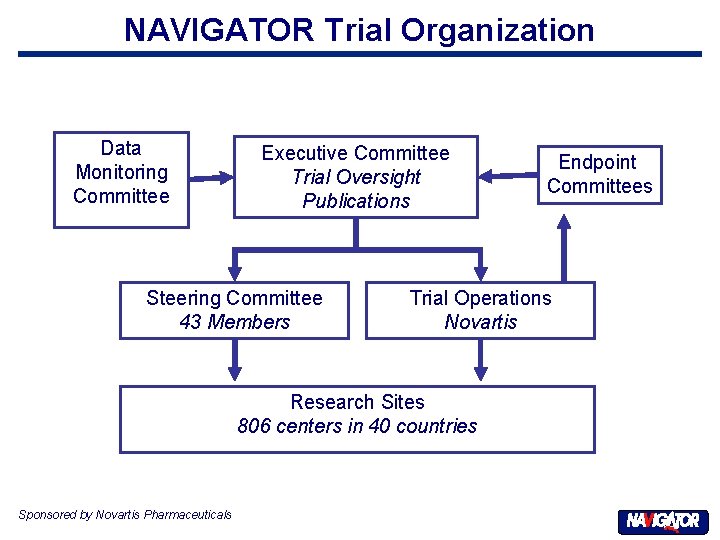
NAVIGATOR Trial Organization Data Monitoring Committee Executive Committee Trial Oversight Publications Steering Committee 43 Members Trial Operations Novartis Research Sites 806 centers in 40 countries Sponsored by Novartis Pharmaceuticals Endpoint Committees
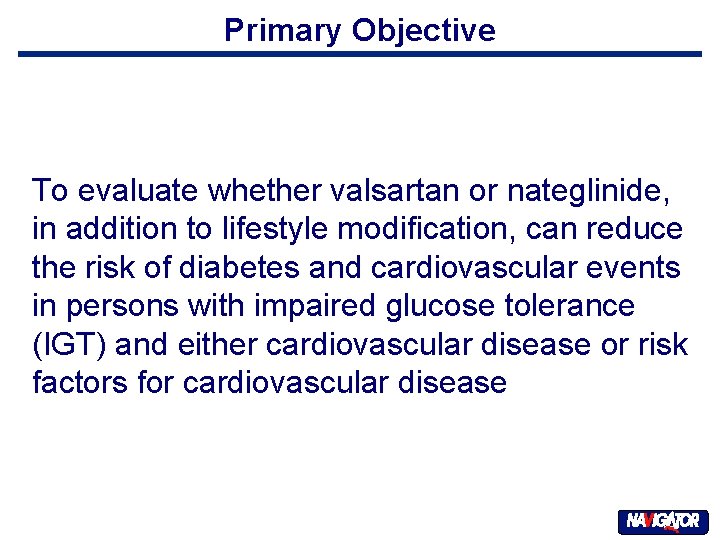
Primary Objective To evaluate whether valsartan or nateglinide, in addition to lifestyle modification, can reduce the risk of diabetes and cardiovascular events in persons with impaired glucose tolerance (IGT) and either cardiovascular disease or risk factors for cardiovascular disease
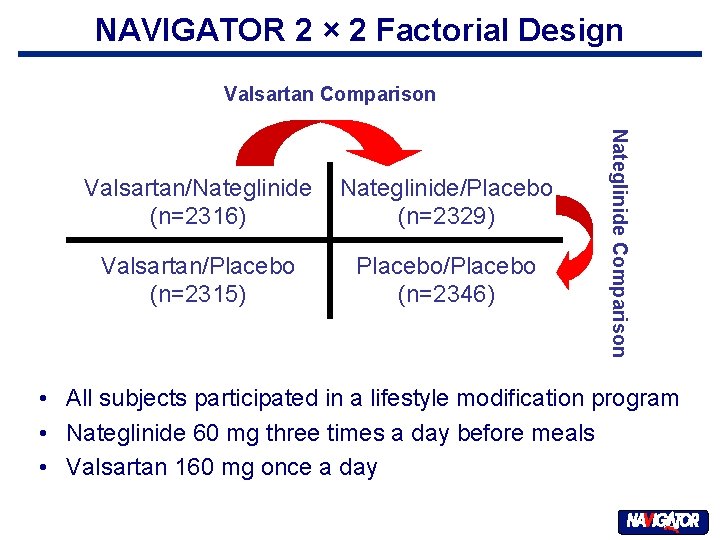
NAVIGATOR 2 × 2 Factorial Design Valsartan Comparison Nateglinide/Placebo (n=2329) Valsartan/Placebo (n=2315) Placebo/Placebo (n=2346) Nateglinide Comparison Valsartan/Nateglinide (n=2316) • All subjects participated in a lifestyle modification program • Nateglinide 60 mg three times a day before meals • Valsartan 160 mg once a day
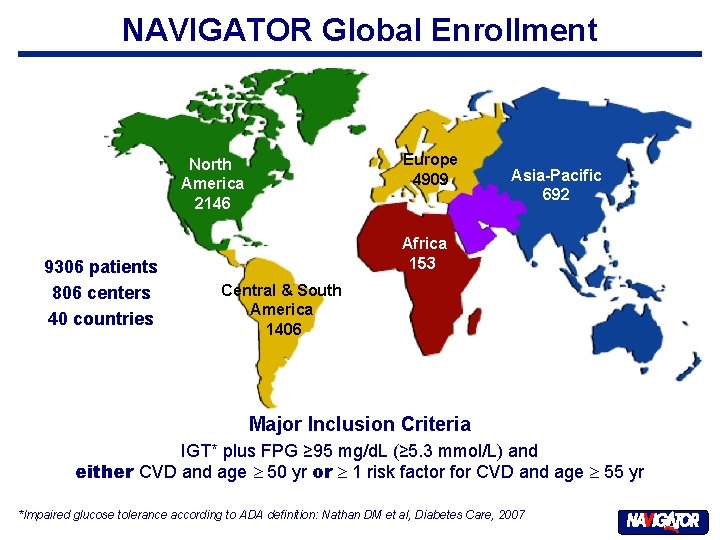
NAVIGATOR Global Enrollment Europe 4909 North America 2146 9306 patients 806 centers 40 countries Asia-Pacific 692 Africa 153 Central & South America 1406 Major Inclusion Criteria IGT* plus FPG ≥ 95 mg/d. L (≥ 5. 3 mmol/L) and either CVD and age 50 yr or 1 risk factor for CVD and age 55 yr *Impaired glucose tolerance according to ADA definition: Nathan DM et al, Diabetes Care, 2007
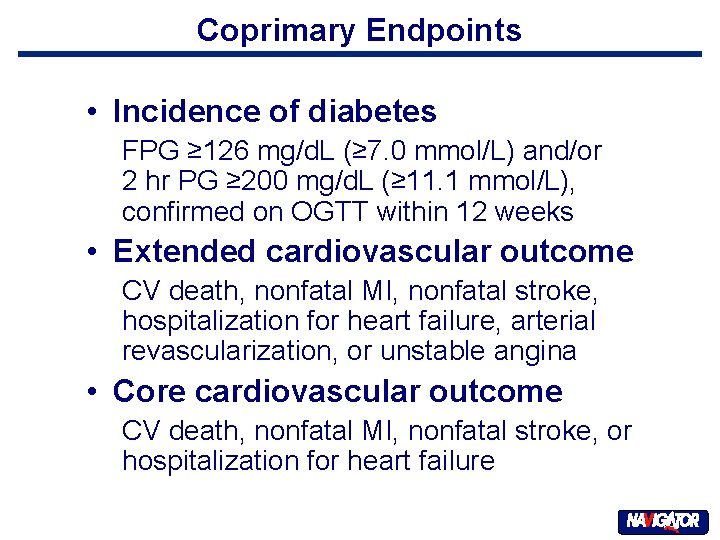
Coprimary Endpoints • Incidence of diabetes FPG ≥ 126 mg/d. L (≥ 7. 0 mmol/L) and/or 2 hr PG ≥ 200 mg/d. L (≥ 11. 1 mmol/L), confirmed on OGTT within 12 weeks • Extended cardiovascular outcome CV death, nonfatal MI, nonfatal stroke, hospitalization for heart failure, arterial revascularization, or unstable angina • Core cardiovascular outcome CV death, nonfatal MI, nonfatal stroke, or hospitalization for heart failure
Nateglinide Data
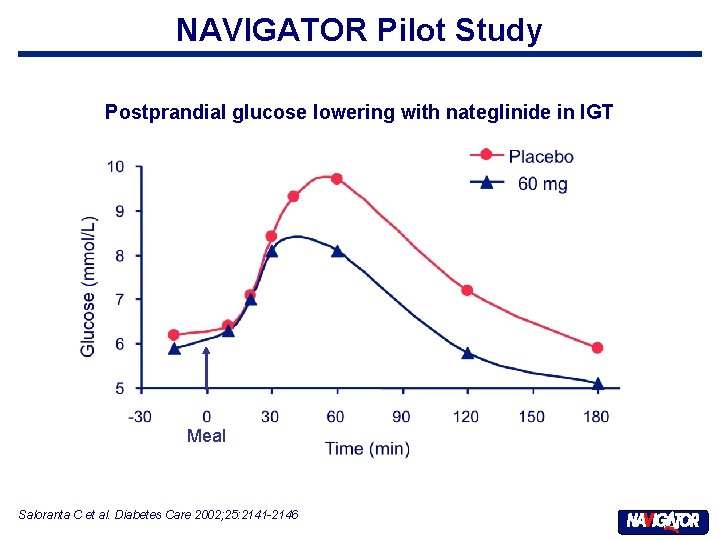
NAVIGATOR Pilot Study Postprandial glucose lowering with nateglinide in IGT Meal Saloranta C et al. Diabetes Care 2002; 25: 2141 -2146
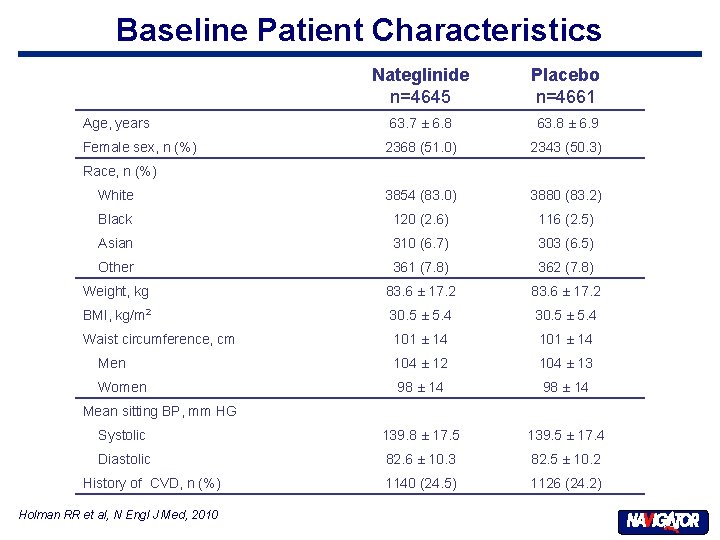
Baseline Patient Characteristics Nateglinide n=4645 Placebo n=4661 63. 7 ± 6. 8 63. 8 ± 6. 9 2368 (51. 0) 2343 (50. 3) White 3854 (83. 0) 3880 (83. 2) Black 120 (2. 6) 116 (2. 5) Asian 310 (6. 7) 303 (6. 5) Other 361 (7. 8) 362 (7. 8) Weight, kg 83. 6 ± 17. 2 BMI, kg/m 2 30. 5 ± 5. 4 Waist circumference, cm 101 ± 14 Men 104 ± 12 104 ± 13 Women 98 ± 14 Systolic 139. 8 ± 17. 5 139. 5 ± 17. 4 Diastolic 82. 6 ± 10. 3 82. 5 ± 10. 2 History of CVD, n (%) 1140 (24. 5) 1126 (24. 2) Age, years Female sex, n (%) Race, n (%) Mean sitting BP, mm HG Holman RR et al, N Engl J Med, 2010
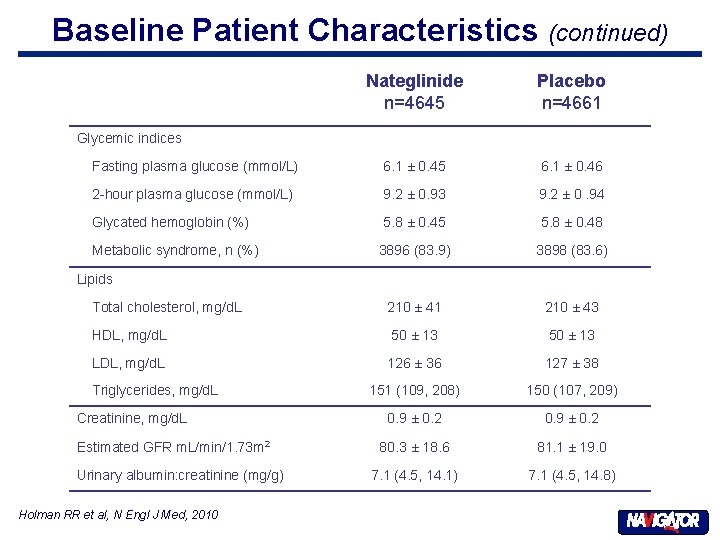
Baseline Patient Characteristics (continued) Nateglinide n=4645 Placebo n=4661 Fasting plasma glucose (mmol/L) 6. 1 ± 0. 45 6. 1 ± 0. 46 2 -hour plasma glucose (mmol/L) 9. 2 ± 0. 93 9. 2 ± 0. 94 Glycated hemoglobin (%) 5. 8 ± 0. 45 5. 8 ± 0. 48 3896 (83. 9) 3898 (83. 6) Total cholesterol, mg/d. L 210 ± 41 210 ± 43 HDL, mg/d. L 50 ± 13 LDL, mg/d. L 126 ± 36 127 ± 38 151 (109, 208) 150 (107, 209) 0. 9 ± 0. 2 80. 3 ± 18. 6 81. 1 ± 19. 0 7. 1 (4. 5, 14. 1) 7. 1 (4. 5, 14. 8) Glycemic indices Metabolic syndrome, n (%) Lipids Triglycerides, mg/d. L Creatinine, mg/d. L Estimated GFR m. L/min/1. 73 m 2 Urinary albumin: creatinine (mg/g) Holman RR et al, N Engl J Med, 2010
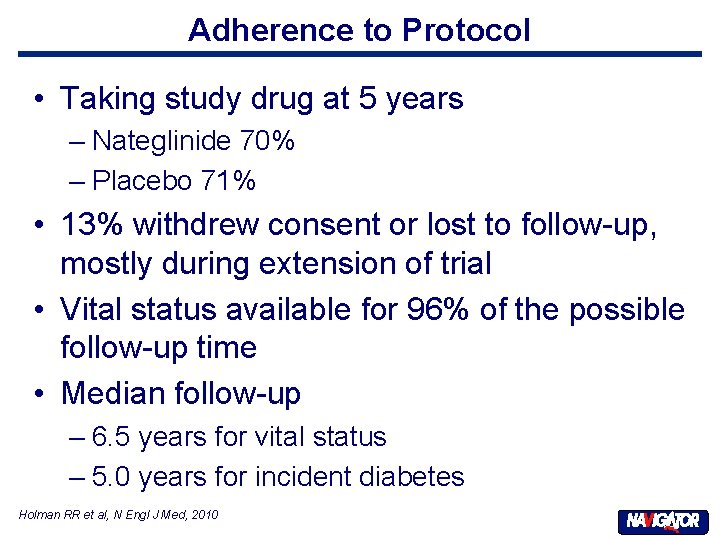
Adherence to Protocol • Taking study drug at 5 years – Nateglinide 70% – Placebo 71% • 13% withdrew consent or lost to follow-up, mostly during extension of trial • Vital status available for 96% of the possible follow-up time • Median follow-up – 6. 5 years for vital status – 5. 0 years for incident diabetes Holman RR et al, N Engl J Med, 2010
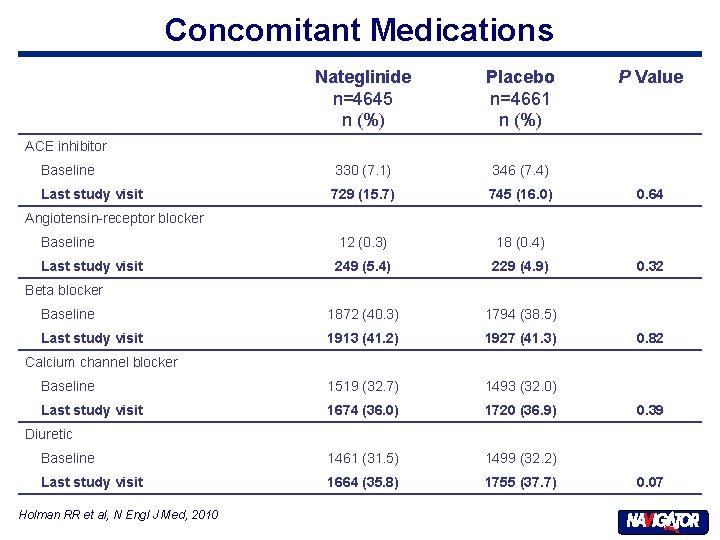
Concomitant Medications Nateglinide n=4645 n (%) Placebo n=4661 n (%) 330 (7. 1) 346 (7. 4) 729 (15. 7) 745 (16. 0) 12 (0. 3) 18 (0. 4) 249 (5. 4) 229 (4. 9) 1872 (40. 3) 1794 (38. 5) 1913 (41. 2) 1927 (41. 3) 1519 (32. 7) 1493 (32. 0) 1674 (36. 0) 1720 (36. 9) 1461 (31. 5) 1499 (32. 2) 1664 (35. 8) 1755 (37. 7) P Value ACE inhibitor Baseline Last study visit 0. 64 Angiotensin-receptor blocker Baseline Last study visit 0. 32 Beta blocker Baseline Last study visit 0. 82 Calcium channel blocker Baseline Last study visit 0. 39 Diuretic Baseline Last study visit Holman RR et al, N Engl J Med, 2010 0. 07
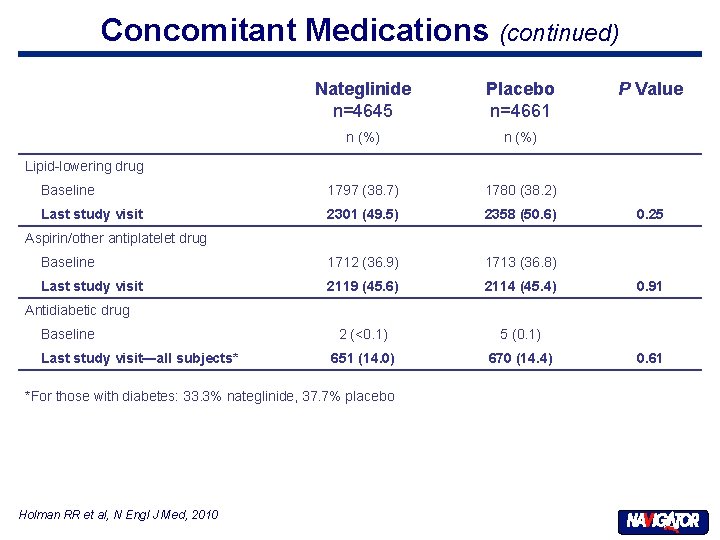
Concomitant Medications (continued) Nateglinide n=4645 Placebo n=4661 n (%) 1797 (38. 7) 1780 (38. 2) 2301 (49. 5) 2358 (50. 6) 1712 (36. 9) 1713 (36. 8) 2119 (45. 6) 2114 (45. 4) 2 (<0. 1) 5 (0. 1) 651 (14. 0) 670 (14. 4) P Value Lipid-lowering drug Baseline Last study visit 0. 25 Aspirin/other antiplatelet drug Baseline Last study visit 0. 91 Antidiabetic drug Baseline Last study visit—all subjects* *For those with diabetes: 33. 3% nateglinide, 37. 7% placebo Holman RR et al, N Engl J Med, 2010 0. 61
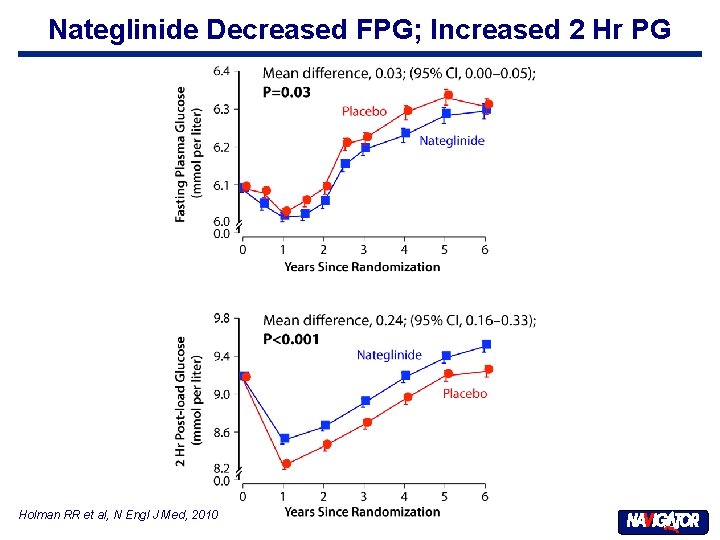
Nateglinide Decreased FPG; Increased 2 Hr PG Holman RR et al, N Engl J Med, 2010
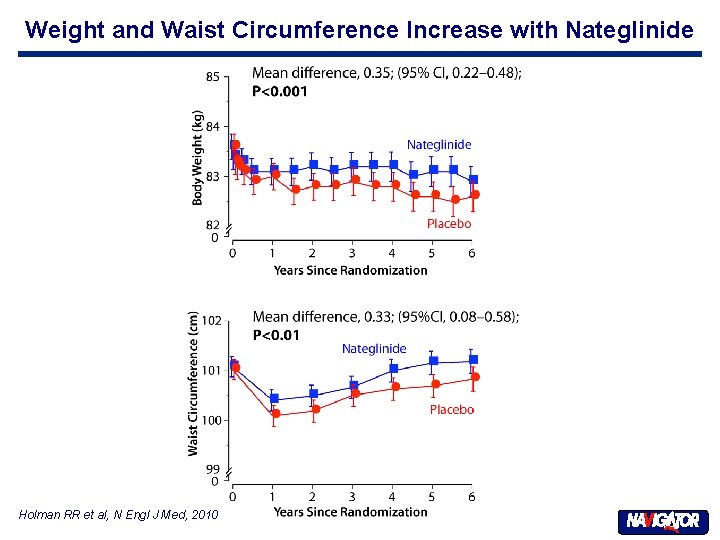
Weight and Waist Circumference Increase with Nateglinide Holman RR et al, N Engl J Med, 2010
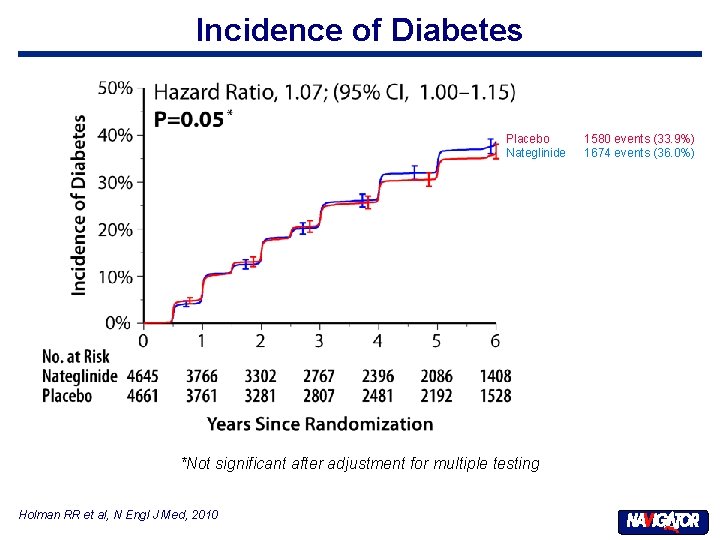
Incidence of Diabetes Placebo Nateglinide *Not significant after adjustment for multiple testing Holman RR et al, N Engl J Med, 2010 1580 events (33. 9%) 1674 events (36. 0%)
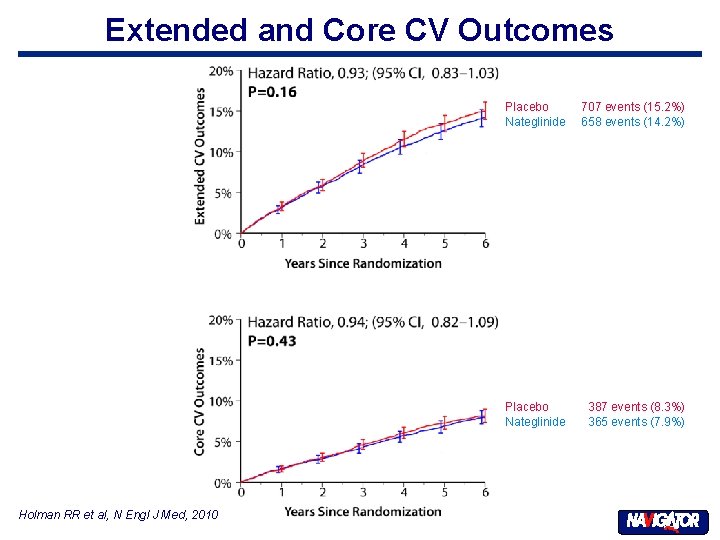
Extended and Core CV Outcomes Holman RR et al, N Engl J Med, 2010 Placebo Nateglinide 707 events (15. 2%) 658 events (14. 2%) Placebo Nateglinide 387 events (8. 3%) 365 events (7. 9%)
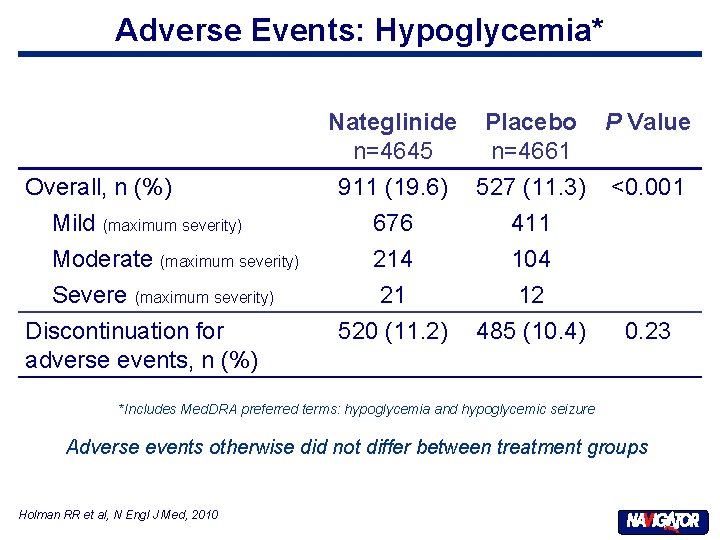
Adverse Events: Hypoglycemia* Overall, n (%) Mild (maximum severity) Moderate (maximum severity) Severe (maximum severity) Discontinuation for adverse events, n (%) Nateglinide Placebo P Value n=4645 n=4661 911 (19. 6) 527 (11. 3) <0. 001 676 411 214 21 520 (11. 2) 104 12 485 (10. 4) 0. 23 *Includes Med. DRA preferred terms: hypoglycemia and hypoglycemic seizure Adverse events otherwise did not differ between treatment groups Holman RR et al, N Engl J Med, 2010
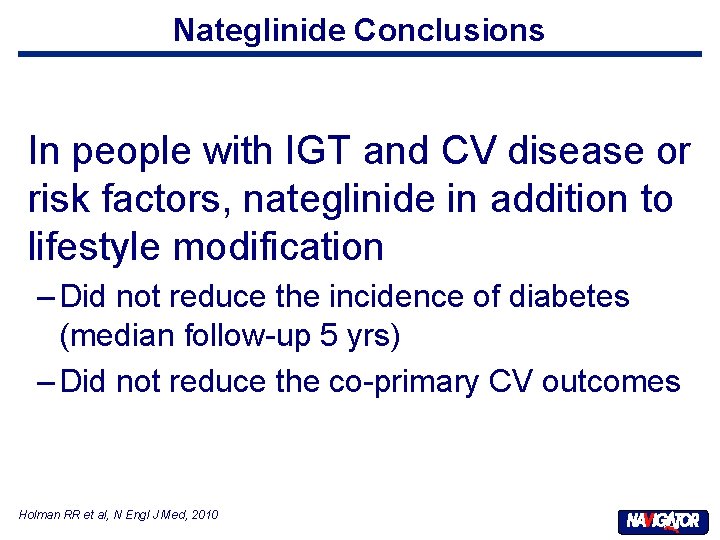
Nateglinide Conclusions In people with IGT and CV disease or risk factors, nateglinide in addition to lifestyle modification – Did not reduce the incidence of diabetes (median follow-up 5 yrs) – Did not reduce the co-primary CV outcomes Holman RR et al, N Engl J Med, 2010
Valsartan Data
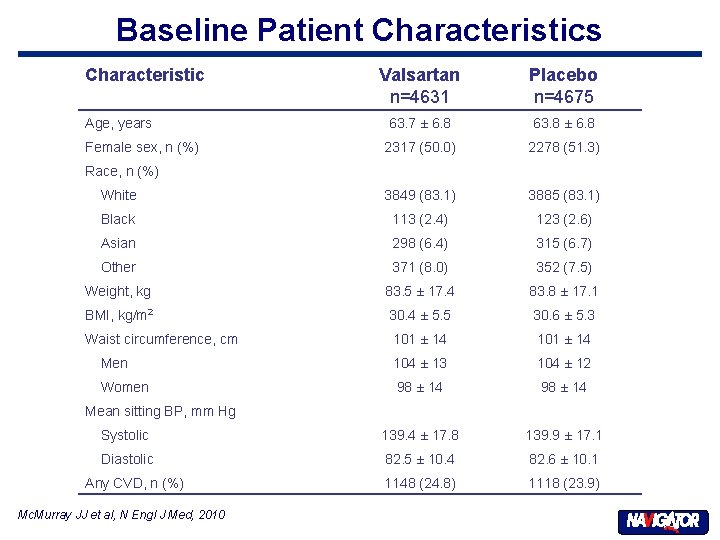
Baseline Patient Characteristics Characteristic Valsartan n=4631 Placebo n=4675 63. 7 ± 6. 8 63. 8 ± 6. 8 2317 (50. 0) 2278 (51. 3) White 3849 (83. 1) 3885 (83. 1) Black 113 (2. 4) 123 (2. 6) Asian 298 (6. 4) 315 (6. 7) Other 371 (8. 0) 352 (7. 5) Weight, kg 83. 5 ± 17. 4 83. 8 ± 17. 1 BMI, kg/m 2 30. 4 ± 5. 5 30. 6 ± 5. 3 Waist circumference, cm 101 ± 14 Men 104 ± 13 104 ± 12 Women 98 ± 14 Systolic 139. 4 ± 17. 8 139. 9 ± 17. 1 Diastolic 82. 5 ± 10. 4 82. 6 ± 10. 1 Any CVD, n (%) 1148 (24. 8) 1118 (23. 9) Age, years Female sex, n (%) Race, n (%) Mean sitting BP, mm Hg Mc. Murray JJ et al, N Engl J Med, 2010
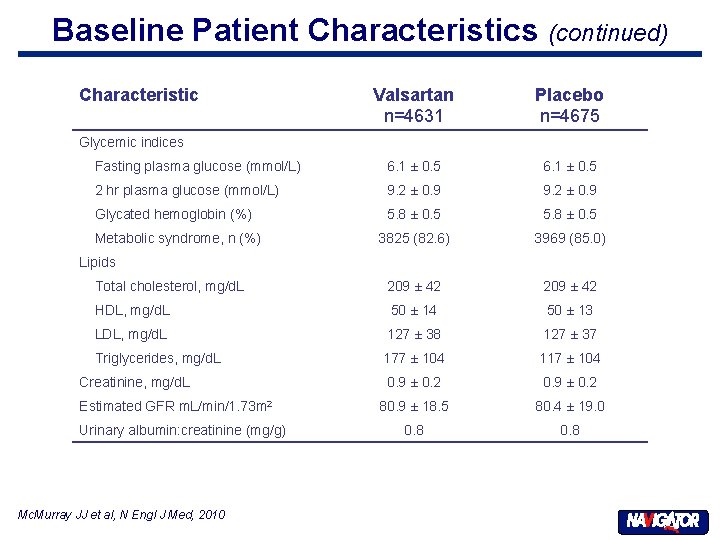
Baseline Patient Characteristics (continued) Characteristic Valsartan n=4631 Placebo n=4675 Fasting plasma glucose (mmol/L) 6. 1 ± 0. 5 2 hr plasma glucose (mmol/L) 9. 2 ± 0. 9 Glycated hemoglobin (%) 5. 8 ± 0. 5 3825 (82. 6) 3969 (85. 0) Total cholesterol, mg/d. L 209 ± 42 HDL, mg/d. L 50 ± 14 50 ± 13 LDL, mg/d. L 127 ± 38 127 ± 37 Triglycerides, mg/d. L 177 ± 104 117 ± 104 Creatinine, mg/d. L 0. 9 ± 0. 2 80. 9 ± 18. 5 80. 4 ± 19. 0 0. 8 Glycemic indices Metabolic syndrome, n (%) Lipids Estimated GFR m. L/min/1. 73 m 2 Urinary albumin: creatinine (mg/g) Mc. Murray JJ et al, N Engl J Med, 2010
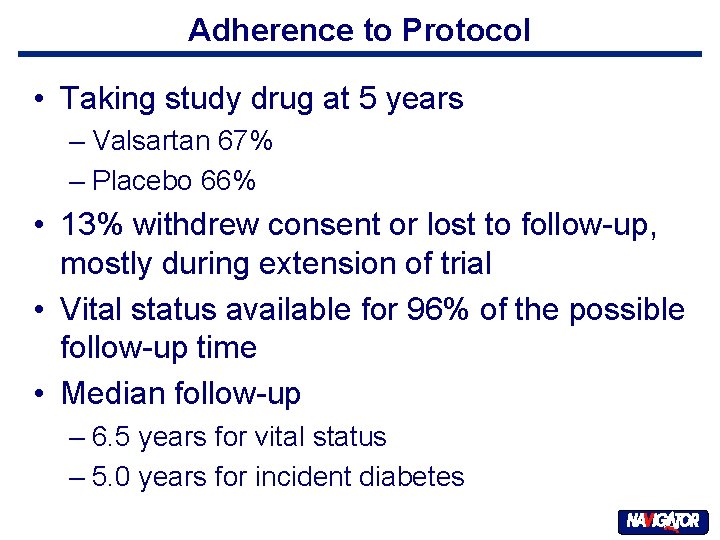
Adherence to Protocol • Taking study drug at 5 years – Valsartan 67% – Placebo 66% • 13% withdrew consent or lost to follow-up, mostly during extension of trial • Vital status available for 96% of the possible follow-up time • Median follow-up – 6. 5 years for vital status – 5. 0 years for incident diabetes
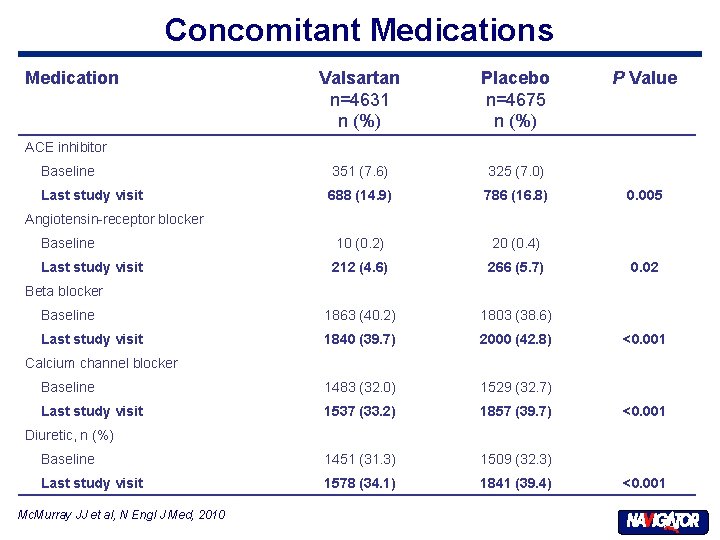
Concomitant Medications Medication Valsartan n=4631 n (%) Placebo n=4675 n (%) 351 (7. 6) 325 (7. 0) 688 (14. 9) 786 (16. 8) 10 (0. 2) 20 (0. 4) 212 (4. 6) 266 (5. 7) 1863 (40. 2) 1803 (38. 6) 1840 (39. 7) 2000 (42. 8) 1483 (32. 0) 1529 (32. 7) 1537 (33. 2) 1857 (39. 7) 1451 (31. 3) 1509 (32. 3) 1578 (34. 1) 1841 (39. 4) P Value ACE inhibitor Baseline Last study visit 0. 005 Angiotensin-receptor blocker Baseline Last study visit 0. 02 Beta blocker Baseline Last study visit <0. 001 Calcium channel blocker Baseline Last study visit <0. 001 Diuretic, n (%) Baseline Last study visit Mc. Murray JJ et al, N Engl J Med, 2010 <0. 001
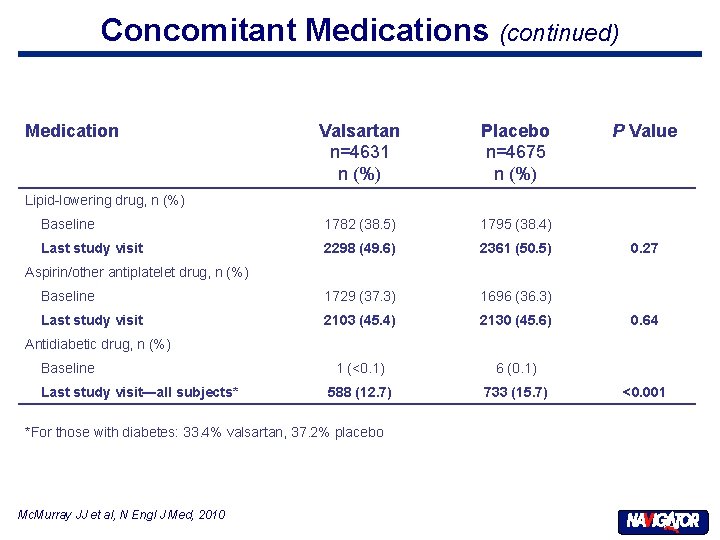
Concomitant Medications (continued) Medication Valsartan n=4631 n (%) Placebo n=4675 n (%) 1782 (38. 5) 1795 (38. 4) 2298 (49. 6) 2361 (50. 5) 1729 (37. 3) 1696 (36. 3) 2103 (45. 4) 2130 (45. 6) 1 (<0. 1) 6 (0. 1) 588 (12. 7) 733 (15. 7) P Value Lipid-lowering drug, n (%) Baseline Last study visit 0. 27 Aspirin/other antiplatelet drug, n (%) Baseline Last study visit 0. 64 Antidiabetic drug, n (%) Baseline Last study visit—all subjects* *For those with diabetes: 33. 4% valsartan, 37. 2% placebo Mc. Murray JJ et al, N Engl J Med, 2010 <0. 001
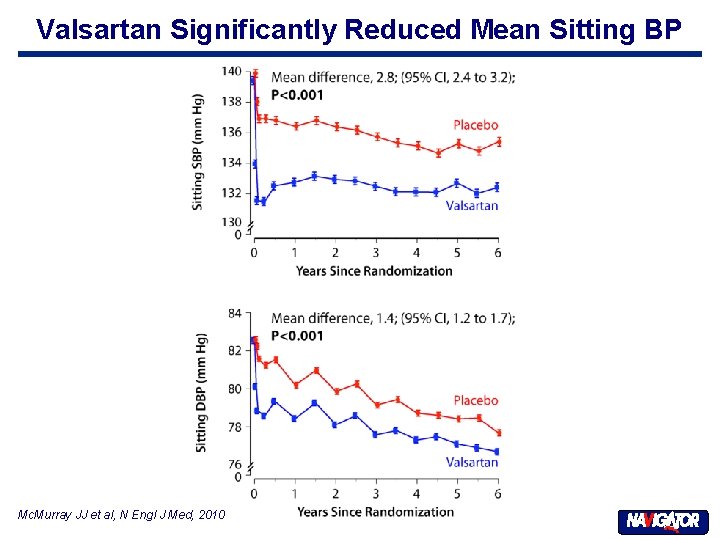
Valsartan Significantly Reduced Mean Sitting BP Mc. Murray JJ et al, N Engl J Med, 2010
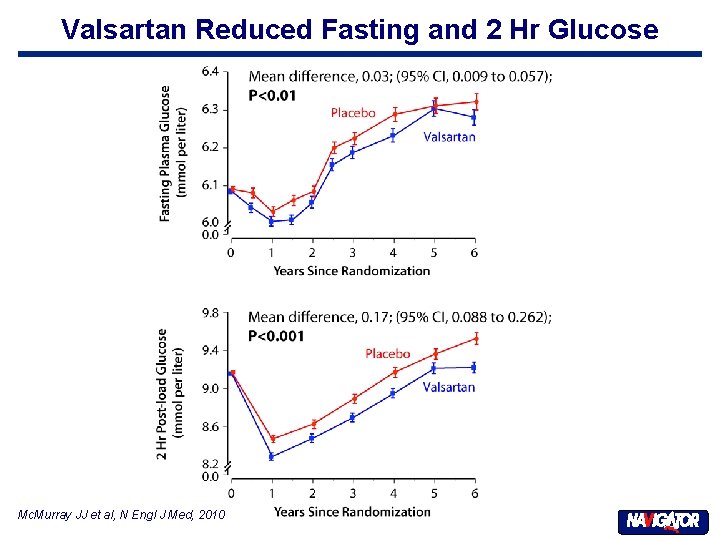
Valsartan Reduced Fasting and 2 Hr Glucose Mc. Murray JJ et al, N Engl J Med, 2010
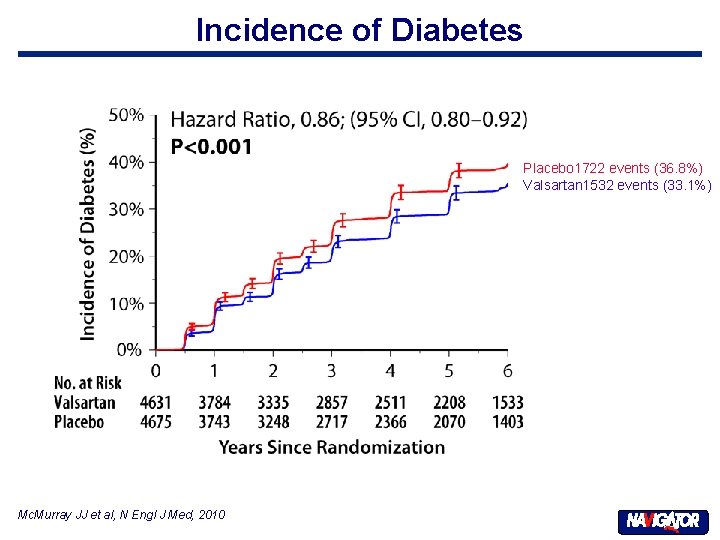
Incidence of Diabetes Placebo 1722 events (36. 8%) Valsartan 1532 events (33. 1%) Mc. Murray JJ et al, N Engl J Med, 2010
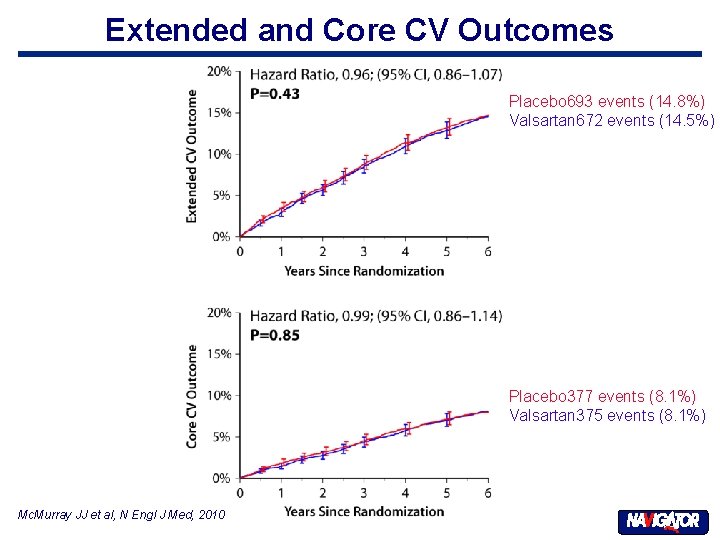
Extended and Core CV Outcomes Placebo 693 events (14. 8%) Valsartan 672 events (14. 5%) Placebo 377 events (8. 1%) Valsartan 375 events (8. 1%) Mc. Murray JJ et al, N Engl J Med, 2010
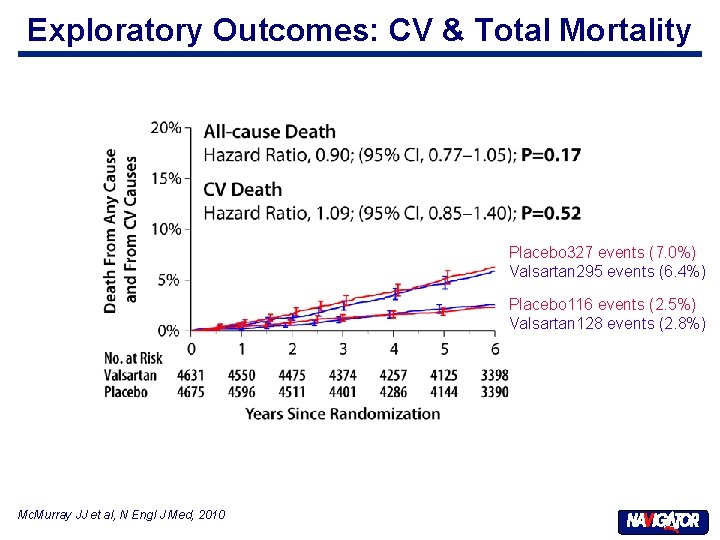
Exploratory Outcomes: CV & Total Mortality Placebo 327 events (7. 0%) Valsartan 295 events (6. 4%) Placebo 116 events (2. 5%) Valsartan 128 events (2. 8%) Mc. Murray JJ et al, N Engl J Med, 2010
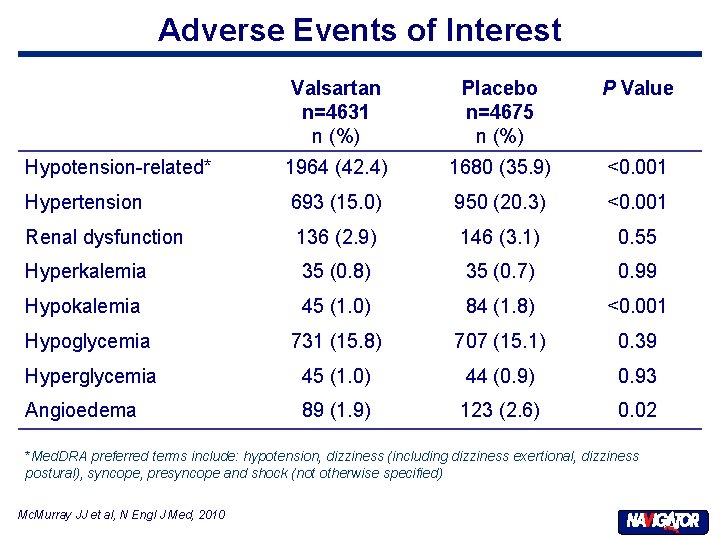
Adverse Events of Interest Valsartan n=4631 n (%) Placebo n=4675 n (%) P Value Hypotension-related* 1964 (42. 4) 1680 (35. 9) <0. 001 Hypertension 693 (15. 0) 950 (20. 3) <0. 001 Renal dysfunction 136 (2. 9) 146 (3. 1) 0. 55 Hyperkalemia 35 (0. 8) 35 (0. 7) 0. 99 Hypokalemia 45 (1. 0) 84 (1. 8) <0. 001 Hypoglycemia 731 (15. 8) 707 (15. 1) 0. 39 Hyperglycemia 45 (1. 0) 44 (0. 9) 0. 93 Angioedema 89 (1. 9) 123 (2. 6) 0. 02 *Med. DRA preferred terms include: hypotension, dizziness (including dizziness exertional, dizziness postural), syncope, presyncope and shock (not otherwise specified) Mc. Murray JJ et al, N Engl J Med, 2010
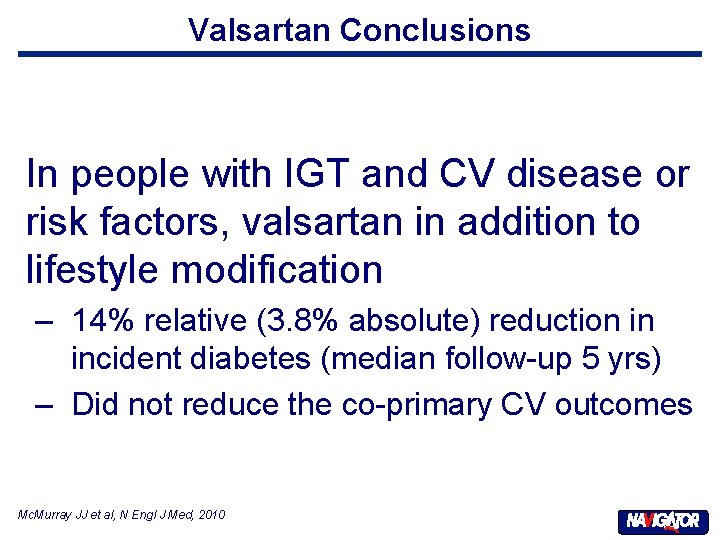
Valsartan Conclusions In people with IGT and CV disease or risk factors, valsartan in addition to lifestyle modification – 14% relative (3. 8% absolute) reduction in incident diabetes (median follow-up 5 yrs) – Did not reduce the co-primary CV outcomes Mc. Murray JJ et al, N Engl J Med, 2010
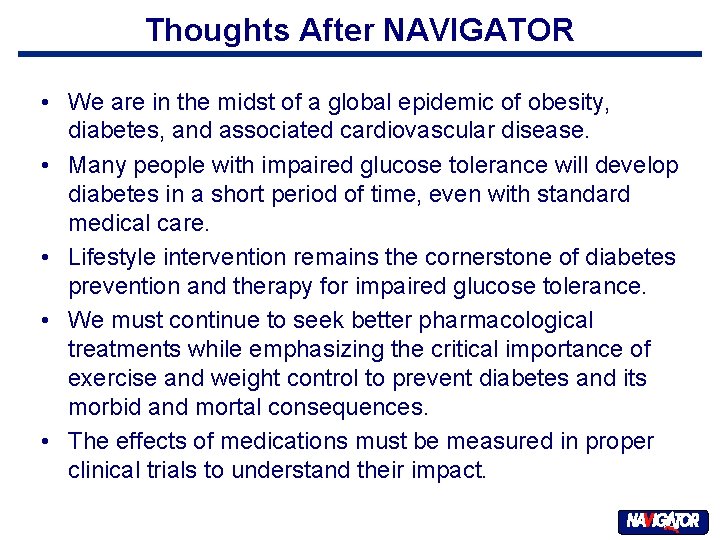
Thoughts After NAVIGATOR • We are in the midst of a global epidemic of obesity, diabetes, and associated cardiovascular disease. • Many people with impaired glucose tolerance will develop diabetes in a short period of time, even with standard medical care. • Lifestyle intervention remains the cornerstone of diabetes prevention and therapy for impaired glucose tolerance. • We must continue to seek better pharmacological treatments while emphasizing the critical importance of exercise and weight control to prevent diabetes and its morbid and mortal consequences. • The effects of medications must be measured in proper clinical trials to understand their impact.