
NATDMA IS136 George Palafox Ai Wen Liang Gee

- Slides: 46
NA-TDMA (IS-136) George Palafox Ai Wen Liang Gee Yee Johnny Kuok EL 604: Wireless & Mobile Networking 1 Polytechnic University
Outline • Introduction • Why North-American TDMA (NA-TDMA) was created • Started as IS-54; additions made to create IS 136 • • Frequency allocation and FDD/TDD Channels Messages Handoff 2 Polytechnic University
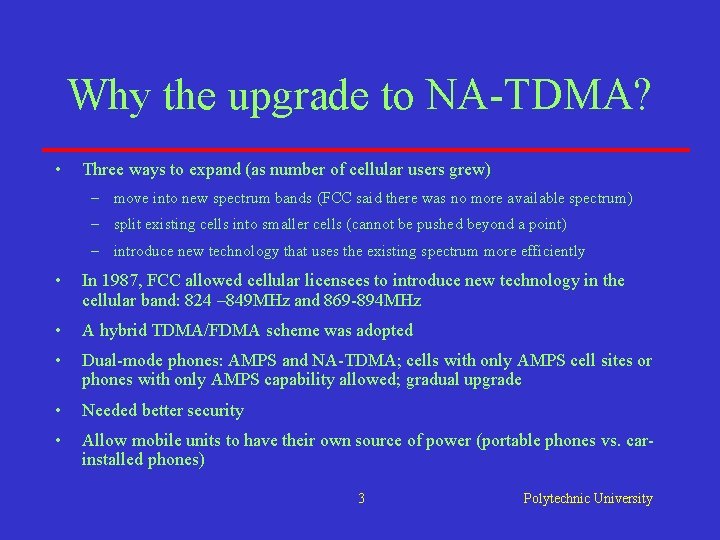
Why the upgrade to NA-TDMA? • Three ways to expand (as number of cellular users grew) – move into new spectrum bands (FCC said there was no more available spectrum) – split existing cells into smaller cells (cannot be pushed beyond a point) – introduce new technology that uses the existing spectrum more efficiently • In 1987, FCC allowed cellular licensees to introduce new technology in the cellular band: 824 – 849 MHz and 869 -894 MHz • A hybrid TDMA/FDMA scheme was adopted • Dual-mode phones: AMPS and NA-TDMA; cells with only AMPS cell sites or phones with only AMPS capability allowed; gradual upgrade • Needed better security • Allow mobile units to have their own source of power (portable phones vs. carinstalled phones) 3 Polytechnic University
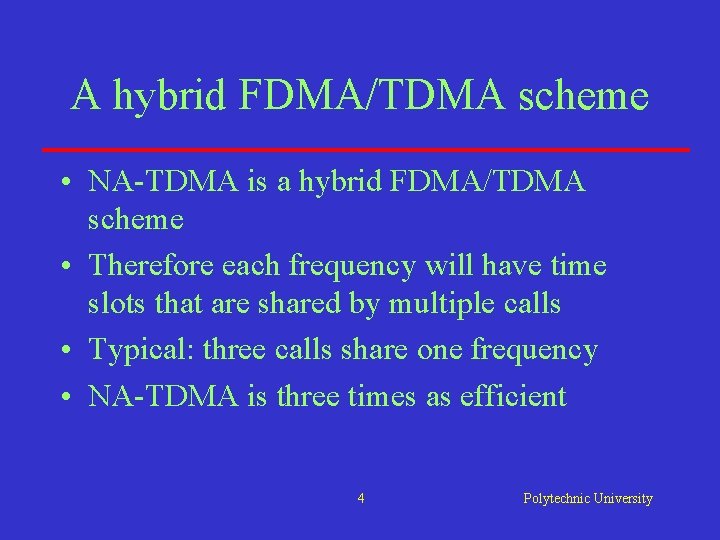
A hybrid FDMA/TDMA scheme • NA-TDMA is a hybrid FDMA/TDMA scheme • Therefore each frequency will have time slots that are shared by multiple calls • Typical: three calls share one frequency • NA-TDMA is three times as efficient 4 Polytechnic University
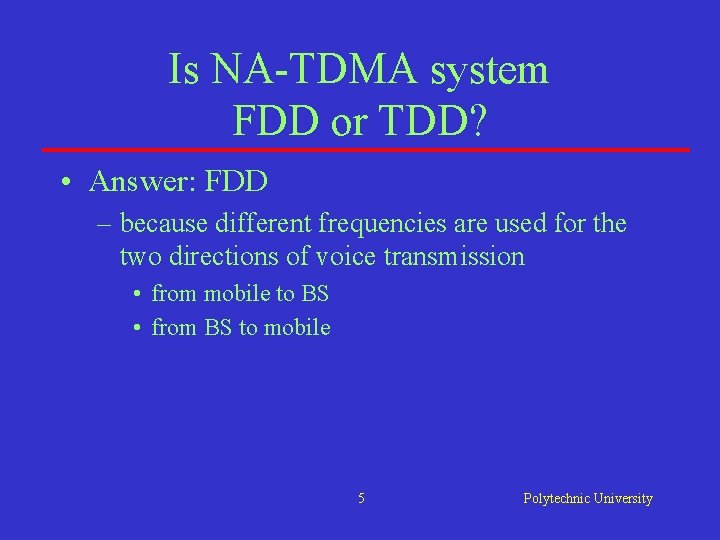
Is NA-TDMA system FDD or TDD? • Answer: FDD – because different frequencies are used for the two directions of voice transmission • from mobile to BS • from BS to mobile 5 Polytechnic University
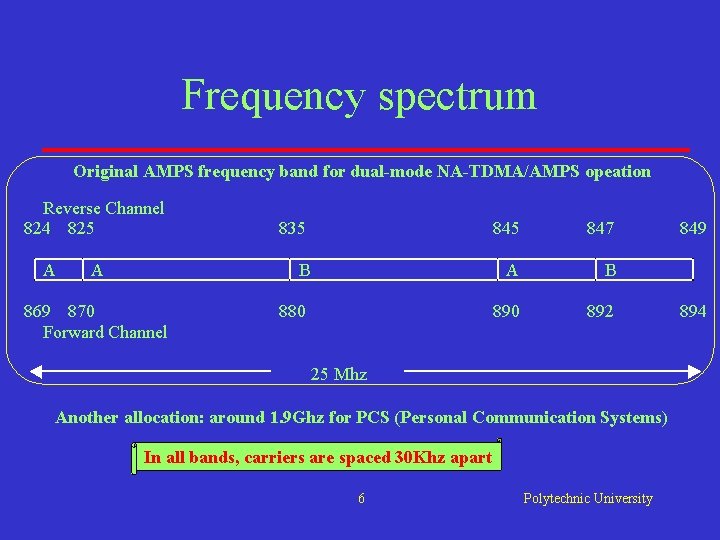
Frequency spectrum Original AMPS frequency band for dual-mode NA-TDMA/AMPS opeation Reverse Channel 824 825 A A 869 870 Forward Channel 835 847 B A B 880 892 25 Mhz Another allocation: around 1. 9 Ghz for PCS (Personal Communication Systems) In all bands, carriers are spaced 30 Khz apart 6 Polytechnic University 849 894
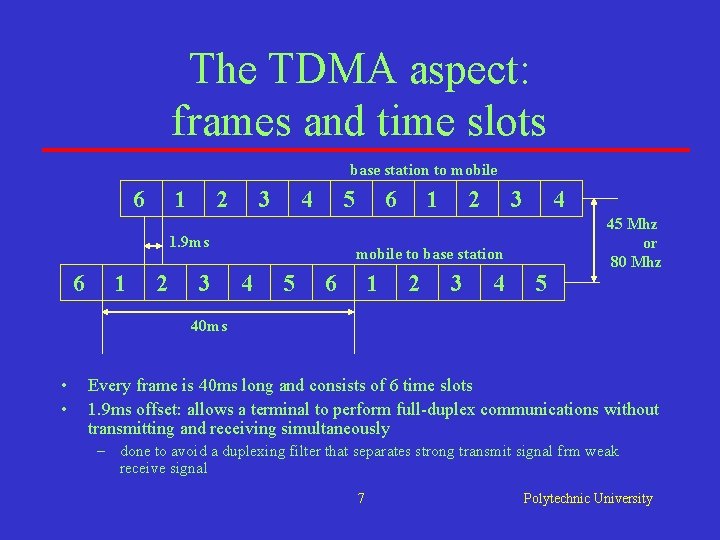
The TDMA aspect: frames and time slots base station to mobile 6 1 2 3 4 5 1. 9 ms 6 1 2 3 4 mobile to base station 4 5 6 1 2 3 4 5 45 Mhz or 80 Mhz 40 ms • • Every frame is 40 ms long and consists of 6 time slots 1. 9 ms offset: allows a terminal to perform full-duplex communications without transmitting and receiving simultaneously – done to avoid a duplexing filter that separates strong transmit signal frm weak receive signal 7 Polytechnic University
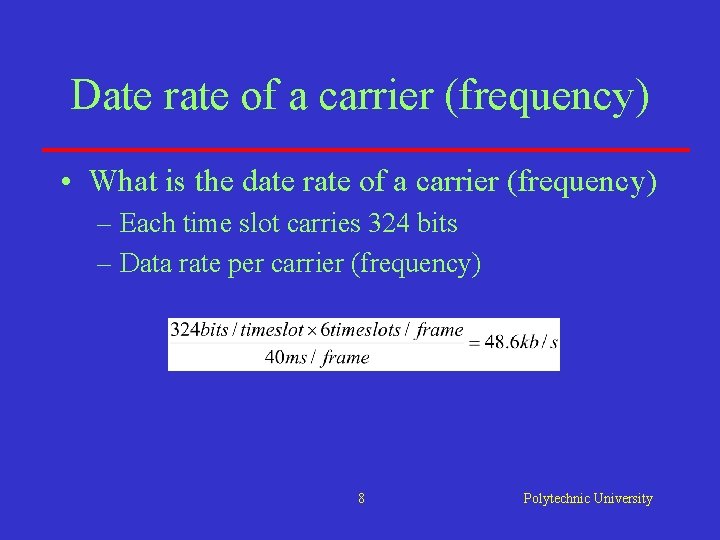
Date rate of a carrier (frequency) • What is the date rate of a carrier (frequency) – Each time slot carries 324 bits – Data rate per carrier (frequency) 8 Polytechnic University
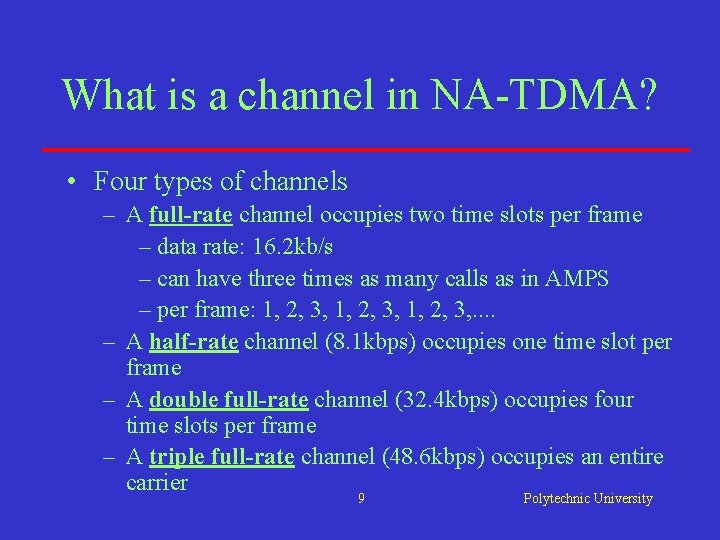
What is a channel in NA-TDMA? • Four types of channels – A full-rate channel occupies two time slots per frame – data rate: 16. 2 kb/s – can have three times as many calls as in AMPS – per frame: 1, 2, 3, . . – A half-rate channel (8. 1 kbps) occupies one time slot per frame – A double full-rate channel (32. 4 kbps) occupies four time slots per frame – A triple full-rate channel (48. 6 kbps) occupies an entire carrier 9 Polytechnic University
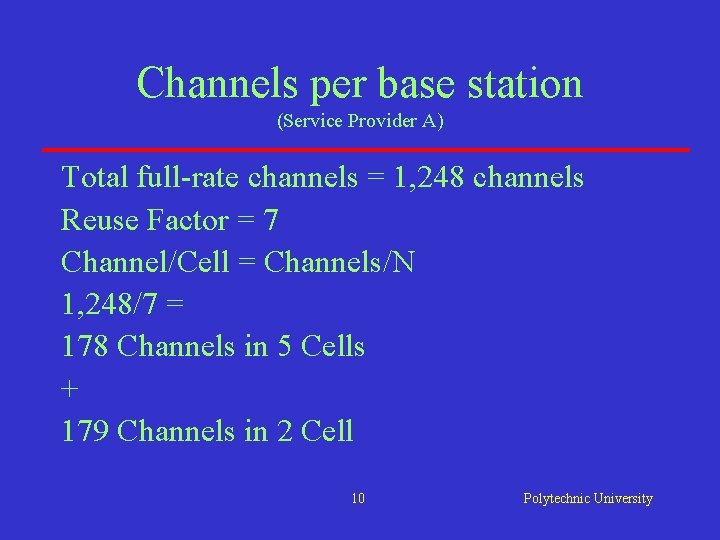
Channels per base station (Service Provider A) Total full-rate channels = 1, 248 channels Reuse Factor = 7 Channel/Cell = Channels/N 1, 248/7 = 178 Channels in 5 Cells + 179 Channels in 2 Cell 10 Polytechnic University
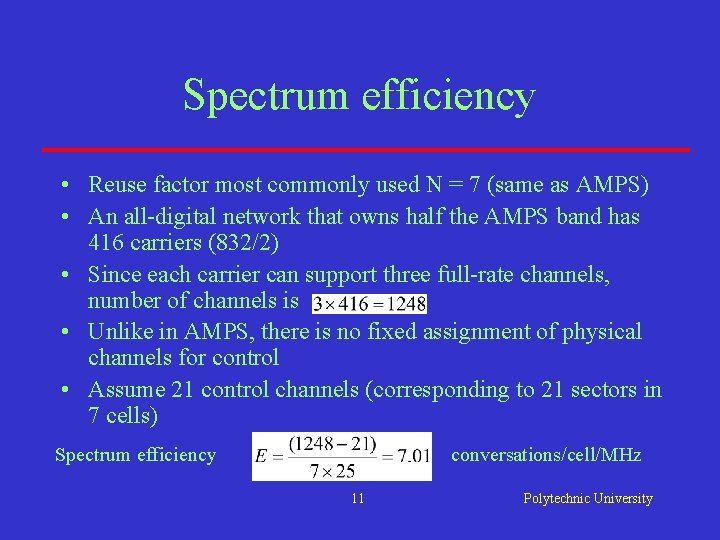
Spectrum efficiency • Reuse factor most commonly used N = 7 (same as AMPS) • An all-digital network that owns half the AMPS band has 416 carriers (832/2) • Since each carrier can support three full-rate channels, number of channels is • Unlike in AMPS, there is no fixed assignment of physical channels for control • Assume 21 control channels (corresponding to 21 sectors in 7 cells) Spectrum efficiency conversations/cell/MHz 11 Polytechnic University
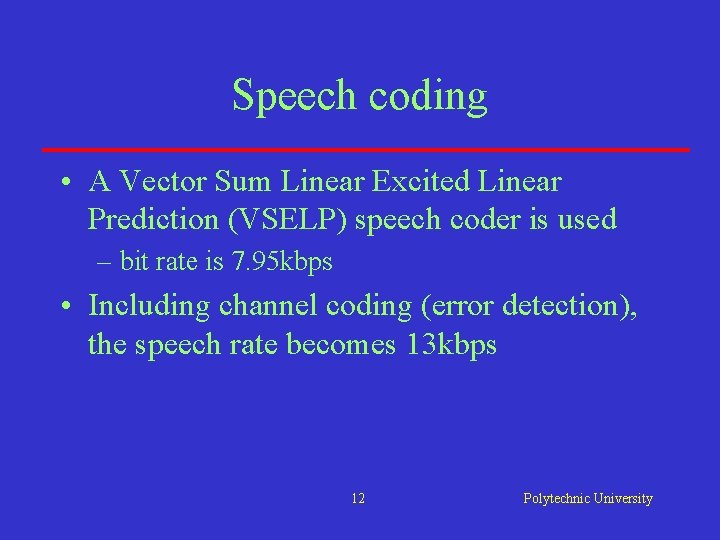
Speech coding • A Vector Sum Linear Excited Linear Prediction (VSELP) speech coder is used – bit rate is 7. 95 kbps • Including channel coding (error detection), the speech rate becomes 13 kbps 12 Polytechnic University
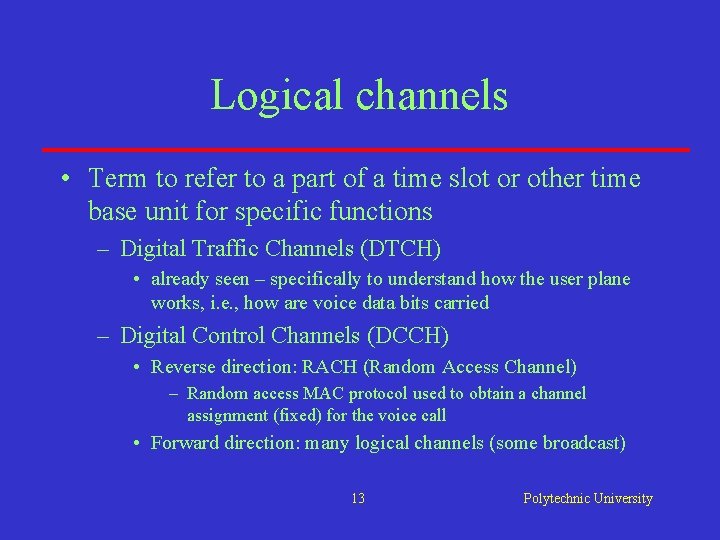
Logical channels • Term to refer to a part of a time slot or other time base unit for specific functions – Digital Traffic Channels (DTCH) • already seen – specifically to understand how the user plane works, i. e. , how are voice data bits carried – Digital Control Channels (DCCH) • Reverse direction: RACH (Random Access Channel) – Random access MAC protocol used to obtain a channel assignment (fixed) for the voice call • Forward direction: many logical channels (some broadcast) 13 Polytechnic University
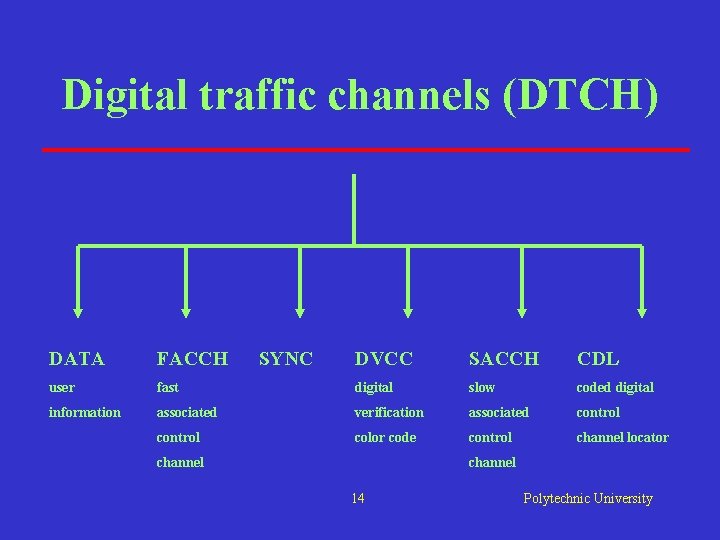
Digital traffic channels (DTCH) DATA FACCH user information SYNC DVCC SACCH CDL fast digital slow coded digital associated verification associated control color code control channel locator channel 14 Polytechnic University
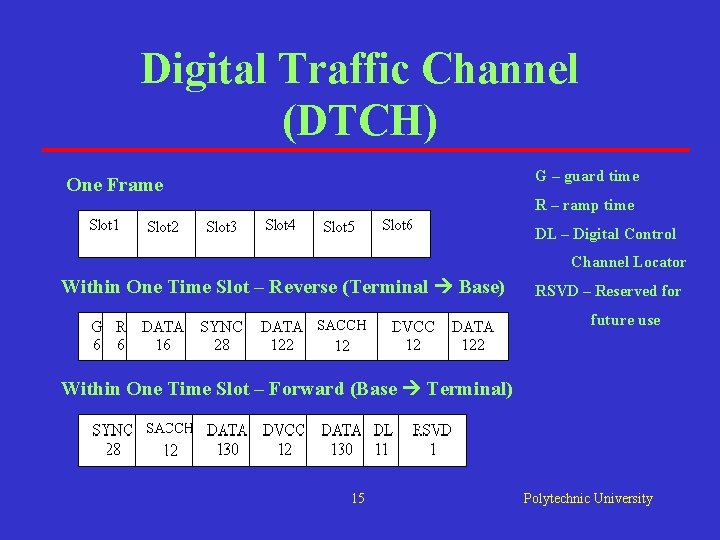
Digital Traffic Channel (DTCH) G – guard time One Frame R – ramp time DL – Digital Control Channel Locator Within One Time Slot – Reverse (Terminal Base) RSVD – Reserved for future use Within One Time Slot – Forward (Base Terminal) 15 Polytechnic University
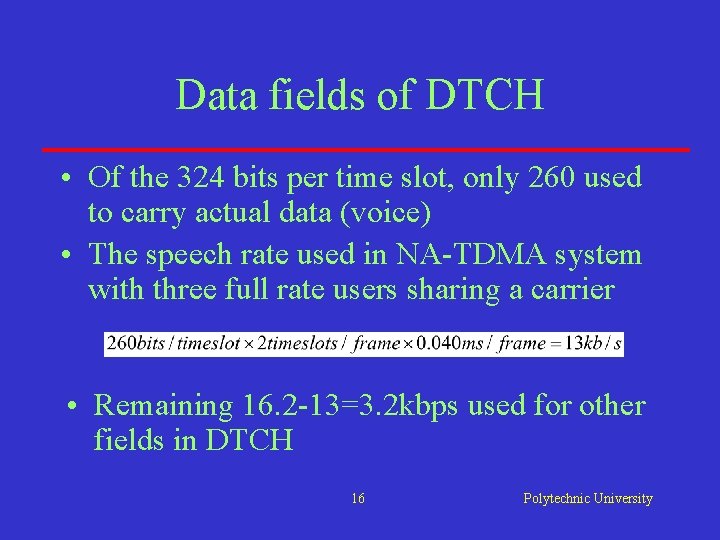
Data fields of DTCH • Of the 324 bits per time slot, only 260 used to carry actual data (voice) • The speech rate used in NA-TDMA system with three full rate users sharing a carrier • Remaining 16. 2 -13=3. 2 kbps used for other fields in DTCH 16 Polytechnic University
DCCH • Any physical carrier can be designated to be a DCCH • Unlike AMPS where a set of frequencies were set aside in the middle of the band as control channels 17 Polytechnic University
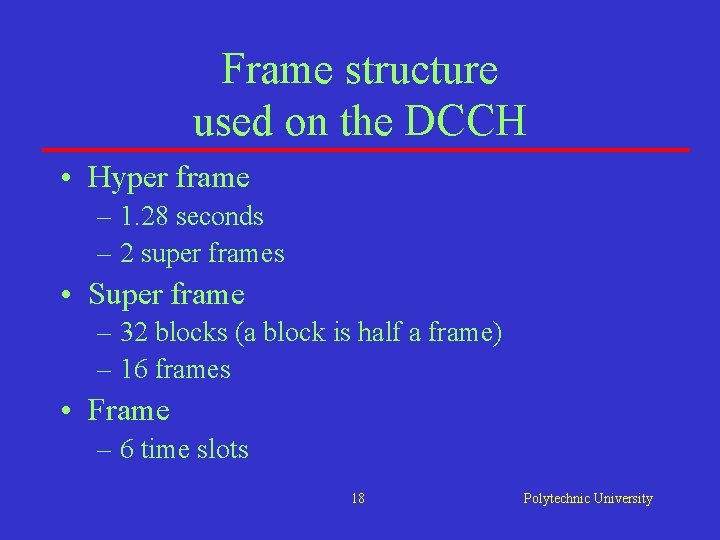
Frame structure used on the DCCH • Hyper frame – 1. 28 seconds – 2 super frames • Super frame – 32 blocks (a block is half a frame) – 16 frames • Frame – 6 time slots 18 Polytechnic University
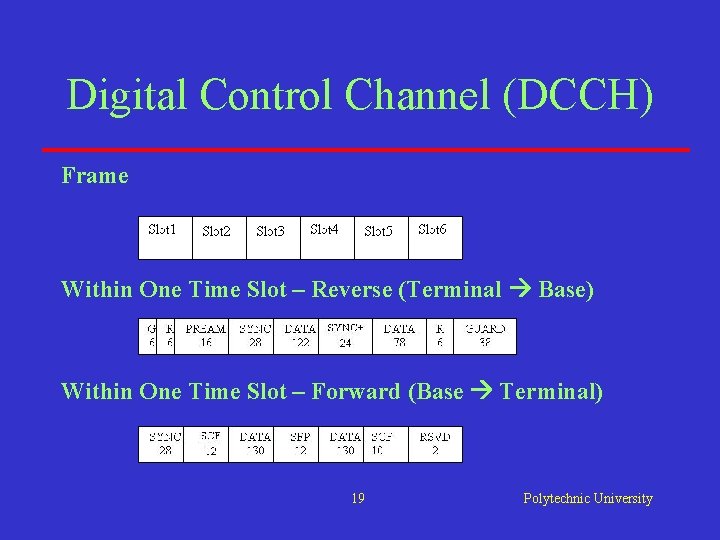
Digital Control Channel (DCCH) Frame Within One Time Slot – Reverse (Terminal Base) Within One Time Slot – Forward (Base Terminal) 19 Polytechnic University
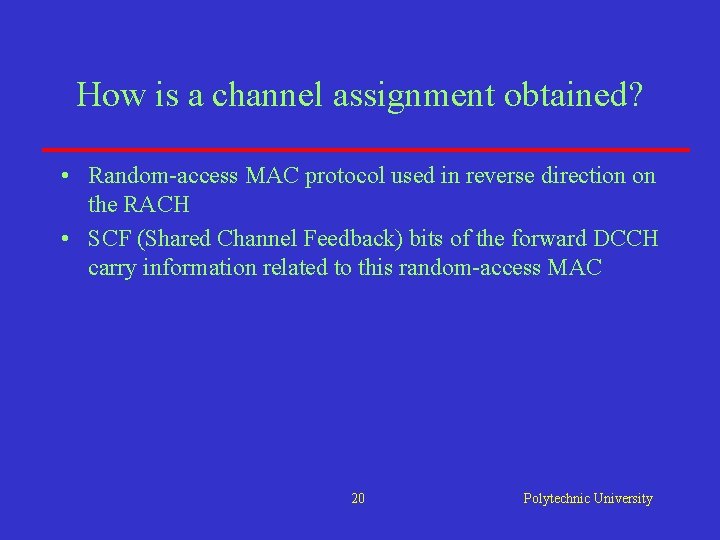
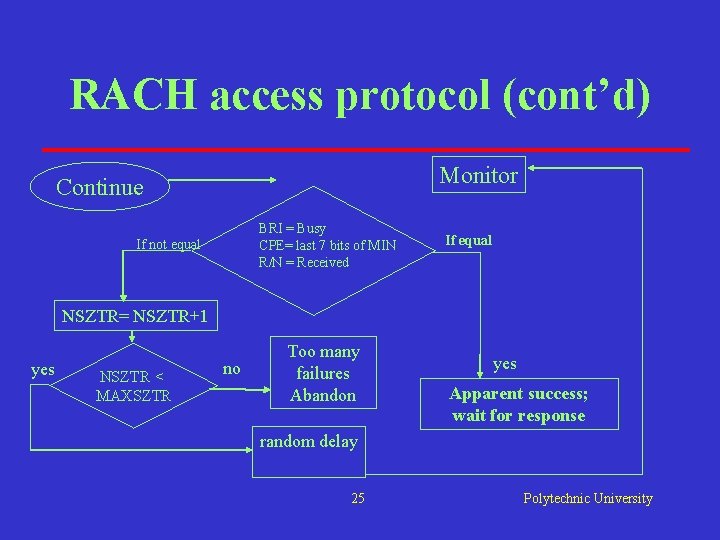
How is a channel assignment obtained? • Random-access MAC protocol used in reverse direction on the RACH • SCF (Shared Channel Feedback) bits of the forward DCCH carry information related to this random-access MAC 20 Polytechnic University
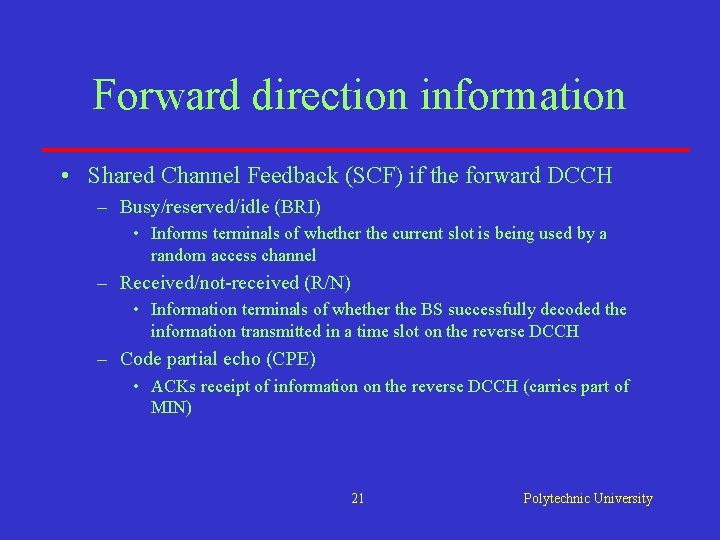
Forward direction information • Shared Channel Feedback (SCF) if the forward DCCH – Busy/reserved/idle (BRI) • Informs terminals of whether the current slot is being used by a random access channel – Received/not-received (R/N) • Information terminals of whether the BS successfully decoded the information transmitted in a time slot on the reverse DCCH – Code partial echo (CPE) • ACKs receipt of information on the reverse DCCH (carries part of MIN) 21 Polytechnic University
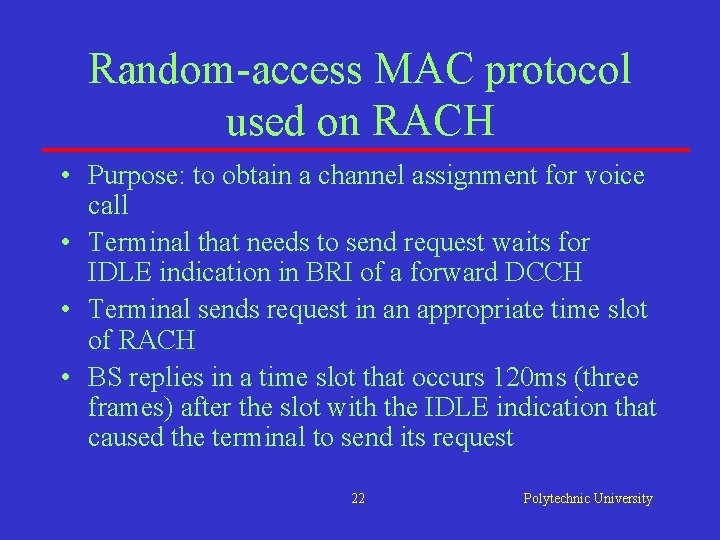
Random-access MAC protocol used on RACH • Purpose: to obtain a channel assignment for voice call • Terminal that needs to send request waits for IDLE indication in BRI of a forward DCCH • Terminal sends request in an appropriate time slot of RACH • BS replies in a time slot that occurs 120 ms (three frames) after the slot with the IDLE indication that caused the terminal to send its request 22 Polytechnic University
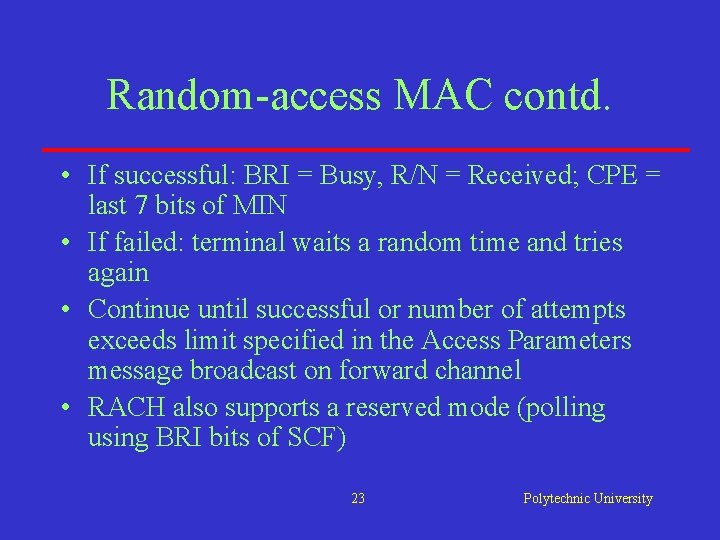
Random-access MAC contd. • If successful: BRI = Busy, R/N = Received; CPE = last 7 bits of MIN • If failed: terminal waits a random time and tries again • Continue until successful or number of attempts exceeds limit specified in the Access Parameters message broadcast on forward channel • RACH also supports a reserved mode (polling using BRI bits of SCF) 23 Polytechnic University
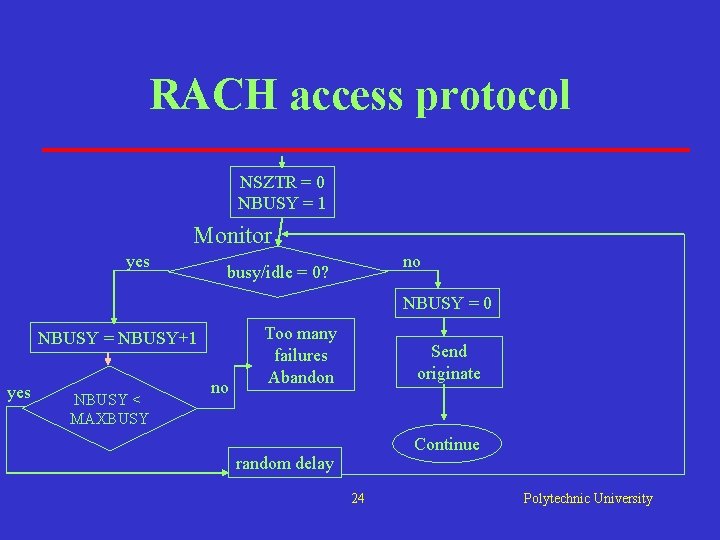
RACH access protocol NSZTR = 0 NBUSY = 1 Monitor yes no busy/idle = 0? NBUSY = 0 NBUSY = NBUSY+1 yes NBUSY < MAXBUSY no Too many failures Abandon Send originate Continue random delay 24 Polytechnic University
RACH access protocol (cont’d) Monitor Continue BRI = Busy CPE= last 7 bits of MIN R/N = Received If not equal If equal NSZTR= NSZTR+1 yes NSZTR < MAXSZTR no Too many failures Abandon yes Apparent success; wait for response random delay 25 Polytechnic University
Messages • Messages on AMPS logical channels • Messages on FACCH and SACCH (on DTCH) • Messages on DCCH 26 Polytechnic University
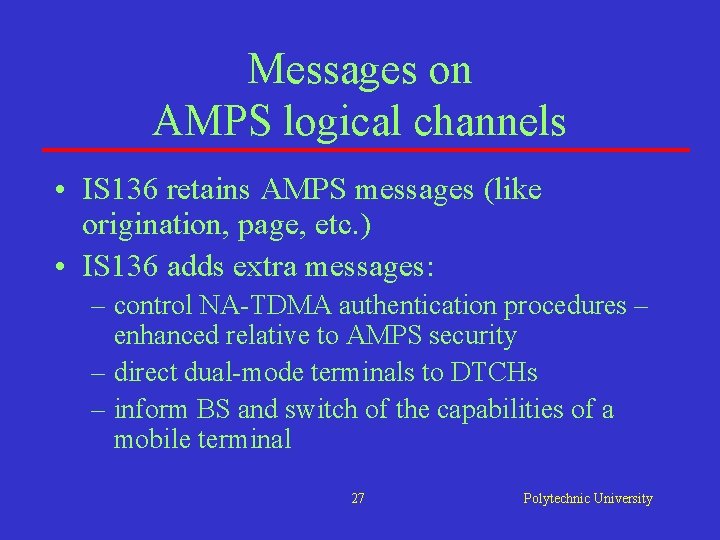
Messages on AMPS logical channels • IS 136 retains AMPS messages (like origination, page, etc. ) • IS 136 adds extra messages: – control NA-TDMA authentication procedures – enhanced relative to AMPS security – direct dual-mode terminals to DTCHs – inform BS and switch of the capabilities of a mobile terminal 27 Polytechnic University
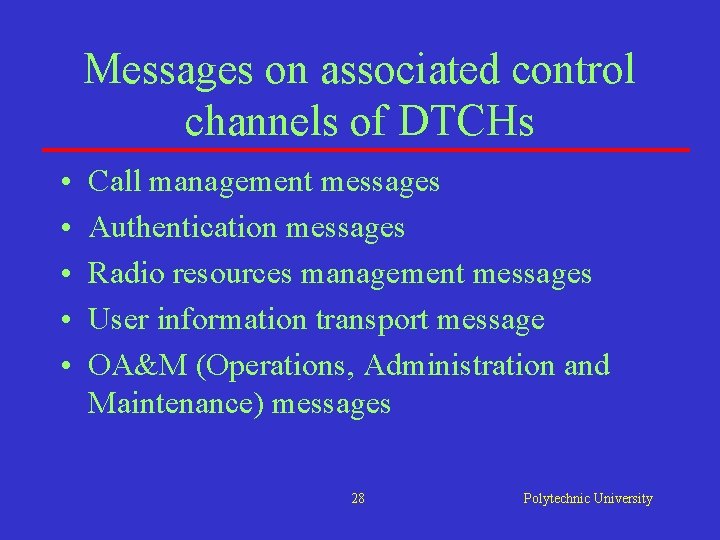
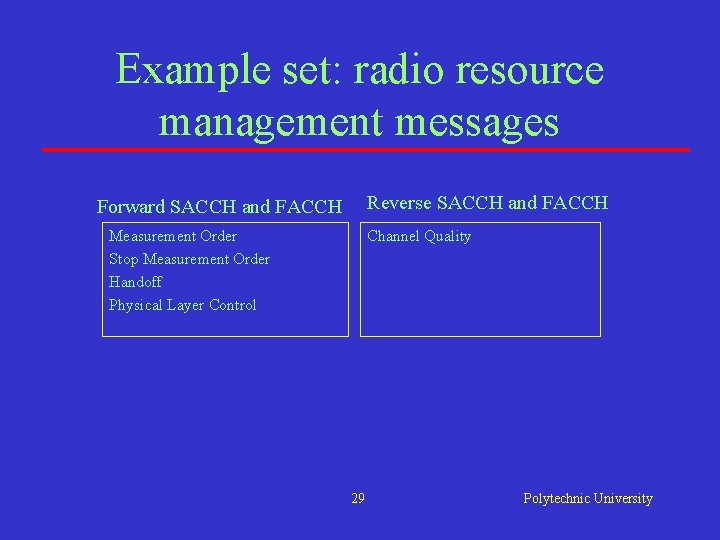
Messages on associated control channels of DTCHs • • • Call management messages Authentication messages Radio resources management messages User information transport message OA&M (Operations, Administration and Maintenance) messages 28 Polytechnic University
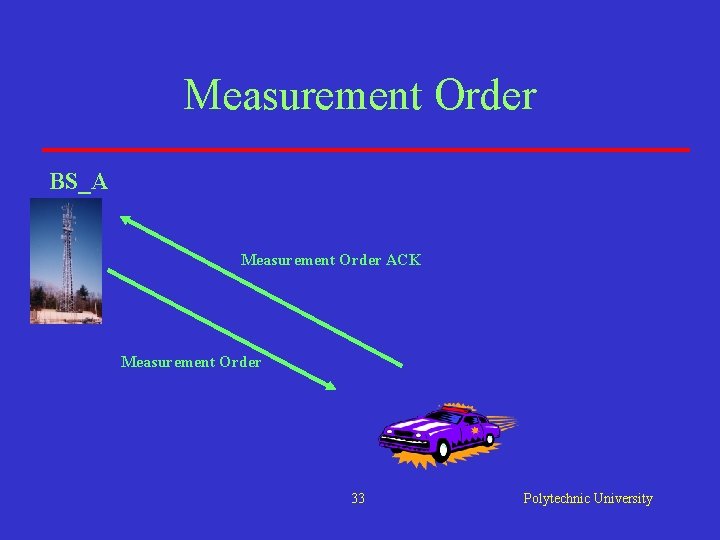
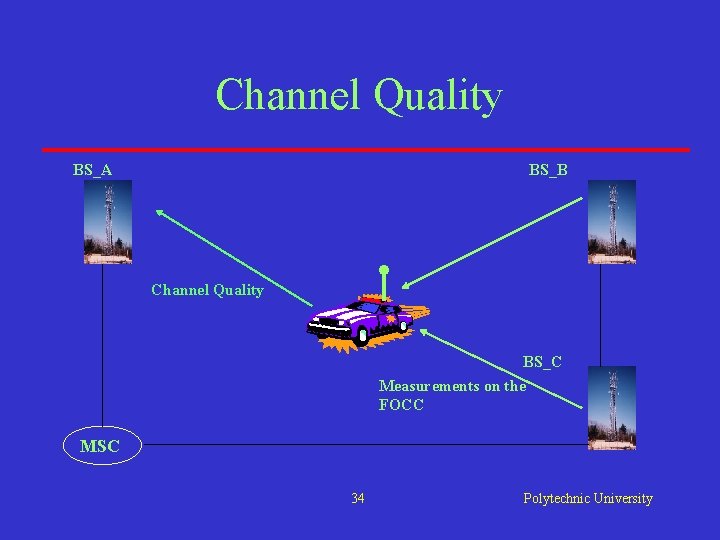
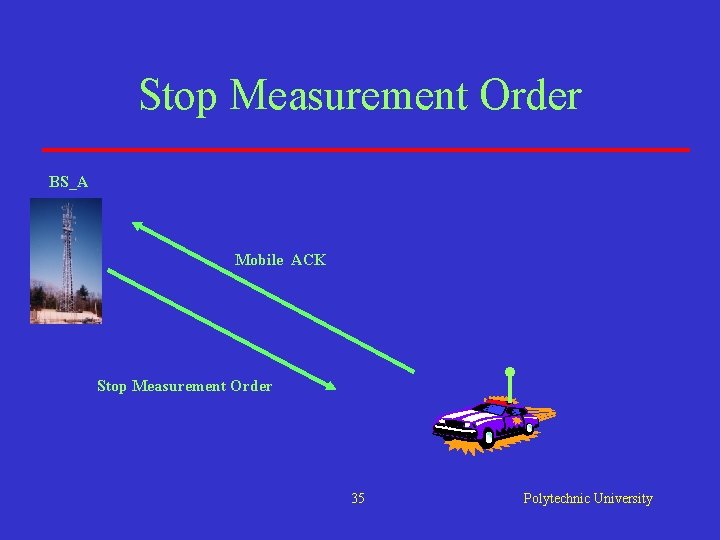
Example set: radio resource management messages Reverse SACCH and FACCH Forward SACCH and FACCH Measurement Order Stop Measurement Order Handoff Physical Layer Control Channel Quality 29 Polytechnic University
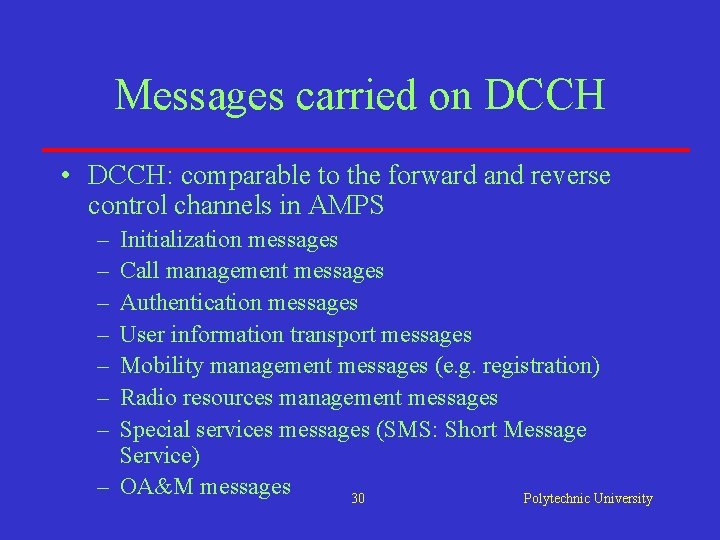
Messages carried on DCCH • DCCH: comparable to the forward and reverse control channels in AMPS – – – – Initialization messages Call management messages Authentication messages User information transport messages Mobility management messages (e. g. registration) Radio resources management messages Special services messages (SMS: Short Message Service) – OA&M messages 30 Polytechnic University
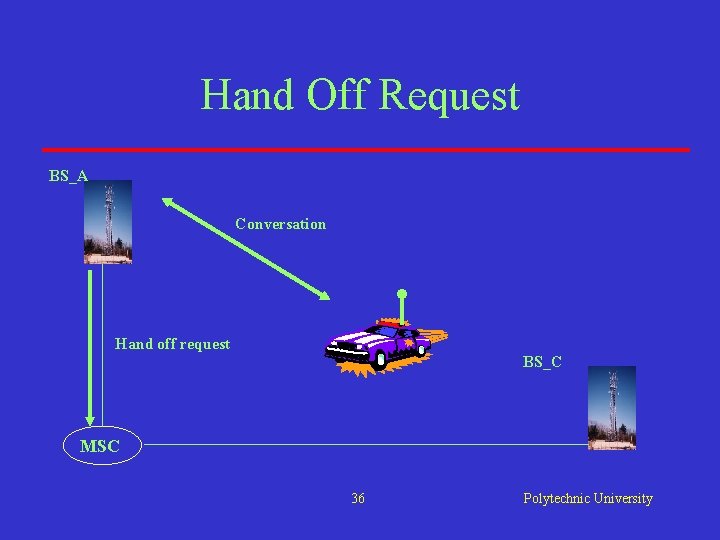
An example IS-136 procedure: handoff • A MAHO scheme • Verifying • Digital-to-digital handing off 31 Polytechnic University
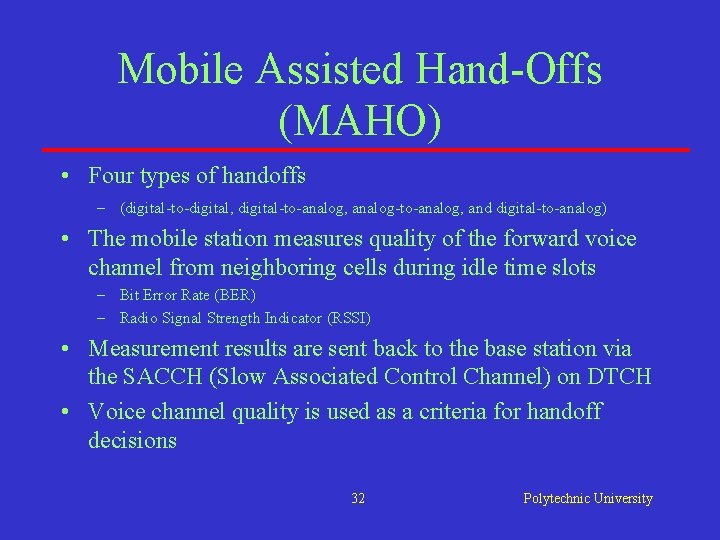
Mobile Assisted Hand-Offs (MAHO) • Four types of handoffs – (digital-to-digital, digital-to-analog, analog-to-analog, and digital-to-analog) • The mobile station measures quality of the forward voice channel from neighboring cells during idle time slots – Bit Error Rate (BER) – Radio Signal Strength Indicator (RSSI) • Measurement results are sent back to the base station via the SACCH (Slow Associated Control Channel) on DTCH • Voice channel quality is used as a criteria for handoff decisions 32 Polytechnic University
Measurement Order BS_A Measurement Order ACK Measurement Order 33 Polytechnic University
Channel Quality BS_A BS_B Channel Quality BS_C Measurements on the FOCC MSC 34 Polytechnic University
Stop Measurement Order BS_A Mobile ACK Stop Measurement Order 35 Polytechnic University
Hand Off Request BS_A Conversation Hand off request BS_C MSC 36 Polytechnic University
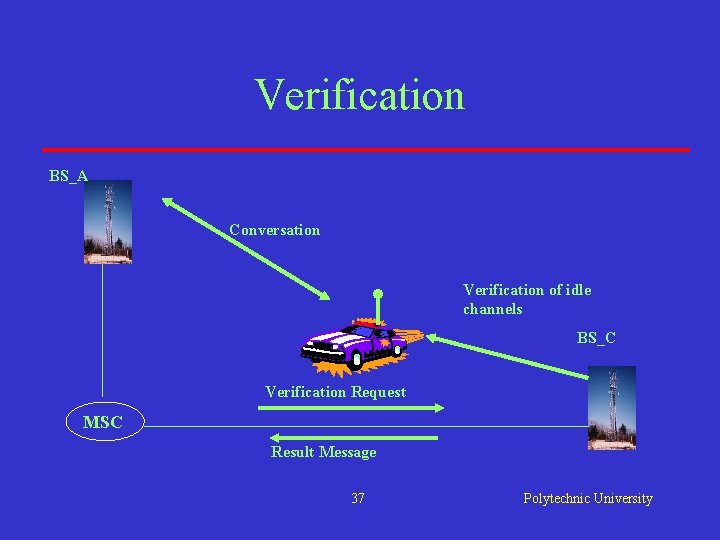
Verification BS_A Conversation Verification of idle channels BS_C Verification Request MSC Result Message 37 Polytechnic University
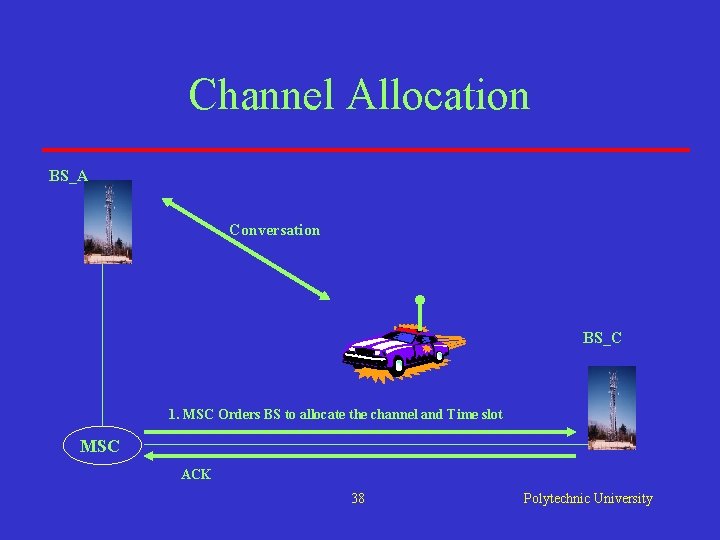
Channel Allocation BS_A Conversation BS_C 1. MSC Orders BS to allocate the channel and Time slot MSC ACK 38 Polytechnic University
Available Idle Channels BS_A Conversation 2. Idle channel availability BS_C MSC 39 Polytechnic University
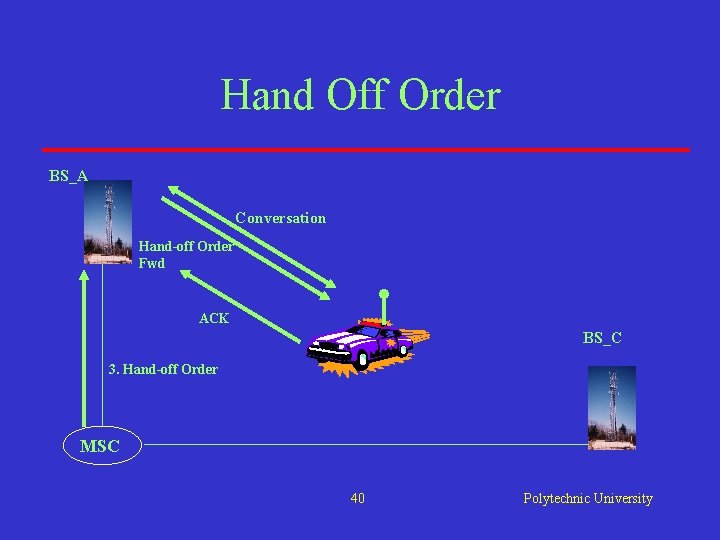
Hand Off Order BS_A Conversation Hand-off Order Fwd ACK BS_C 3. Hand-off Order MSC 40 Polytechnic University
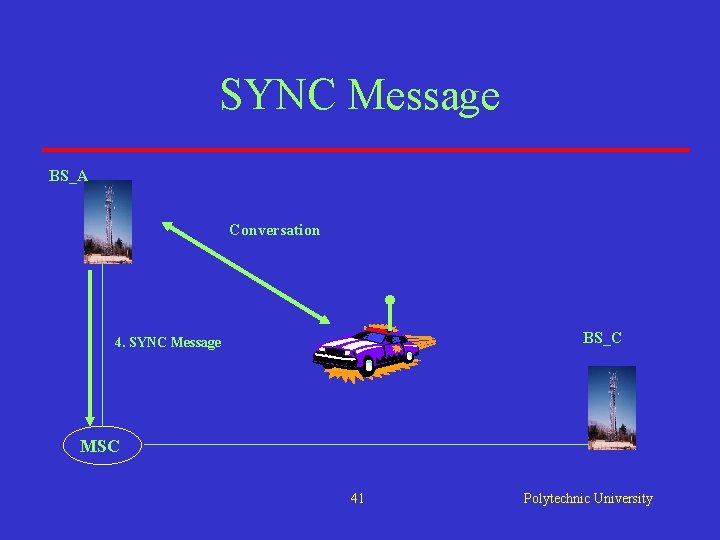
SYNC Message BS_A Conversation BS_C 4. SYNC Message MSC 41 Polytechnic University
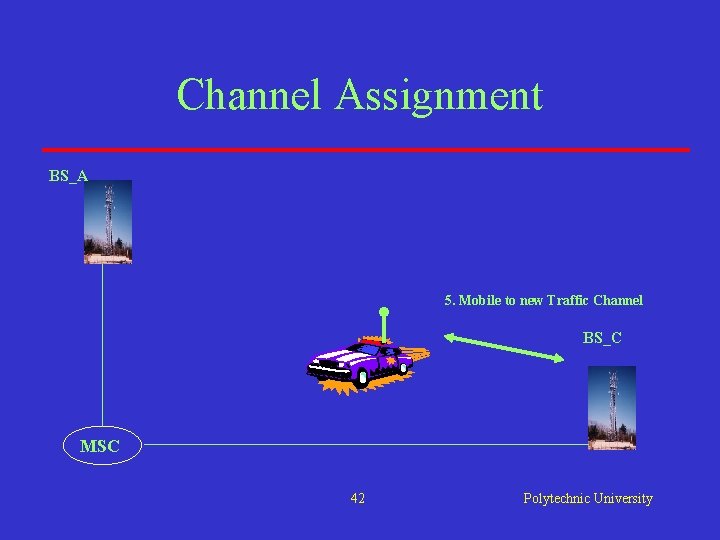
Channel Assignment BS_A 5. Mobile to new Traffic Channel BS_C MSC 42 Polytechnic University
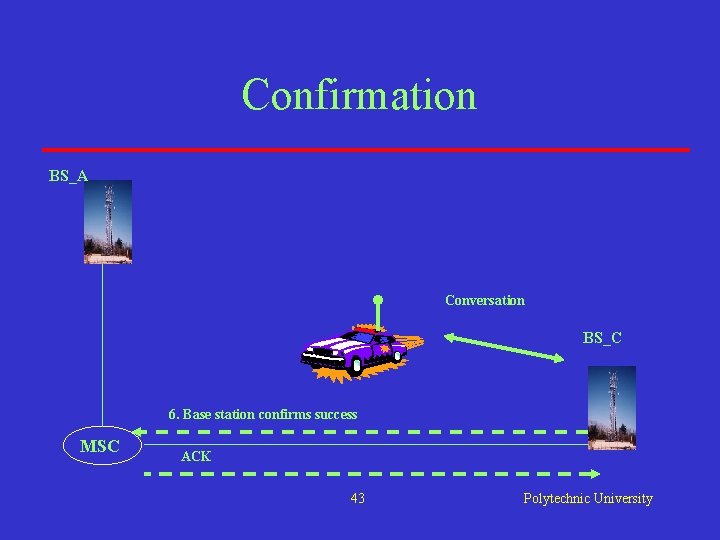
Confirmation BS_A Conversation BS_C 6. Base station confirms success MSC ACK 43 Polytechnic University
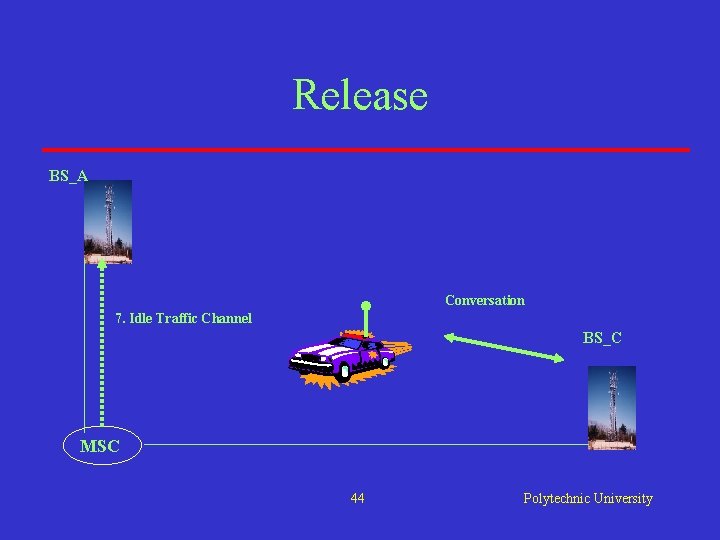
Release BS_A Conversation 7. Idle Traffic Channel BS_C MSC 44 Polytechnic University
Advantages of using MAHO • Can handle signal quality problems at the terminal – Quality is measured at the MS as well as at the BS • Fast response to signal quality problems – Quality of neighboring cells is readily available • BER is used in addition to RSSI – Can handle excessive interference traffic channels • Reduce signaling and information processing requirement on the MSC 45 Polytechnic University
Reference • David Goodman, “Wireless Personal Communication Systems, ” Prentice Hall, ISBN 0 -201 -63470 -8, 1997. 46 Polytechnic University