
NAT Network Address Translation Reading KR Chapter 4


- Slides: 7
NAT Network Address Translation Reading: KR Chapter 4 Savior or The Devil ? Note to Students: The course slides are a combination of slides from: 1. Peterson & Davie 2. Kurose & Ross 3. My previous lectures I claim no copyright for any of the material and would recommend either book for a detailed treatment of the material 3/11/2021 my. KRnat 1
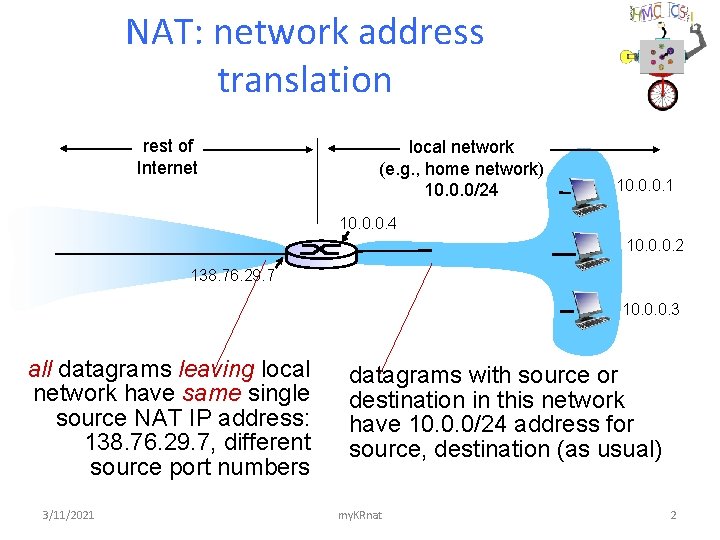
NAT: network address translation rest of Internet local network (e. g. , home network) 10. 0. 0/24 10. 0. 0. 1 10. 0. 0. 4 10. 0. 0. 2 138. 76. 29. 7 10. 0. 0. 3 all datagrams leaving local network have same single source NAT IP address: 138. 76. 29. 7, different source port numbers 3/11/2021 datagrams with source or destination in this network have 10. 0. 0/24 address for source, destination (as usual) my. KRnat 2
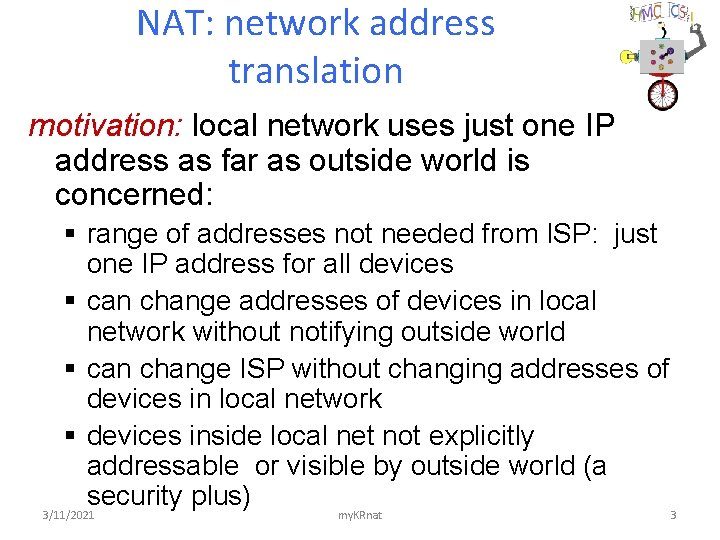
NAT: network address translation motivation: local network uses just one IP address as far as outside world is concerned: § range of addresses not needed from ISP: just one IP address for all devices § can change addresses of devices in local network without notifying outside world § can change ISP without changing addresses of devices in local network § devices inside local net not explicitly addressable or visible by outside world (a security plus) 3/11/2021 my. KRnat 3
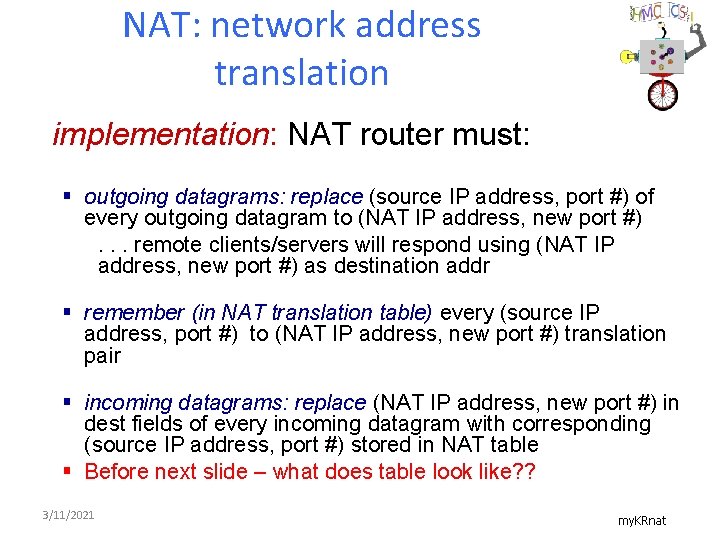
NAT: network address translation implementation: NAT router must: § outgoing datagrams: replace (source IP address, port #) of every outgoing datagram to (NAT IP address, new port #). . . remote clients/servers will respond using (NAT IP address, new port #) as destination addr § remember (in NAT translation table) every (source IP address, port #) to (NAT IP address, new port #) translation pair § incoming datagrams: replace (NAT IP address, new port #) in dest fields of every incoming datagram with corresponding (source IP address, port #) stored in NAT table § Before next slide – what does table look like? ? 3/11/2021 my. KRnat
Blank Slide 3/11/2021 my. KRnat 5
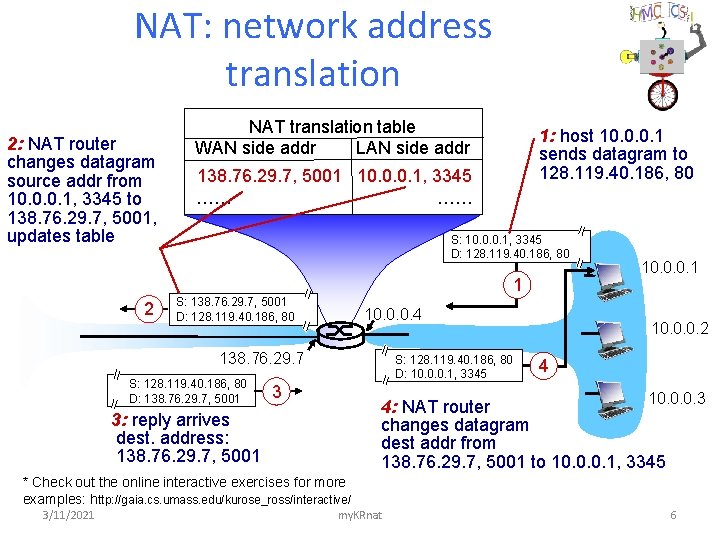
NAT: network address translation 2: NAT router changes datagram source addr from 10. 0. 0. 1, 3345 to 138. 76. 29. 7, 5001, updates table NAT translation table WAN side addr LAN side addr 1: host 10. 0. 0. 1 sends datagram to 128. 119. 40. 186, 80 138. 76. 29. 7, 5001 10. 0. 0. 1, 3345 …… …… S: 10. 0. 0. 1, 3345 D: 128. 119. 40. 186, 80 1 2 S: 138. 76. 29. 7, 5001 D: 128. 119. 40. 186, 80 10. 0. 0. 4 138. 76. 29. 7 S: 128. 119. 40. 186, 80 D: 138. 76. 29. 7, 5001 S: 128. 119. 40. 186, 80 D: 10. 0. 0. 1, 3345 3 10. 0. 0. 1 10. 0. 0. 2 4 10. 0. 0. 3 4: NAT router changes datagram dest addr from 138. 76. 29. 7, 5001 to 10. 0. 0. 1, 3345 3: reply arrives dest. address: 138. 76. 29. 7, 5001 * Check out the online interactive exercises for more examples: http: //gaia. cs. umass. edu/kurose_ross/interactive/ 3/11/2021 my. KRnat 6
NAT: network address translation • 16 -bit port-number field: – 60, 000 simultaneous connections with a single LANside address! • NAT is controversial: – routers should only process up to layer 3 – address shortage should be solved by IPv 6 – violates end-to-end argument • NAT possibility must be taken into account by app designers, e. g. , P 2 P applications – NAT traversal: what if client wants to connect to server behind NAT? • There are ways, but most networks public put servers outside NAT 3/11/2021 my. KRnat 7