
Nasya Karma 1 Definition of Nasya Karma 2

- Slides: 12
Nasya Karma 1. Definition of Nasya Karma 2. Nose is the gate way of head 3. Anatomy, Path of Drug absorption- Modern view 4. Shirorog Samprapti 5. Anatomy, Path of Drug absorption- Ayurved view Prof. Dr. Surendra Vedpathak, Department of Panchakarma, NIA, Jaipur
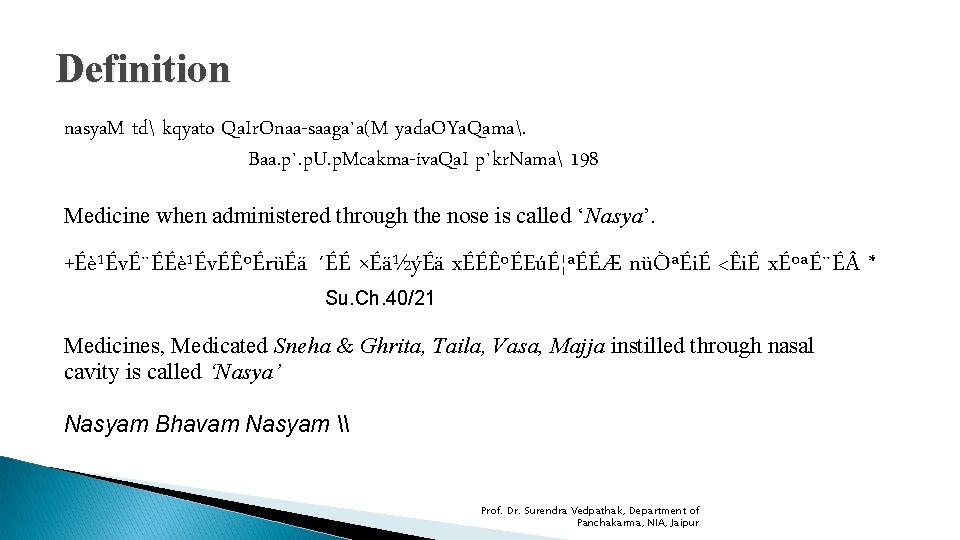
Definition nasya. M td kqyato Qa. Ir. Onaa-saaga`a(M yada. OYa. Qama. Baa. p`. p. U. p. Mcakma-iva. Qa. I p`kr. Nama 198 Medicine when administered through the nose is called ‘Nasya’. +Éè¹ÉvɨÉÉè¹ÉvÉʺÉrüÉä ´ÉÉ ×Éä½ýÉä xÉÉʺÉEúɦªÉÉÆ nüÒªÉiÉ <ÊiÉ xɺªÉ¨É * Su. Ch. 40/21 Medicines, Medicated Sneha & Ghrita, Taila, Vasa, Majja instilled through nasal cavity is called ‘Nasya’ Nasyam Bhavam Nasyam \ Prof. Dr. Surendra Vedpathak, Department of Panchakarma, NIA, Jaipur
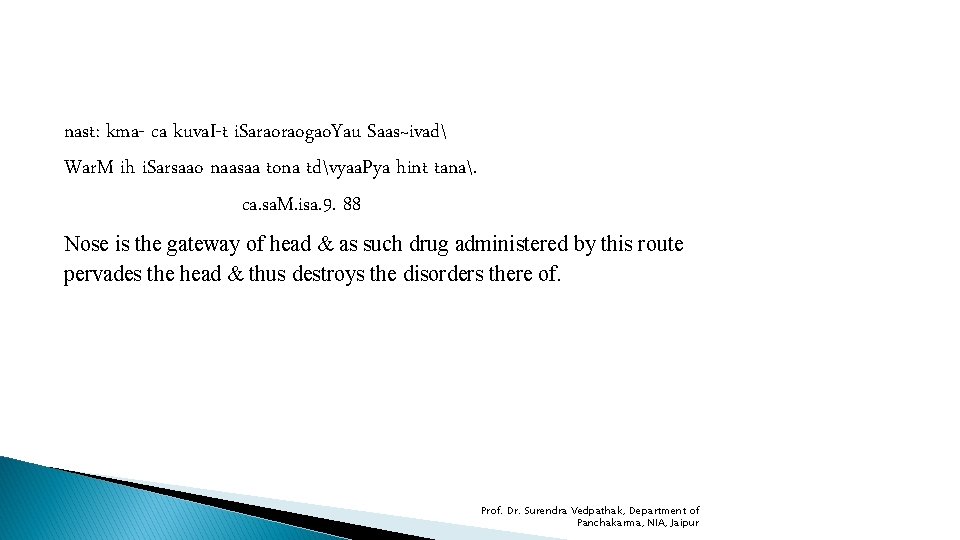
nast: kma- ca kuva. I-t i. Saraoraogao. Yau Saas~ivad War. M ih i. Sarsaao naasaa tona tdvyaa. Pya hint tana. ca. sa. M. isa. 9. 88 Nose is the gateway of head & as such drug administered by this route pervades the head & thus destroys the disorders there of. Prof. Dr. Surendra Vedpathak, Department of Panchakarma, NIA, Jaipur
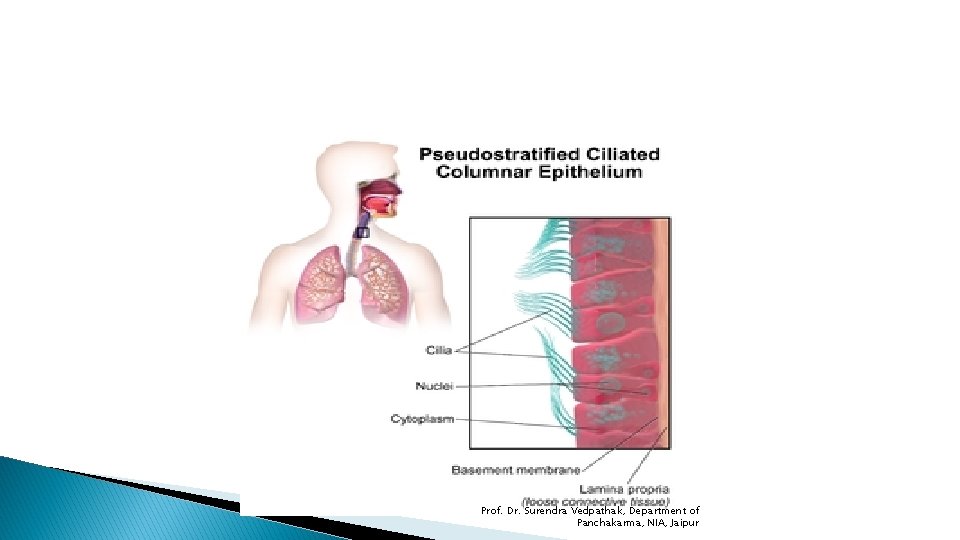
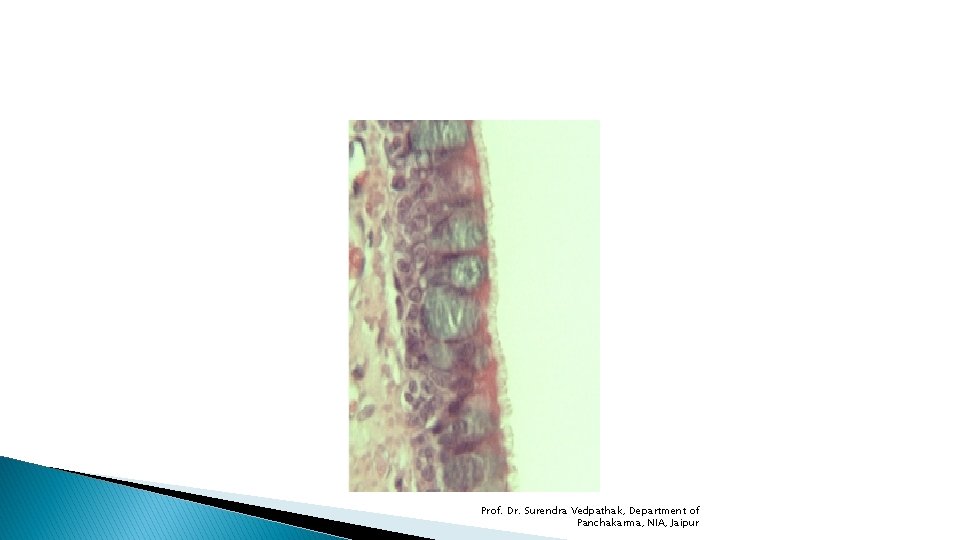
Anatomy , Path of drug absorption The walls of the nasal chamber and accessory sinuses are lined almost entirely by pseudostratified columnar ciliated epithelium converted in microvilli (except the olfactory area and the preturbinal area) thus increasing the surface area and hence suggested as a site of any drug absorption. Reference-Limzerwala R L, Paradkar A R, Pawar A P and Mahadik K R, Author, Nasal Drug Absorption, Indian Drugs, 25 January 1996. Prof. Dr. Surendra Vedpathak, Department of Panchakarma, NIA, Jaipur
Prof. Dr. Surendra Vedpathak, Department of Panchakarma, NIA, Jaipur
Prof. Dr. Surendra Vedpathak, Department of Panchakarma, NIA, Jaipur
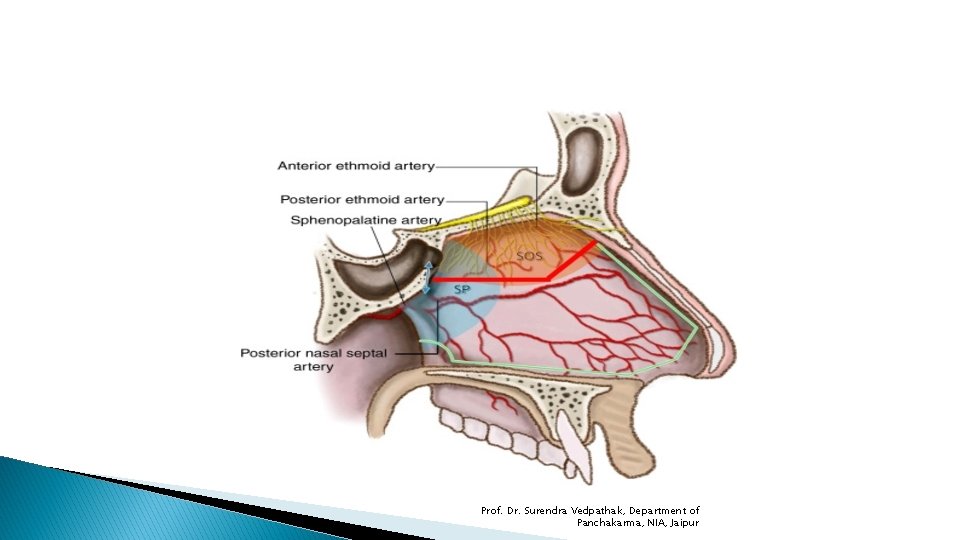
The nasal mucosa is supplied by spheno-palatine branches of the maxillary artery and the anterior and posterior ethmoidal branches of the ophthalmic artery spaced interossously further branching out to form a fine sub-epithelial plexus. Prof. Dr. Surendra Vedpathak, Department of Panchakarma, NIA, Jaipur
Prof. Dr. Surendra Vedpathak, Department of Panchakarma, NIA, Jaipur
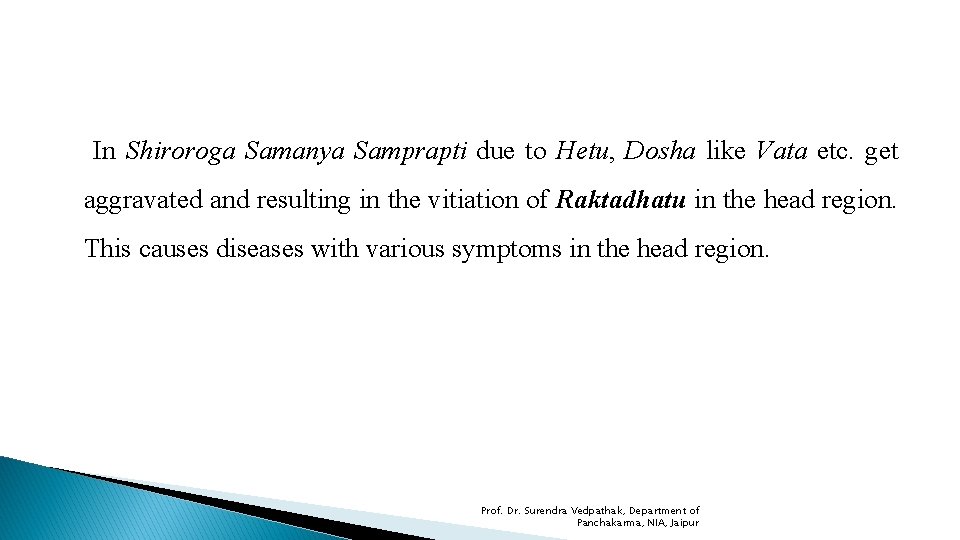
In Shiroroga Samanya Samprapti due to Hetu, Dosha like Vata etc. get aggravated and resulting in the vitiation of Raktadhatu in the head region. This causes diseases with various symptoms in the head region. Prof. Dr. Surendra Vedpathak, Department of Panchakarma, NIA, Jaipur
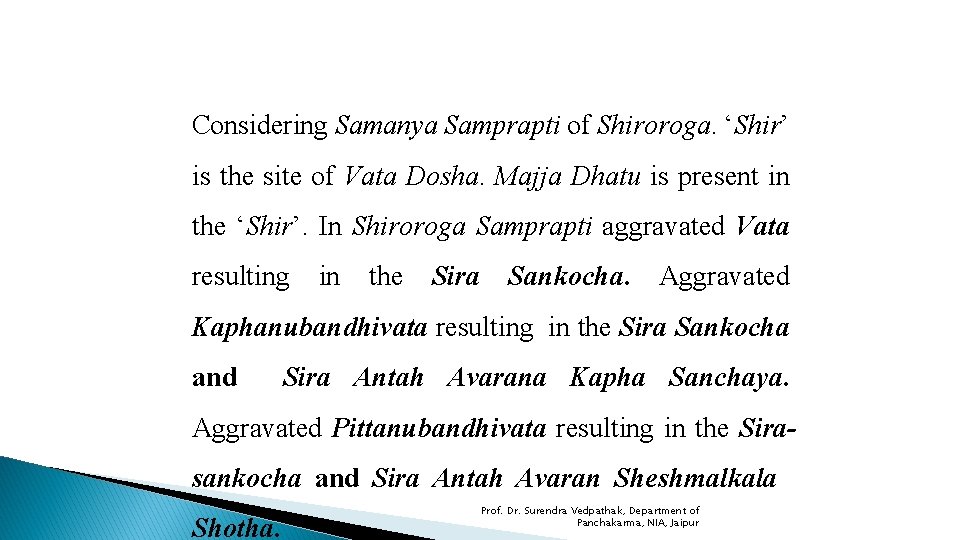
Considering Samanya Samprapti of Shiroroga. ‘Shir’ is the site of Vata Dosha. Majja Dhatu is present in the ‘Shir’. In Shiroroga Samprapti aggravated Vata resulting in the Sira Sankocha. Aggravated Kaphanubandhivata resulting in the Sira Sankocha and Sira Antah Avarana Kapha Sanchaya. Aggravated Pittanubandhivata resulting in the Sirasankocha and Sira Antah Avaran Sheshmalkala Shotha. Prof. Dr. Surendra Vedpathak, Department of Panchakarma, NIA, Jaipur
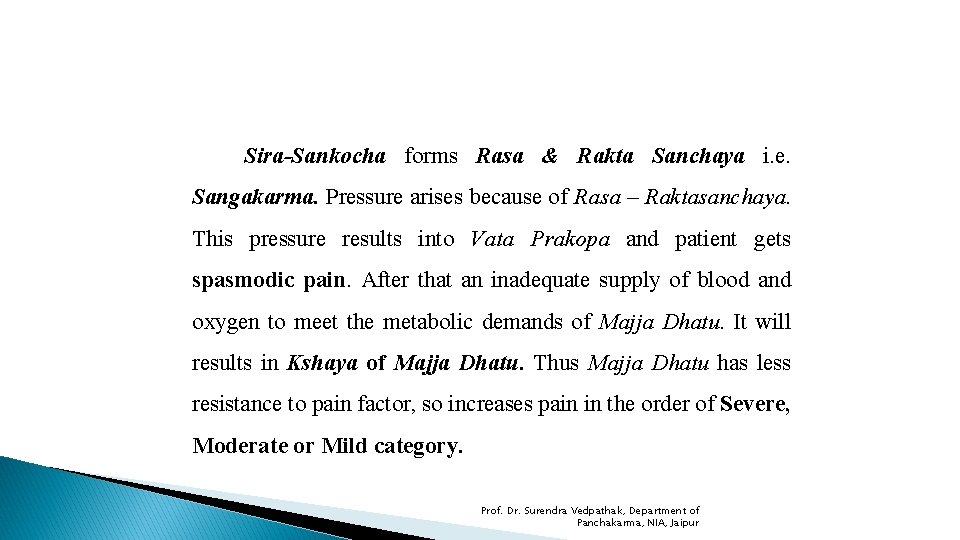
Sira-Sankocha forms Rasa & Rakta Sanchaya i. e. Sangakarma. Pressure arises because of Rasa – Raktasanchaya. This pressure results into Vata Prakopa and patient gets spasmodic pain. After that an inadequate supply of blood and oxygen to meet the metabolic demands of Majja Dhatu. It will results in Kshaya of Majja Dhatu. Thus Majja Dhatu has less resistance to pain factor, so increases pain in the order of Severe, Moderate or Mild category. Prof. Dr. Surendra Vedpathak, Department of Panchakarma, NIA, Jaipur