
NASAs Earth Science Data Systems Update Kevin Murphy
- Slides: 12
NASA’s Earth Science Data Systems Update Kevin Murphy – NASA HQ Earth Science Division WGISS 3 April 2017
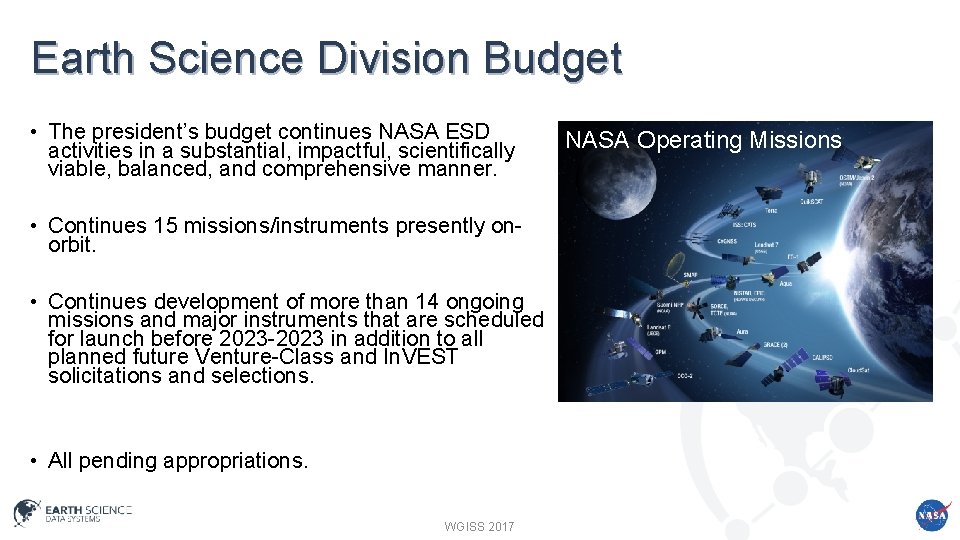
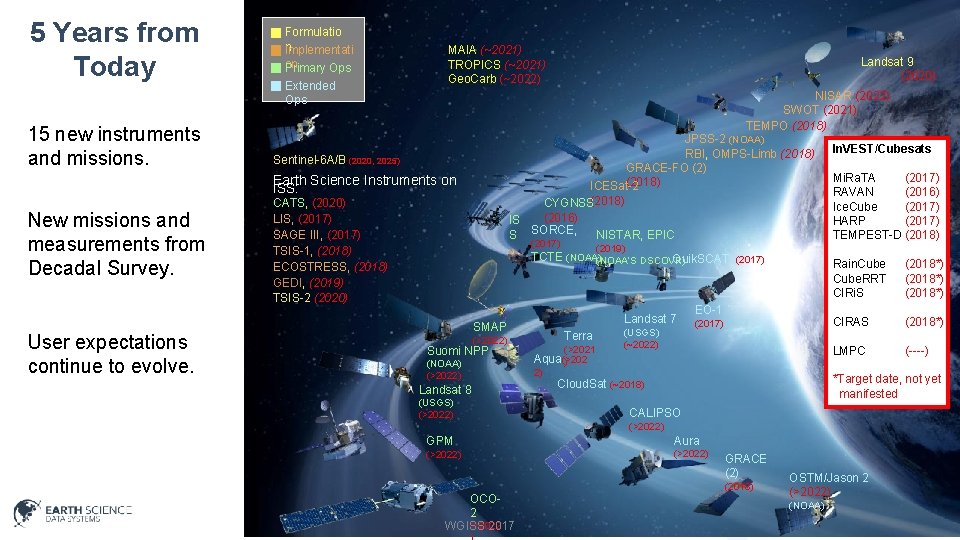
Earth Science Division Budget • The president’s budget continues NASA ESD activities in a substantial, impactful, scientifically viable, balanced, and comprehensive manner. • Continues 15 missions/instruments presently onorbit. • Continues development of more than 14 ongoing missions and major instruments that are scheduled for launch before 2023 -2023 in addition to all planned future Venture-Class and In. VEST solicitations and selections. • All pending appropriations. WGISS 2017 NASA Operating Missions
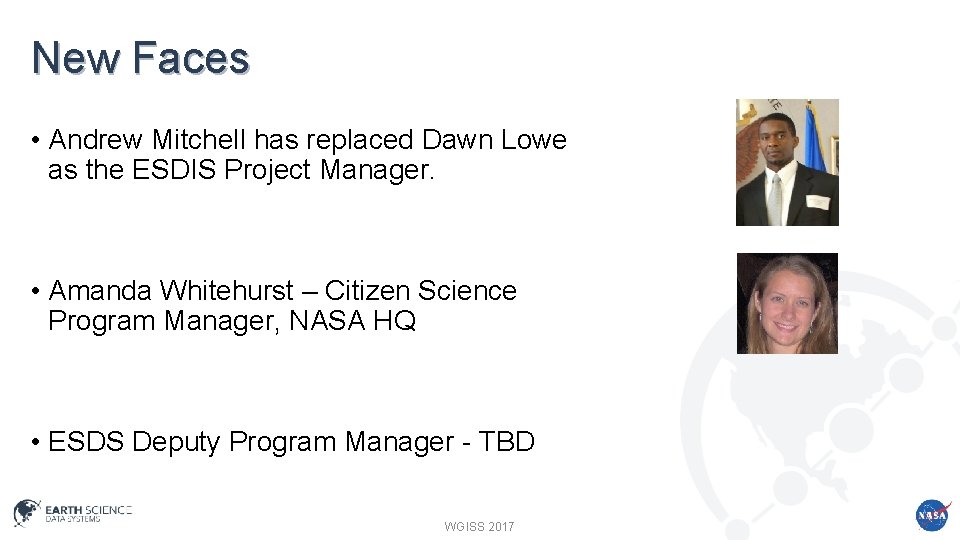
New Faces • Andrew Mitchell has replaced Dawn Lowe as the ESDIS Project Manager. • Amanda Whitehurst – Citizen Science Program Manager, NASA HQ • ESDS Deputy Program Manager - TBD WGISS 2017
Earth Science Open Source Policy • Core Earth Science Data System software • All new projects and existing core software components shall be released as open source (policy enacted fall 2015) • 15 core software projects have been open sourced since policy was initiated. • NASA funded competitive research projects • Reviewers may now consider open source software plan as an evaluation criteria. • Started with NASA’s 2017 Research Announcement (ROSES 17) – Section A. 1 WGISS 2017
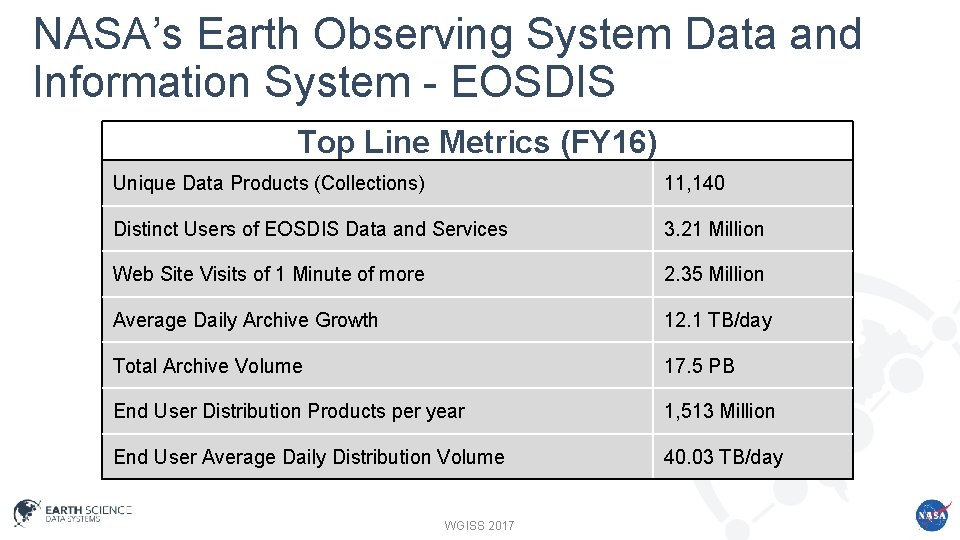
NASA’s Earth Observing System Data and Information System - EOSDIS Top Line Metrics (FY 16) Unique Data Products (Collections) 11, 140 Distinct Users of EOSDIS Data and Services 3. 21 Million Web Site Visits of 1 Minute of more 2. 35 Million Average Daily Archive Growth 12. 1 TB/day Total Archive Volume 17. 5 PB End User Distribution Products per year 1, 513 Million End User Average Daily Distribution Volume 40. 03 TB/day WGISS 2017
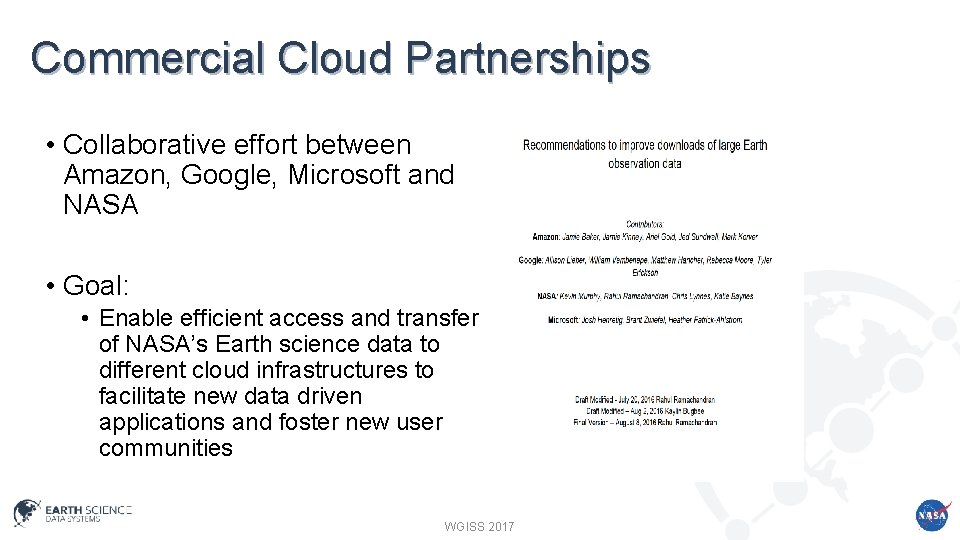
Commercial Cloud Partnerships • Collaborative effort between Amazon, Google, Microsoft and NASA • Goal: • Enable efficient access and transfer of NASA’s Earth science data to different cloud infrastructures to facilitate new data driven applications and foster new user communities WGISS 2017
Preparing for the Future • Preparing for upcoming missions • Looking towards the cloud • Streamlining tools • Continuing commitment to open source Credit: Chris Lynnes
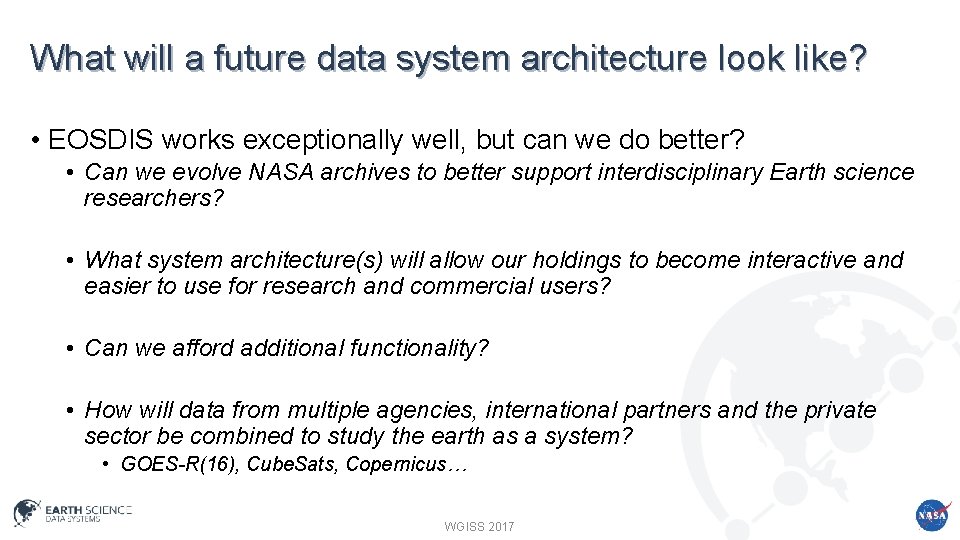
What will a future data system architecture look like? • EOSDIS works exceptionally well, but can we do better? • Can we evolve NASA archives to better support interdisciplinary Earth science researchers? • What system architecture(s) will allow our holdings to become interactive and easier to use for research and commercial users? • Can we afford additional functionality? • How will data from multiple agencies, international partners and the private sector be combined to study the earth as a system? • GOES-R(16), Cube. Sats, Copernicus… WGISS 2017
5 Years from Today 15 new instruments and missions. (Pre)Formulatio on n Implementati on Primary Ops Extended Ops MAIA (~2021) TROPICS (~2021) Geo. Carb (~2022) SWOT (2021) TEMPO (2018) JPSS-2 (NOAA) RBI, OMPS-Limb (2018) GRACE-FO (2) (2018) ICESat-2 Sentinel-6 A/B (2020, 2025) Earth Science Instruments on ISS: New missions and measurements from Decadal Survey. User expectations continue to evolve. Landsat 9 (2020) NISAR (2022) (2018) CYGNSS (2016) IS SORCE, S NISTAR, EPIC CATS, (2020) LIS, (2017) SAGE III, (2017) TSIS-1, (2018) ECOSTRESS, (2018) GEDI, (2019) TSIS-2 (2020) (2017) Landsat 7 Terra (>2022) Suomi NPP (NOAA) (>2022) Landsat 8 (USGS) (>2022) (>2021 (USGS) (~2022) EO-1 (2017) Aqua(>202 ) 2) Mi. Ra. TA (2017) RAVAN (2016) Ice. Cube (2017) HARP (2017) TEMPEST-D (2018) (2019) TCTE (NOAA)(NOAA’S DSCOVR) Quik. SCAT (2017) SMAP In. VEST/Cubesats Rain. Cube. RRT CIRi. S (2018*) CIRAS (2018*) LMPC (----) *Target date, not yet manifested Cloud. Sat (~2018) CALIPSO (>2022) GPM Aura (>2022) OCO 2 (>2022 WGISS 2017 GRACE (2) (2018) OSTM/Jason 2 (>2022) (NOAA)
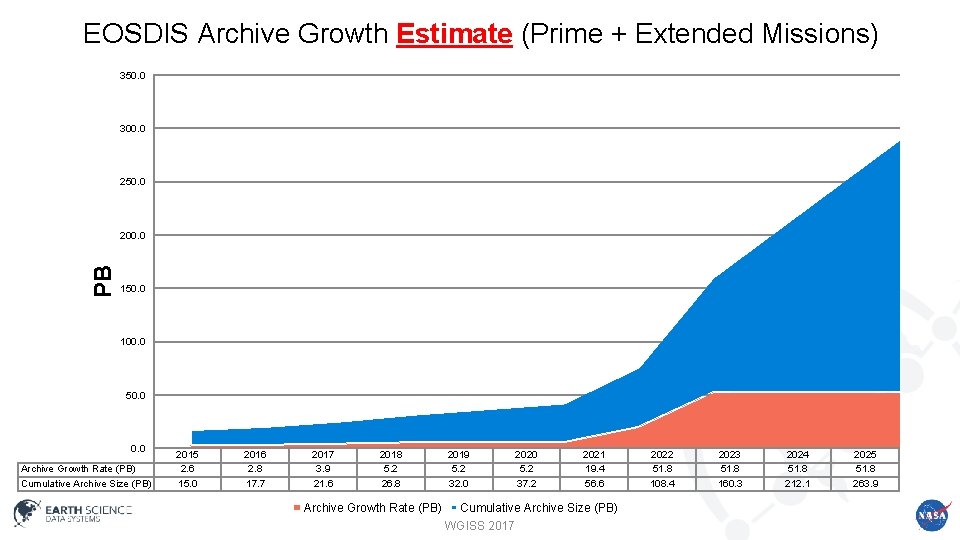
EOSDIS Archive Growth Estimate (Prime + Extended Missions) 350. 0 300. 0 250. 0 PB 200. 0 150. 0 100. 0 50. 0 Archive Growth Rate (PB) Cumulative Archive Size (PB) 2015 2. 6 15. 0 2016 2. 8 17. 7 2017 3. 9 21. 6 2018 5. 2 26. 8 Archive Growth Rate (PB) 2019 5. 2 32. 0 2020 5. 2 37. 2 2021 19. 4 56. 6 Cumulative Archive Size (PB) WGISS 2017 2022 51. 8 108. 4 2023 51. 8 160. 3 2024 51. 8 212. 1 2025 51. 8 263. 9
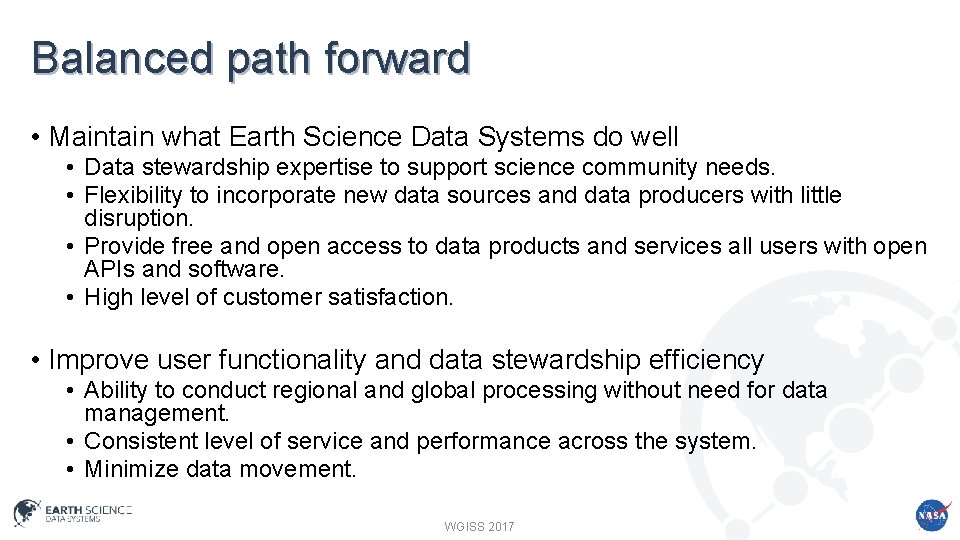
Balanced path forward • Maintain what Earth Science Data Systems do well • Data stewardship expertise to support science community needs. • Flexibility to incorporate new data sources and data producers with little disruption. • Provide free and open access to data products and services all users with open APIs and software. • High level of customer satisfaction. • Improve user functionality and data stewardship efficiency • Ability to conduct regional and global processing without need for data management. • Consistent level of service and performance across the system. • Minimize data movement. WGISS 2017
Thank You Feel Free to Contact Me Kevin. J. Murphy@nasa. gov