
Nasal Drug Delivery System By Mr Girish B
Nasal Drug Delivery System By: Mr. Girish B KLE College of Pharmacy, Belagavi A constituent Unit of KLE Academy of Higher Education and Research Nehru Nagar, Belagavi – 590 010, Karnataka, India Phone: 0831 -2471399; Fax: 0831 -2472387; Web: http: //www. klepharm. edu. E-mail: principal@klepharm. edu
contents • • • Introduction Advantages and disadvantages Anatomy and physiology of nasal cavity Mechanism of drug absorption Factors influencing nasal drug absorption Enhancement of nasal drug absorption Various dosage forms and devices Recent advances Conclusion and references 2
INTRODUCTION • In ancient times the Indian Ayurvedic system of medicines used nasal route for administration of drug and the process is called as “Nashya” • The first nasal drug delivery system was for re-establishing normal nasal conditions, thus employed for only local drug effects. • However, recently the nasal mucosa has emerged as a therapeutically viable route for systemic drug delivery 3
ADVANTAGES • • Easy and convinient route Non-invasive, painless, needle free Useful for both local and systemic drug delivery. Avoids first pass effect. Rapid onset of pharmacological action. Better site for rapid onset of action for CNS drugs. Rate of absorption is comparable with IV route. Lower doses hence less side effects. 4
Limitations Ø Once administered, rapid removal of therapeutic agent from the site of absorption is difficult Ø Pathologic conditions such as cold or allergies may alter significantly the nasal bioavailability Ø Nasal irritation Ø Small surface area 5
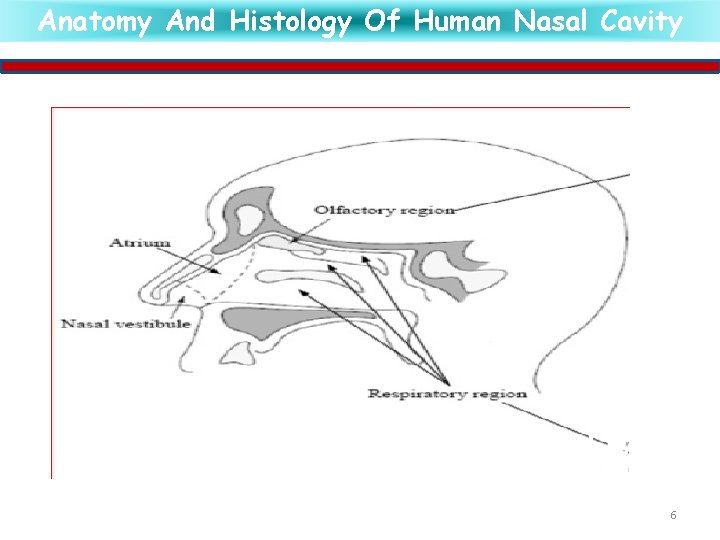
Anatomy And Histology Of Human Nasal Cavity 6
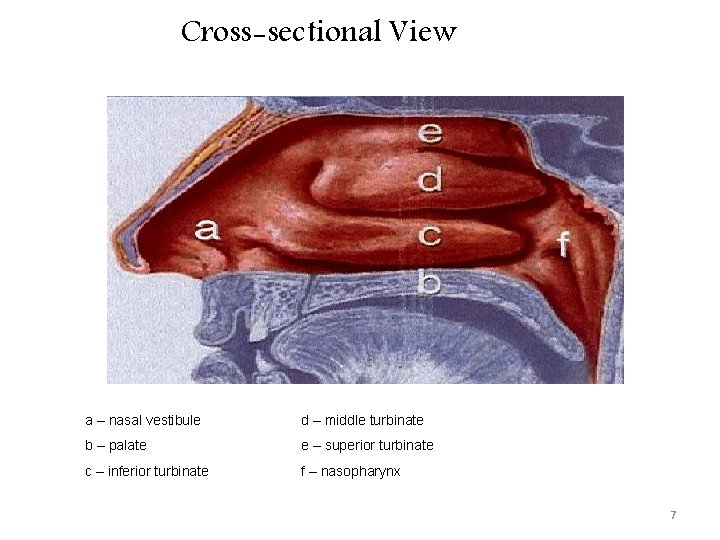
Cross-sectional View a – nasal vestibule d – middle turbinate b – palate e – superior turbinate c – inferior turbinate f – nasopharynx 7
The nasal cavity consists three main regions: 1) Nasal vestibule -forward section of nasal cavity lying within & above nasal cavity. 2) Respiratory region – Nose is a prominent structure on face and it's external openings are called nostrils that open into nasopharynx, leading to trachea and oesophagus. 3) Olfactory region – small area in the roof of the nasal cavity of about 10 cm 2 drug is exposed to neurons thus facilitate it across the cerebrospinal fluid. – Facilitates the drug delivery to brain. Nasal cavity is covered with a mucous membrane. Mucus secretion is composed of 95%water, 2%mucin, 1%salts, 1%of other proteins 8
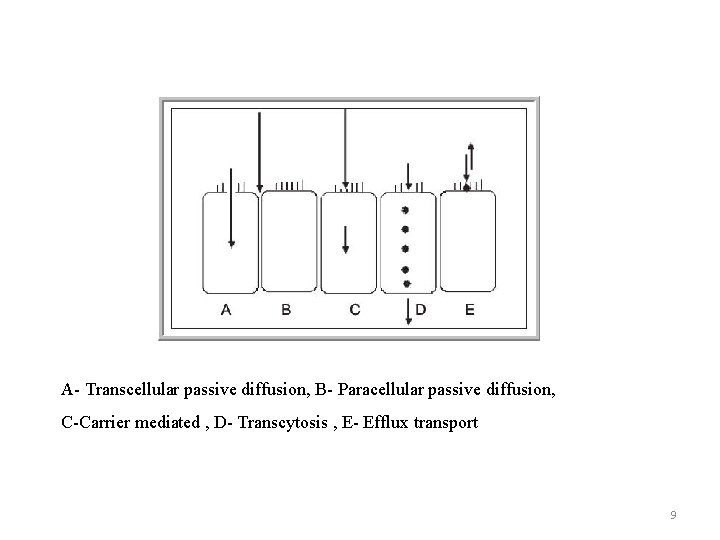
A- Transcellular passive diffusion, B- Paracellular passive diffusion, C-Carrier mediated , D- Transcytosis , E- Efflux transport 9
Mechanism of drug absortion • Passage of drug through the mucus is the first step in the absorption from the nasal cavity. • Uncharged, small particles easily pass through mucus. but charged and large particles may find it difficult to cross • Among several mechanisms but 2 mechanisms are considered predominantly. paracellular route >Transport of drud through aqueous route. >Slow transcellular route >Transport of drug through lipoidal route >Responsible for transport of lipophilic drugs 10
Factors influencing nasal drug absorption • Physiological conditions of nose • Physicochemical properities of drugs Physiological conditions of nose >Nasal blood flow >Mucociliary clearance >Enzymatic degradation >p. H of nasal cavity >Pathological condition of nose/presence of infection 11
Nasal blood flowmucosa are crucial in • The blood vessels supplying to the nasal various functions of the nose. like >themal regulation >humidification Histamine, isoproterenol, albuterol increase the blood flow clonidine, oxymethazoline decrease nasal blood flow Mucociliary clearance >Combined action of cilia and mucous layer is called mucociliary clearance. • >Important defence mechanism against >inhaled dust >allergens >microorganisms 12
Enzymatic degradation • Intranasally adm of drugs avoids first pass effect but drugs may be metabolised in lumen of nasal cavity due to the presence of broad range of metabolic enzymes. ex : hydrolases aldolase carboxylesterase Nasal p. H Nasal secretion of adult : 5. 5 -6. 5 • Infants and children: 5 -6. 7 13
Physicochemical properities of drug • • • Molecular weight Lipophilicity Stability Solubility Viscosity p. H 14
• Molecular weight Easy permeation for molecules with a molecular weight of 1000 daltons. permeation enhancers can enhance permeability of molecules upto 6000 daltons. • Lipophilicity of drug > Nasal membrane is lipophilic > Not easy for polar drugs to cross membrane 15
Stability of drug • Stability(biological, physical, chemical) aspect is a major consideration for new drg development • The biological stability of nasally given drugs may reduce due to defence enzyme mechanism by nasal cavity Solubility of drug For drug absorption dissolution is a pre-requisite. Drugs must dissolve in nasal cavity before it's absorption. Lipophilic drugs are easily absorbed 16
Enhancement of nasal absorption • Strategies employed for improving the nasal drug absorption are 1. structural modification : chemical modification of the molecular structure of drug which can alter physicochemical properities of drugs. 2. Formulation design : selection of suitable formulation excipients which includes >Viscosity modifiers >Absorption enhancers >Bioadhesive polymers >Liposomes 17
modifiers • Increases the nasal. Viscosity resident time of fomulation Ex : 0. 25% methyl cellulose hydroxy propyl methyl cellulose smart hydrogel Absorption enhancers Employed for improving the absorption of poorly absorbed drugs. Mechanism : Breaches the epithelial barrier and any large molecule can enter into systemic circulation. ex : surfactants (laureth-9) bile salts (deoxy cholate) chelators(citric acid) 18
General requirement of an ideal penetration enhancer 1. It should lead to an effective increase in the absorption of the drug 2. It should not cause permanent damage or alteration to the tissue 3. It should be non irritant and nontoxic. 4. It should be effective in small quantity 5. It should be compatible with other excipients. 19
some enhancers can also inhibit enzyme activity (ex: proteases, amino peptidases) some studies indicate that Ø Derivatives of cholic acid break down mucous membrane structure. Ø Permeation enhancers like bile salts, Ø surfactants are reported to cause damage and inhibition of nasal membrane. Ø Cyclodextrins are well tolerated. 20
BIO ADHESIVE POLYMERS • Bio adhesion -any bond between two biological surfaces. • when the adhesion is restricted to mucus lining-muco adhesion. • Improves the bioavailability due to -It increases the contact time between the delivery system and the mucosa. -Release drug in a sustained manner. -Protects drug from enzymatic degradation. Ex: hydrophilic polymers hydrogels. 21
> Rigid membrane Liposomes Ø They can effectively encapsulate small and large molecules with a wide range of hydrophilicity. Ø They enhance nasal absorption of peptides such as insulin by increasing their membrane penetration. Ø Lliposomal drug delivery systems were also reported as useful for influenza vaccine and non-peptide drugs such as nifedipine. 22
Various dosage forms and devices Various dosage forms are suitable for nasal drug delivery Ø Solution Ø Suspension Ø Emulsion Ø Dry powder Ø Gel 23
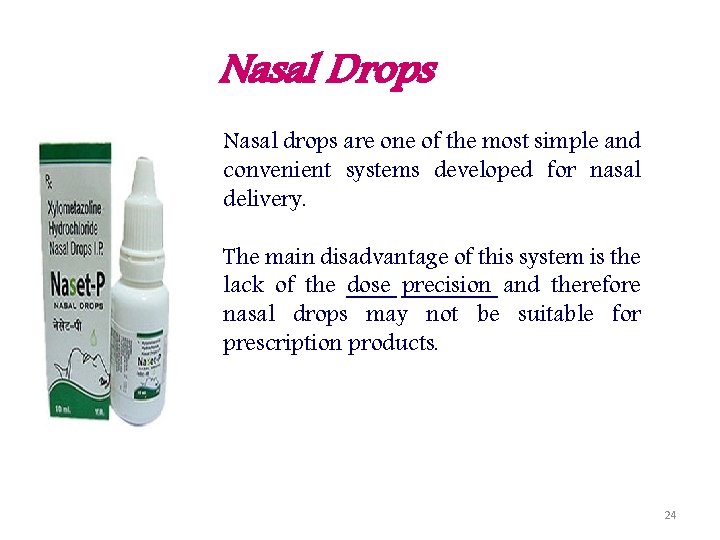
Nasal Drops Nasal drops are one of the most simple and convenient systems developed for nasal delivery. The main disadvantage of this system is the lack of the dose precision and therefore nasal drops may not be suitable for prescription products. 24
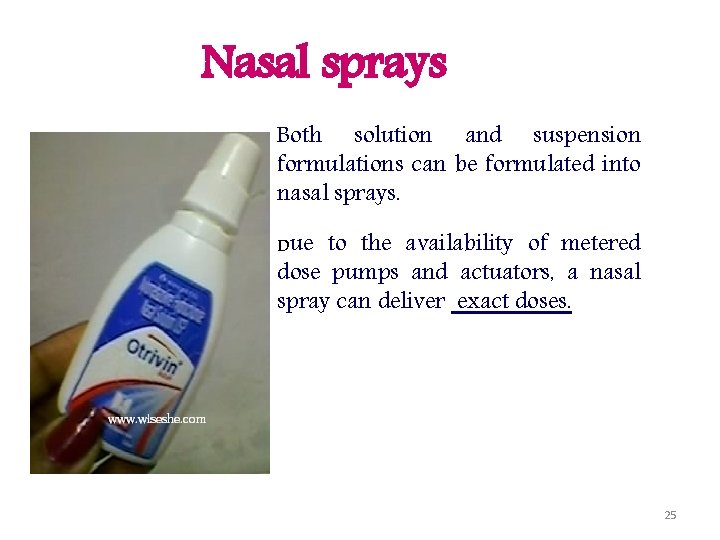
Nasal sprays Both solution and suspension formulations can be formulated into nasal sprays. Due to the availability of metered dose pumps and actuators, a nasal spray can deliver exact doses. 25
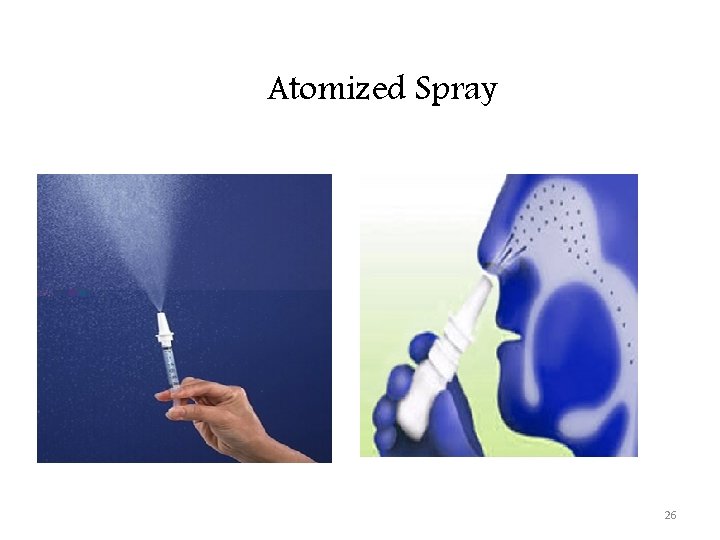
Atomized Spray 26
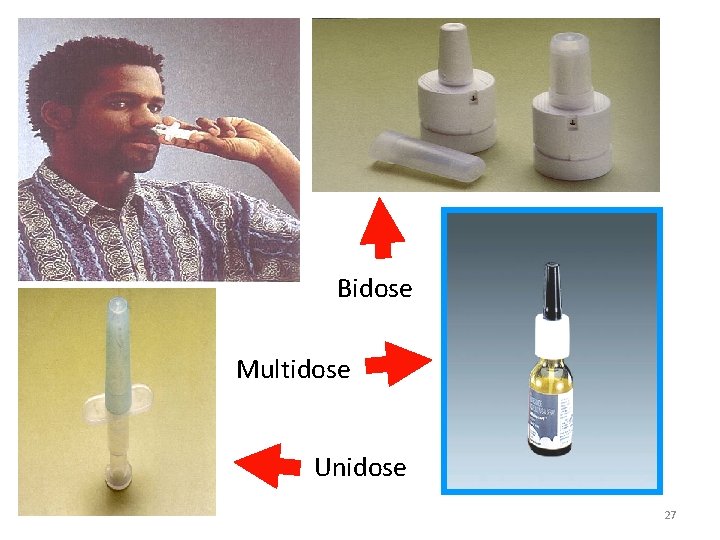
Bidose Multidose Unidose 27
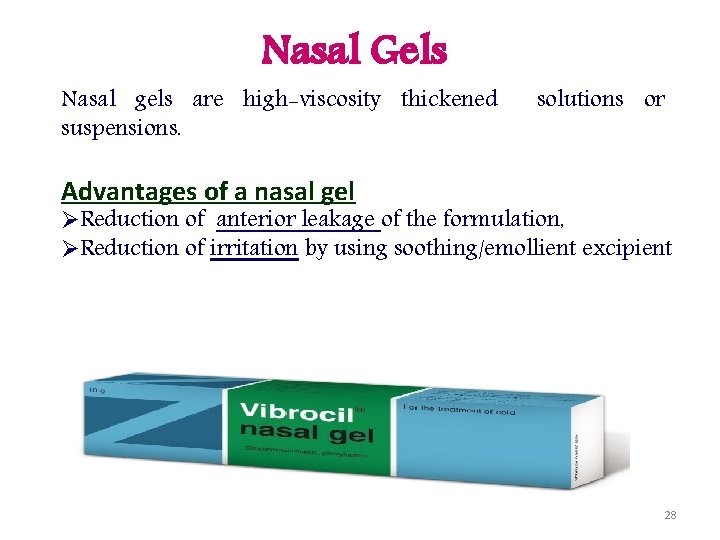
Nasal Gels Nasal gels are high-viscosity thickened suspensions. solutions or Advantages of a nasal gel ØReduction of anterior leakage of the formulation, ØReduction of irritation by using soothing/emollient excipient 28

Nasal Powder The advantages to the nasal powder dosage form are the absence of preservative and superior stability of the formulation. Local application of drug is another advantage of this system. Nasal powder formulation depends on the solubility, particles size, aerodynamic properties and nasal irritancy of the active drug and /or excipients. 29
Recent advances in nasal drug delivery systems • Nasal insulin • Nasal vaccine • Nasal anti-vomiting agents 30
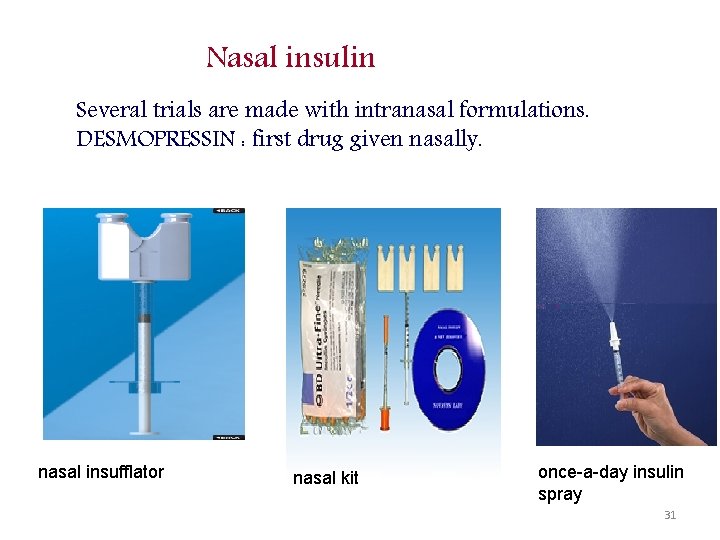
Nasal insulin Several trials are made with intranasal formulations. DESMOPRESSIN : first drug given nasally. nasal insufflator nasal kit once-a-day insulin spray 31
Nasal vaccines Nasal mucosa is first site of contact with inhaled antigens and, therefore, its use for vaccination, especially against respiratory infections Nasal vaccination is a promising alternative to the classic parenteral route, because it is able to enhance the systemic levels of specific immunoglobulins Examples of intranasal vaccines include those against influenza A and B virus 32
NASAL ANTI-VOMITING Lincoln Pharma : • Presently in India anti-vomiting treatments are available in the conventional form of tablet and injection which take longer time to bring relief. • But now through LPL’s new Nasal Drug Delivery System, the patient can get immediate relief. LPL becomes the first company in India to introduce an anti-vomiting treatment in the form of a Nasal spray pump. 33
Applications Delivery of non-peptide Pharmaceuticals • Adrenal corticosteroids • Sex hormones: 17ß-estradiol, progesterone, norethindrone, and testosterone. • Vitamins: vitamin B • Cardiovascular drugs: hydralazine, Angiotensin. II antagonist, nitroglycerine, isosobidedinitrate, propanolol. • CNS stimulants: cocaine, lidocaine • Narcotics and antagonists: bupemorphine, naloxane • Histamine and antihistamines: disodium cromoglycate, meclizine • Antimigrane drugs: dierogotamine, ergotamine, tartarate • Antibiotics : Penicillin, cephalosporins, gentamycin • Antivirals: Phenyl-p-guanidine benzoate, enviroxime. 34
Delivery of peptide-based pharmaceuticals • Peptides and proteins are hydrophilic polar molecules of high molecular weight, poorly absorbed. Examples are insulin, calcitonin, pituitary hormones etc. Delivery of diagnostic drugs Phenol sulfonphthalein is used to diagnose kidney function. • Secretin – pancreatic disorders • Pentagastrin – secretory function of gastric acid 35
CONCLUSION • It is expected that the novel nasal products will continue to reach the market due to the wide spread of benifits ot this route. • Nasal insulin and vaccination are the most recent advances. • Much has been investigated & much more is to be investigated for the advancement of nasal drug delivery system. 36
REFERENCES. 1. SURESH P. VYAS , ROOP K. KHAR, controlled drug delivery, page 301 -327 2. Talegaonkar S, Mishra PR. Intranasal delivery: An approach to bypass the blood brain barrier. Indian J Pharmacol 2004; 36(3): 140 -147 3. Illum L. Transport of drugs from the nasal cavity to the central nervous system. Eur J Pharm Sci 2000; page no: 11: 1 -18 4. Y. W. Chien, S. F. Chang, Intranasal drug delivery for systemic medication, Crit. Rev. Ther. Drug Carrier Syst. 4 (1987) 67 5. H. E JUNGINGER. . , Drug targetting and delivery. page 203 -245 37
- Slides: 37