
NASA Search A Strategic Deployment NASA Knowledge Management

- Slides: 57
NASA Search: A Strategic Deployment NASA Knowledge Management Conference Gilruth Center, Johnson Space Center March 3, 2006 Jayne Dutra With Help From Lisa Smith Jet Propulsion Laboratory California Institute of Technology
Agenda For Today v Overview v Vision and Technologies – Semantic Web, Metadata, SOA’s v Goals and Objectives v Strategy – NASA Engineering Network (NEN) – Benefits v Possible Next Steps 2
Overview v More data v More sources and repositories v More silos (how many passwords do you have? ) v More fragmented information space Result: Search getting harder than ever! 3
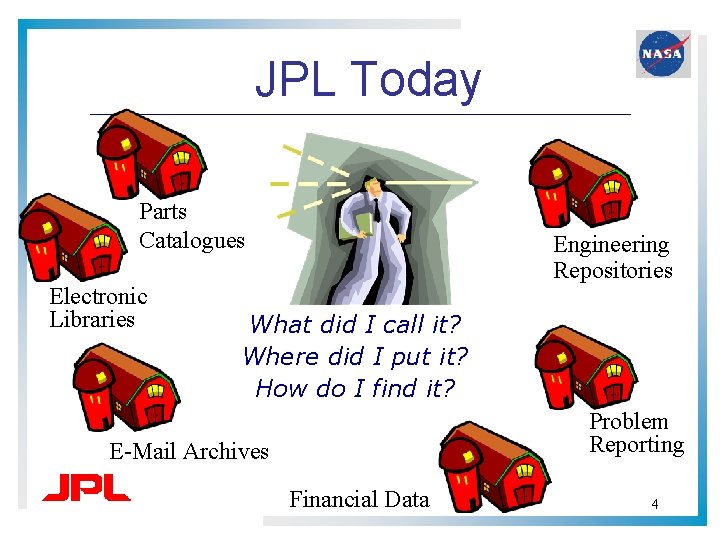
JPL Today Parts Catalogues Electronic Libraries Engineering Repositories What did I call it? Where did I put it? How do I find it? Problem Reporting E-Mail Archives Financial Data 4
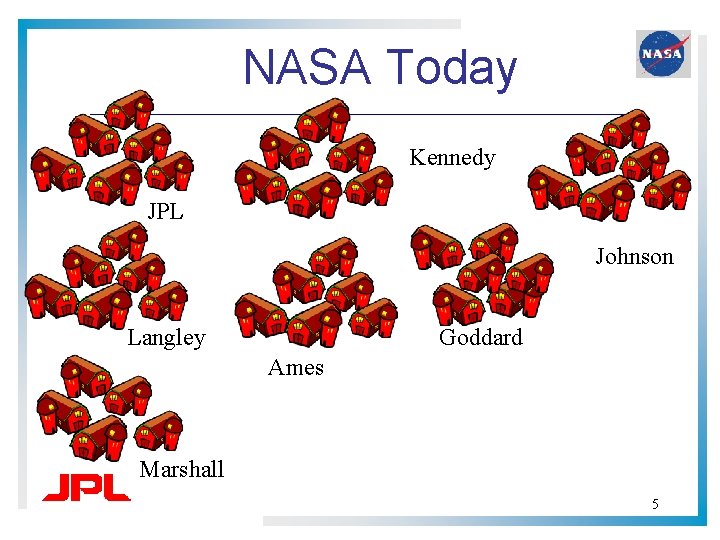
NASA Today Kennedy JPL Johnson Langley Goddard Ames Marshall 5
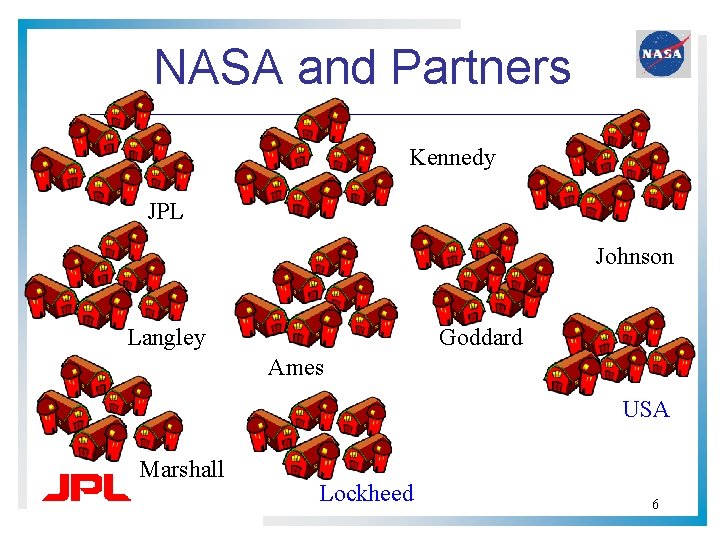
NASA and Partners Kennedy JPL Johnson Langley Goddard Ames USA Marshall Lockheed 6
NASA and Other Agencies Kennedy JPL Johnson Langley Goddard Ames USA Marshall Lockheed ESA 7
Knowledge Retrieval Chances of Finding Needed Information in a Timely Fashion 8
Knowledge Retrieval 0% 9
A Different Paradigm But what if content came to you? 10
Turning Search Upside Down v Just in time information delivery based on – Engineering Lifecycle – Task Analysis – Associations and relationships – Agents and electronic subscriptions • Persistent queries and syndicated content 11
New Technology From Tim Berners-Lee and the W 3 C “The Semantic Web is a vision: the idea of having data on the web defined and linked in a way that it can be used by machines not just for display purposes, but for automation, integration and reuse of data across various applications. ” http: //www. w 3. org/2001/sw/ 12
New Technology From Tim Berners-Lee and the W 3 C “The Semantic Web is a vision: the idea of having data on the web defined and linked in a way that it can be used by machines not just for display purposes, but for automation, integration and reuse of data across various applications. ” http: //www. w 3. org/2001/sw/ 13
So, What is the Semantic Web? v Today’s Web is made for people to read and understand v Tomorrow’s Web will be made for computers to read and understand – Systems will be able to perform transactions across applications without human help – Leverages the vast amount of data accessible on the Web for machine processing – Integration of data sets that are currently unlinked using the Web 14
So, What is the Semantic Web? v Today’s Web is made for people to read and understand v Tomorrow’s Web will be made for computers to read and understand – Systems will be able to perform transactions across applications without human help – Leverages the vast amount of data accessible on the Web for machine processing – Integration of data sets that are currently unlinked using the Web 15
Information Building Blocks An integrated information architecture made up of several components: – Common Metadata Specification • Core Metadata Specification for JPL Project Documentation – Common language or controlled vocabularies • By discipline, product, and process, etc. - taxonomies • Knowledge representations including relationships • Intersecting ontology hubs – Business Rules for data reconciliation • You say “tomato”…… – Use new technologies developed for the Semantic Web to enable enhanced capability 16
How Does It Work? v Focused on encoding metadata about Web resources into Web pages – Start with a basic taxonomy of terms and agreed upon definitions – Add relationships and associations, ie ontologies v Based on knowledge representation languages – RDF, RDFS (Resource Description Framework) – OWL (Web Ontology Language) 17
Then What? v Make content available to delivery mechanisms using Service Oriented Architectures v Data streams presented as services and available for consumption by workers in portals and other devices 18
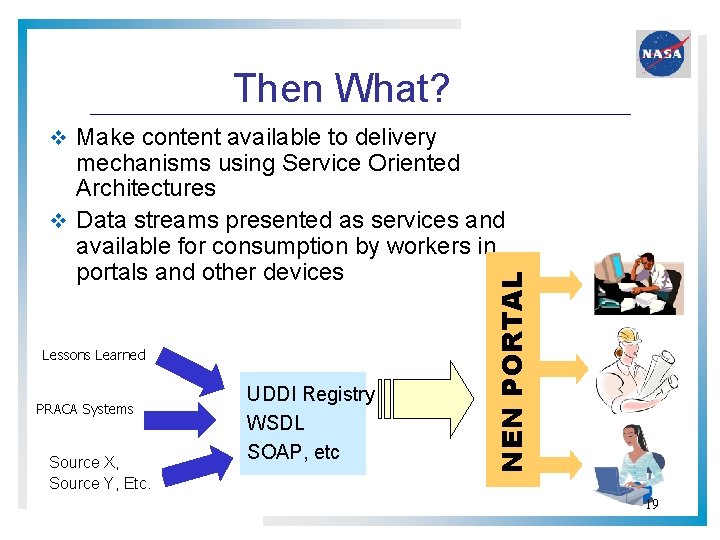
Then What? v Make content available to delivery Lessons Learned PRACA Systems Source X, Source Y, Etc. UDDI Registry WSDL SOAP, etc NEN PORTAL mechanisms using Service Oriented Architectures v Data streams presented as services and available for consumption by workers in portals and other devices 19
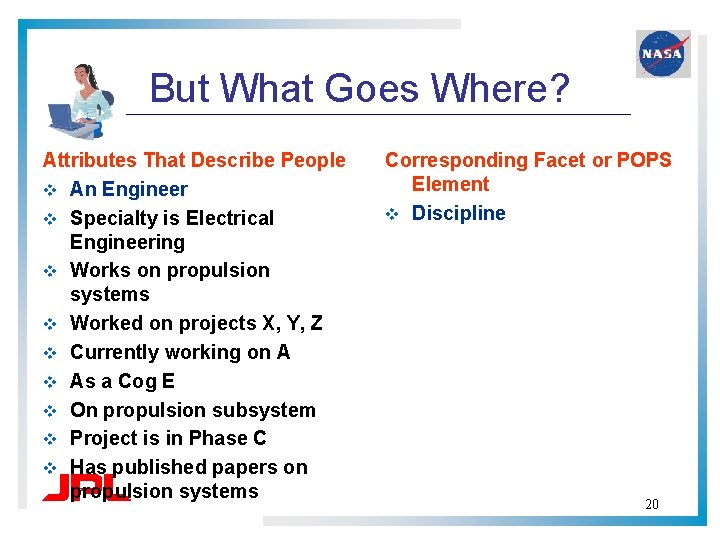
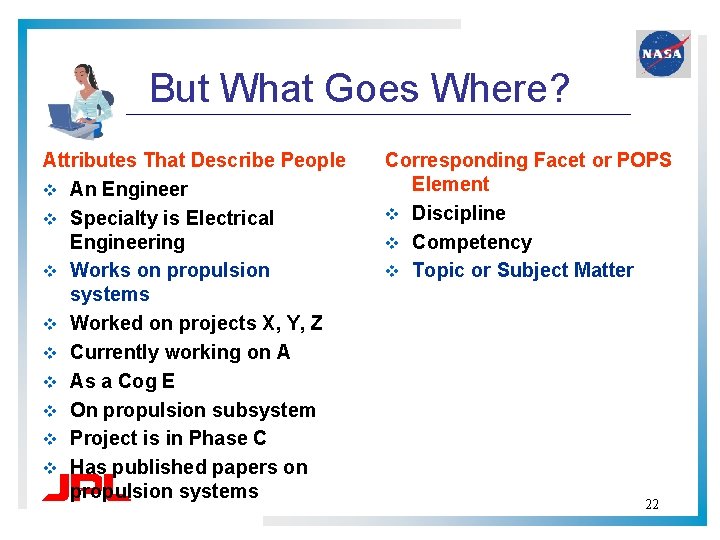
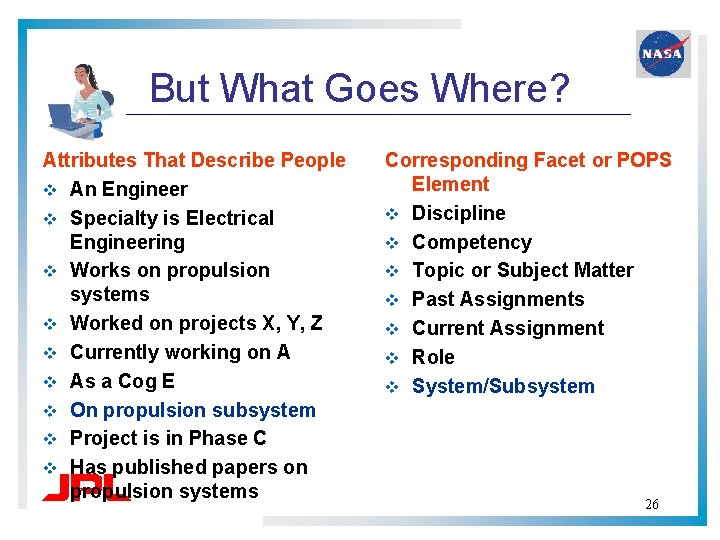
But What Goes Where? Attributes That Describe People v An Engineer v Specialty is Electrical Engineering v Works on propulsion systems v Worked on projects X, Y, Z v Currently working on A v As a Cog E v On propulsion subsystem v Project is in Phase C v Has published papers on propulsion systems Corresponding Facet or POPS Element v Discipline 20
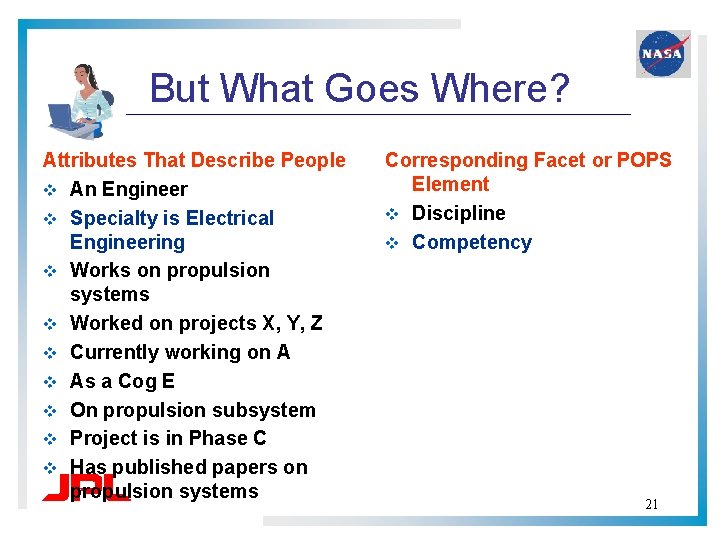
But What Goes Where? Attributes That Describe People v An Engineer v Specialty is Electrical Engineering v Works on propulsion systems v Worked on projects X, Y, Z v Currently working on A v As a Cog E v On propulsion subsystem v Project is in Phase C v Has published papers on propulsion systems Corresponding Facet or POPS Element v Discipline v Competency 21
But What Goes Where? Attributes That Describe People v An Engineer v Specialty is Electrical Engineering v Works on propulsion systems v Worked on projects X, Y, Z v Currently working on A v As a Cog E v On propulsion subsystem v Project is in Phase C v Has published papers on propulsion systems Corresponding Facet or POPS Element v Discipline v Competency v Topic or Subject Matter 22
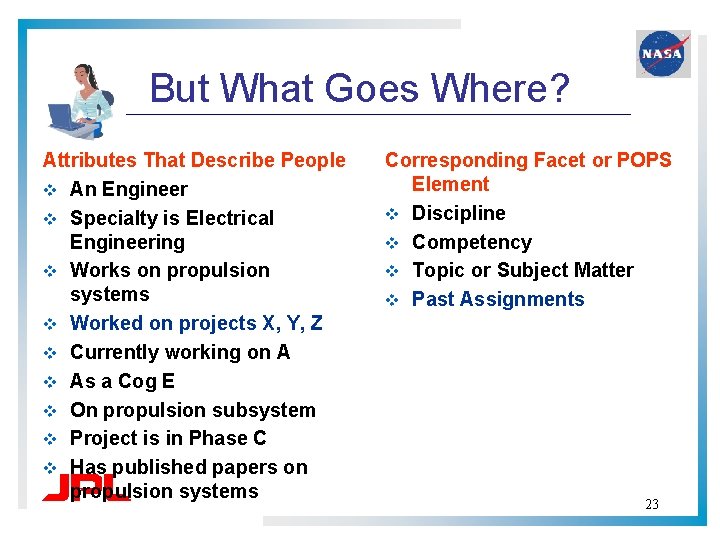
But What Goes Where? Attributes That Describe People v An Engineer v Specialty is Electrical Engineering v Works on propulsion systems v Worked on projects X, Y, Z v Currently working on A v As a Cog E v On propulsion subsystem v Project is in Phase C v Has published papers on propulsion systems Corresponding Facet or POPS Element v Discipline v Competency v Topic or Subject Matter v Past Assignments 23
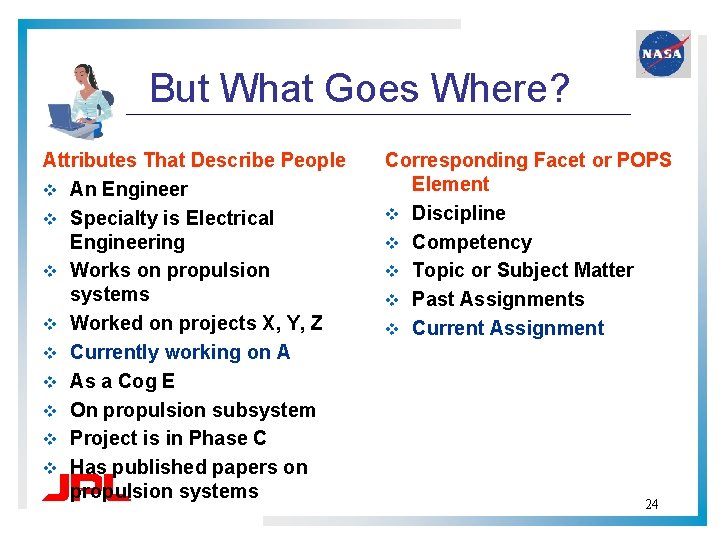
But What Goes Where? Attributes That Describe People v An Engineer v Specialty is Electrical Engineering v Works on propulsion systems v Worked on projects X, Y, Z v Currently working on A v As a Cog E v On propulsion subsystem v Project is in Phase C v Has published papers on propulsion systems Corresponding Facet or POPS Element v Discipline v Competency v Topic or Subject Matter v Past Assignments v Current Assignment 24
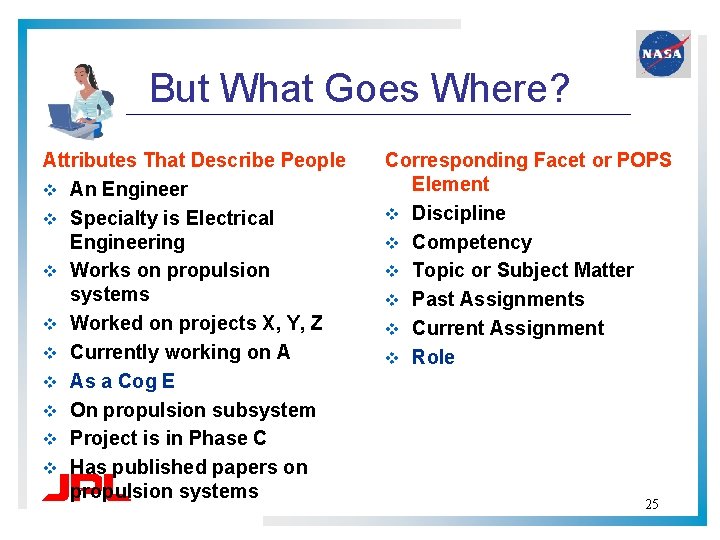
But What Goes Where? Attributes That Describe People v An Engineer v Specialty is Electrical Engineering v Works on propulsion systems v Worked on projects X, Y, Z v Currently working on A v As a Cog E v On propulsion subsystem v Project is in Phase C v Has published papers on propulsion systems Corresponding Facet or POPS Element v Discipline v Competency v Topic or Subject Matter v Past Assignments v Current Assignment v Role 25
But What Goes Where? Attributes That Describe People v An Engineer v Specialty is Electrical Engineering v Works on propulsion systems v Worked on projects X, Y, Z v Currently working on A v As a Cog E v On propulsion subsystem v Project is in Phase C v Has published papers on propulsion systems Corresponding Facet or POPS Element v Discipline v Competency v Topic or Subject Matter v Past Assignments v Current Assignment v Role v System/Subsystem 26
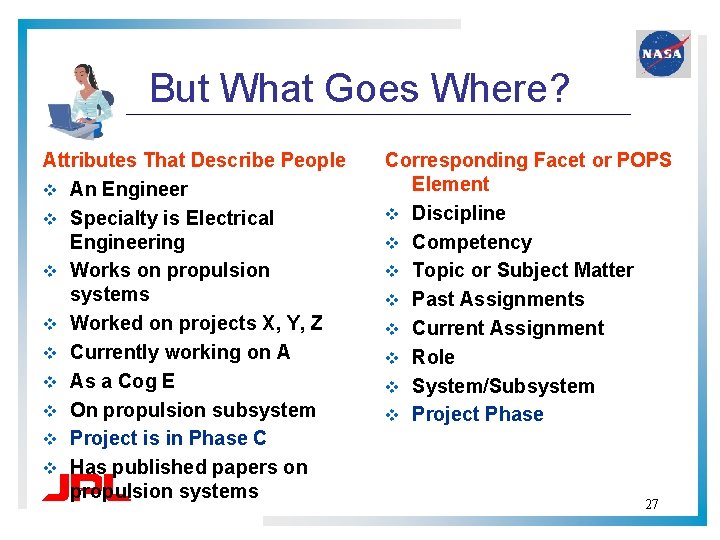
But What Goes Where? Attributes That Describe People v An Engineer v Specialty is Electrical Engineering v Works on propulsion systems v Worked on projects X, Y, Z v Currently working on A v As a Cog E v On propulsion subsystem v Project is in Phase C v Has published papers on propulsion systems Corresponding Facet or POPS Element v Discipline v Competency v Topic or Subject Matter v Past Assignments v Current Assignment v Role v System/Subsystem v Project Phase 27
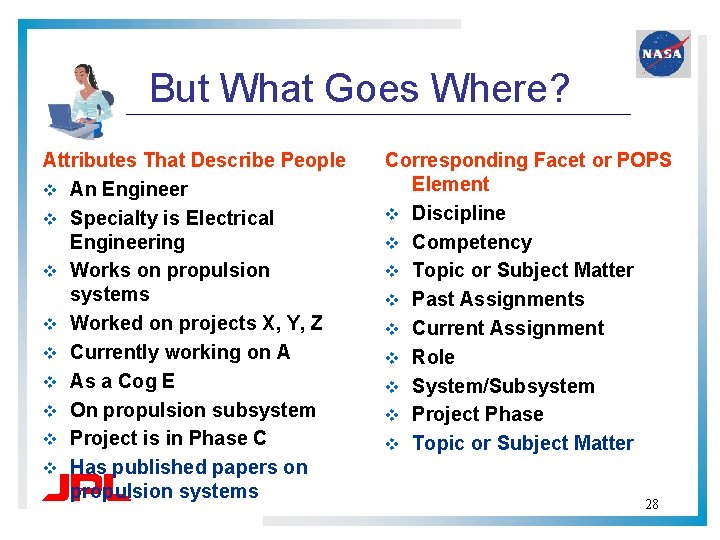
But What Goes Where? Attributes That Describe People v An Engineer v Specialty is Electrical Engineering v Works on propulsion systems v Worked on projects X, Y, Z v Currently working on A v As a Cog E v On propulsion subsystem v Project is in Phase C v Has published papers on propulsion systems Corresponding Facet or POPS Element v Discipline v Competency v Topic or Subject Matter v Past Assignments v Current Assignment v Role v System/Subsystem v Project Phase v Topic or Subject Matter 28
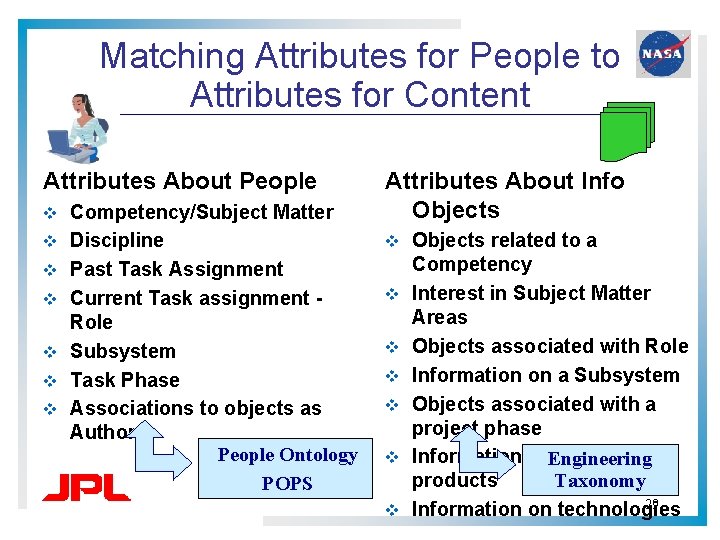
Matching Attributes for People to Attributes for Content Attributes About People v Competency/Subject Matter Attributes About Info Objects v Discipline v Objects related to a v Past Task Assignment v Current Task assignment - Role v Subsystem v Task Phase v Associations to objects as Author People Ontology POPS v v v Competency Interest in Subject Matter Areas Objects associated with Role Information on a Subsystem Objects associated with a project phase Information on. Engineering project Taxonomy products 29 Information on technologies
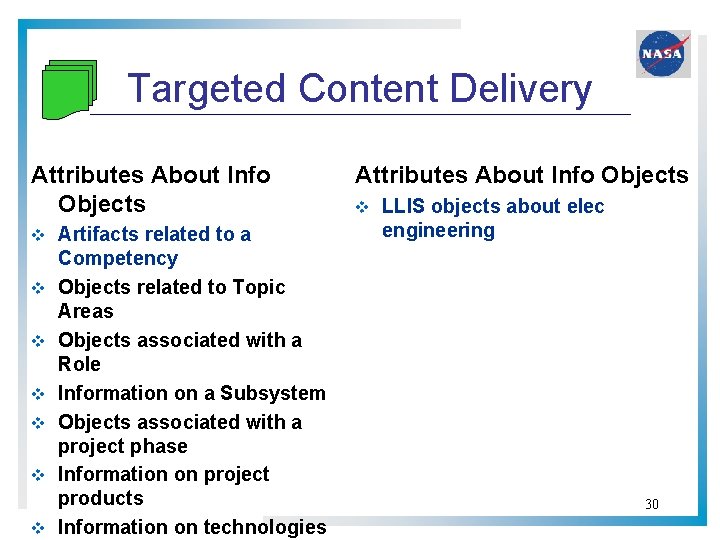
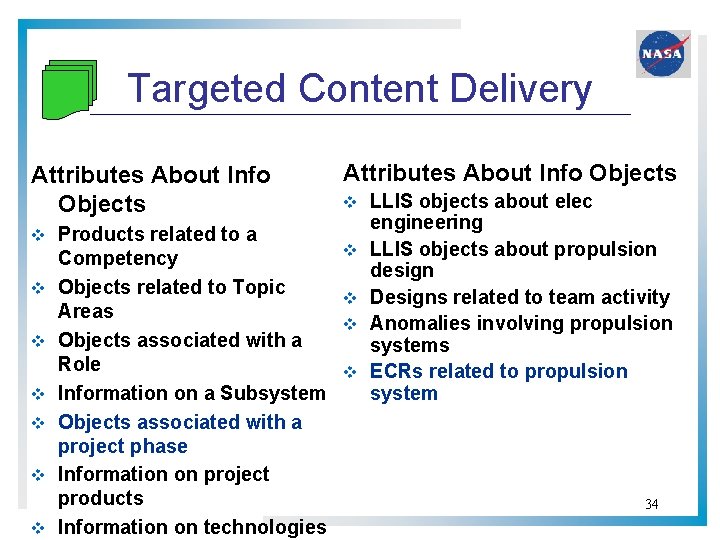
Targeted Content Delivery Attributes About Info Objects v Artifacts related to a v v v Competency Objects related to Topic Areas Objects associated with a Role Information on a Subsystem Objects associated with a project phase Information on project products Information on technologies Attributes About Info Objects v LLIS objects about elec engineering 30
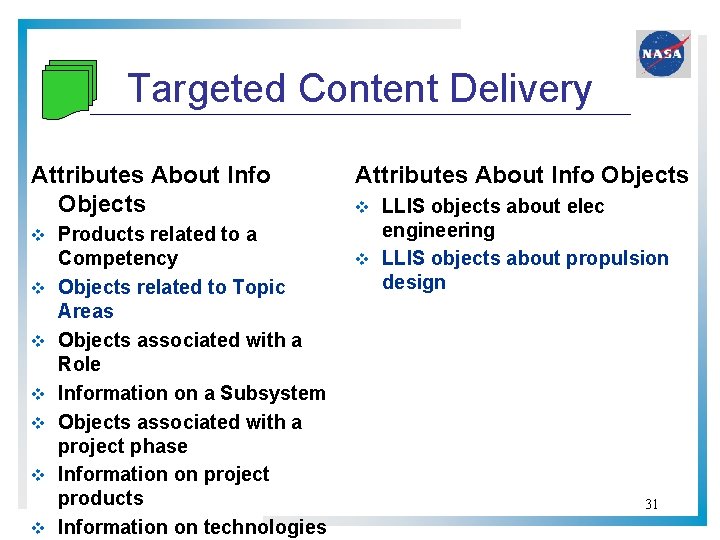
Targeted Content Delivery Attributes About Info Objects v Products related to a engineering v LLIS objects about propulsion design v v v Competency Objects related to Topic Areas Objects associated with a Role Information on a Subsystem Objects associated with a project phase Information on project products Information on technologies v LLIS objects about elec 31
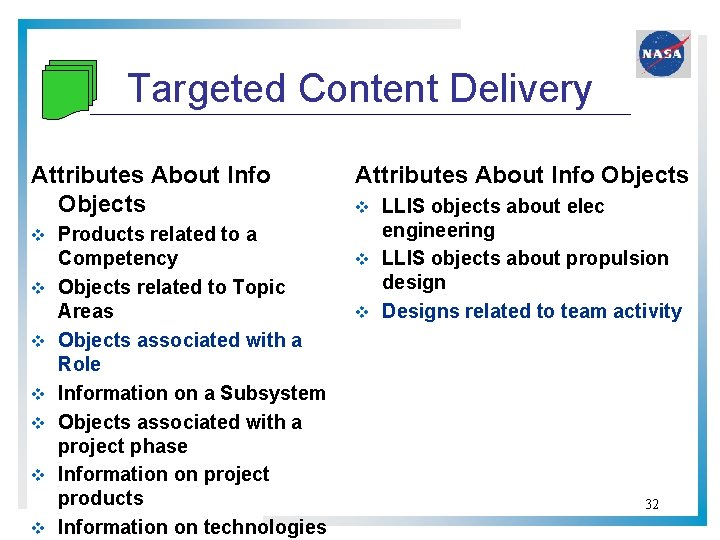
Targeted Content Delivery Attributes About Info Objects v Products related to a engineering v LLIS objects about propulsion design v Designs related to team activity v v v Competency Objects related to Topic Areas Objects associated with a Role Information on a Subsystem Objects associated with a project phase Information on project products Information on technologies v LLIS objects about elec 32
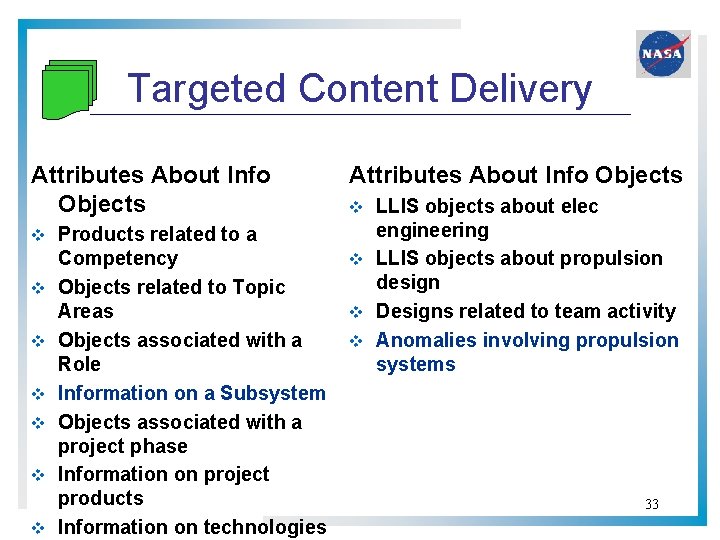
Targeted Content Delivery Attributes About Info Objects v Products related to a engineering v LLIS objects about propulsion design v Designs related to team activity v Anomalies involving propulsion systems v v v Competency Objects related to Topic Areas Objects associated with a Role Information on a Subsystem Objects associated with a project phase Information on project products Information on technologies v LLIS objects about elec 33
Targeted Content Delivery Attributes About Info Objects v Products related to a v v v Competency Objects related to Topic Areas Objects associated with a Role Information on a Subsystem Objects associated with a project phase Information on project products Information on technologies Attributes About Info Objects v LLIS objects about elec v v engineering LLIS objects about propulsion design Designs related to team activity Anomalies involving propulsion systems ECRs related to propulsion system 34
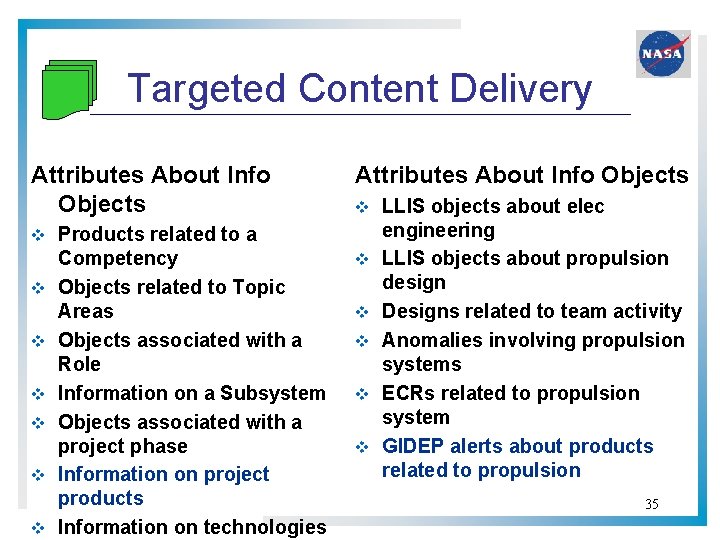
Targeted Content Delivery Attributes About Info Objects v LLIS objects about elec v Products related to a v v v Competency Objects related to Topic Areas Objects associated with a Role Information on a Subsystem Objects associated with a project phase Information on project products Information on technologies v v v engineering LLIS objects about propulsion design Designs related to team activity Anomalies involving propulsion systems ECRs related to propulsion system GIDEP alerts about products related to propulsion 35
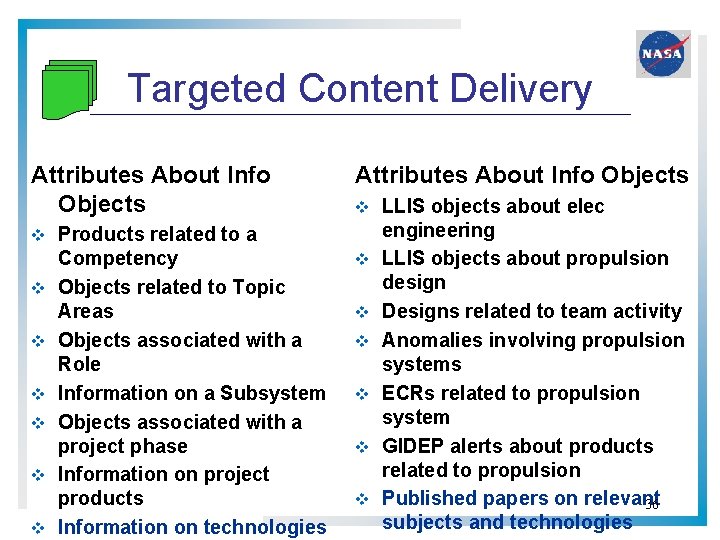
Targeted Content Delivery Attributes About Info Objects v LLIS objects about elec v Products related to a v v v Competency Objects related to Topic Areas Objects associated with a Role Information on a Subsystem Objects associated with a project phase Information on project products Information on technologies v v v engineering LLIS objects about propulsion design Designs related to team activity Anomalies involving propulsion systems ECRs related to propulsion system GIDEP alerts about products related to propulsion Published papers on relevant 36 subjects and technologies
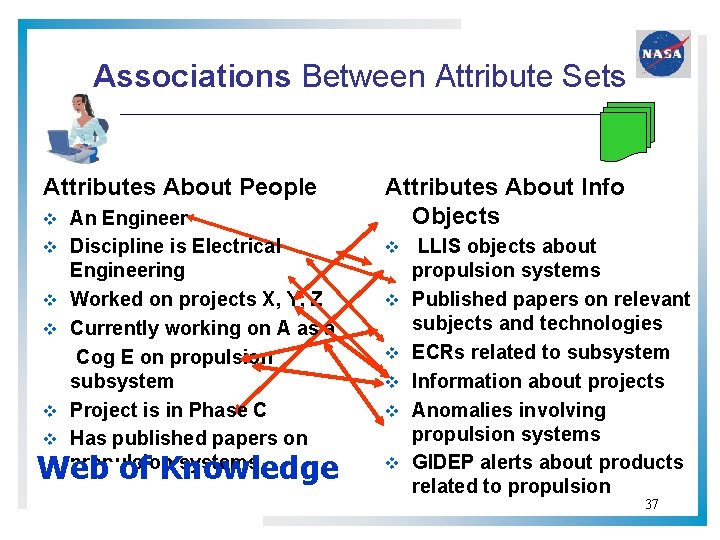
Associations Between Attribute Sets Attributes About People v An Engineer Attributes About Info Objects v Discipline is Electrical v LLIS objects about v v Engineering Worked on projects X, Y, Z Currently working on A as a Cog E on propulsion subsystem Project is in Phase C Has published papers on propulsion systems Web of Knowledge v v v propulsion systems Published papers on relevant subjects and technologies ECRs related to subsystem Information about projects Anomalies involving propulsion systems GIDEP alerts about products related to propulsion 37
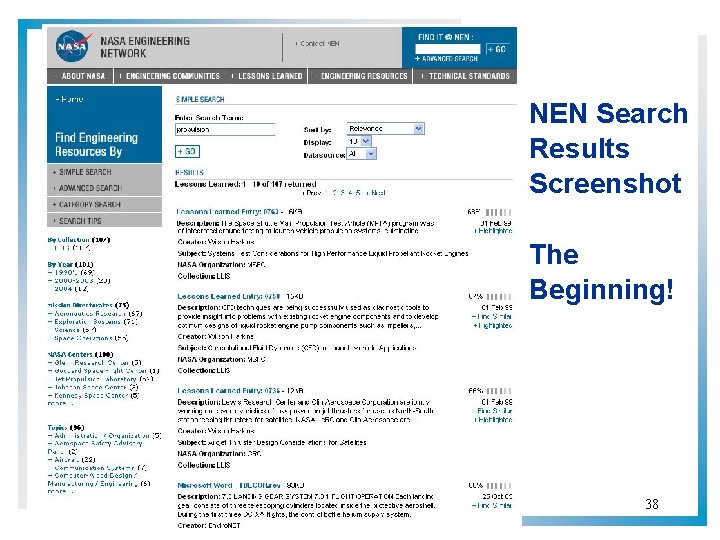
NEN Search Results Screenshot The Beginning! 38
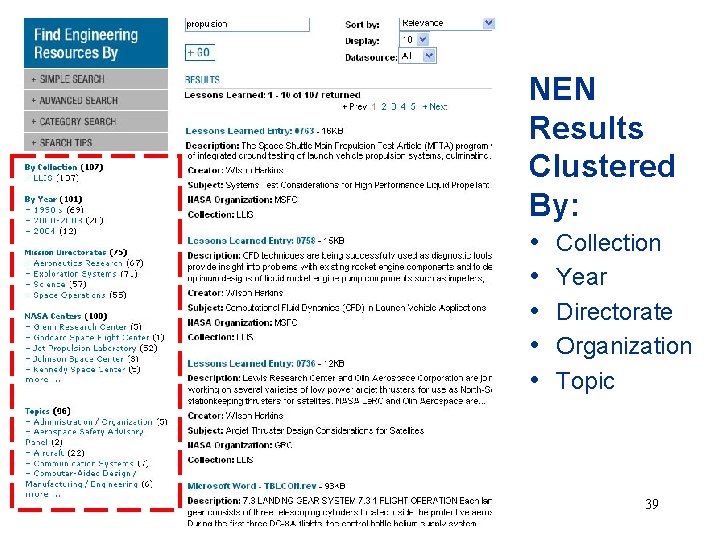
NEN Results Clustered By: • • • Collection Year Directorate Organization Topic 39
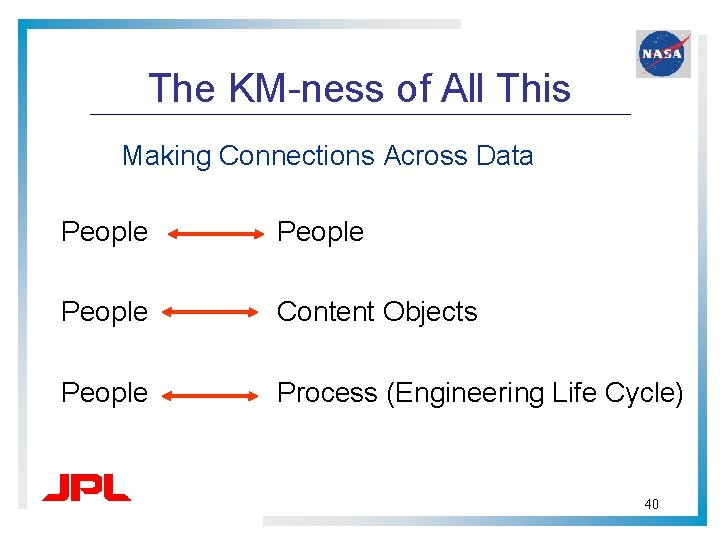
The KM-ness of All This Making Connections Across Data People Content Objects People Process (Engineering Life Cycle) 40
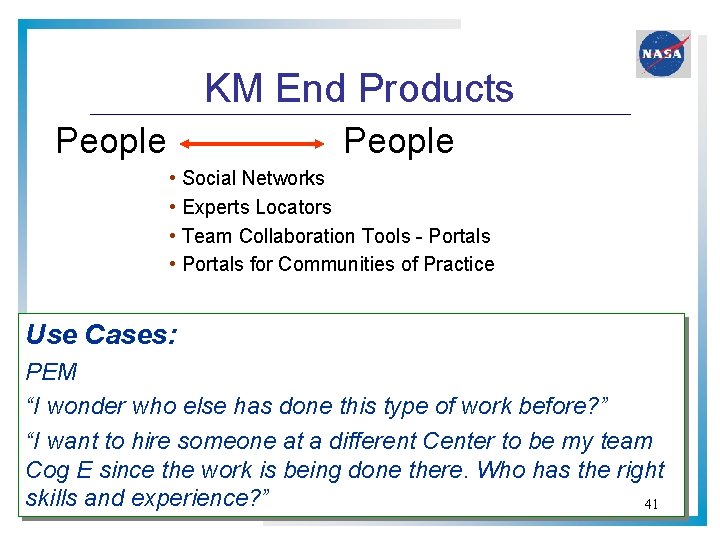
KM End Products People • Social Networks • Experts Locators • Team Collaboration Tools - Portals • Portals for Communities of Practice Use Cases: PEM “I wonder who else has done this type of work before? ” “I want to hire someone at a different Center to be my team Cog E since the work is being done there. Who has the right skills and experience? ” 41
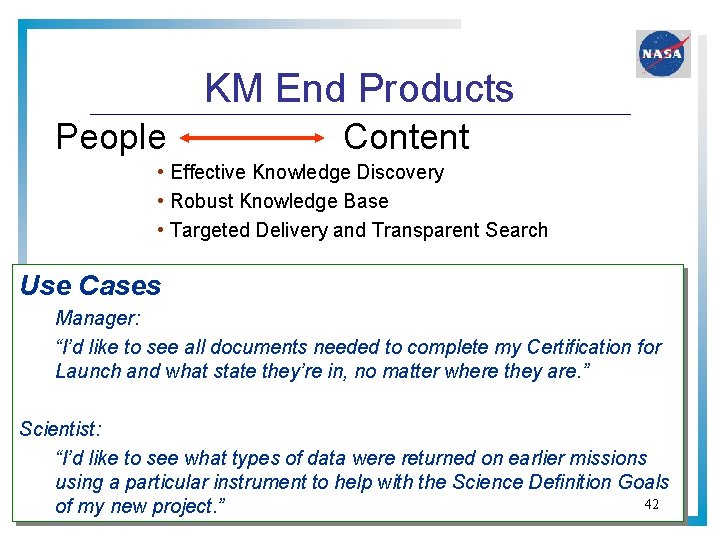
KM End Products People Content • Effective Knowledge Discovery • Robust Knowledge Base • Targeted Delivery and Transparent Search Use Cases Manager: “I’d like to see all documents needed to complete my Certification for Launch and what state they’re in, no matter where they are. ” Scientist: “I’d like to see what types of data were returned on earlier missions using a particular instrument to help with the Science Definition Goals 42 of my new project. ”
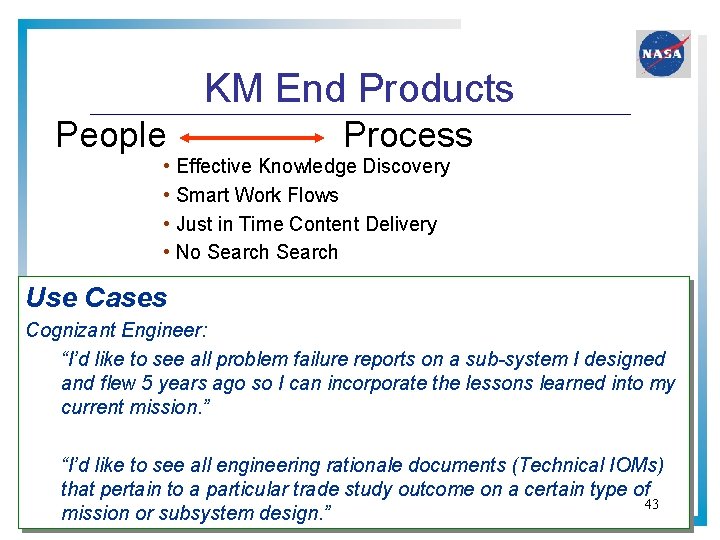
KM End Products People Process • Effective Knowledge Discovery • Smart Work Flows • Just in Time Content Delivery • No Search Use Cases Cognizant Engineer: “I’d like to see all problem failure reports on a sub-system I designed and flew 5 years ago so I can incorporate the lessons learned into my current mission. ” “I’d like to see all engineering rationale documents (Technical IOMs) that pertain to a particular trade study outcome on a certain type of 43 mission or subsystem design. ”
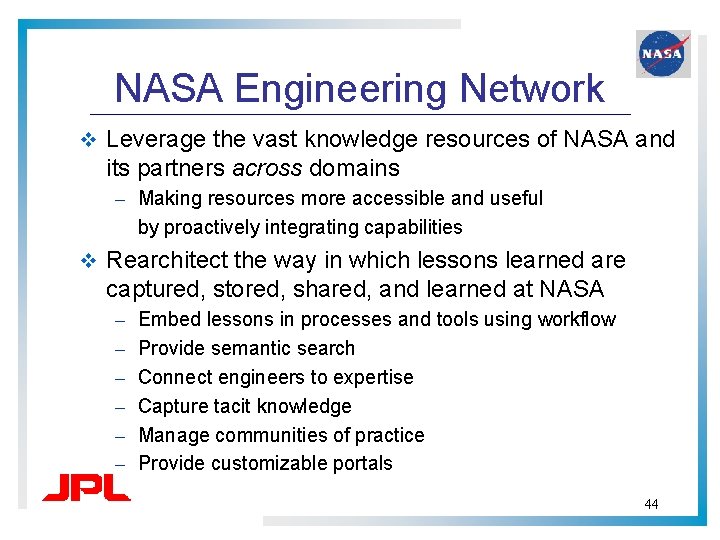
NASA Engineering Network v Leverage the vast knowledge resources of NASA and its partners across domains – Making resources more accessible and useful by proactively integrating capabilities v Rearchitect the way in which lessons learned are captured, stored, shared, and learned at NASA – – – Embed lessons in processes and tools using workflow Provide semantic search Connect engineers to expertise Capture tacit knowledge Manage communities of practice Provide customizable portals 44
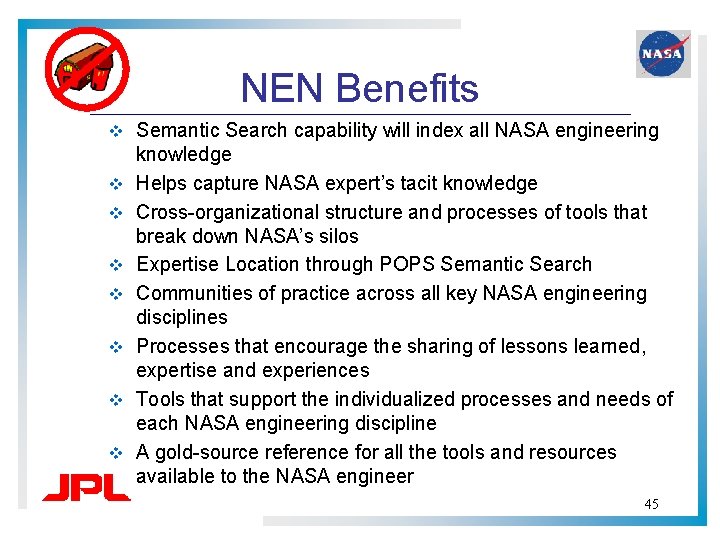
NEN Benefits v Semantic Search capability will index all NASA engineering v v v v knowledge Helps capture NASA expert’s tacit knowledge Cross-organizational structure and processes of tools that break down NASA’s silos Expertise Location through POPS Semantic Search Communities of practice across all key NASA engineering disciplines Processes that encourage the sharing of lessons learned, expertise and experiences Tools that support the individualized processes and needs of each NASA engineering discipline A gold-source reference for all the tools and resources available to the NASA engineer 45
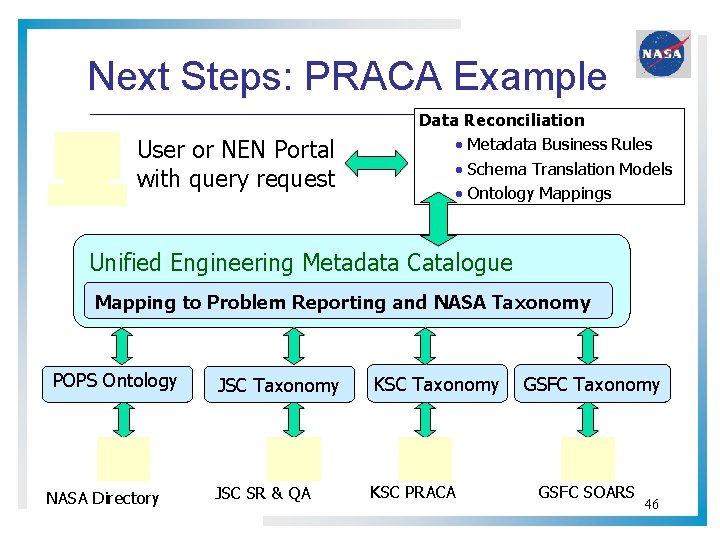
Next Steps: PRACA Example User or NEN Portal with query request Data Reconciliation • Metadata Business Rules • Schema Translation Models • Ontology Mappings Unified Engineering Metadata Catalogue Mapping to Problem Reporting and NASA Taxonomy POPS Ontology NASA Directory JSC Taxonomy KSC Taxonomy JSC SR & QA KSC PRACA GSFC Taxonomy GSFC SOARS 46
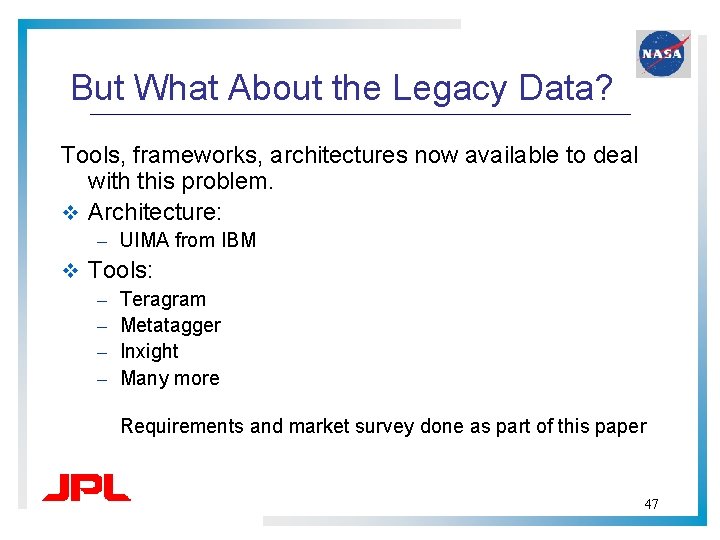
But What About the Legacy Data? Tools, frameworks, architectures now available to deal with this problem. v Architecture: – UIMA from IBM v Tools: – Teragram – Metatagger – Inxight – Many more Requirements and market survey done as part of this paper 47
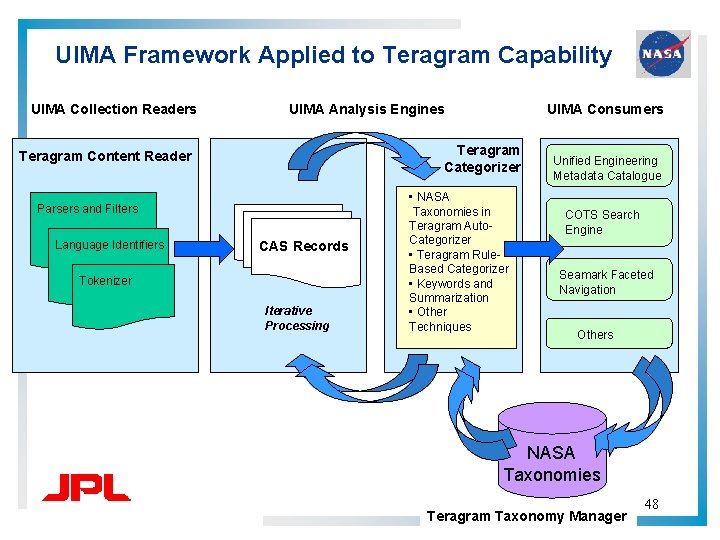
UIMA Framework Applied to Teragram Capability UIMA Collection Readers UIMA Analysis Engines Teragram Categorizer Teragram Content Reader Parsers and Filters Language Identifiers UIMA Consumers CAS Records Tokenizer Iterative Processing • NASA Taxonomies in Teragram Auto. Categorizer • Teragram Rule. Based Categorizer • Keywords and Summarization • Other Techniques Unified Engineering Metadata Catalogue COTS Search Engine Seamark Faceted Navigation Others NASA Taxonomies Teragram Taxonomy Manager 48
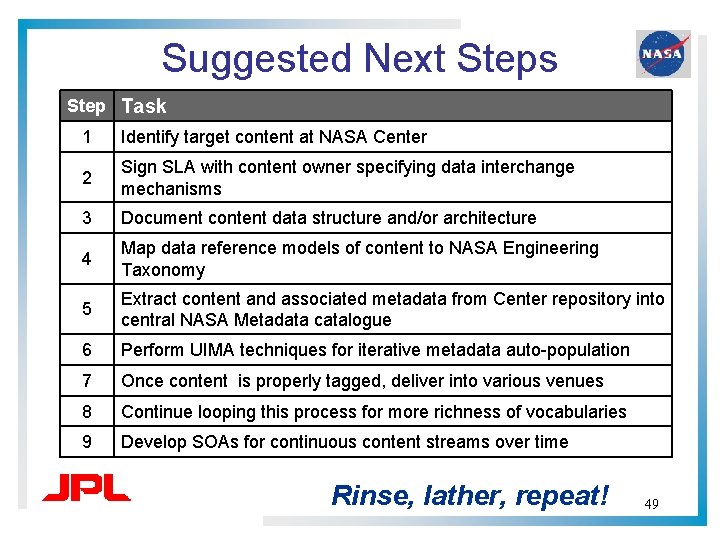
Suggested Next Steps Step Task 1 Identify target content at NASA Center 2 Sign SLA with content owner specifying data interchange mechanisms 3 Document content data structure and/or architecture 4 Map data reference models of content to NASA Engineering Taxonomy 5 Extract content and associated metadata from Center repository into central NASA Metadata catalogue 6 Perform UIMA techniques for iterative metadata auto-population 7 Once content is properly tagged, deliver into various venues 8 Continue looping this process for more richness of vocabularies 9 Develop SOAs for continuous content streams over time Rinse, lather, repeat! 49
Thanks for your time! Jayne. E. Dutra@jpl. nasa. gov
Back Up Slides (Dry Technical Stuff)
What Makes a Technology Semantic? Makes the Web understandable to computer systems Has the ability to: v Represent knowledge – More than just data element definitions – Expresses data relationships and process – Richness in statements about a specific knowledge domain v Reason over knowledge to create new knowledge v Make connections between data that are non-explicit v Deploy a knowledge model for run time consideration v Support disparate, distributed resources – Ask questions across repositories for integrated results 52
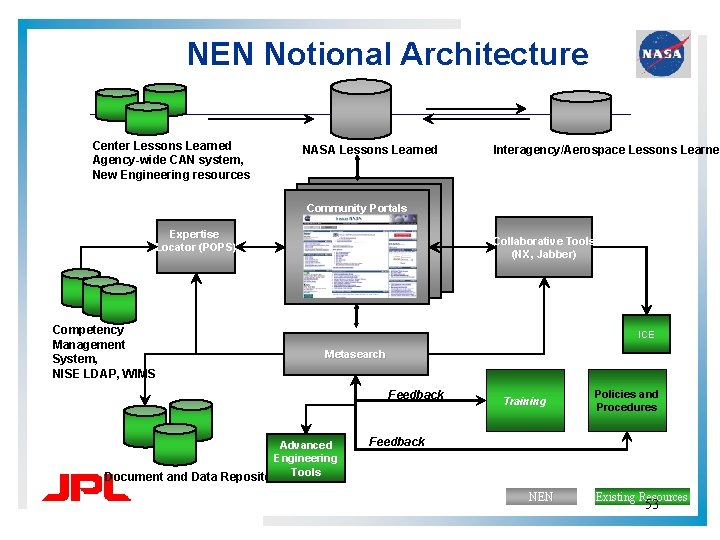
NEN Notional Architecture Center Lessons Learned Agency-wide CAN system, New Engineering resources NASA Lessons Learned Interagency/Aerospace Lessons Learne Community Portals Expertise Locator (POPS) Competency Management System, NISE LDAP, WIMS Collaborative Tools (NX, Jabber) ICE Metasearch Feedback Advanced Engineering Document and Data Repositories. Tools Training Policies and Procedures Feedback NEN Existing Resources 53
About UIMA “IBM’s Unstructured Information Management Architecture (UIMA) is an architecture and software framework for creating, discovering, composing and deploying a broad range of multimodal analysis capabilities and integrating them with search technologies. ” -UIMA SDK User’s Guide and Reference (August 2005), p. 13 54
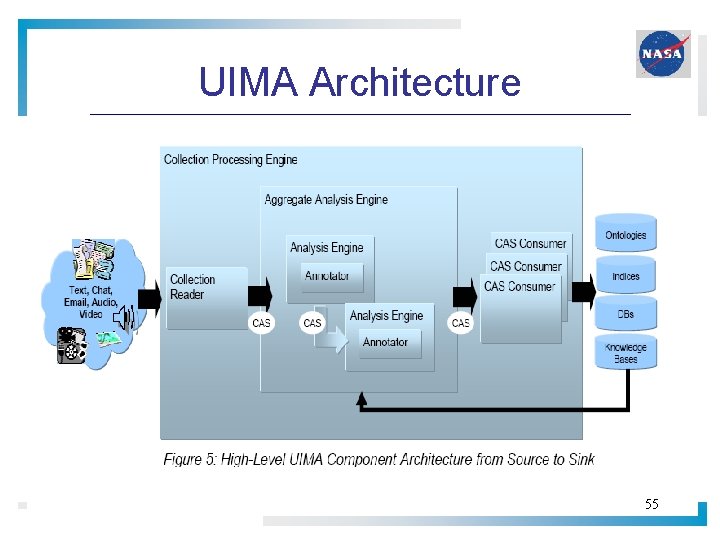
UIMA Architecture 55
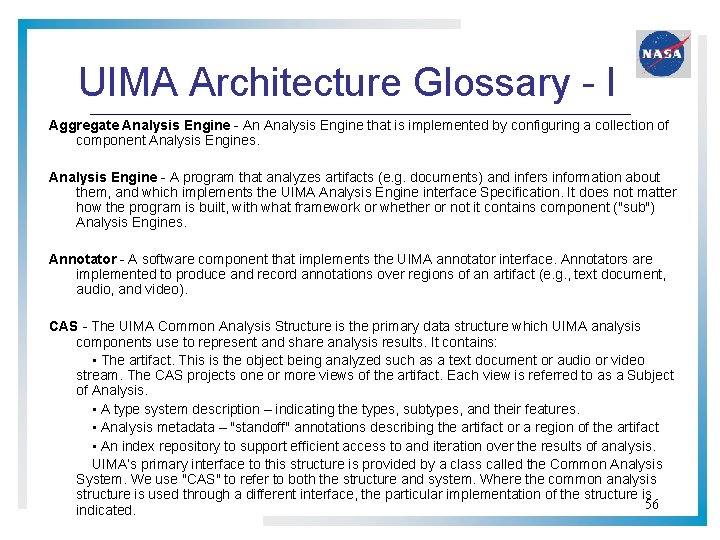
UIMA Architecture Glossary - I Aggregate Analysis Engine - An Analysis Engine that is implemented by configuring a collection of component Analysis Engines. Analysis Engine - A program that analyzes artifacts (e. g. documents) and infers information about them, and which implements the UIMA Analysis Engine interface Specification. It does not matter how the program is built, with what framework or whether or not it contains component ("sub") Analysis Engines. Annotator - A software component that implements the UIMA annotator interface. Annotators are implemented to produce and record annotations over regions of an artifact (e. g. , text document, audio, and video). CAS - The UIMA Common Analysis Structure is the primary data structure which UIMA analysis components use to represent and share analysis results. It contains: • The artifact. This is the object being analyzed such as a text document or audio or video stream. The CAS projects one or more views of the artifact. Each view is referred to as a Subject of Analysis. • A type system description – indicating the types, subtypes, and their features. • Analysis metadata – "standoff" annotations describing the artifact or a region of the artifact • An index repository to support efficient access to and iteration over the results of analysis. UIMA’s primary interface to this structure is provided by a class called the Common Analysis System. We use "CAS" to refer to both the structure and system. Where the common analysis structure is used through a different interface, the particular implementation of the structure is 56 indicated.
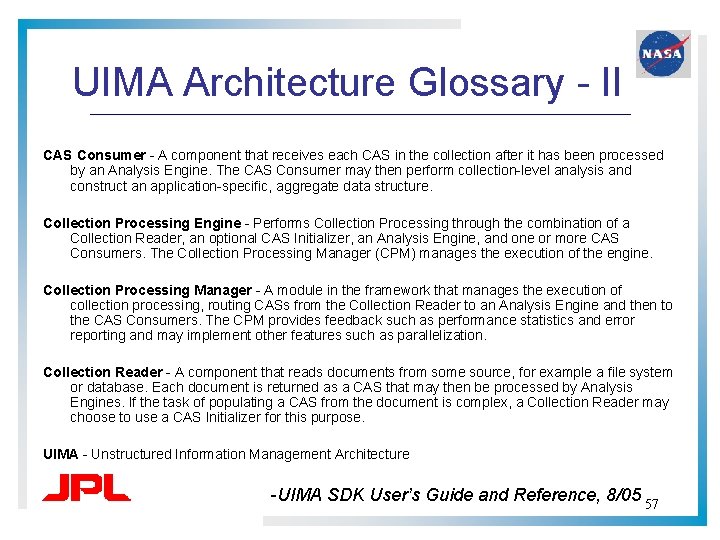
UIMA Architecture Glossary - II CAS Consumer - A component that receives each CAS in the collection after it has been processed by an Analysis Engine. The CAS Consumer may then perform collection-level analysis and construct an application-specific, aggregate data structure. Collection Processing Engine - Performs Collection Processing through the combination of a Collection Reader, an optional CAS Initializer, an Analysis Engine, and one or more CAS Consumers. The Collection Processing Manager (CPM) manages the execution of the engine. Collection Processing Manager - A module in the framework that manages the execution of collection processing, routing CASs from the Collection Reader to an Analysis Engine and then to the CAS Consumers. The CPM provides feedback such as performance statistics and error reporting and may implement other features such as parallelization. Collection Reader - A component that reads documents from some source, for example a file system or database. Each document is returned as a CAS that may then be processed by Analysis Engines. If the task of populating a CAS from the document is complex, a Collection Reader may choose to use a CAS Initializer for this purpose. UIMA - Unstructured Information Management Architecture -UIMA SDK User’s Guide and Reference, 8/05 57