
NASA SBIRSTTR Technologies High fidelity downconversion source for
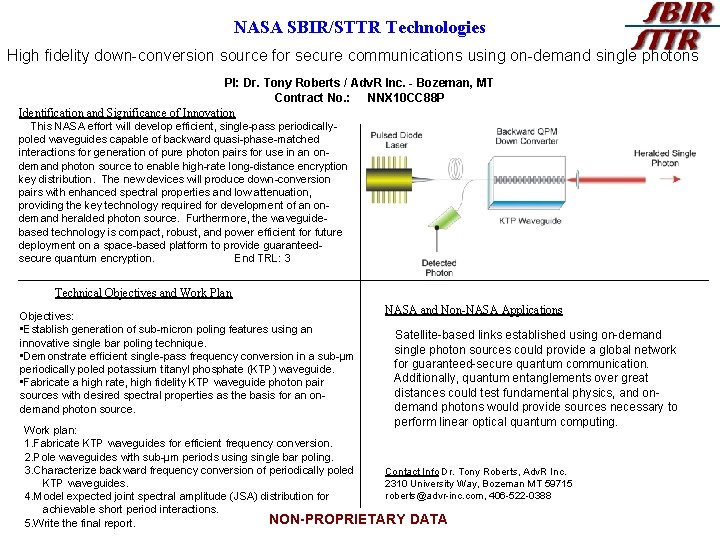
NASA SBIR/STTR Technologies High fidelity down-conversion source for secure communications using on-demand single photons PI: Dr. Tony Roberts / Adv. R Inc. - Bozeman, MT Contract No. : NNX 10 CC 88 P Identification and Significance of Innovation This NASA effort will develop efficient, single-pass periodicallypoled waveguides capable of backward quasi-phase-matched interactions for generation of pure photon pairs for use in an ondemand photon source to enable high-rate long-distance encryption key distribution. The new devices will produce down-conversion pairs with enhanced spectral properties and low attenuation, providing the key technology required for development of an ondemand heralded photon source. Furthermore, the waveguidebased technology is compact, robust, and power efficient for future deployment on a space-based platform to provide guaranteedsecure quantum encryption. End TRL: 3 Technical Objectives and Work Plan Objectives: • Establish generation of sub-micron poling features using an innovative single bar poling technique. • Demonstrate efficient single-pass frequency conversion in a sub-µm periodically poled potassium titanyl phosphate (KTP) waveguide. • Fabricate a high rate, high fidelity KTP waveguide photon pair sources with desired spectral properties as the basis for an ondemand photon source. NASA and Non-NASA Applications Satellite-based links established using on-demand single photon sources could provide a global network for guaranteed-secure quantum communication. Additionally, quantum entanglements over great distances could test fundamental physics, and ondemand photons would provide sources necessary to perform linear optical quantum computing. Work plan: 1. Fabricate KTP waveguides for efficient frequency conversion. 2. Pole waveguides with sub-µm periods usingle bar poling. 3. Characterize backward frequency conversion of periodically poled Contact Info Dr. Tony Roberts, Adv. R Inc. KTP waveguides. 2310 University Way, Bozeman MT 59715 roberts@advr-inc. com, 406 -522 -0388 4. Model expected joint spectral amplitude (JSA) distribution for achievable short period interactions. NON-PROPRIETARY DATA 5. Write the final report.
- Slides: 1