
NASA OBPG Satellite Ocean Color Update Bryan Franz
NASA OBPG Satellite Ocean Color Update Bryan Franz and the Ocean Biology Processing Group NASA Goddard Space Flight Center Ocean Color Research Team Meeting 26 & 28 May 2020 Virtual
Contents 1. Status of MODIS, VIIRS ocean color data quality 2. Temporal calibration issue with VIIRS on SNPP 3. Plans for the next multi-mission ocean color reprocessing 4. Evolution of Sea. DAS 2
Current Ocean Color Processing Version R 2018. 0 Completed • VIIRS/SNPP (Dec 2017), MODIS/Aqua (Jan 2018), February 2018 (Sea. Wi. FS), MODIS/Terra (April 2018), and VIIRS/JPSS 1 (Sep 2018) Purpose • incorporate updates to vicarious calibration due to revised MOBY time-series • incorporate updates to instrument calibration • no algorithm changes since R 2014. 0 • first processing for VIIRS on JPSS-1 o algorithms identical to SNPP VIIRS o instrument calibration as-is (no temporal calibration) o used SNPP for vicarious cal
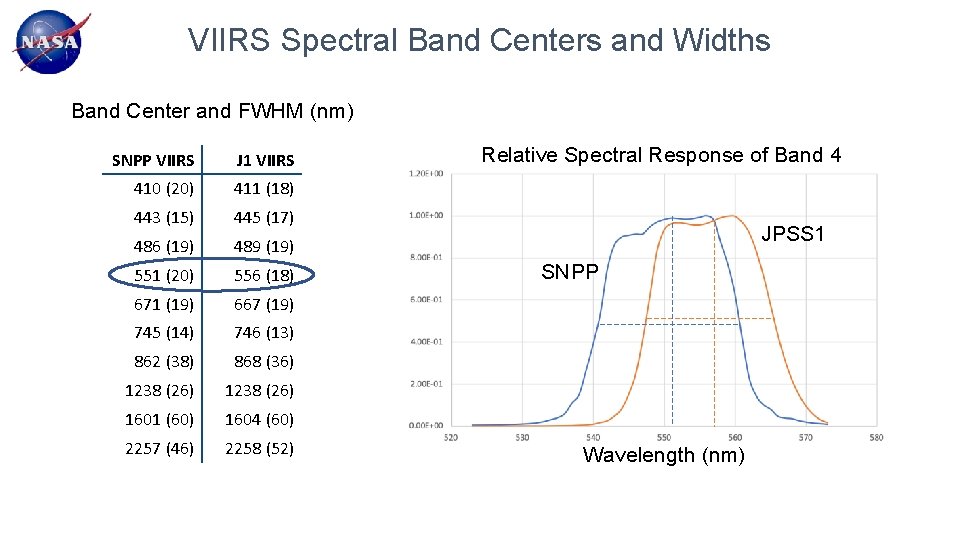
VIIRS Spectral Band Centers and Widths Band Center and FWHM (nm) SNPP VIIRS J 1 VIIRS 410 (20) 411 (18) 443 (15) 445 (17) 486 (19) 489 (19) 551 (20) 556 (18) 671 (19) 667 (19) 745 (14) 746 (13) 862 (38) 868 (36) 1238 (26) 1601 (60) 1604 (60) 2257 (46) 2258 (52) Relative Spectral Response of Band 4 JPSS 1 SNPP Wavelength (nm)
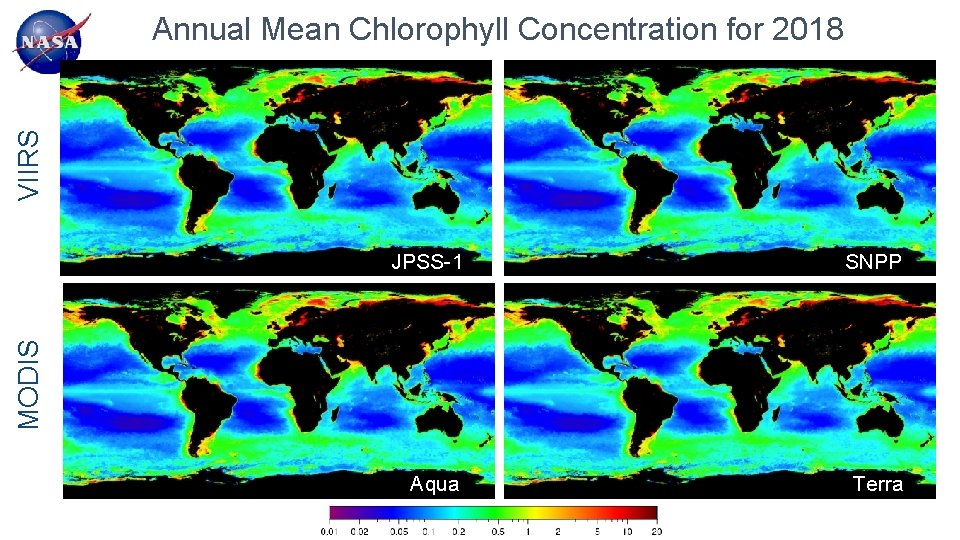
VIIRS Annual Mean Chlorophyll Concentration for 2018 SNPP Aqua Terra MODIS JPSS-1
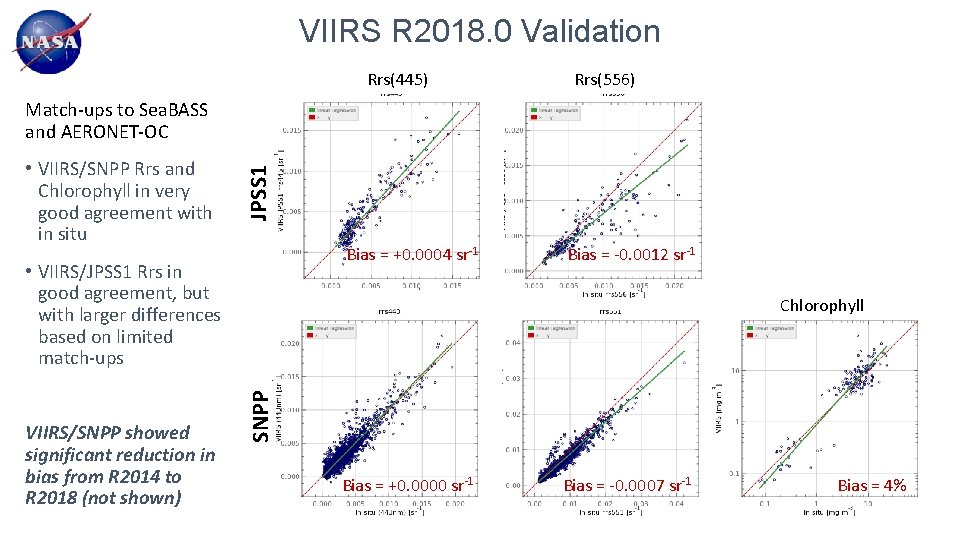
VIIRS R 2018. 0 Validation Rrs(445) Rrs(556) • VIIRS/SNPP Rrs and Chlorophyll in very good agreement with in situ JPSS 1 Match-ups to Sea. BASS and AERONET-OC Bias = +0. 0004 sr-1 • VIIRS/JPSS 1 Rrs in good agreement, but with larger differences based on limited match-ups Chlorophyll SNPP VIIRS/SNPP showed significant reduction in bias from R 2014 to R 2018 (not shown) Bias = -0. 0012 sr-1 Bias = +0. 0000 sr-1 Bias = -0. 0007 sr-1 Bias = 4%
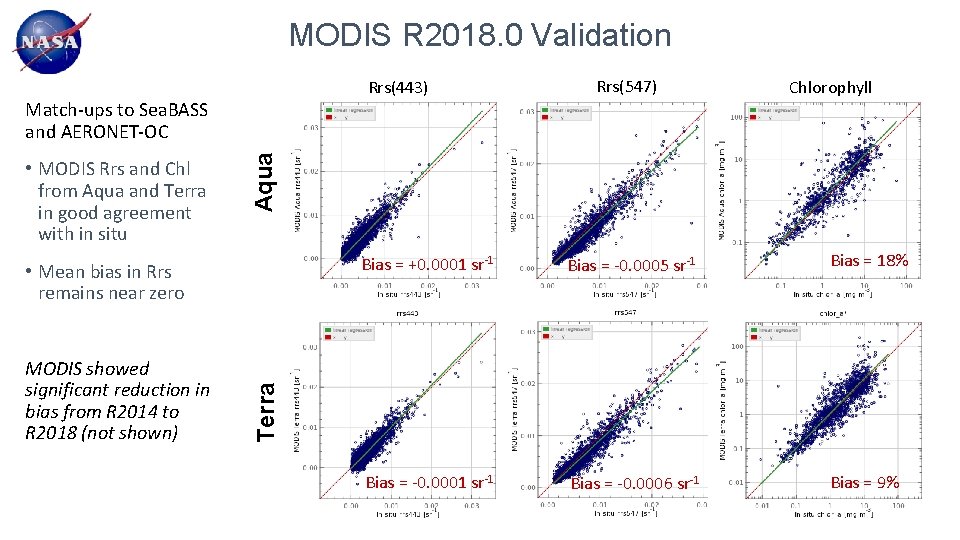
MODIS R 2018. 0 Validation Rrs(443) • MODIS Rrs and Chl from Aqua and Terra in good agreement with in situ Bias = +0. 0001 sr-1 Bias = -0. 0005 sr-1 Bias = 18% Bias = -0. 0001 sr-1 Bias = -0. 0006 sr-1 Bias = 9% Terra • Mean bias in Rrs remains near zero MODIS showed significant reduction in bias from R 2014 to R 2018 (not shown) Chlorophyll Aqua Match-ups to Sea. BASS and AERONET-OC Rrs(547)
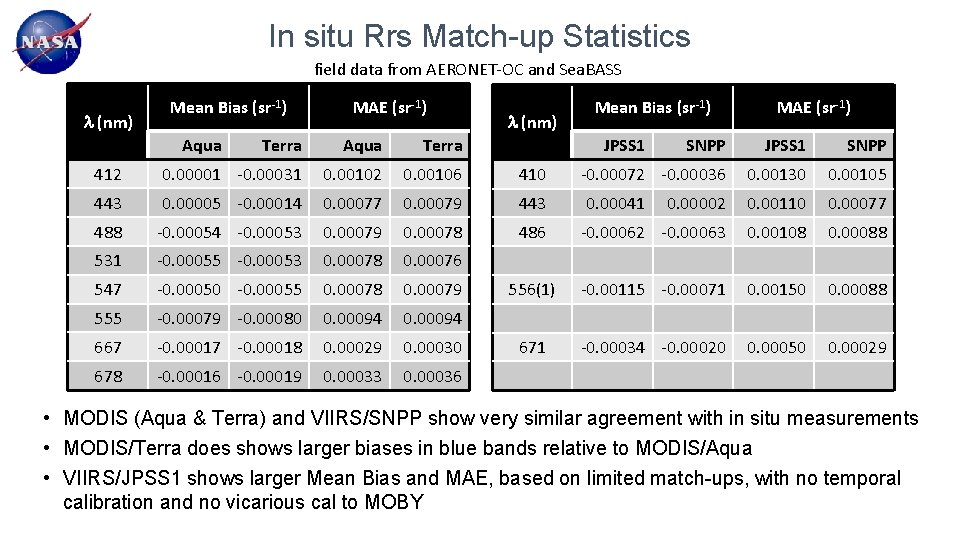
In situ Rrs Match-up Statistics field data from AERONET-OC and Sea. BASS l (nm) Mean Bias (sr-1) Aqua MAE (sr-1) l (nm) Terra Aqua Terra 412 0. 00001 -0. 00031 0. 00102 0. 00106 410 443 0. 00005 -0. 00014 0. 00077 0. 00079 443 488 -0. 00054 -0. 00053 0. 00079 0. 00078 531 -0. 00055 -0. 00053 0. 00078 0. 00076 547 -0. 00050 -0. 00055 0. 00078 0. 00079 555 -0. 00079 -0. 00080 0. 00094 667 -0. 00018 0. 00029 0. 00030 678 -0. 00016 -0. 00019 0. 00033 0. 00036 Mean Bias (sr-1) JPSS 1 MAE (sr-1) SNPP JPSS 1 SNPP -0. 00072 -0. 00036 0. 00130 0. 00105 0. 00002 0. 00110 0. 00077 486 -0. 00062 -0. 00063 0. 00108 0. 00088 556(1) -0. 00115 -0. 00071 0. 00150 0. 00088 671 -0. 00034 -0. 00020 0. 00050 0. 00029 0. 00041 • MODIS (Aqua & Terra) and VIIRS/SNPP show very similar agreement with in situ measurements • MODIS/Terra does shows larger biases in blue bands relative to MODIS/Aqua • VIIRS/JPSS 1 shows larger Mean Bias and MAE, based on limited match-ups, with no temporal calibration and no vicarious cal to MOBY
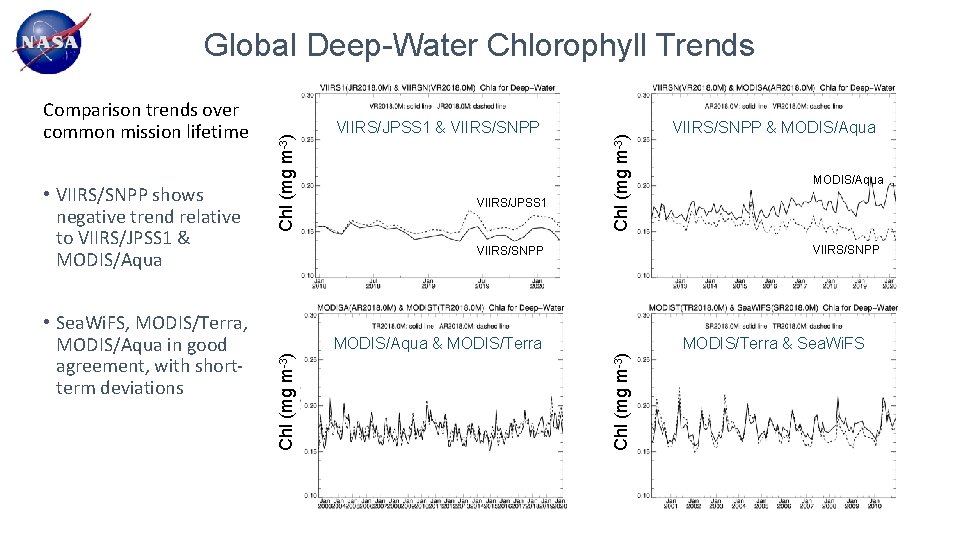
• Sea. Wi. FS, MODIS/Terra, MODIS/Aqua in good agreement, with shortterm deviations VIIRS/JPSS 1 Chl (mg m-3) VIIRS/JPSS 1 & VIIRS/SNPP & MODIS/Aqua VIIRS/SNPP MODIS/Aqua & MODIS/Terra & Sea. Wi. FS Chl (mg m-3) • VIIRS/SNPP shows negative trend relative to VIIRS/JPSS 1 & MODIS/Aqua Chl (mg m-3) Comparison trends over common mission lifetime Chl (mg m-3) Global Deep-Water Chlorophyll Trends
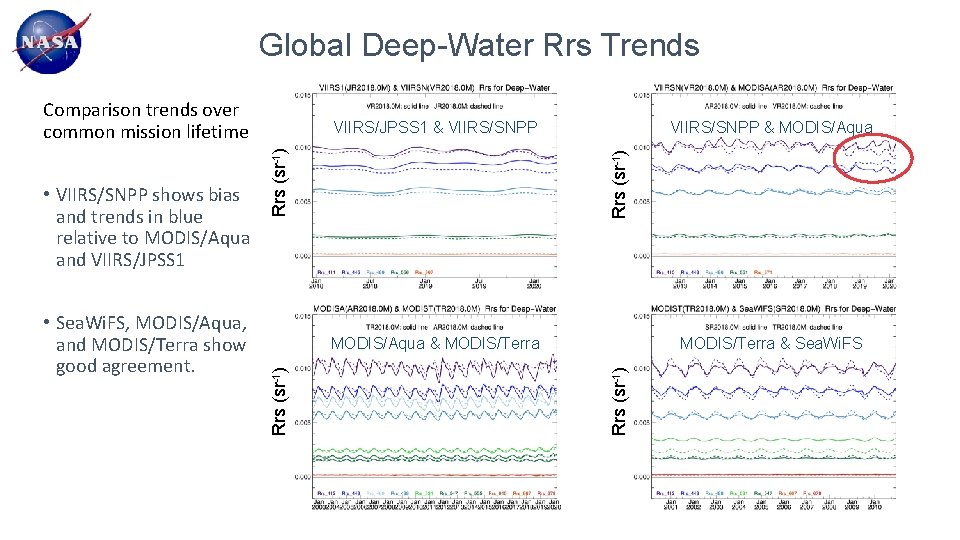
Global Deep-Water Rrs Trends Comparison trends over common mission lifetime Rrs (sr-1) VIIRS/SNPP & MODIS/Aqua & MODIS/Terra & Sea. Wi. FS Rrs (sr-1) • Sea. Wi. FS, MODIS/Aqua, and MODIS/Terra show good agreement. Rrs (sr-1) • VIIRS/SNPP shows bias and trends in blue relative to MODIS/Aqua and VIIRS/JPSS 1 & VIIRS/SNPP
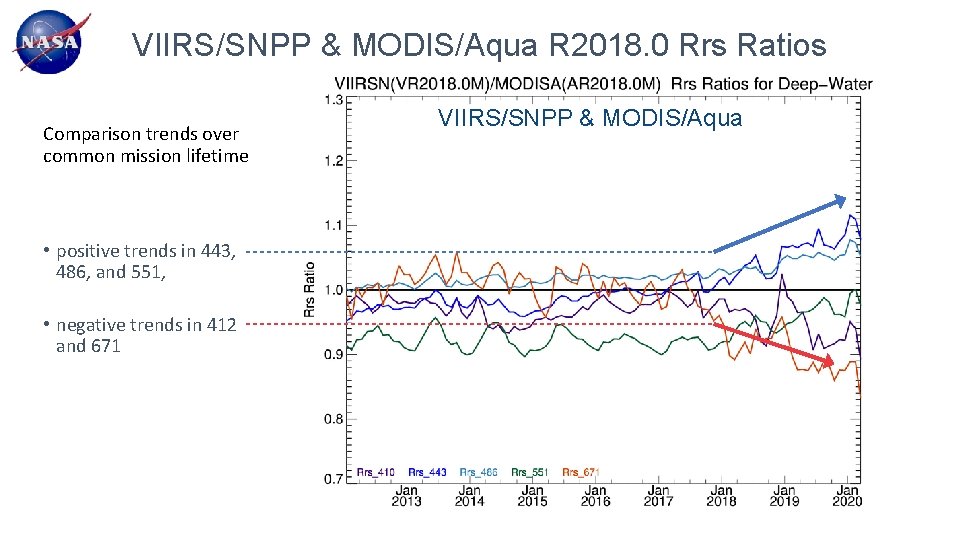
VIIRS/SNPP & MODIS/Aqua R 2018. 0 Rrs Ratios Comparison trends over common mission lifetime • positive trends in 443, 486, and 551, • negative trends in 412 and 671 VIIRS/SNPP & MODIS/Aqua
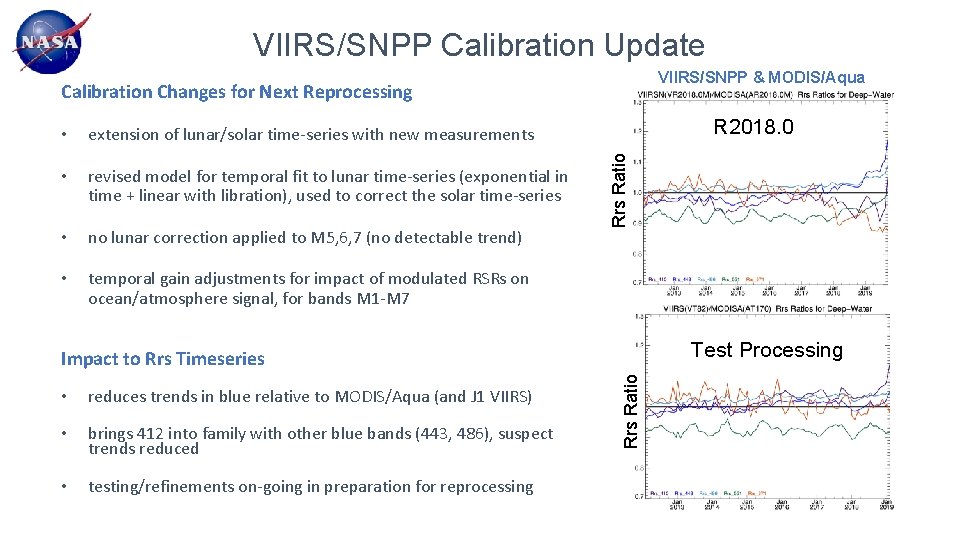
VIIRS/SNPP Calibration Update VIIRS/SNPP & MODIS/Aqua Calibration Changes for Next Reprocessing extension of lunar/solar time-series with new measurements • revised model for temporal fit to lunar time-series (exponential in time + linear with libration), used to correct the solar time-series • no lunar correction applied to M 5, 6, 7 (no detectable trend) • temporal gain adjustments for impact of modulated RSRs on ocean/atmosphere signal, for bands M 1 -M 7 R 2018. 0 Rrs Ratio • Test Processing • reduces trends in blue relative to MODIS/Aqua (and J 1 VIIRS) • brings 412 into family with other blue bands (443, 486), suspect trends reduced • testing/refinements on-going in preparation for reprocessing Rrs Ratio Impact to Rrs Timeseries
NASA Ocean Color Reprocessing 2020. 0 Planning for Spring 2020, first major update of algorithms since R 2014. 0 1. updates to ancillary data sources - from NCEP/TOMS-OMI/etc. to MERRA-2 assimilation product 2. updates to atmospheric correction methods and tables - multi-scattering aerosol selection, improved gas corrections (H 2 O), bug in Rayleigh tables at extreme solar zenith, instrumental error propagation 3. updates to pure seawater optical properties (nw, aw, bbw) - apply temperature & salinity dependence (e. g. , Werdell et al. 2013), bug in pure-water aw/bbw (off by few nm) 4. updates to masks and flags - reduced straylight masking (Hu et al. 2019, JGRO), absorbing aerosol flag based on MERRA-2 transport model 5. updates to derived product algorithms - Chl coefficient update (Hu et al. 2019, JGRO; O'Reilly and Werdell, 2019), PIC, PAR, etc. 6. new products - Rrs uncertainties (TBD), new standard/provisional products (TBD)
Sea. DAS 8: moving from BEAM to SNAP Sea. DAS Toolbox • Released in 2019 • Can be installed within the ESA SNAP • Contains NASA Ocean Color processing tools currently in Sea. DAS 7. • • Sea. DAS 8 Beta release planned for Summer 2020 Built on SNAP framework, modified GUI Includes Sea. DAS-Toolbox and Sentinel-3 Toolbox (other ESA toolboxes can be installed) Enables continuation of joint development in visualization tools and capabilities. Sea. DAS 8 Visualization SNAP = Sentinel Application Platform (developed for ESA by Brockmann Consult) 14
Higher Spatial Resolution Level-3 Products • Standard Level-3 products are based on binning from Level-2 native resolution into quasi-equal-area bins at 4. 6 x 4. 6 km, using the center location of the observation. • Users frequently ask for higher resolution binned/mapped data products, or produce them with the standard binner in Sea. DAS. • Result is poor quality imagery and invalid statistics due to pixel growth from nadir to scan edge. • OBPG developed an efficient mechanism to approximate the observational footprint of each pixel and weight the contribution into the fixed geographical bins. • Updated binner will be distributed with Sea. DAS 8, and may be applied by OBPG to produce/distribute higher-resolution standard products.
Summary • MODISA, MODIST, Sea. Wi. FS R 2018. 0 looking good • SNPP VIIRS R 2018. 0 showing late-mission drifts, significant improvements expected with next reprocessing • JPSS 1 VIIRS OC products now available, temporal calibration appears stable, vicarious calibration to MOBY should reduce biases • Consistently-processed L 2/L 3 OLCI products from S 3 A & S 3 B likely in next reprocessing (L 1 B currently available from OB. DAAC) • Still supporting GOCI, & heritage missions (Sea. Wi. FS, HICO, etc. ), and leveraging OBPG facilities for Sea. Hawk, PACE, and GLIMR • Next multi-mission ocean color reprocessing, R 2020. 0, now planned to start in Summer 2020 (calibration updates, algorithm refinements) 16

Questions? Back-up
- Slides: 17