
NASA Lessons From Columbia Wayne Hale Director of
NASA Lessons From Columbia Wayne Hale Director of Human Spaceflight Notice: Information Subject to Export Control Laws. This document contains NO “Technical Data” as defined under The International Traffic in Arms Regulations (ITAR) (22 C. F. R. 120. 10). DTC Case TA 2777 -09. SAS Approved For Release
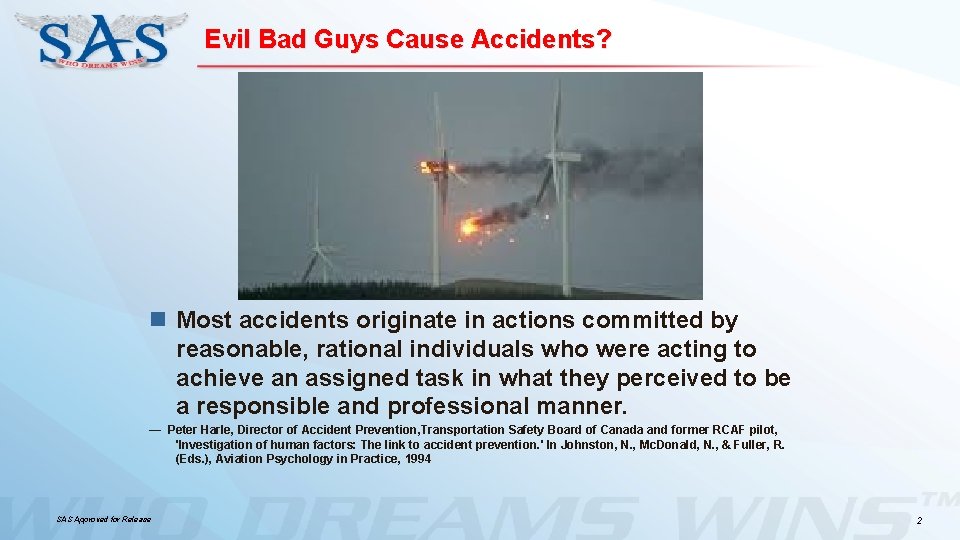
Evil Bad Guys Cause Accidents? n Most accidents originate in actions committed by reasonable, rational individuals who were acting to achieve an assigned task in what they perceived to be a responsible and professional manner. — Peter Harle, Director of Accident Prevention, Transportation Safety Board of Canada and former RCAF pilot, 'Investigation of human factors: The link to accident prevention. ' In Johnston, N. , Mc. Donald, N. , & Fuller, R. (Eds. ), Aviation Psychology in Practice, 1994 SAS Approved for Release 2
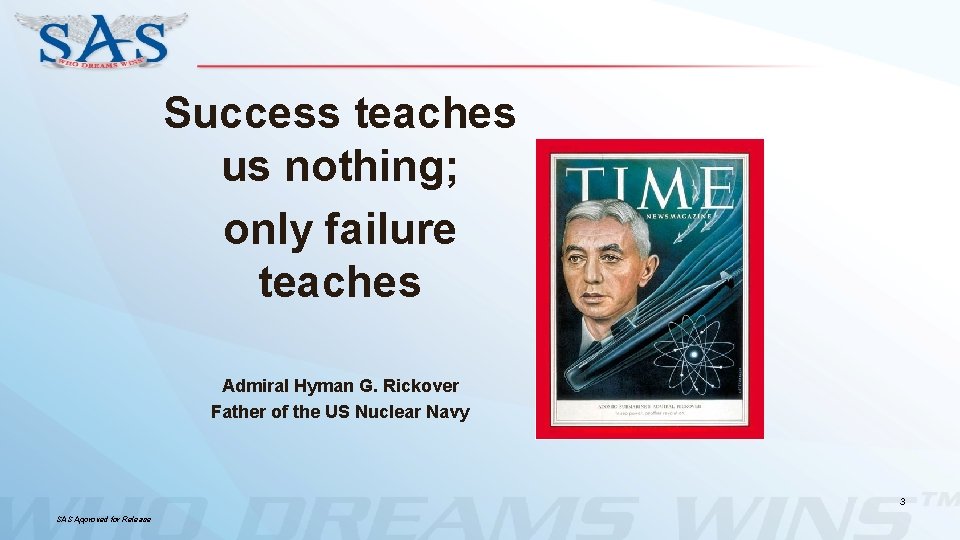
Success teaches us nothing; only failure teaches Admiral Hyman G. Rickover Father of the US Nuclear Navy 3 SAS Approved for Release
Success and Adversity n 87 successful space shuttle flights between Challenger and Columbia n “Cultural traits and organizational practices detrimental to safety were allowed to develop including reliance on past successes as a substitute for sound engineering practices …‟ - Columbia Accident Investigation Board, September 2003 n Several Technical Issues faced by the Space Shuttle Program before Columbia: Ball-Strut-Tie Rod Assembly (BSTRA) Main Prop System Flowliner Cracks TVC Hydraulic Power Unit ET Foam loss ETA Ring Structural Margin SRB Nozzle Pocketing SRB Insulation Ply Lifting SRB Nozzle Bonds SRB Propellant Cracks Payload Bay Door Power Drive Unit MLP Corrosion – Hydrogen Vent Line Orbiter Corrosion Rudder/Speedbrake Orbiter Wiring Transporter Bearings Pyrotechnic Duds Main Engine. Turbine Tip Seals SAS Approved for Release 4
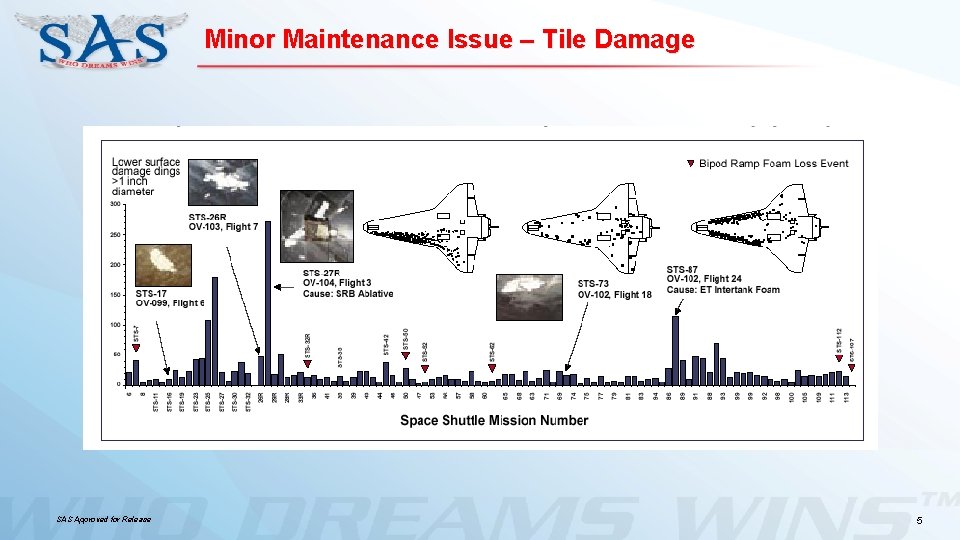
Minor Maintenance Issue – Tile Damage SAS Approved for Release 5
As Columbia Counted Down to Launch n The Space Shuttle perceived as “Operational” and “a Mature System” after flying for 22 years and 112 flights v No major surprises expected v Environments and hardware thought to be well understood. n NASA under intense budgetary pressure – costs must be reduced v Annual inflation adjusted Shuttle budget reduced 45% between 1991 and 2002 n NASA under intense schedule pressure – Space Station Assembly significantly behind schedule n Columbia mission STS-107 was considered “routine” and “low complexity” n On Orbit repair to heat shield considered impossible “Nothing We Can Do” – an “Accepted Risk” SAS Approved for Release 6
Success leads to Failure n Success can be more dangerous than failure n Learn to ask for help early n Keep your leaders informed n Don’t be like the frog in the pot of water – boiled to death slowly n Encourage your subordinates to report problems and ask for help v Don’t punish them inadvertently – encourage ‘bad news’ reports v Don’t punish them by over helping them Failure really is an option – Lucy V. Kranz SAS Approved for Release 7

NASA’s Return to Flight Rationale Primary Hazard Control Warning Devices I Elimination of Critical Debris II Impact Detection During Ascent III On-Orbit Debris Impact/Damage Detection Special Procedures IV On-Orbit TPS Repair (Tile & RCC) V Crew Rescue SAS Approved for Release 5 6 7 8 9
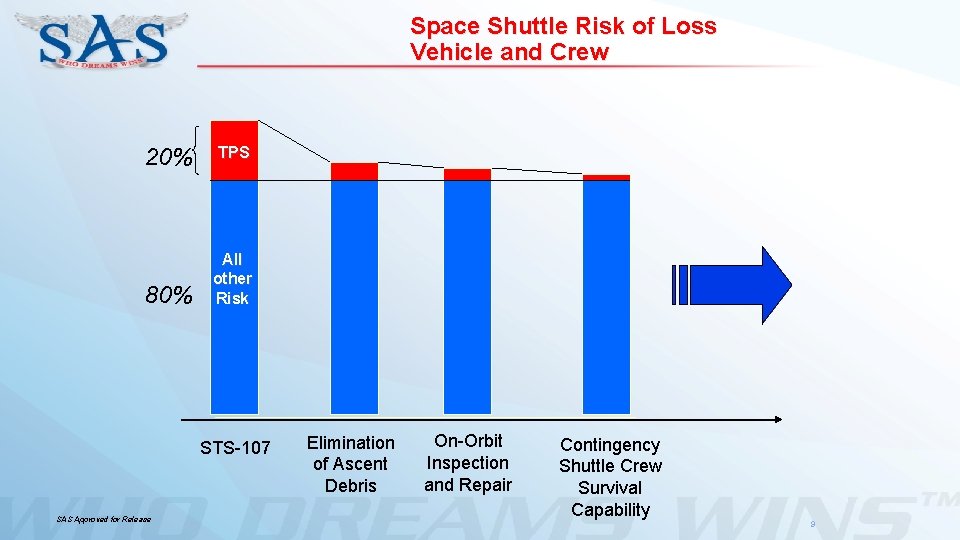
Space Shuttle Risk of Loss Vehicle and Crew 20% TPS 80% All other Risk STS-107 SAS Approved for Release Elimination of Ascent Debris On-Orbit Inspection and Repair Contingency Shuttle Crew Survival Capability 9
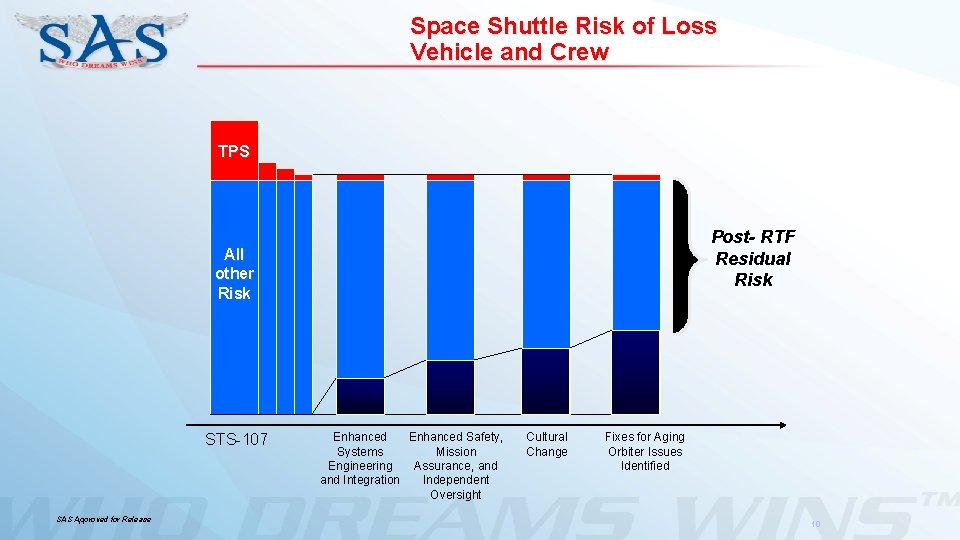
Space Shuttle Risk of Loss Vehicle and Crew TPS Post- RTF Residual Risk All other Risk STS-107 SAS Approved for Release Enhanced Safety, Systems Mission Engineering Assurance, and Integration Independent Oversight Cultural Change Fixes for Aging Orbiter Issues Identified 10
Post Columbia n Several Senior (retired) NASA officials involved in Space Shuttle Development gave us two areas to avoid: v On Orbit Tile Repair will never work – we tried everything 20 years ago and nothing worked v Do not change the outer mold line of the shuttle stack – the aerodynamics are too hard to get right n In Return to Flight we were forced to do both v On Orbit Tile and RCC repair materials and techniques developed and validated v Ice-Frost-Ramp reduced, Protuberance-Air-Load ramp removed, wind tunnel campaign verified aero loads SAS Approved for Release 11
Addressing the Culture n NASA Administrator Sean O’Keefe emphatically instructed all employees to “Accept the [CAIB] Report” v Posters all over the agency asked “Have you read the report? ” n Independent Review Teams (ASAP, RTFTG, others) met almost continuously to ensure the Space Shuttle Program rigorously completed all requirements for return to flight n Program Management power curbed with checks and balances from Independent Technical Authorities n Behavior Sciences Technology company hired to retrain NASA managers SAS Approved for Release 12
Safety and Management Changes n Mission Management Team (MMT) v Significant changes to the composition and focus of the MMT v Formal training requirements established v Now a well-functioning real-time management body v New MMT room designed to facilitate open communication n Safety and Mission Assurance (S&MA) v Reinvigorated independent S&MA at HQ and Centers v Strengthened Shuttle Program S&MA and Systems Engineering and Integration capabilities v Established Independent Technical Authority and technical warrant holders n NASA Engineering and Safety Center v Established at Langley as an independent source of engineering and technical expertise v Important resource for Space Shuttle engineering SAS Approved for Release 13
Management Re-Training n Reading assignments on management culture and best practices v “Angle of Attack” about Apollo 1 Fire v “The Challenger Launch Decision” n Hiring of two academic management experts to embed with the mission management team v Dr. Don Van Ende from Trinity University v Dr. Chris Jones from University of Central Florida n Multiple MMT training sessions and very specific certification requirements n Lectures by experts on management culture v v SAS Approved for Release Dr. Diane Vaughn Dr. Charles Perrow Dr. Nancy Levison Dr. Edward Tufte 14
Culture Change Initiatives n Attendance at MMT and PRCB mandatory for senior managers (substitutes not allowed) n Inclusion of all NASA centers in decision making emphasized n New Mission Management Team room built v Round Table v Teleconferenced all meetings with all NASA Centers v Call on all parties – not just subject matter experts – for their advice and review n Smaller, ‘warmer’ conference rooms designed for MMT n Behavorial Sciences Technology, Inc. Hired to observe and debrief all Space Shuttle Program meetings v Emphasis on drawing out ‘weak signals’ v Emphasis on non-confrontational management style v Emphasis on civility and courtesy SAS Approved for Release 15
Management Classes Added n Cockpit Resource Management course by Flight Safety International developed into Spaceflight Resource Management class taught internally n Safety Culture Training Class developed n Lessons in writing ‘white papers’ vs. building Power. Point presentations n Lessons in human social interaction were instituted v How to draw out dissenting opinions v The valuable use of silence in meetings SAS Approved for Release 16
Fighting the Culture Wars n Many ‘old line’ managers resisted the culture changes as ‘coddling’ the workforce – and wasting time n While some personnel transfers to S&MA were made, it was still regarded as a sideline organization to be avoided v Cultural Biases are hard to change n Senior NASA HQ management agonized over the slowness of return to flight v “Take the foam off the bipod and fly in October 2003” n Some independent reviewers remained skeptical – hostile – to the very end n Virtually everyone hated BST SAS Approved for Release 17
More Pushback n Frequently heard comment: “The CAIB got it wrong” v Generally heard from senior (old line) managers v Generally regarding NASA organizational culture n “Not invented here” syndrome continues to exacerbate inter-center relationship difficulties n Email from a retired senior NASA executive to me in late 2015 (typical of many received): “The general thrust of the questions give me some concern. The strong emphasis seems to be targeted toward "Organizational Culture". The principal thought appears to be correcting a culture where young engineers at a low organizational level could not exercise proper influence. I am not aware of any organizational cultural flaw of this nature having any effect on the Shuttle Program Management's lack of attention to foam shedding from the tank. What am I missing? The so called organizational cultural flaw attributed to the Challenger accident is a very different issue. The o-ring discussion between a contractor and MSFC that occurred prior to the Challenger launch has no relationship to Columbia that I am aware of. Are we chasing ghosts invented by the CAIB? ” SAS Approved for Release 18
Embrace Dissent “If we are all in agreement on the decision – then I propose we postpone further discussion of this matter until our next meeting to give ourselves time to develop disagreement and perhaps gain some understanding of that the decision is all about” – Charles E. Wilson, CEO of General Motors, 1950 Listen to weak signals and poor arguments for the truth they hold but are having difficulty communicating. Tip: Appoint a ‘devil’s advocate’ to make the argument on the other side when all appear to be in agreement. SAS Approved for Release 19
Afraid to Ask for Help n Sometimes people are afraid to ask for help because they might get more help than they want. Or at least more management attention than they want. n Many times our team members want to be the ‘hero’ that saves the program – the one that works all day and all night and gets the vehicle to flight no matter what n More often than not, those ‘heroes’ are unsuccessful, and the issues come out very late – when resources could have been provided to help solve them earlier n One Project Manager: “Don’t worry Boss, we have it under control. I’ll let you know when to worry. ” Me: “That makes me worry more than ever” SAS Approved for Release 20
Trying to break out of the mold n Commercial Crew and Commercial Cargo programs are an attempt to lighten NASA control and allow for innovation and flexibility – and lower cost n Shuttle had 40, 000 specifications and requirements, Constellation had (estimated) over 100, 000 specifications and requirements, Commercial Crew has about 10, 000 specifications and requirements n NASA trying to relinquish control in areas where the technology is more mature and private companies can be motivated to adequately provide safety and reliability at lower cost n Results are open, human spaceflight certification is pending. SAS Approved for Release 21
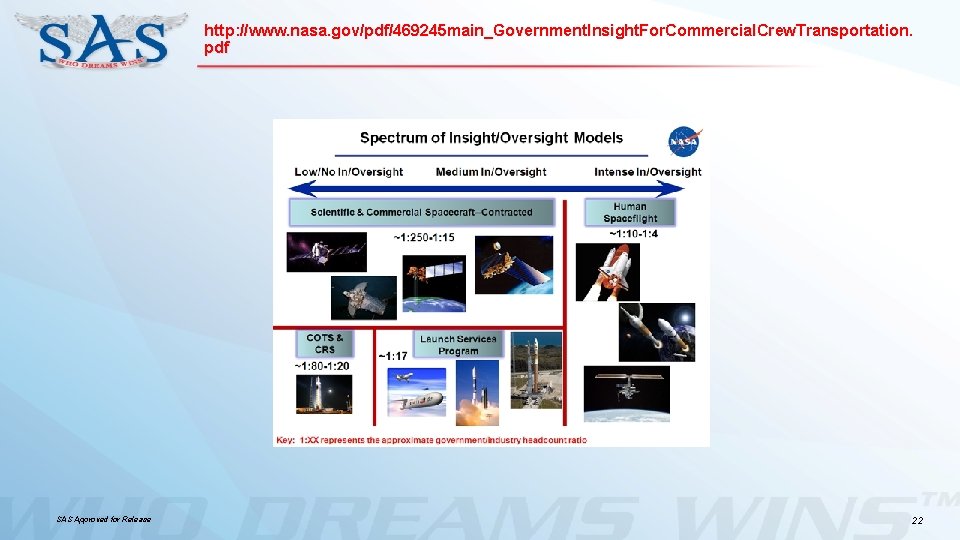
http: //www. nasa. gov/pdf/469245 main_Government. Insight. For. Commercial. Crew. Transportation. pdf SAS Approved for Release 22
Fifteen Years On – What Has Changed n Anecdotal evidence that emphasis on safety has eroded n Alternatively, emphasis on process and ‘safety’ have increased cost and delayed schedule critically on new NASA programs v Balance is needed n Anecdotal evidence that old management styles have crept back in v Not looking for dissenting opinions v More concerned with schedule and cost than risk n Some changes have devolved into ‘checking the square’ v “No dissenting opinions” frequent statement on management briefings SAS Approved for Release 23
![NASA as a High Reliability Organization n Preoccupied with [the Possibility of] Failure n](http://slidetodoc.com/presentation_image_h2/7c8919fa5d66201622be82d6984b8834/image-24.jpg "NASA as a High Reliability Organization n Preoccupied with [the Possibility of] Failure n")
NASA as a High Reliability Organization n Preoccupied with [the Possibility of] Failure n A Learning Organization v Internal Lessons Documented, Studied v Lessons from Others Gleaned and Studied n Reluctant to Simplify Interpretations n Sensitive to Operations n Committed to Resilience v Redundancy or “defense in depth” n Deferential to Expertise v Management defers to Engineering defers to “hands-on” personnel SAS Approved for Release 24
Ten Enduring Lessons n n n n n It can happen to you. Focus. Speak up. You are not nearly as smart as you think you are. Dissention has tremendous value. Question the Conventional Wisdom Do good work. Engineering is done with numbers Use your imagination Nothing worthwhile was accomplished without taking risk. SAS Approved for Release 25
- Slides: 25