
NASA Engineering and Safety Center NESC December 2016
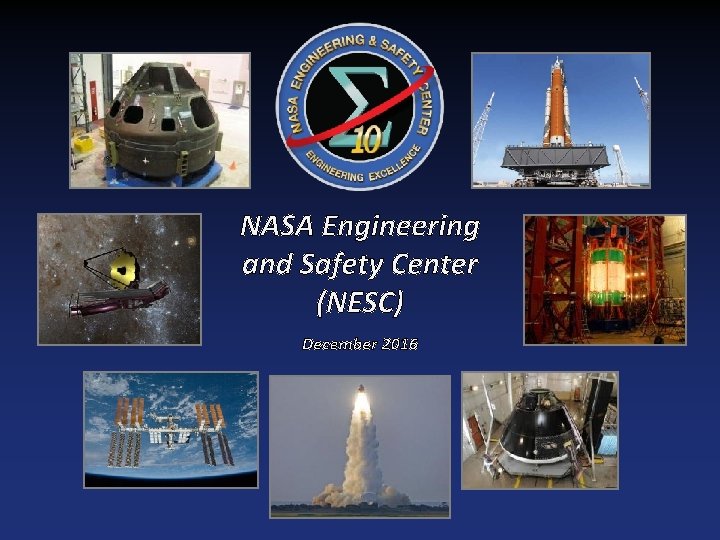
NASA Engineering and Safety Center (NESC) December 2016
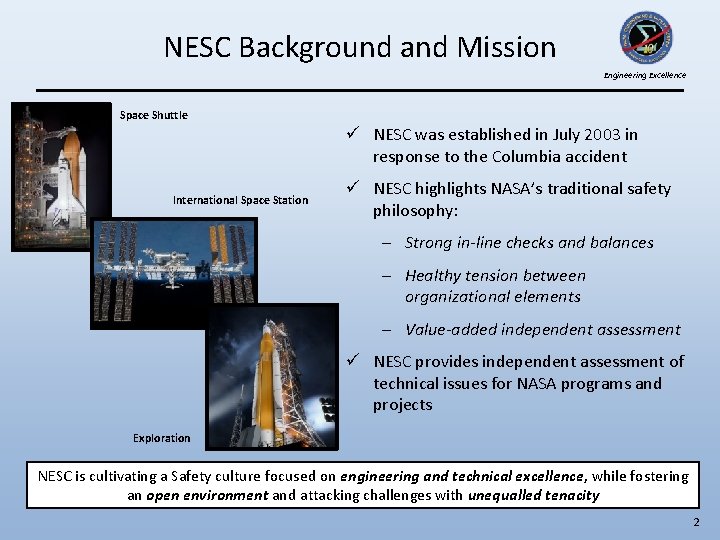
NESC Background and Mission Engineering Excellence Space Shuttle ü NESC was established in July 2003 in response to the Columbia accident International Space Station ü NESC highlights NASA’s traditional safety philosophy: – Strong in-line checks and balances – Healthy tension between organizational elements – Value-added independent assessment ü NESC provides independent assessment of technical issues for NASA programs and projects Exploration NESC is cultivating a Safety culture focused on engineering and technical excellence, while fostering an open environment and attacking challenges with unequalled tenacity 2
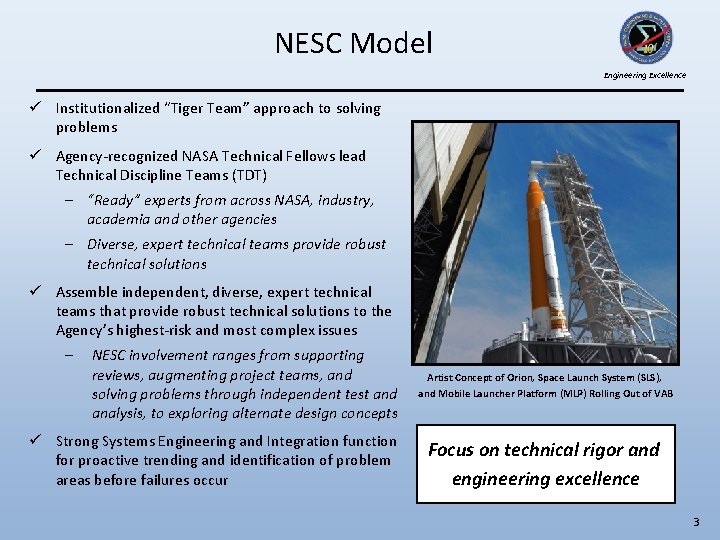
NESC Model Engineering Excellence ü Institutionalized “Tiger Team” approach to solving problems ü Agency-recognized NASA Technical Fellows lead Technical Discipline Teams (TDT) – “Ready” experts from across NASA, industry, academia and other agencies – Diverse, expert technical teams provide robust technical solutions ü Assemble independent, diverse, expert technical teams that provide robust technical solutions to the Agency’s highest-risk and most complex issues – NESC involvement ranges from supporting reviews, augmenting project teams, and solving problems through independent test and analysis, to exploring alternate design concepts ü Strong Systems Engineering and Integration function for proactive trending and identification of problem areas before failures occur Artist Concept of Orion, Space Launch System (SLS), and Mobile Launcher Platform (MLP) Rolling Out of VAB Focus on technical rigor and engineering excellence 3
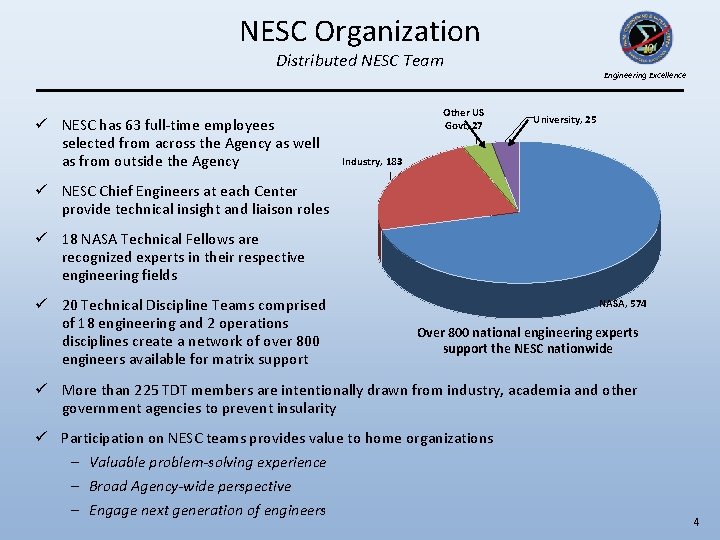
NESC Organization Distributed NESC Team ü NESC has 63 full-time employees selected from across the Agency as well as from outside the Agency Other US Govt, 27 Engineering Excellence University, 25 Industry, 183 ü NESC Chief Engineers at each Center provide technical insight and liaison roles ü 18 NASA Technical Fellows are recognized experts in their respective engineering fields ü 20 Technical Discipline Teams comprised of 18 engineering and 2 operations disciplines create a network of over 800 engineers available for matrix support NASA, 574 Over 800 national engineering experts support the NESC nationwide ü More than 225 TDT members are intentionally drawn from industry, academia and other government agencies to prevent insularity ü Participation on NESC teams provides value to home organizations – Valuable problem-solving experience – Broad Agency-wide perspective – Engage next generation of engineers 4

NASA Technical Fellows Engineering Excellence ü Senior-level engineers and scientists with distinguished and sustained records of technical achievement ü Agency’s leading experts in their respective technical disciplines ü Maintain NESC Technical Discipline Teams with ready-experts ü Provide leadership and act as role models for NASA discipline engineering communities beyond the Technical Discipline Teams ü Provide technical consistency across NASA through inputs to Agency-level specifications and standards and the tailoring of those standards for programs and projects ü Promote discipline stewardship through workshops, conferences and assorted discipline-advancing activities ü Ensure lessons learned are identified, widely shared across engineering organizations, and incorporated into Agency processes ü Serve as NASA Capability Leaders, assessing technical discipline readiness to execute current and future missions; conduct discipline specific gap analyses to identify areas that require strategic investment to develop fundamental engineering sciences; and provide recommendations to promote capability health 5

NASA Technical Fellows Engineering Excellence Michael Aguilar Software La. RC Thomas Brown Propulsion MSFC Neil Dennehy GN&C GSFC Michael Dube Mechanical Systems GSFC Oscar Gonzalez Avionics GSFC Jon Holladay Systems Engineering GSFC Chris Iannello Electrical Power KSC Curtis Larsen Loads & Dynamics JSC Joseph Minow Space Environments MSFC Daniel Murri Flight Mechanics La. RC Cynthia Null Human Factors ARC William Prosser NDE La. RC Henry Rotter Steven Rickman Richard Russell Passive Thermal Environmental Control/ Materials Life Support JSC KSC JSC David Schuster Aerosciences La. RC Upendra Singh Sensors/ Instrumentation La. RC Ivatury Raju Structures La. RC 6
NESC Chief Engineers Engineering Excellence ü Serve as liaison between resident Center and NESC ü Foster proactive involvement with programs and projects at resident Center ü Provide technical expertise and technical resources external to the program/project to assist with resolving issues ü Provide program/project insight to NESC through participation at major boards and panels ü Review assessment requests, clarify issues, perform risk assessments, recommend NESC courses of action, develop associated cost ROM, and present information to NESC Review Board ü Manage NESC resources at resident center ü Assist Principal Engineers and NASA Technical Fellows staff NESC technical activities with resident Center resources ü Contribute to Technical Discipline Teams and NESC technical activities – both assessments and support activities – based on their areas of expertise 7
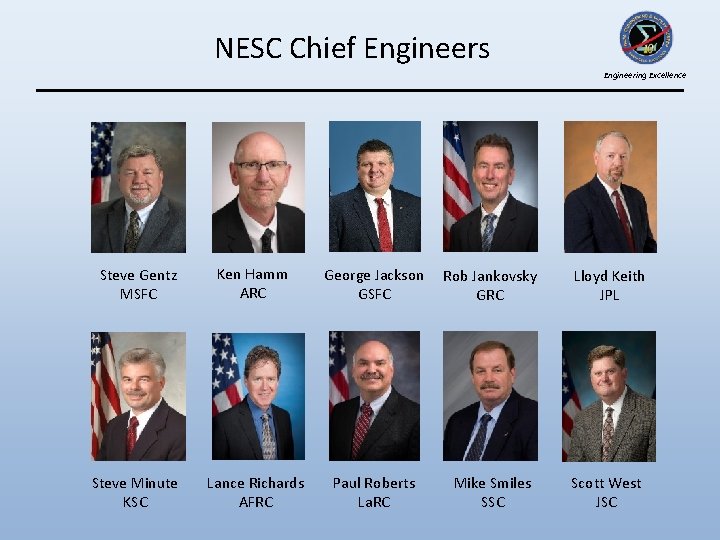
NESC Chief Engineers Engineering Excellence Steve Gentz MSFC Ken Hamm ARC George Jackson GSFC Rob Jankovsky GRC Lloyd Keith JPL Steve Minute KSC Lance Richards AFRC Paul Roberts La. RC Mike Smiles SSC Scott West JSC
NESC Principal Engineers Engineering Excellence ü Manage and lead cross-discipline NESC technical assessment and support activities ü Provide technical and project management guidance and assistance to assessment teams ü Assist other assessment leads, especially those not in NESC, with developing and implementing assessment plans, briefings and final reports, and help ensure consistency of NESC recommendations across Agency programs ü Review NESC Review Board documentation - plans, briefings, final reports - for technical content and adherence/tailoring of reporting requirements ü Help develop and implement NESC internal policies and practices for conducting assessments ü Contribute to NESC technical activities based on areas of expertise NESC Principal Engineers • • Clinton Cragg (La. RC) Nancy Currie-Gregg (JSC) Michael Squire (La. RC) Michael Gilbert (La. RC) NESC Associate Principal Engineers • • Jon Haas (WSTF) Heather Hickman (GRC) Michael Kelly (La. RC) Tannen Van. Zwieten (MSFC) 9
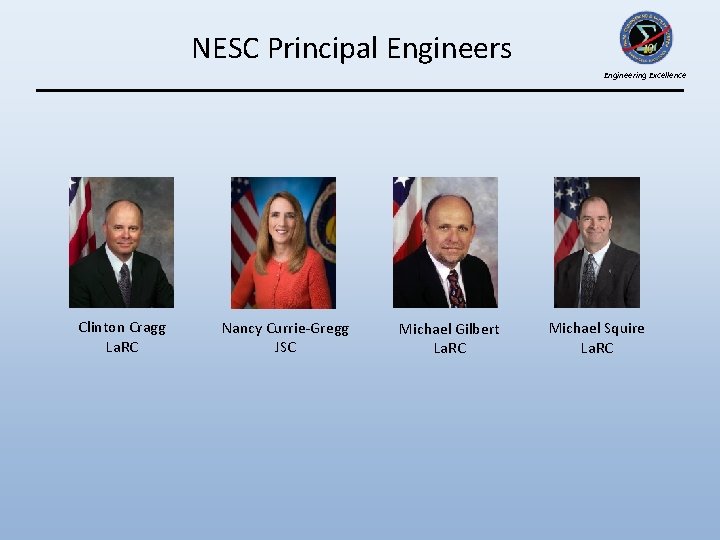
NESC Principal Engineers Engineering Excellence Clinton Cragg La. RC Nancy Currie-Gregg JSC Michael Gilbert La. RC Michael Squire La. RC
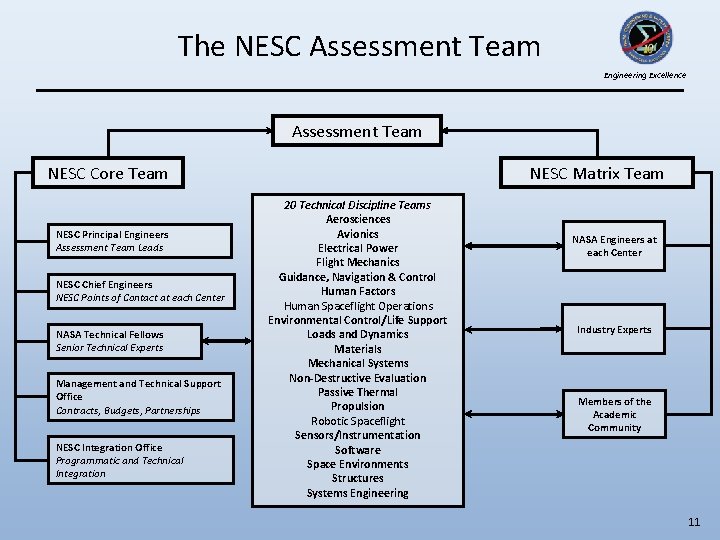
The NESC Assessment Team Engineering Excellence Assessment Team NESC Core Team NESC Principal Engineers Assessment Team Leads NESC Chief Engineers NESC Points of Contact at each Center NASA Technical Fellows Senior Technical Experts Management and Technical Support Office Contracts, Budgets, Partnerships NESC Integration Office Programmatic and Technical Integration NESC Matrix Team 20 Technical Discipline Teams Aerosciences Avionics Electrical Power Flight Mechanics Guidance, Navigation & Control Human Factors Human Spaceflight Operations Environmental Control/Life Support Loads and Dynamics Materials Mechanical Systems Non-Destructive Evaluation Passive Thermal Propulsion Robotic Spaceflight Sensors/Instrumentation Software Space Environments Structures Systems Engineering NASA Engineers at each Center Industry Experts Members of the Academic Community 11
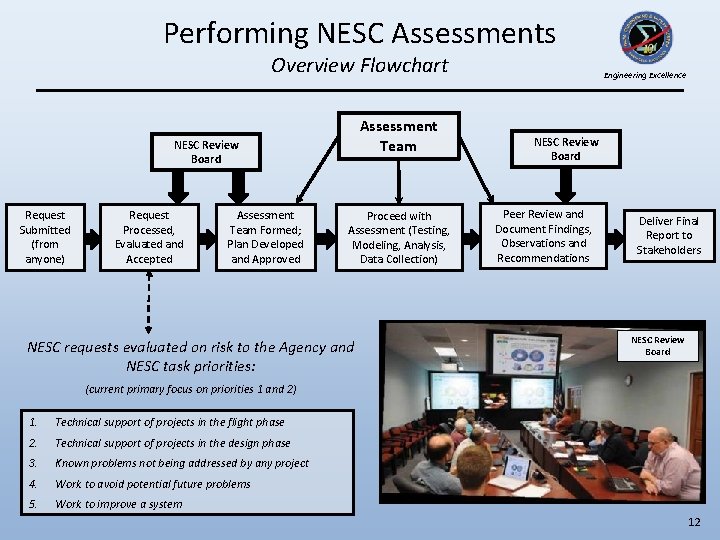
Performing NESC Assessments Overview Flowchart Assessment Team NESC Review Board Request Submitted (from anyone) Request Processed, Evaluated and Accepted Assessment Team Formed; Plan Developed and Approved Proceed with Assessment (Testing, Modeling, Analysis, Data Collection) NESC requests evaluated on risk to the Agency and NESC task priorities: Engineering Excellence NESC Review Board Peer Review and Document Findings, Observations and Recommendations Deliver Final Report to Stakeholders NESC Review Board (current primary focus on priorities 1 and 2) 1. Technical support of projects in the flight phase 2. Technical support of projects in the design phase 3. Known problems not being addressed by any project 4. Work to avoid potential future problems 5. Work to improve a system 12
![Sources of Accepted Requests (FY ‘ 04 -’ 17) [CATEGORY NAME], [PERCENTAGE] Engineering Excellence](http://slidetodoc.com/presentation_image_h/c4431bdbf1145e3092d2b7edde5e2032/image-13.jpg "Sources of Accepted Requests (FY ‘ 04 -’ 17) [CATEGORY NAME], [PERCENTAGE] Engineering Excellence")
Sources of Accepted Requests (FY ‘ 04 -’ 17) [CATEGORY NAME], [PERCENTAGE] Engineering Excellence [CATEGORY NAME], [PERCENTAGE] [CATEGORY NAME], [CATEGORY [PERCENTAGE] NAME], [PERCENTAGE] Data as of December 6, 2016
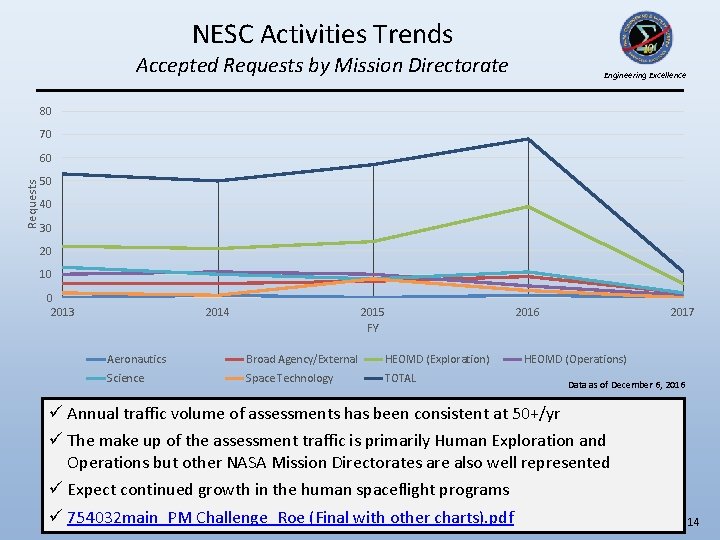
NESC Activities Trends Accepted Requests by Mission Directorate Engineering Excellence 80 70 Requests 60 50 40 30 20 10 0 2013 2014 2015 FY Aeronautics Broad Agency/External HEOMD (Exploration) Science Space Technology TOTAL 2016 2017 HEOMD (Operations) Data as of December 6, 2016 ü Annual traffic volume of assessments has been consistent at 50+/yr ü The make up of the assessment traffic is primarily Human Exploration and Operations but other NASA Mission Directorates are also well represented ü Expect continued growth in the human spaceflight programs ü 754032 main_PM Challenge_Roe (Final with other charts). pdf 14
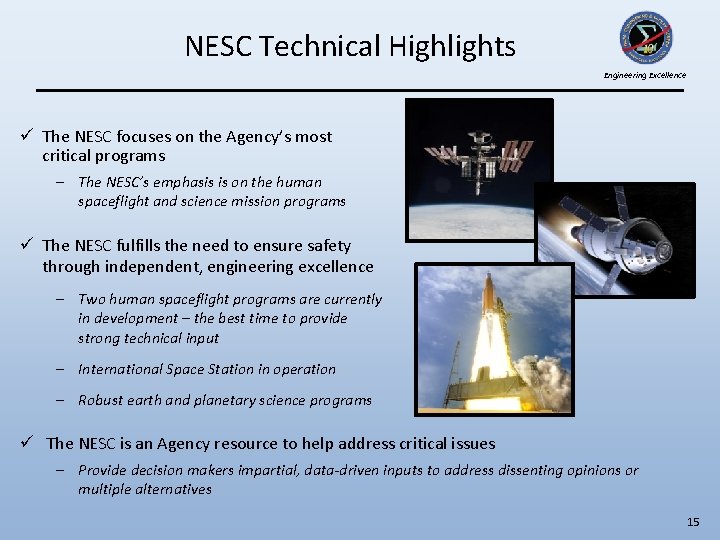
NESC Technical Highlights Engineering Excellence ü The NESC focuses on the Agency’s most critical programs – The NESC’s emphasis is on the human spaceflight and science mission programs ü The NESC fulfills the need to ensure safety through independent, engineering excellence – Two human spaceflight programs are currently in development – the best time to provide strong technical input – International Space Station in operation – Robust earth and planetary science programs ü The NESC is an Agency resource to help address critical issues – Provide decision makers impartial, data-driven inputs to address dissenting opinions or multiple alternatives 15
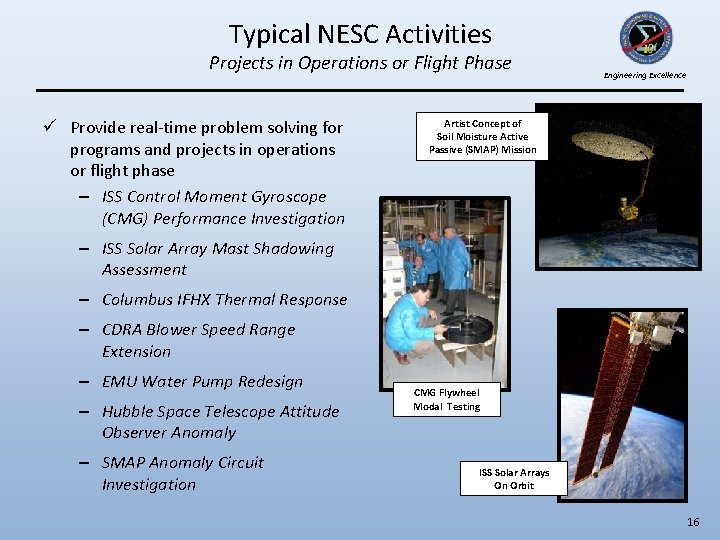
Typical NESC Activities Projects in Operations or Flight Phase ü Provide real-time problem solving for programs and projects in operations or flight phase – ISS Control Moment Gyroscope (CMG) Performance Investigation Engineering Excellence Artist Concept of Soil Moisture Active Passive (SMAP) Mission – ISS Solar Array Mast Shadowing Assessment – Columbus IFHX Thermal Response – CDRA Blower Speed Range Extension – EMU Water Pump Redesign – Hubble Space Telescope Attitude Observer Anomaly – SMAP Anomaly Circuit Investigation CMG Flywheel Modal Testing ISS Solar Arrays On Orbit 16
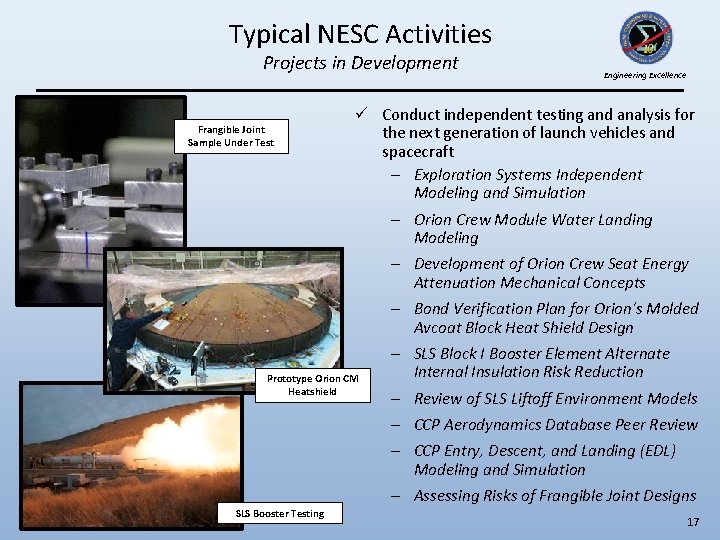
Typical NESC Activities Projects in Development Frangible Joint Sample Under Test Engineering Excellence ü Conduct independent testing and analysis for the next generation of launch vehicles and spacecraft – Exploration Systems Independent Modeling and Simulation – Orion Crew Module Water Landing Modeling – Development of Orion Crew Seat Energy Attenuation Mechanical Concepts – Bond Verification Plan for Orion's Molded Avcoat Block Heat Shield Design Prototype Orion CM Heatshield – SLS Block I Booster Element Alternate Internal Insulation Risk Reduction – Review of SLS Liftoff Environment Models – CCP Aerodynamics Database Peer Review – CCP Entry, Descent, and Landing (EDL) Modeling and Simulation – Assessing Risks of Frangible Joint Designs SLS Booster Testing 17
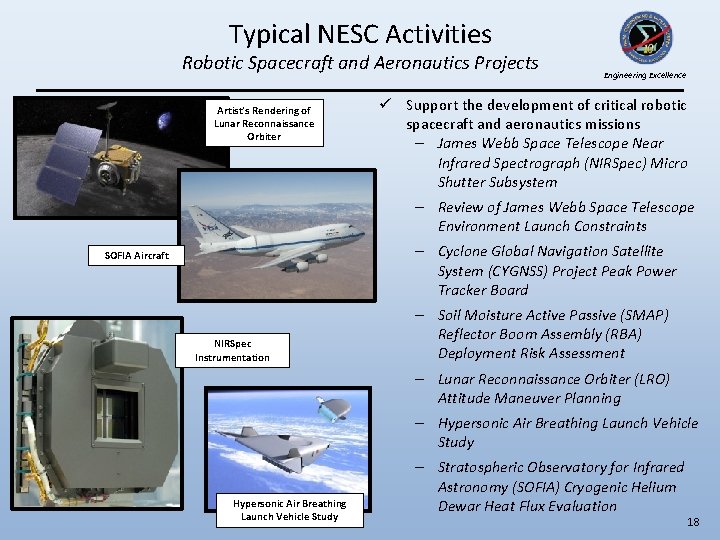
Typical NESC Activities Robotic Spacecraft and Aeronautics Projects Artist’s Rendering of Lunar Reconnaissance Orbiter Engineering Excellence ü Support the development of critical robotic spacecraft and aeronautics missions – James Webb Space Telescope Near Infrared Spectrograph (NIRSpec) Micro Shutter Subsystem – Review of James Webb Space Telescope Environment Launch Constraints – Cyclone Global Navigation Satellite System (CYGNSS) Project Peak Power Tracker Board SOFIA Aircraft NIRSpec Instrumentation – Soil Moisture Active Passive (SMAP) Reflector Boom Assembly (RBA) Deployment Risk Assessment – Lunar Reconnaissance Orbiter (LRO) Attitude Maneuver Planning – Hypersonic Air Breathing Launch Vehicle Study – Stratospheric Observatory for Infrared Astronomy (SOFIA) Cryogenic Helium Dewar Heat Flux Evaluation 18
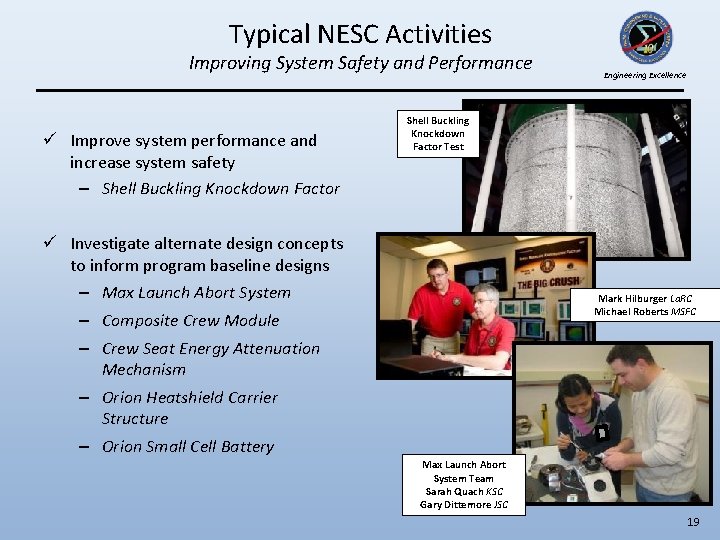
Typical NESC Activities Improving System Safety and Performance ü Improve system performance and increase system safety – Shell Buckling Knockdown Factor Engineering Excellence Shell Buckling Knockdown Factor Test ü Investigate alternate design concepts to inform program baseline designs – Max Launch Abort System – Composite Crew Module – Crew Seat Energy Attenuation Mechanism – Orion Heatshield Carrier Structure – Orion Small Cell Battery Mark Hilburger La. RC Michael Roberts MSFC Max Launch Abort System Team Sarah Quach KSC Gary Dittemore JSC 19
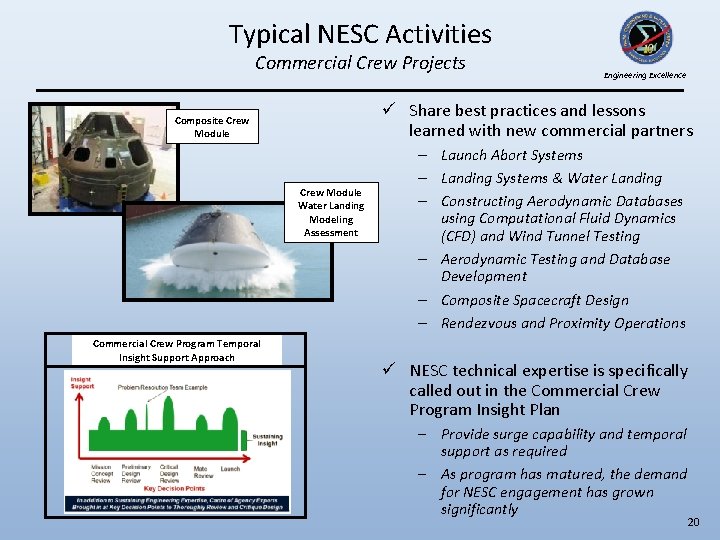
Typical NESC Activities Commercial Crew Projects ü Share best practices and lessons learned with new commercial partners Composite Crew Module Water Landing Modeling Assessment Commercial Crew Program Temporal Insight Support Approach Engineering Excellence – Launch Abort Systems – Landing Systems & Water Landing – Constructing Aerodynamic Databases using Computational Fluid Dynamics (CFD) and Wind Tunnel Testing – Aerodynamic Testing and Database Development – Composite Spacecraft Design – Rendezvous and Proximity Operations ü NESC technical expertise is specifically called out in the Commercial Crew Program Insight Plan – Provide surge capability and temporal support as required – As program has matured, the demand for NESC engagement has grown significantly 20
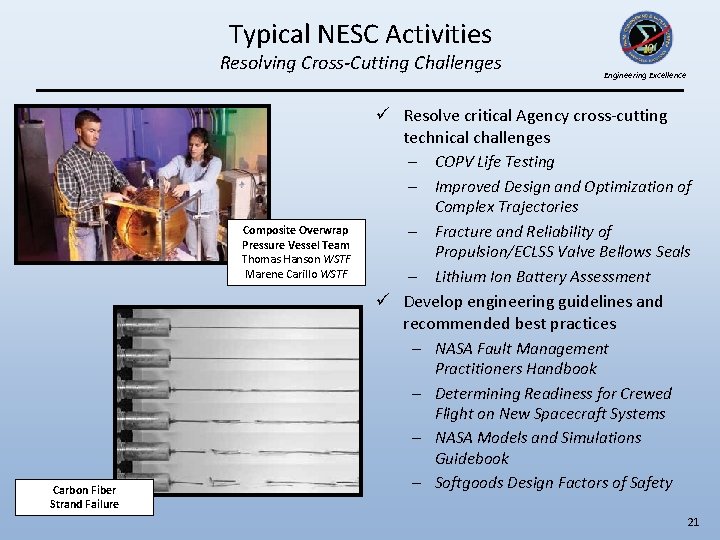
Typical NESC Activities Resolving Cross-Cutting Challenges Engineering Excellence ü Resolve critical Agency cross-cutting technical challenges – – Composite Overwrap Pressure Vessel Team Thomas Hanson WSTF Marene Carillo WSTF Carbon Fiber Strand Failure – COPV Life Testing Improved Design and Optimization of Complex Trajectories Fracture and Reliability of Propulsion/ECLSS Valve Bellows Seals Lithium Ion Battery Assessment – ü Develop engineering guidelines and recommended best practices – NASA Fault Management Practitioners Handbook – Determining Readiness for Crewed Flight on New Spacecraft Systems – NASA Models and Simulations Guidebook – Softgoods Design Factors of Safety 21
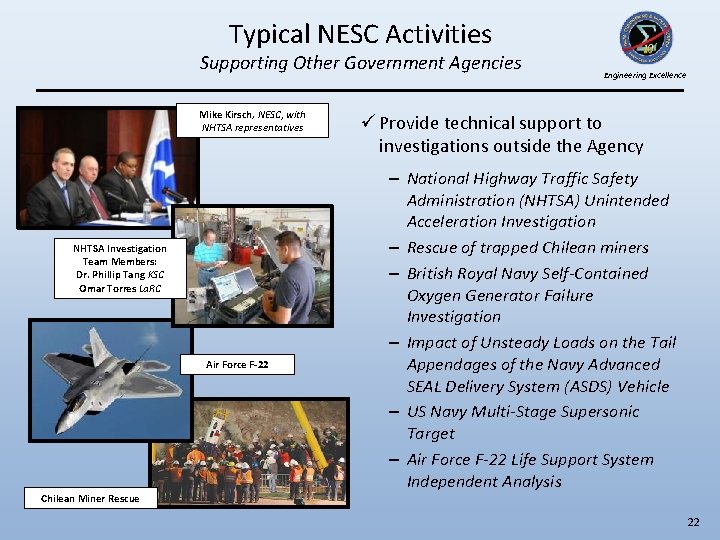
Typical NESC Activities Supporting Other Government Agencies Mike Kirsch, NESC, with NHTSA representatives NHTSA Investigation Team Members: Dr. Phillip Tang KSC Omar Torres La. RC Air Force F-22 Chilean Miner Rescue Engineering Excellence ü Provide technical support to investigations outside the Agency – National Highway Traffic Safety Administration (NHTSA) Unintended Acceleration Investigation – Rescue of trapped Chilean miners – British Royal Navy Self-Contained Oxygen Generator Failure Investigation – Impact of Unsteady Loads on the Tail Appendages of the Navy Advanced SEAL Delivery System (ASDS) Vehicle – US Navy Multi-Stage Supersonic Target – Air Force F-22 Life Support System Independent Analysis 22
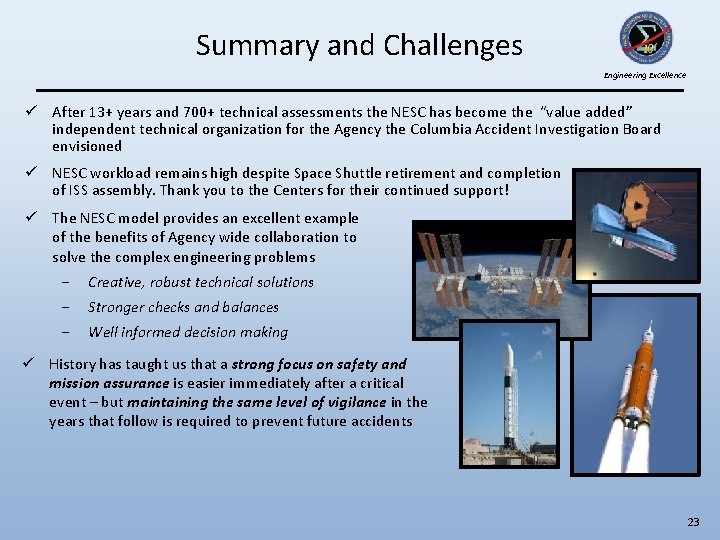
Summary and Challenges Engineering Excellence ü After 13+ years and 700+ technical assessments the NESC has become the “value added” independent technical organization for the Agency the Columbia Accident Investigation Board envisioned ü NESC workload remains high despite Space Shuttle retirement and completion of ISS assembly. Thank you to the Centers for their continued support! ü The NESC model provides an excellent example of the benefits of Agency wide collaboration to solve the complex engineering problems − Creative, robust technical solutions − Stronger checks and balances − Well informed decision making ü History has taught us that a strong focus on safety and mission assurance is easier immediately after a critical event – but maintaining the same level of vigilance in the years that follow is required to prevent future accidents 23
Engineering Excellence Backup 24
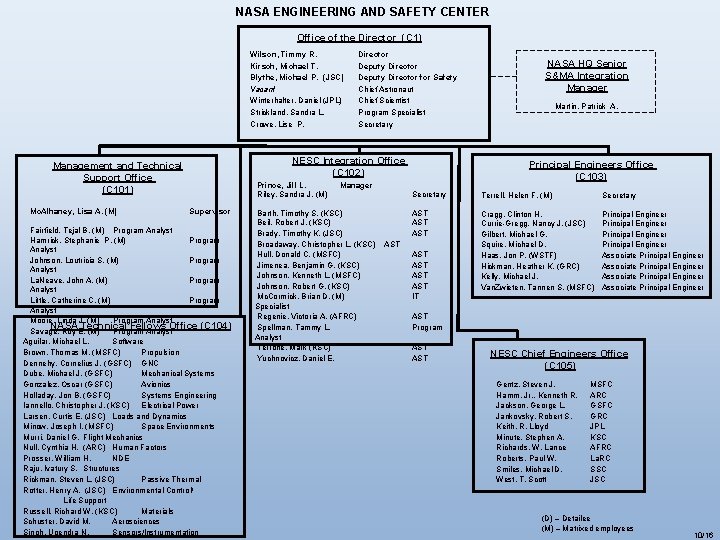
NASA ENGINEERING AND SAFETY CENTER Office of the Director (C 1) Wilson, Timmy R. Kirsch, Michael T. Blythe, Michael P. (JSC) Vacant Winterhalter, Daniel (JPL) Strickland, Sandra L. Crowe, Lise P. NESC Integration Office (C 102) Management and Technical Support Office (C 101) Mc. Alhaney, Lisa A. (M) Director Deputy Director for Safety Chief Astronaut Chief Scientist Program Specialist Secretary Prince, Jill L. Riley, Sandra J. (M) Supervisor Fairfield, Tejal B. (M) Program Analyst Hamrick, Stephanie P. (M) Program Analyst Johnson, Loutricia S. (M) Program Analyst La. Neave, John A. (M) Program Analyst Little, Catherine C. (M) Program Analyst Moore, Linda J. (M) Program Analyst NASA Technical Fellows Office (C 104) Savage, Roy E. (M) Program Analyst Aguilar, Michael L. Software Brown, Thomas M. (MSFC) Propulsion Dennehy, Cornelius J. (GSFC) GNC Dube, Michael J. (GSFC) Mechanical Systems Gonzalez, Oscar (GSFC) Avionics Holladay, Jon B. (GSFC) Systems Engineering Iannello, Christopher J. (KSC) Electrical Power Larsen, Curtis E. (JSC) Loads and Dynamics Minow, Joseph I. (MSFC) Space Environments Murri, Daniel G. Flight Mechanics Null, Cynthia H. (ARC) Human Factors Prosser, William H. NDE Raju, Ivatury S. Structures Rickman, Steven L. (JSC) Passive Thermal Rotter, Henry A. (JSC) Environmental Control/ Life Support Russell, Richard W. (KSC) Materials Schuster, David M. Aerosciences Singh, Upendra N. Sensors/Instrumentation Martin, Patrick A. Principal Engineers Office (C 103) Manager Barth, Timothy S. (KSC) Beil, Robert J. (KSC) Brady, Timothy K. (JSC) Broadaway, Christopher L. (KSC) Hull, Donald C. (MSFC) Jimenea, Benjamin G. (KSC) Johnson, Kenneth L. (MSFC) Johnson, Robert G. (KSC) Mc. Cormick, Brian D. (M) Specialist Regenie, Victoria A. (AFRC) Spellman, Tammy L. Analyst Terrone, Mark (KSC) Yuchnovicz, Daniel E. NASA HQ Senior S&MA Integration Manager Secretary Terrell, Helen F. (M) Secretary AST AST Cragg, Clinton H. Currie-Gregg, Nancy J. (JSC) Gilbert, Michael G. Squire, Michael D. Haas, Jon P. (WSTF) Hickman, Heather K. (GRC) Kelly, Michael J. Van. Zwieten, Tannen S. (MSFC) Principal Engineer Associate Principal Engineer AST AST AST IT AST Program AST NESC Chief Engineers Office (C 105) Gentz, Steven J. Hamm, Jr. , Kenneth R. Jackson, George L. Jankovsky, Robert S. Keith, R. Lloyd Minute, Stephen A. Richards, W. Lance Roberts, Paul W. Smiles, Michael D. West, T. Scott MSFC ARC GSFC GRC JPL KSC AFRC La. RC SSC JSC (D) – Detailee (M) – Matrixed employees 10/16
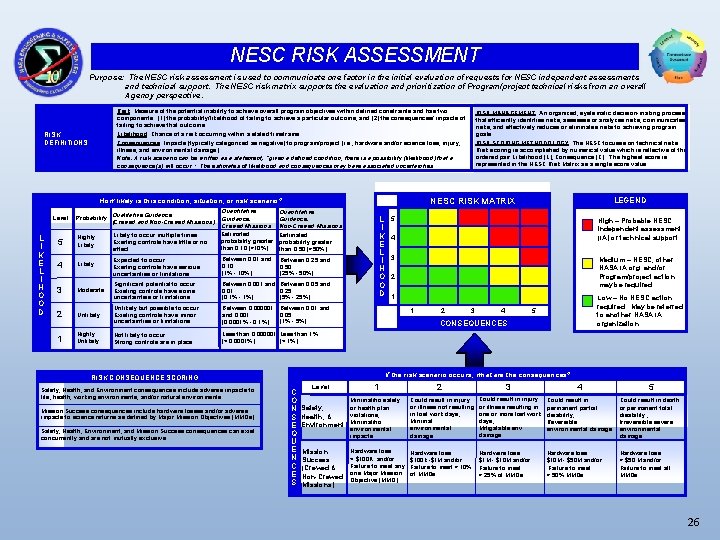
NESC RISK ASSESSMENT Purpose: The NESC risk assessment is used to communicate one factor in the initial evaluation of requests for NESC independent assessments and technical support. The NESC risk matrix supports the evaluation and prioritization of Program/project technical risks from an overall Agency perspective. Risk: Measure of the potential inability to achieve overall program objectives within defined constraints and has two components: (1) the probability/likelihood of failing to achieve a particular outcome, and (2) the consequences/ impacts of failing to achieve that outcome. Likelihood: Chance of a risk occurring within a stated timeframe. Consequences: Impacts (typically categorized as negative) to program/project (i. e. , hardware and/or science loss, injury, illness, and environmental damage) Note: A risk scenario can be written as a statement; “given a defined condition, there is a possibility (likelihood) that a consequence(s) will occur. ” The estimates of likelihood and consequences may have associated uncertainties. RISK DEFINITIONS NESC RISK MATRIX How likely is this condition, situation, or risk scenario? 5 Highly Likely to occur multiple times. Existing controls have little or no effect. Quantitative Guidance: Crewed Missions Non-Crewed Missions Estimated probability greater than 0. 10 (>10%) than 0. 50 (>50%) 4 Likely Expected to occur. Existing controls have serious uncertainties or limitations. Between 0. 01 and 0. 10 (1% - 10%) Moderate Significant potential to occur. Existing controls have some uncertainties or limitations. Between 0. 001 and Between 0. 05 and 0. 01 0. 25 (0. 1% - 1%) (5% - 25%) 2 Unlikely but possible to occur. Existing controls have minor uncertainties or limitations. Between 0. 000001 Between 0. 01 and 0. 05 and 0. 001 (1% - 5%) (0. 0001% - 0. 1%) 1 Highly Unlikely Not likely to occur. Strong controls are in place. Less than 0. 000001 Less than 1% (< 1%) (< 0. 0001%) Level L I K E L I H O O D 3 Probability Qualitative Guidance (Crewed and Non-Crewed Missions) Between 0. 25 and 0. 50 (25% - 50%) L I K E L I H O O D Mission Success consequences include hardware losses and/or adverse impacts to science returns as defined by Major Mission Objectives (MMOs). Safety, Health, Environment, and Mission Success consequences can exist concurrently and are not mutually exclusive. LEGEND 5 High – Probable NESC independent assessment (IA) or technical support. 4 3 Medium – NESC, other NASA IA org. and/or Program/project action may be required. 2 1 1 2 3 4 Low – No NESC action required. May be referred to another NASA IA organization. 5 CONSEQUENCES If the risk scenario occurs, what are the consequences? RISK CONSEQUENCE SCORING Safety, Health, and Environment consequences include adverse impacts to life, health, working environments, and/or natural environments. RISK MANAGEMENT: An organized, systematic decision-making process that efficiently identifies risks, assesses or analyzes risks, communicates risks, and effectively reduces or eliminates risks to achieving program goals. RISK SCORING METHODOLOGY: The NESC focuses on technical risks. Risk scoring is accomplished by numerical value which is reflective of the ordered pair Likelihood (L), Consequence (C). The highest score is represented in the NESC Risk Matrix as a single score value. C O N S E Q U E N C E S 3 4 5 Safety, Health, & Environment Minimal/no safety or health plan violations; Minimal/no environmental impacts Could result in injury or illness not resulting in lost work days; Minimal environmental damage Could result in injury or illness resulting in one or more lost work days; Mitigatable env. damage Could result in permanent partial disability; Reversible environmental damage Could result in death or permanent total disability ; Irreversible severe environmental damage Mission Success (Crewed & Non-Crewed Missions) Hardware loss < $100 K and/or Failure to meet any one Major Mission Objective (MMO) Hardware loss $100 k -$1 M and/or Failure to meet > 10% of MMOs Hardware loss $1 M - $10 M and/or Failure to meet > 25% of MMOs Hardware loss $10 M - $50 M and/or Failure to meet > 50% MMOs Hardware loss > $50 M and/or Failure to meet all MMOs Level 1 2 26
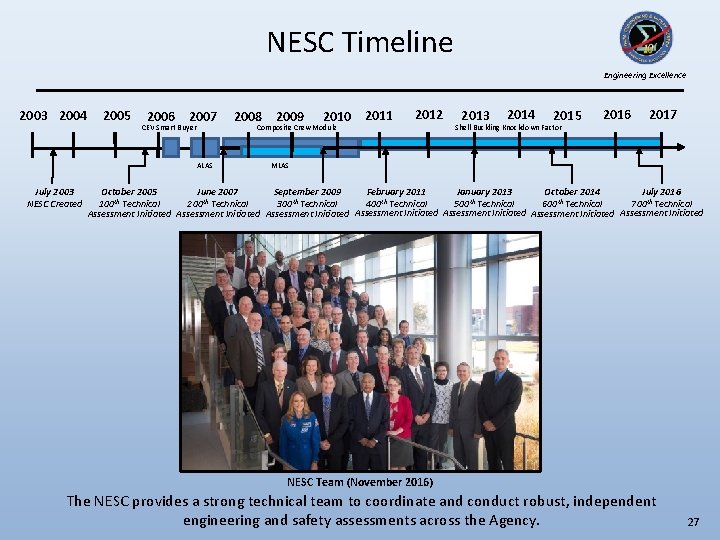
NESC Timeline Engineering Excellence 2003 2004 2005 2006 2007 CEV Smart Buyer ALAS July 2003 NESC Created 2008 2009 2010 2011 Composite Crew Module 2012 2013 2014 2015 Shell Buckling Knockdown Factor 2016 2017 MLAS January 2013 February 2011 July 2016 October 2005 June 2007 September 2009 October 2014 500 th Technical 400 th Technical 700 th Technical 100 th Technical 200 th Technical 300 th Technical 600 th Technical Assessment Initiated Assessment Initiated NESC Team (November 2016) The NESC provides a strong technical team to coordinate and conduct robust, independent engineering and safety assessments across the Agency. 27
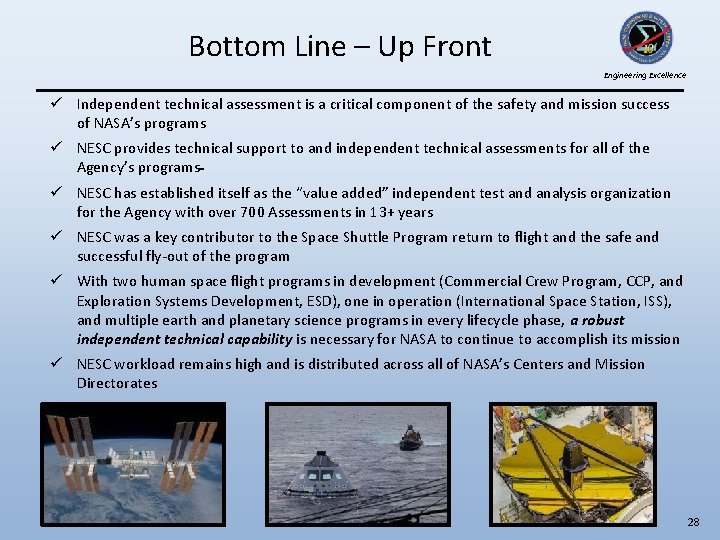
Bottom Line – Up Front Engineering Excellence ü Independent technical assessment is a critical component of the safety and mission success of NASA’s programs ü NESC provides technical support to and independent technical assessments for all of the Agency’s programs ü NESC has established itself as the “value added” independent test and analysis organization for the Agency with over 700 Assessments in 13+ years ü NESC was a key contributor to the Space Shuttle Program return to flight and the safe and successful fly-out of the program ü With two human space flight programs in development (Commercial Crew Program, CCP, and Exploration Systems Development, ESD), one in operation (International Space Station, ISS), and multiple earth and planetary science programs in every lifecycle phase, a robust independent technical capability is necessary for NASA to continue to accomplish its mission ü NESC workload remains high and is distributed across all of NASA’s Centers and Mission Directorates 28
- Slides: 28