
NASA Earth Science Division Summary Bradley Doorn Program
NASA Earth Science Division Summary Bradley Doorn, Program Manager 28 April 2010 4/28/2010

Science Mission Directorate Earth Science Astrophysics Heliophysics Planetary Science Jnt. Ag. Sat. Div. The purpose of NASA's Earth science program is to develop a scientific understanding of Earth's system and its response to natural and human-induced changes, and to improve prediction of climate, weather, and natural hazards. 4/28/2010

Earth Science Division Flight Research Applications Research focus areas: Applied Sciences Program elements: • Atmospheric composition • Agriculture • Weather • Air Quality • Climate Variability and Change • Climate • Water and Energy Cycles • Natural Disasters • Carbon Cycle and Ecosystems • Ecological Forecasting • Earth Surface and Interior • Public Health • Water Resources • Weather 4/28/2010
4/28/2010
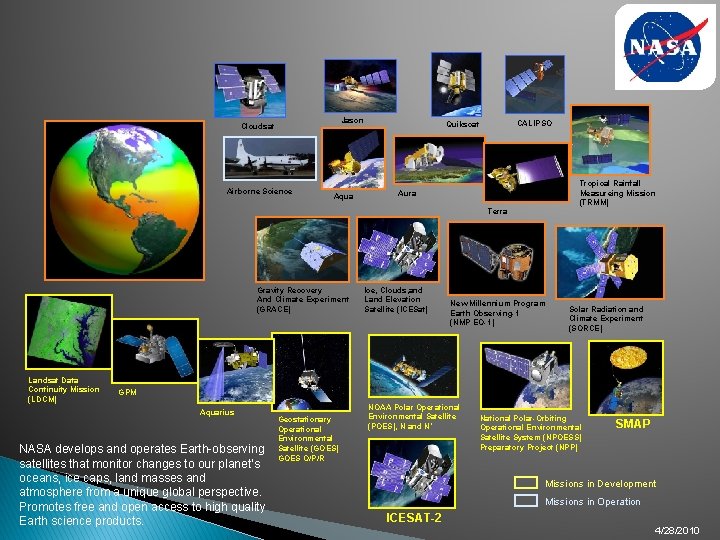
Jason Cloudsat Airborne Science Aqua CALIPSO Quikscat Tropical Rainfall Measureing Mission (TRMM) Aura Terra Gravity Recovery And Climate Experiment (GRACE) Landsat Data Continuity Mission (LDCM) Ice, Clouds, and Land Elevation Satellite (ICESat) New Millennium Program Earth Observing-1 (NMP EO-1) Solar Radiation and Climate Experiment (SORCE) GPM Aquarius NASA develops and operates Earth-observing satellites that monitor changes to our planet’s oceans, ice caps, land masses and atmosphere from a unique global perspective. Promotes free and open access to high quality Earth science products. Geostationary Operational Environmental Satellite (GOES) GOES O/P/R NOAA Polar Operational Environmental Satellite (POES), N and N’ National Polar-Orbiting Operational Environmental Satellite System (NPOESS) Preparatory Project (NPP) SMAP Missions in Development Missions in Operation ICESAT-2 4/28/2010
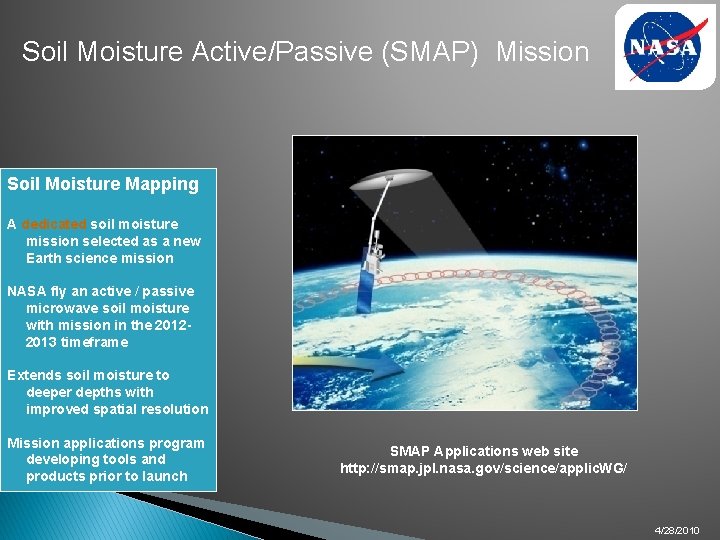
Soil Moisture Active/Passive (SMAP) Mission Soil Moisture Mapping A dedicated soil moisture mission selected as a new Earth science mission NASA fly an active / passive microwave soil moisture with mission in the 20122013 timeframe Extends soil moisture to deeper depths with improved spatial resolution Mission applications program developing tools and products prior to launch SMAP Applications web site http: //smap. jpl. nasa. gov/science/applic. WG/ 4/28/2010
4/28/2010
4/28/2010
4/28/2010
4/28/2010
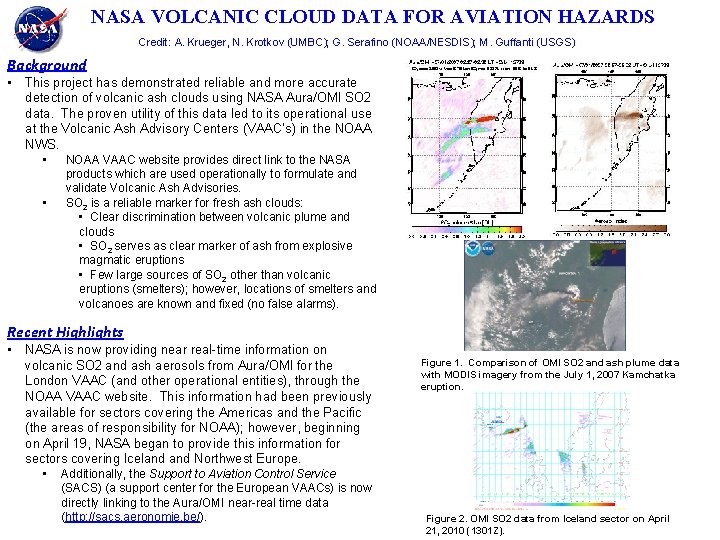
NASA VOLCANIC CLOUD DATA FOR AVIATION HAZARDS Credit: A. Krueger, N. Krotkov (UMBC); G. Serafino (NOAA/NESDIS); M. Guffanti (USGS) Background • This project has demonstrated reliable and more accurate detection of volcanic ash clouds using NASA Aura/OMI SO 2 data. The proven utility of this data led to its operational use at the Volcanic Ash Advisory Centers (VAAC’s) in the NOAA NWS. • • NOAA VAAC website provides direct link to the NASA products which are used operationally to formulate and validate Volcanic Ash Advisories. SO 2 is a reliable marker for fresh ash clouds: • Clear discrimination between volcanic plume and clouds • SO 2 serves as clear marker of ash from explosive magmatic eruptions • Few large sources of SO 2 other than volcanic eruptions (smelters); however, locations of smelters and volcanoes are known and fixed (no false alarms). Recent Highlights • NASA is now providing near real-time information on volcanic SO 2 and ash aerosols from Aura/OMI for the London VAAC (and other operational entities), through the NOAA VAAC website. This information had been previously available for sectors covering the Americas and the Pacific (the areas of responsibility for NOAA); however, beginning on April 19, NASA began to provide this information for sectors covering Iceland Northwest Europe. • Additionally, the Support to Aviation Control Service (SACS) (a support center for the European VAACs) is now directly linking to the Aura/OMI near-real time data (http: //sacs. aeronomie. be/). Figure 1. Comparison of OMI SO 2 and ash plume data with MODIS imagery from the July 1, 2007 Kamchatka eruption. Figure 2. OMI SO 2 data from Iceland sector on April 21, 2010 (1301 Z).
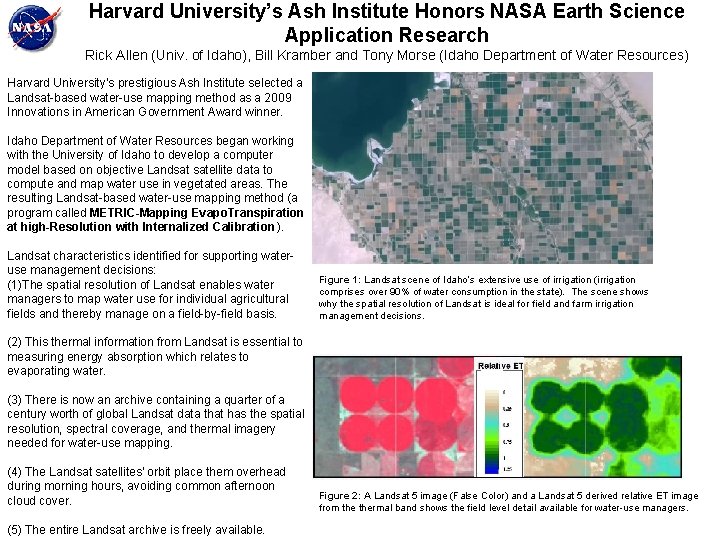
Harvard University’s Ash Institute Honors NASA Earth Science Application Research Rick Allen (Univ. of Idaho), Bill Kramber and Tony Morse (Idaho Department of Water Resources) Harvard University’s prestigious Ash Institute selected a Landsat-based water-use mapping method as a 2009 Innovations in American Government Award winner. Idaho Department of Water Resources began working with the University of Idaho to develop a computer model based on objective Landsat satellite data to compute and map water use in vegetated areas. The resulting Landsat-based water-use mapping method (a program called METRIC-Mapping Evapo. Transpiration at high-Resolution with Internalized Calibration). Landsat characteristics identified for supporting wateruse management decisions: (1)The spatial resolution of Landsat enables water managers to map water use for individual agricultural fields and thereby manage on a field-by-field basis. Figure 1: Landsat scene of Idaho’s extensive use of irrigation (irrigation comprises over 90% of water consumption in the state). The scene shows why the spatial resolution of Landsat is ideal for field and farm irrigation management decisions. (2) This thermal information from Landsat is essential to measuring energy absorption which relates to evaporating water. (3) There is now an archive containing a quarter of a century worth of global Landsat data that has the spatial resolution, spectral coverage, and thermal imagery needed for water-use mapping. (4) The Landsat satellites' orbit place them overhead during morning hours, avoiding common afternoon cloud cover. (5) The entire Landsat archive is freely available. Figure 2: A Landsat 5 image (False Color) and a Landsat 5 derived relative ET image from thermal band shows the field level detail available for water-use managers.
- Slides: 12