
NASA Disasters Program Arc GIS Portal Overview NASA
- Slides: 18
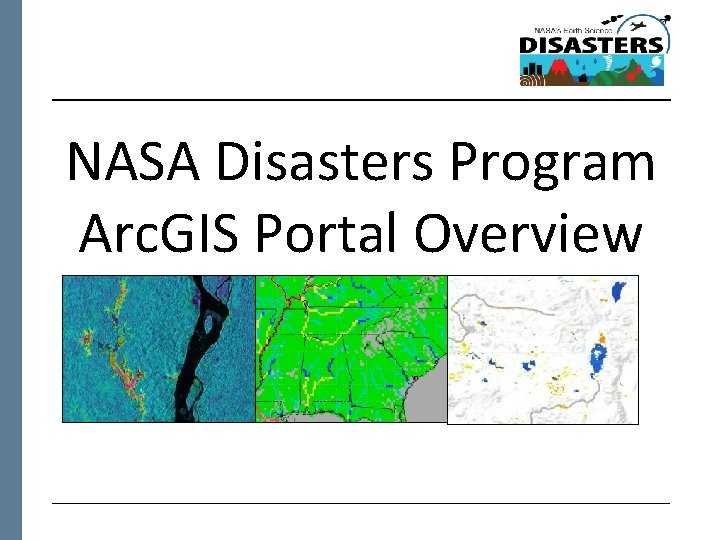
NASA Disasters Program Arc. GIS Portal Overview
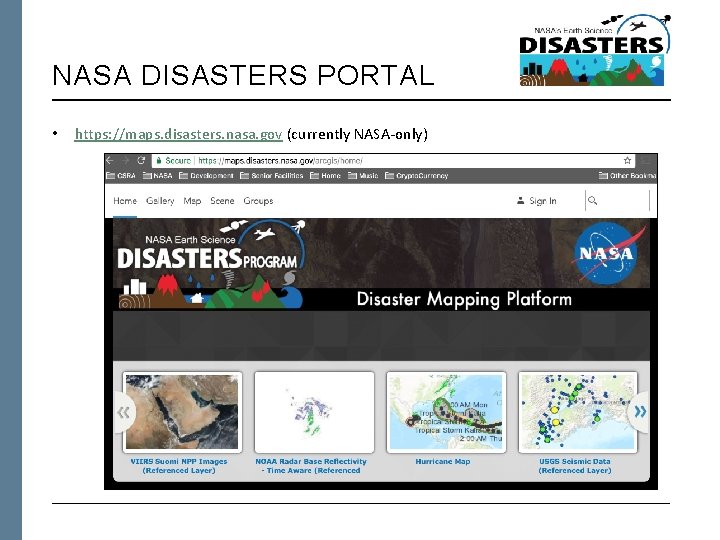
NASA DISASTERS PORTAL • https: //maps. disasters. nasa. gov (currently NASA-only)
WHY DO WE NEED A PORTAL? • Provide NASA products to Disaster Management end users in useful format • Migrate products into GIS compatible format to: - Improve tactical and operational decision making - Assist with rescue and response - Provide up-to-date situational awareness about the events • Add a “One stop shop” for products and data developed through the Disasters Program • Greater dissemination of products and delivered in OGC format • Provide data that is readable/downloadable in QGIS and other open source mapping tools (while built in ESRI’s Arc. GIS)
DISASTERS PROGRAM PORTAL GOALS • Designed to… - Equip NASA scientists with the tools needed to communicate earth science data in a way that is useful and understandable to the external user community - Install, configure, and deliver highly available, open standards based GIS server platform that can be both self-sufficient and fed by NASA data center (DAAC) and other data provider hosted servers. - Service enable high-priority DAAC and other data provider hosted data products for use in commonly used GIS systems - Test and deploy services to internal and external user community (i. e. FEMA) and work with partners to combine data services, knowledge, geoprocessing tools, and experience to develop solutions and enhance decisions
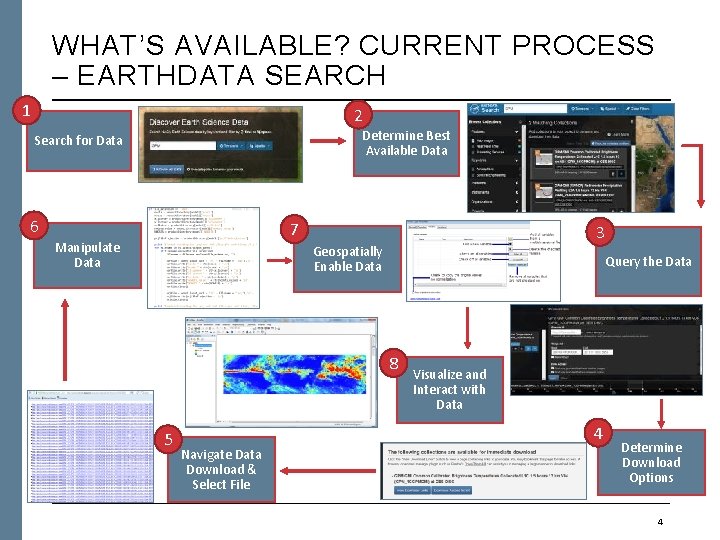
WHAT’S AVAILABLE? CURRENT PROCESS – EARTHDATA SEARCH 1 2 Determine Best Available Data Search for Data 6 7 Manipulate Data 3 Geospatially Enable Data Query the Data 8 5 Visualize and Interact with Data 4 Navigate Data Download & Select File Determine Download Options 4
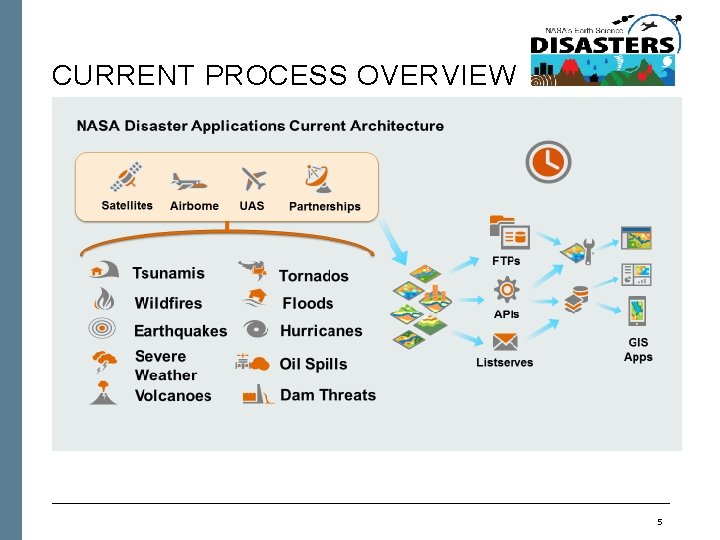
CURRENT PROCESS OVERVIEW 5
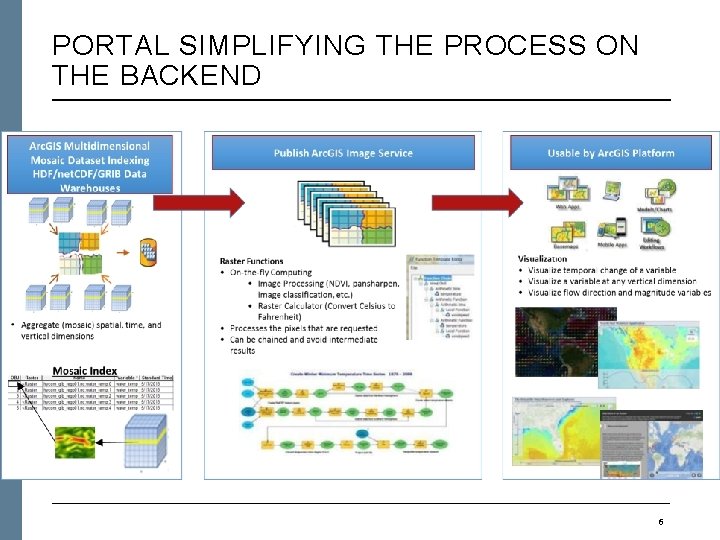
PORTAL SIMPLIFYING THE PROCESS ON THE BACKEND 6
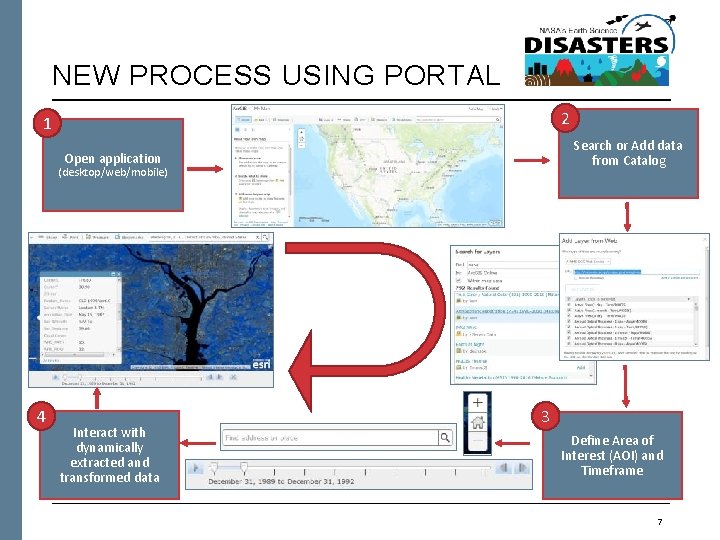
NEW PROCESS USING PORTAL 2 1 Search or Add data from Catalog Open application (desktop/web/mobile) 4 Interact with dynamically extracted and transformed data 3 Define Area of Interest (AOI) and Timeframe 7
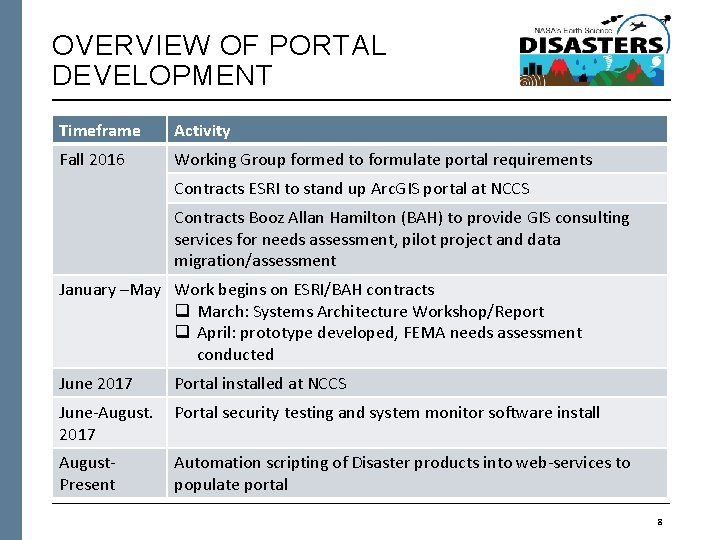
OVERVIEW OF PORTAL DEVELOPMENT Timeframe Activity Fall 2016 Working Group formed to formulate portal requirements Contracts ESRI to stand up Arc. GIS portal at NCCS Contracts Booz Allan Hamilton (BAH) to provide GIS consulting services for needs assessment, pilot project and data migration/assessment January –May Work begins on ESRI/BAH contracts q March: Systems Architecture Workshop/Report q April: prototype developed, FEMA needs assessment conducted June 2017 Portal installed at NCCS June-August. Portal security testing and system monitor software install 2017 August. Present Automation scripting of Disaster products into web-services to populate portal 8
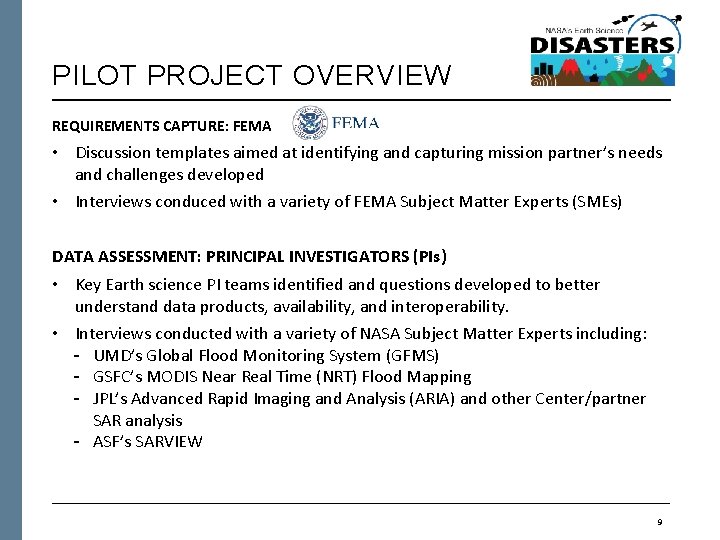
PILOT PROJECT OVERVIEW REQUIREMENTS CAPTURE: FEMA • Discussion templates aimed at identifying and capturing mission partner’s needs and challenges developed • Interviews conduced with a variety of FEMA Subject Matter Experts (SMEs) DATA ASSESSMENT: PRINCIPAL INVESTIGATORS (PIs) • Key Earth science PI teams identified and questions developed to better understand data products, availability, and interoperability. • Interviews conducted with a variety of NASA Subject Matter Experts including: - UMD’s Global Flood Monitoring System (GFMS) - GSFC’s MODIS Near Real Time (NRT) Flood Mapping - JPL’s Advanced Rapid Imaging and Analysis (ARIA) and other Center/partner SAR analysis - ASF’s SARVIEW 9
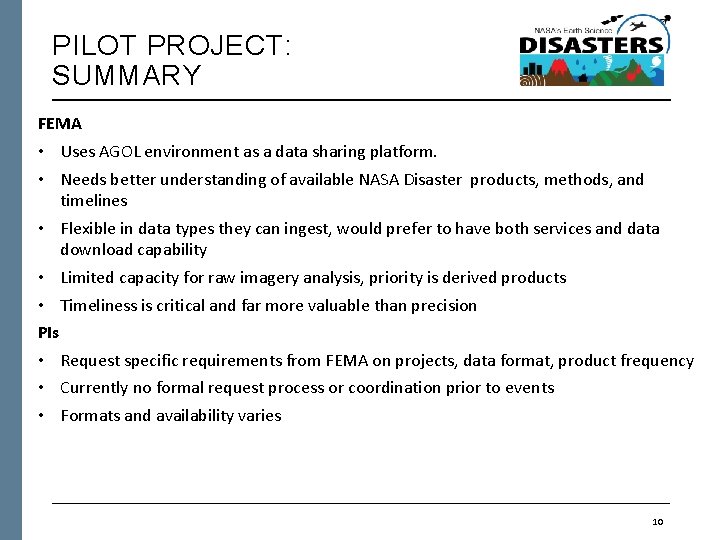
PILOT PROJECT: SUMMARY FEMA • Uses AGOL environment as a data sharing platform. • Needs better understanding of available NASA Disaster products, methods, and timelines • Flexible in data types they can ingest, would prefer to have both services and data download capability • Limited capacity for raw imagery analysis, priority is derived products • Timeliness is critical and far more valuable than precision PIs • Request specific requirements from FEMA on projects, data format, product frequency • Currently no formal request process or coordination prior to events • Formats and availability varies 10
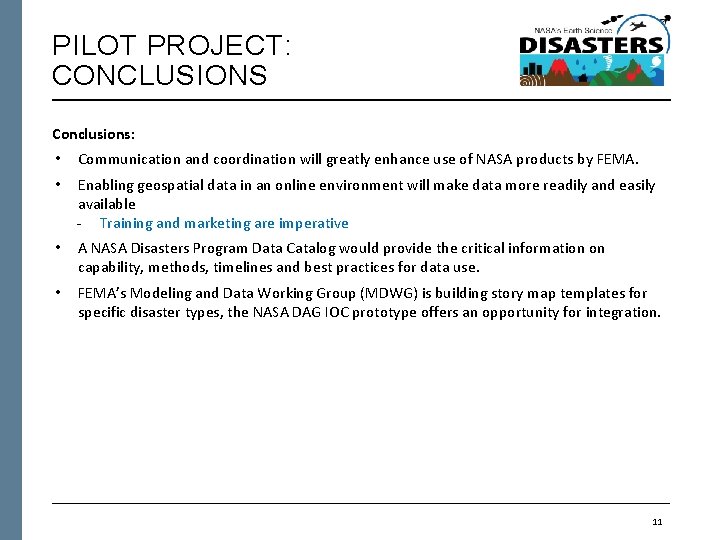
PILOT PROJECT: CONCLUSIONS Conclusions: • Communication and coordination will greatly enhance use of NASA products by FEMA. • Enabling geospatial data in an online environment will make data more readily and easily available - Training and marketing are imperative • A NASA Disasters Program Data Catalog would provide the critical information on capability, methods, timelines and best practices for data use. • FEMA’s Modeling and Data Working Group (MDWG) is building story map templates for specific disaster types, the NASA DAG IOC prototype offers an opportunity for integration. 11
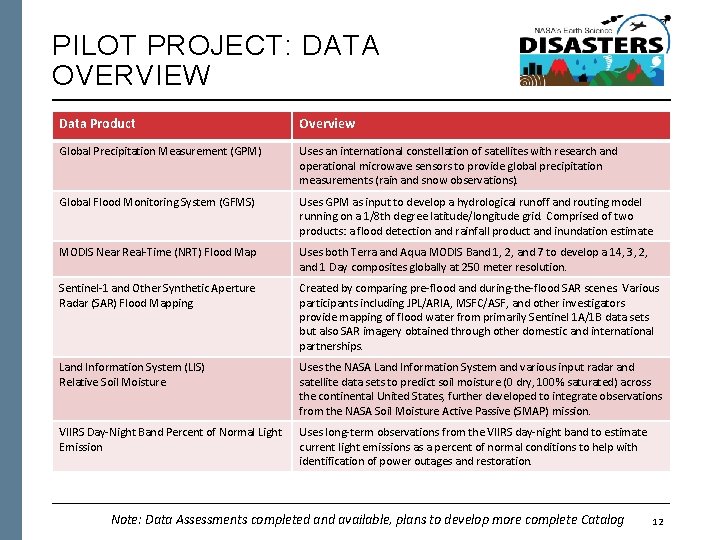
PILOT PROJECT: DATA OVERVIEW Data Product Overview Global Precipitation Measurement (GPM) Uses an international constellation of satellites with research and operational microwave sensors to provide global precipitation measurements (rain and snow observations). Global Flood Monitoring System (GFMS) Uses GPM as input to develop a hydrological runoff and routing model running on a 1/8 th degree latitude/longitude grid. Comprised of two products: a flood detection and rainfall product and inundation estimate MODIS Near Real-Time (NRT) Flood Map Uses both Terra and Aqua MODIS Band 1, 2, and 7 to develop a 14, 3, 2, and 1 Day composites globally at 250 meter resolution. Sentinel-1 and Other Synthetic Aperture Radar (SAR) Flood Mapping Created by comparing pre-flood and during-the-flood SAR scenes. Various participants including JPL/ARIA, MSFC/ASF, and other investigators provide mapping of flood water from primarily Sentinel 1 A/1 B data sets but also SAR imagery obtained through other domestic and international partnerships. Land Information System (LIS) Relative Soil Moisture Uses the NASA Land Information System and various input radar and satellite data sets to predict soil moisture (0 dry, 100% saturated) across the continental United States, further developed to integrate observations from the NASA Soil Moisture Active Passive (SMAP) mission. VIIRS Day-Night Band Percent of Normal Light Emission Uses long-term observations from the VIIRS day-night band to estimate current light emissions as a percent of normal conditions to help with identification of power outages and restoration. Note: Data Assessments completed and available, plans to develop more complete Catalog 12
CURRENT PROJECT STATUS • • Portal installed at NCCS – not yet public facing Prototype migration - currently testing on development site Front-end for portal under development (disasters. nasa. gov) ESRI consultants working on product automation scripting development to populate portal with data • Dedicated Disasters Program GIS hire started on October 2 rd 13
WHAT’S NEXT? • Decisions on portal governance and standards - Facilitated discussions - Meet with EPA GIS team for “benchmarking” • Continue to populate portal and complete testing of geospatial products - Continue with automation scripting of products • Receive technical trainings and Arc. GIS training • Consultants to lead group discussions focused on addressing issues of governance, developing workflows, structure of portal, etc. 14
DISASTERS PORTAL AND LANCE • Disasters Portal is not accelerating the processing of EO data to make it ready in real time • Portal is simply taking data that is produced in NRT and providing a central access destination for data related to specific disasters/hazards • LANCE will continue to serve as authoritative data source producing NRT data. - Portal will be able to consume current Web Map Services (WMS), Web Map Tile Services (WMTS) and Keyhole Markup Language (KML) services provided by LANCE 15
WHAT THE PORTAL BRINGS TO LANCE Disasters Portal will serve to enhance LANCE offerings by: • Automatically ingesting multi-dimensional data from LANCE and turning it into multi-dimensional image services distributed as Web-Coverage Services (WCS) • Help make LANCE data more discoverable • Allow LANCE data products to be more robust and used by more people - E. g can use day/night image to overlay on map and figure out stats of people that live in that area, # of people over 65, etc. Currently not available to do in GIBS • Drive more traffic to LANCE - Refer users back to LANCE for authoritative source and metadata 16
NEXT STEPS AND QUESTIONS • MODIS data automation • Discussion of VIIRS incorporation once flood related products are finished • Happy to schedule time to discuss Disasters Portal and LANCE as well as have ESRI provide more information about backend of portal Additional questions? Contact : Jessica Seepersad Disasters Portal Project Manager 202 -358 -0612 Jessica. b. Seepersad@nasa. gov 17