
NASA Bioregenerative Life Support Past Present Future Marshall

NASA Bioregenerative Life Support: Past, Present & Future Marshall Porterfield, Director, Life and Physical Sciences Division NASA ISLSWG Bioregenerative Life Support Workshop Turino, Italy May 18, 2015
WHY? WHAT HAVE WE DONE? EXPLORING A DESOLATE WILDERNESS! WHAT DO WE NEED TO DO?
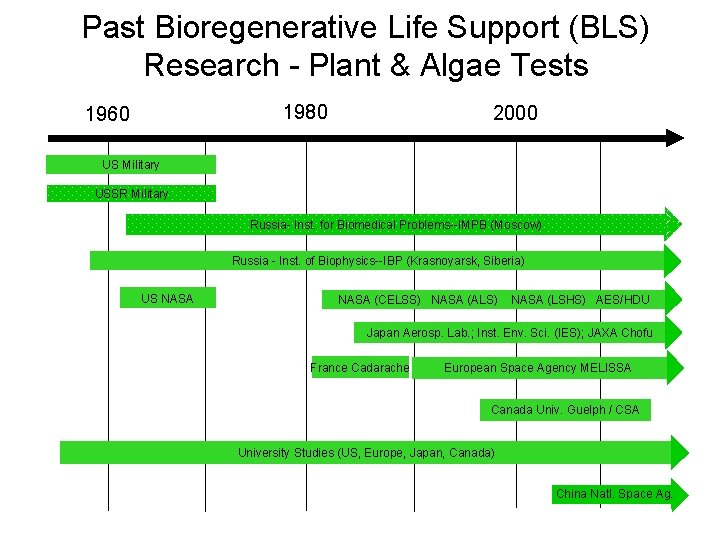
Past Bioregenerative Life Support (BLS) Research - Plant & Algae Tests 1980 1960 2000 US Military USSR Military Russia- Inst. for Biomedical Problems--IMPB (Moscow) Russia - Inst. of Biophysics--IBP (Krasnoyarsk, Siberia) US NASA (CELSS) NASA (ALS) NASA (LSHS) AES/HDU Japan Aerosp. Lab. ; Inst. Env. Sci. (IES); JAXA Chofu France Cadarache European Space Agency MELISSA Canada Univ. Guelph / CSA University Studies (US, Europe, Japan, Canada) China Natl. Space Ag.
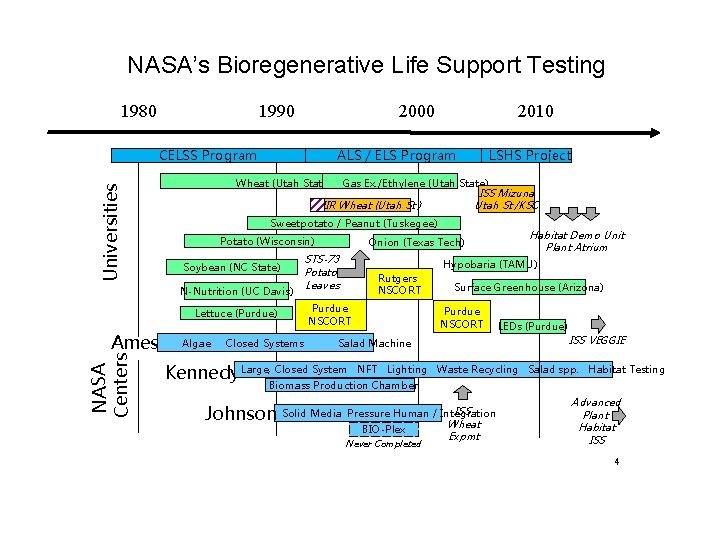
NASA’s Bioregenerative Life Support Testing 1980 1990 2000 Universities CELSS Program ALS / ELS Program Wheat (Utah State) ISS Mizuna Utah St. /KSC Sweetpotato / Peanut (Tuskegee) Potato (Wisconsin) Soybean (NC State) Algae Onion (Texas Tech) STS-73 Potato Leaves Lettuce (Purdue) NASA Centers LSHS Project Gas Ex. /Ethylene (Utah State) MIR Wheat (Utah St. ) N-Nutrition (UC Davis) Ames 2010 Closed Systems Rutgers NSCORT Purdue NSCORT Habitat Demo Unit Plant Atrium Hypobaria (TAMU) Surface Greenhouse (Arizona) Purdue NSCORT Salad Machine LEDs (Purdue) ISS VEGGIE Kennedy Large, Closed System NFT Lighting Waste Recycling Salad spp. Habitat Testing Biomass Production Chamber Johnson Solid Media ISS Pressure Human / Integration BIO-Plex Never Completed Wheat Expmt Advanced Plant Habitat ISS 4
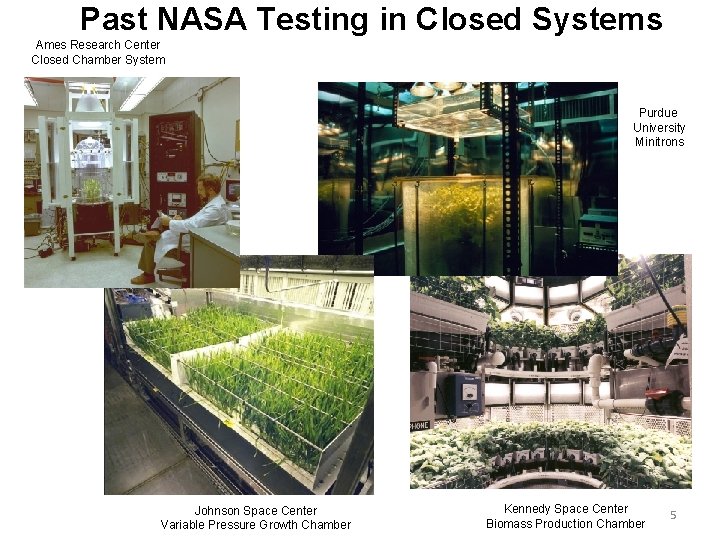
Past NASA Testing in Closed Systems Ames Research Center Closed Chamber System Purdue University Minitrons Johnson Space Center Variable Pressure Growth Chamber Kennedy Space Center Biomass Production Chamber 5
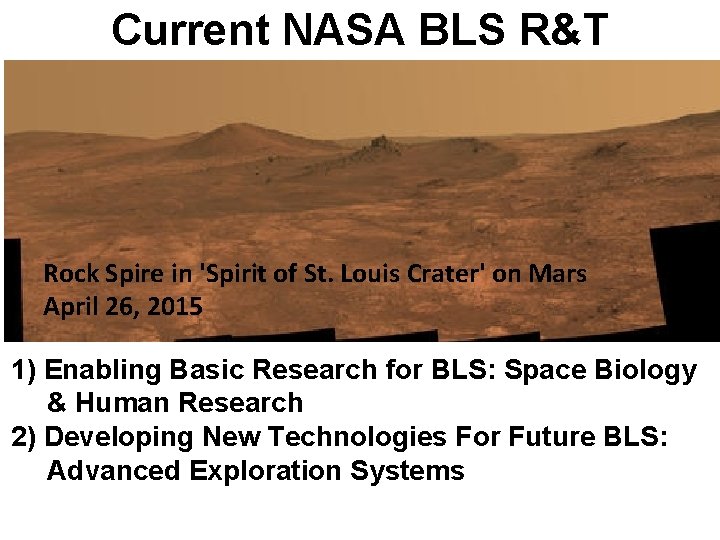
Current NASA BLS R&T Rock Spire in 'Spirit of St. Louis Crater' on Mars April 26, 2015 1) Enabling Basic Research for BLS: Space Biology & Human Research 2) Developing New Technologies For Future BLS: Advanced Exploration Systems
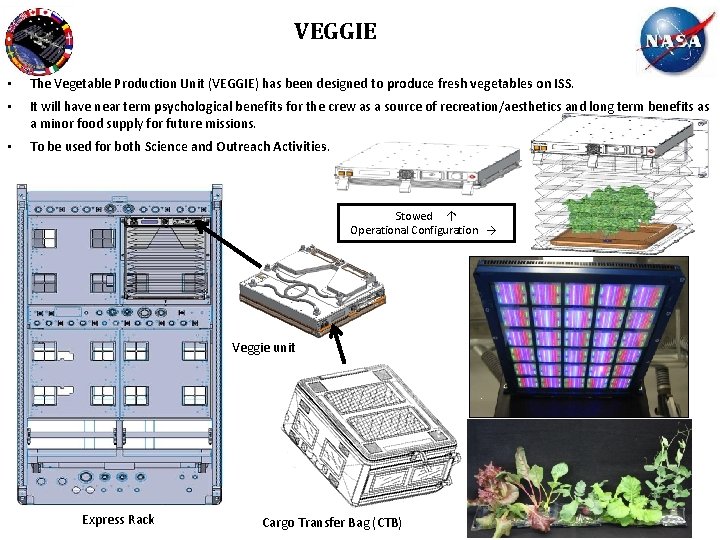
VEGGIE Unit (VEGGIE) Vegetable Production • The Vegetable Production Unit (VEGGIE) has been designed to produce fresh vegetables on ISS. • It will have near term psychological benefits for the crew as a source of recreation/aesthetics and long term benefits as a minor food supply for future missions. • To be used for both Science and Outreach Activities. Stowed ↑ Operational Configuration → Veggie unit Express Rack Cargo Transfer Bag (CTB)
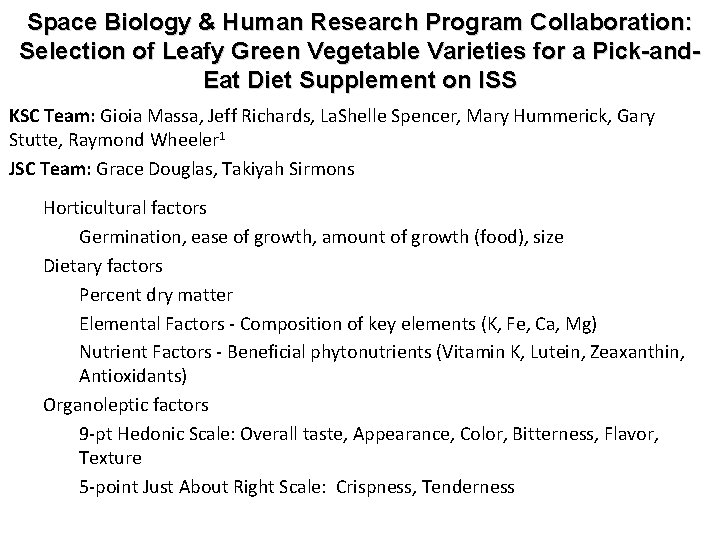
Space Biology & Human Research Program Collaboration: Selection of Leafy Green Vegetable Varieties for a Pick-and. Eat Diet Supplement on ISS KSC Team: Gioia Massa, Jeff Richards, La. Shelle Spencer, Mary Hummerick, Gary Stutte, Raymond Wheeler 1 JSC Team: Grace Douglas, Takiyah Sirmons Horticultural factors Germination, ease of growth, amount of growth (food), size Dietary factors Percent dry matter Elemental Factors - Composition of key elements (K, Fe, Ca, Mg) Nutrient Factors - Beneficial phytonutrients (Vitamin K, Lutein, Zeaxanthin, Antioxidants) Organoleptic factors 9 -pt Hedonic Scale: Overall taste, Appearance, Color, Bitterness, Flavor, Texture 5 -point Just About Right Scale: Crispness, Tenderness
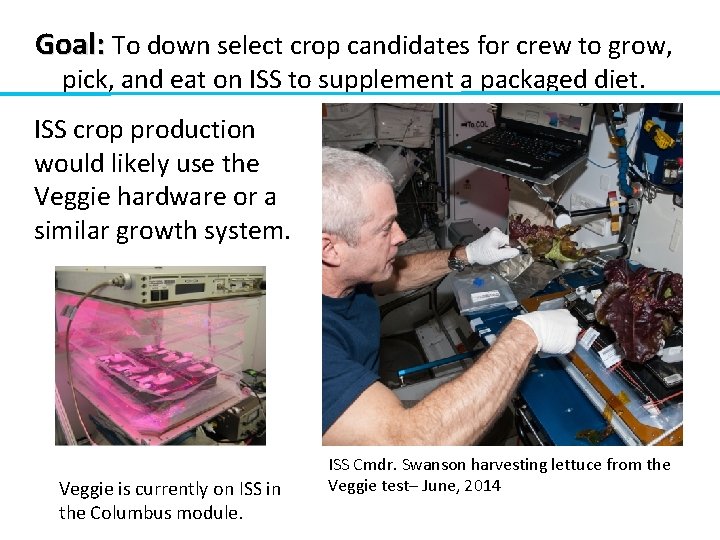
Goal: To down select crop candidates for crew to grow, pick, and eat on ISS to supplement a packaged diet. ISS crop production would likely use the Veggie hardware or a similar growth system. Veggie is currently on ISS in the Columbus module. ISS Cmdr. Swanson harvesting lettuce from the Veggie test– June, 2014

NASA SPACE BIOLOGY Advanced Plant Habitat (APH) Objective: Develop a large volume plant habitat for multi-generational studies in which environmental variables (e. g. , Temperature, Relative Humidity, Carbon Dioxide Level, Light Intensity and Spectral Quality) can be tracked and controlled in support of whole plant physiological testing and Bioregenerative Life Support System investigations. Open architecture concept to allow critical subsystems to be removed and replaced. Specs: Max. Shoot Height: 45 cm; Root Zone Height: 5 cm, Growth Area: 2, 500 cm 2; Growth Volume: 112, 500 cm 3; Light Intensity: >600 mmol/m 2/s; Temp: 18 -30 C; Relative Humidity: 50 -86%
SPACE BIOLOGY USING APH TO GAIN KNOWLEDGE TO ENABLE BLS Integrated Omics Guided Approach to Lignification and Gravitational Responses: The Final Frontier - Norman Lewis (Washington State University, Arabidopsis multi-omic study (metabolomics, transcriptomics, proteomics, Pullman) phenomics) using integrated computational biology (ICB) approach using mutants with different lignin amounts & lines enhanced in carbon assimilation capacity. Investigate gene/metabolic network relationships & adaptations resulting from varying lignin & carbon assimilation levels on photosynthesis, C allocation, water use efficiency (WUE), plant growth/development, vasculature performance, auxin transport and gravitational adaptations. Objectives Establish multi-omics’ effects of modulating lignin & carbon concentrating mechanism (CCM) levels on Earth & in space & how they affect carbon assimilation/re-allocation, photosynthesis & WUE. Compare/contrast data, using ICB, to better define & understand gravity sensing & responses, & if threshold/induction parameters are modified or changed when lignin and CCM levels are varied. Determine if system-wide transcriptome modification occurs through a common transcriptional regulatory mechanism, and transcriptome/proteome “discrepancies” that result from over simplification of transcript analyses. Understand how alterations in lignin & CCM levels effect protein expression & phosphorylation patterns in a defined set of proteins. Integrated omics approach yields plant biological process insight on Earth & in space
Current NASA R&D Projects Funded by Advanced Exploration Systems Division • NASA Steckler Grant: – A Phase III grant to the University of Arizona was awarded to continue testing of a deployable, surface greenhouse (crop growth) system • Small Business Innovative Research Grants: – Rapid Activation of Biological Wastewater Treatment Systems – Solar Plant Growth System for Food Production in Space Exploration Missions • Biological Water Processor – Collaborative effort between NASA Johnson Space Center and Texas Tech University • Synthetic Biology – Biomaterials – Utilize resources available in wastewater to produce bioplastics that can be used in 3 D printing manufacturing. – Bionutrients – Produce fresh (timely), high value nutrients that can be used to supplement crew food supplies – Biomining – Produce an integrated circuit chip using biologically acquired materials and advanced manufacturing techniques.
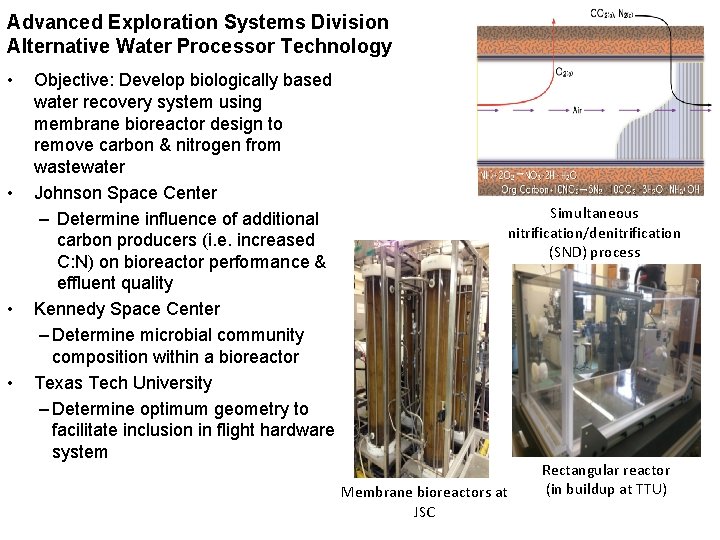
Advanced Exploration Systems Division Alternative Water Processor Technology • • Objective: Develop biologically based water recovery system using membrane bioreactor design to remove carbon & nitrogen from wastewater Johnson Space Center – Determine influence of additional carbon producers (i. e. increased C: N) on bioreactor performance & effluent quality Kennedy Space Center – Determine microbial community composition within a bioreactor Texas Tech University – Determine optimum geometry to facilitate inclusion in flight hardware system Simultaneous nitrification/denitrification (SND) process Membrane bioreactors at JSC Rectangular reactor (in buildup at TTU)
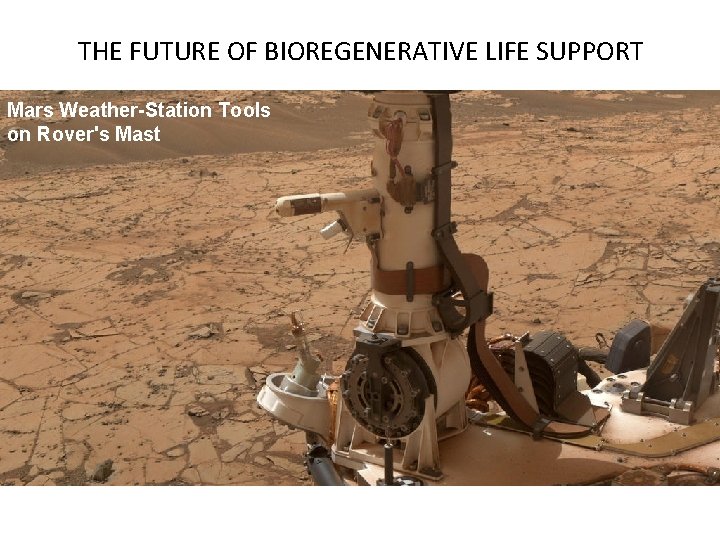
THE FUTURE OF BIOREGENERATIVE LIFE SUPPORT Mars Weather-Station Tools on Rover's Mast
THE FUTURE OF BIOREGENERATIVE LIFE SUPPORT • Use of Systems Biology tools on ISS, in Free-Flier Satellite, and in Ground-based studies to better understand how to improve food production and waste processing in BLS • International Cooperation in Design of Projects to Enable future, more mature BLS capabilities within limited fiscal and resource constraints • Determine genetic engineering strategies to produce plants that are optimally suited for growth in spaceflight conditions
NASA Bioregenerative Life Support: Past, Present & Future THANK YOU!! COMMENTS/QUESTIONS? ? Marshall Porterfield, Director, Life and Physical Sciences Division NASA ISLSWG Bioregenerative Life Support Workshop Turino, Italy May 18, 2015
- Slides: 16