
NAS Fallon Conservation Easement Program Rob Rule Community
NAS Fallon Conservation Easement Program Rob Rule Community Plans and Liaison Officer NASF “Nevada’s Carrier in the Desert”

Naval Air Station Fallon and Fallon Range Training Complex “Nevada’s Carrier in the Desert” 2

Naval Air Station Fallon • Integrated Training • • Air Wing Strike Fighter Advanced Readiness Program Graduate Level Schools • Navy Fighter Weapons School (TOPGUN) • Naval Strike Warfare Center (Strike University) • Carrier Airborne Early Warning Weapons School • Rotary Wing Weapons School • Electronic Reconnaissance Weapons School • Joint Close Air Support School • Naval Special Warfare Tactical Mobility Course • Growler Weapons School • Tomahawk Land Attack Missile Cell Special Warfare • • • Tactical Ground Mobility Close Air Support Sniper Sustainment “Nevada’s Carrier in the Desert” 3
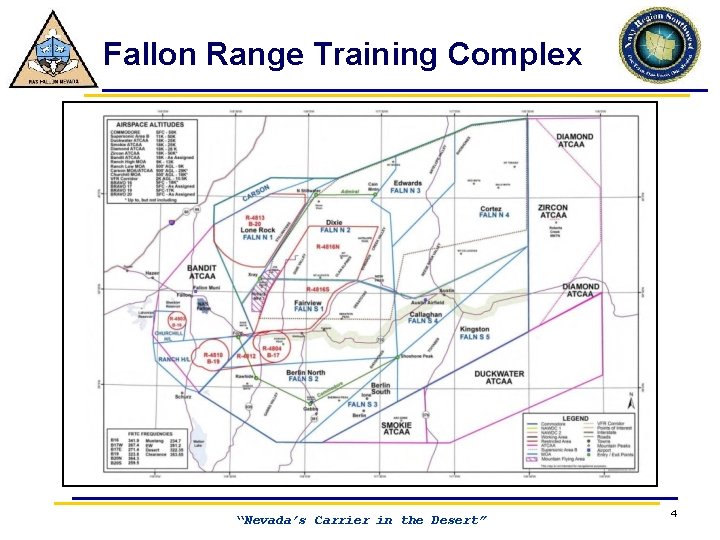
Fallon Range Training Complex “Nevada’s Carrier in the Desert” 4

Department of Defense and Readiness and Environmental Protection Integration (REPI) “Nevada’s Carrier in the Desert” 5

REPI Locations • Leveraged over $667 million in Do. D funds with $648 million in partner funds to protect over 464, 000 acres of land at 89 locations in 30 states across the country (as of 30 Sept 2016) • Facts and other accomplishments can be found in the 2016 REPI Report to Congress available at www. repi. mil “Nevada’s Carrier in the Desert” 6
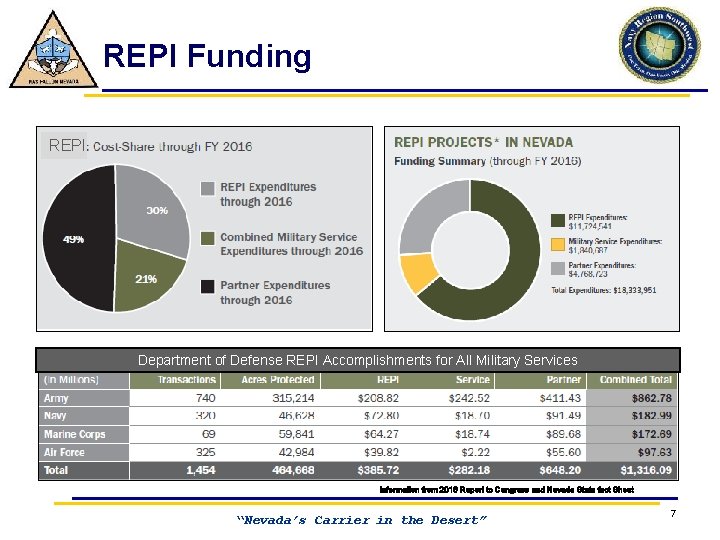
REPI Funding REPI Department of Defense REPI Accomplishments for All Military Services Information from 2016 Report to Congress and Nevada State fact Sheet “Nevada’s Carrier in the Desert” 7
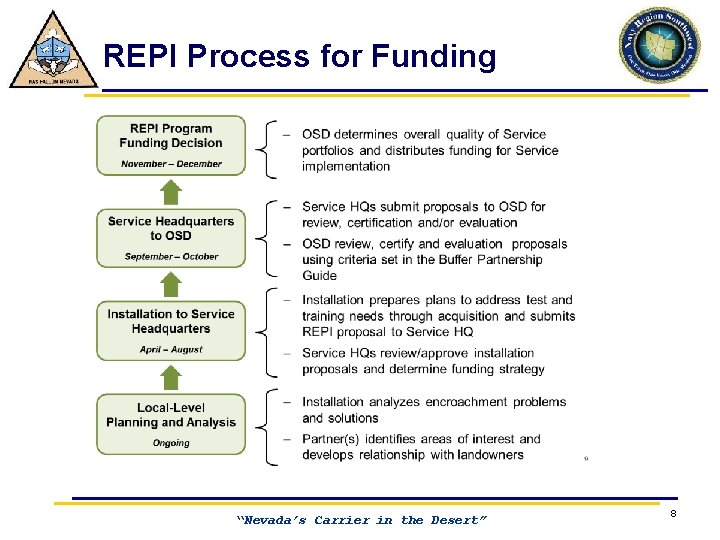
REPI Process for Funding “Nevada’s Carrier in the Desert” 8
REPI Basics Authority provided by Congress in Fiscal Year 2003 National Defense Authorization Act Authorizes agreements to acquire: • Real property interests or water rights • For property in the vicinity of, or ecologically related to, • A military installation, range or airspace Two-pronged justification: • Limit development or use of the property that is incompatible with the installation’s mission, and / or • Preserve habitat to relieve current or anticipated environmental restrictions on military activities “Nevada’s Carrier in the Desert” 9
Essential Elements of a REPI Partnership l l l Willing seller (voluntary) Eligible entity- State or local government or private conservation organization Cost share for the partner’s acquisition of real property interests Must protect compatible land uses or preserve habitat Show clear link to mission benefit REPI Guide for State, Local, and Private Partners “Nevada’s Carrier in the Desert” 10
Naval Air Station Fallon and REPI “Nevada’s Carrier in the Desert” 11

Naval Air Station Fallon “Nevada’s Carrier in the Desert” 12
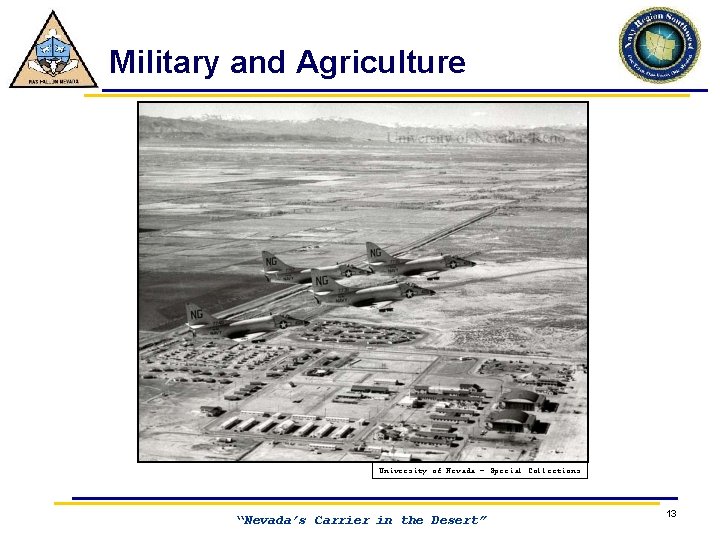
Military and Agriculture University of Nevada – Special Collections “Nevada’s Carrier in the Desert” 13
Importance of REPI Program l Military airfield impacted by development while in a cooperative county Nellis Air Force Base, Nevada l NAS Miramar, California l Luke Air Force Base, Arizona l NAS Oceana, Virginia l l Last new Naval air station constructed in 1961 (Lemoore) “Nevada’s Carrier in the Desert” 14
Long Term Strategy l l Protect Military Readiness by preserving agriculture / open space lands within military operational areas Promote Compatible Land Use l l Military flight operations / agriculture Protect productive agricultural lands from commercial/ residential / industrial development Encourage residential / commercial / industrial development outside of the noise contours Minimize fee acquisition l Easements allow farmers and ranches to continue to manage the land for agriculture “Nevada’s Carrier in the Desert” 15
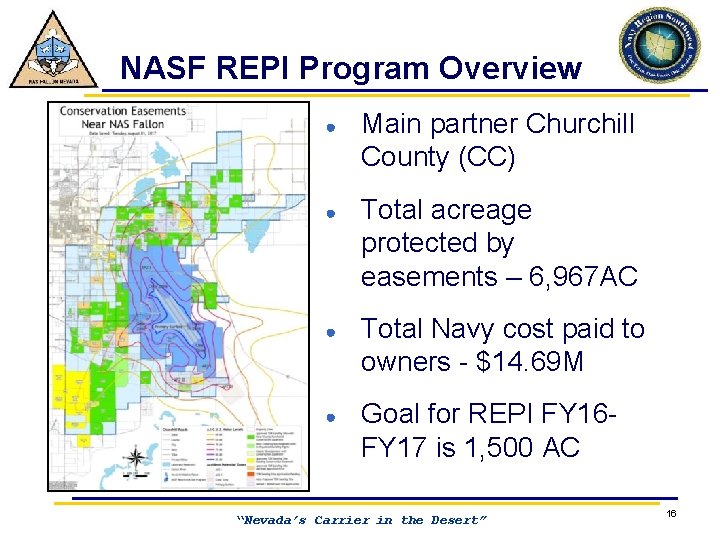
NASF REPI Program Overview ● Main partner Churchill County (CC) ● Total acreage protected by easements – 6, 967 AC ● Total Navy cost paid to owners - $14. 69 M ● Goal for REPI FY 16 FY 17 is 1, 500 AC “Nevada’s Carrier in the Desert” 16
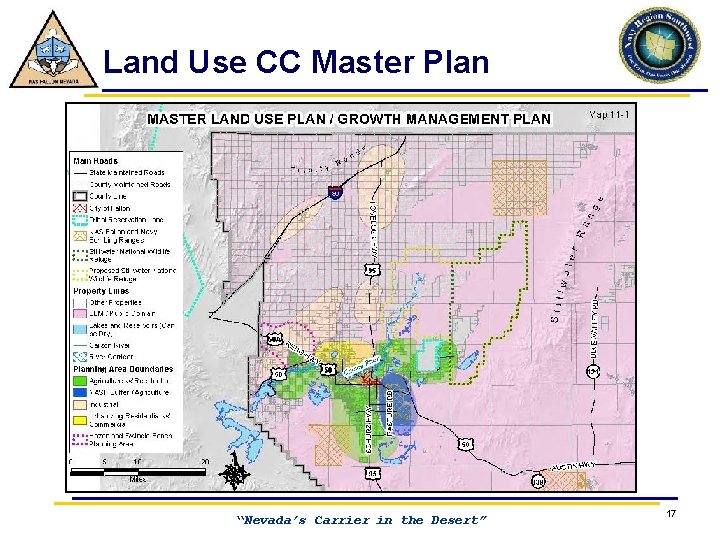
Land Use CC Master Plan “Nevada’s Carrier in the Desert” 17
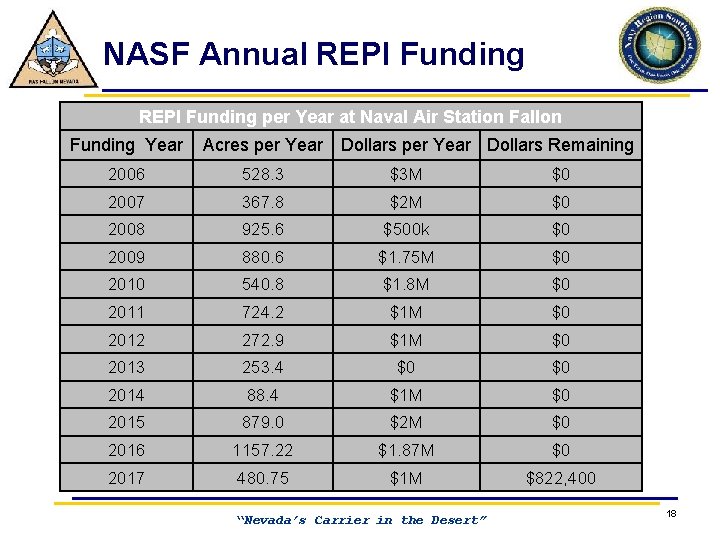
NASF Annual REPI Funding per Year at Naval Air Station Fallon Funding Year Acres per Year Dollars Remaining 2006 528. 3 $3 M $0 2007 367. 8 $2 M $0 2008 925. 6 $500 k $0 2009 880. 6 $1. 75 M $0 2010 540. 8 $1. 8 M $0 2011 724. 2 $1 M $0 2012 272. 9 $1 M $0 2013 253. 4 $0 $0 2014 88. 4 $1 M $0 2015 879. 0 $2 M $0 2016 1157. 22 $1. 87 M $0 2017 480. 75 $1 M $822, 400 “Nevada’s Carrier in the Desert” 18
Fallon Range Training Complex and REPI “Nevada’s Carrier in the Desert” 19
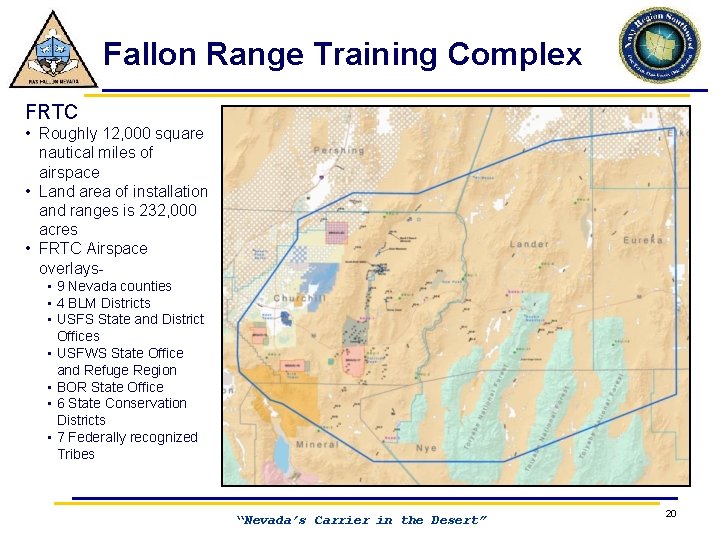
Fallon Range Training Complex FRTC • Roughly 12, 000 square nautical miles of airspace • Land area of installation and ranges is 232, 000 acres • FRTC Airspace overlays • 9 Nevada counties • 4 BLM Districts • USFS State and District Offices • USFWS State Office and Refuge Region • BOR State Office • 6 State Conservation Districts • 7 Federally recognized Tribes “Nevada’s Carrier in the Desert” 20
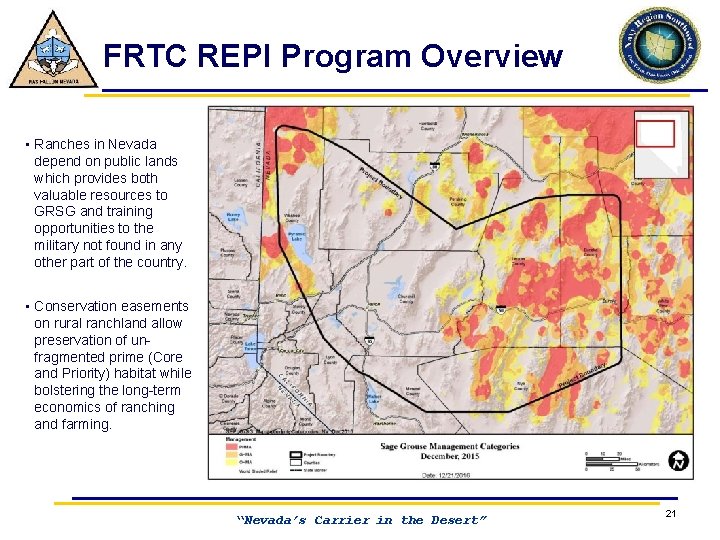
FRTC REPI Program Overview • Ranches in Nevada depend on public lands which provides both valuable resources to GRSG and training opportunities to the military not found in any other part of the country. • Conservation easements on rural ranchland allow preservation of unfragmented prime (Core and Priority) habitat while bolstering the long-term economics of ranching and farming. “Nevada’s Carrier in the Desert” 21
REPI Partners l l l l l Natural Resources Conservation Service Nevada Department of Wildlife The Nature Conservancy State of Nevada Conservation Districts Program Naval Air Station Fallon Bureau of Land Management U. S. Forest Service U. S. Fish and Wildlife Service Nevada Sage Grouse Initiative Great Basin Landscape Conservation Cooperative “Nevada’s Carrier in the Desert” 22
Purpose and Objectives l Conservation easements l l l Restoration Projects l l Purchase development rights Strengthen working lands Pinion Juniper removal Spring improvement Noxious weed abatement Research and Monitoring l l Project evaluation Long term strategy “Nevada’s Carrier in the Desert” 23
Purpose and Objectives “Today’s decision reflects the joint efforts by countless ranchers and partners who have worked so hard to conserve wildlife habitat and preserve the Western way of life, together we have shown that voluntary efforts joining the resources of private landowners, federal and state agencies, and partner organizations can help drive landscape-level conservation that is good for sage-grouse, ranching operations, and rural communities. Through the comprehensive initiatives on both public and private lands, the partnership has made and will continue to make monumental strides in supporting the people and wildlife that depend on the sagebrush landscape. ” U. S. Agriculture Secretary Tom Vilsack September 2015 “Nevada’s Carrier in the Desert” 24
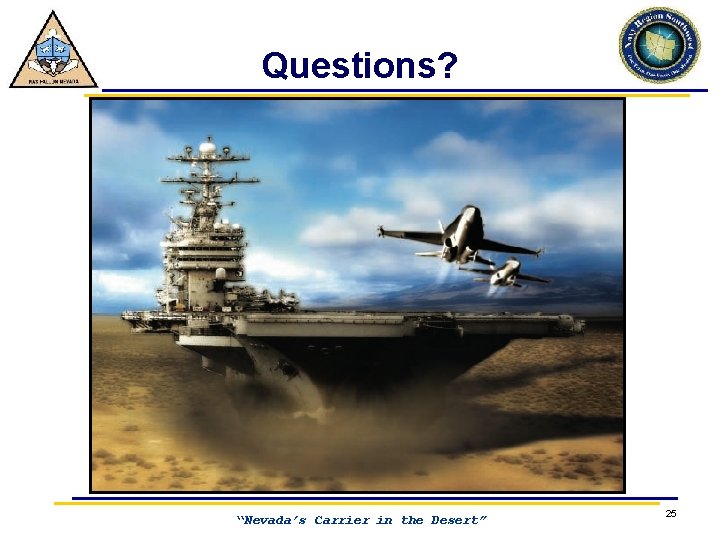
Questions? “Nevada’s Carrier in the Desert” 25
“Nevada’s Carrier in the Desert” 26
- Slides: 26