
NARRATIVE WRITING Examples of narration Short stories Novels
- Slides: 12
NARRATIVE WRITING
Examples of narration • Short stories • Novels • Biographies • Fairy-tales • Fantasy • Detective stories
Purpose: • The purpose of a narrative text is to tell a story. Provide details in the sequence the events occur. • There has to be a complication to increase the interest of the reader • The story must have a definite ending.
A good narrative: • Involves readers in the story • Tells events in sequence • Includes detailed observations of people, places, and events • Presents important changes, contrasts, or conflicts and creates tension • Focuses on connection between past events, people, or places and the present
The text of a narrative is organized into: • An orientation (introduction)that tells us about the who? , where? and when? of the story. This is also known as the setting. • A sequence of events (main body) that leads to a complication where some problem confronting the characters arises. • A resolution (conclusion) where the crisis caused by the complication is solved. In short stories this is often at the very end of the story.
TIPS • Always decide on your plot before you start writing! • Sequence of events is very important. Use time words such as: at first, before, until, while, during, then, after, finally, etc. • Use various adjectives (disgusting, terrified…) and adverbs (desperately, surprisingly, etc) to describe feelings and actions • Use linking words or phrases to join the ideas and make your story flow.
TIPS • Use direct speech. • Variety of verbs will make your story more fascinating to read. • Be careful with the tenses you choose. • Descriptions of people, places, objects or events and descriptive techniques can be used in a narrative when you want to emphasize specific parts of your narration.
TECHNIQUES TO BEGIN A STORY A good beginning is as important as a good ending. A good beginning should make your reader want to go on with your story. A good ending will make your reader feel satisfied. You can start your story by: • Describing weather, surroundings, people, etc. • Using direct speech • Creating mystery.
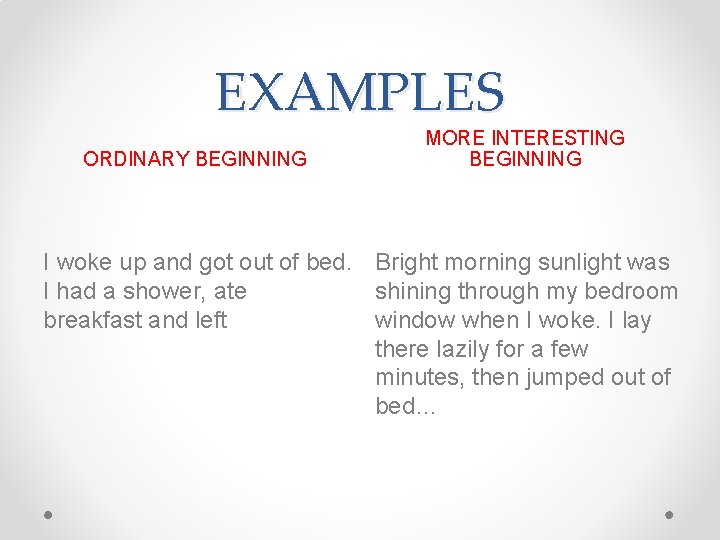
EXAMPLES ORDINARY BEGINNING MORE INTERESTING BEGINNING I woke up and got out of bed. Bright morning sunlight was I had a shower, ate shining through my bedroom breakfast and left window when I woke. I lay there lazily for a few minutes, then jumped out of bed…
TECHNIQUES TO END A STORY You can end you story by • Referring to your feelings or moods. • Describing people’s reactions to the events developed in the main body. • Creating mystery. • Asking a rhetorical question.
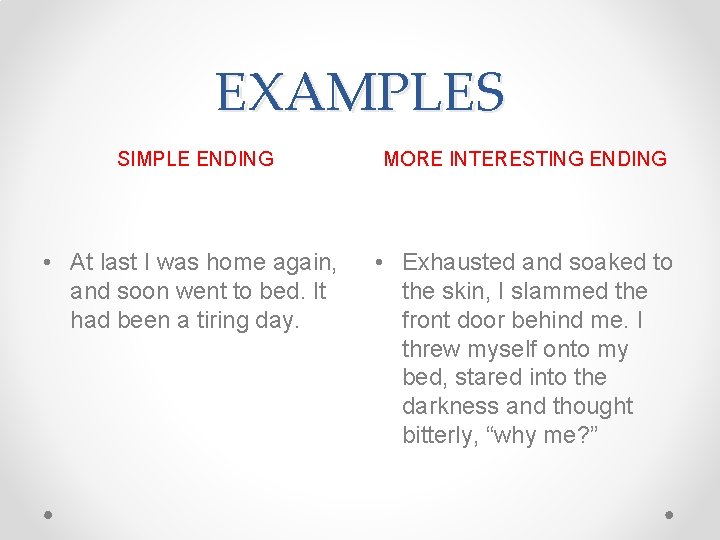
EXAMPLES SIMPLE ENDING MORE INTERESTING ENDING • At last I was home again, and soon went to bed. It had been a tiring day. • Exhausted and soaked to the skin, I slammed the front door behind me. I threw myself onto my bed, stared into the darkness and thought bitterly, “why me? ”
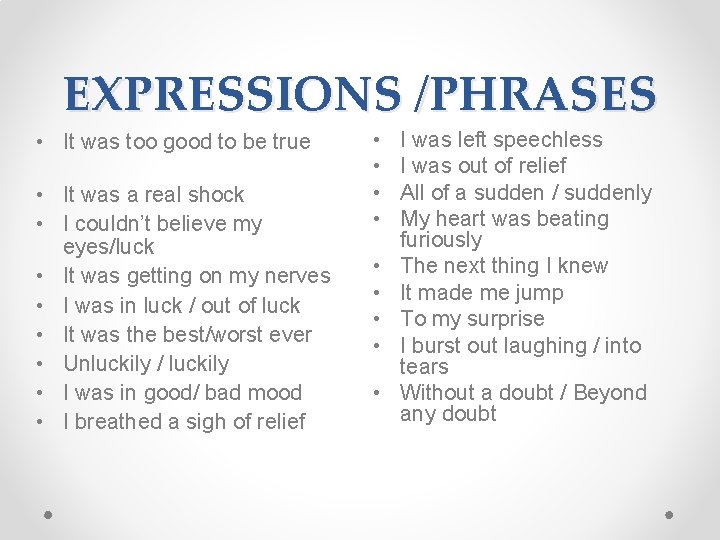
EXPRESSIONS /PHRASES • It was too good to be true • It was a real shock • I couldn’t believe my eyes/luck • It was getting on my nerves • I was in luck / out of luck • It was the best/worst ever • Unluckily / luckily • I was in good/ bad mood • I breathed a sigh of relief • • • I was left speechless I was out of relief All of a sudden / suddenly My heart was beating furiously The next thing I knew It made me jump To my surprise I burst out laughing / into tears Without a doubt / Beyond any doubt