
Narrative voice Explore narrative voice and point of
- Slides: 9
Narrative voice • Explore narrative voice and point of view • Identify the different types of narrative perspective Comment on Fitzgerald’s narrative style in TGG •
Do we ever really get the WHOLE story? https: //www. youtube. com/watch? v=v. DGrfh. JH 1 P 4&s afe=active Yes or no? And does it matter?
Lesson Objectives In today’s lesson you will: Explore narrative voice and point of view Identify the different types of narrative perspective Comment on Fitzgerald’s narrative style in TGG
What is narrative? The choice of the point(s) of view from which the story is told…fundamentally affects the way readers will respond, emotionally and morally, to the fictional character and their actions. David Lodge: The Art of Fiction
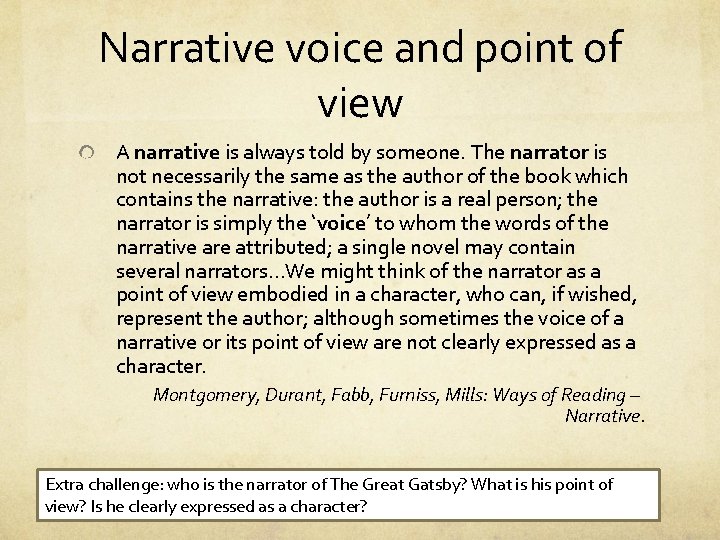
Narrative voice and point of view A narrative is always told by someone. The narrator is not necessarily the same as the author of the book which contains the narrative: the author is a real person; the narrator is simply the ‘voice’ to whom the words of the narrative are attributed; a single novel may contain several narrators…We might think of the narrator as a point of view embodied in a character, who can, if wished, represent the author; although sometimes the voice of a narrative or its point of view are not clearly expressed as a character. Montgomery, Durant, Fabb, Furniss, Mills: Ways of Reading – Narrative. Extra challenge: who is the narrator of The Great Gatsby? What is his point of view? Is he clearly expressed as a character?
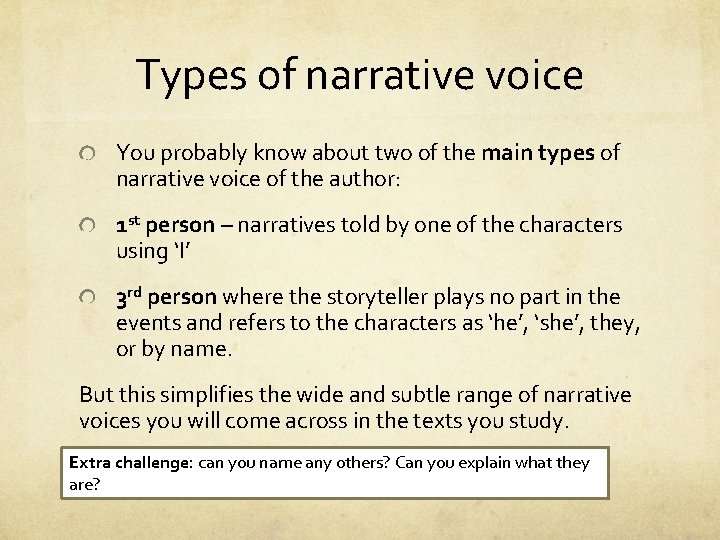
Types of narrative voice You probably know about two of the main types of narrative voice of the author: 1 st person – narratives told by one of the characters using ‘I’ 3 rd person where the storyteller plays no part in the events and refers to the characters as ‘he’, ‘she’, they, or by name. But this simplifies the wide and subtle range of narrative voices you will come across in the texts you study. Extra challenge: can you name any others? Can you explain what they are?
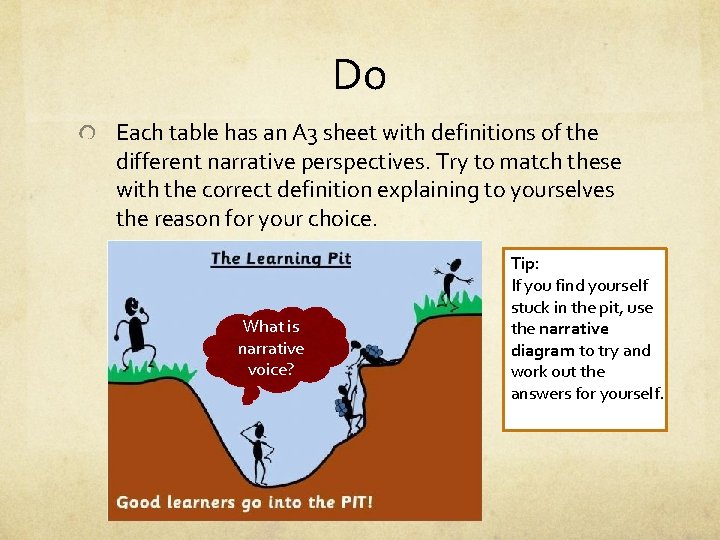
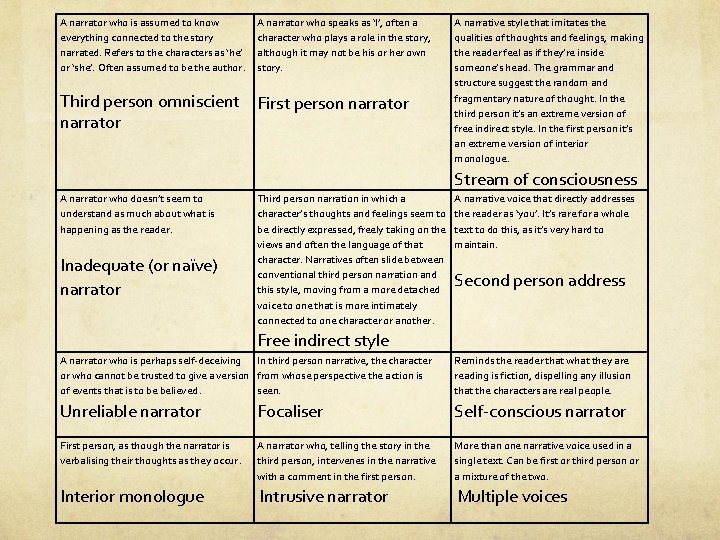
Do Each table has an A 3 sheet with definitions of the different narrative perspectives. Try to match these with the correct definition explaining to yourselves the reason for your choice. What is narrative voice? Tip: If you find yourself stuck in the pit, use the narrative diagram to try and work out the answers for yourself.
A narrator who is assumed to know everything connected to the story narrated. Refers to the characters as ‘he’ or ‘she’. Often assumed to be the author. A narrator who speaks as ‘I’, often a character who plays a role in the story, although it may not be his or her own story. Third person omniscient First person narrator A narrative style that imitates the qualities of thoughts and feelings, making the reader feel as if they’re inside someone’s head. The grammar and structure suggest the random and fragmentary nature of thought. In the third person it’s an extreme version of free indirect style. In the first person it’s an extreme version of interior monologue. Stream of consciousness A narrator who doesn’t seem to understand as much about what is happening as the reader. Inadequate (or naïve) narrator Third person narration in which a character’s thoughts and feelings seem to be directly expressed, freely taking on the views and often the language of that character. Narratives often slide between conventional third person narration and this style, moving from a more detached voice to one that is more intimately connected to one character or another. A narrative voice that directly addresses the reader as ‘you’. It’s rare for a whole text to do this, as it’s very hard to maintain. Second person address Free indirect style A narrator who is perhaps self-deceiving In third person narrative, the character or who cannot be trusted to give a version from whose perspective the action is of events that is to be believed. seen. Reminds the reader that what they are reading is fiction, dispelling any illusion that the characters are real people. Unreliable narrator Focaliser Self-conscious narrator First person, as though the narrator is verbalising their thoughts as they occur. A narrator who, telling the story in the third person, intervenes in the narrative with a comment in the first person. More than one narrative voice used in a single text. Can be first or third person or a mixture of the two. Interior monologue Intrusive narrator Multiple voices
Review As a class, share what you have learned about the different types of narrative voice and work together to clarify anything you don’t understand or find confusing.