
Narrative Tenses Or the tenses we use to
- Slides: 8
Narrative Tenses Or, the tenses we use to tell stories: past simple, past continuous, past perfect continuous
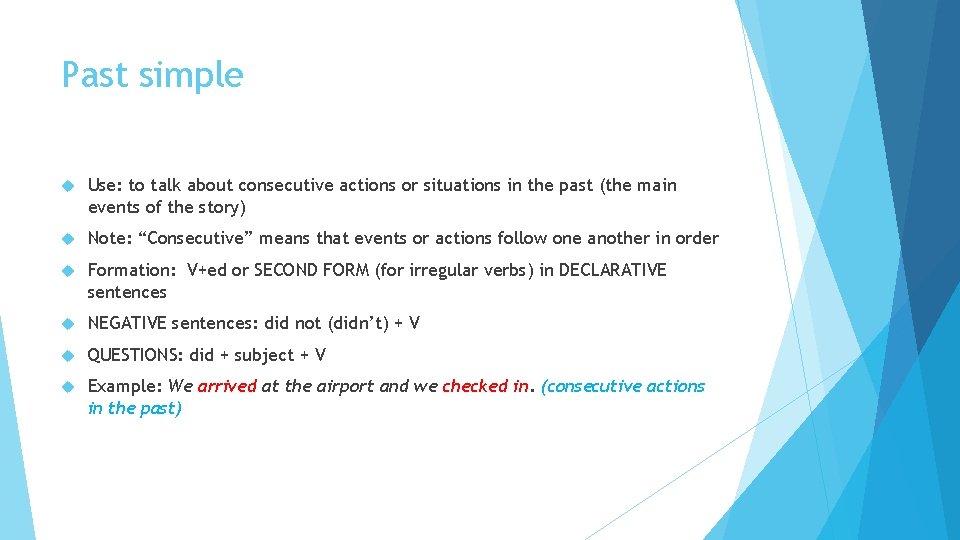
Past simple Use: to talk about consecutive actions or situations in the past (the main events of the story) Note: “Consecutive” means that events or actions follow one another in order Formation: V+ed or SECOND FORM (for irregular verbs) in DECLARATIVE sentences NEGATIVE sentences: did not (didn’t) + V QUESTIONS: did + subject + V Example: We arrived at the airport and we checked in. (consecutive actions in the past)
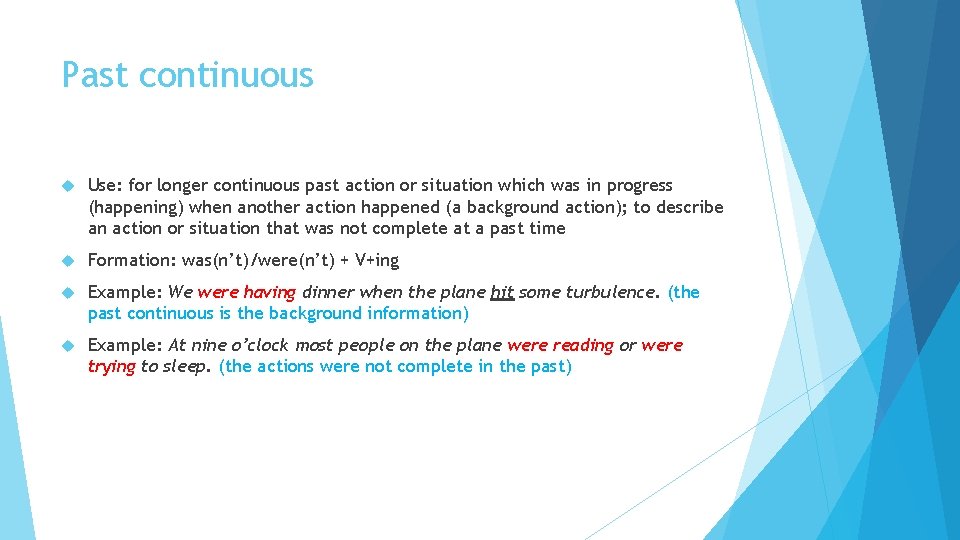
Past continuous Use: for longer continuous past action or situation which was in progress (happening) when another action happened (a background action); to describe an action or situation that was not complete at a past time Formation: was(n’t)/were(n’t) + V+ing Example: We were having dinner when the plane hit some turbulence. (the past continuous is the background information) Example: At nine o’clock most people on the plane were reading or were trying to sleep. (the actions were not complete in the past)
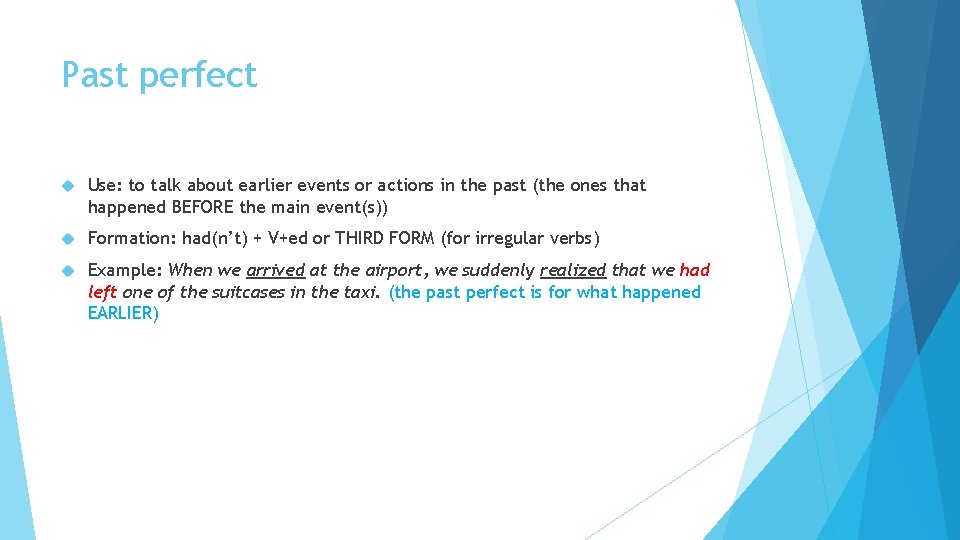
Past perfect Use: to talk about earlier events or actions in the past (the ones that happened BEFORE the main event(s)) Formation: had(n’t) + V+ed or THIRD FORM (for irregular verbs) Example: When we arrived at the airport, we suddenly realized that we had left one of the suitcases in the taxi. (the past perfect is for what happened EARLIER)
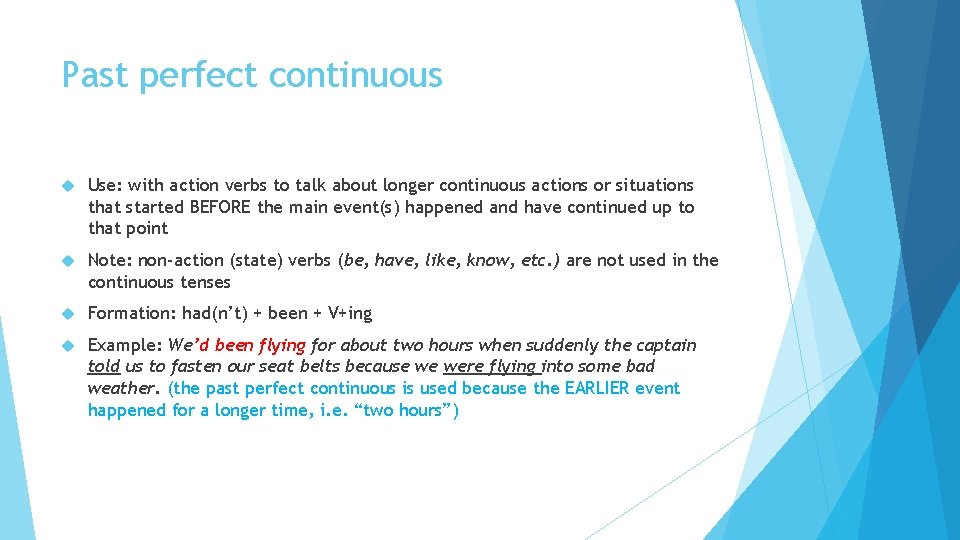
Past perfect continuous Use: with action verbs to talk about longer continuous actions or situations that started BEFORE the main event(s) happened and have continued up to that point Note: non-action (state) verbs (be, have, like, know, etc. ) are not used in the continuous tenses Formation: had(n’t) + been + V+ing Example: We’d been flying for about two hours when suddenly the captain told us to fasten our seat belts because we were flying into some bad weather. (the past perfect continuous is used because the EARLIER event happened for a longer time, i. e. “two hours”)
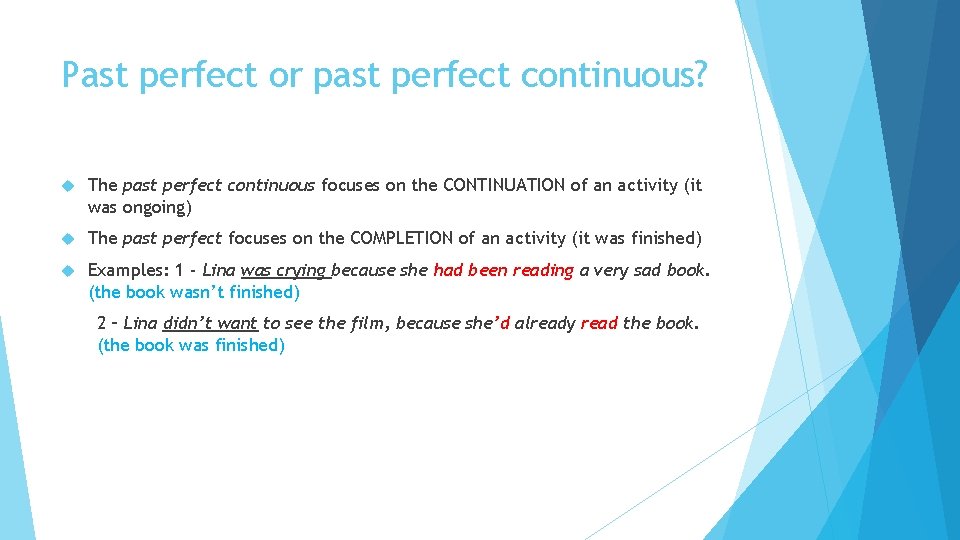
Past perfect or past perfect continuous? The past perfect continuous focuses on the CONTINUATION of an activity (it was ongoing) The past perfect focuses on the COMPLETION of an activity (it was finished) Examples: 1 - Lina was crying because she had been reading a very sad book. (the book wasn’t finished) 2 – Lina didn’t want to see the film, because she’d already read the book. (the book was finished)
Practice Student’s book, pg. 136 (a. , b. ) Workbook, pg. 18 -19 (4 GRAMMAR a. , b. ) Please complete these exercises by our next lesson, take a photo of them and send them to me in a private message via EDMODO!
Thank you for your patience and attention!