
NARRATIVE Personal and story writing YOU NEED ActivePassive
- Slides: 33
NARRATIVE Personal and story writing
YOU NEED: Active/Passive voice homework Computer: The Medicine Bag test online Handout on narratives Student Sample Narrative
STANDARD 8. W. TTP. 3 Write narratives (fiction and nonfiction) to develop real or imagined experiences or events using effective techniques, relevant descriptive details, and well-structured event sequences. Activity: Narrative description, student sample narrative
NARRATIVE https: //www. youtube. com/watch? v=mj-eh 5 VFsg 0
NARRATIVE WRITING A Narrative is a STORY. Narrative ~ A fictional story you can make up all of the events. Personal Narrative~ A TRUE story about an event that happened in your life.
NARRATIVE WRITING Tell a story, either a personal experience or a fictional story. Write the events in order. Paragraphs can be any size. INDENT! Still proper grammar, spelling and capitalization. This Photo by Unknown Author is licensed under CC BY-NC-ND
NARRATIVE VOCABULARY Flashback: Go back in time to explain an event or feeling Foreshadowing: Hints to future events Adjectives: Describe nouns Sensory language: See, hear, feel, taste, smell
NARRATIVE VOCABULARY Cause and effect: Do something, something happens Chronological order: Events go in order of TIME
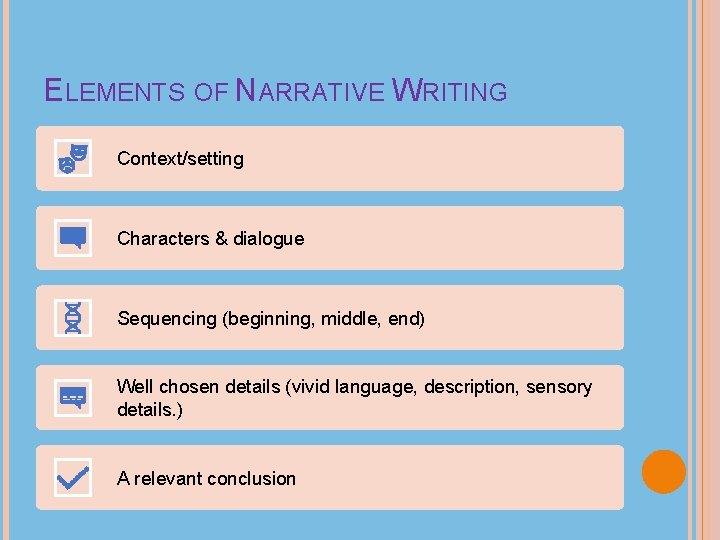
ELEMENTS OF NARRATIVE WRITING Context/setting Characters & dialogue Sequencing (beginning, middle, end) Well chosen details (vivid language, description, sensory details. ) A relevant conclusion
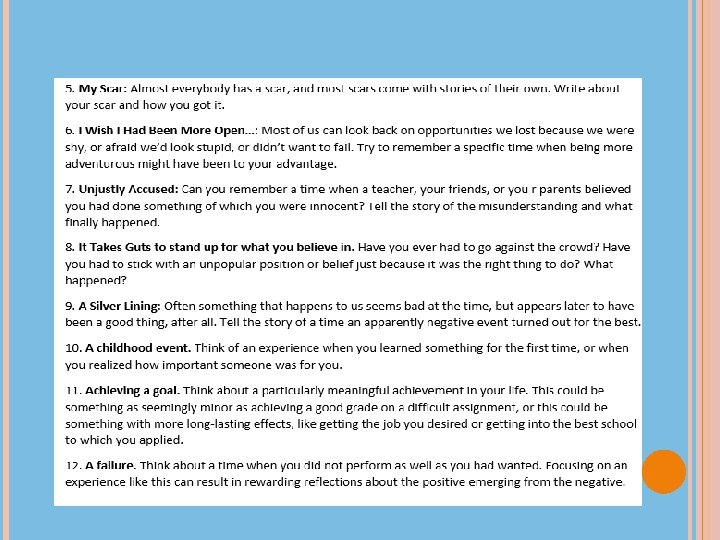
YOUR PROMPT Write a narrative nonfiction of a rite of passage: an experience that causes you to learn something from the world around you. Example: A silver lining: Often something that happens to us seems bad at the time, but appears later to have been a good thing, after all. Tell the story of a time an apparently negative event turned out for the best.
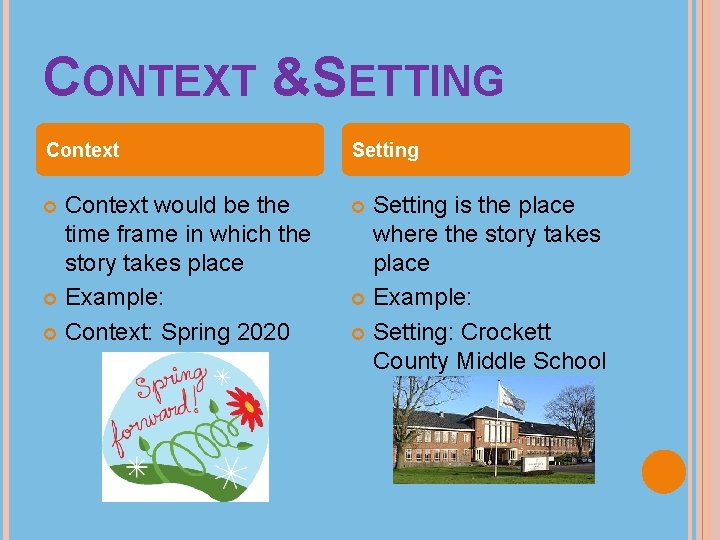
CONTEXT &SETTING Context Setting Context would be the time frame in which the story takes place Example: Context: Spring 2020 Setting is the place where the story takes place Example: Setting: Crockett County Middle School
CHARACTERS & DIALOGUE Words spoken by a person in the story. Use quotation marks. Use commas inside the quotation marks, then who said the words. Example: teachers and students communicating
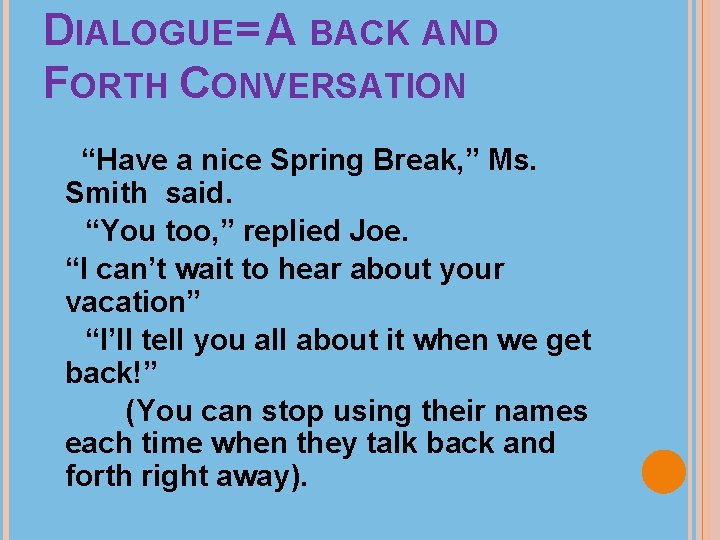
DIALOGUE= A BACK AND FORTH CONVERSATION “Have a nice Spring Break, ” Ms. Smith said. “You too, ” replied Joe. “I can’t wait to hear about your vacation” “I’ll tell you all about it when we get back!” (You can stop using their names each time when they talk back and forth right away).
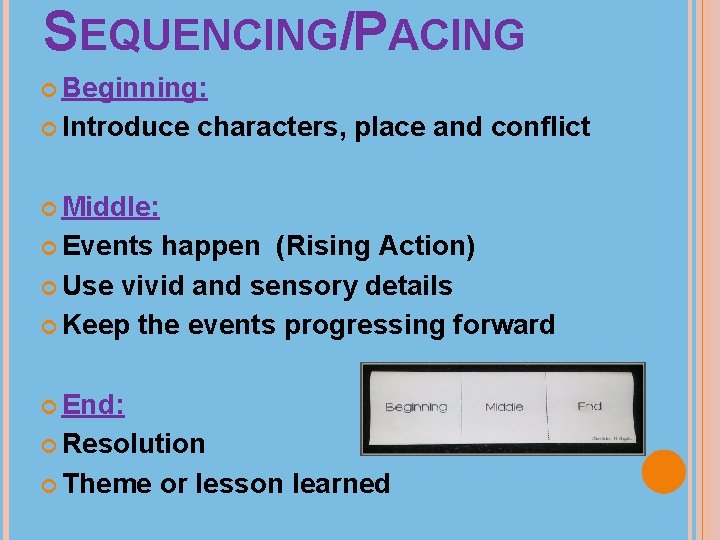
SEQUENCING/PACING Beginning: Introduce characters, place and conflict Middle: Events happen (Rising Action) Use vivid and sensory details Keep the events progressing forward End: Resolution Theme or lesson learned
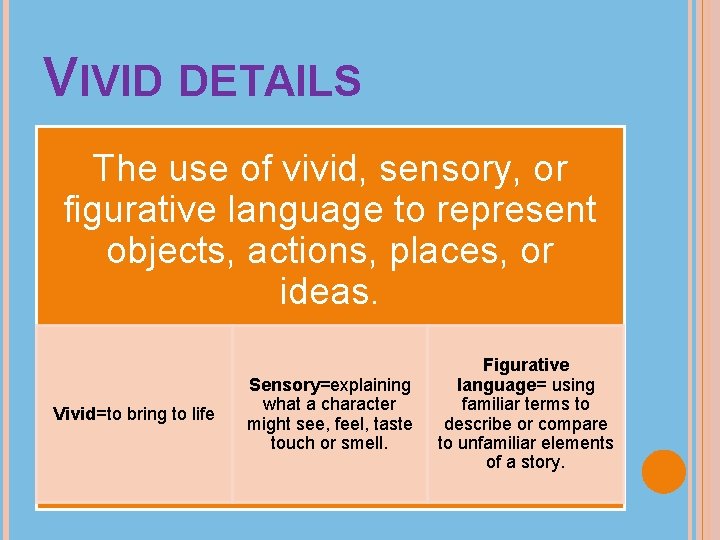
VIVID DETAILS The use of vivid, sensory, or figurative language to represent objects, actions, places, or ideas. Vivid=to bring to life Sensory=explaining what a character might see, feel, taste touch or smell. Figurative language= using familiar terms to describe or compare to unfamiliar elements of a story.
CONCLUSION Resolution-how the problem is solved. Explain how the character reacted to the problem. Closure. Theme-What has the experience taught you? Explain you lesson learned.
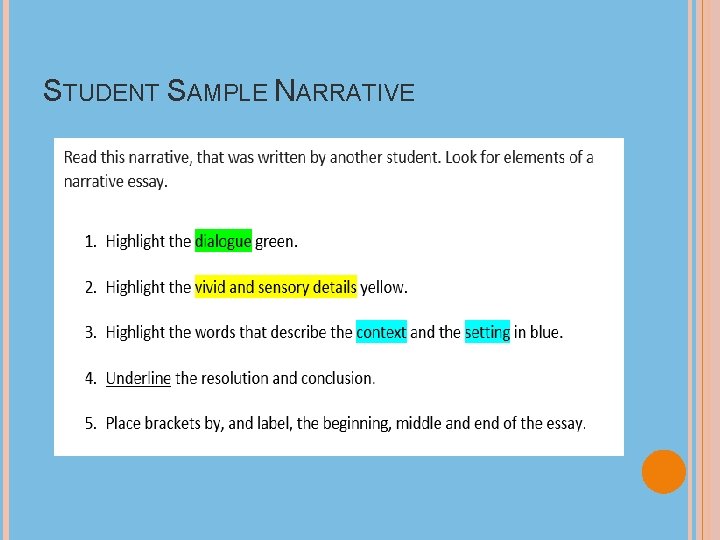
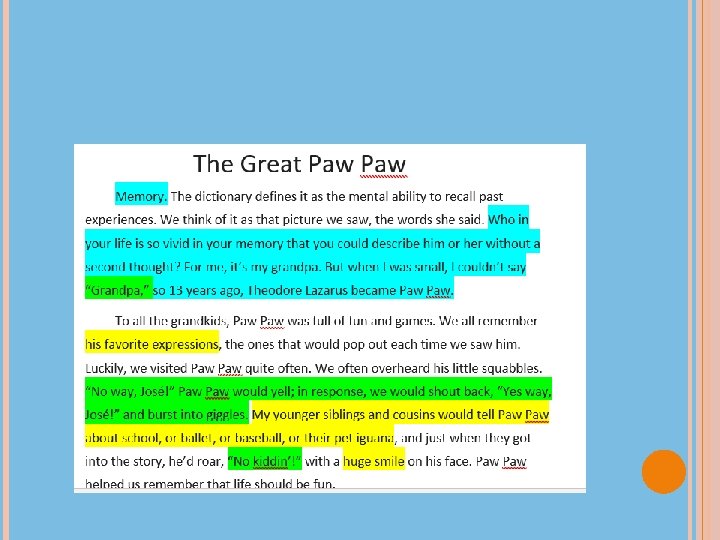
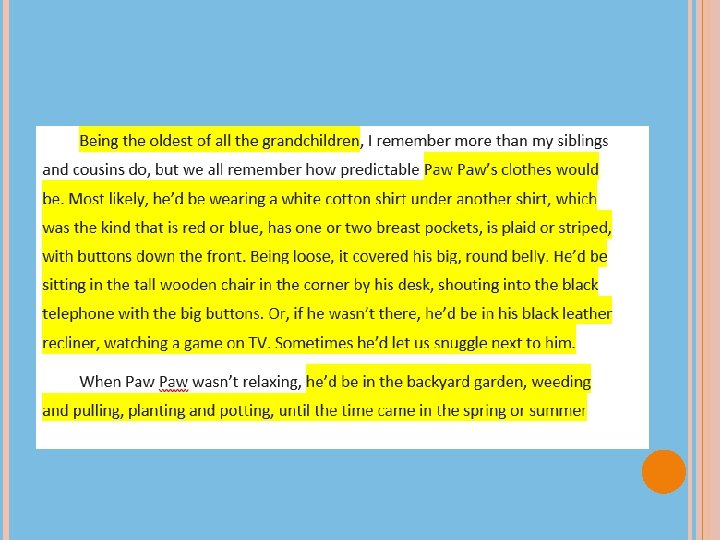
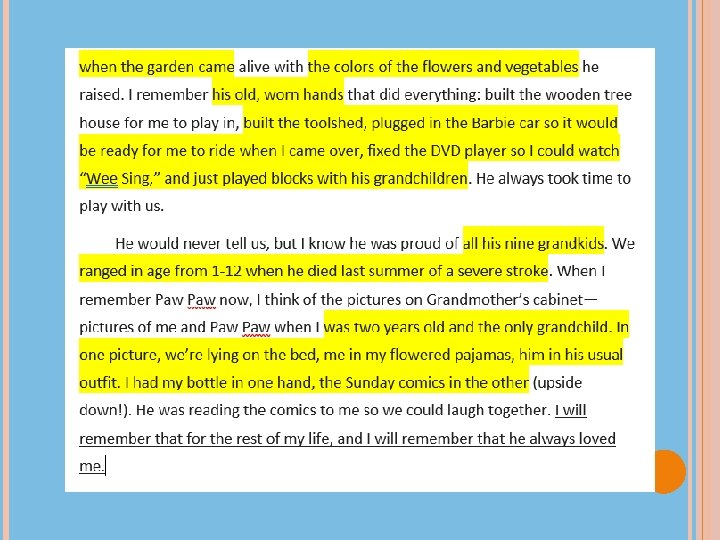
STUDENT SAMPLE NARRATIVE
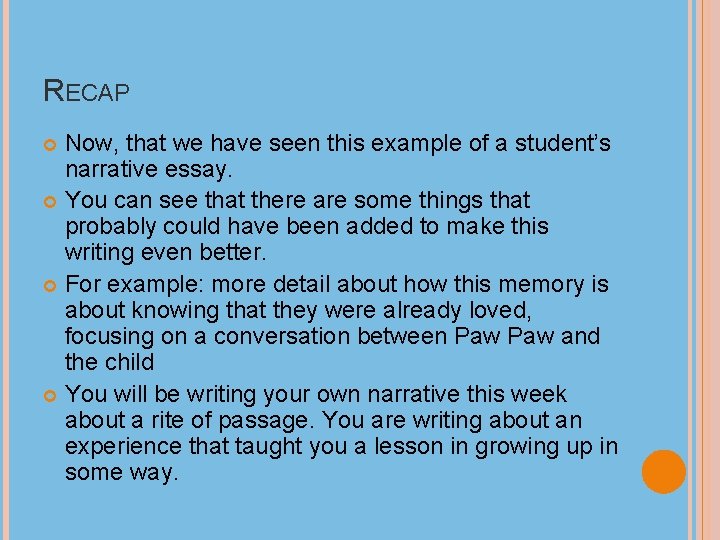
RECAP Now, that we have seen this example of a student’s narrative essay. You can see that there are some things that probably could have been added to make this writing even better. For example: more detail about how this memory is about knowing that they were already loved, focusing on a conversation between Paw and the child You will be writing your own narrative this week about a rite of passage. You are writing about an experience that taught you a lesson in growing up in some way.
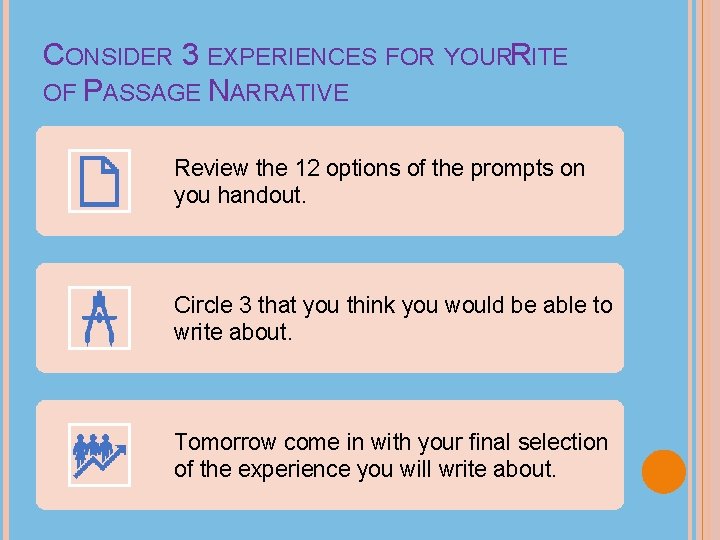
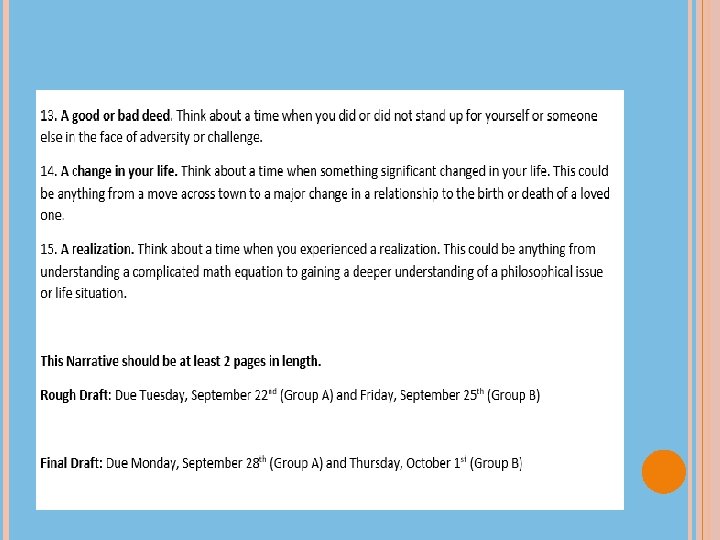
CONSIDER 3 EXPERIENCES FOR YOURRITE OF PASSAGE NARRATIVE Review the 12 options of the prompts on you handout. Circle 3 that you think you would be able to write about. Tomorrow come in with your final selection of the experience you will write about.
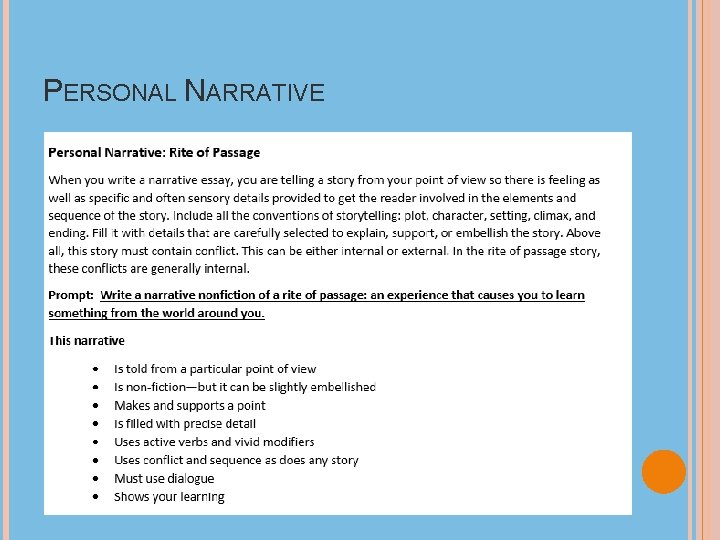
PERSONAL NARRATIVE
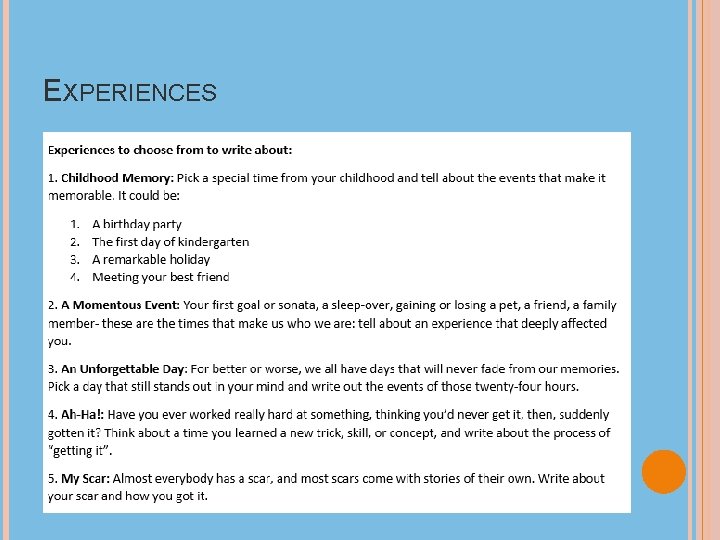
EXPERIENCES
PERSONAL NARRATIVE https: //www. youtube. com/watch? v=i. WHc 5 Yar 6 Ps Homework: Please select 3 experiences and decide which one you are going to write about. Have your final experience ready to go tomorrow. Tomorrow will be our writing day.
DAY 2 Writing workshop day You will complete your outline and first draft of narrative about your experience as a rite of passage. You need: notebook paper Pencil Outline paper Handout on narrative from yesterday
STANDARD 8. W. TTP. 3 Write narratives (fiction and nonfiction) to develop real or imagined experiences or events using effective techniques, relevant descriptive details, and well-structured event sequences. Activity: Outline, Draft, Final Draft
OUTLINE Write the experience you have chosen to write about at the top of the outline where it says “Which experience are you writing about? ” Think about your lesson that you learned from this experience and at the bottom where it says “THEME” put that there. Make sure as you are writing your story that things make sense to show your theme. **Remember your prompt asked you to write about an experience that shows a rite of passage. Does your experience show that you have grown and/or changed in some way?
NOW…BRAINSTORM Beginning-how will you introduce your story, setting, conflict(what is the problem) You can also tell what you have learned here and then explain in your story. Middle-what happened in your story have at least 3 things that happened that led up to the big event that caused you to change or grow or learn End-Wrap your story up. How does the story come to an end? What did you learn, grow, or change?
MY OUTLINE IS DONE…. NOW WHAT? It is time to take your thoughts and put them into complete sentences to make good pararaphs. You should have an introduction (Beginning), body (middle-at least 3 paragraphs), and a conclusion (ending). At least 5 paragraphs. You should be descriptive. We should be able to picture your story in our minds. Remember to indent. Sentences should make sense, have correct grammar and punctuation.
TELL YOUR STORY. WHAT HAS BEEN A RITE OF PASSAGE FOR YOU? SHARE YOUR EXPERIENCE AND WHAT YOU LEARNED.