
Narrative and Simulation in Interactive Dialogue Emily Short

![Character Persuasiveness [On occasion, t]he stars aligned such that the prose and the choices](https://slidetodoc.com/presentation_image_h2/55ec85abce5ad26089251c73964e677d/image-41.jpg "Character Persuasiveness [On occasion, t]he stars aligned such that the prose and the choices")
- Slides: 51
Narrative and Simulation in Interactive Dialogue Emily Short @emshort http: //emshort. wordpress. com
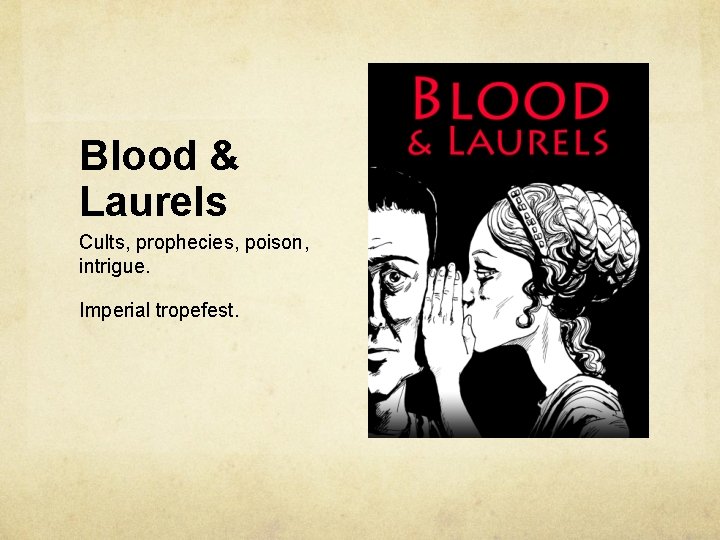
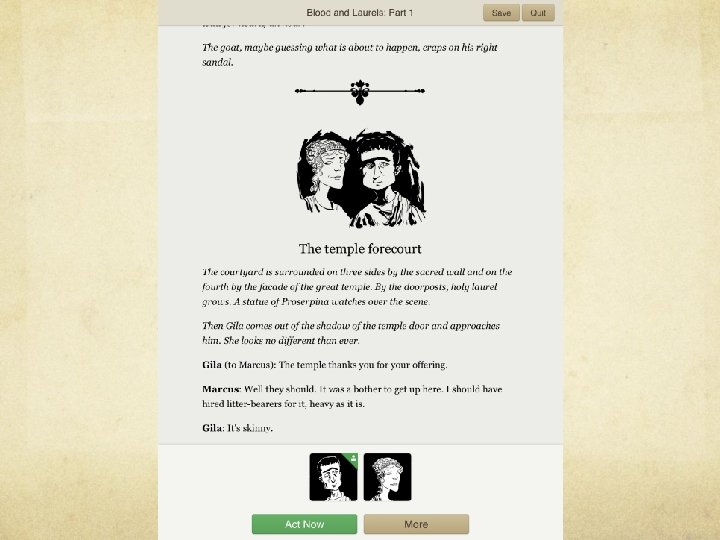
Blood & Laurels Cults, prophecies, poison, intrigue. Imperial tropefest.
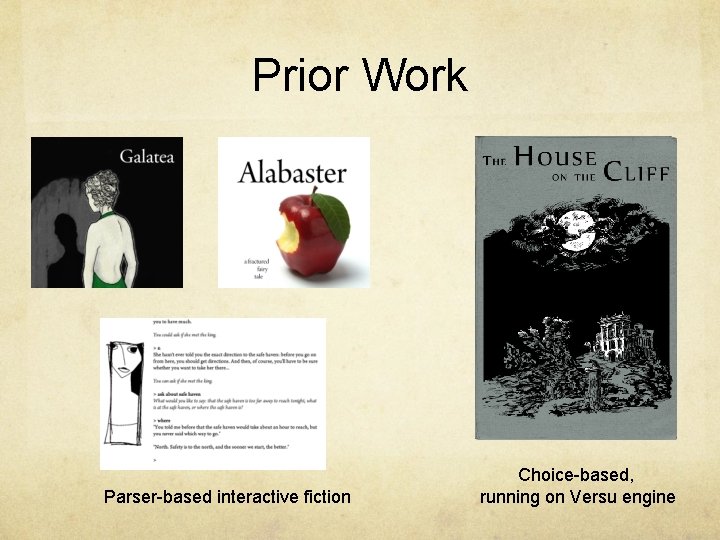
Prior Work Parser-based interactive fiction Choice-based, running on Versu engine
Conversation Design Goals Explorability: Player is free to explore dialogue space
Conversation Design Goals Explorability: Player is free to explore dialogue space Expressiveness: Player and NPC can signal emotional states as well as information
Conversation Design Goals Explorability: Player is free to explore dialogue space Expressiveness: Player and NPC can signal emotional states as well as information Pacing: story moves forward on its own when the player is out of things to say
Conversation Design Goals Explorability: Player is free to explore dialogue space Expressiveness: Player and NPC can signal emotional states as well as information Pacing: story moves forward on its own when the player is out of things to say Characters appear as entities with convincing emotional states Player agency involves manipulating characters Player responds to characters in non-utilitarian way
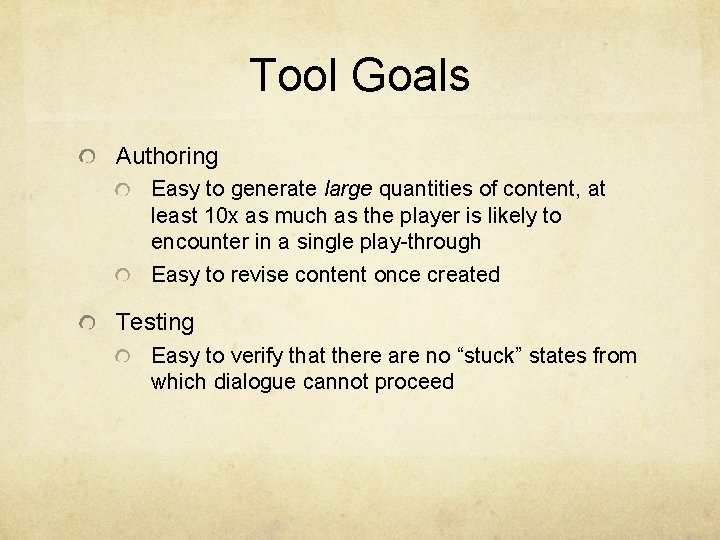
Tool Goals Authoring Easy to generate large quantities of content, at least 10 x as much as the player is likely to encounter in a single play-through Easy to revise content once created
Tool Goals Authoring Easy to generate large quantities of content, at least 10 x as much as the player is likely to encounter in a single play-through Easy to revise content once created Testing Easy to verify that there are no “stuck” states from which dialogue cannot proceed
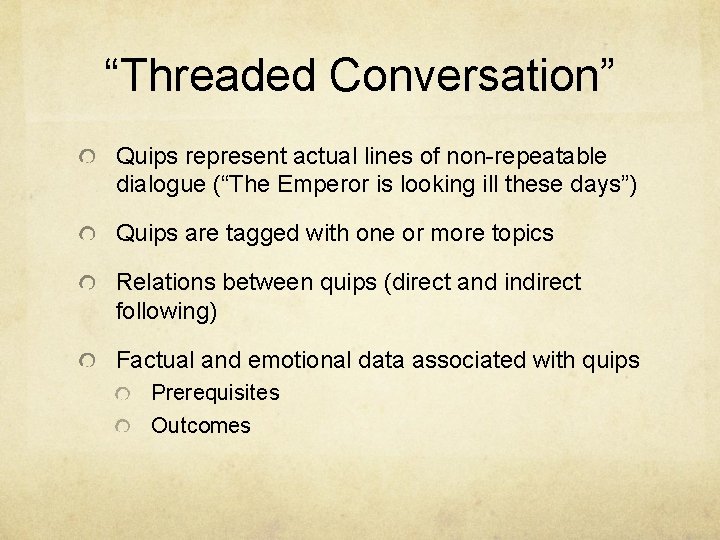
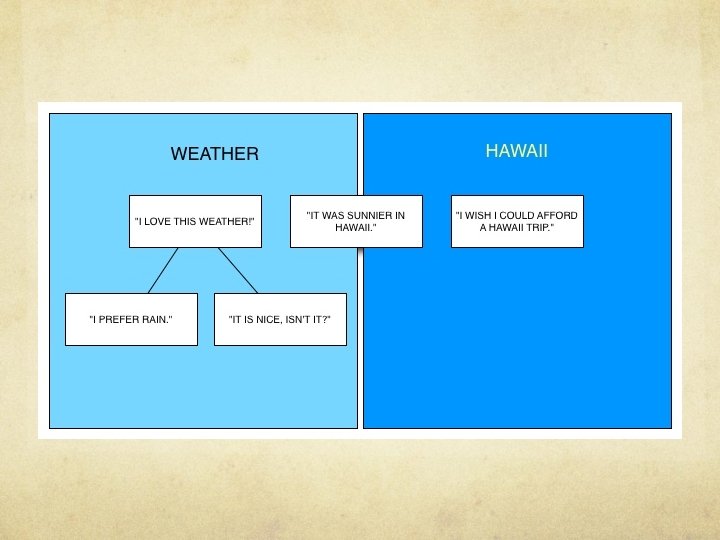
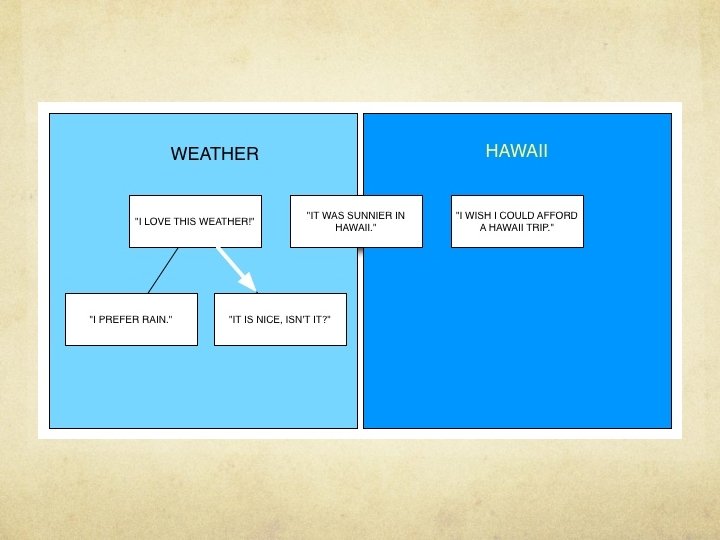
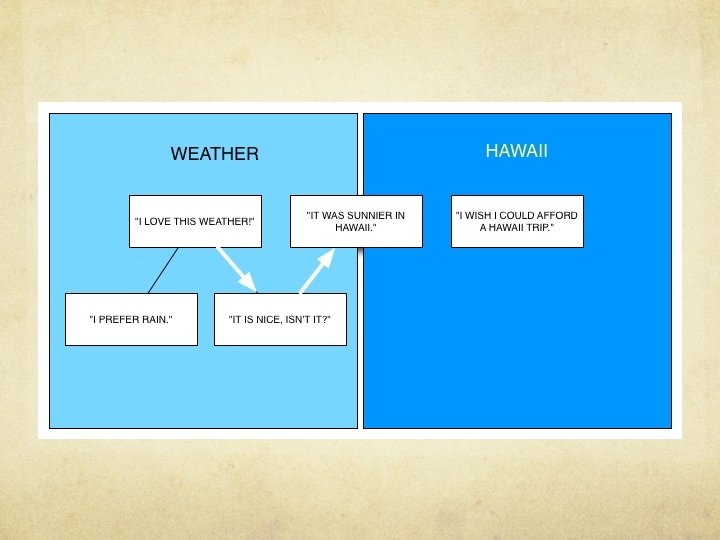
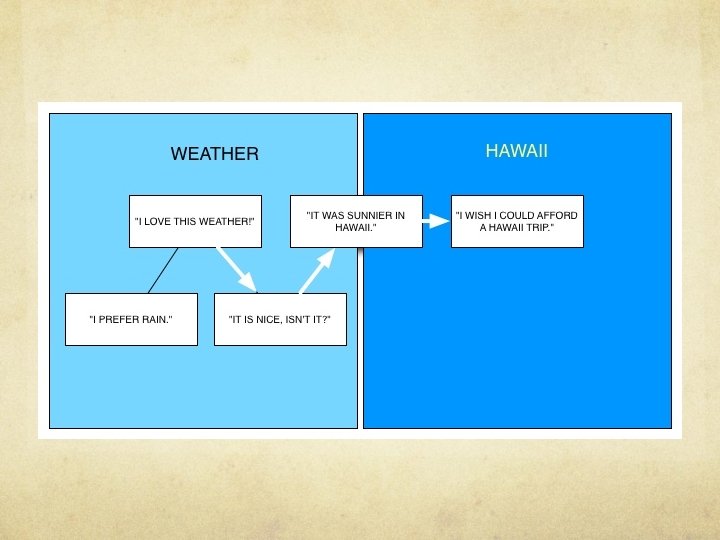
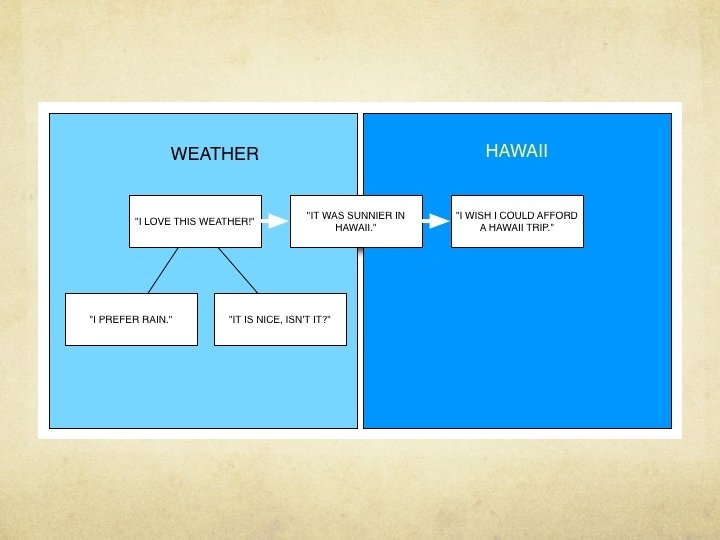
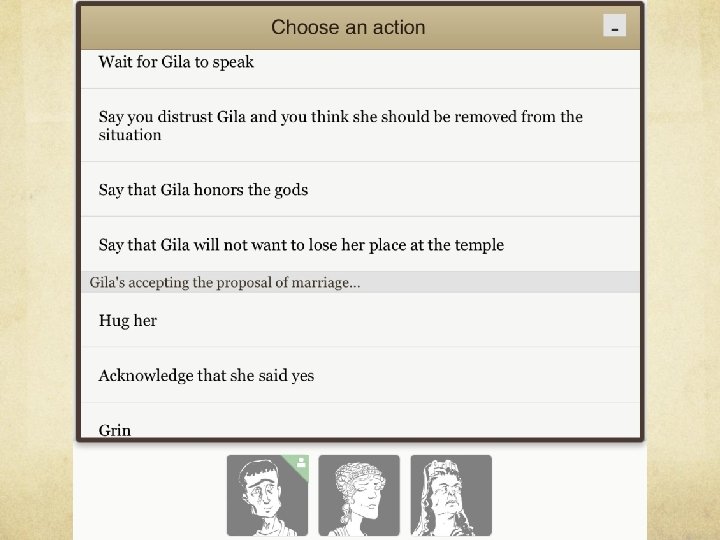
“Threaded Conversation” Quips represent actual lines of non-repeatable dialogue (“The Emperor is looking ill these days”) Quips are tagged with one or more topics Relations between quips (direct and indirect following) Factual and emotional data associated with quips Prerequisites Outcomes
Blood & Laurels Versu AI engine + Threaded Conversation dialogue model More about Versu at versu. com
Project-Specific Goals Large story with many relationship configurations Multiple ways of enacting the protagonist role Richly branching narrative, high variability within scenes
Project-Specific Goals Large story with many relationship configurations Multiple ways of enacting the protagonist role Richly branching narrative, high variability within scenes 90 -120 minutes of play time per complete reading
Project-Specific Goals Large story with many relationship configurations Multiple ways of enacting the protagonist role Richly branching narrative, high variability within scenes 90 -120 minutes of play time per complete reading Accessible, book-like style High-stakes thriller plot Numerous achievements for the player to unlock
Project-Specific Goals Large story with many relationship configurations Multiple ways of enacting the protagonist role Richly branching narrative, high variability within scenes 90 -120 minutes of play time per complete reading Accessible, book-like style High-stakes thriller plot Numerous achievements for the player to unlock Finished, illustrated, and ready for QA in 2 months
Areas of Assessment Authorability (speed, scope) Pacing/Narrative Coherence Agency based on “Social Physics” Character Persuasiveness / Empathy
Library Development: TC Threaded Conversation -style dialogue marked up for Versu to indicate emotional content and social actions Conversation Interrogate Artus about cult (tagged be_assertive) Tell Artus about the Emperor Other Social Practices Flatter Artus Pose assertively
Library Development: TC Topic-specific exposition (“memories”) “Filler” dialogue relating to various topics that appear in a number of scenes “Pause” text for when the conversation thread had been dropped and we want to allow a transition
Library Development: Scenes Exploration scenes — end when the player has either explored dialogue or stopped doing dialogue exploration Forking scenes — end in several ways when specific things are achieved Key decision scenes — very short decision points with focused interaction
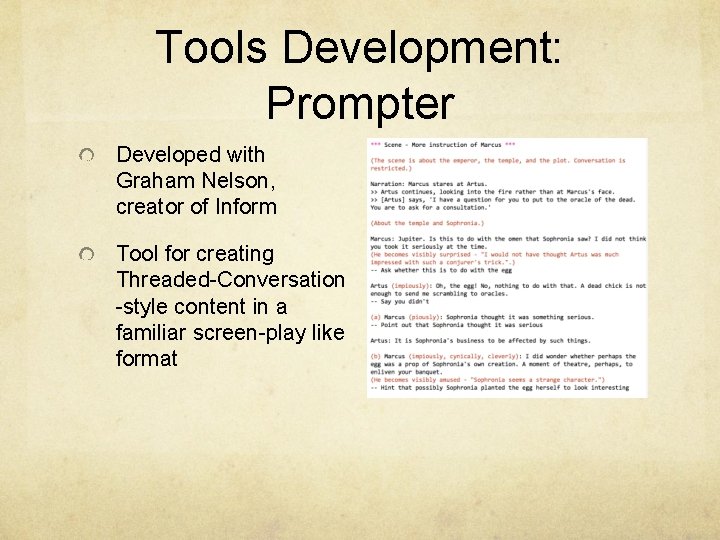
Tools Development: Prompter Developed with Graham Nelson, creator of Inform Tool for creating Threaded-Conversation -style content in a familiar screen-play like format
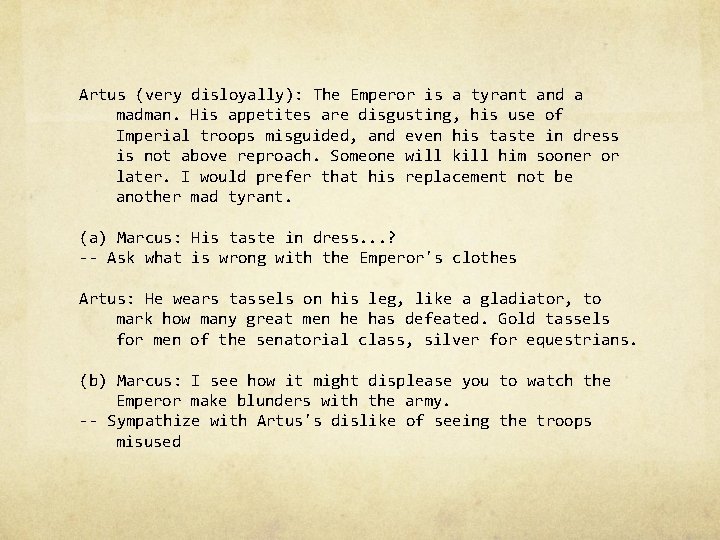
Artus (very disloyally): The Emperor is a tyrant and a madman. His appetites are disgusting, his use of Imperial troops misguided, and even his taste in dress is not above reproach. Someone will kill him sooner or later. I would prefer that his replacement not be another mad tyrant. (a) Marcus: His taste in dress. . . ? -- Ask what is wrong with the Emperor's clothes Artus: He wears tassels on his leg, like a gladiator, to mark how many great men he has defeated. Gold tassels for men of the senatorial class, silver for equestrians. (b) Marcus: I see how it might displease you to watch the Emperor make blunders with the army. -- Sympathize with Artus's dislike of seeing the troops misused
Finished Product Stats 2503 quips in ep 1, 2460 quips in ep 2: roughly 10 x the content of Galatea or Alabaster 172 scenes in ep 1, 238 scenes in ep 2 240 K words of Prompter script Automated testing to discover scenes which did not conclude for some reason
Ease of Authoring Content Successes Rapid creation process Strong sense of flow Considerable variation within a scene Problems Rotating agent responsibility in Versu made some dialogue bits inaccessible without hacking
Pacing and Plot Coherence There’s a great deal of room here to affect the pacing of a scene… [it offers] a wealth of tonal interactivity and allowance for subtle performance – Pocket. Tactics
Pacing and Plot Coherence There’s a great deal of room here to affect the pacing of a scene… [it offers] a wealth of tonal interactivity and allowance for subtle performance – Pocket. Tactics Blood & Laurels made me feel more like an improviser than a reader… – New York Times
Pacing and Plot Coherence There’s a great deal of room here to affect the pacing of a scene… [it offers] a wealth of tonal interactivity and allowance for subtle performance – Pocket. Tactics Blood & Laurels made me feel more like an improviser than a reader… – New York Times The interface gives a sense of kinesis to the story –something is always happening. . . the story is about being swept up in events much larger than yourself and attempting to gain control of them. -Storycade
Pacing and Plot Coherence Successes Pacing generally successful Problems Juxtapositions of dialogue and setting investigation occasionally surprising Occasionally a player did not understand why a piece of dialogue became unavailable again; prototyped Versu Galatea UI addressed this
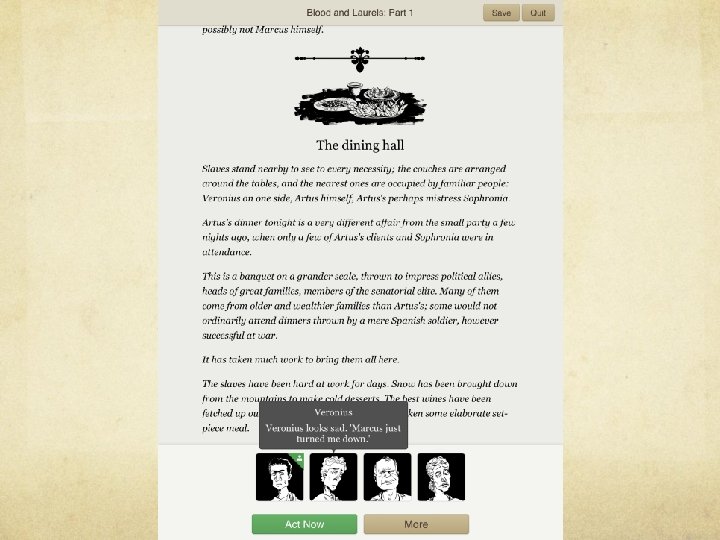
Characters and Agency When it works, it works. There are dinner parties where people will think you impetuous and rude if you talk too much, situations where you can act dumb in order to influence others to drop their guard, times where you have a choice between the same action with different motivations. – Storycade
Characters and Agency When it works, it works. There are dinner parties where people will think you impetuous and rude if you talk too much, situations where you can act dumb in order to influence others to drop their guard, times where you have a choice between the same action with different motivations. – Storycade But: [Veronius’] relationship with Marcus doesn’t do much to affect the plot of Blood and Laurels. -Pocket. Tactics
Characters and Agency Successes Ability to see character thoughts and expressions helped “Pushing your luck” as a play experience was often satisfying Problems Players did not always understand how character manipulation drove scenes
Character Persuasiveness Versu isn’t at the point where it’s able to make this emergent behavior interesting to read. The most obvious is in the realm of romance. . . all of them feel fairly perfunctory in execution… The vast, vast majority of Blood and Laurels‘s passages–the ones directly under the author’s control–are wonderful. The emergent bits feel like static. – Storycade
Character Persuasiveness [On occasion, t]he stars aligned such that the prose and the choices meshed in such a way that I felt I experienced a “text holodeck”. However, I’m fairly certain the parts I felt inspired by were heavily scripted. When Versu as an engine clearly took over… it hit solid as a rock. -- Jason Dyer
Character Persuasiveness Problems Players rebelled against the reuse of “repeatable” bits of conversation Some social practices (flirtation, anger) felt too generic
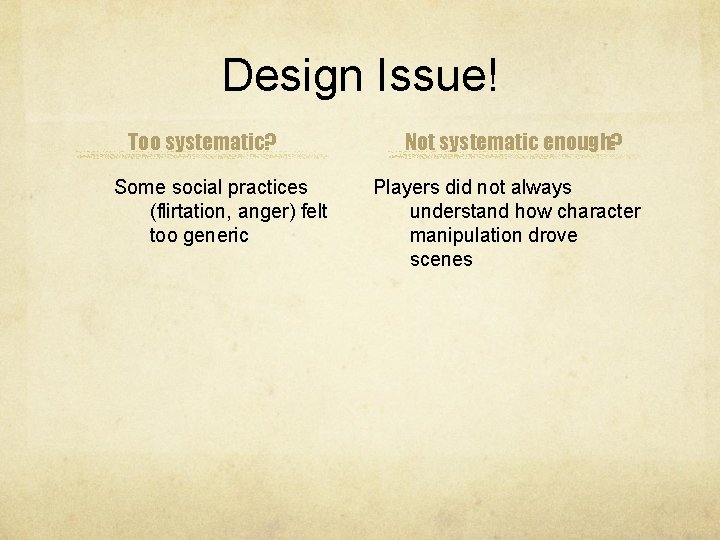
Design Issue! Too systematic? Some social practices (flirtation, anger) felt too generic Not systematic enough? Players did not always understand how character manipulation drove scenes
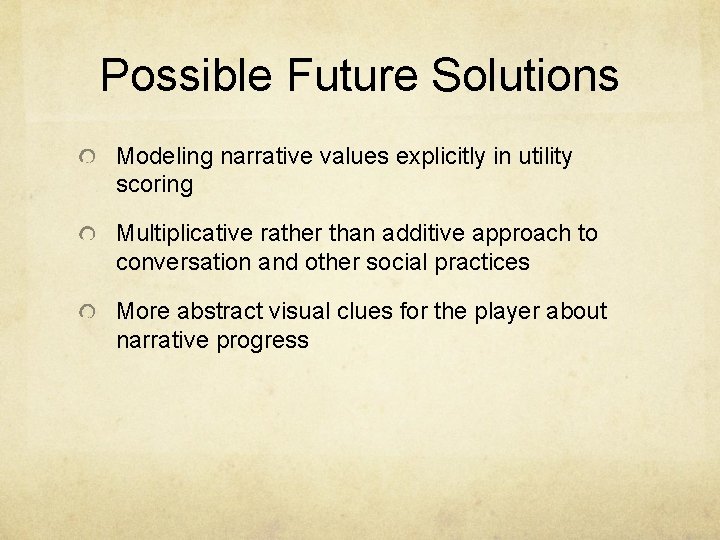
Possible Future Solutions Modeling narrative values explicitly in utility scoring Multiplicative rather than additive approach to conversation and other social practices More abstract visual clues for the player about narrative progress
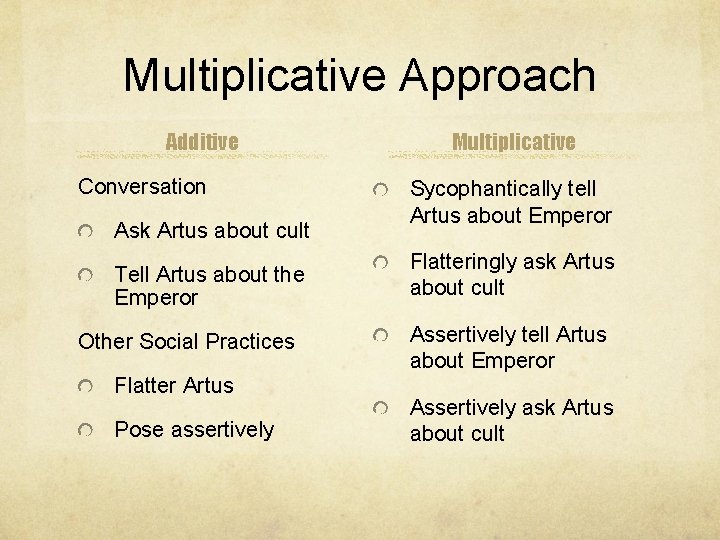
Multiplicative Approach Additive Conversation Ask Artus about cult Tell Artus about the Emperor Other Social Practices Flatter Artus Pose assertively Multiplicative Sycophantically tell Artus about Emperor Flatteringly ask Artus about cult Assertively tell Artus about Emperor Assertively ask Artus about cult
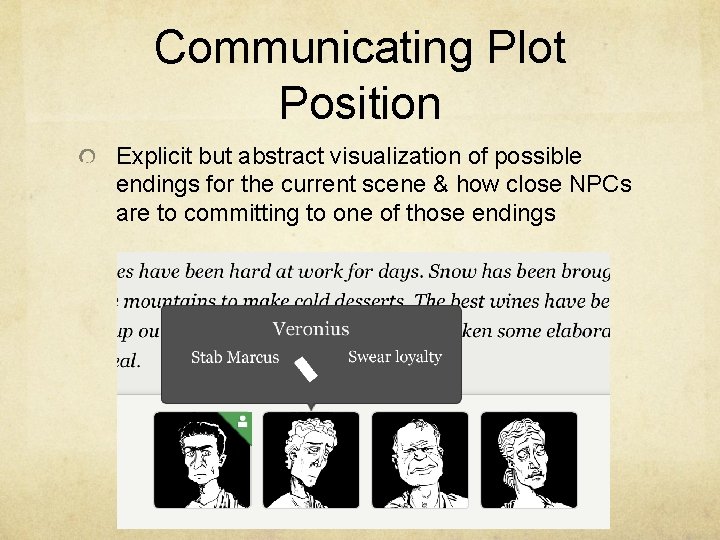
Communicating Plot Position Explicit but abstract visualization of possible endings for the current scene & how close NPCs are to committing to one of those endings
Communicating Plot Position Explicit but abstract visualization of possible endings for the current scene & how close NPCs are to committing to one of those endings
Concluding Questions If we’re modeling multiple kinds of system (narrative, agent relationships and emotions, conversation flow, protagonist intentions), which of these is most directly accessible to the player?
Concluding Questions If we’re modeling multiple kinds of system (narrative, agent relationships and emotions, conversation flow, protagonist intentions), which of these is most directly accessible to the player? Does the player understand how these systems fit together? Does the UI support that understanding?
Concluding Questions If we’re modeling multiple kinds of system (narrative, agent relationships and emotions, conversation flow, protagonist intentions), which of these is most directly accessible to the player? Does the player understand how these systems fit together? Does the UI support that understanding? Which offers the highest fidelity? Are other, lower -fidelity systems providing output in the same channel?
Resources Versu. com – papers on Versu and Prompter “Threaded Conversation” library for Inform 7 Emshort. wordpress. com – my writing on interactive storytelling, including “conversation” subcategory for articles and post mortems on conversation projects emshortif@gmail. com or @emshort to contact me