
Narrative and Classical Hollywood Style 1903 1915 ADV

- Slides: 33
Narrative and Classical Hollywood Style 1903 -1915 ADV 3 M
Cinema Expands • As the medium of film evolved during the late 1890 s and into the turn of the century, the art and business of filmmaking also expanded: – New companies were created that devoted themselves to making movies. – Exhibition venues became more plentiful and more common, especially as projection methods improved. – Filmmakers began to build on the realist traditions established by the Lumiere Brothers and the fantastical ones forged by Georges Melies, establishing new cinema styles, conventions and language.
Edwin S. Porter • A film projectionist and camera operator for Edison, Porter was one of the most notable film innovators in the early 1900 s. • He created the first story film, Life of an American Fireman (1903) • Although he drew on techniques that had been established by his predecessors, especially Melies, Porter was among the first filmmakers to use film editing as a means to tell a story. • For this reason, he is considered to be an inventor of film editing and is credited as the first person to begin development of the cinematic style and language we still use today.
Life of an American Fireman • Most famous for its storytelling techniques, Porter was also the first to use camera distance (a close up shot place amid long shots) to show action and meaning. • The film begins with a dozing fireman dreaming of a woman and child threatened by fire; the dream is rendered as a sort of thought balloon, a circular vignette superimposed in the upper part of the screen. A cut to a close-up shows a hand pulling a fire alarm. Several shots, mixing studio and location filming, show the firemen racing to the scene. The film ends with two lengthy shots that show the same action from two vantage points: in the first, a fireman comes in a bedroom window to rescue a mother and then returns for her baby; in the second, we see both rescues again from a camera position outside the house. To a modern audience, this repetition of events seems strange, however such displays of the same event from a different viewpoint were common in early cinema.
The Great Train Robbery • Porter’s most important film, The Great Train Robbery, was also made in 1903. • This film used eleven separate shots to tell the story of a gang of bandits who hold up a train. • Porter experimented even further with camera distance and editing in this film to communicate its story and convey meaning.
The Great Train Robbery - Innovations • Porter employed: – parallel action – he showed action in one locale and then immediately cut to a second venue, implying that the actions in both places were happening simultaneously* – Gripping (fictional) storytelling and violence – Panning shot – slight camera movement following action – Location and studio shots – Camera distance - long and medium shots to tell his story and convey meaning *Precursor to modern film editing technique of intercutting.
Thomas Ince • Another notable director/producer of the era was Thomas Ince, however, his accomplishments were less artistic and more business-oriented. • Ince’s lasting influence upon cinema is as a producer and involves his introduction of the assembly-line system of studio production. • Working with storyboards and using tight control over his directors, he decreed that the films he produced would be shot to order—that is, exactly as he planned. • In this manner, he was able to oversee the production of numerous features simultaneously and worked with a number of major filmmakers. • However, this cookie-cutter method reduced Ince’s directors to the status of glorified traffic cops. Thus the films he produced, while commercially successful, were creatively unadventurous. • Unlike Porter, who was interested in developing cinematic narratives and style or film quality, Ince was concerned with film quantity.
Industry Changes • By about 1905 -1910, major changes were taking place in the new medium and art form of the cinema. • Fiction films were becoming the industry’s main product. • Movies were rented to exhibitors, a practice that established a division among film production, distribution and exhibition. • Exhibition was spreading internationally. • Exhibition venues were no longer just vaudeville houses/theatres, but venues built for film viewing called nickelodeons. • Leading film industries were still in France, England – the industry was still developing in the USA, most films shown in the USA were coming from abroad.
Development of American Film Industry • The nickelodeon boom launched the careers of several important businessmen in the film industry: – – – The Warner Brothers Carl Laemmle, later founder of Universal Louis B. Mayer, later founder of MGM Adolph Zukor, later head of Paramount William Fox, formed the company that became 20 th Century Fox – Marcus Loew, later founder of Loew’s and eventual parent company of MGM. • All of these men would help create the basic structure of the Hollywood studio system during the 1910 s. These men started as nickelodeon exhibitors and went on the develop their own film companies
Development of American Film Industry – the MPPC • As new film companies emerged, there was intense competition between them but also for control of the American film industry. • In 1908, Edison founded the MPPC (Motion Picture Patents Company), also known as “The Trust”. Several other production companies belonged to the MPPC. However, to keep operating, these companies had to pay fees to MPPC and its two parent companies (also Edison-owned). • The MPPC strictly limited the number of foreign firms that could join its organization, hoping to develop the American market. • The MPPC hoped to control all three phases of the industry: production, distribution and exhibition.
MPPC - Impact • The impact of the formation of the MPPC was that an oligopoly was created in the American film industry – several firms cooperate and work together to control the market and block entry of new companies. • Due to this oligopoly, several developing, independent film companies in the USA fought against the MPPC’s control of the industry in court – this was spearheaded by Carl Laemmle. • In 1912 -1915, the courts ruled against the MPPC, allowing other film companies to further develop and help build the film industry in the USA.
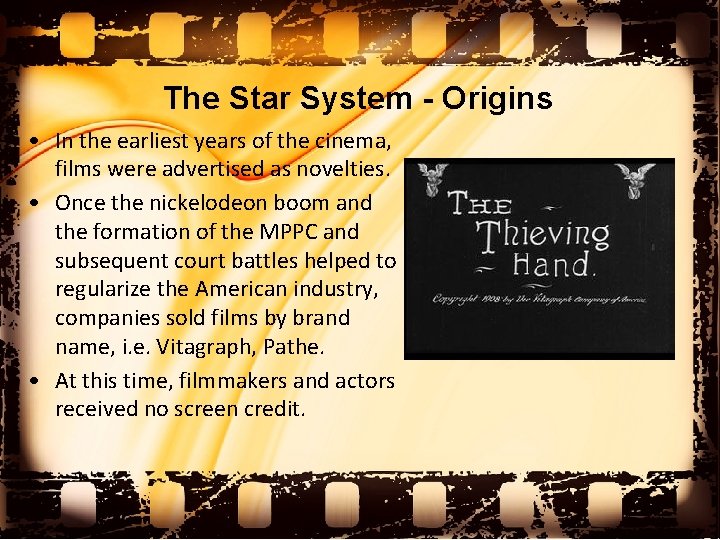
The Star System - Origins • In the earliest years of the cinema, films were advertised as novelties. • Once the nickelodeon boom and the formation of the MPPC and subsequent court battles helped to regularize the American industry, companies sold films by brand name, i. e. Vitagraph, Pathe. • At this time, filmmakers and actors received no screen credit.
The Star System • Film companies began the practice of signing film actors to longterm contracts, and actors appeared in multiple films, becoming familiar faces to their audiences. • Viewers began to show interest in their favorite performers, referring to the unknown actors as “the Biograph Girl” or “the Vitagraph Girl”. • By 1910, some companies began responding to audience demand began exploiting their popular actors for publicity purposes – this was the beginning of the Star System - the practice of casting and promoting star performers for their ability to draw at the box office.
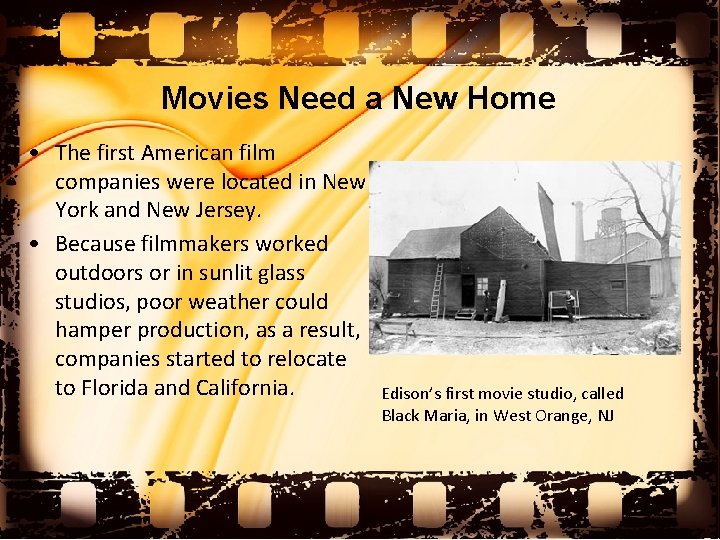
Movies Need a New Home • The first American film companies were located in New York and New Jersey. • Because filmmakers worked outdoors or in sunlit glass studios, poor weather could hamper production, as a result, companies started to relocate to Florida and California. Edison’s first movie studio, called Black Maria, in West Orange, NJ
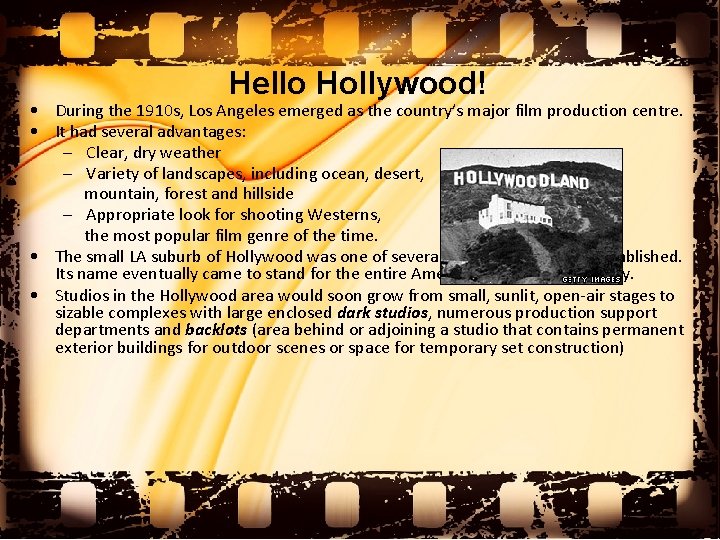
Hello Hollywood! • During the 1910 s, Los Angeles emerged as the country’s major film production centre. • It had several advantages: – Clear, dry weather – Variety of landscapes, including ocean, desert, mountain, forest and hillside – Appropriate look for shooting Westerns, the most popular film genre of the time. • The small LA suburb of Hollywood was one of several where studios were established. Its name eventually came to stand for the entire American filmmaking industry. • Studios in the Hollywood area would soon grow from small, sunlit, open-air stages to sizable complexes with large enclosed dark studios, numerous production support departments and backlots (area behind or adjoining a studio that contains permanent exterior buildings for outdoor scenes or space for temporary set construction)
Classical Hollywood Cinema • As studios regrouped (after the MPPC court decision) expanded and moved to Hollywood in the 1910 s, the basis began to formulate for American filmmaking for decades to come. • Classical Hollywood cinema refers to a motion picture visual style and a mode of production used in the American film industry between 1910 s-1960 s. • The identifiable cinematic form that emerged during this period is called classical Hollywood style.
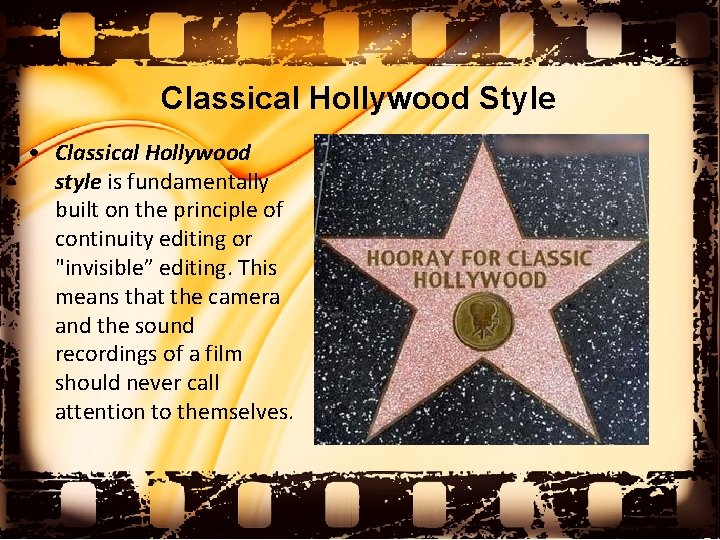
Classical Hollywood Style • Classical Hollywood style is fundamentally built on the principle of continuity editing or "invisible” editing. This means that the camera and the sound recordings of a film should never call attention to themselves.
The Studio System • During this period of classical Hollywood cinema and style, the big Hollywood firms grew enormously. • With this growth, the Studio System began to develop. • The Studio System was a means of film production and distribution dominant in Hollywood from the late 1910 s-early 1920 s to the 1960 s. Under this system, large motion picture studios: – produced movies primarily on their own filmmaking lots with their own creative personnel who were signed to long-term, exclusive contracts – pursued vertical integration through ownership and/or control over all three aspects of filmmaking – production, distribution and exhibition.
Vertical Integration • During the 1910 s, the film industry started to become vertically integrated. • This meant that studios not only created films, but also distributed and exhibited them. • (Definition) Vertical Integration within the film industry refers to one large company having various departments (or owning a series of sub-companies) that produce, distribute and exhibit movies, i. e. Owning a theatre chain and having a national distribution operation. • Three-tiered vertical integration guaranteed that a company’s films would definitely find distribution and exhibition.
Films and Filmmaking – 1910 s • With this guarantee of success through a vertically-integrated business structure, the film industry boomed in the late 1910 s. • Generally speaking: – Feature-length films (running on average about 75 min) dominated exhibition by 1915 causing the eventual decline of the serial (a series of episodic short films ranging from 15 – 40 minutes) – The Star System became even more prominent as studios competed to sign up the most popular actors to long-term contracts. – Many major Hollywood directors began their careers in the 1910 s – D. W. Griffith, Maurice Tourneur, Cecil B. De Mille, John Ford, Mack Sennett.
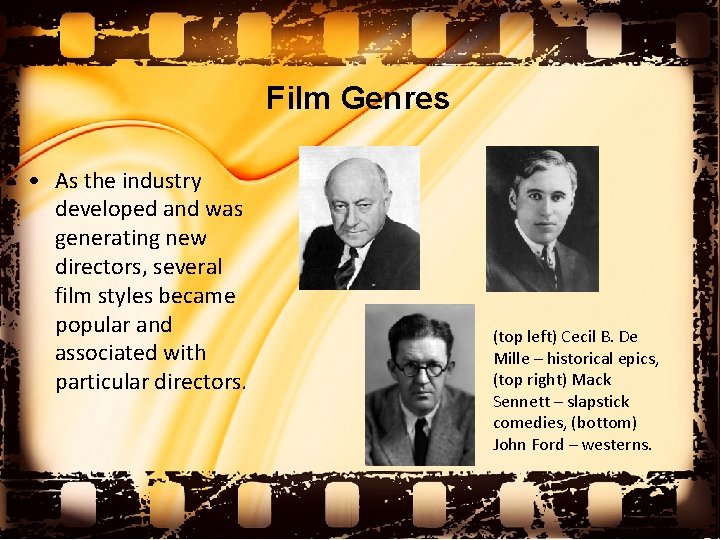
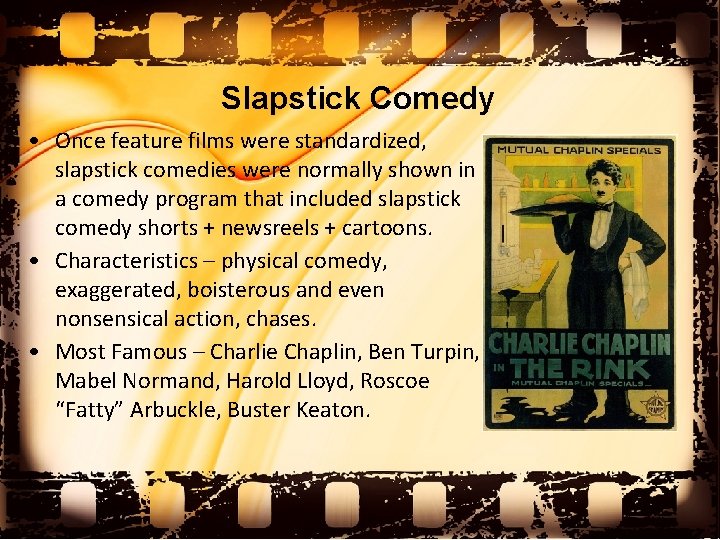
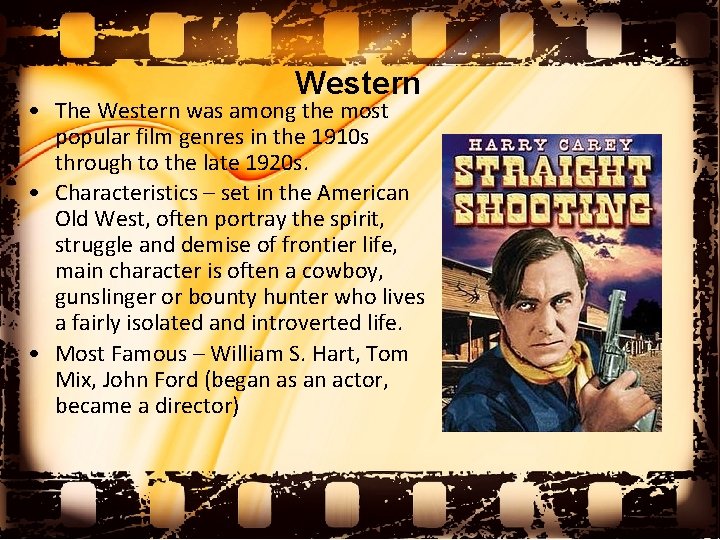
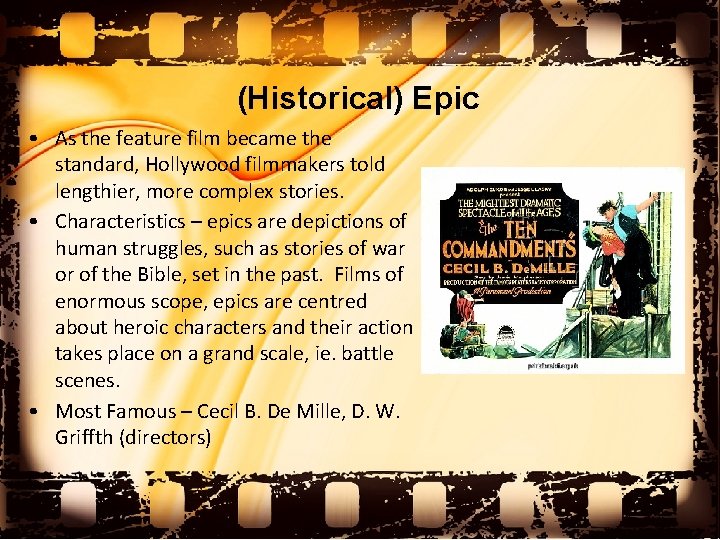
Film Genres • As the industry developed and was generating new directors, several film styles became popular and associated with particular directors. (top left) Cecil B. De Mille – historical epics, (top right) Mack Sennett – slapstick comedies, (bottom) John Ford – westerns.
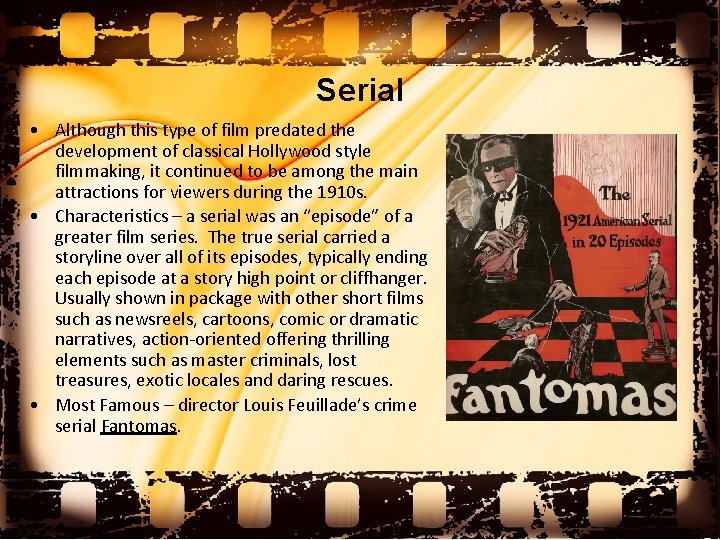
Serial • Although this type of film predated the development of classical Hollywood style filmmaking, it continued to be among the main attractions for viewers during the 1910 s. • Characteristics – a serial was an “episode” of a greater film series. The true serial carried a storyline over all of its episodes, typically ending each episode at a story high point or cliffhanger. Usually shown in package with other short films such as newsreels, cartoons, comic or dramatic narratives, action-oriented offering thrilling elements such as master criminals, lost treasures, exotic locales and daring rescues. • Most Famous – director Louis Feuillade’s crime serial Fantomas.
Slapstick Comedy • Once feature films were standardized, slapstick comedies were normally shown in a comedy program that included slapstick comedy shorts + newsreels + cartoons. • Characteristics – physical comedy, exaggerated, boisterous and even nonsensical action, chases. • Most Famous – Charlie Chaplin, Ben Turpin, Mabel Normand, Harold Lloyd, Roscoe “Fatty” Arbuckle, Buster Keaton.
Western • The Western was among the most popular film genres in the 1910 s through to the late 1920 s. • Characteristics – set in the American Old West, often portray the spirit, struggle and demise of frontier life, main character is often a cowboy, gunslinger or bounty hunter who lives a fairly isolated and introverted life. • Most Famous – William S. Hart, Tom Mix, John Ford (began as an actor, became a director)
(Historical) Epic • As the feature film became the standard, Hollywood filmmakers told lengthier, more complex stories. • Characteristics – epics are depictions of human struggles, such as stories of war or of the Bible, set in the past. Films of enormous scope, epics are centred about heroic characters and their action takes place on a grand scale, ie. battle scenes. • Most Famous – Cecil B. De Mille, D. W. Griffth (directors)
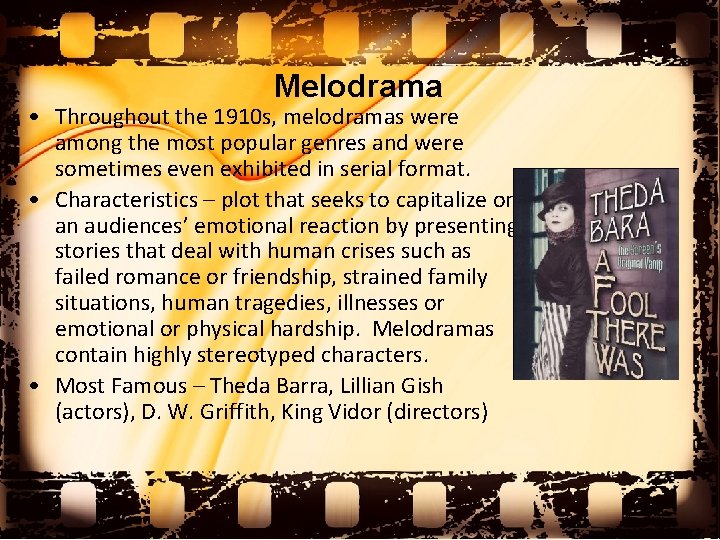
Melodrama • Throughout the 1910 s, melodramas were among the most popular genres and were sometimes even exhibited in serial format. • Characteristics – plot that seeks to capitalize on an audiences’ emotional reaction by presenting stories that deal with human crises such as failed romance or friendship, strained family situations, human tragedies, illnesses or emotional or physical hardship. Melodramas contain highly stereotyped characters. • Most Famous – Theda Barra, Lillian Gish (actors), D. W. Griffith, King Vidor (directors)
Early Films and other Artistic Forms of Expression • Within these genres, early filmmakers began to understand that in order to be commercially successful, their film works needed: – to effectively reach their audiences – to be relatable • As a result, they turned to other art forms to become the basis of and inspiration for their film stories. • The majority of films from 1902 -1915 were based on: – Works of literature – Real-life legends or stories
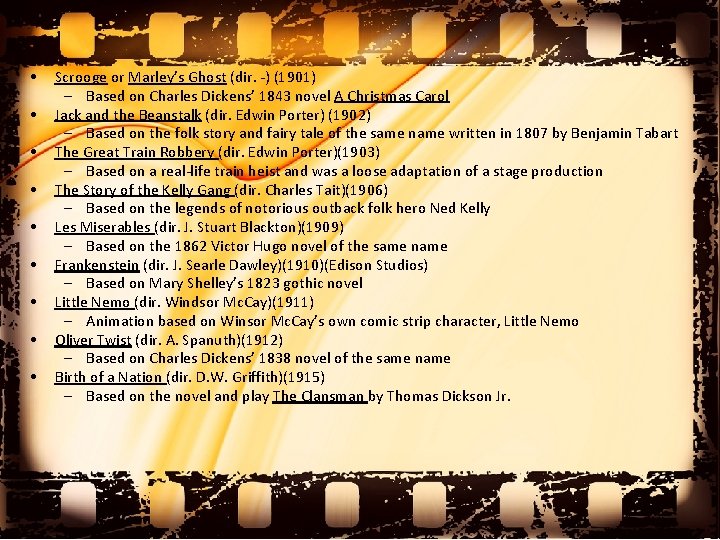
• • • Scrooge or Marley’s Ghost (dir. -) (1901) – Based on Charles Dickens’ 1843 novel A Christmas Carol Jack and the Beanstalk (dir. Edwin Porter) (1902) – Based on the folk story and fairy tale of the same name written in 1807 by Benjamin Tabart The Great Train Robbery (dir. Edwin Porter)(1903) – Based on a real-life train heist and was a loose adaptation of a stage production The Story of the Kelly Gang (dir. Charles Tait)(1906) – Based on the legends of notorious outback folk hero Ned Kelly Les Miserables (dir. J. Stuart Blackton)(1909) – Based on the 1862 Victor Hugo novel of the same name Frankenstein (dir. J. Searle Dawley)(1910)(Edison Studios) – Based on Mary Shelley’s 1823 gothic novel Little Nemo (dir. Windsor Mc. Cay)(1911) – Animation based on Winsor Mc. Cay’s own comic strip character, Little Nemo Oliver Twist (dir. A. Spanuth)(1912) – Based on Charles Dickens’ 1838 novel of the same name Birth of a Nation (dir. D. W. Griffith)(1915) – Based on the novel and play The Clansman by Thomas Dickson Jr.
Other Artistic Forms: Transition to Film • Real-life legends and pieces of literature provided filmmakers with known characters and relatable stories they could generate into films. • Since film was a relatively new medium, using known stories and characters ensured that audiences would understand film content, hereby permitting filmmakers to experiment with new methods of filmmaking and storytelling. • For example, since audiences were familiar with the basic story of The Great Train Robbery, Porter was able to experiment while constructing the film, shooting out of chronological sequence and using parallel action to convey plot points.
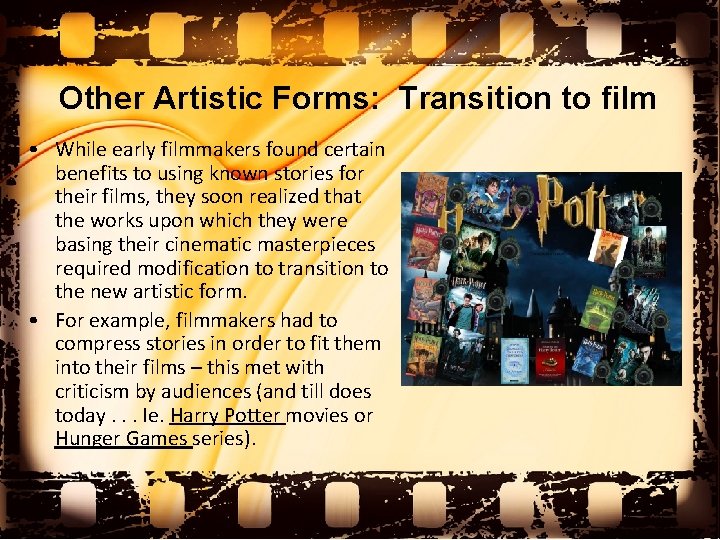
Other Artistic Forms: Transition to film • While early filmmakers found certain benefits to using known stories for their films, they soon realized that the works upon which they were basing their cinematic masterpieces required modification to transition to the new artistic form. • For example, filmmakers had to compress stories in order to fit them into their films – this met with criticism by audiences (and till does today. . . Ie. Harry Potter movies or Hunger Games series).
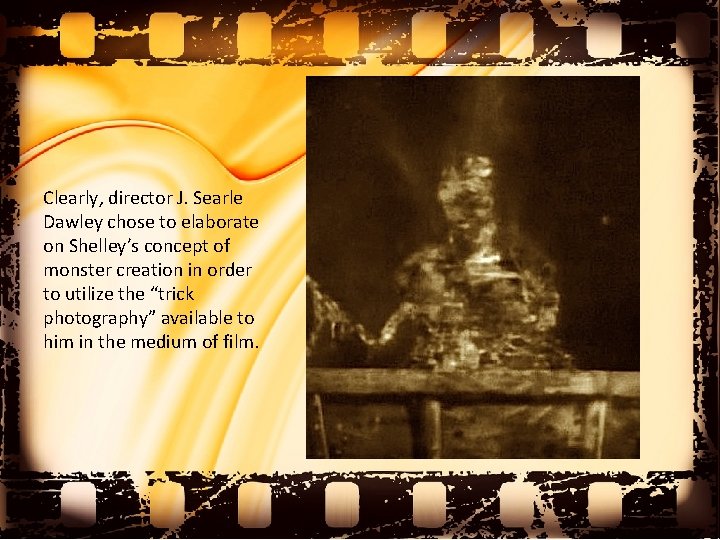
Other Artistic Forms: Transition to Film • In some cases, filmmakers deliberately modified characters or plot points to make their stories better translate onto film or to take advantage/incorporate an impressive special effect unique to the medium of film. • For example, in Frankenstein (the novel), Mary Shelley provides virtually no explanation of how Victor Frankenstein accomplishes the creation of life, but simply suggests that life is created through a chemical process discovered by Victor due to his interest in alchemy. Frankenstein (1910) depicts the monster being forged by potions and fire. This was accomplished by burning a dummy in a cauldron-like vat until it collapsed in a smoldering heap, and then playing the footage backwards in the final edit of the movie giving the illusion of creation.
Clearly, director J. Searle Dawley chose to elaborate on Shelley’s concept of monster creation in order to utilize the “trick photography” available to him in the medium of film.
Summary • The 1910 s were a crucial transitional period for the cinema as it was starting to be viewed as a potentially long-lasting artistic form. • The development of the Hollywood studio system and the accompanying American takeover of world film markets were among the most influential changes in cinema history during this era. • The events of the 1910 s defined standard commercial filmmaking – some of the companies founded during this time are still making movies today, the studio system prevailed for 50 + years. • The Star System still remains one of the primary means of generating audience appeal. • The basic principles of the classical Hollywood style of filmmaking established in the 1910 s continued throughout the decades to come and has changed remarkably little. • During this era, Hollywood and the movies became almost synonymous for many audiences around the world.