
Napoleonic France 1804 1815 Napoleons Rise to Power



- Slides: 26
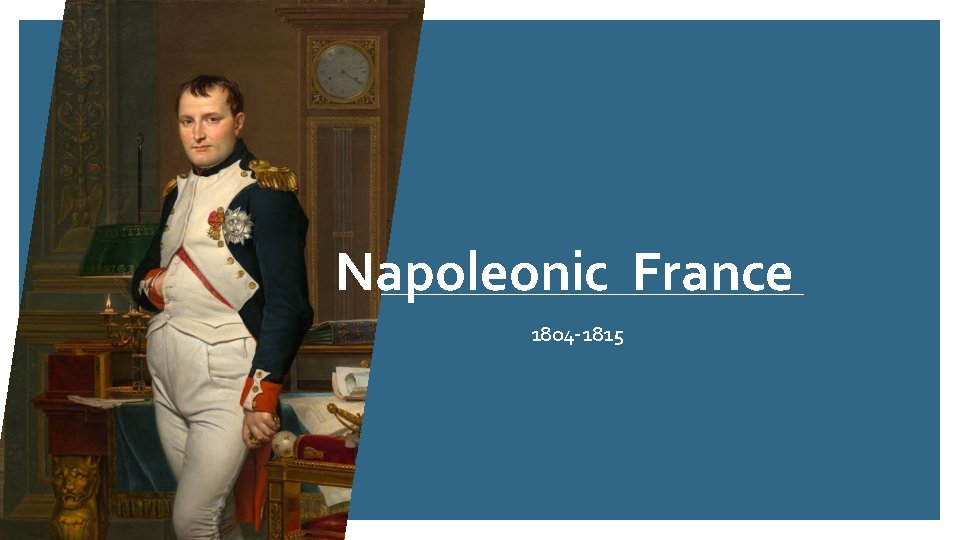
Napoleonic France 1804 -1815
Napoleon’s Rise to Power • During the revolution Napoleon had been a successful general fighting against the Prussians and Austrians • As his power grew he new he had to consolidate his power. • In order to do so he needed to end the civil strife within France • Plot Against the Directory: • The plot arose out of the desire to have a firm rule rather than a weak dictator • Abbe Sieyes: “Confidence from below, authority from above • November 9, 1799 - Napoleon and the coconspirators ousted the Directory and the following day disbanded the legislature
Napoleon Becomes the Ruler • December 25, 1799 • Napoleon's appointment to the position of first consul is approved • France maintains a republic appearance while in reality Napoleon is the sole ruler • Napoleon becomes an absolute ruler rather than revolutionary statesmen • He sought to govern France by demanding loyalty to the state, rewarding ability, and creating an effective hierarchical bureaucracy. • However, wealth determined status. • Napoleon may be thought of as the last and most eminent of the enlightened despots
Napoleonic Code • Legal unity provided the first clear and complete codification of French Law. • Perhaps the longest lasting legacy of Napoleon’s rule • Included a civil code, code of criminal procedure, a commercial code, and a penal code • Emphasized the protection of private property • Resulted in a strong central gov’t and administrative unity • Many achievements of the Revolution were made permanent. • Equality before the law: no more estates, legal classes, privileges, local liberties, hereditary offices, guilds, or manors • Freedom of religion • The state was secular in character • Property rights • Abolition of serfdom • Women gained inheritance rights
• Denied women equal status with men (except inheritance rights) • Women and children were legally dependent on their husband or father. • Divorce was more difficult to obtain than during the Revolution. • Women could not buy or sell property or begin a business without the consent of their husbands. • Income earned by wives went to their husbands. • Penalties for adultery were far more severe for women than men.
Other Reforms Under Napoleon • Citizens theoretically were able to rise in gov’t service purely according to their abilities. • However, a new imperial nobility was created to reward the most talented generals and officials. • Wealth determined status. • The middle class benefited significantly. • The gov’t rewarded wealthy people who effectively served the state with pensions, property or titles. • Over one-half of titles were given to those who had served in the military. • Napoleon created 3, 600 titles between 1808 and 1814. • Yet, the number of nobles in France in 1814 only totaled 1/7 of the nobles that had existed in the Old Regime.
• Religious reforms: Concordat of 1801 with the Roman Catholic Church • Napoleon’s motives: • Making peace with the Church would help weaken its link to monarchists who sought a restoration of the Bourbons. • Religion would help people accept economic inequalities in French society. • Provisions: • The pope renounced claims to Church property that had been seized during the Revolution. • The French gov’t had power to nominate or depose bishops. • In return, priests who had resisted the Civil Constitutions of the Clergy would replace those that had sworn an oath to the state
• Education Reform • based on a system of public education under state control. • Rigorous standards; available to the masses • Secondary and higher education (called lycées) were reorganized to prepare young men for gov’t service and professional occupations. • Education became important in determining social standing: one system for those who could spend 12 or more years at school; the other for boys who entered the work force at age of 12 or 14. • Napoleon sought to increase the size of the middle class.
Bank of France • The Bank of France (1800) served the interests of the state and the financial oligarchy. • It was a revived version of one of the banks of the Old Regime. • The gov’t balanced the national budget. • The gov’t established sound currency and public credit. • This was far superior to the chaos surrounding the assignats during the Revolution. • Economic reforms • • stimulated the economy: Provided food at low prices Increased employment Lowered taxes on farmers Guaranteed that church lands redistributed during the Revolution remained in hands of the new owners, mostly peasants Created an independent peasantry that would be the backbone of French democracy. Tax collections became more efficient. Workers were not allowed to form guilds or trade unions.
Creation of a Police State • A spy system kept thousands of citizens under continuous surveillance. • After 1810, political suspects were held in state prisons (as they had been during the Terror). • 2, 500 political prisoners existed in 1814. • The gov’t ruthlessly put down opposition, especially guerrillas in the western provinces of the Vendèe and Brittany. • Napoleon’s most publicly notorious action was the 1804 arrest and execution of a Bourbon, the duke of Enghien, who had allegedly took part in a plot against Napoleon. • There was no evidence he was involved with the plot. • European public opinion was livid.
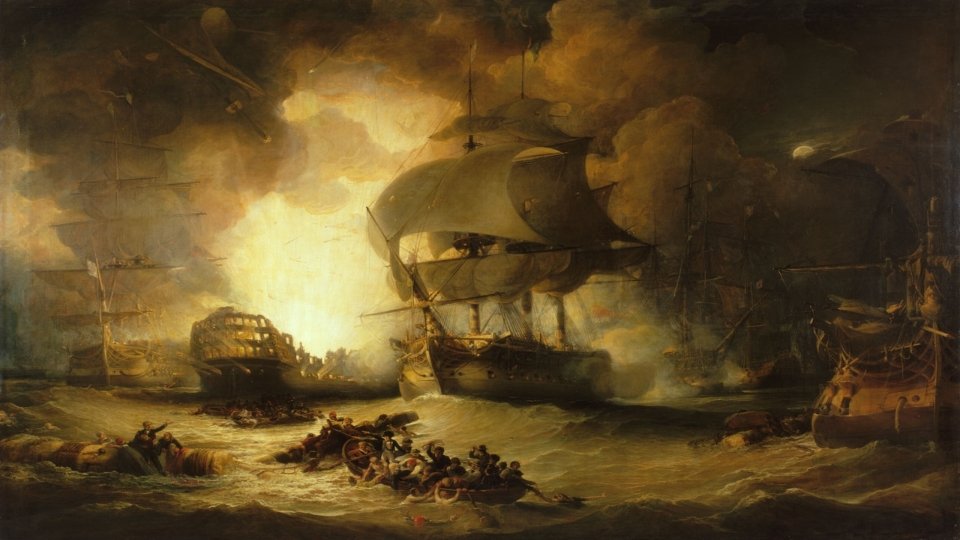
Early Wars of Napoleon • Only Great Britain was continually at war with France • The four major powers (Britain, Russia, Prussia, and Austria) did not all fight Napoleonic France until 1813 • • Only after Napoleon had conquered Italy did they determine to secure peace and maintain the balance of power in Europe The War of Second Coalition 1798 -1801 Napoleon had his navy destroyed by England’s Lord Horatio Nelson in the Battle of the Nile (1798). • Napoleon was victorious in the war, nevertheless. • Treaty of Lunéville (1801) • • • Ended the Second Coalition Resulted in Austria’s loss of its Italian possessions German territory on the west bank of the Rhine was incorporated into France. Russia retreated from western Europe when they saw their ambitions in the Mediterranean blocked by the British. Britain again was isolated.
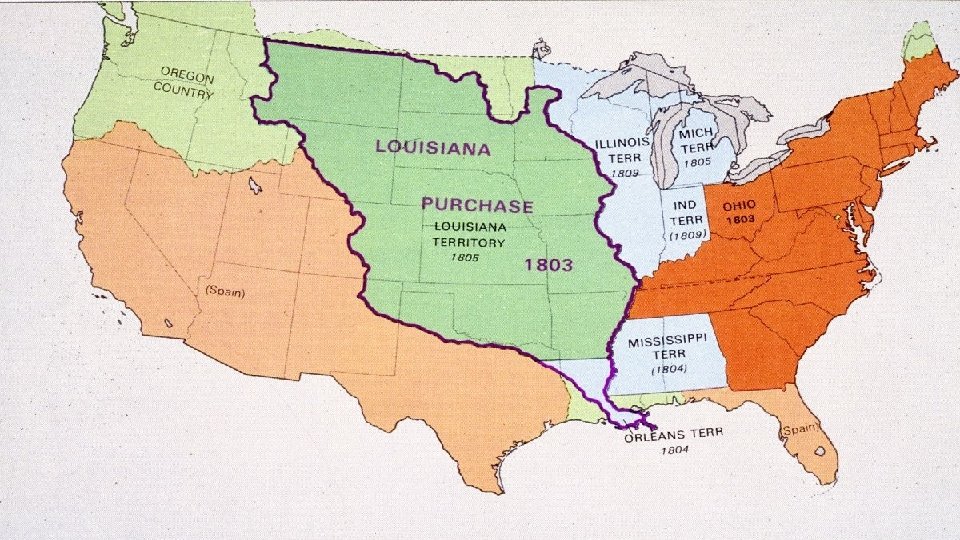
Revolution in Saint Domingue • Napoleon sent a large army to Haiti to subdue a slave rebellion there. • French forces were decimated by disease and slave rebels. • Haitian forces were led by Toissant L’Ouverture. • The Haitians were motivated by French Revolutionary ideals of freedom from absolute rule and natural rights. • Haiti won its independence from France in 1804. • 1803 - Napoleon sold Louisiana in North America to the U. S. as his hopes for re-creating an American empire were getting slimmer
Empire (1804 -1814) • On December 2, 1804, Napoleon crowned himself hereditary Emperor of France in Notre-Dame Cathedral. • He hoped to preempt plans of royalists to return the Bourbons to the throne. • He believed an empire was necessary for France to maintain and expand its influence throughout Europe. • Napoleon viewed himself as a liberator who freed foreign peoples from the absolute rulers who oppressed them. • His domination over other nations unleashed the forces of nationalism in those countries which ultimately resulted in his downfall.
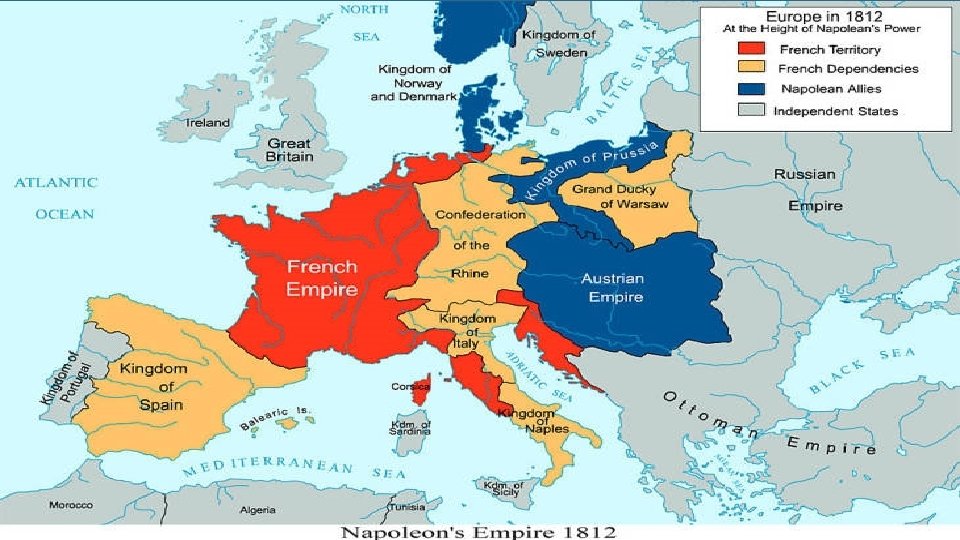
Grand Empire • Beginning in 1805, Napoleon engaged in constant warfare. • Eventually, Napoleon achieved the largest empire since Roman times (although it was only temporary). • • France extended to the Rhine, including Belgium and Holland, the German coast to the western Baltic, and the Italian coast extending down to Rome. Dependent satellite kingdoms: where Napoleon took leadership or placed his appointees on the throne • Holland, Spain, Westphalia, Venice, Naples, Papal States, Warsaw, The Rhine, Trieste and the Dalmatian coast • • Independent but allied states included: Austria, Prussia and Russia. • All countries of the Grand Empire saw the introduction of some of the main principles of the French Revolution. • Notable exception: no self-gov’t through elected legislative bodies.
War of the Third Coalition (1805 -1807) • In 1803 Napoleon began preparations to invade Britain • In 1805 Austria signed an alliance with Britain • The alliance (coalition) was completed with the additions of Russia and Sweden • All four viewed Napoleon as a threat to the balance of power • Battle of Trafalgar (October 1805) • French and Spanish navies are defeated by the British navy under the command of Lord Horatio Nelson Establishes the supremacy of the British navy for century • French invasion of Britain no longer possible • • In December of 1805 French forces defeat Austrian and Russian forces • • To commemorate this victory Napoleon commissions the Arc de Triomphe in 1806 Treaty of Tilsit (June 1807) • Austria and Prussia lose territory making Napoleon the master of western and central Europe
The Continental System • Napoleon decided to wage economic warfare against Britain after his loss at the Battle of Trafalgar. • Berlin Decree, 1806: Napoleon sought to starve Britain out by closing ports on the continent to British commerce. • England, in response, issued the “order in council”: neutrals might enter continental ports only if they first stopped in Great Britain. • Milan Decree, 1807: Napoleon’s response to the “order in council” • • Any neutral ship entering a British port, or submitting to a British warship at sea, would be confiscated by if it attempted to enter a Continental port. War of 1812: U. S. eventually declared war against Britain in defense of its neutral shipping rights.
Outcomes of the Continental System • The Continental System ultimately was a major failure. • It caused widespread antagonism to Napoleon’s rule in Europe. • Imports from America were too much in demand in Europe. • European industries could not equal Britain’s industrial output. • Without railroads, the Continental system was impossible to maintain. • British made up lost trade with Europe by expanding exports to Latin America.
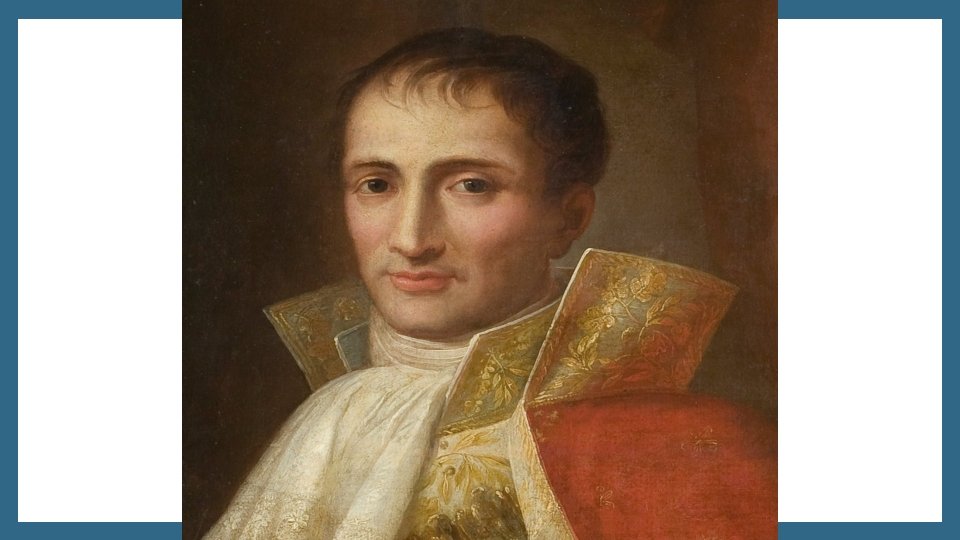
The Peninsular War (1808 -1814) • The first great revolt against Napoleon’s power occurred in Spain. • When Napoleon tried to tighten his control over Spain by replacing the Spanish King with his brother, Joseph, the Spanish people waged a costly guerrilla war. • They received aid from the British under one of their ablest commanders, the Duke of Wellington. • France suffered from Britain’s counter-blockade resulting in the Continental System’s failure. • Looking for a scapegoat, Napoleon turned on Alexander I of Russia, who had actually supported his blockade against Britain.
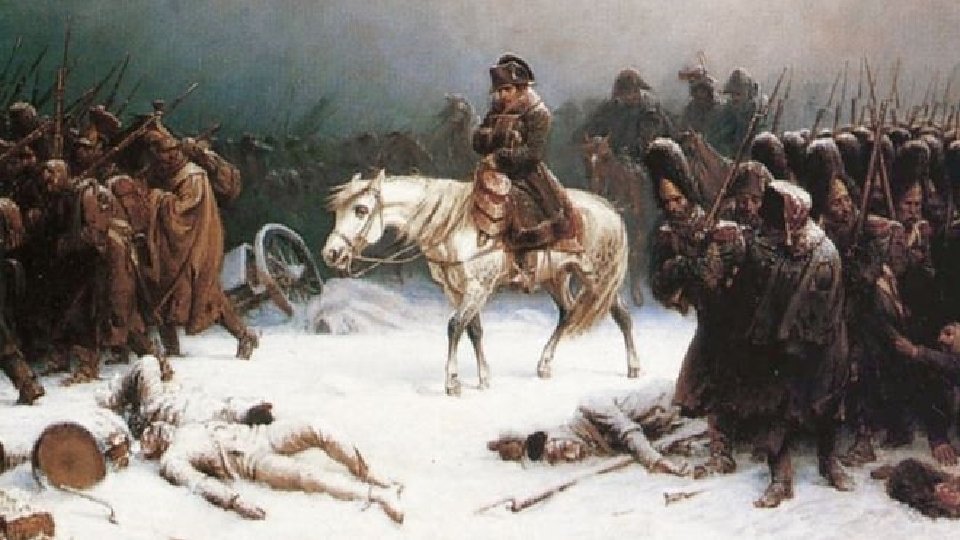
Russian Campaign (1812) • Napoleon invaded Russia in June of 1812, with his Grand Army of 600, 000. • Only 1/3 of his forces were French. • Cause: Russia withdrew from the Continental System due to economic hardships it had caused. • Napoleon was forced to retreat from Moscow after 5 weeks during the brutal Russian winter due to the “scorched earth” tactic of the Russians. • Only 30, 000 men in Napoleon’s army returned to their homelands. • 400, 000 died of battle casualties, starvation, and exposure.
War of the Fourth Coalition (1813 -1814) • During the Russian campaign Austria and Prussia had joined Britain and Russia to form a fourth alliance against Napoleon • Battle of Leipzig (“Battle of Nations”), October, 1813: Napoleon was finally defeated. • • Napoleon lost 500, 000 of his 600, 000 Grand Army. It was the largest battle in world history until the 20 th century. • Napoleon refused to accept the terms of Austrian foreign minister Metternich’s “Frankfurt Proposals” to reduce France to its historical size in return for his remaining on the throne. • The Quadruple Alliance was created in March, 1814. • Each power agreed to provide 150, 000 soldiers to enforce peace terms. • Napoleon abdicated as emperor on April 4, 1814 after allied armies entered Paris.