
Napoleon Bonaparte1769 1821 and Congress of Vienna Early
Napoleon Bonaparte(1769 - 1821) and Congress of Vienna Early life of Napoleon, Napoleonic war, Defeat , Congress of Vienna. Dr. Sujata Menon
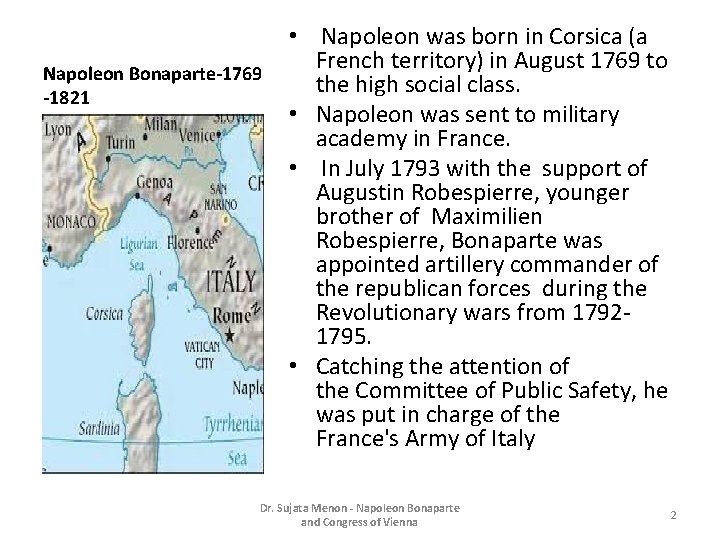
Napoleon Bonaparte-1769 -1821 • Napoleon was born in Corsica (a French territory) in August 1769 to the high social class. • Napoleon was sent to military academy in France. • In July 1793 with the support of Augustin Robespierre, younger brother of Maximilien Robespierre, Bonaparte was appointed artillery commander of the republican forces during the Revolutionary wars from 17921795. • Catching the attention of the Committee of Public Safety, he was put in charge of the France's Army of Italy Dr. Sujata Menon - Napoleon Bonaparte and Congress of Vienna 2
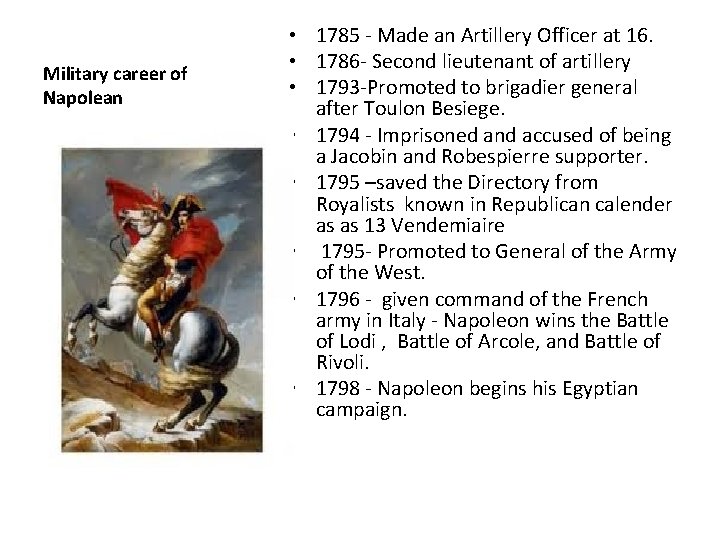
Military career of Napolean • 1785 - Made an Artillery Officer at 16. • 1786 - Second lieutenant of artillery • 1793 -Promoted to brigadier general after Toulon Besiege. • 1794 - Imprisoned and accused of being a Jacobin and Robespierre supporter. • 1795 –saved the Directory from Royalists known in Republican calender as as 13 Vendemiaire • 1795 - Promoted to General of the Army of the West. • 1796 - given command of the French army in Italy - Napoleon wins the Battle of Lodi , Battle of Arcole, and Battle of Rivoli. • 1798 - Napoleon begins his Egyptian campaign.
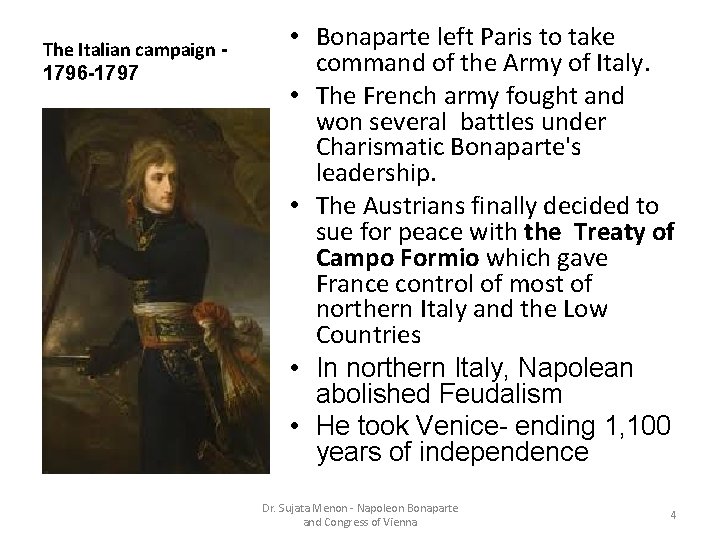
The Italian campaign 1796 -1797 • Bonaparte left Paris to take command of the Army of Italy. • The French army fought and won several battles under Charismatic Bonaparte's leadership. • The Austrians finally decided to sue for peace with the Treaty of Campo Formio which gave France control of most of northern Italy and the Low Countries • In northern Italy, Napolean abolished Feudalism • He took Venice- ending 1, 100 years of independence Dr. Sujata Menon - Napoleon Bonaparte and Congress of Vienna 4

Napoleon's Egypt Campaign (1798– 1801) • In 1798, Napoleon invaded Egypt because it was a vital lifeline to British outposts in India. • Bonaparte wished to establish a French presence in the Middle East, with the ultimate dream of linking with France's ally Tipu Sultan, ruler of Mysore , India. • Battle of Nile- the British fleet, under Admiral Horatio Nelson, destroyed the French fleet in the battle of the Nile. • Leaving the army in Egypt, Napoleon returned to Paris. The French people were not fully aware of the losses in Egypt, and they welcomed him as a hero. Dr. Sujata Menon - Napoleon Bonaparte and Congress of Vienna 5
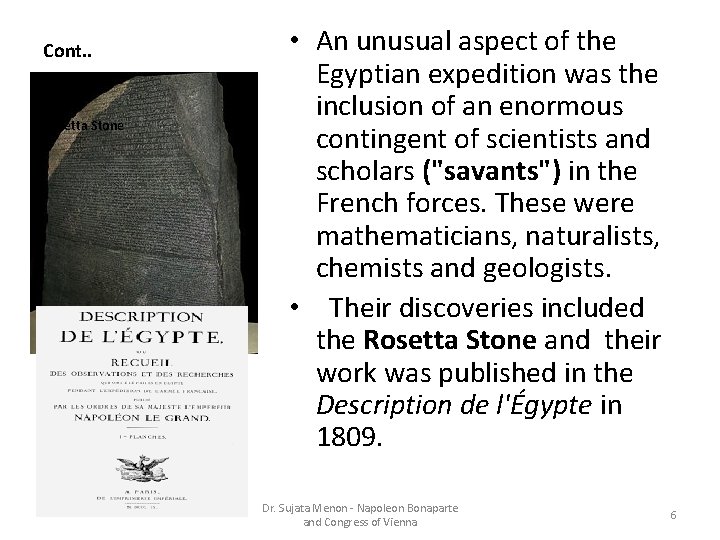
Cont. . Rosetta Stone • An unusual aspect of the Egyptian expedition was the inclusion of an enormous contingent of scientists and scholars ("savants") in the French forces. These were mathematicians, naturalists, chemists and geologists. • Their discoveries included the Rosetta Stone and their work was published in the Description de l'Égypte in 1809. Dr. Sujata Menon - Napoleon Bonaparte and Congress of Vienna 6
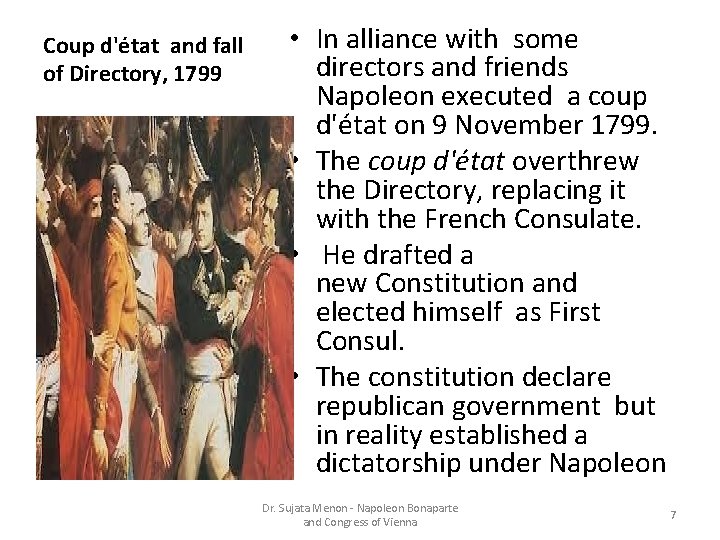
Coup d'état and fall of Directory, 1799 • In alliance with some directors and friends Napoleon executed a coup d'état on 9 November 1799. • The coup d'état overthrew the Directory, replacing it with the French Consulate. • He drafted a new Constitution and elected himself as First Consul. • The constitution declare republican government but in reality established a dictatorship under Napoleon Dr. Sujata Menon - Napoleon Bonaparte and Congress of Vienna 7
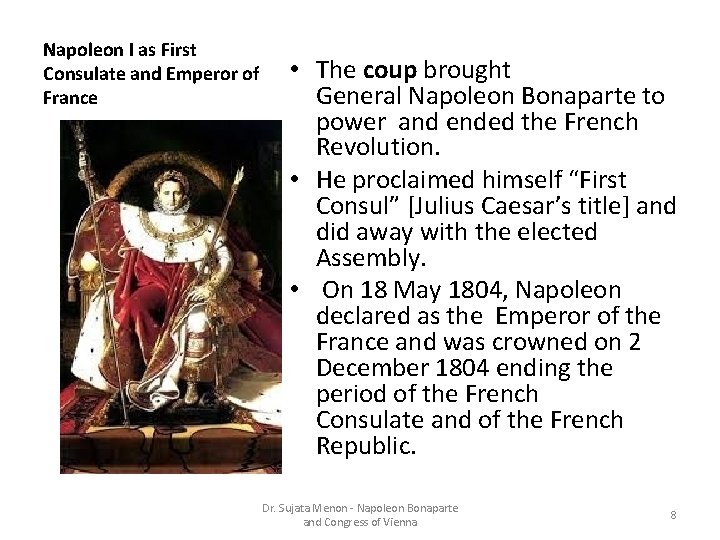
Napoleon I as First Consulate and Emperor of France • The coup brought General Napoleon Bonaparte to power and ended the French Revolution. • He proclaimed himself “First Consul” [Julius Caesar’s title] and did away with the elected Assembly. • On 18 May 1804, Napoleon declared as the Emperor of the France and was crowned on 2 December 1804 ending the period of the French Consulate and of the French Republic. Dr. Sujata Menon - Napoleon Bonaparte and Congress of Vienna 8

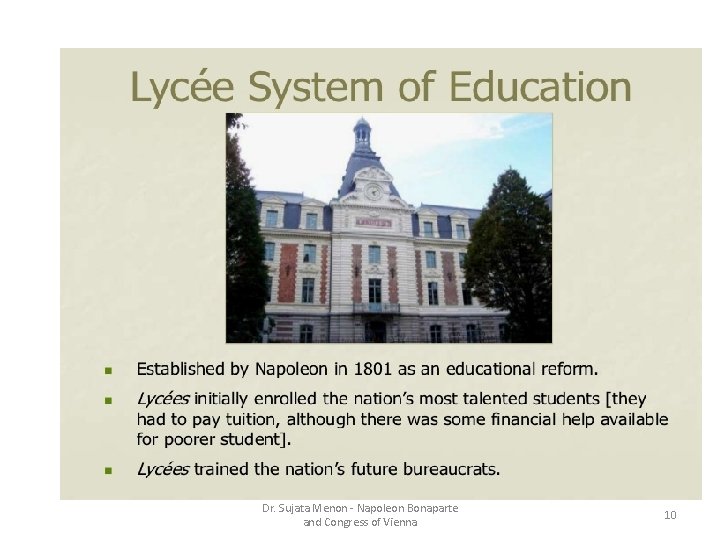
Reforms under Napoleon I • Napoleon knew the French would never stand for a return to the Old Regime. Therefore, he continued many reforms of the revolution. • Following were significant reforms by Napoleon Centralized bank and currency • Napoleon Established the Banque de France in 1800. Napoleon enforced a law requiring all citizens to pay taxes. The tax money was deposited and the Bank, in turn, issued money and made loans to businesses. Lycée System of Education or secondary school education • Established by Napoleon in 1801 as an educational reform. Lycées enrolled the nation’s most talented students. Dr. Sujata Menon - Napoleon Bonaparte and Congress of Vienna 9
Dr. Sujata Menon - Napoleon Bonaparte and Congress of Vienna 10
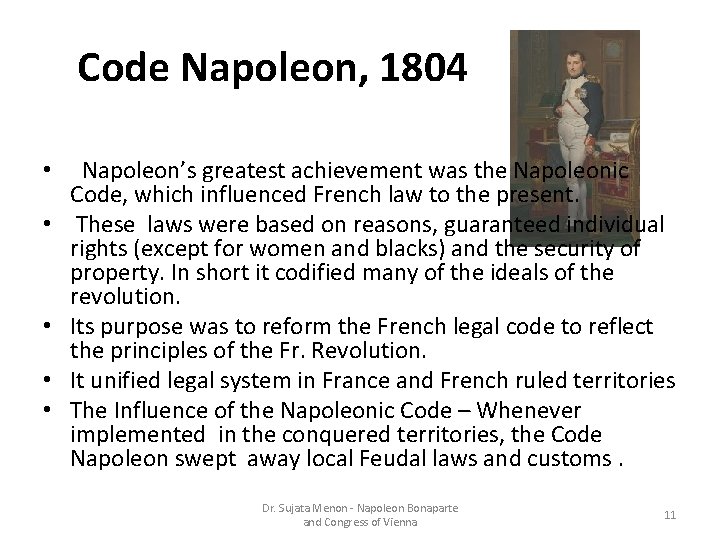
Code Napoleon, 1804 • • • Napoleon’s greatest achievement was the Napoleonic Code, which influenced French law to the present. These laws were based on reasons, guaranteed individual rights (except for women and blacks) and the security of property. In short it codified many of the ideals of the revolution. Its purpose was to reform the French legal code to reflect the principles of the Fr. Revolution. It unified legal system in France and French ruled territories The Influence of the Napoleonic Code – Whenever implemented in the conquered territories, the Code Napoleon swept away local Feudal laws and customs. Dr. Sujata Menon - Napoleon Bonaparte and Congress of Vienna 11
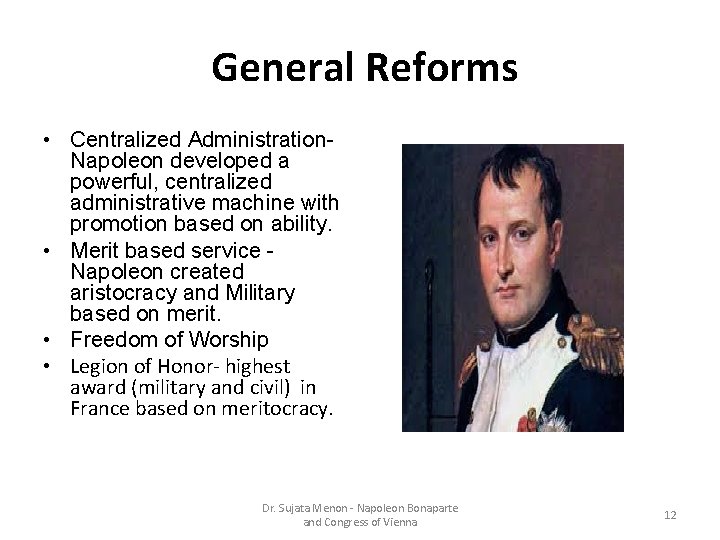
General Reforms • Centralized Administration. Napoleon developed a powerful, centralized administrative machine with promotion based on ability. • Merit based service Napoleon created aristocracy and Military based on merit. • Freedom of Worship • Legion of Honor- highest award (military and civil) in France based on meritocracy. Dr. Sujata Menon - Napoleon Bonaparte and Congress of Vienna 12
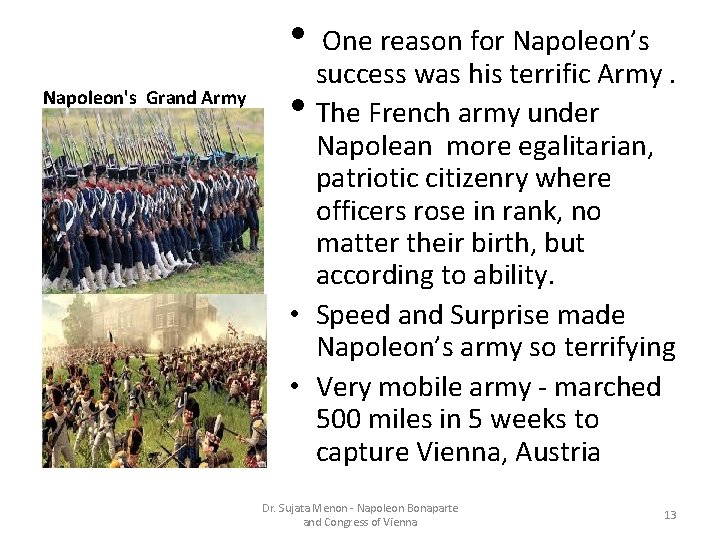
• Napoleon's Grand Army One reason for Napoleon’s success was his terrific Army. • The French army under Napolean more egalitarian, patriotic citizenry where officers rose in rank, no matter their birth, but according to ability. • Speed and Surprise made Napoleon’s army so terrifying • Very mobile army - marched 500 miles in 5 weeks to capture Vienna, Austria Dr. Sujata Menon - Napoleon Bonaparte and Congress of Vienna 13
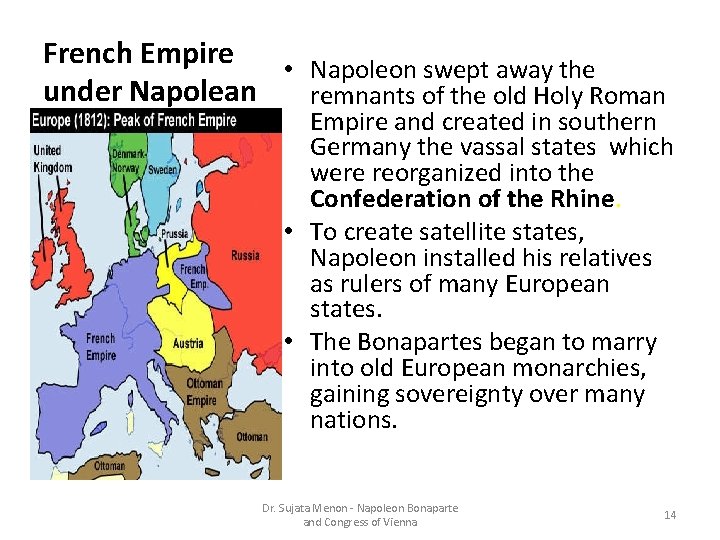
French Empire • Napoleon swept away the under Napolean remnants of the old Holy Roman Empire and created in southern Germany the vassal states which were reorganized into the Confederation of the Rhine. • To create satellite states, Napoleon installed his relatives as rulers of many European states. • The Bonapartes began to marry into old European monarchies, gaining sovereignty over many nations. Dr. Sujata Menon - Napoleon Bonaparte and Congress of Vienna 14
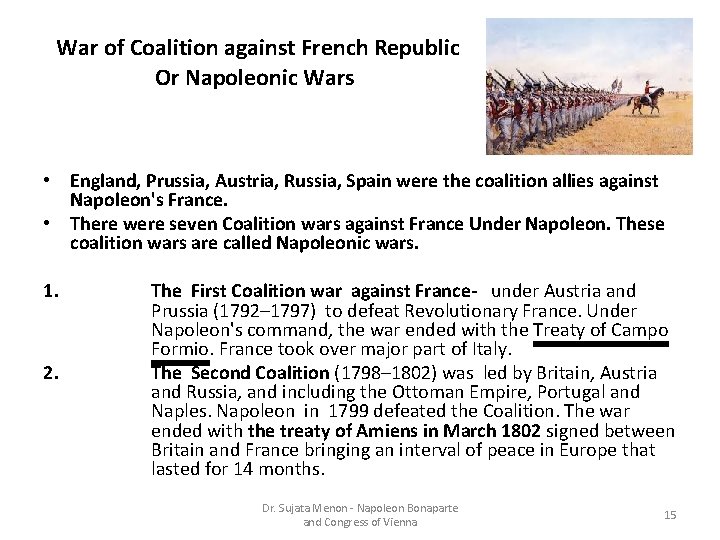
War of Coalition against French Republic Or Napoleonic Wars • England, Prussia, Austria, Russia, Spain were the coalition allies against Napoleon's France. • There were seven Coalition wars against France Under Napoleon. These coalition wars are called Napoleonic wars. 1. 2. The First Coalition war against France- under Austria and Prussia (1792– 1797) to defeat Revolutionary France. Under Napoleon's command, the war ended with the Treaty of Campo Formio. France took over major part of Italy. The Second Coalition (1798– 1802) was led by Britain, Austria and Russia, and including the Ottoman Empire, Portugal and Naples. Napoleon in 1799 defeated the Coalition. The war ended with the treaty of Amiens in March 1802 signed between Britain and France bringing an interval of peace in Europe that lasted for 14 months. Dr. Sujata Menon - Napoleon Bonaparte and Congress of Vienna 15

The Third Coalition war and the Battle of Trafalgar 3. The Third Coalition (1803 to 1806) was made up of the Holy Roman Empire, Russia, and others. Two major battles fought- Battle of Trafalgar and Battle of Austerlitz ü The Battle of Trafalgar 21 October 1805 - was a naval engagement fought by the Royal British Navy against the combined fleets of the French and Spanish Navies, during the War of the Third Coalition. • The strategic daring of Admiral Nelson and the tactical superiority of the British fleet won the day. The British hero Horatio Nelson achieves lasting fame. • With reduced naval power, Napoleon had to suspend his invasion plans. Dr. Sujata Menon - Napoleon Bonaparte and Congress of Vienna 16
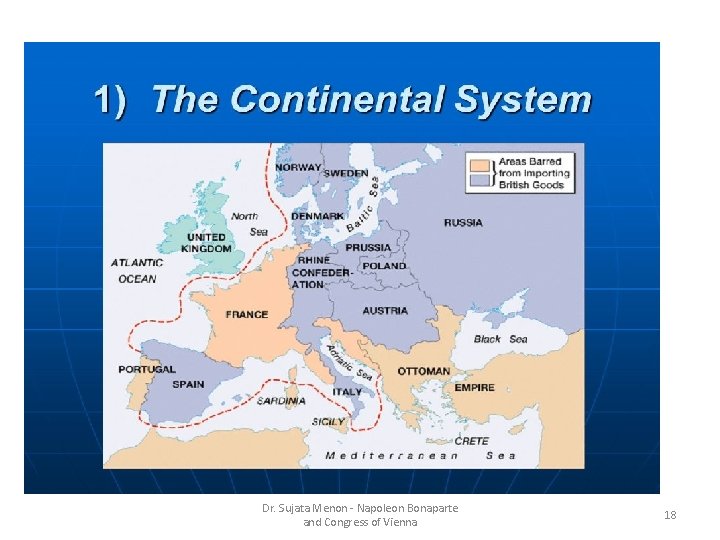
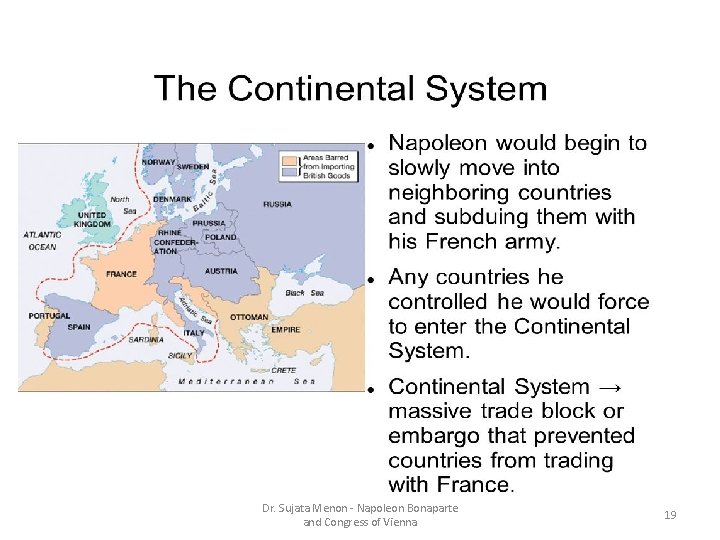
First Blunder- The Continental System • Admiral Nelson dashed Napoleon’s plans • Napoleon then decided to blockade British ports and ordered all European nations to stop trade with Britain. This is called the Continental System - a circling of Europe in order to prevent England from trading with the continent. With this plan, Napoleon hopes to break the financial back of the British Empire. • It failed. Everyone still traded with England • For France, the Continental System backfired. Britain did lose trade, but France suffered more. • The powerful British navy was able to cut off overseas imports to France and the rest of the continent. This weakened the French economy. Dr. Sujata Menon - Napoleon Bonaparte and Congress of Vienna 17
Dr. Sujata Menon - Napoleon Bonaparte and Congress of Vienna 18
Dr. Sujata Menon - Napoleon Bonaparte and Congress of Vienna 19
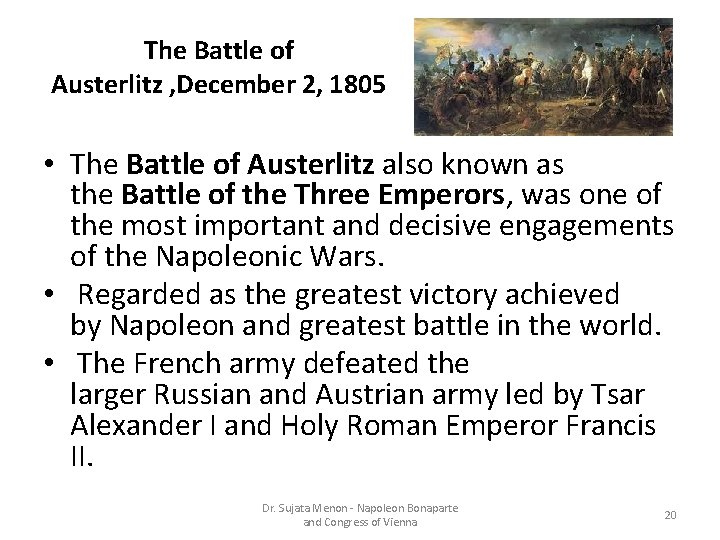
The Battle of Austerlitz , December 2, 1805 • The Battle of Austerlitz also known as the Battle of the Three Emperors, was one of the most important and decisive engagements of the Napoleonic Wars. • Regarded as the greatest victory achieved by Napoleon and greatest battle in the world. • The French army defeated the larger Russian and Austrian army led by Tsar Alexander I and Holy Roman Emperor Francis II. Dr. Sujata Menon - Napoleon Bonaparte and Congress of Vienna 20

The war of Fourth Coalition 1806 -1807 • The Fourth Coalition(18061807) against Napoleon's France included Prussia, Russia, Saxony, Sweden, and Great Britain. • Napoleon decisively defeated the Prussians at the Battle of Jena-Auerstedt on 14 October 1806. Russian forces were crushed by the French at the Battle of Friedland on 14 June 1807. • With the Treaties of Tilsit in July 1807, France made peace with Russia, which agreed to join the Continental System. Dr. Sujata Menon - Napoleon Bonaparte and Congress of Vienna 21
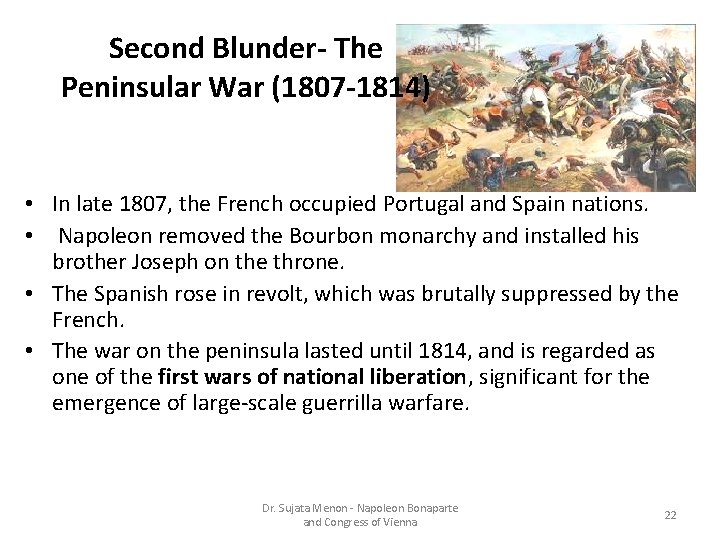
Second Blunder- The Peninsular War (1807 -1814) • In late 1807, the French occupied Portugal and Spain nations. • Napoleon removed the Bourbon monarchy and installed his brother Joseph on the throne. • The Spanish rose in revolt, which was brutally suppressed by the French. • The war on the peninsula lasted until 1814, and is regarded as one of the first wars of national liberation, significant for the emergence of large-scale guerrilla warfare. Dr. Sujata Menon - Napoleon Bonaparte and Congress of Vienna 22
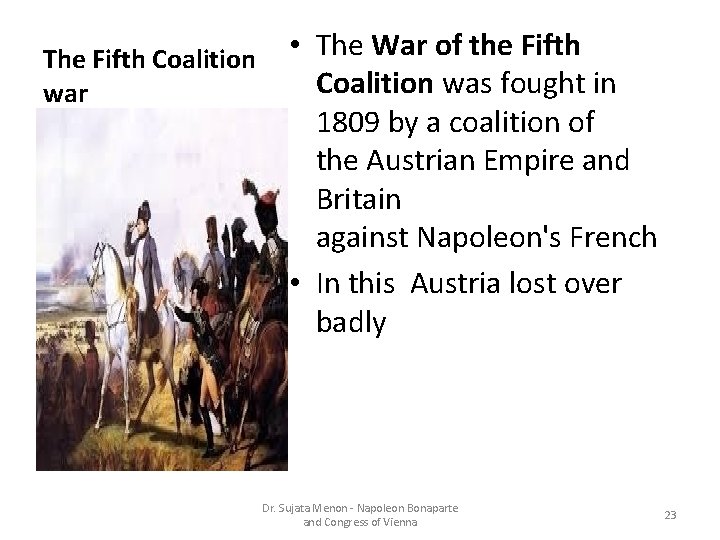
The Fifth Coalition war • The War of the Fifth Coalition was fought in 1809 by a coalition of the Austrian Empire and Britain against Napoleon's French • In this Austria lost over badly Dr. Sujata Menon - Napoleon Bonaparte and Congress of Vienna 23
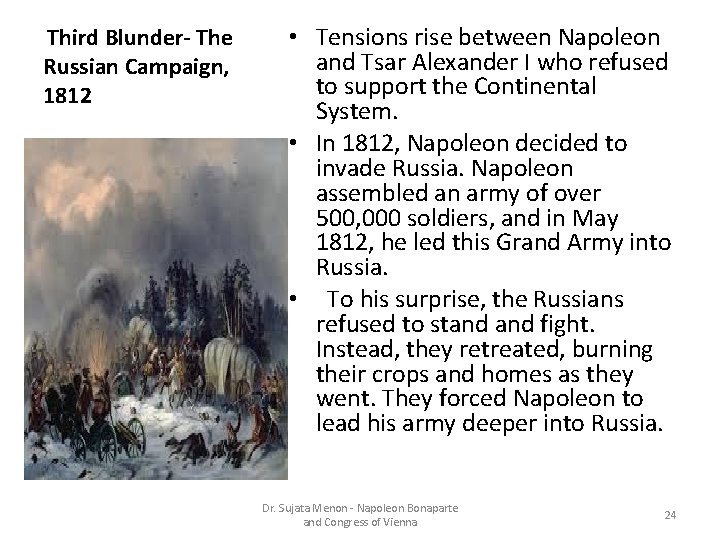
Third Blunder- The Russian Campaign, 1812 • Tensions rise between Napoleon and Tsar Alexander I who refused to support the Continental System. • In 1812, Napoleon decided to invade Russia. Napoleon assembled an army of over 500, 000 soldiers, and in May 1812, he led this Grand Army into Russia. • To his surprise, the Russians refused to stand fight. Instead, they retreated, burning their crops and homes as they went. They forced Napoleon to lead his army deeper into Russia. Dr. Sujata Menon - Napoleon Bonaparte and Congress of Vienna 24
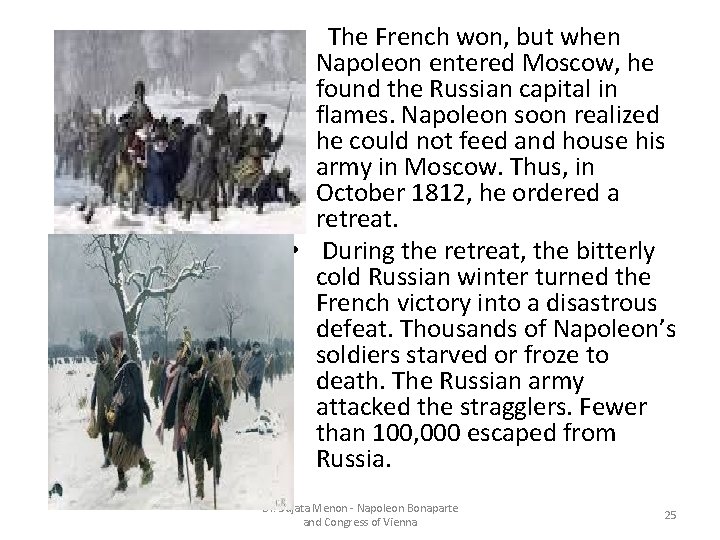
The French won, but when Napoleon entered Moscow, he found the Russian capital in flames. Napoleon soon realized he could not feed and house his army in Moscow. Thus, in October 1812, he ordered a retreat. • During the retreat, the bitterly cold Russian winter turned the French victory into a disastrous defeat. Thousands of Napoleon’s soldiers starved or froze to death. The Russian army attacked the stragglers. Fewer than 100, 000 escaped from Russia. • Dr. Sujata Menon - Napoleon Bonaparte and Congress of Vienna 25
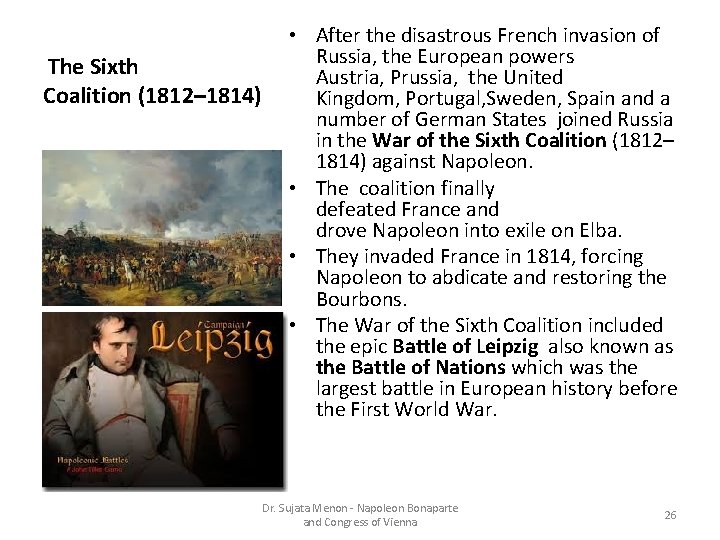
The Sixth Coalition (1812– 1814) • After the disastrous French invasion of Russia, the European powers Austria, Prussia, the United Kingdom, Portugal, Sweden, Spain and a number of German States joined Russia in the War of the Sixth Coalition (1812– 1814) against Napoleon. • The coalition finally defeated France and drove Napoleon into exile on Elba. • They invaded France in 1814, forcing Napoleon to abdicate and restoring the Bourbons. • The War of the Sixth Coalition included the epic Battle of Leipzig also known as the Battle of Nations which was the largest battle in European history before the First World War. Dr. Sujata Menon - Napoleon Bonaparte and Congress of Vienna 26
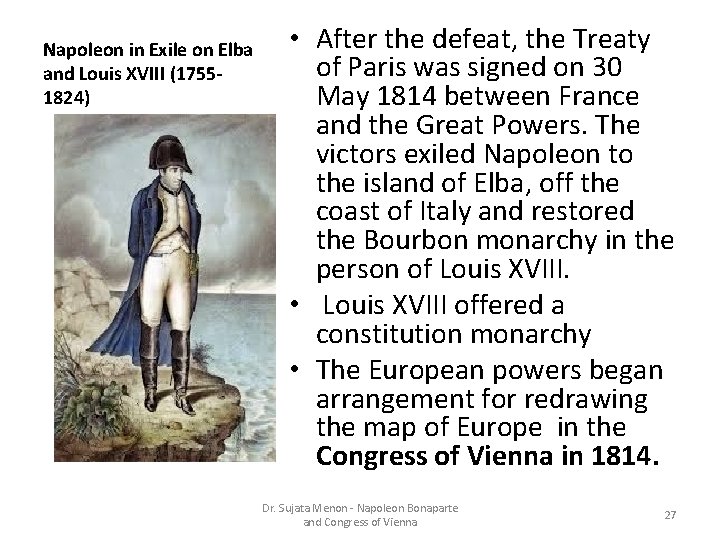
Napoleon in Exile on Elba and Louis XVIII (17551824) • After the defeat, the Treaty of Paris was signed on 30 May 1814 between France and the Great Powers. The victors exiled Napoleon to the island of Elba, off the coast of Italy and restored the Bourbon monarchy in the person of Louis XVIII. • Louis XVIII offered a constitution monarchy • The European powers began arrangement for redrawing the map of Europe in the Congress of Vienna in 1814. Dr. Sujata Menon - Napoleon Bonaparte and Congress of Vienna 27
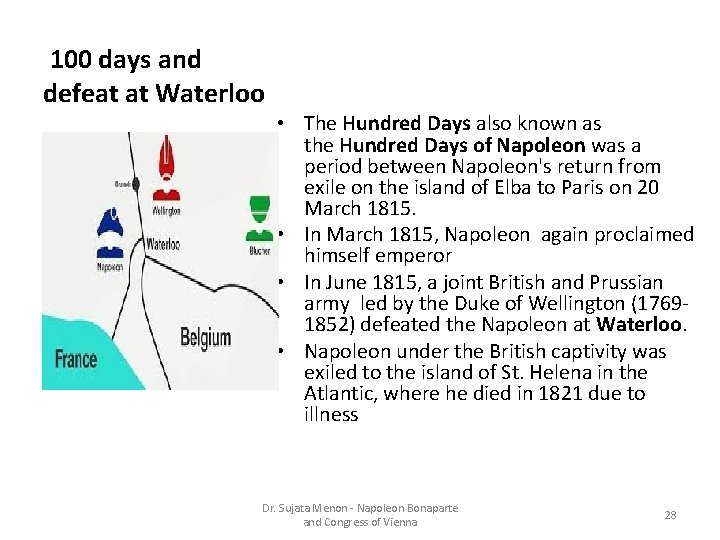
100 days and defeat at Waterloo • The Hundred Days also known as the Hundred Days of Napoleon was a period between Napoleon's return from exile on the island of Elba to Paris on 20 March 1815. • In March 1815, Napoleon again proclaimed himself emperor • In June 1815, a joint British and Prussian army led by the Duke of Wellington (17691852) defeated the Napoleon at Waterloo. • Napoleon under the British captivity was exiled to the island of St. Helena in the Atlantic, where he died in 1821 due to illness Dr. Sujata Menon - Napoleon Bonaparte and Congress of Vienna 28
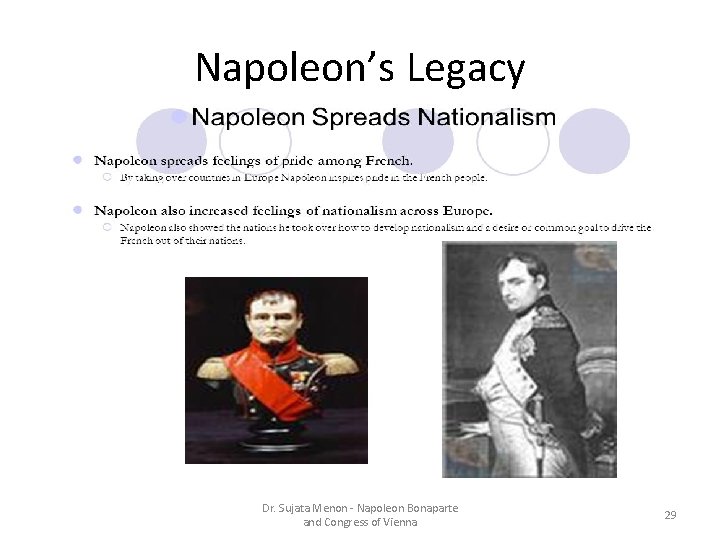
Napoleon’s Legacy Dr. Sujata Menon - Napoleon Bonaparte and Congress of Vienna 29
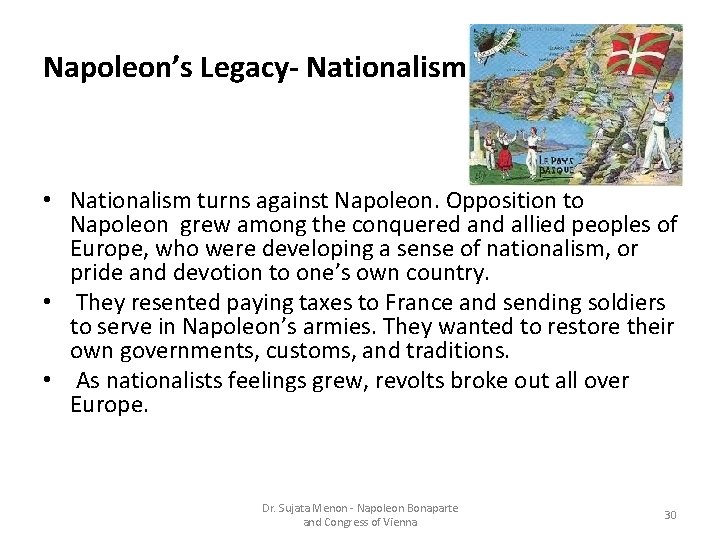
Napoleon’s Legacy- Nationalism • Nationalism turns against Napoleon. Opposition to Napoleon grew among the conquered and allied peoples of Europe, who were developing a sense of nationalism, or pride and devotion to one’s own country. • They resented paying taxes to France and sending soldiers to serve in Napoleon’s armies. They wanted to restore their own governments, customs, and traditions. • As nationalists feelings grew, revolts broke out all over Europe. Dr. Sujata Menon - Napoleon Bonaparte and Congress of Vienna 30
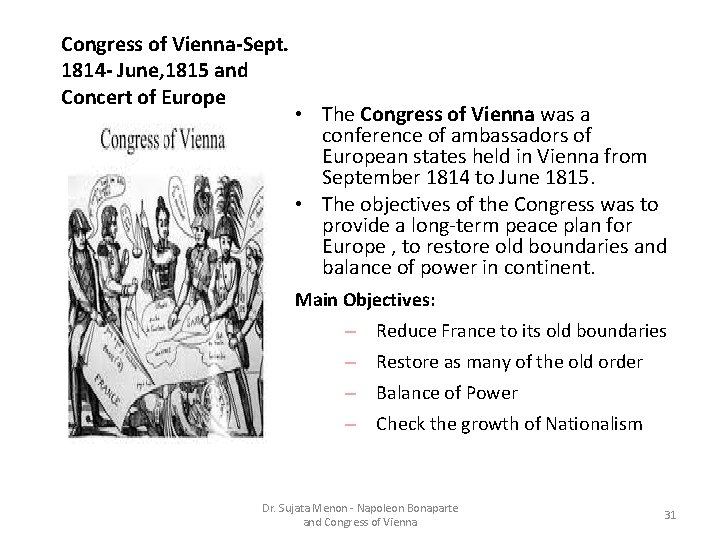
Congress of Vienna-Sept. 1814 - June, 1815 and Concert of Europe • The Congress of Vienna was a conference of ambassadors of European states held in Vienna from September 1814 to June 1815. • The objectives of the Congress was to provide a long-term peace plan for Europe , to restore old boundaries and balance of power in continent. Main Objectives: – Reduce France to its old boundaries – Restore as many of the old order – Balance of Power – Check the growth of Nationalism Dr. Sujata Menon - Napoleon Bonaparte and Congress of Vienna 31
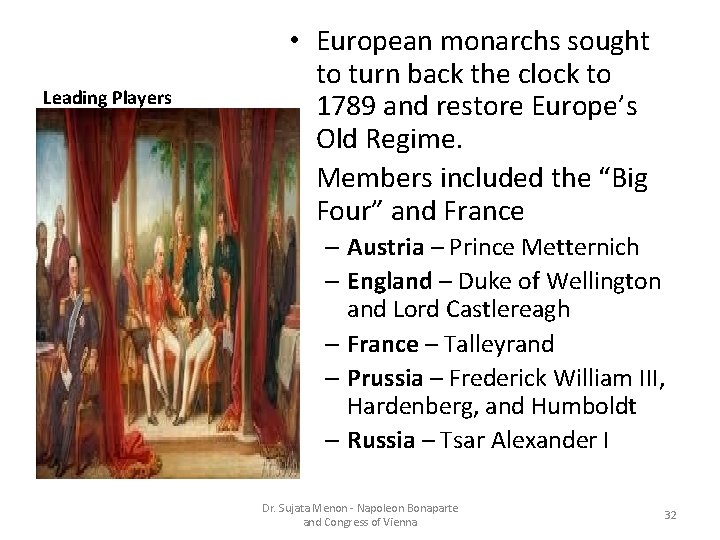
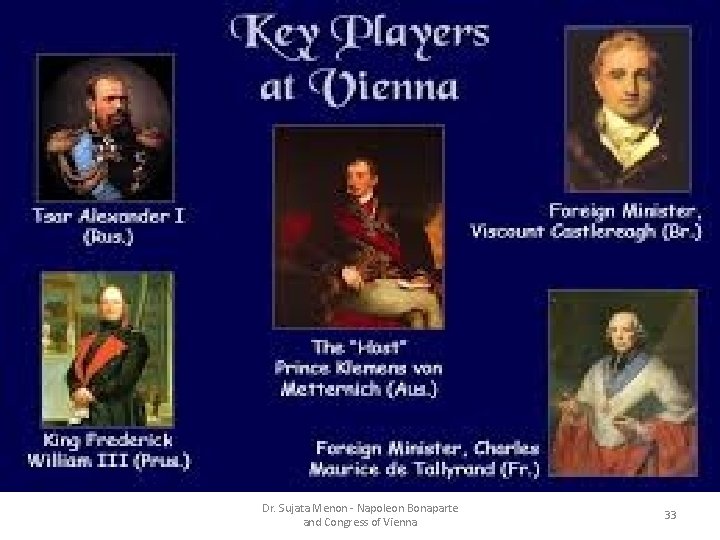
Leading Players • European monarchs sought to turn back the clock to 1789 and restore Europe’s Old Regime. • Members included the “Big Four” and France – Austria – Prince Metternich – England – Duke of Wellington and Lord Castlereagh – France – Talleyrand – Prussia – Frederick William III, Hardenberg, and Humboldt – Russia – Tsar Alexander I Dr. Sujata Menon - Napoleon Bonaparte and Congress of Vienna 32
Dr. Sujata Menon - Napoleon Bonaparte and Congress of Vienna 33
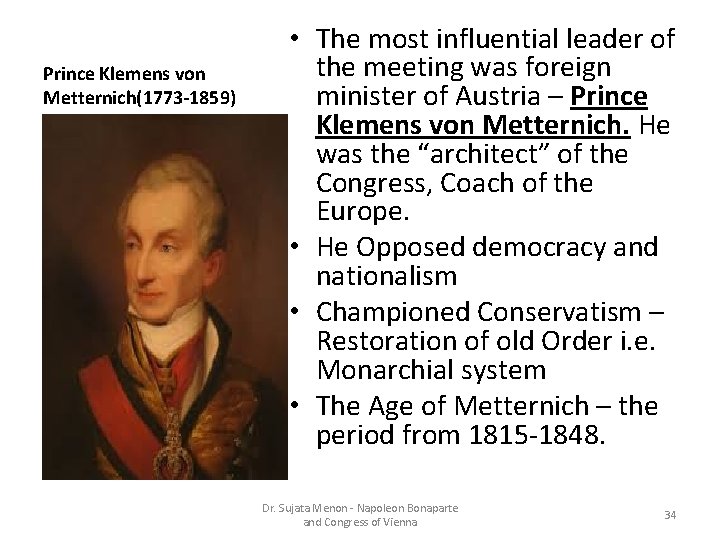
Prince Klemens von Metternich(1773 -1859) • The most influential leader of the meeting was foreign minister of Austria – Prince Klemens von Metternich. He was the “architect” of the Congress, Coach of the Europe. • He Opposed democracy and nationalism • Championed Conservatism – Restoration of old Order i. e. Monarchial system • The Age of Metternich – the period from 1815 -1848. Dr. Sujata Menon - Napoleon Bonaparte and Congress of Vienna 34
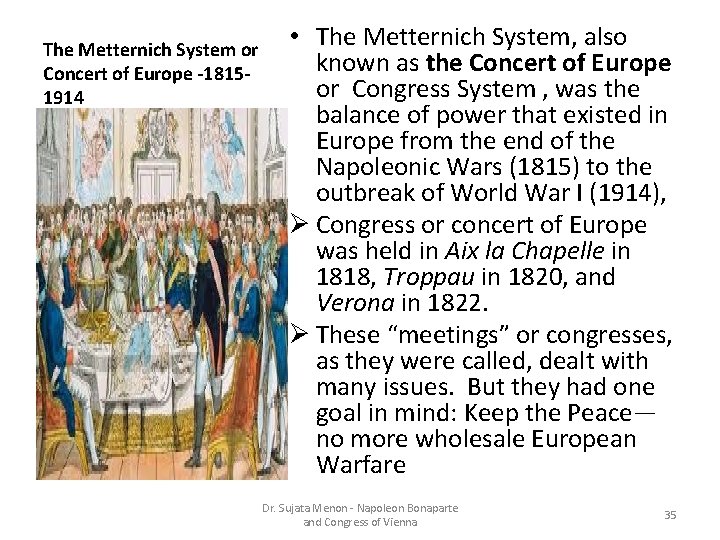
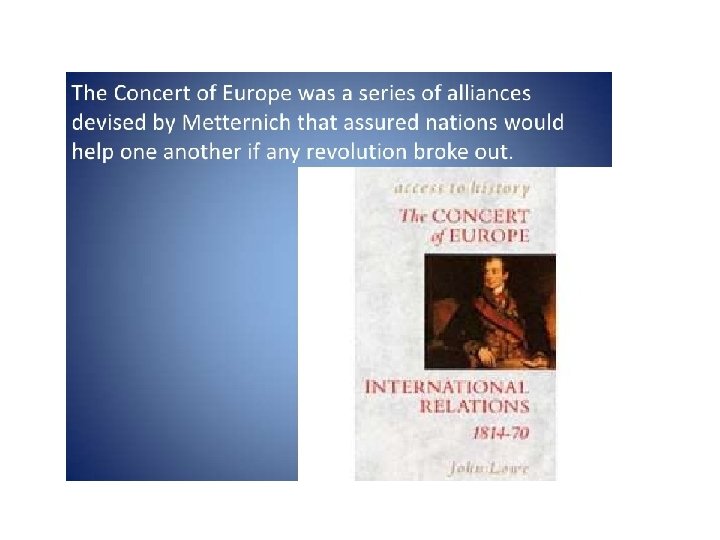
The Metternich System or Concert of Europe -18151914 • The Metternich System, also known as the Concert of Europe or Congress System , was the balance of power that existed in Europe from the end of the Napoleonic Wars (1815) to the outbreak of World War I (1914), Ø Congress or concert of Europe was held in Aix la Chapelle in 1818, Troppau in 1820, and Verona in 1822. Ø These “meetings” or congresses, as they were called, dealt with many issues. But they had one goal in mind: Keep the Peace— no more wholesale European Warfare Dr. Sujata Menon - Napoleon Bonaparte and Congress of Vienna 35
Other Alliances- Quadruple and Holy Alliances • Quadruple Alliance of 1815 – Austria, England, Prussia, and Russia – France joined in 1818 – Pledged to put down democratic or nationalistic revolts • Holy Alliance- was formed by Prussia , Austria and Russia on 26 September 1815 with the objectives of preserving Christian social values and traditional monarchism. • Largely Organized by Tsar Alexander I of Russia – Most European monarchs joined – Pledged to govern with charity, justice, and peace • But none of them did so. It did not work Dr. Sujata Menon - Napoleon Bonaparte and Congress of Vienna 37
Dr. Sujata Menon - Napoleon Bonaparte and Congress of Vienna 38
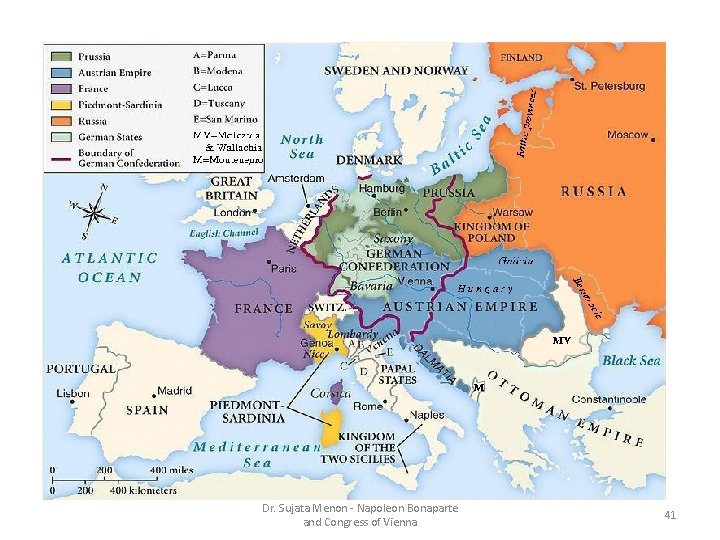
Compensation and Legitimacy • Metternich Proposed principles of compensation and legitimacy. • Compensation – nations compensated for land taken – Redrew the map of Europe • Legitimacy – – – – Restoration of pre-Napoleon Rulers and dynasties House of Bourbon – France, Spain, and the two Sicilies House of Braganza – Portugal House of Orange – Netherlands House of Savoy – Sardinia German princes – territories in the Confederation of the Rhine Pope and Catholic Church – Papal States Dr. Sujata Menon - Napoleon Bonaparte and Congress of Vienna 39
Territorial Changes • Austria gained Lombardy, Modena, Parma, Tuscany, and Venetia (all areas in Italy) • England gained Cape Colony, Ceylon, Heligoland, Guiana, and Malta (areas in Africa, the Americas, and Asia) • Holland gained Austrian Netherlands (Belgium) • Prussia gained part of Poland, land along the Rhine River, 40% of Saxony, Swedish Pomerania, and Westphalia • Russia gained Finland part of Poland • Sweden gained Norway Dr. Sujata Menon - Napoleon Bonaparte and Congress of Vienna 40
Dr. Sujata Menon - Napoleon Bonaparte and Congress of Vienna 41
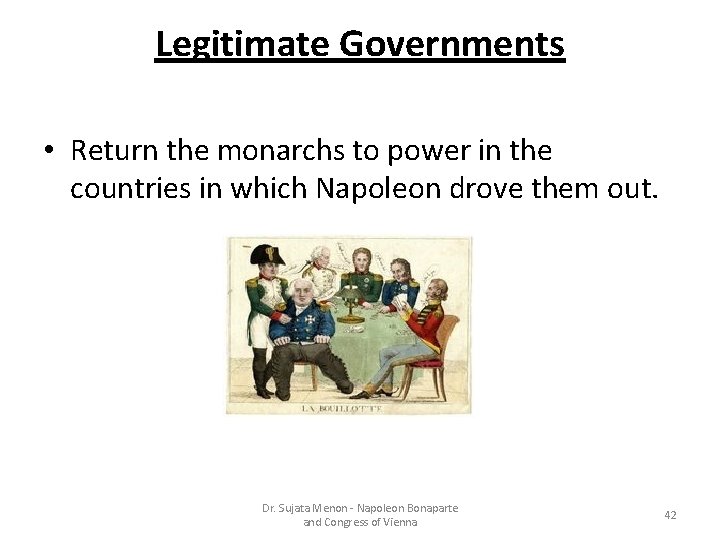
Legitimate Governments • Return the monarchs to power in the countries in which Napoleon drove them out. Dr. Sujata Menon - Napoleon Bonaparte and Congress of Vienna 42
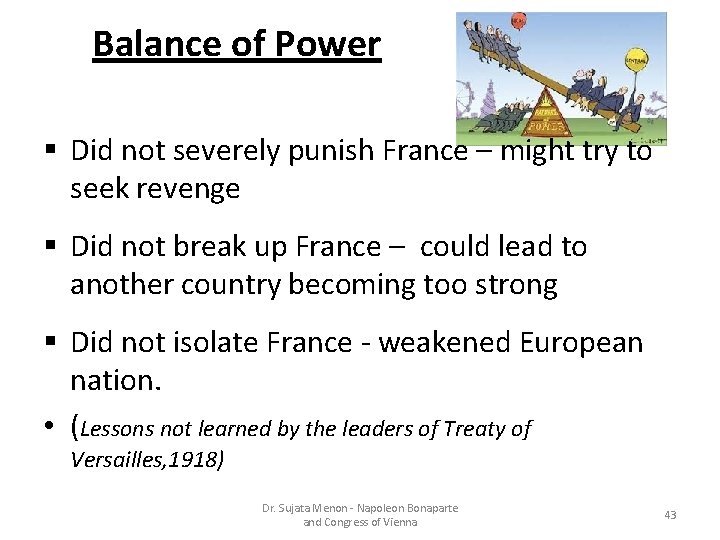
Balance of Power § Did not severely punish France – might try to seek revenge § Did not break up France – could lead to another country becoming too strong § Did not isolate France - weakened European nation. • (Lessons not learned by the leaders of Treaty of Versailles, 1918) Dr. Sujata Menon - Napoleon Bonaparte and Congress of Vienna 43

Working of Metternich System • Suppression of Revolution and Nationalism. Metternich used secret spies, censored papers, and suppressed students movements. • The Metternich system was adopted by other countries. Their leaders supported spying, informants, and suppression. Dr. Sujata Menon - Napoleon Bonaparte and Congress of Vienna 44
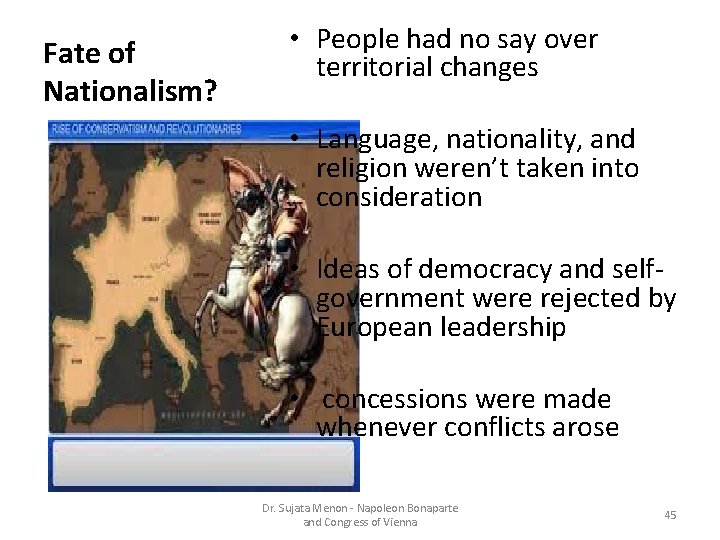
Fate of Nationalism? • People had no say over territorial changes • Language, nationality, and religion weren’t taken into consideration • Ideas of democracy and selfgovernment were rejected by European leadership • concessions were made whenever conflicts arose Dr. Sujata Menon - Napoleon Bonaparte and Congress of Vienna 45
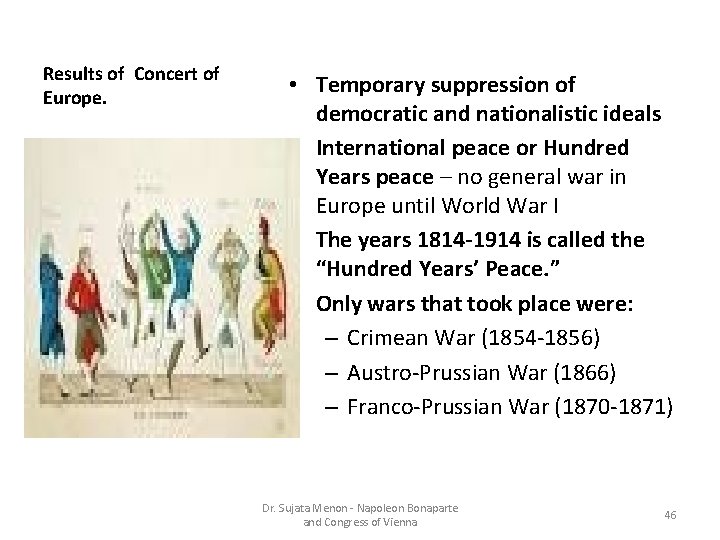
Results of Concert of Europe. • Temporary suppression of democratic and nationalistic ideals • International peace or Hundred Years peace – no general war in Europe until World War I • The years 1814 -1914 is called the “Hundred Years’ Peace. ” • Only wars that took place were: – Crimean War (1854 -1856) – Austro-Prussian War (1866) – Franco-Prussian War (1870 -1871) Dr. Sujata Menon - Napoleon Bonaparte and Congress of Vienna 46
- Slides: 46