
Napoleon Bonaparte Small But Mighty Who was Napoleon

Napoleon Bonaparte Small But Mighty
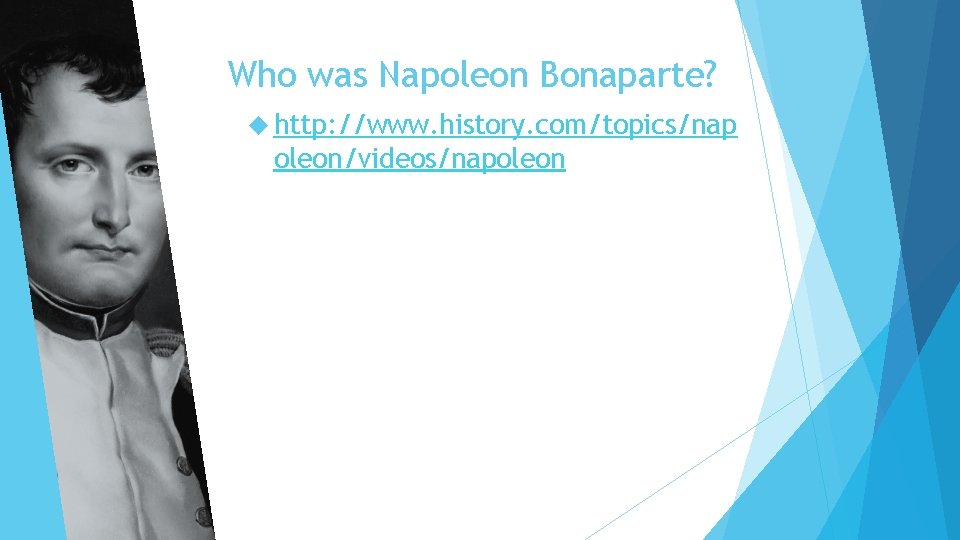
Who was Napoleon Bonaparte? http: //www. history. com/topics/nap oleon/videos/napoleon
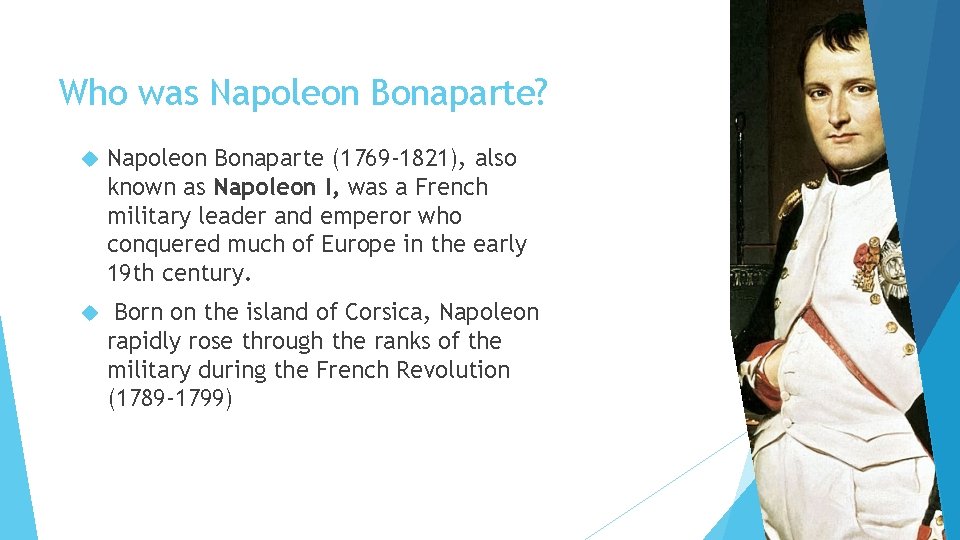
Who was Napoleon Bonaparte? Napoleon Bonaparte (1769 -1821), also known as Napoleon I, was a French military leader and emperor who conquered much of Europe in the early 19 th century. Born on the island of Corsica, Napoleon rapidly rose through the ranks of the military during the French Revolution (1789 -1799)
Napoleon’s Life Napoleon Bonaparte was born on August 15, 1769, in Ajaccio, on the Mediterranean island of Corsica. As a boy, Napoleon attended school in mainland France, where he learned the French language, and went on to graduate from a French military academy in 1785. He then became a second lieutenant in an artillery regiment of the French army. During the early years of the revolution, Napoleon was largely on leave from the military and home in Corsica, where he became affiliated with the Jacobins, a pro-democracy political group. In France, Napoleon became associated with Augustin Robespierre (17631794), the brother of revolutionary leader Maximilien Robespierre (17581794), a Jacobin who was a key force behind the Reign of Terror (1793 -1794)
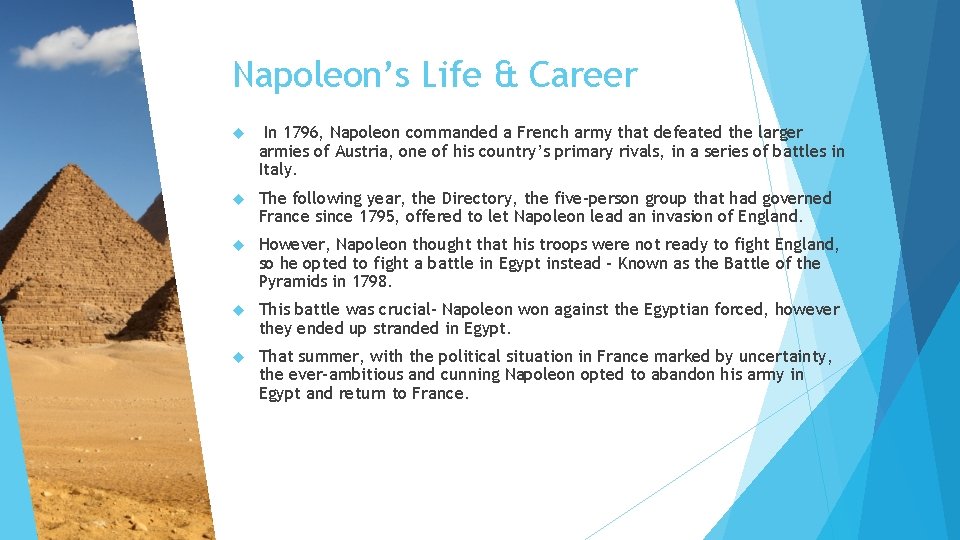
Napoleon’s Life & Career In 1796, Napoleon commanded a French army that defeated the larger armies of Austria, one of his country’s primary rivals, in a series of battles in Italy. The following year, the Directory, the five-person group that had governed France since 1795, offered to let Napoleon lead an invasion of England. However, Napoleon thought that his troops were not ready to fight England, so he opted to fight a battle in Egypt instead – Known as the Battle of the Pyramids in 1798. This battle was crucial- Napoleon won against the Egyptian forced, however they ended up stranded in Egypt. That summer, with the political situation in France marked by uncertainty, the ever-ambitious and cunning Napoleon opted to abandon his army in Egypt and return to France.

Turn and Talk Imagine that you had been fighting a bloody war in the desert for almost a year, only to find out that you can’t go home. How would you feel when you find out that your boss left you to die in Egypt?
Back in France… In November 1799, in an event known as the coup of 18 Brumaire, Napoleon was part of a group that successfully overthrew the French Directory. The Directory was replaced with a threemember Consulate, and Napoleon became first consul, making him France’s leading political figure.

Napoleon Crowns Himself Emperor The coronation of Napoleon as Emperor of the French took place on Sunday December 2, 1804 Napoleon wanted to establish legitimacy of his Imperial reign, with its new royal family and new nobility. Therefore, he designed a new coronation ceremony that was unlike the ceremony used for the kings of France. Instead of letting the Church Crown him as a leader, he crowned himself the leader, and decreed that he would be the supreme leader of France. Napoleon would be the Emperor from 18041815. Who’s the Empe ror No w? !
Good things that Napoleon Did Napoleon worked to restore stability to post-revolutionary France. He centralized the government instituted reforms in such areas as banking and education supported science and the arts Created the Napoleonic Code, which streamlined the French legal system and continues to form the foundation of French civil law to this day.
Napoleon’s rise From 1803 to 1815, France was engaged in the Napoleonic Wars, a series of major conflicts with various coalitions of European nations. In 1803, partly as a means to raise funds for future wars, Napoleon sold France’s Louisiana Territory in North America to the newly independent United States for $15 million, a transaction that later became known as the Louisiana Purchase. In October 1805, the British wiped out Napoleon’s fleet at the Battle of Trafalgar. However, in December of that same year, Napoleon achieved what is considered to be one of his greatest victories at the Battle of Austerlitz, in which his army defeated the Austrians and Russians. The victory resulted in the dissolution of the Holy Roman Empire and the creation of the Confederation of the Rhine.
Russia – The Ultimate demise and the 100 days In 1810, Russia withdrew from the Continental System. In retaliation, Napoleon led a massive army into Russia in the summer of 1812. Rather than engaging the French in a full-scale battle, the Russians adopted a strategy of retreating whenever Napoleon’s forces attempted to attack. As a result, Napoleon’s troops trekked deeper into Russia despite being illprepared for an extended campaign. In September, both sides suffered heavy casualties in the indecisive Battle of Borodino. Napoleon’s forces marched on to Moscow, only to discover almost the entire population evacuated. Retreating Russians set fires across the city in an effort to deprive enemy troops of supplies. After waiting a month for a surrender that never came, Napoleon, faced with the onset of the Russian winter, was forced to order his starving, exhausted army out of Moscow. During the disastrous retreat, his army suffered continual harassment from a suddenly aggressive and merciless Russian army. Of Napoleon’s 600, 000 troops who began the campaign, only an estimated 100, 000 made it out of Russia.
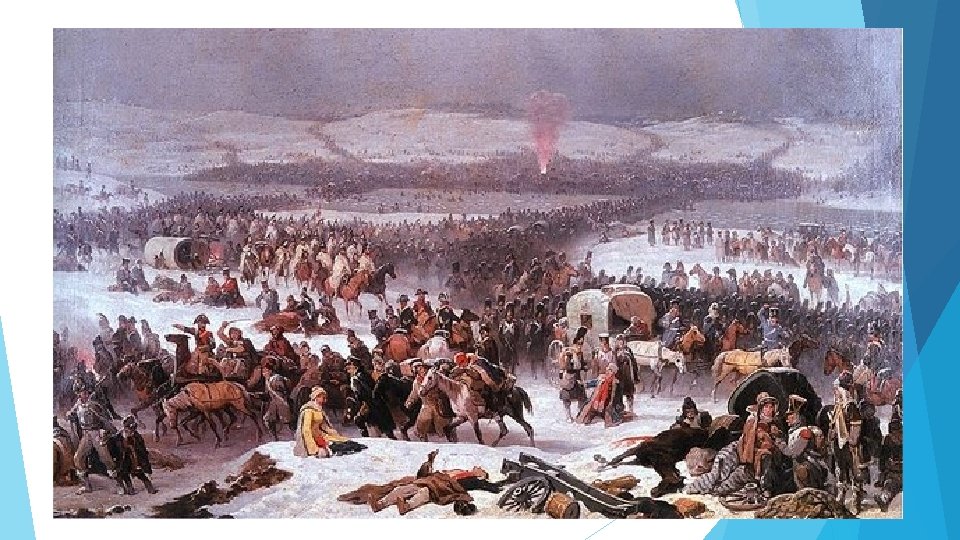


Russia http: //www. history. com/topics/n apoleon/videos/napoleon-invadesrussia
Napoleon’s FALL Upon Napoleon’s return to France, a coalition of allies–the Austrians, British, Prussians and Russians–who considered the French emperor an enemy began to prepare for war. Napoleon raised a new army and planned to strike preemptively, defeating the allied forces one by one before they could launch a united attack against him. In June 1815, his forces invaded Belgium, where British and Prussian troops were stationed. On June 16, Napoleon’s troops defeated the Prussians at the Battle of Ligny. However, two days later, on June 18, at the Battle of Waterloo near Brussels, the French were crushed by the British, with assistance from the Prussians. On June 22, 1815, Napoleon was once again forced to abdicate.

Napoleons final years In October 1815, Napoleon was exiled to the remote, Britishheld island of Saint Helena, in the South Atlantic Ocean. He died there on May 5, 1821, at age 51, most likely from stomach cancer.

Fun Fact Napoleon was only 5’ 1. Because of his small height, he often had himself painted ontop of horses, or sitting to disguise the fact that he was very short.
- Slides: 18