
NAP 6 Perioperative Anaphylaxis Antibiotics Shuaib Nasser Cambridge
NAP 6: Perioperative Anaphylaxis Antibiotics Shuaib Nasser Cambridge University Hospitals NHS Foundation Trust NAP 6 Steering Committee member
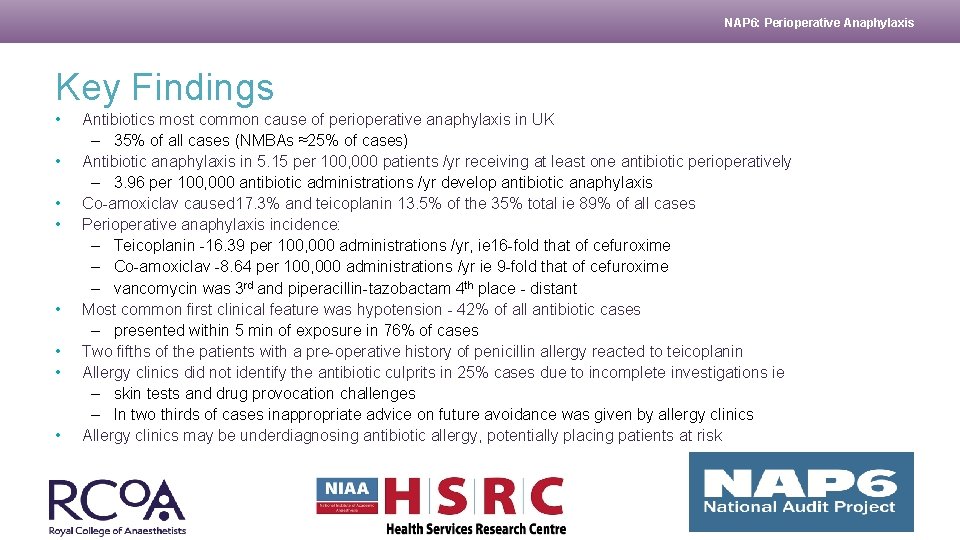
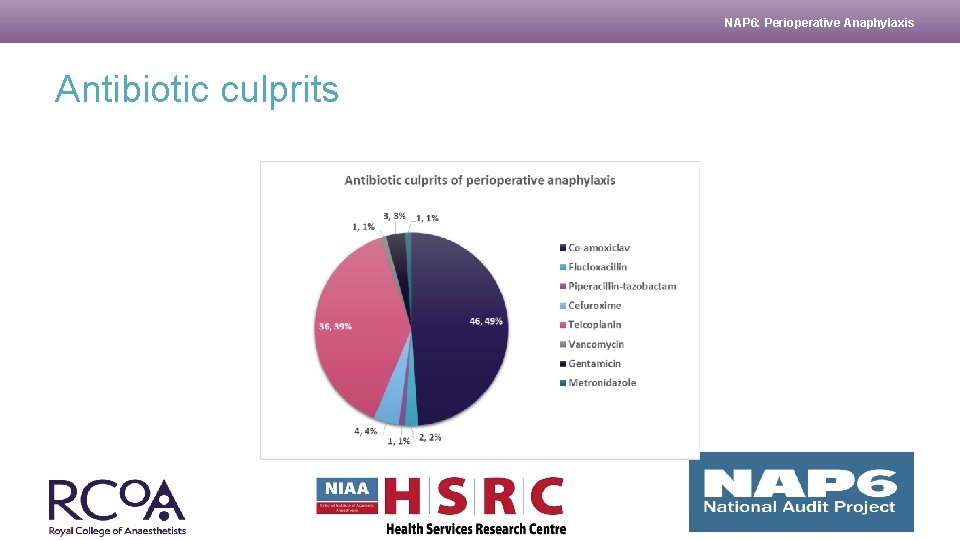
NAP 6: Perioperative Anaphylaxis Key Findings • • Antibiotics most common cause of perioperative anaphylaxis in UK – 35% of all cases (NMBAs ≈25% of cases) Antibiotic anaphylaxis in 5. 15 per 100, 000 patients /yr receiving at least one antibiotic perioperatively – 3. 96 per 100, 000 antibiotic administrations /yr develop antibiotic anaphylaxis Co-amoxiclav caused 17. 3% and teicoplanin 13. 5% of the 35% total ie 89% of all cases Perioperative anaphylaxis incidence: – Teicoplanin -16. 39 per 100, 000 administrations /yr, ie 16 -fold that of cefuroxime – Co-amoxiclav -8. 64 per 100, 000 administrations /yr ie 9 -fold that of cefuroxime – vancomycin was 3 rd and piperacillin-tazobactam 4 th place - distant Most common first clinical feature was hypotension - 42% of all antibiotic cases – presented within 5 min of exposure in 76% of cases Two fifths of the patients with a pre-operative history of penicillin allergy reacted to teicoplanin Allergy clinics did not identify the antibiotic culprits in 25% cases due to incomplete investigations ie – skin tests and drug provocation challenges – In two thirds of cases inappropriate advice on future avoidance was given by allergy clinics Allergy clinics may be underdiagnosing antibiotic allergy, potentially placing patients at risk

NAP 6: Perioperative Anaphylaxis Antibiotic allergy reported pre-operatively Allergy to Penicillin Cephalosporin Other antibiotic Penicillin 45 3 4 Cephalosporin 3 2 2 Other antibiotic 4 2 10 total 52 7 16

NAP 6: Perioperative Anaphylaxis Demographics –antibiotic allergy Age 6% 1% 3% 7% 9% 6 - 15 16 - 25 30% 26 - 35 36 - 45 46 - 55 18% 56 - 65 66 - 75 76 - 85 26%
NAP 6: Perioperative Anaphylaxis Antibiotic culprits

NAP 6: Perioperative Anaphylaxis Time interval from IV injection to first clinical feature Metronidazole Gentamicin Vancomycin 35 30 Teicoplanin 25 Cefuroxime 20 15 Piperacillin-tazobactam 10 Flucloxacillin 5 0 0 -5 min 6 -10 min 11 -15 min 16 -30 min Co-amoxiclav

NAP 6: Perioperative Anaphylaxis First Clinical Feature Bradycardia 1% 1% Tachycardia 2% 2% Hypotension 7% 13% 1% Cardiac arrest 3% Bronchospasm/High airway pressure 4% Cyanosis/Oxygen desaturation 7% Reduced/absent CO 2 trace Other Respiratory Distress Flushing/Non-urticarial rash 15% 42% Itching Laryngeal oedema/Stridor 1% Nausea/Vomiting Patient Feeling Unwell

NAP 6: Perioperative Anaphylaxis

NAP 6: Perioperative Anaphylaxis Grade of anaphylaxis for all antibiotics Grade Antibiotic Grade 3 Total Grade 4 Total Grade 5 Total all Total Co-amoxiclav 24 21 1 46 Teicoplanin 18 16 2 36 4 0 4 3 0 0 3 1 1 0 2 0 1 1 0 0 1 48 43 3 94 Cefuroxime Gentamicin Flucloxacillin Piperacillintazobactam Metronidazole Vancomycin Total
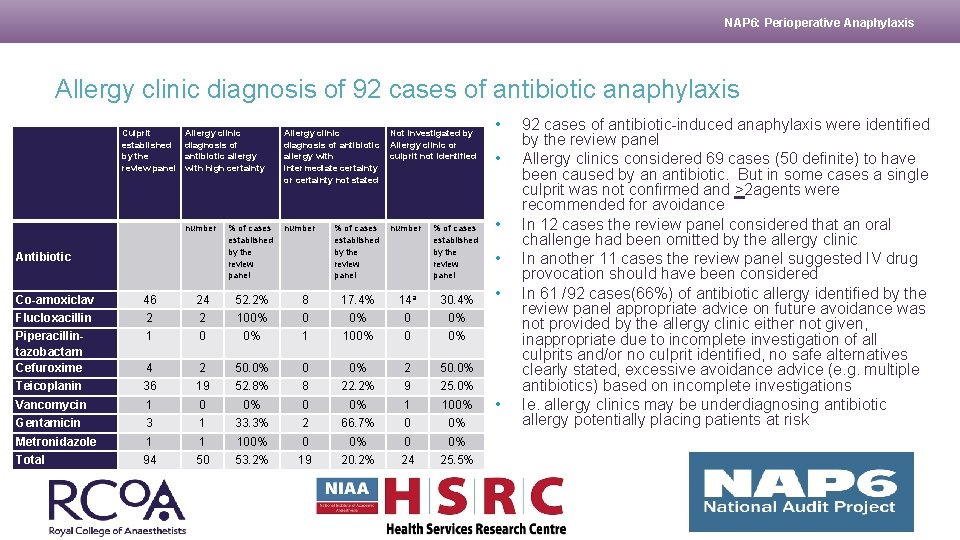
NAP 6: Perioperative Anaphylaxis Allergy clinic diagnosis of 92 cases of antibiotic anaphylaxis Culprit established by the review panel Allergy clinic diagnosis of antibiotic allergy with high certainty number Antibiotic Allergy clinic Not investigated by diagnosis of antibiotic Allergy clinic or allergy with culprit not identified intermediate certainty or certainty not stated % of cases number established by the review panel % of cases established by the review panel Co-amoxiclav 46 24 52. 2% 8 17. 4% 14 a 30. 4% Flucloxacillin 2 2 100% 0 0% Piperacillintazobactam Cefuroxime 1 0 0% 1 100% 0 0% 4 2 50. 0% 0 0% 2 50. 0% Teicoplanin 36 19 52. 8% 8 22. 2% 9 25. 0% Vancomycin 1 0 0% 1 100% Gentamicin 3 1 33. 3% 2 66. 7% 0 0% Metronidazole 1 1 100% 0 0% Total 94 50 53. 2% 19 20. 2% 24 25. 5% • • • 92 cases of antibiotic-induced anaphylaxis were identified by the review panel Allergy clinics considered 69 cases (50 definite) to have been caused by an antibiotic. But in some cases a single culprit was not confirmed and >2 agents were recommended for avoidance In 12 cases the review panel considered that an oral challenge had been omitted by the allergy clinic In another 11 cases the review panel suggested IV drug provocation should have been considered In 61 /92 cases(66%) of antibiotic allergy identified by the review panel appropriate advice on future avoidance was not provided by the allergy clinic either not given, inappropriate due to incomplete investigation of all culprits and/or no culprit identified, no safe alternatives clearly stated, excessive avoidance advice (e. g. multiple antibiotics) based on incomplete investigations Ie. allergy clinics may be underdiagnosing antibiotic allergy potentially placing patients at risk
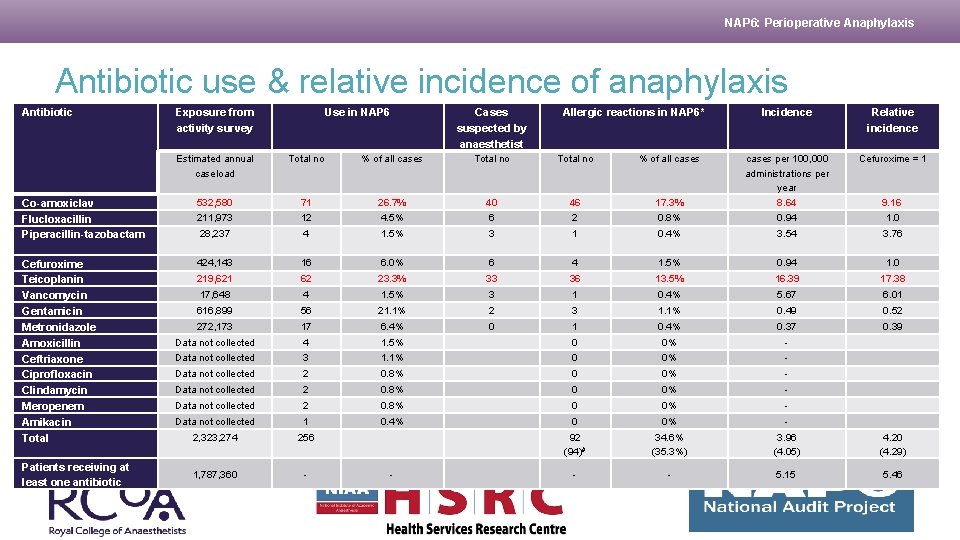
NAP 6: Perioperative Anaphylaxis Antibiotic use & relative incidence of anaphylaxis Antibiotic Exposure from activity survey Use in NAP 6 Cases suspected by anaesthetist Allergic reactions in NAP 6* Incidence Relative incidence Cefuroxime = 1 Estimated annual caseload Total no % of all cases Co-amoxiclav Flucloxacillin Piperacillin-tazobactam 532, 580 71 26. 7% 40 46 17. 3% cases per 100, 000 administrations per year 8. 64 211, 973 12 4. 5% 6 2 0. 8% 0. 94 1. 0 28, 237 4 1. 5% 3 1 0. 4% 3. 54 3. 76 Cefuroxime Teicoplanin Vancomycin Gentamicin Metronidazole Amoxicillin Ceftriaxone Ciprofloxacin Clindamycin Meropenem Amikacin Total 424, 143 16 6. 0% 6 4 1. 5% 0. 94 1. 0 219, 621 62 23. 3% 33 36 13. 5% 16. 39 17. 38 17, 648 4 1. 5% 3 1 0. 4% 5. 67 6. 01 616, 899 56 21. 1% 2 3 1. 1% 0. 49 0. 52 272, 173 17 6. 4% 0 1 0. 4% 0. 37 0. 39 Data not collected 4 1. 5% 0 0% - Data not collected 3 1. 1% 0 0% - Data not collected 2 0. 8% 0 0% - Data not collected 1 0. 4% 0 0% - 2, 323, 274 256 92 (94)# 34. 6% (35. 3%) 3. 96 (4. 05) 4. 20 (4. 29) 1, 787, 360 - - 5. 15 5. 46 Patients receiving at least one antibiotic 9. 16
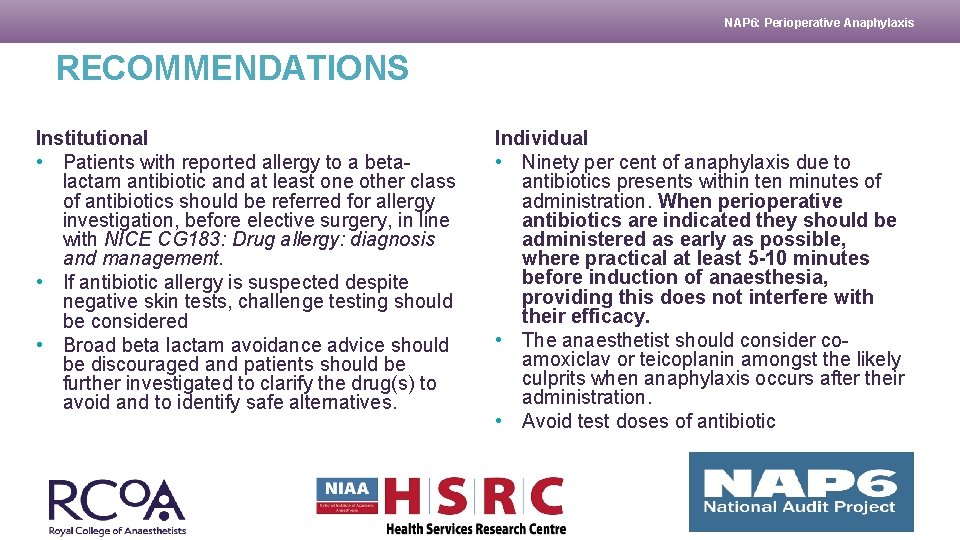
NAP 6: Perioperative Anaphylaxis RECOMMENDATIONS Institutional • Patients with reported allergy to a betalactam antibiotic and at least one other class of antibiotics should be referred for allergy investigation, before elective surgery, in line with NICE CG 183: Drug allergy: diagnosis and management. • If antibiotic allergy is suspected despite negative skin tests, challenge testing should be considered • Broad beta lactam avoidance advice should be discouraged and patients should be further investigated to clarify the drug(s) to avoid and to identify safe alternatives. Individual • Ninety per cent of anaphylaxis due to antibiotics presents within ten minutes of administration. When perioperative antibiotics are indicated they should be administered as early as possible, where practical at least 5 -10 minutes before induction of anaesthesia, providing this does not interfere with their efficacy. • The anaesthetist should consider co- amoxiclav or teicoplanin amongst the likely culprits when anaphylaxis occurs after their administration. • Avoid test doses of antibiotic
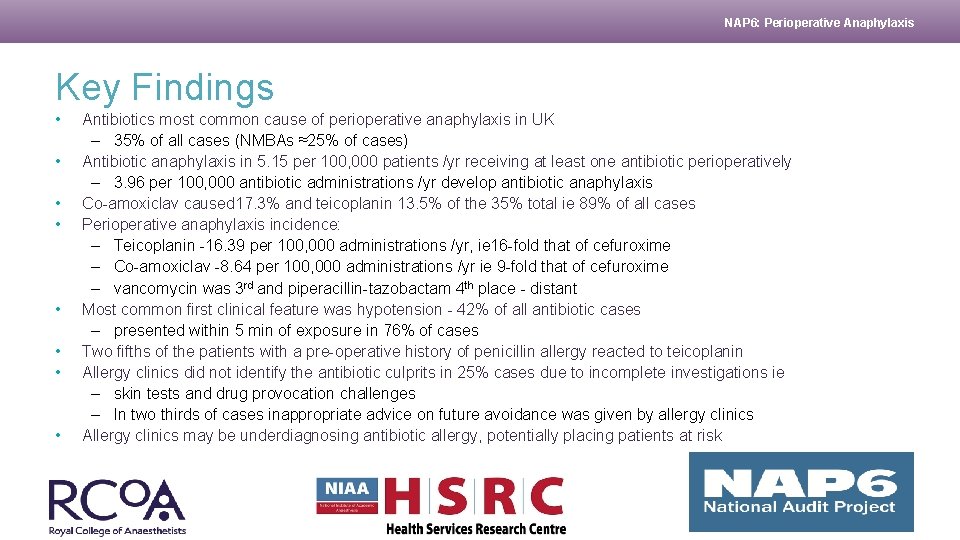
NAP 6: Perioperative Anaphylaxis Key Findings • • Antibiotics most common cause of perioperative anaphylaxis in UK – 35% of all cases (NMBAs ≈25% of cases) Antibiotic anaphylaxis in 5. 15 per 100, 000 patients /yr receiving at least one antibiotic perioperatively – 3. 96 per 100, 000 antibiotic administrations /yr develop antibiotic anaphylaxis Co-amoxiclav caused 17. 3% and teicoplanin 13. 5% of the 35% total ie 89% of all cases Perioperative anaphylaxis incidence: – Teicoplanin -16. 39 per 100, 000 administrations /yr, ie 16 -fold that of cefuroxime – Co-amoxiclav -8. 64 per 100, 000 administrations /yr ie 9 -fold that of cefuroxime – vancomycin was 3 rd and piperacillin-tazobactam 4 th place - distant Most common first clinical feature was hypotension - 42% of all antibiotic cases – presented within 5 min of exposure in 76% of cases Two fifths of the patients with a pre-operative history of penicillin allergy reacted to teicoplanin Allergy clinics did not identify the antibiotic culprits in 25% cases due to incomplete investigations ie – skin tests and drug provocation challenges – In two thirds of cases inappropriate advice on future avoidance was given by allergy clinics Allergy clinics may be underdiagnosing antibiotic allergy, potentially placing patients at risk

NAP 6: Perioperative Anaphylaxis Thank you
- Slides: 14