
NANTAI NVERSTES MATERIALS SCIENCE CHAPTER 7 HEAT TREATMENT
- Slides: 10
NİŞANTAŞI ÜNİVERSİTESİ MATERIALS SCIENCE CHAPTER 7 - HEAT TREATMENT OF STEELS Mühendislik Mimarlık Fakültesi mmf. nisantasi. edu. tr NİŞANTAŞI ÜNİVERS İTESİ ©
Heat Treating – defined as the controlled heating and cooling of metals for the primary purpose of altering their properties (strength, ductility, hardness, toughness, machinability, etc) Can be done for Strengthening Purposes (converting structure to martensite) Can be done for Softening and Conditioning Purposes (annealing, tempering, etc. )
HEAT TREATMENT OF STEELS FOR STRENGTH: • • • Steel = 0. 06% to 1. 0% carbon Must have a carbon content of at least. 6% (ideally) to heat treat. Must heat to austenitic temperature range. Must rapid quench to prevent formation of equilibrium products. Basically crystal structure changes from BCC to FCC at high Temp. The FCC can hold more carbon in solution and on rapid cooling the crystal structure wants to return to its BCC structure. It cannot due to trapped carbon atoms. The net result is a distorted crystal structure called body centered tetragonal called martensite. • Almost always followed by tempering.
DIRECT HARDENING – AUSTENITIZING AND QUENCH: • Austenitizing – again taking a steel with. 6% carbon or greater and heating to the austenite region. • Rapid quench to trap the carbon in the crystal structure – called martensite (BCT) • Quench requirements determined from isothermal transformation diagram (IT diagram).
Direct Hardening - Selective Hardening : • Same requirements as austenitizing: – Must have sufficient carbon levels (>0. 4%) – Heat to austenite region and quench • Why do? – When only desire a select region to be hardened: Knives, gears, etc. – Object to big to heat in furnace! Large casting w/ wear surface • Types: – Flame hardening, induction hardening, laser beam hardening
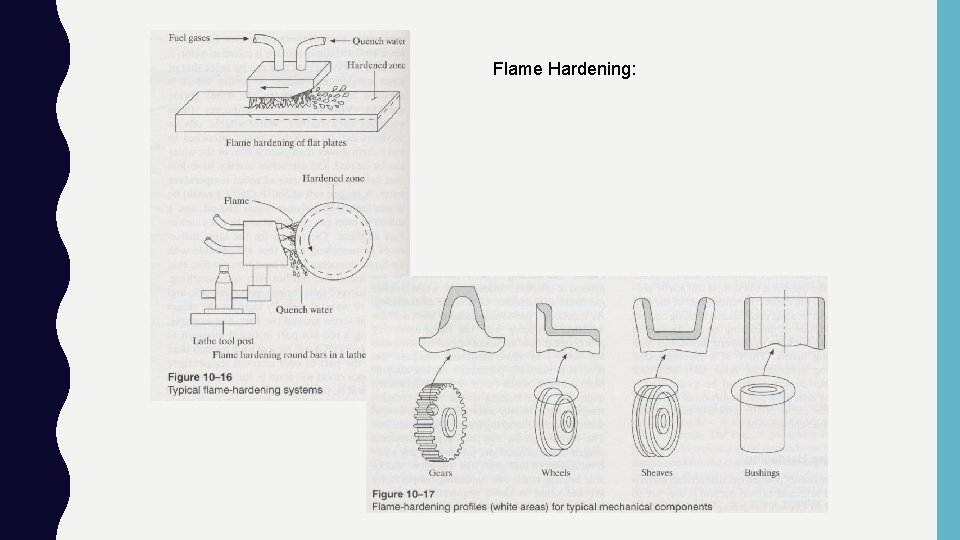
Flame Hardening:
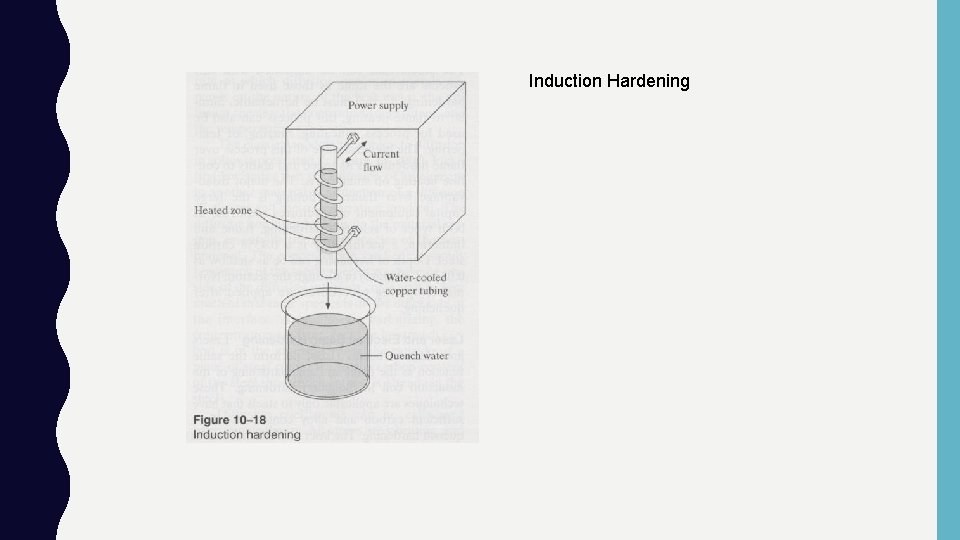
Induction Hardening
DIFFUSION HARDENING (AKA CASE HARDENING): • Why do? – Carbon content to low to through harden with previous processes. – Desire hardness only in select area – More controlled versus flame hardening and induction hardening. – Can get VERY hard local areas (i. e. HRC of 60 or greater) – Interstitial diffusion when tiny solute atoms diffuce into spaces of host atoms – Substitiutional diffusion when diffusion atoms to big to occupy interstitial sites – then must occupy vacancies
DIFFUSION HARDENING: • Most Common Types: – Carburizing – Nitriding – Carbonitriding – Cyaniding
REFERENCES 1. The Science and Engineering of Materials, 4 th ed Donald R. Askeland – Pradeep P. Phulé 2. Heat Treatment and Properties of Iron and Steel Thomas G. Digges, Samuel J. Rosenberg, and Glenn W. Geil National Bureau of Standards Monograph 88 Issued November 1, 1966 NİŞANTAŞI ÜNİVERSİTESİ ©