
NANTAI NVERSTES BUILDING MATERIALS CHAPTER 5 MAKING CONCRETE

NİŞANTAŞI ÜNİVERSİTESİ BUILDING MATERIALS CHAPTER 5 -MAKING CONCRETE: CEMENTS Mühendislik Mimarlık Fakültesi mmf. nisantasi. edu. tr NİŞANTAŞI ÜNİVERS İTESİ ©
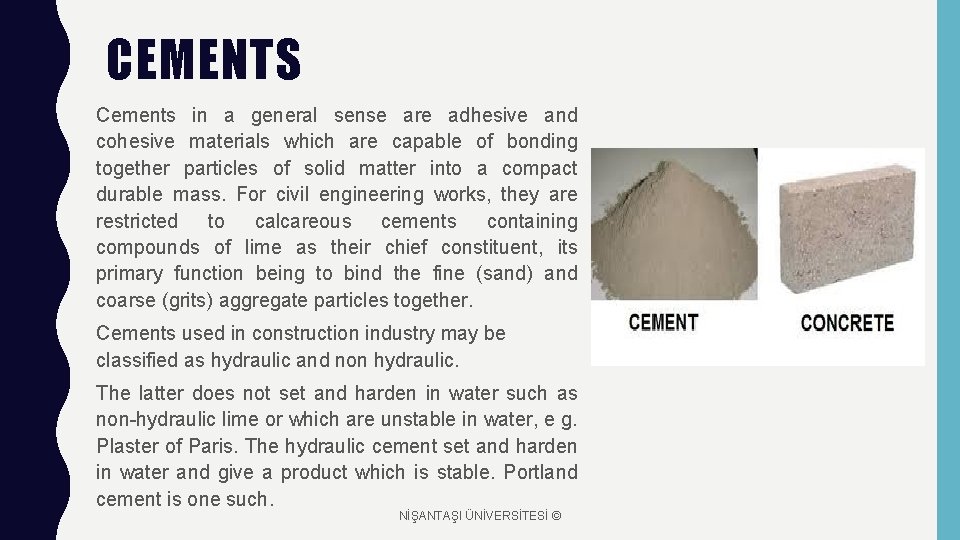
CEMENTS Cements in a general sense are adhesive and cohesive materials which are capable of bonding together particles of solid matter into a compact durable mass. For civil engineering works, they are restricted to calcareous cements containing compounds of lime as their chief constituent, its primary function being to bind the fine (sand) and coarse (grits) aggregate particles together. Cements used in construction industry may be classified as hydraulic and non hydraulic. The latter does not set and harden in water such as non-hydraulic lime or which are unstable in water, e g. Plaster of Paris. The hydraulic cement set and harden in water and give a product which is stable. Portland cement is one such. NİŞANTAŞI ÜNİVERSİTESİ ©
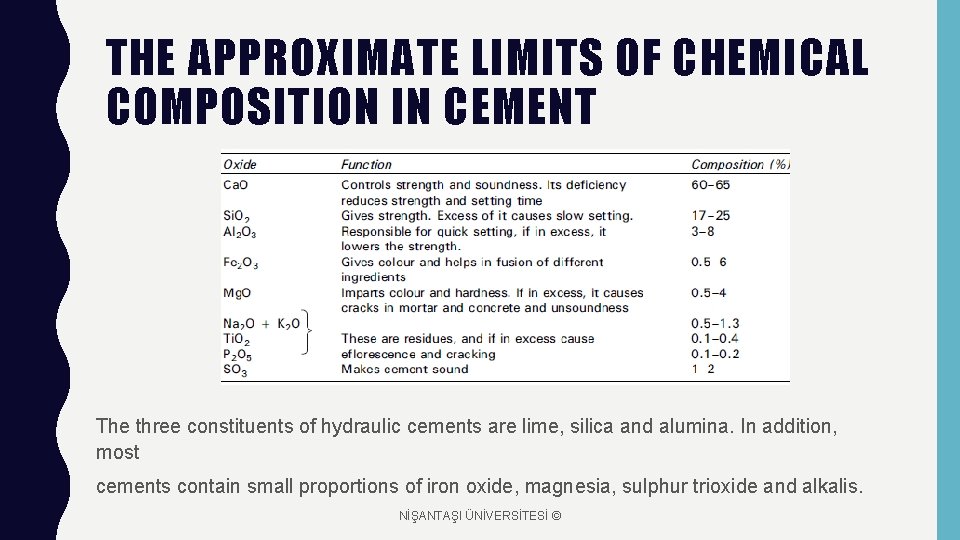
THE APPROXIMATE LIMITS OF CHEMICAL COMPOSITION IN CEMENT The three constituents of hydraulic cements are lime, silica and alumina. In addition, most cements contain small proportions of iron oxide, magnesia, sulphur trioxide and alkalis. NİŞANTAŞI ÜNİVERSİTESİ ©

HYDRATION OF CEMENT The chemical reaction between cement and water is known as hydration of cement. The reaction takes place between the active components of cement (C 4 AF, C 3 A, C 3 S and C 2 S) and water. The factors responsible for the physical properties of concrete are the extent of hydration of cement and the resultant microstructure of the hydrated cement. The reactions of the compounds and their products are as follows: NİŞANTAŞI ÜNİVERSİTESİ ©
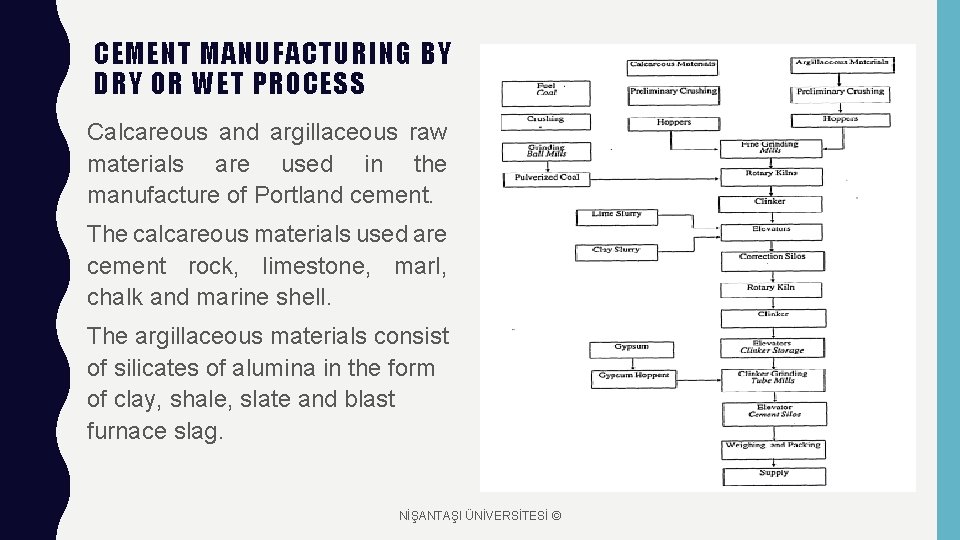
CEMENT MANUFACTURING BY DRY OR WET PROCESS Calcareous and argillaceous raw materials are used in the manufacture of Portland cement. The calcareous materials used are cement rock, limestone, marl, chalk and marine shell. The argillaceous materials consist of silicates of alumina in the form of clay, shale, slate and blast furnace slag. NİŞANTAŞI ÜNİVERSİTESİ ©
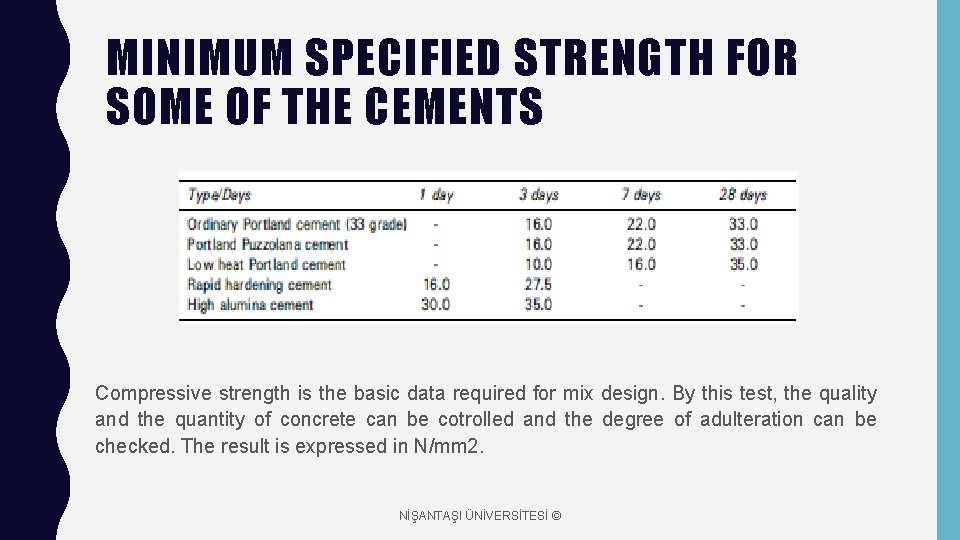
MINIMUM SPECIFIED STRENGTH FOR SOME OF THE CEMENTS Compressive strength is the basic data required for mix design. By this test, the quality and the quantity of concrete can be cotrolled and the degree of adulteration can be checked. The result is expressed in N/mm 2. NİŞANTAŞI ÜNİVERSİTESİ ©
REFERENCES 1. S. K. DUGGAL, BUILDING MATERIALS, NEW AGE INTERNATIONAL (P) LIMITED, PUBLISHERS NİŞANTAŞI ÜNİVERSİTESİ ©
- Slides: 7