
Nanotechnology Spatial Computing Using Molecular Electronics Mihai Budiu

Nanotechnology: Spatial Computing Using Molecular Electronics Mihai Budiu joint work with Seth Copen Goldstein Dan Rosewater SSS April 20, 2001
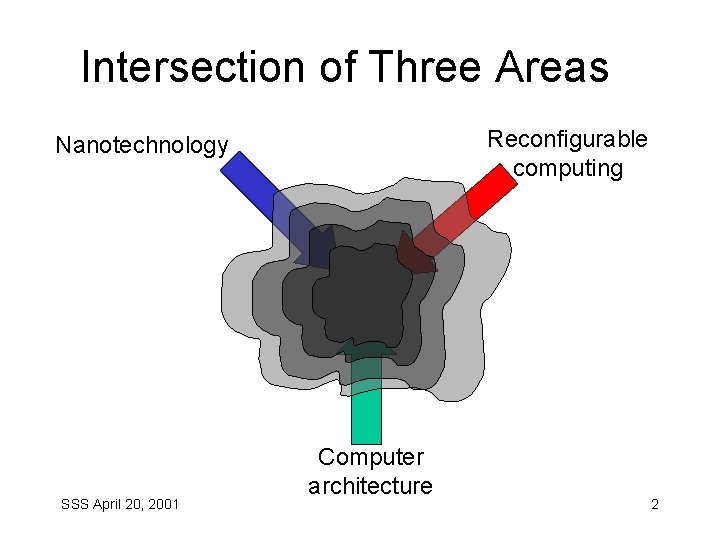
Intersection of Three Areas Reconfigurable computing Nanotechnology SSS April 20, 2001 Computer architecture 2
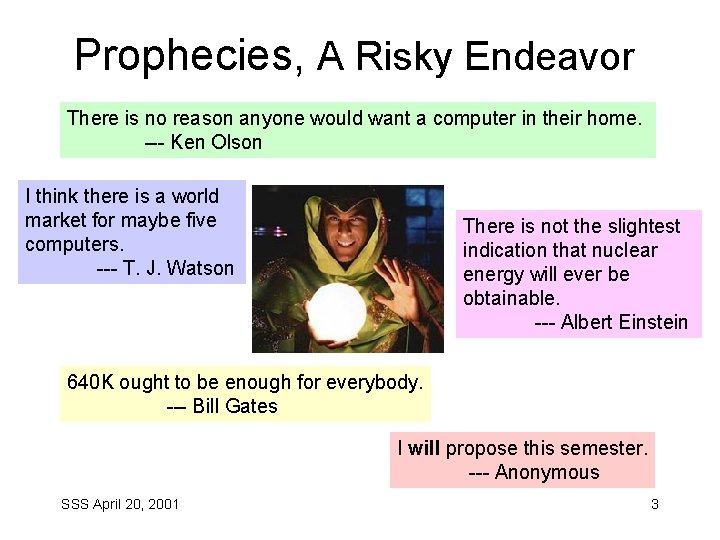
Prophecies, A Risky Endeavor There is no reason anyone would want a computer in their home. --- Ken Olson I think there is a world market for maybe five computers. --- T. J. Watson There is not the slightest indication that nuclear energy will ever be obtainable. --- Albert Einstein 640 K ought to be enough for everybody. --- Bill Gates I will propose this semester. --- Anonymous SSS April 20, 2001 3
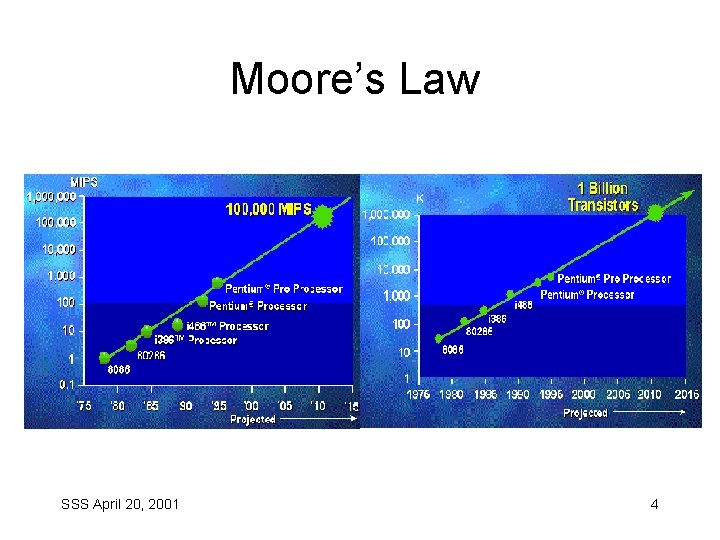
Moore’s Law SSS April 20, 2001 4
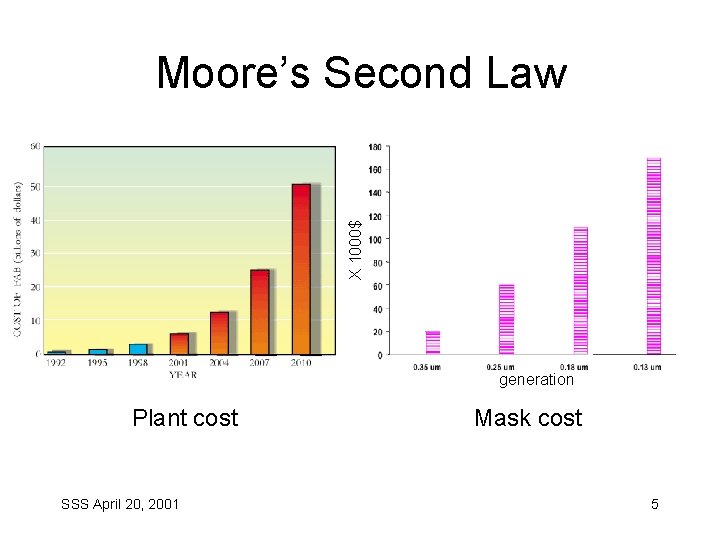
X 1000$ Moore’s Second Law generation Plant cost SSS April 20, 2001 Mask cost 5
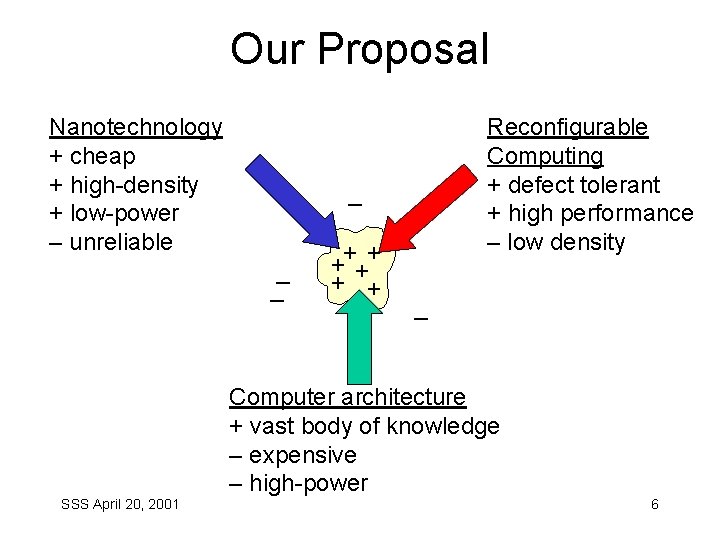
Our Proposal Nanotechnology + cheap + high-density + low-power – unreliable Reconfigurable Computing + defect tolerant + high performance – low density _ _ _ ++++ + + _ Computer architecture + vast body of knowledge – expensive – high-power SSS April 20, 2001 6
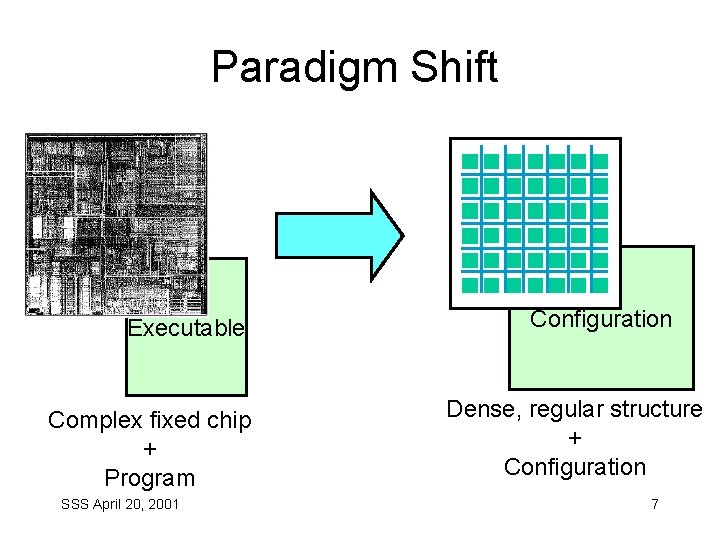
Paradigm Shift Executable Complex fixed chip + Program SSS April 20, 2001 Configuration Dense, regular structure + Configuration 7
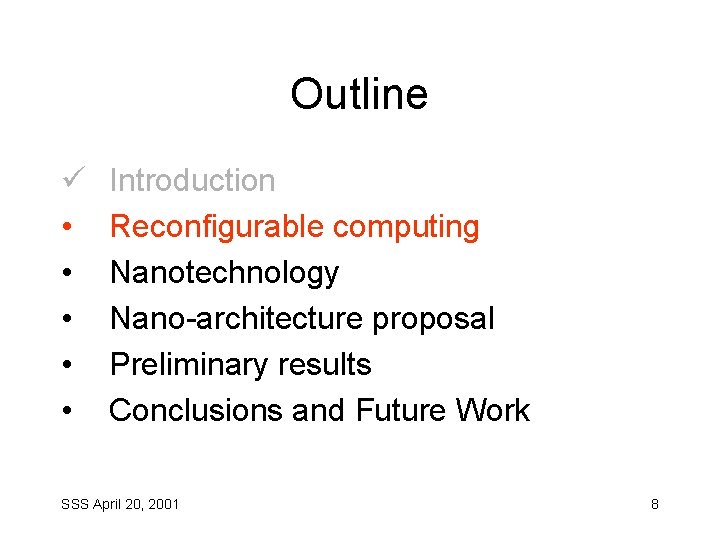
Outline ü • • • Introduction Reconfigurable computing Nanotechnology Nano-architecture proposal Preliminary results Conclusions and Future Work SSS April 20, 2001 8

Reconfigurable Computing • Back to ENIAC-style computing • Synthesize one machine to solve one problem SSS April 20, 2001 9
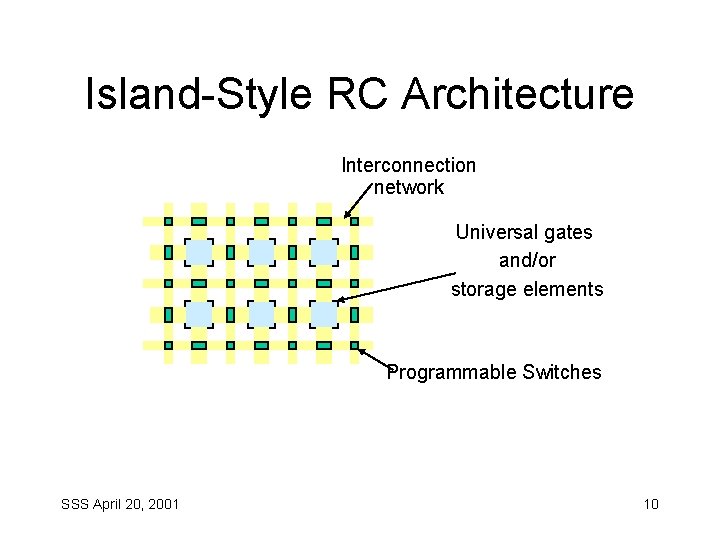
Island-Style RC Architecture Interconnection network Universal gates and/or storage elements Programmable Switches SSS April 20, 2001 10
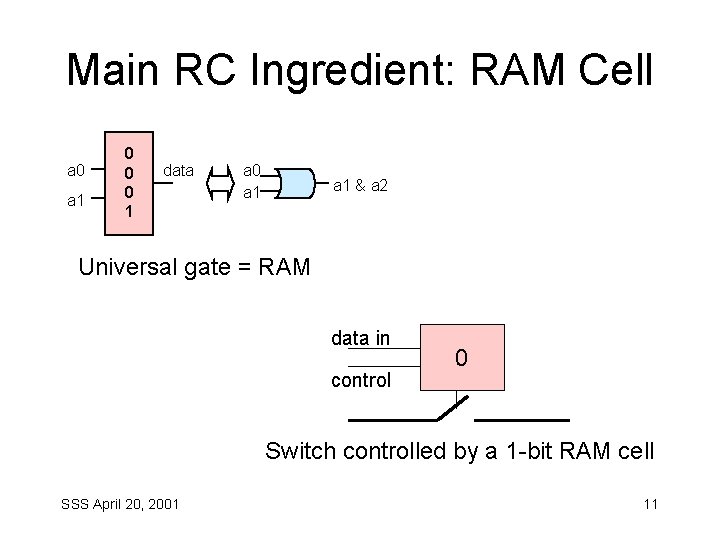
Main RC Ingredient: RAM Cell a 0 a 1 0 0 0 1 data a 0 a 1 & a 2 Universal gate = RAM data in control 0 Switch controlled by a 1 -bit RAM cell SSS April 20, 2001 11
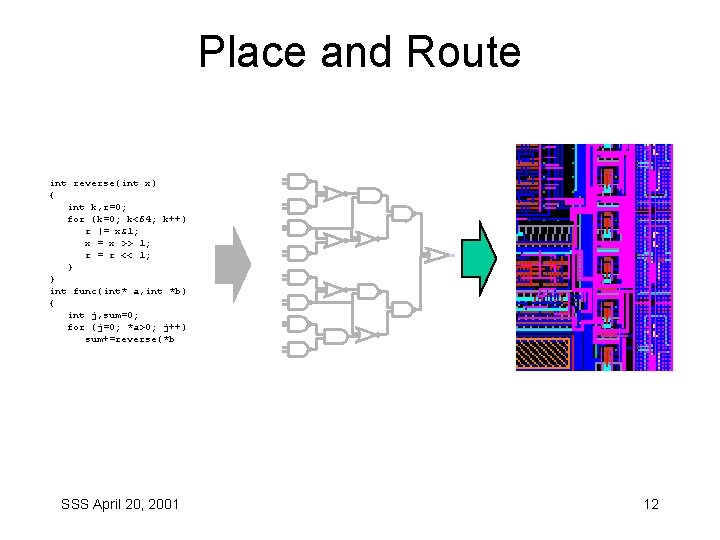
Place and Route int reverse(int x) { int k, r=0; for (k=0; k<64; k++) r |= x&1; x = x >> 1; r = r << 1; } } int func(int* a, int *b) { int j, sum=0; for (j=0; *a>0; j++) sum+=reverse(*b SSS April 20, 2001 12
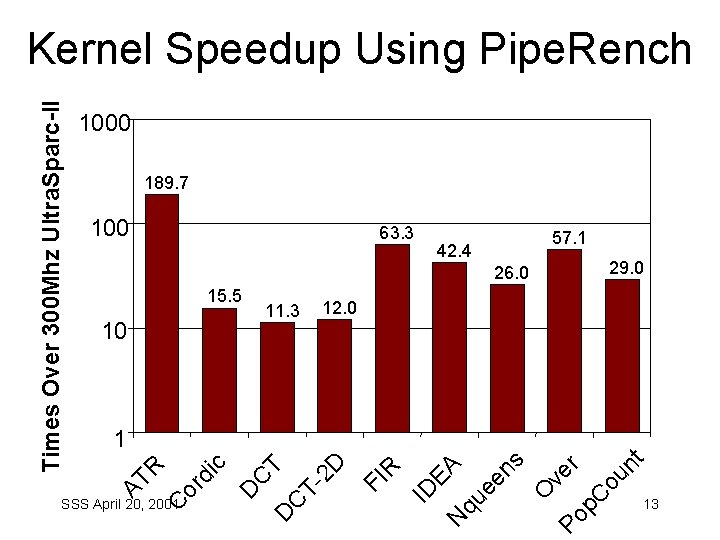
1000 189. 7 100 63. 3 57. 1 42. 4 29. 0 26. 0 15. 5 11. 3 10 12. 0 nt p. C ou r ve ns ee O Po N qu EA ID R FI 2 D C T- T C D C SSS April 20, 2001 D or di R c 1 AT Times Over 300 Mhz Ultra. Sparc-II Kernel Speedup Using Pipe. Rench 13
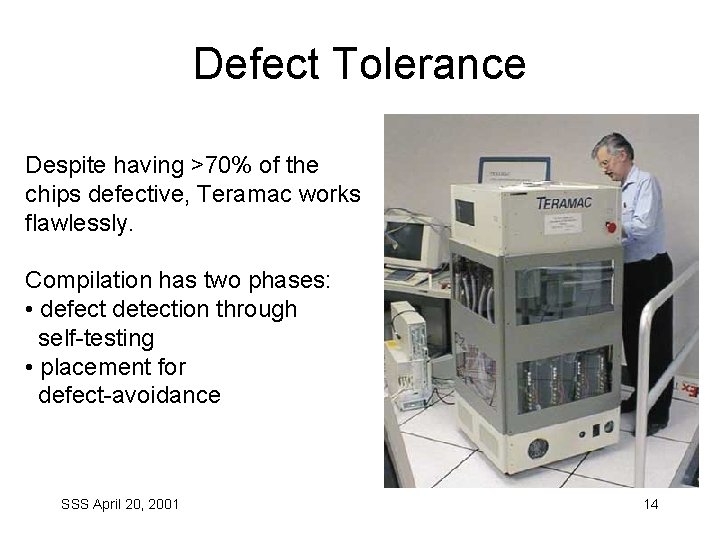
Defect Tolerance Despite having >70% of the chips defective, Teramac works flawlessly. Compilation has two phases: • defect detection through self-testing • placement for defect-avoidance SSS April 20, 2001 14
Outline ü ü • • Introduction Reconfigurable computing Nanotechnology Nano-architecture proposal Preliminary results Conclusions and Future work SSS April 20, 2001 15
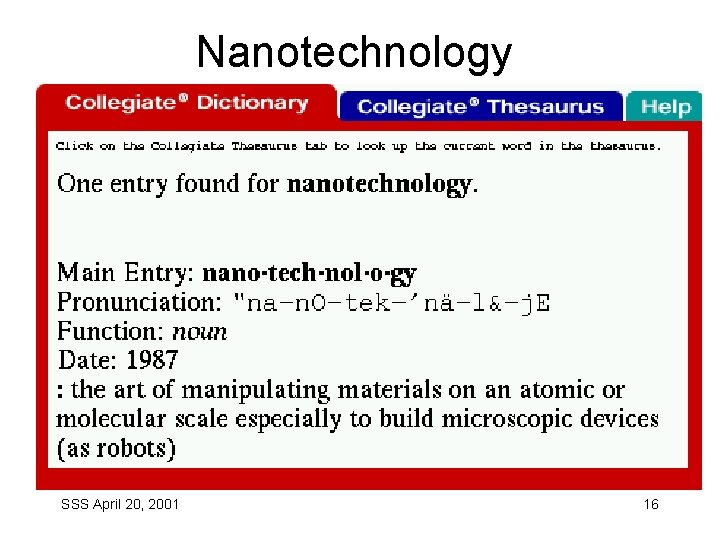
Nanotechnology SSS April 20, 2001 16
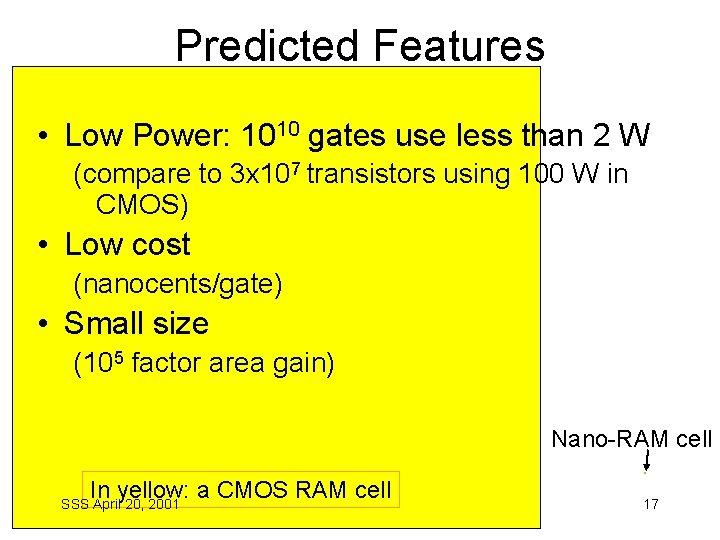
Predicted Features • Low Power: 1010 gates use less than 2 W (compare to 3 x 10⁷ transistors using 100 W in CMOS) • Low cost (nanocents/gate) • Small size (105 factor area gain) Nano-RAM cell In yellow: a CMOS RAM cell SSS April 20, 2001 . 17
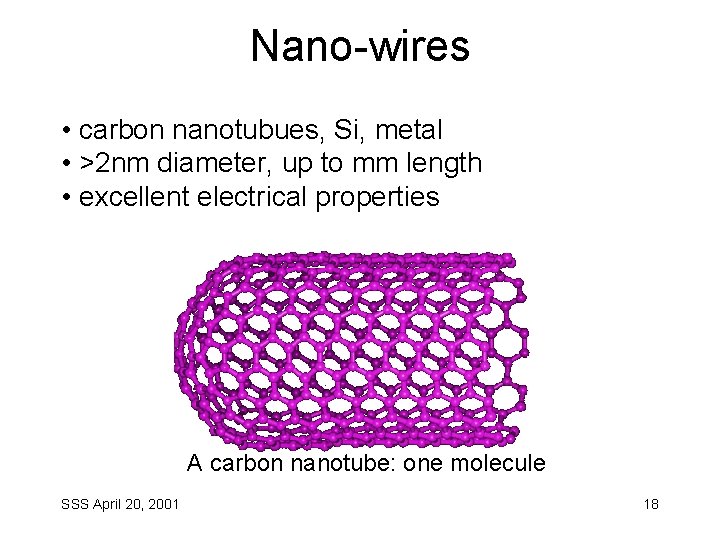
Nano-wires • carbon nanotubues, Si, metal • >2 nm diameter, up to mm length • excellent electrical properties A carbon nanotube: one molecule SSS April 20, 2001 18
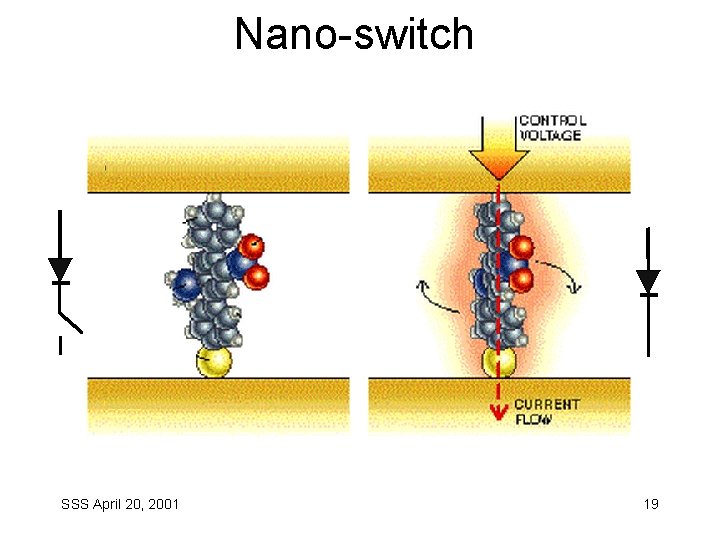
Nano-switch SSS April 20, 2001 19
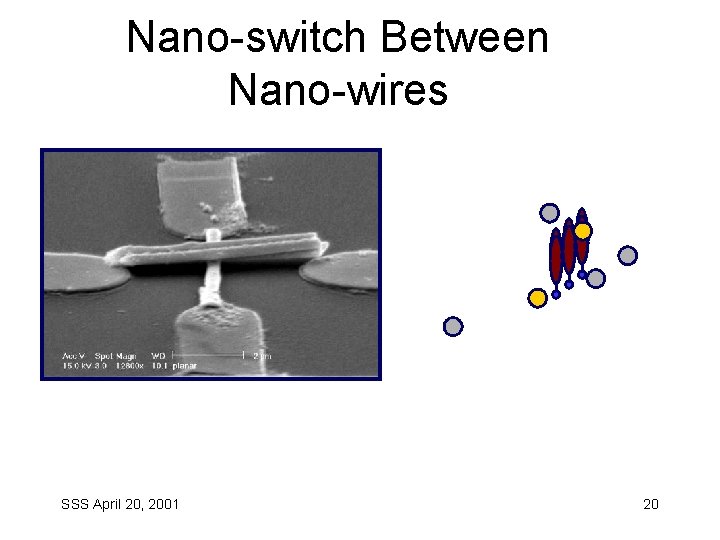
Nano-switch Between Nano-wires SSS April 20, 2001 20
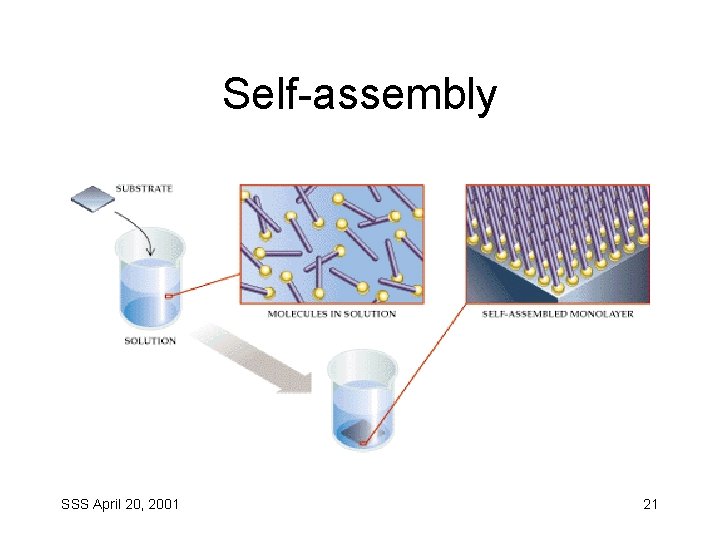
Self-assembly SSS April 20, 2001 21
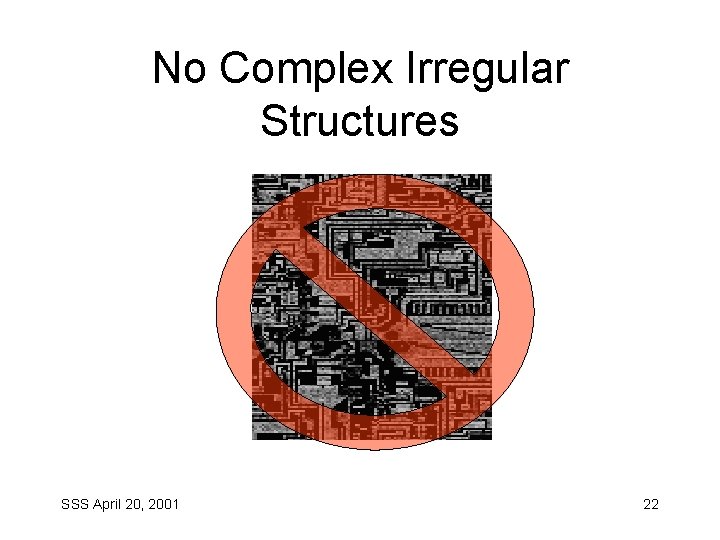
No Complex Irregular Structures SSS April 20, 2001 22
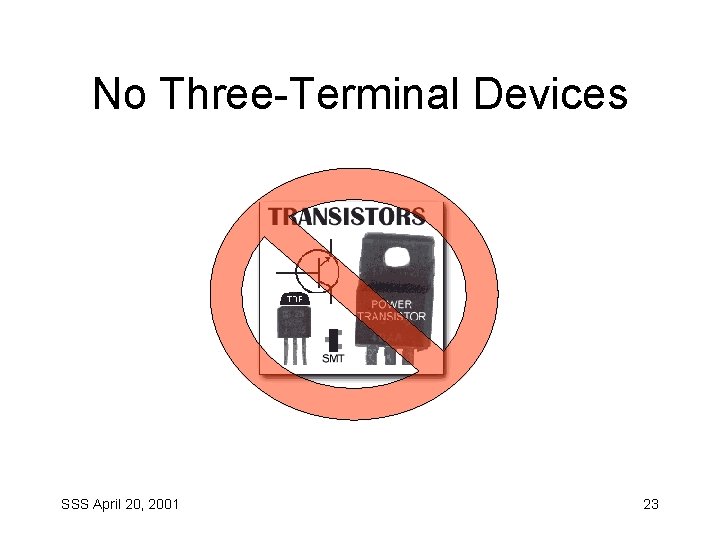
No Three-Terminal Devices SSS April 20, 2001 23
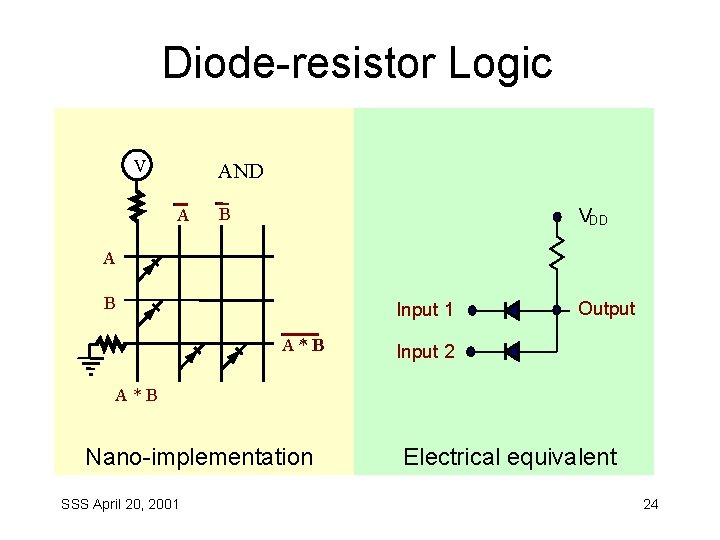
Diode-resistor Logic V AND A B VDD A B Input 1 A *^ B Output Input 2 A*B Nano-implementation SSS April 20, 2001 Electrical equivalent 24
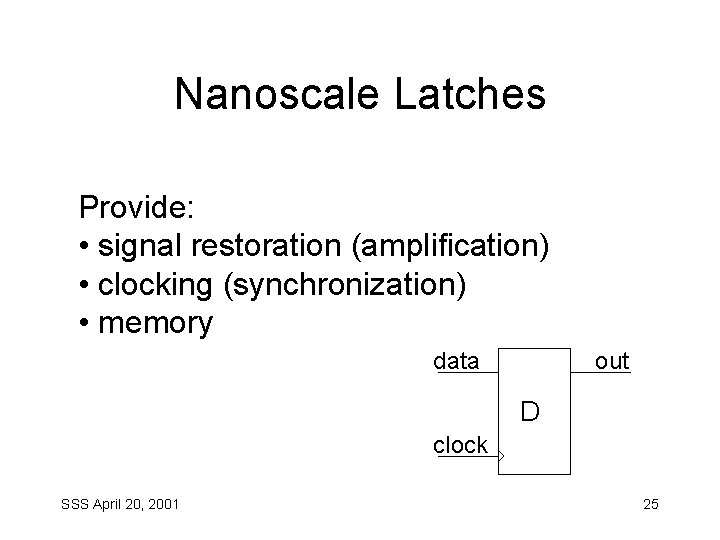
Nanoscale Latches Provide: • signal restoration (amplification) • clocking (synchronization) • memory data out D clock SSS April 20, 2001 25
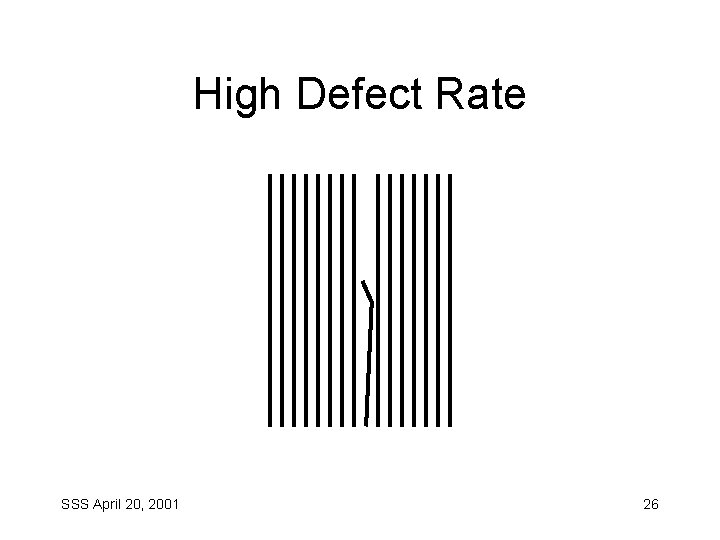
High Defect Rate SSS April 20, 2001 26
Outline ü ü ü • • • Introduction Reconfigurable computing Nanotechnology Nano-architecture proposal Preliminary results Conclusions and future work SSS April 20, 2001 27
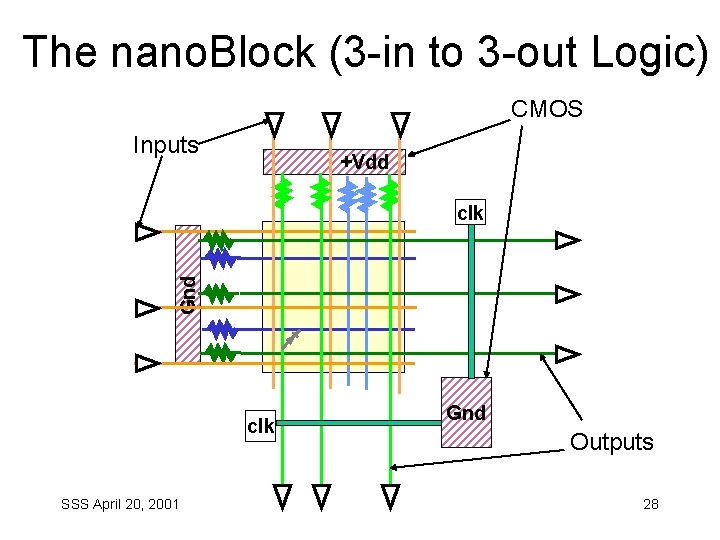
The nano. Block (3 -in to 3 -out Logic) CMOS Inputs +Vdd Gnd clk SSS April 20, 2001 Gnd Outputs 28
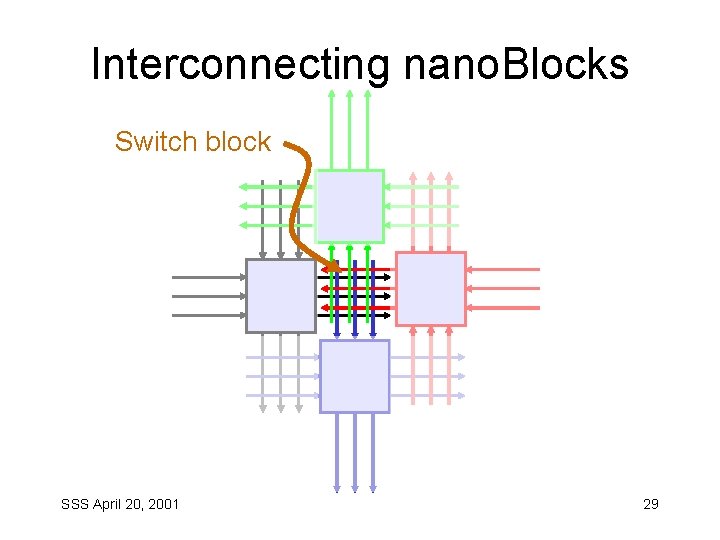
Interconnecting nano. Blocks Switch block SSS April 20, 2001 29
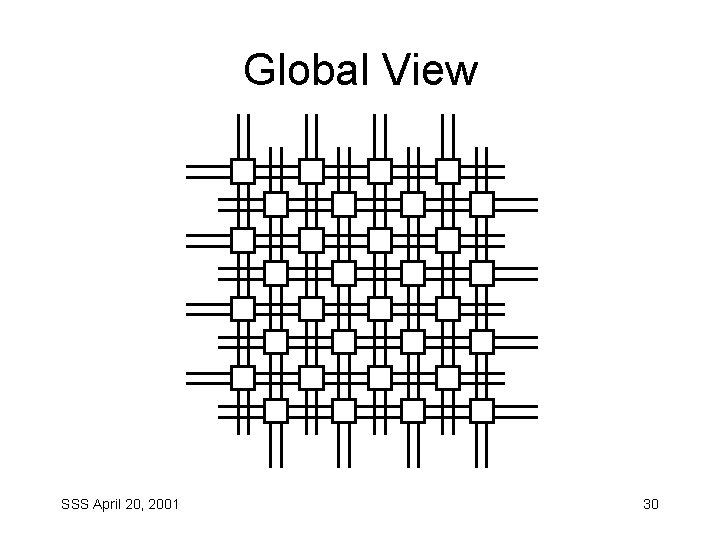
Global View SSS April 20, 2001 30
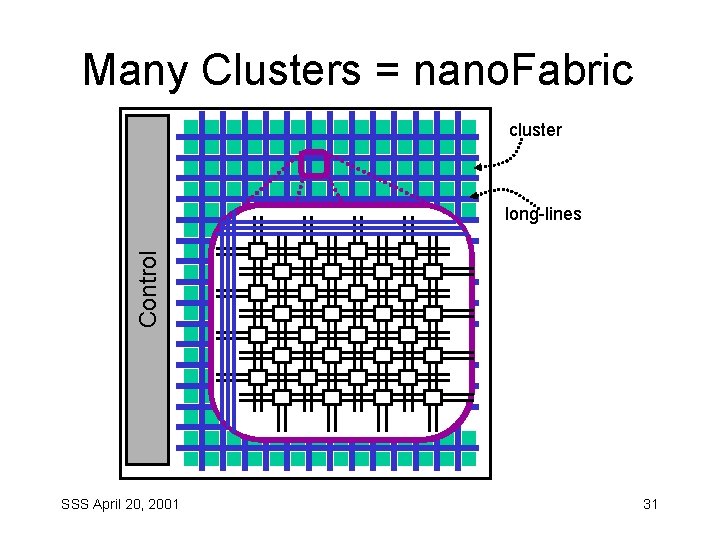
Many Clusters = nano. Fabric cluster Control long-lines SSS April 20, 2001 31
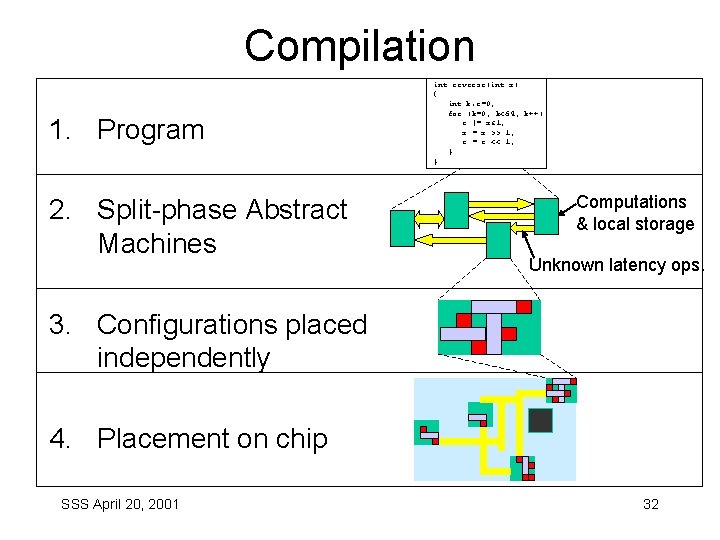
Compilation 1. Program 2. Split-phase Abstract Machines int reverse(int x) { int k, r=0; for (k=0; k<64; k++) r |= x&1; x = x >> 1; r = r << 1; } } Computations & local storage Unknown latency ops. 3. Configurations placed independently 4. Placement on chip SSS April 20, 2001 32
Outline ü ü • • Introduction Reconfigurable Hardware Nanotechnology Nano-architecture proposal Preliminary results Conclusions and Future work SSS April 20, 2001 33
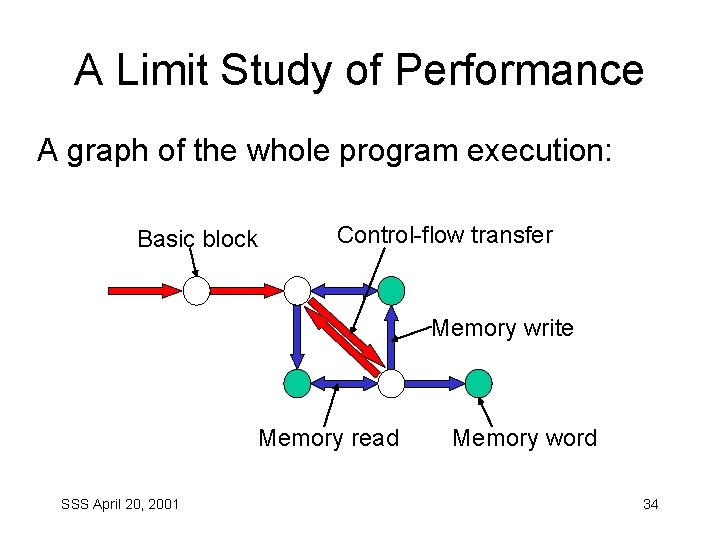
A Limit Study of Performance A graph of the whole program execution: Basic block Control-flow transfer Memory write Memory read SSS April 20, 2001 Memory word 34
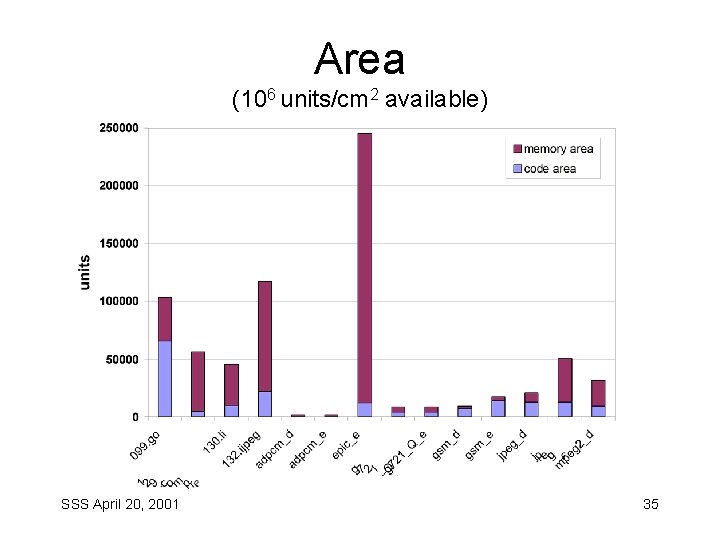
Area (106 units/cm 2 available) SSS April 20, 2001 35
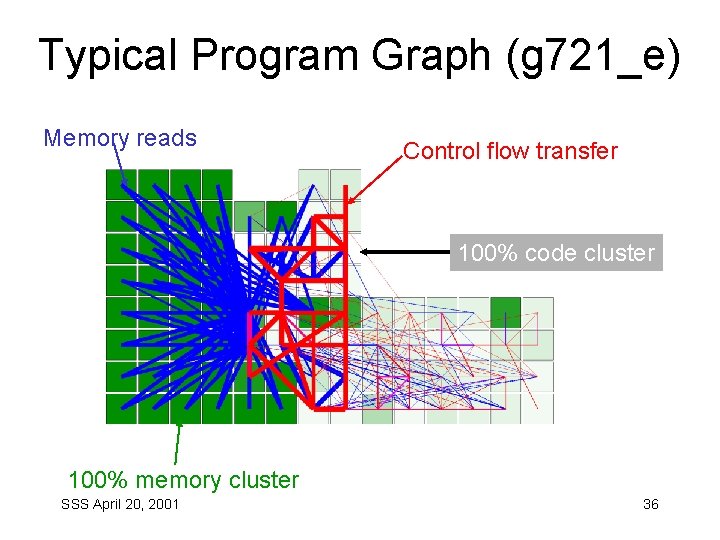
Typical Program Graph (g 721_e) Memory reads Control flow transfer 100% code cluster 100% memory cluster SSS April 20, 2001 36
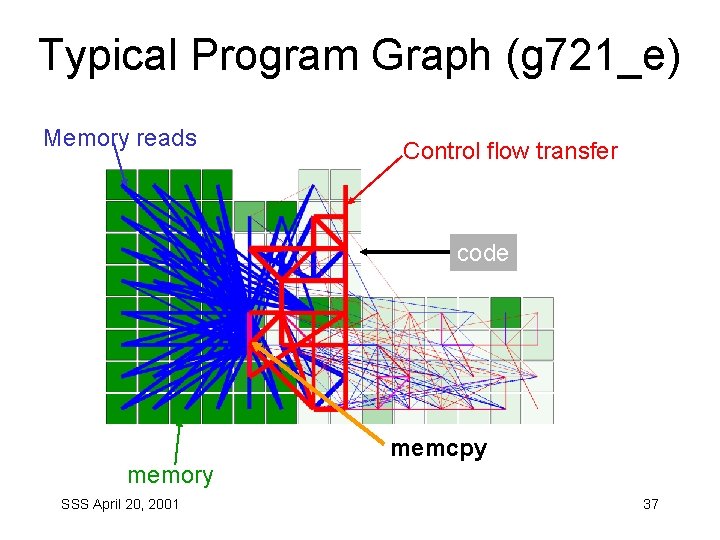
Typical Program Graph (g 721_e) Memory reads Control flow transfer code memcpy memory SSS April 20, 2001 37
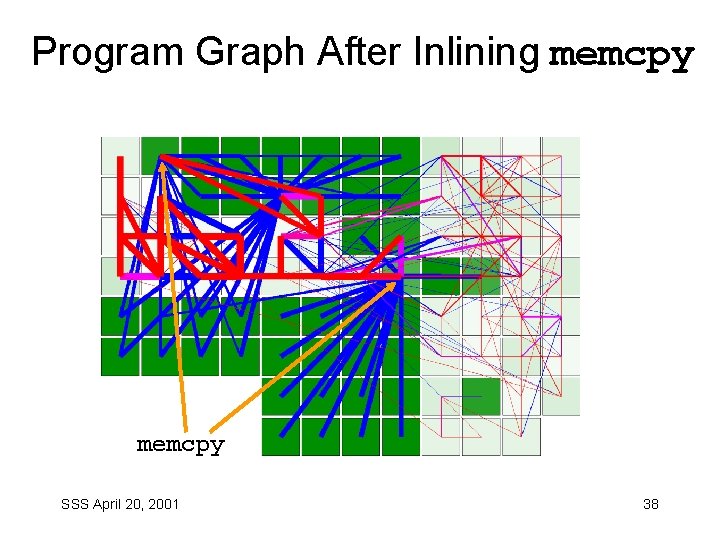
Program Graph After Inlining memcpy SSS April 20, 2001 38
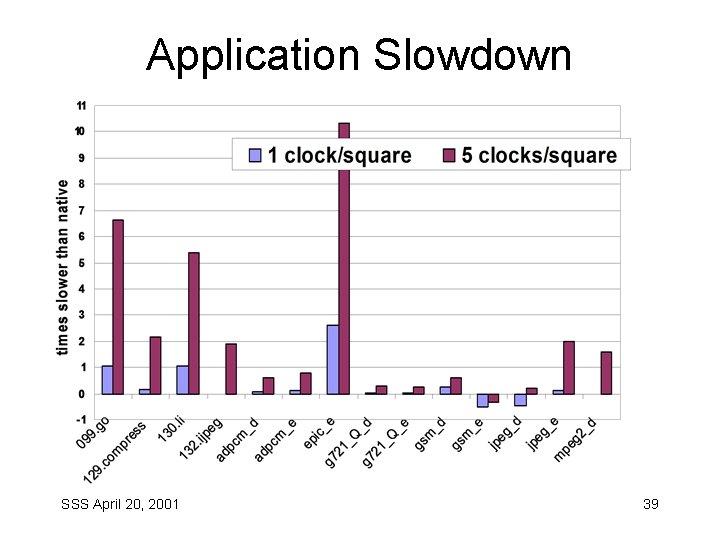
Application Slowdown SSS April 20, 2001 39
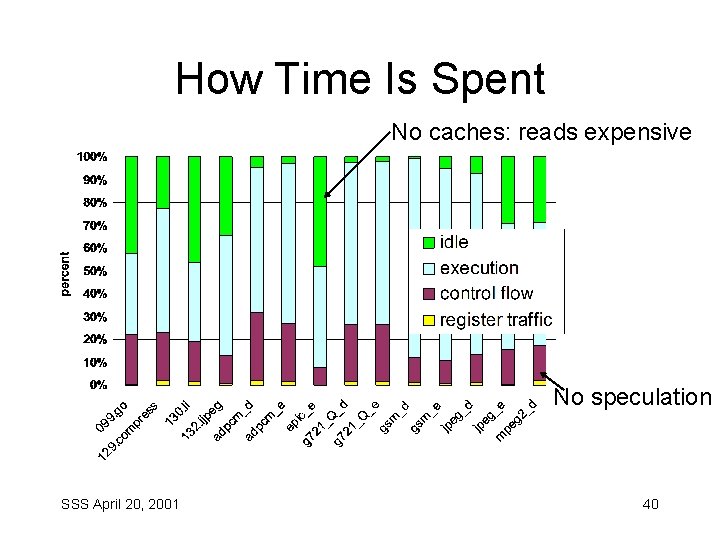
How Time Is Spent No caches: reads expensive No speculation SSS April 20, 2001 40
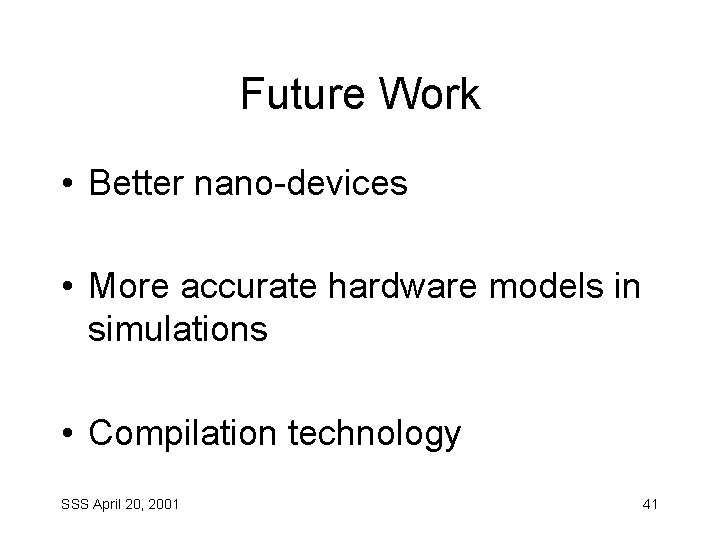
Future Work • Better nano-devices • More accurate hardware models in simulations • Compilation technology SSS April 20, 2001 41
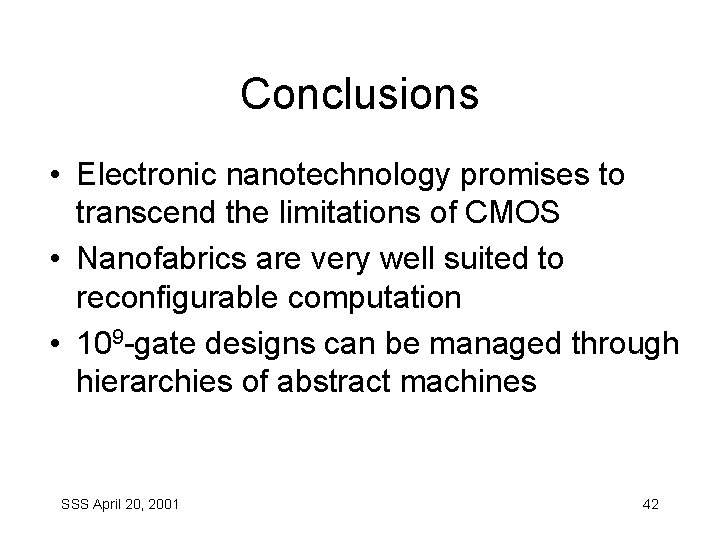
Conclusions • Electronic nanotechnology promises to transcend the limitations of CMOS • Nanofabrics are very well suited to reconfigurable computation • 109 -gate designs can be managed through hierarchies of abstract machines SSS April 20, 2001 42
- Slides: 42