
Nanotechnology in sports Introduction Nanotechnology is a branch

Nanotechnology in sports
Introduction • Nanotechnology is a branch of research that has gained much momentum in recent years due to its wide application of its principles and products. Within the niche of sports, nanotechnology has proven to very useful, and has the potential to improve a broad range of aspects of the sports world.
Tennis • The game of tennis is a prime example of how nanotechnology is having an interesting impact on sports equipment producer Wilson has been able to create tennis racquets that are twice as stable conventional racquets, and up to 22% more powerful. This increase in the racquet’s performance capabilities can lead to big speed increases in what is already an extremely fast paced game. In addition to racquet research, Wilson is also conducting research to find innovative ways to improve the tennis balls used today. This research has allowed them to design balls that hold their bounce much longer than is seen in balls currently available on the market. This is accomplished by bonding microscopic balls of butyl rubber with clay particles. This mixture is then applied to the inner layer of the ball, creating an airtight but still flexible boundary that keeps the gas inside the tennis much longer.
Swimwear • Nanotechnology is allowing scientists to create new, ultra‐ lightweight swimwear that allows the swimmers to practically glide through the water. In fact, testing has shown that the developers have been able to reduce the water absorbed by the new fabrics to only 2% of fabric weight. This is an amazing breakthrough compared to the 50% absorption of previous materials made specifically for low drag swimwear. These new materials also have huge potential is other sports and applications. Because the material rejects moisture, these fabrics can be used to manufacture clothing that repels sweat, leaving the athletes dryer. It can also be used for bicycle riders who wish to cut down on the drag caused by their clothing.
Racing • Like swimming, where friction reduction is an important concern, nanotechnology has made it way in to the world of racing. In particular, it has made land speed record setting cars even faster. To prove this, Nanotec‐USA applied their Nano‐Bionics treatment to the Nish Motor Sports’ speed car prior to the Speed Week 2008 at the Bonneville Sand Flats in Utah this year. Despite using a 50% less than usual mixture of Nitro Methane fuel mixture, they were able to obtain a speed that was 37 miles per hour faster than their previous top speed. This state‐of‐the‐art treatment makes any surface that it is applied to ultra smooth

How it happens? • The self‐assembling nano‐particles dock directly to the molecules of paint and metal, within the pores of the material. The Nano. Bionics Smart Particles/molecules self‐align themselves, forming new structures.
Athletic shoes • Athletic shoes are an interesting product to design because of the fact that they have to be soft in order to absorb the impact of usage, and yet they still have to be hard enough to still maintain their shape and not “deaden out” as they are used. This has been a difficult problem for designers to overcome, but nanotechnology has proven to be useful in solving this problem. The solution to this problem is the shoes are made of a mix of both hard and soft particles. Nanotechnology comes in to play because the particles used are the size of molecules, and it enables the designers to control the mixture. The shoe “provides more stability, comfort, better torsion, safety and increased flexibility while minimizing the energy loss.
• Nanotechnology is even giving sports fans the chance to feel an even more intimate connection to the teams they love. Adidas has launched a promotion in New Zealand aimed at involving the fans of the nationally inspiring rugby team, The All Blacks, to an all new level of commitment. Adidas wants to take the names of thousands of the team’s fans, and engrave them on to a single thread that will be used to make one of the jerseys worn by the rugby team. This jersey would then be presented to, and worn by, All Blacks’ team captain Richie Mc. Caw. Along with the fan’s names, the names of all 1073 past and present All Blacks players will be etched on to the thread. The team is also very excited about the idea of having their fans be a part of the team jerseys. Richie Mc. Caw says, “Having the names of fans stitched onto the jerseys provides the players with a further reminded of the public support for the team. ”

Disinfectant • One of the biggest and most universal problems in the sports world is that of smelly gym clothes and sports equipment. Sports equipment is traditionally one of the best breading grounds for bacteria and fungi that “cause infection, odor, itchiness sores and smelly feet. ” Silver has been used for the treatment of medical ailments for over 100 years due to its natural antibacterial and anti fungal properties. Nano. Horizons of State College, Pa. , this fall said it developed silver nano‐particles that can mesh with the cotton, plastic or nylon material in shoes, pads, jerseys, helmets, socks or other pieces of sports equipment. This is accomplished by making nano‐silver particles that typically measure around 25 nm. This gives the particles a small volume, but a very large surface area at the same time. The large surface area enables the particles to interact with more bacteria and fungi, which greatly improves its effectiveness in killing them. “The nano‐silver suppresses respiration, basal metabolism of electron transfer system, and transport of substrate in the microbial cell membrane. ” This process inhibits the multiplication and growth of the bacteria and fungi, therefore leading to much cleaner and better smelling equipment.
Golf • The sport of golf is also impacted by nanotechnology is a similar fashion as tennis. Breakthroughs in the production of lighter, yet strong, composite materials has greatly impacted the design of golf clubs. For example, Wilson is using a nano‐composite to replace the titanium crown used on its current golf clubs. The result of this is to lower the weight and center of gravity of the club, thus increasing the power and accuracy potential of the club. In addition, the stronger materials used to produce the shafts used on golf clubs will render them more reliable and increase their service life. The golf balls have also reaped benefits of advances in nanotechnology. [3] The ability to control the production of materials on the molecular level has enabled companies to develop a golf ball that does not suffer from having an uneven spin. This allows for a ball that flies along a much straighter path. [2]
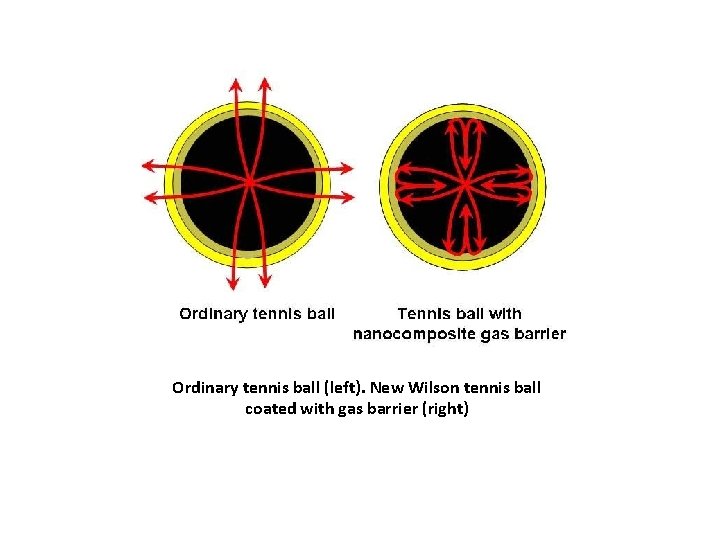
Ordinary tennis ball (left). New Wilson tennis ball coated with gas barrier (right)
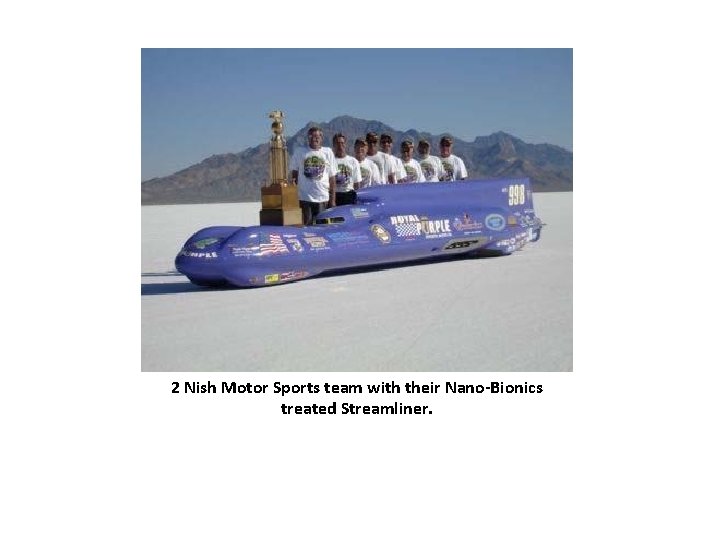
2 Nish Motor Sports team with their Nano‐Bionics treated Streamliner.
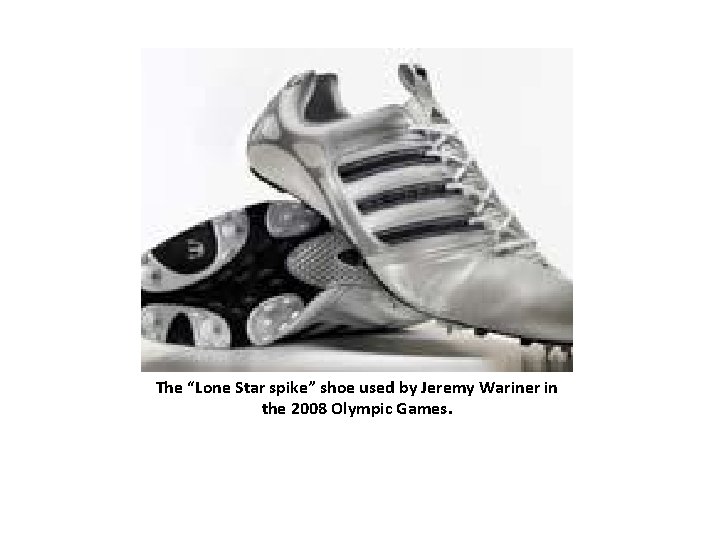
The “Lone Star spike” shoe used by Jeremy Wariner in the 2008 Olympic Games.
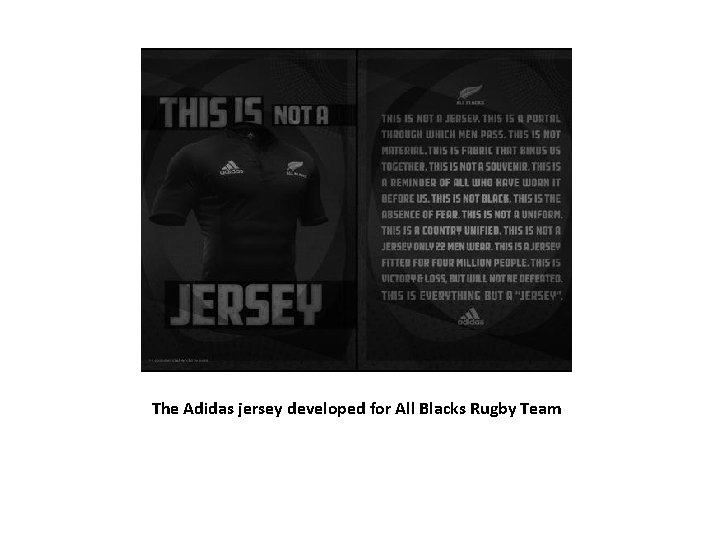
The Adidas jersey developed for All Blacks Rugby Team
A towel treated with Silver. Sure which is a nano‐silver particle treatment that fights bacteria and fungi.

Nanotechnology will be a very significant branch of research to further improve our society in the future.

References • • • • • Amer Sports. March 2004. Amer Sports. 03 December 2008. <http: //www. amersports. com/media/news/view/powered_by_nanotechnology. html>. Nanotechnology and Sports. Nanopedia: The web course of nanotechnology. 03 December 2008. <http: //nanopedia. case. edu/NWPrint. php? page=nw. nanosports>. Nanotech could put a new spin on sports. 17 November 2004. USAToday. 03 December 2008. < http: //www. usatoday. com/sports/2004‐ 11‐ 17‐nanotechnology‐sports_x. htm >. Nano helps with gold. Nano: The magazine for small science. 03 December 2008. < http: //www. nanomagazine. co. uk/read. Article. php? id=33>. Nanotechnology Now. 26 October 2008. Nanotechnology Now: Your gateway to everything nanotech. 03 December 2008. < http: //www. nanotech‐now. com/news. cgi? story_id=31150>. Nanotechnology in Sports and Running Shoes. AZo. Nano: The A to Z of Nanotechnology. 04 December 2008. < http: //www. azonano. com/nanotechnology‐video‐details. asp? Vid. ID=64>. Bringing sports fans closer to brands through nanotechnology. 21 October 2008. Bhat. Naturally. 04 December 2008. < http: //www. lbhat. com/advertising/this‐is‐not‐a‐jersey‐all‐blacks‐adidas‐new‐zealand/>. Bath and Sports Towels. 4 June 2007. PEN: The project on emerging nanotechnologies. 04 December 2008. < http: //www. nanotechproject. org/inventories/consumer/browse/products/5431 />.
- Slides: 17