
Nanoscale Imaging of Catalyst Chemistry A promising tool
- Slides: 1
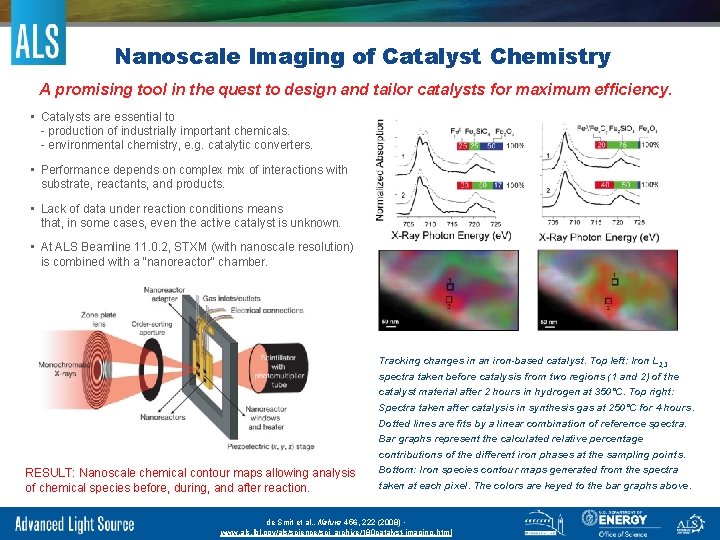
Nanoscale Imaging of Catalyst Chemistry A promising tool in the quest to design and tailor catalysts for maximum efficiency. • Catalysts are essential to - production of industrially important chemicals. - environmental chemistry, e. g. catalytic converters. • Performance depends on complex mix of interactions with substrate, reactants, and products. • Lack of data under reaction conditions means that, in some cases, even the active catalyst is unknown. • At ALS Beamline 11. 0. 2, STXM (with nanoscale resolution) is combined with a "nanoreactor" chamber. Tracking changes in an iron-based catalyst. Top left: Iron L 2, 3 spectra taken before catalysis from two regions (1 and 2) of the catalyst material after 2 hours in hydrogen at 350°C. Top right: Spectra taken after catalysis in synthesis gas at 250°C for 4 hours. Dotted lines are fits by a linear combination of reference spectra. Bar graphs represent the calculated relative percentage contributions of the different iron phases at the sampling points. RESULT: Nanoscale chemical contour maps allowing analysis of chemical species before, during, and after reaction. Bottom: Iron species contour maps generated from the spectra taken at each pixel. The colors are keyed to the bar graphs above. de Smit et al. , Nature 456, 222 (2008) • www. als. lbl. gov/als/science/sci_archive/180 catalyst-imaging. html