
Nanopositioning of the main linac quadrupole as means

- Slides: 24
Nanopositioning of the main linac quadrupole as means of laboratory pre-alignment David Tshilumba, Kurt Artoos, Stef Janssens 1 D. Tshilumba, CERN, 03 February 2015
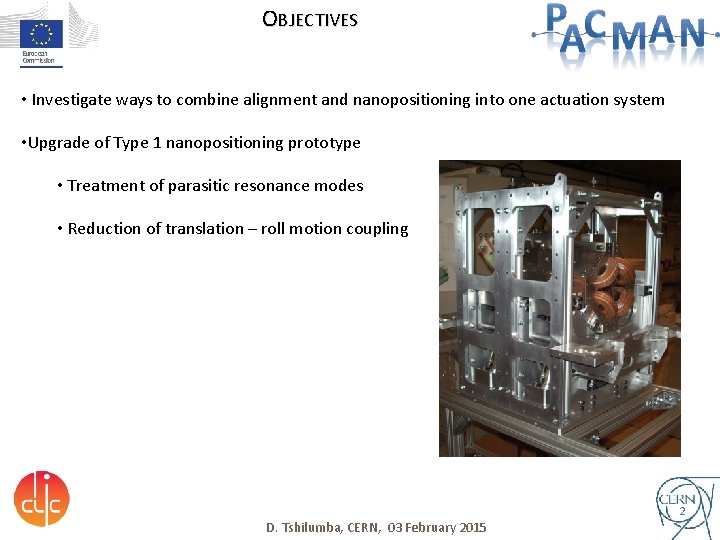
OBJECTIVES • Investigate ways to combine alignment and nanopositioning into one actuation system • Upgrade of Type 1 nanopositioning prototype • Treatment of parasitic resonance modes • Reduction of translation – roll motion coupling 2 D. Tshilumba, CERN, 03 February 2015
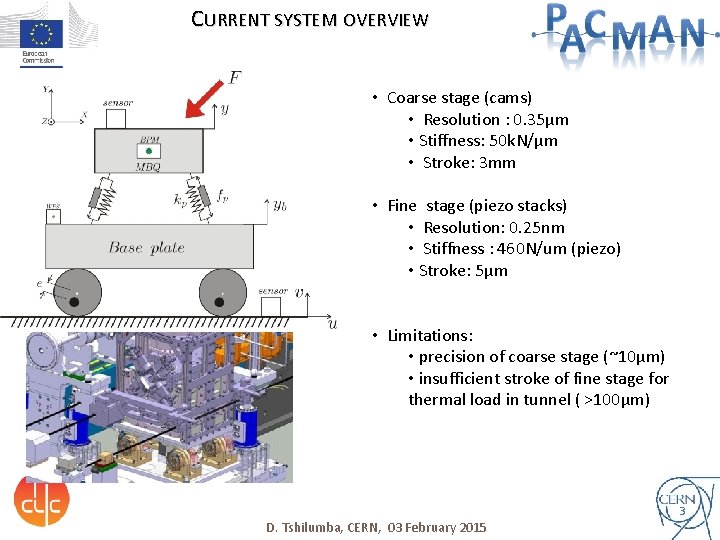
CURRENT SYSTEM OVERVIEW • Coarse stage (cams) • Resolution : 0. 35µm • Stiffness: 50 k. N/µm • Stroke: 3 mm • Fine stage (piezo stacks) • Resolution: 0. 25 nm • Stiffness : 460 N/um (piezo) • Stroke: 5µm • Limitations: • precision of coarse stage (~10µm) • insufficient stroke of fine stage for thermal load in tunnel ( >100µm) 3 D. Tshilumba, CERN, 03 February 2015
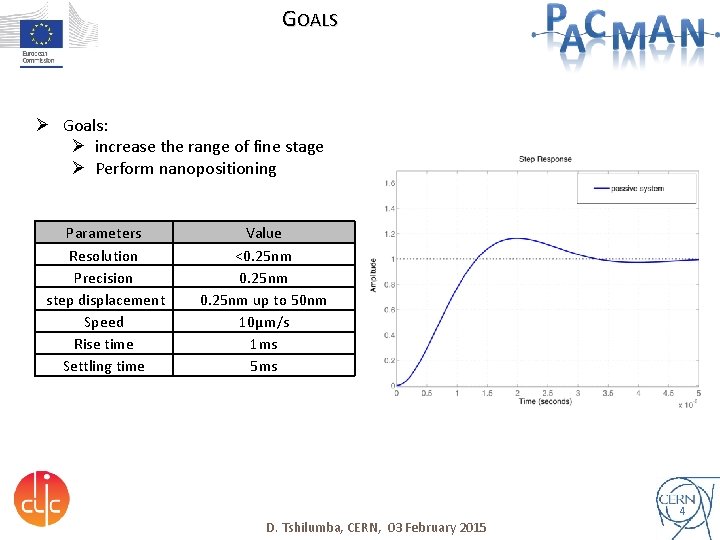
GOALS Ø Goals: Ø increase the range of fine stage Ø Perform nanopositioning Parameters Resolution Precision step displacement Speed Rise time Settling time Value <0. 25 nm up to 50 nm 10μm/s 1 ms 5 ms 4 D. Tshilumba, CERN, 03 February 2015
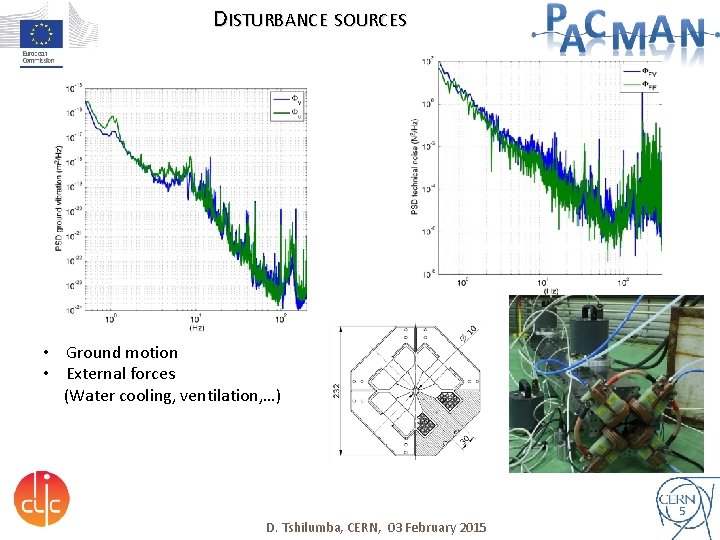
DISTURBANCE SOURCES • Ground motion • External forces (Water cooling, ventilation, …) 5 D. Tshilumba, CERN, 03 February 2015
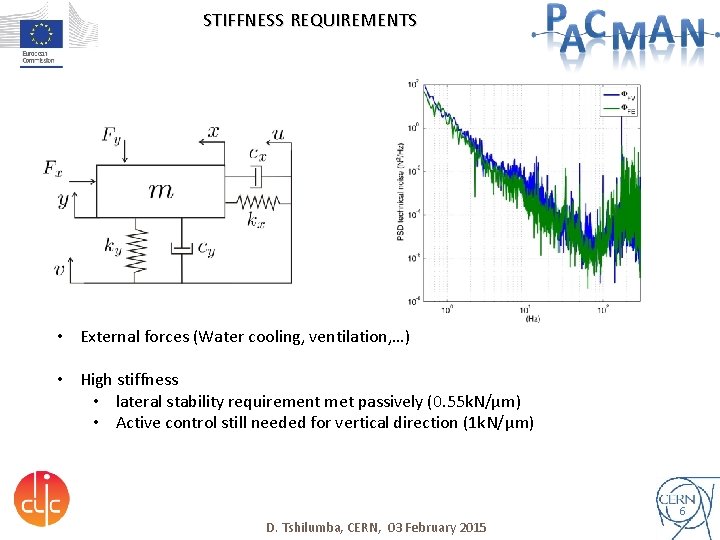
STIFFNESS REQUIREMENTS • External forces (Water cooling, ventilation, …) • High stiffness • lateral stability requirement met passively (0. 55 k. N/µm) • Active control still needed for vertical direction (1 k. N/µm) 6 D. Tshilumba, CERN, 03 February 2015
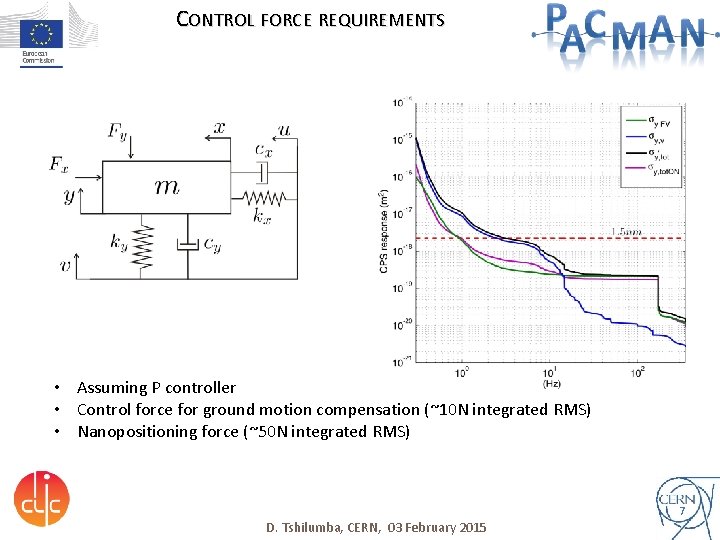
CONTROL FORCE REQUIREMENTS • Assuming P controller • Control force for ground motion compensation (~10 N integrated RMS) • Nanopositioning force (~50 N integrated RMS) 7 D. Tshilumba, CERN, 03 February 2015
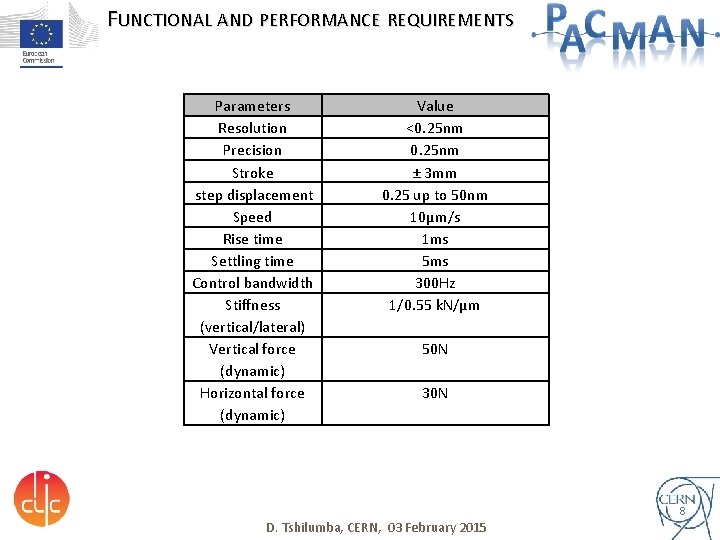
FUNCTIONAL AND PERFORMANCE REQUIREMENTS Parameters Resolution Precision Stroke step displacement Speed Rise time Settling time Control bandwidth Stiffness (vertical/lateral) Vertical force (dynamic) Horizontal force (dynamic) Value <0. 25 nm ± 3 mm 0. 25 up to 50 nm 10μm/s 1 ms 5 ms 300 Hz 1/0. 55 k. N/μm 50 N 30 N 8 D. Tshilumba, CERN, 03 February 2015
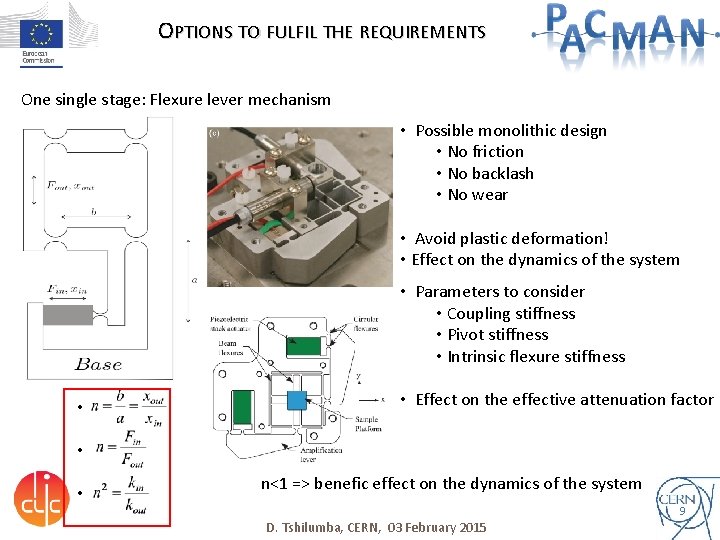
OPTIONS TO FULFIL THE REQUIREMENTS One single stage: Flexure lever mechanism • Possible monolithic design • No friction • No backlash • No wear • Avoid plastic deformation! • Effect on the dynamics of the system • Parameters to consider • Coupling stiffness • Pivot stiffness • Intrinsic flexure stiffness • • Effect on the effective attenuation factor • • n<1 => benefic effect on the dynamics of the system 9 D. Tshilumba, CERN, 03 February 2015
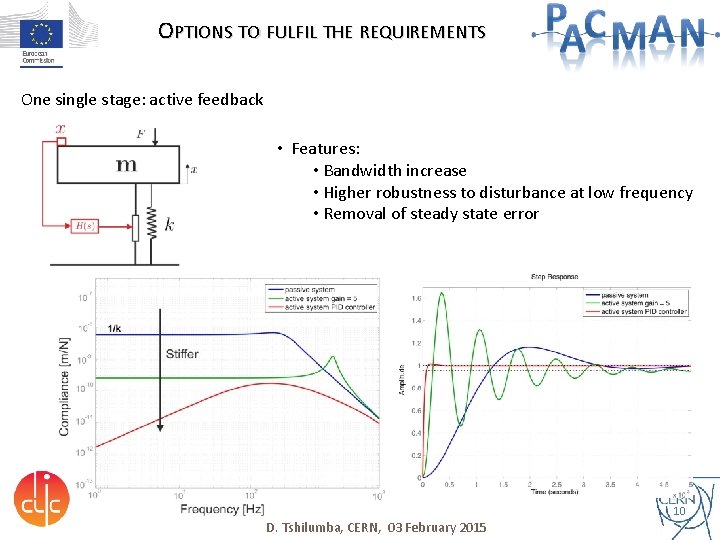
OPTIONS TO FULFIL THE REQUIREMENTS One single stage: active feedback • Features: • Bandwidth increase • Higher robustness to disturbance at low frequency • Removal of steady state error 10 D. Tshilumba, CERN, 03 February 2015
OPTIONS TO FULFIL THE REQUIREMENTS • Coarse – fine resolution approach • Improvement of Coarse stage (Juha Kemppinen) • Improvement in the WPS measurement speed • Improvement in precision via feedback loop • Improvement of fine stage • Higher stiffness • Larger stroke (>200μm) Ø Compensation of thermal loads in tunnel Ø Beam time > 50 days 11 D. Tshilumba, CERN, 03 February 2015
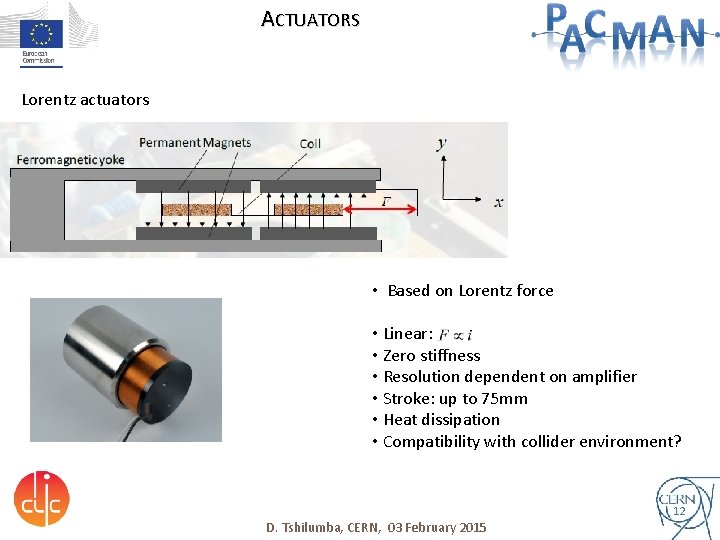
ACTUATORS Lorentz actuators • Based on Lorentz force • Linear: • Zero stiffness • Resolution dependent on amplifier • Stroke: up to 75 mm • Heat dissipation • Compatibility with collider environment? 12 D. Tshilumba, CERN, 03 February 2015
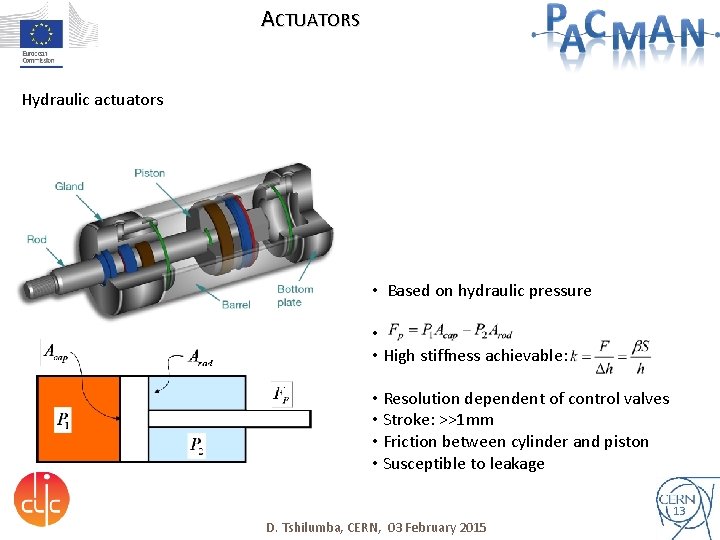
ACTUATORS Hydraulic actuators • Based on hydraulic pressure • • High stiffness achievable: • Resolution dependent of control valves • Stroke: >>1 mm • Friction between cylinder and piston • Susceptible to leakage 13 D. Tshilumba, CERN, 03 February 2015
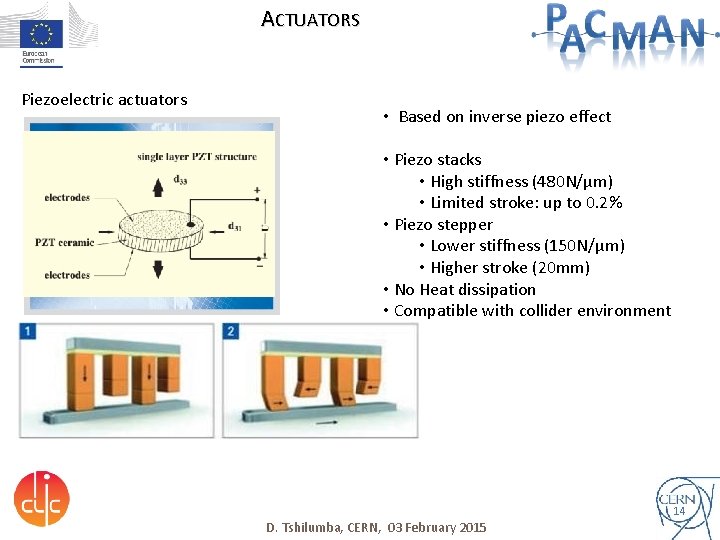
ACTUATORS Piezoelectric actuators • Based on inverse piezo effect • Piezo stacks • High stiffness (480 N/μm) • Limited stroke: up to 0. 2% • Piezo stepper • Lower stiffness (150 N/μm) • Higher stroke (20 mm) • No Heat dissipation • Compatible with collider environment 14 D. Tshilumba, CERN, 03 February 2015
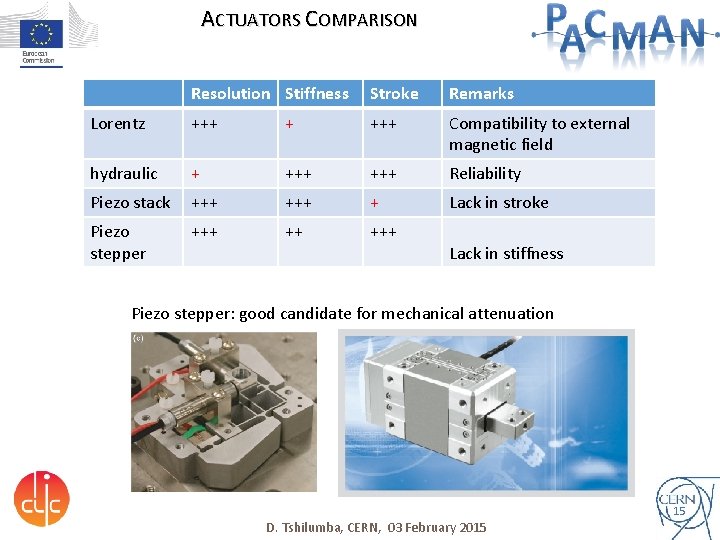
ACTUATORS COMPARISON Resolution Stiffness Stroke Remarks Lorentz +++ + +++ Compatibility to external magnetic field hydraulic + +++ Reliability Piezo stack +++ + Lack in stroke Piezo stepper +++ ++ +++ Lack in stiffness Piezo stepper: good candidate for mechanical attenuation 15 D. Tshilumba, CERN, 03 February 2015
INTERMEDIATE CONCLUSION • Overview of the current system • Requirements for Nano-positioning summarized • Alternatives to increase the range • single stage • Passive mechanical solution • Active solution • coarse-fine stage • Comparison of classical actuators • Piezo stepper + mechanical attenuation 16 D. Tshilumba, CERN, 03 February 2015
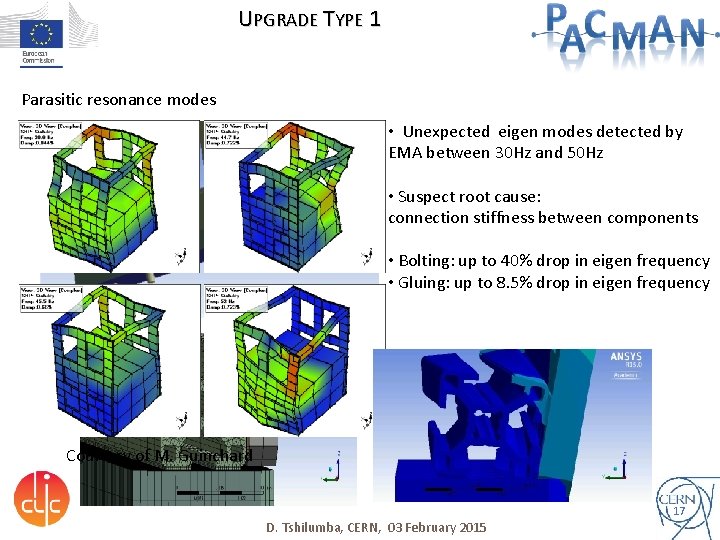
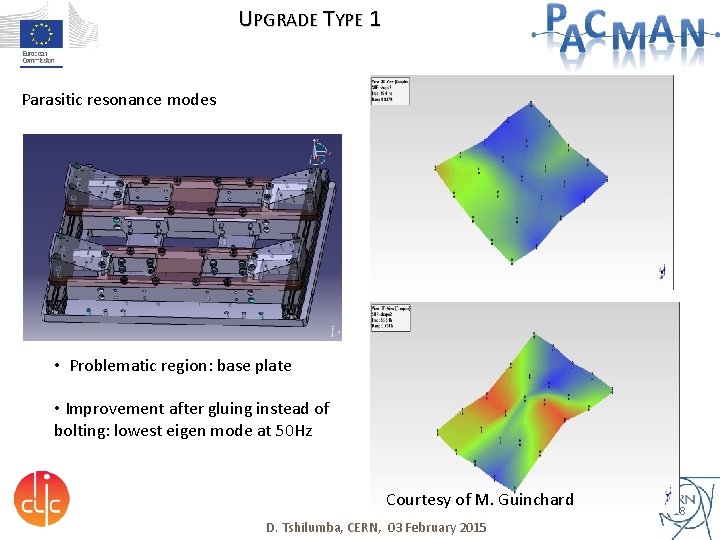
UPGRADE TYPE 1 Parasitic resonance modes • Unexpected eigen modes detected by EMA between 30 Hz and 50 Hz • Suspect root cause: connection stiffness between components • Bolting: up to 40% drop in eigen frequency • Gluing: up to 8. 5% drop in eigen frequency Courtesy of M. Guinchard 17 D. Tshilumba, CERN, 03 February 2015
UPGRADE TYPE 1 Parasitic resonance modes • Problematic region: base plate • Improvement after gluing instead of bolting: lowest eigen mode at 50 Hz Courtesy of M. Guinchard D. Tshilumba, CERN, 03 February 2015 18
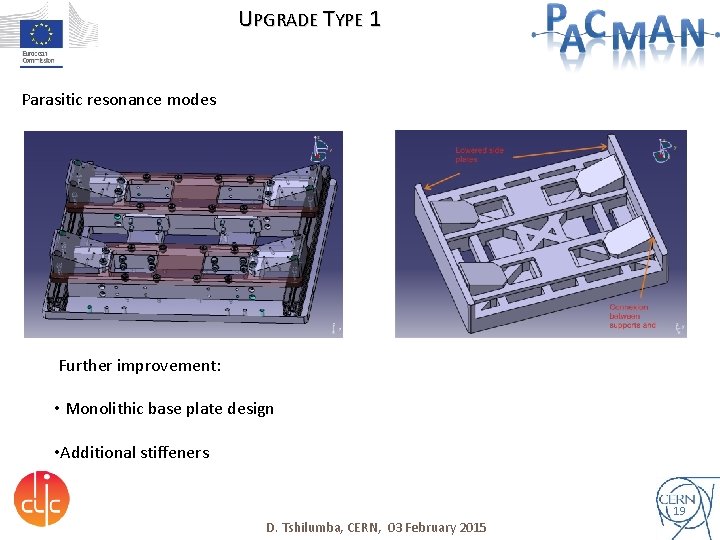
UPGRADE TYPE 1 Parasitic resonance modes Further improvement: • Monolithic base plate design • Additional stiffeners 19 D. Tshilumba, CERN, 03 February 2015
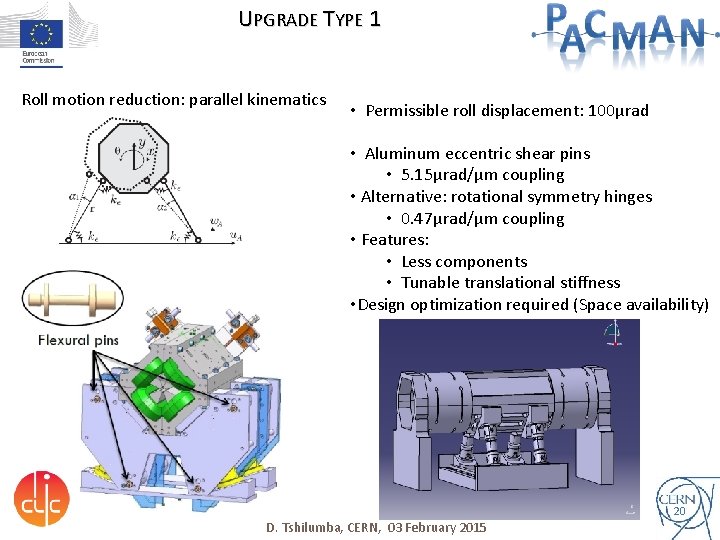
UPGRADE TYPE 1 Roll motion reduction: parallel kinematics • Permissible roll displacement: 100μrad • Aluminum eccentric shear pins • 5. 15μrad/μm coupling • Alternative: rotational symmetry hinges • 0. 47μrad/μm coupling • Features: • Less components • Tunable translational stiffness • Design optimization required (Space availability) 20 D. Tshilumba, CERN, 03 February 2015
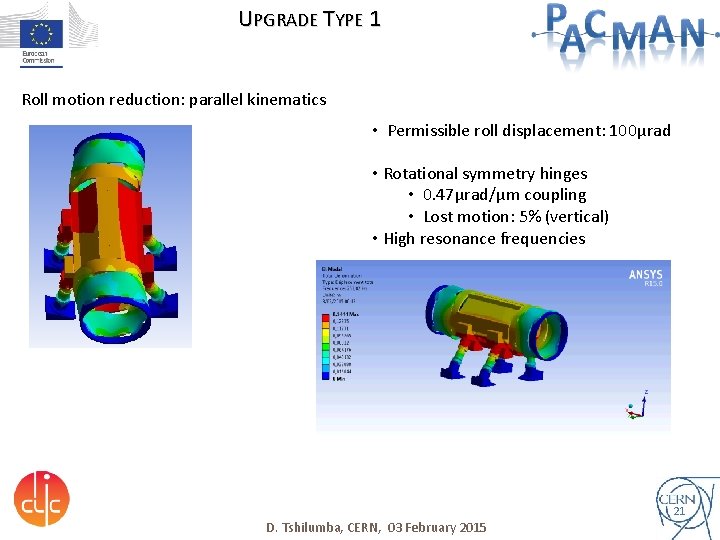
UPGRADE TYPE 1 Roll motion reduction: parallel kinematics • Permissible roll displacement: 100μrad • Rotational symmetry hinges • 0. 47μrad/μm coupling • Lost motion: 5% (vertical) • High resonance frequencies 21 D. Tshilumba, CERN, 03 February 2015
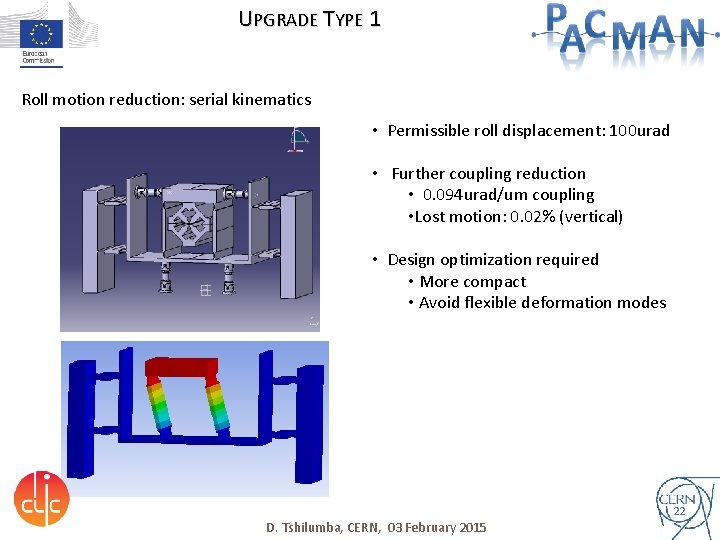
UPGRADE TYPE 1 Roll motion reduction: serial kinematics • Permissible roll displacement: 100 urad • Further coupling reduction • 0. 094 urad/um coupling • Lost motion: 0. 02% (vertical) • Design optimization required • More compact • Avoid flexible deformation modes 22 D. Tshilumba, CERN, 03 February 2015
CONCLUSION • Actuator requirements defined • Existing actuation technologies Vs performance requirements • Introduction of concepts for further study to increase the range • Type 1 upgrade proposals under study 23 D. Tshilumba, CERN, 03 February 2015
FUTURE WORK • Optimize the presented alternative concepts for the kinematic decoupling in type 1 stage • Design a 1 dof extended nanopositioning stage with attenuation mechanism + Experimental validation • Secondment at TUDelft and TNO almost finished 24 D. Tshilumba, CERN, 03 February 2015