
Nanoparticle diameter and mobility calculator assuming singly charged
Nanoparticle diameter and mobility calculator assuming singly charged spherical symmetric aerosol particles Hannes. Tammet@ut. ee Pühajärve 2014

Sometimes we meet statements like this: “Results of the paper A differ from results of the paper B because authors of A use the mobility diameter but authors of B use mass diameter”. Therefore, let’s start from an introductory explanation 2/54

3/54
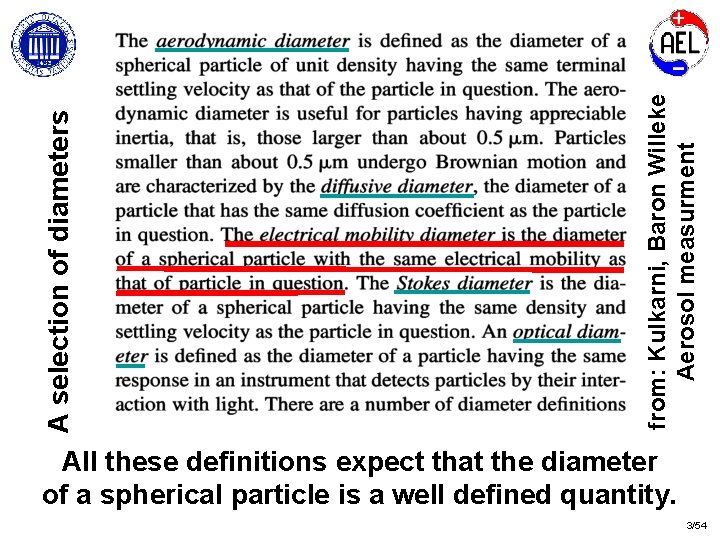
from: Kulkarni, Baron Willeke Aerosol measurment A selection of diameters All these definitions expect that the diameter of a spherical particle is a well defined quantity. 3/54
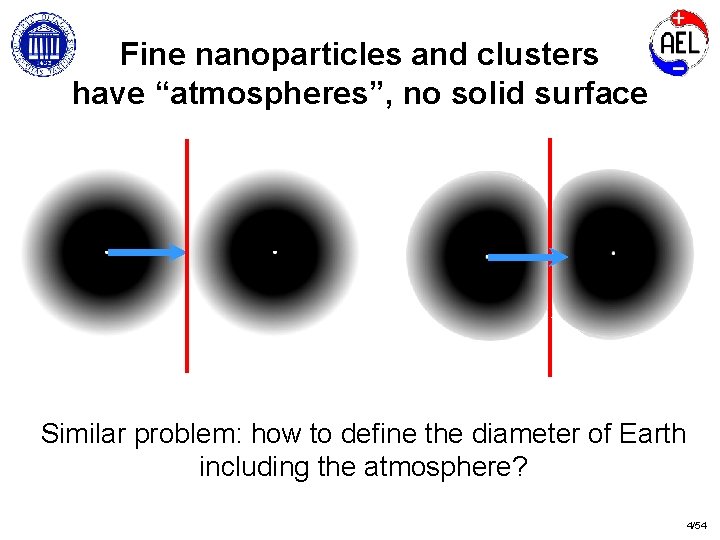
Fine nanoparticles and clusters have “atmospheres”, no solid surface Similar problem: how to define the diameter of Earth including the atmosphere? 4/54
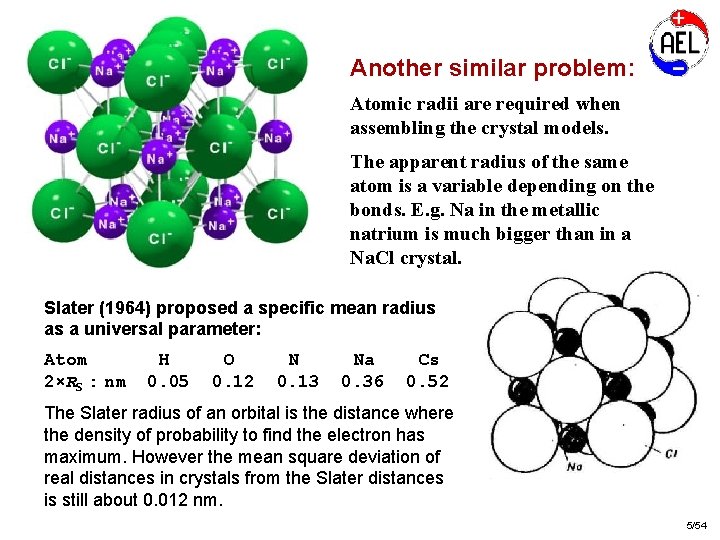
Another similar problem: Atomic radii are required when assembling the crystal models. The apparent radius of the same atom is a variable depending on the bonds. E. g. Na in the metallic natrium is much bigger than in a Na. Cl crystal. Slater (1964) proposed a specific mean radius as a universal parameter: Atom 2×RS : nm H 0. 05 O 0. 12 N 0. 13 Na 0. 36 Cs 0. 52 The Slater radius of an orbital is the distance where the density of probability to find the electron has maximum. However the mean square deviation of real distances in crystals from the Slater distances is still about 0. 012 nm. 5/54
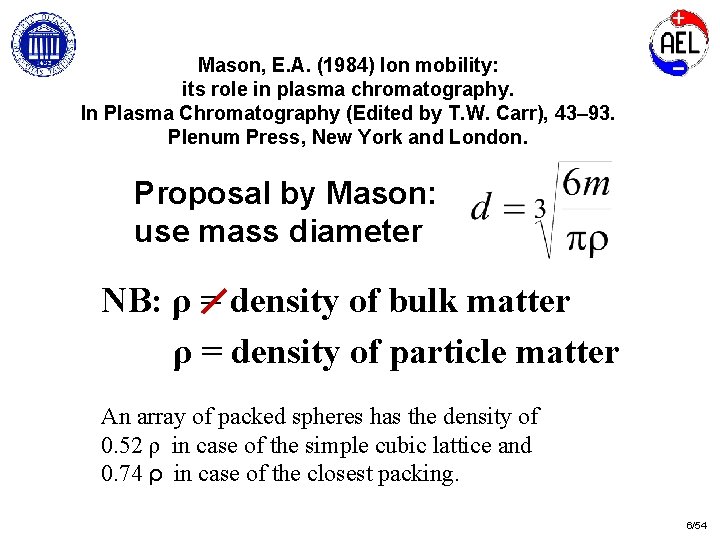
Mason, E. A. (1984) Ion mobility: its role in plasma chromatography. In Plasma Chromatography (Edited by T. W. Carr), 43– 93. Plenum Press, New York and London. Proposal by Mason: use mass diameter NB: ρ = density of bulk matter ρ = density of particle matter An array of packed spheres has the density of 0. 52 ρ in case of the simple cubic lattice and 0. 74 ρ in case of the closest packing. 6/54
A key to understanding The question about the diameter of the Earth including the atmosphere requires definition of the height of the atmosphere. A widely used measure of the height of the atmosphere is the isothermal scale-height: the height of an apparent column of air of same density as the air on the sea level. This is about 8 km. The concept of the mass density of a cluster can be compared with the concept of the scale-height of the atmosphere. This comparison is a key to understanding the concept of the mass diameter. 6/54

Conclusions Mobility diameter is defined as the diameter of a hard sphere of the same mobility as the considered particle. Thus the mobility diameter of a spherical particle is just the same as its geometric diameter. We are not able directly measure the nanoparticle geometric diameter. One way is to use of an estimate according to a specific mobility model d. M = g. M (p, T, Z), where g. M is inverse function of the model M and Z is measured mobility. The choice of the specific model is free, one could choose even plain Stokes or Newton. 9/54

Mobility and mobility model Assumption: the mean drift velocity v is proportional to the drag force F. Mechanical mobility B = v / F, electrical mobility Z = v / E F = Eq follows in Z = q. B. We have q = e and Z = e. B. A model of mobility is an algorithm that uses parameters of the particle and the air (pressure, temperature, diameter etc. ) and issues an estimate of the particle mobility: Z ≈ ZM = f. M (p, T, d) The inverse model d ≈ d. M = g. M(p, T, Z) is to be mathematically derived from the direct algorithm. 7/54
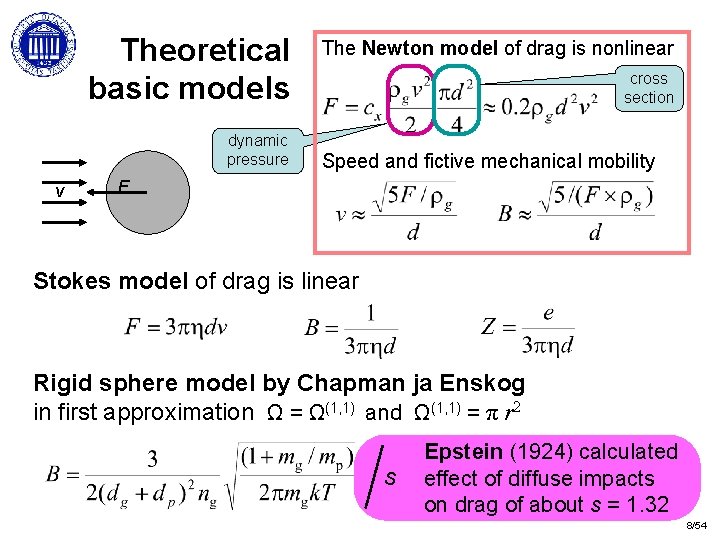
Theoretical basic models dynamic pressure v The Newton model of drag is nonlinear cross section Speed and fictive mechanical mobility F Stokes model of drag is linear Rigid sphere model by Chapman ja Enskog in first approximation Ω = Ω(1, 1) and Ω(1, 1) = π r 2 s Epstein (1924) calculated effect of diffuse impacts on drag of about s = 1. 32 8/54
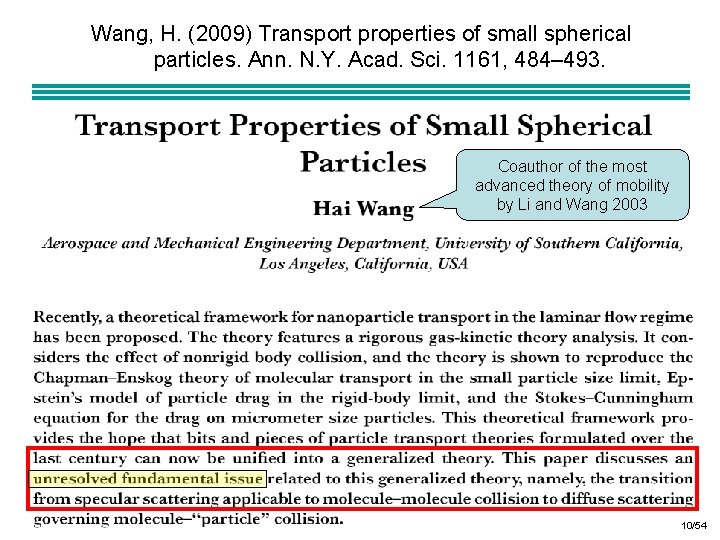
Wang, H. (2009) Transport properties of small spherical particles. Ann. N. Y. Acad. Sci. 1161, 484– 493. Coauthor of the most advanced theory of mobility by Li and Wang 2003 10/54
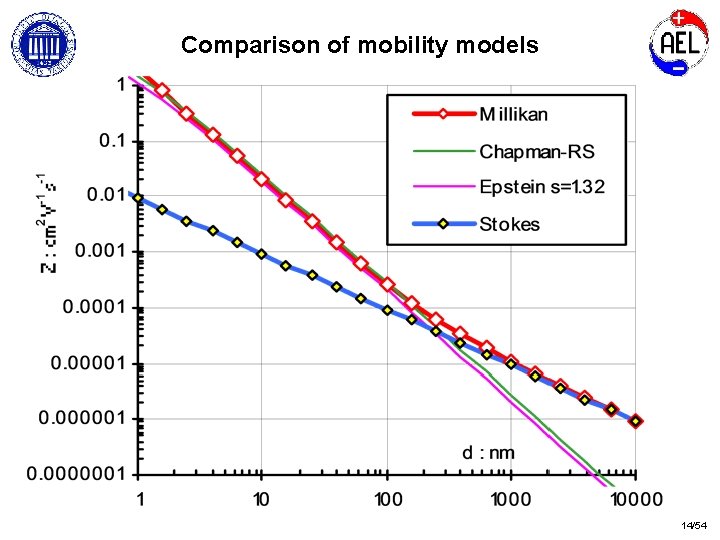
Comparison of mobility models 14/54
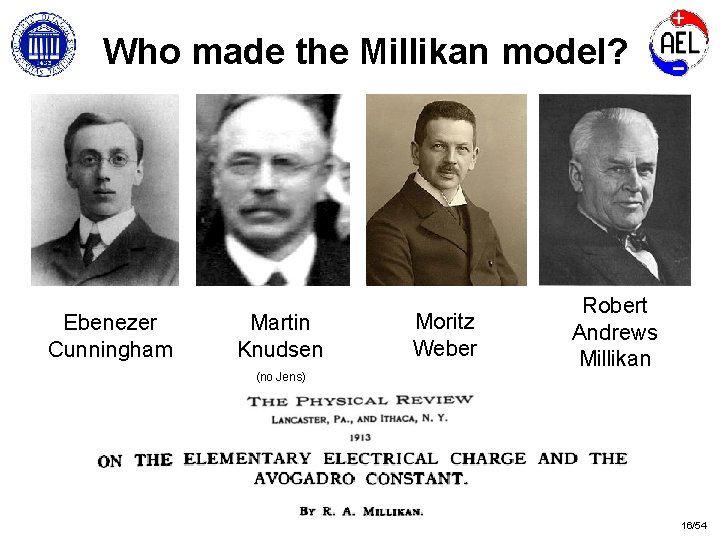
Who made the Millikan model? Ebenezer Cunningham Martin Knudsen (no Jens) Moritz Weber Robert Andrews Millikan 16/54
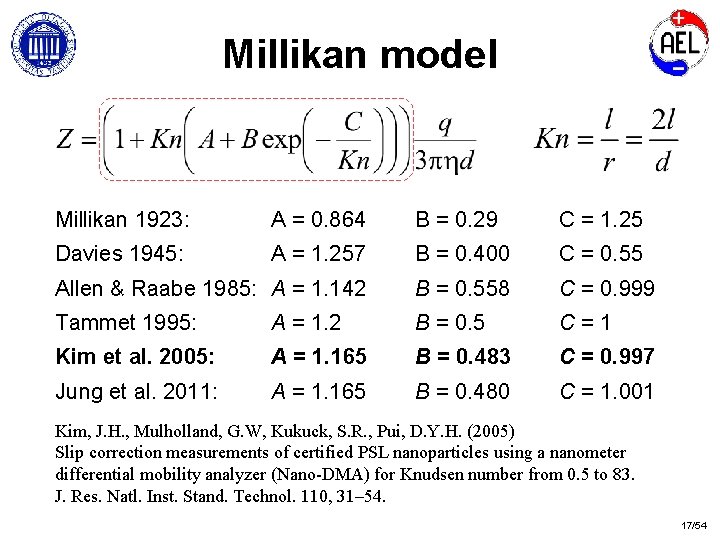
Millikan model Millikan 1923: A = 0. 864 B = 0. 29 C = 1. 25 Davies 1945: A = 1. 257 B = 0. 400 C = 0. 55 Allen & Raabe 1985: A = 1. 142 B = 0. 558 C = 0. 999 Tammet 1995: A = 1. 2 B = 0. 5 C = 1 Kim et al. 2005: A = 1. 165 B = 0. 483 C = 0. 997 Jung et al. 2011: A = 1. 165 B = 0. 480 C = 1. 001 Kim, J. H. , Mulholland, G. W, Kukuck, S. R. , Pui, D. Y. H. (2005) Slip correction measurements of certified PSL nanoparticles using a nanometer differential mobility analyzer (Nano-DMA) for Knudsen number from 0. 5 to 83. J. Res. Natl. Inst. Stand. Technol. 110, 31– 54. 17/54
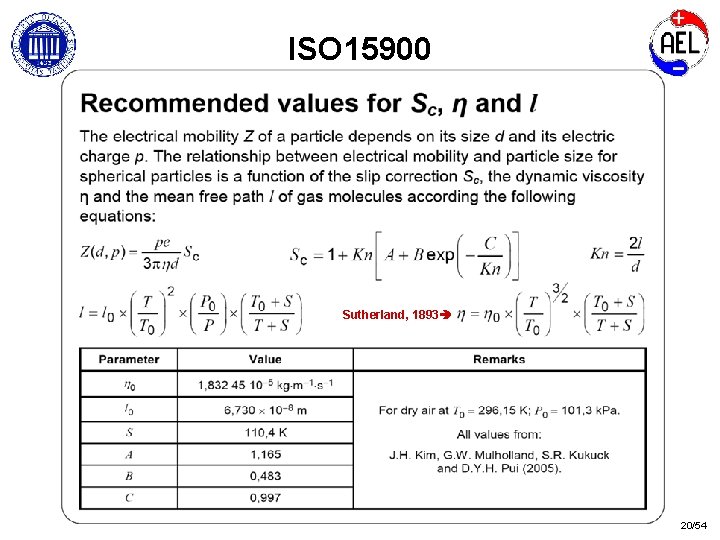
ISO 15900 Sutherland, 1893 20/54
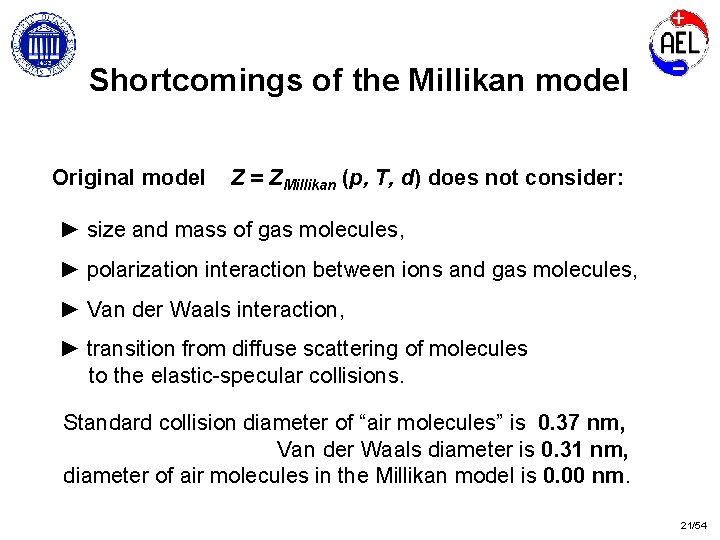
Shortcomings of the Millikan model Original model Z = ZMillikan (p, T, d) does not consider: ► size and mass of gas molecules, ► polarization interaction between ions and gas molecules, ► Van der Waals interaction, ► transition from diffuse scattering of molecules to the elastic-specular collisions. Standard collision diameter of “air molecules” is 0. 37 nm, Van der Waals diameter is 0. 31 nm, diameter of air molecules in the Millikan model is 0. 00 nm. 21/54
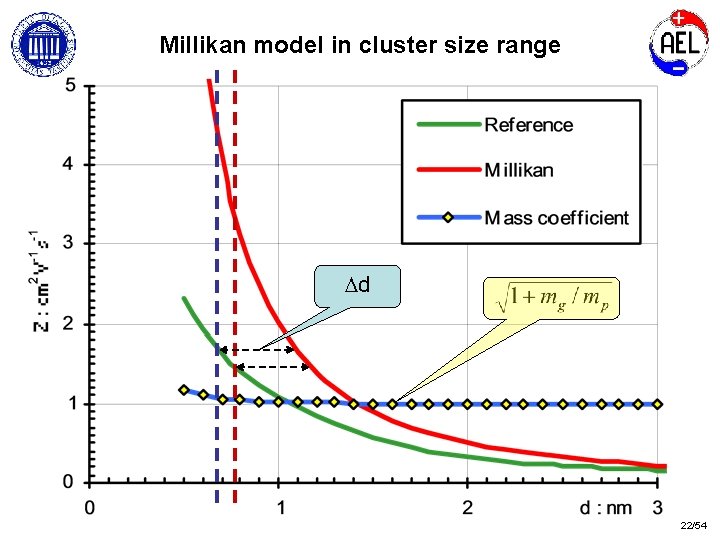
Millikan model in cluster size range Dd 22/54
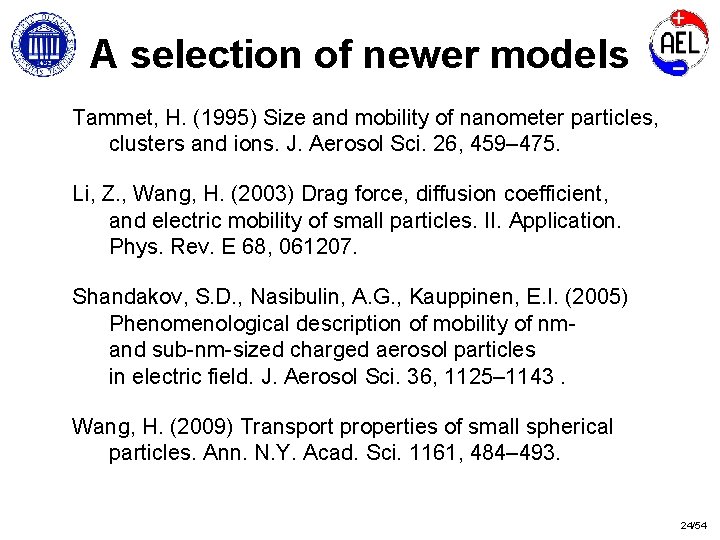
A selection of newer models Tammet, H. (1995) Size and mobility of nanometer particles, clusters and ions. J. Aerosol Sci. 26, 459– 475. Li, Z. , Wang, H. (2003) Drag force, diffusion coefficient, and electric mobility of small particles. II. Application. Phys. Rev. E 68, 061207. Shandakov, S. D. , Nasibulin, A. G. , Kauppinen, E. I. (2005) Phenomenological description of mobility of nm- and sub-nm-sized charged aerosol particles in electric field. J. Aerosol Sci. 36, 1125– 1143. Wang, H. (2009) Transport properties of small spherical particles. Ann. N. Y. Acad. Sci. 1161, 484– 493. 24/54

Poor success of new models The model by Li and Wang (2003) is based on the most developed theory. However, Google did not find any application of this model in aerosol measurements. The same can be told about the model by Shandakov el al. (2005). Few references are found only in introductions of the papers. Reasons? 1. No simple computing algorithm available. 2. No comprehensible interpretation available. 26/54
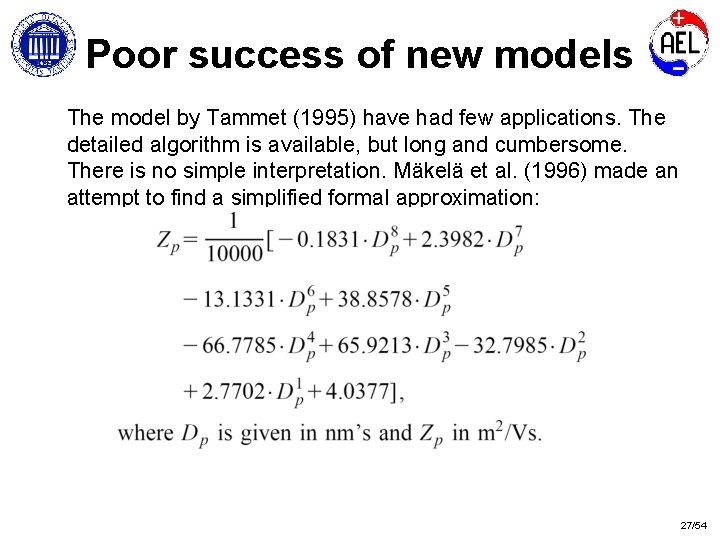
Poor success of new models The model by Tammet (1995) have had few applications. The detailed algorithm is available, but long and cumbersome. There is no simple interpretation. Mäkelä et al. (1996) made an attempt to find a simplified formal approximation: 27/54
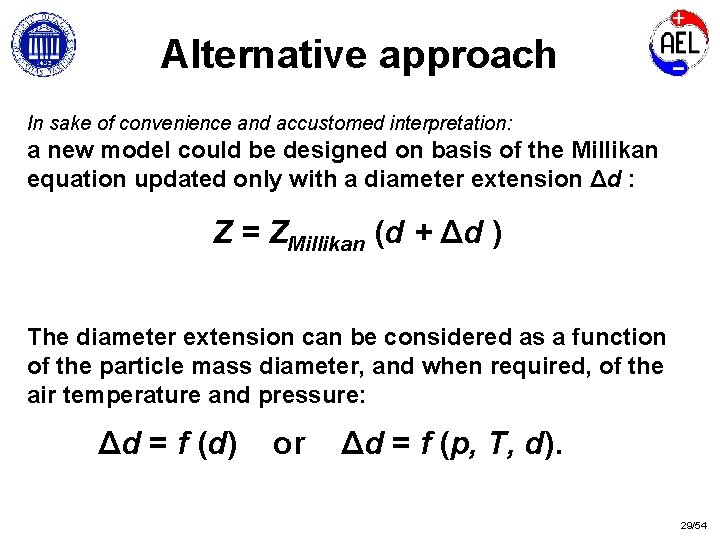
Alternative approach In sake of convenience and accustomed interpretation: a new model could be designed on basis of the Millikan equation updated only with a diameter extension Δd : Z = ZMillikan (d + Δd ) The diameter extension can be considered as a function of the particle mass diameter, and when required, of the air temperature and pressure: Δd = f (d) or Δd = f (p, T, d). 29/54
0/54
PART 2 of the presentation THE CALCULATOR 0/54
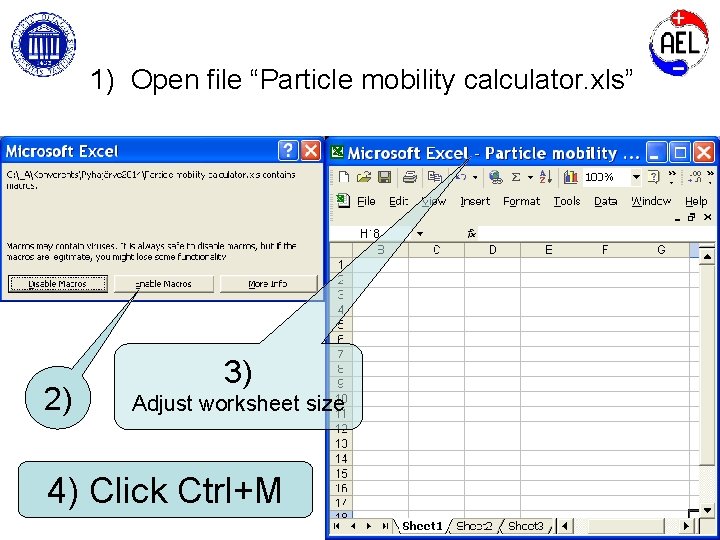
1) Open file “Particle mobility calculator. xls” 2) 3) Adjust worksheet size 4) Click Ctrl+M 0/54
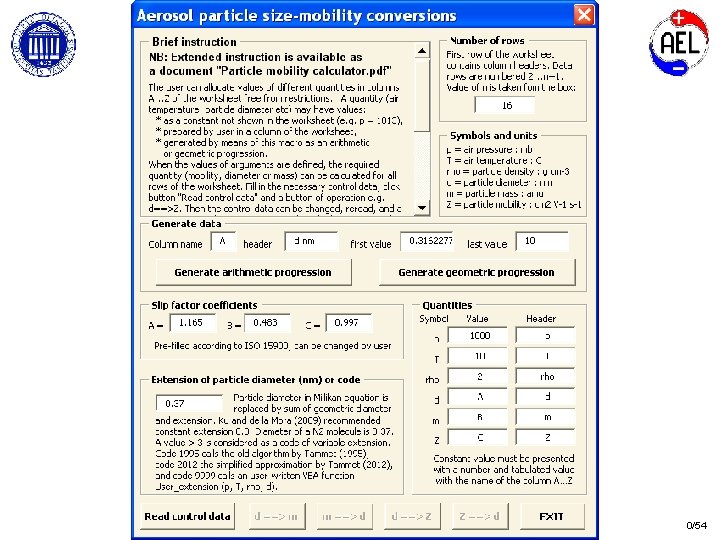
0/54
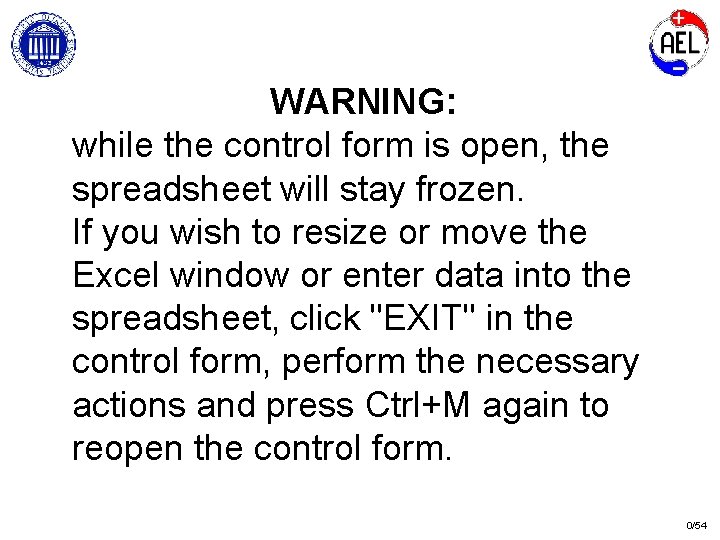
WARNING: while the control form is open, the spreadsheet will stay frozen. If you wish to resize or move the Excel window or enter data into the spreadsheet, click "EXIT" in the control form, perform the necessary actions and press Ctrl+M again to reopen the control form. 0/54
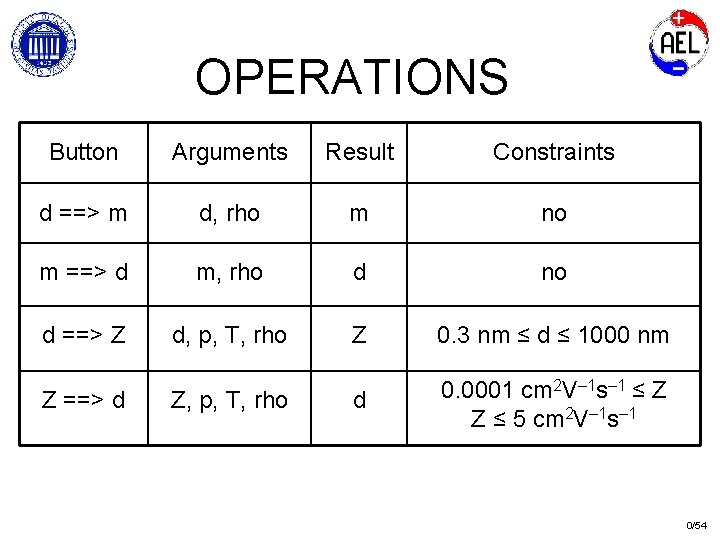
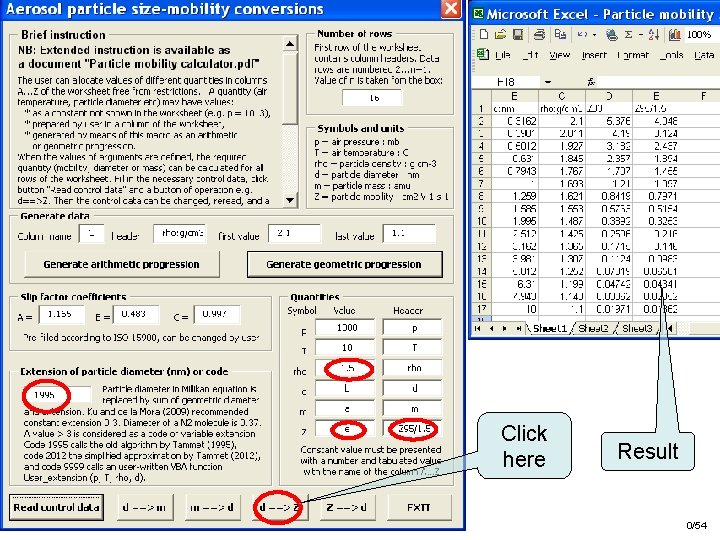
OPERATIONS Button Arguments Result Constraints d ==> m d, rho m no m ==> d m, rho d no d ==> Z d, p, T, rho Z 0. 3 nm ≤ d ≤ 1000 nm d 0. 0001 cm 2 V– 1 s– 1 ≤ Z Z ≤ 5 cm 2 V– 1 s– 1 Z ==> d Z, p, T, rho 0/54
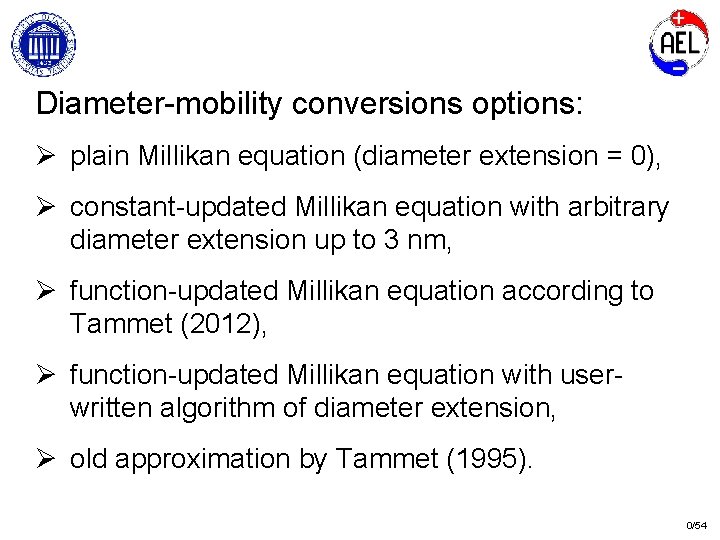
Diameter-mobility conversions options: Ø plain Millikan equation (diameter extension = 0), Ø constant-updated Millikan equation with arbitrary diameter extension up to 3 nm, Ø function-updated Millikan equation according to Tammet (2012), Ø function-updated Millikan equation with userwritten algorithm of diameter extension, Ø old approximation by Tammet (1995). 0/54
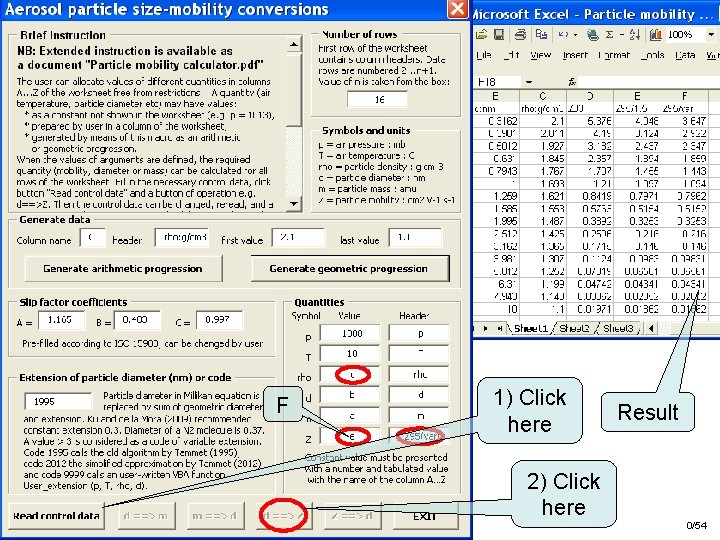
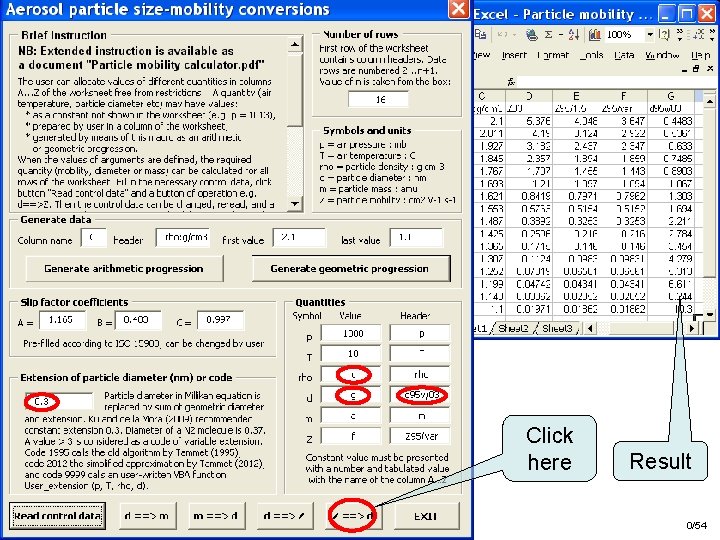
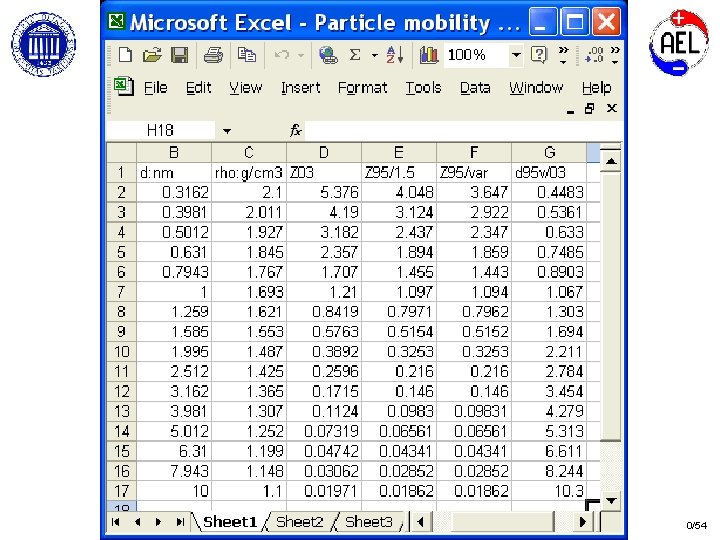
EXAMPLE (protocol of actions) 1) Column B, header d: nm, first value 0. 31622, last value 10 Generate geometric progression 2) Column C, header rho: g/cm 3, first value 2. 1, last value 1. 1 Generate geometric progression 3) Extension 0. 3, quantities d : B (header d), Z : D (header Z 03) Read control data, d ==> Z 4) Extension 1995, quantities rho = 1. 5 (rho), d : B (d), Z : E (Z 95/1. 5), Read control data, d ==> Z 5) Extension 1995, quantities rho = C (rho), d : B (d), Z : F (Z 95/var), Read control data, d ==> Z 6) Extension 0. 3, quantities rho = C (rho), d : G (d 95 v/03), Z : F (Z 95/var), Read control data, Z ==> d 7) EXIT 0/54
Write here B Click here Result 0/54
Click here Result 0/54
1) Fill in boxes Result 2) Click here 3) Click here 0/54
Click here Result 0/54
F 1) Click here 2) Click here Result 0/54
Click here Result 0/54
0/54
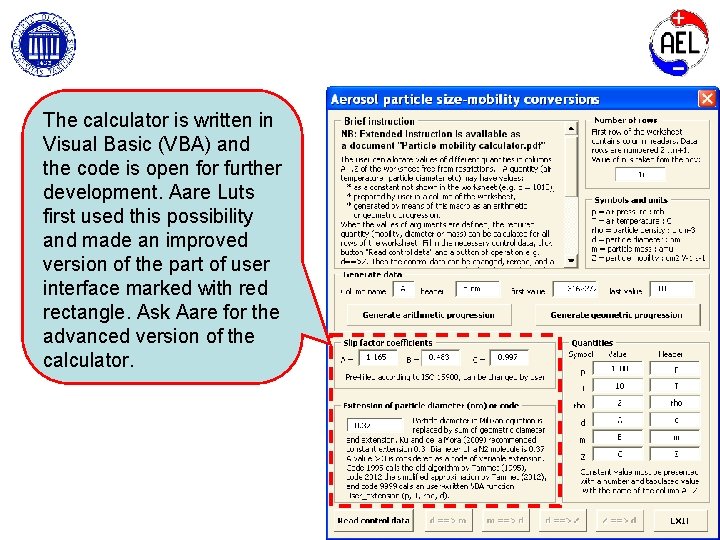
The calculator is written in Visual Basic (VBA) and the code is open for further development. Aare Luts first used this possibility and made an improved version of the part of user interface marked with red rectangle. Ask Aare for the advanced version of the calculator. 0/54
Examples of a simple and a sophisticated exercise A simple exercise: The mobility of a particle depends in some extent on the air temperature and pressure. Create a worksheet and diagrams, which illlustrate the effect of temperature and pressure for 1 nm and 100 nm particles according to different size-mobility models. An uphill task: The present calculator can convert the diameter to mobility and mobility to diameter but has no tool for manipulating the particle mobility and size distributions. Compile similar calculator which allows to convert the particle mobility distribution to the size distribution and vice versa using different size-mobility models. 0/54

0/54
- Slides: 40