
Nanomechanics Simulation Tool Dislocations Make or Break Materials
Nanomechanics Simulation Tool- Dislocations Make or Break Materials Michael Sakano, Mitchell Wood, David Johnson, Alejandro Strachan Department of Biomedical Engineering, University of North Carolina at Chapel Hill School of Materials Engineering, Purdue University
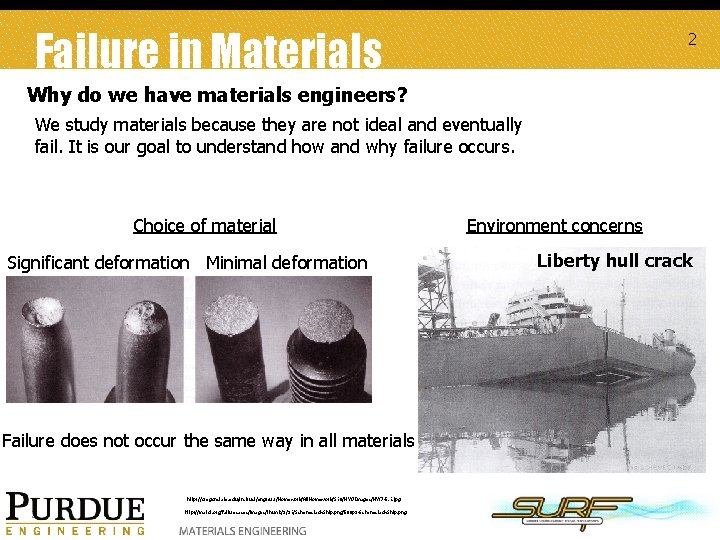
Failure in Materials 2 Why do we have materials engineers? We study materials because they are not ideal and eventually fail. It is our goal to understand how and why failure occurs. Choice of material Significant deformation Minimal deformation Failure does not occur the same way in all materials http: //oregonstate. edu/instruct/engr 322/Homework/All. Homework/S 10/HW 7 Images/HW 7 -5. 1. jpg 2 http: //matdl. org/failurecases/images/thumb/9/91/Schenectady. Ship. png/500 px-Schenectady. Ship. png Environment concerns Liberty hull crack
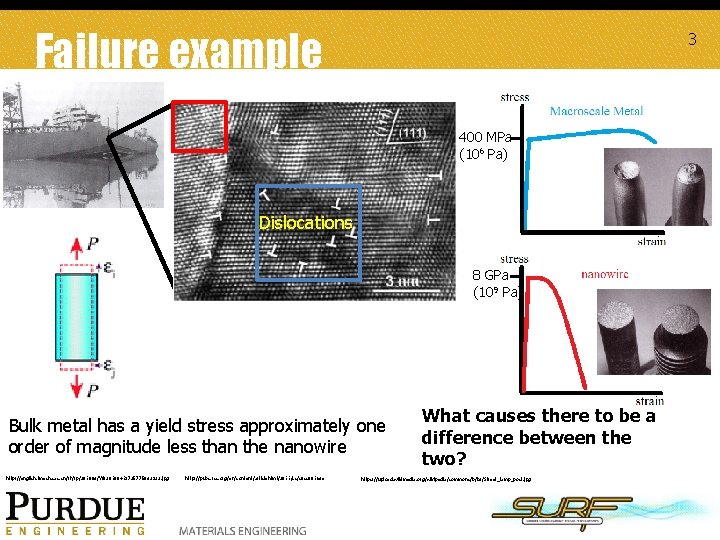
Failure example 3 400 MPa (106 Pa) Dislocations 8 GPa (109 Pa) Bulk metal has a yield stress approximately one order of magnitude less than the nanowire http: //english. imech. cas. cn/rh/rp/201003/W 020100419725775832922. jpg 3 http: //pubs. rsc. org/en/content/articlehtml/2011/cs/c 0 cs 00163 e What causes there to be a difference between the two? https: //upload. wikimedia. org/wikipedia/commons/b/b 2/Street_lamp_post. jpg
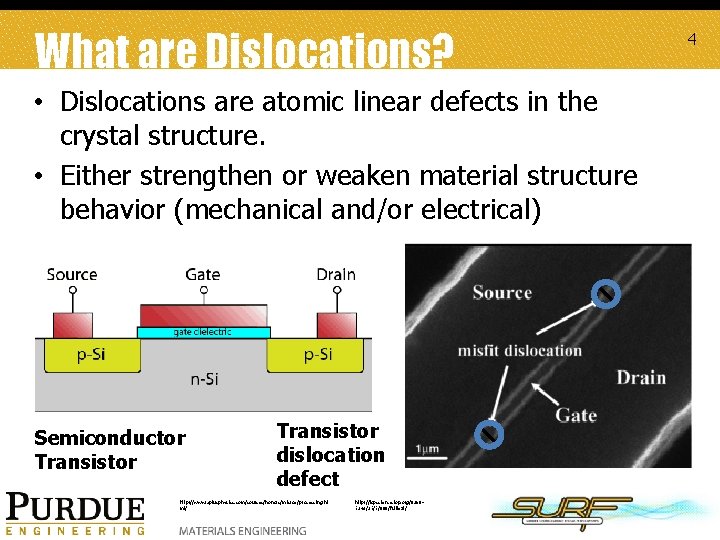
What are Dislocations? • Dislocations are atomic linear defects in the crystal structure. • Either strengthen or weaken material structure behavior (mechanical and/or electrical) Semiconductor Transistor 4 Transistor dislocation defect http: //www. aplusphysics. com/courses/honors/microe/processing. ht ml/ http: //iopscience. iop. org/02681242/21/1/008/fulltext/ 4
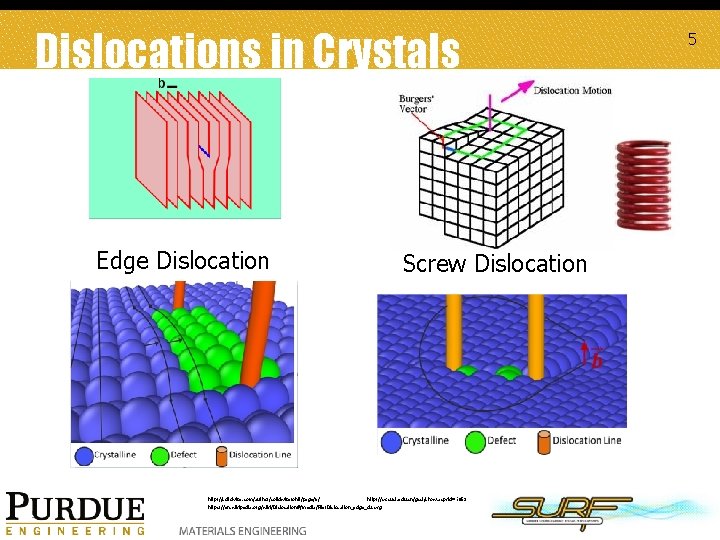
Dislocations in Crystals Edge Dislocation http: //solidwize. com/author/solidwizerohit/page/6/ 5 Screw Dislocation http: //sy. cust. edu. cn/gccl/show. asp? id=1059 https: //en. wikipedia. org/wiki/Dislocation#/media/File: Dislocation_edge_d 2. svg 5
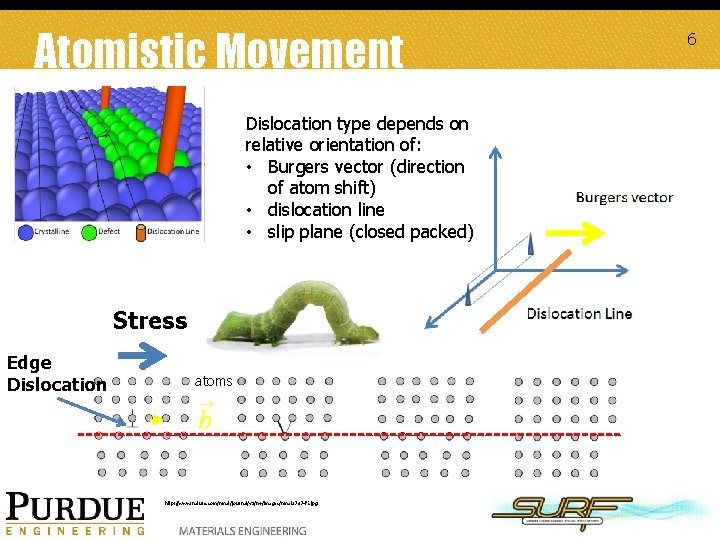
Atomistic Movement Dislocation type depends on relative orientation of: • Burgers vector (direction of atom shift) • dislocation line • slip plane (closed packed) Stress Edge Dislocation atoms http: //www. nature. com/nmat/journal/v 9/n 4/images/nmat 2737 -f 1. jpg 6 6
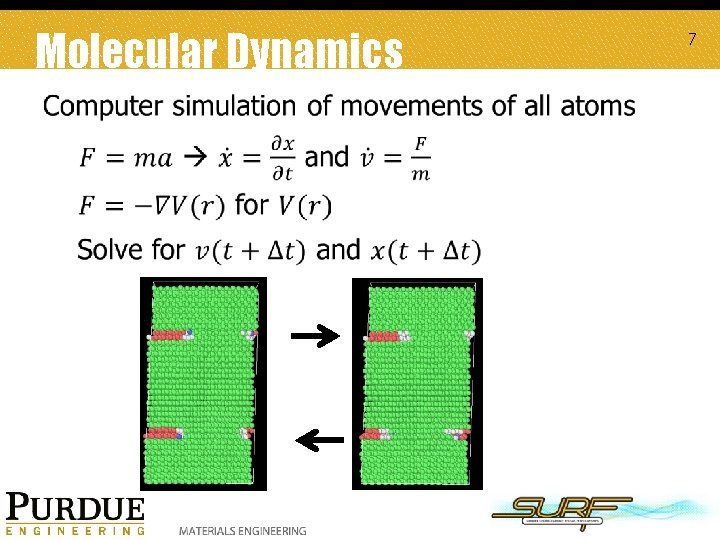
Molecular Dynamics 7 7
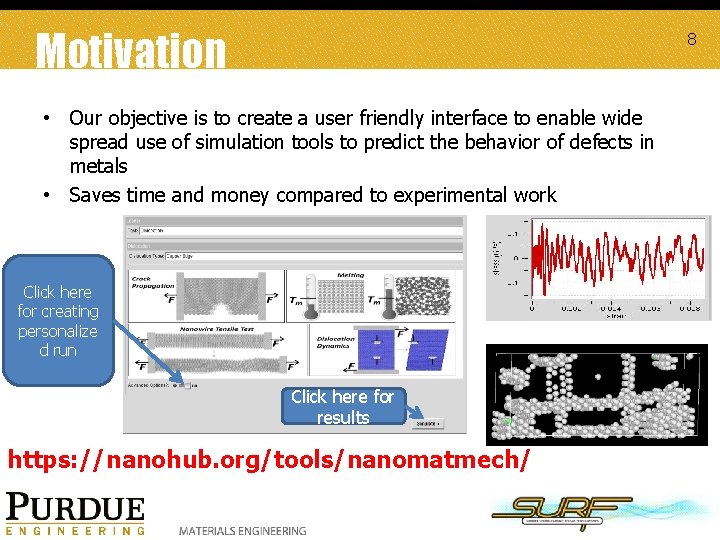
Motivation 8 • Our objective is to create a user friendly interface to enable wide spread use of simulation tools to predict the behavior of defects in metals • Saves time and money compared to experimental work Click here for creating personalize d run Click here for results https: //nanohub. org/tools/nanomatmech/ 8
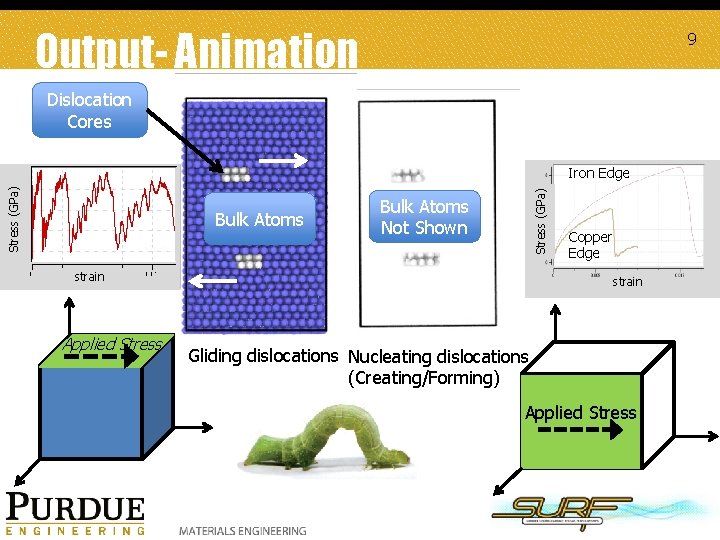
Output- Animation 9 Dislocation Cores Bulk Atoms Stress (GPa) Iron Edge Bulk Atoms Not Shown strain Applied Stress Copper Edge strain Gliding dislocations Nucleating dislocations (Creating/Forming) Applied Stress 9
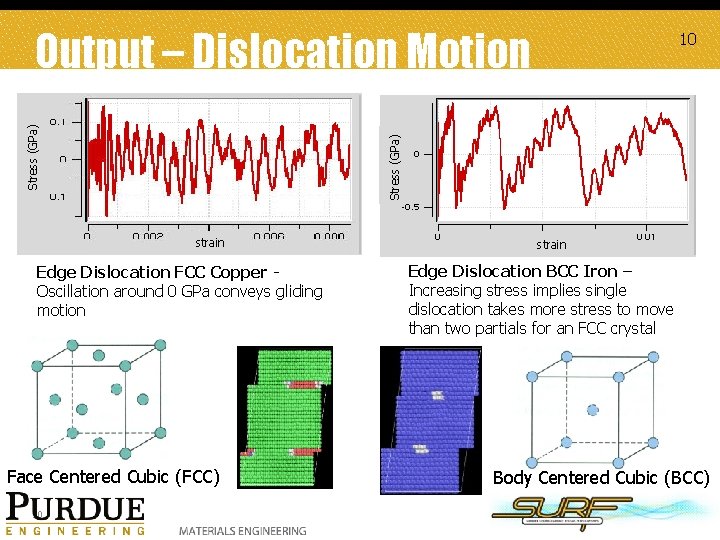
Stress (GPa) Output – Dislocation Motion strain Edge Dislocation FCC Copper Oscillation around 0 GPa conveys gliding motion Face Centered Cubic (FCC) 10 10 strain Edge Dislocation BCC Iron – Increasing stress implies single dislocation takes more stress to move than two partials for an FCC crystal Body Centered Cubic (BCC)
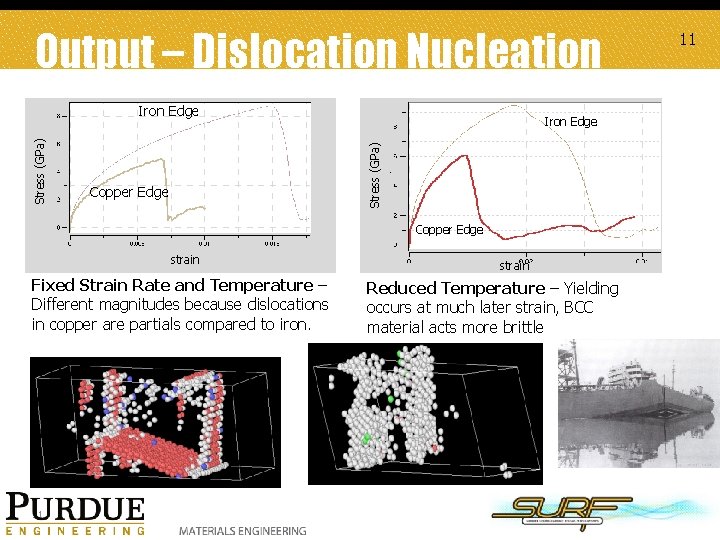
Output – Dislocation Nucleation Iron Edge Stress (GPa) Iron Edge Copper Edge strain Fixed Strain Rate and Temperature – Different magnitudes because dislocations in copper are partials compared to iron. 11 strain Reduced Temperature – Yielding occurs at much later strain, BCC material acts more brittle 11
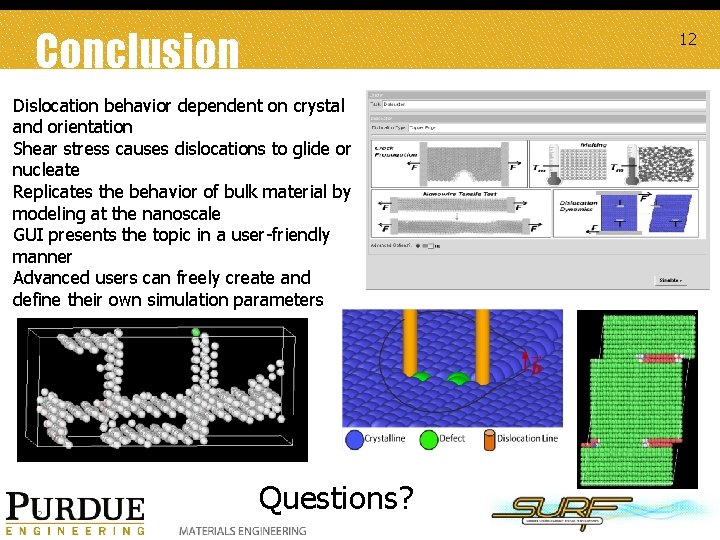
Conclusion 12 Dislocation behavior dependent on crystal and orientation Shear stress causes dislocations to glide or nucleate Replicates the behavior of bulk material by modeling at the nanoscale GUI presents the topic in a user-friendly manner Advanced users can freely create and define their own simulation parameters 12 Questions?
- Slides: 12