
Nanoimprint lithography NIL 1 2 3 4 5
- Slides: 50
Nanoimprint lithography (NIL) 1. 2. 3. 4. 5. 6. UV-curable NIL. Resists for UV-NIL. Mold fabrication for thermal and UV-NIL. Alignment. NIL into metals. NIL systems (air press, roller, roll-to-roll, EFAN…) ECE 730: Fabrication in the nanoscale: principles, technology and applications Instructor: Bo Cui, ECE, University of Waterloo; http: //ece. uwaterloo. ca/~bcui/ Textbook: Nanofabrication: principles, capabilities and limits, by Zheng Cui
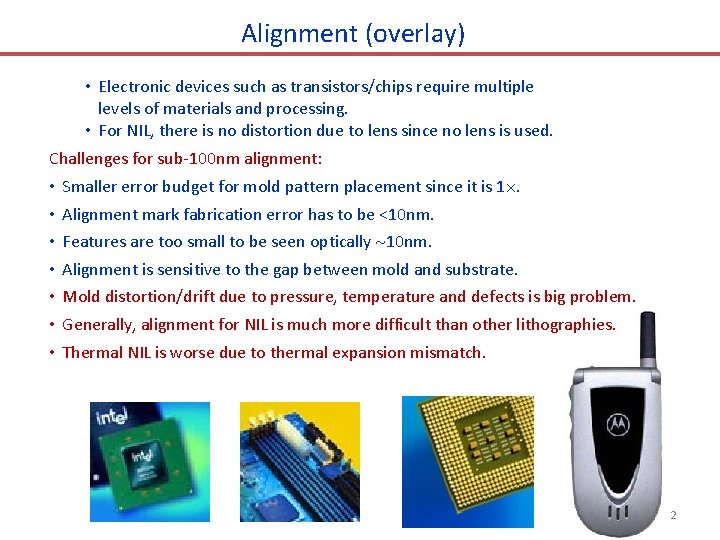
Alignment (overlay) • Electronic devices such as transistors/chips require multiple levels of materials and processing. • For NIL, there is no distortion due to lens since no lens is used. Challenges for sub-100 nm alignment: • • Smaller error budget for mold pattern placement since it is 1. Alignment mark fabrication error has to be <10 nm. Features are too small to be seen optically 10 nm. Alignment is sensitive to the gap between mold and substrate. Mold distortion/drift due to pressure, temperature and defects is big problem. Generally, alignment for NIL is much more difficult than other lithographies. Thermal NIL is worse due to thermal expansion mismatch. 2
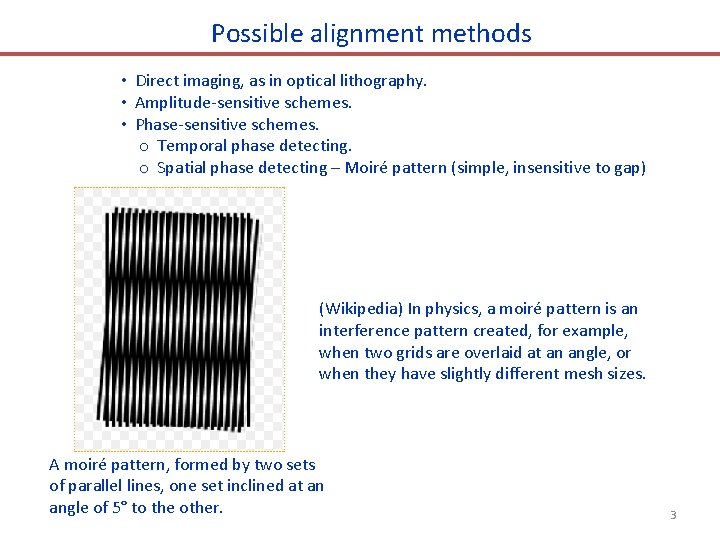
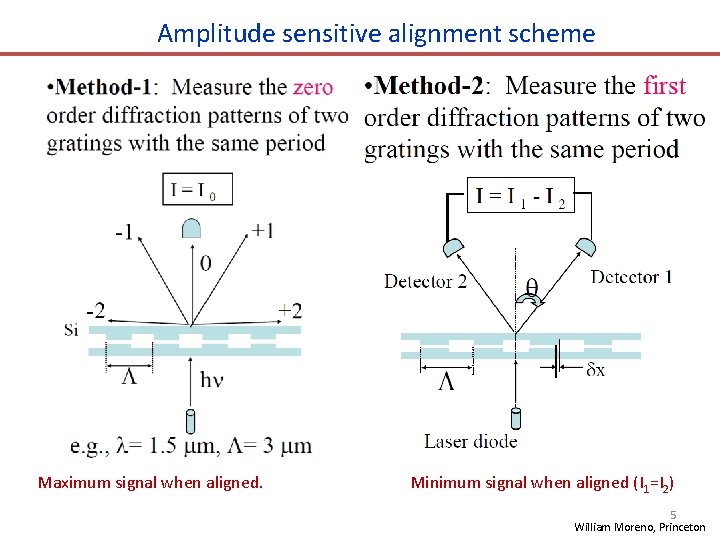
Possible alignment methods • Direct imaging, as in optical lithography. • Amplitude-sensitive schemes. • Phase-sensitive schemes. o Temporal phase detecting. o Spatial phase detecting – Moiré pattern (simple, insensitive to gap) (Wikipedia) In physics, a moiré pattern is an interference pattern created, for example, when two grids are overlaid at an angle, or when they have slightly different mesh sizes. A moiré pattern, formed by two sets of parallel lines, one set inclined at an angle of 5° to the other. 3
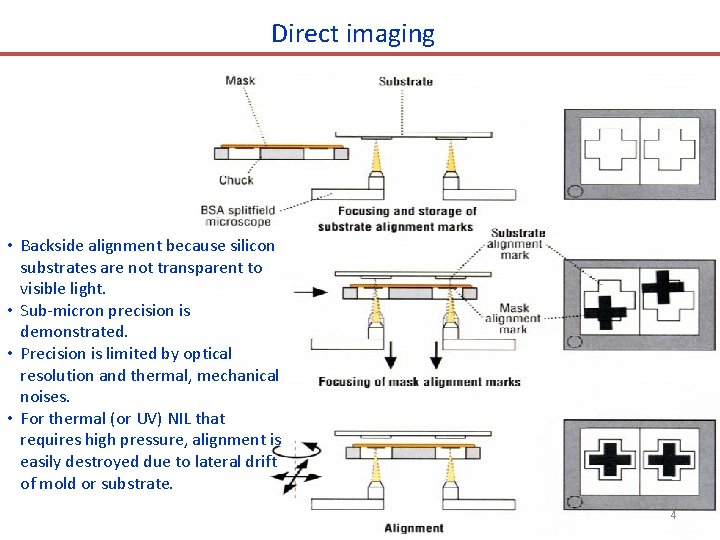
Direct imaging • Backside alignment because silicon substrates are not transparent to visible light. • Sub-micron precision is demonstrated. • Precision is limited by optical resolution and thermal, mechanical noises. • For thermal (or UV) NIL that requires high pressure, alignment is easily destroyed due to lateral drift of mold or substrate. 4
Amplitude sensitive alignment scheme Maximum signal when aligned. Minimum signal when aligned (I 1=I 2) 5 William Moreno, Princeton
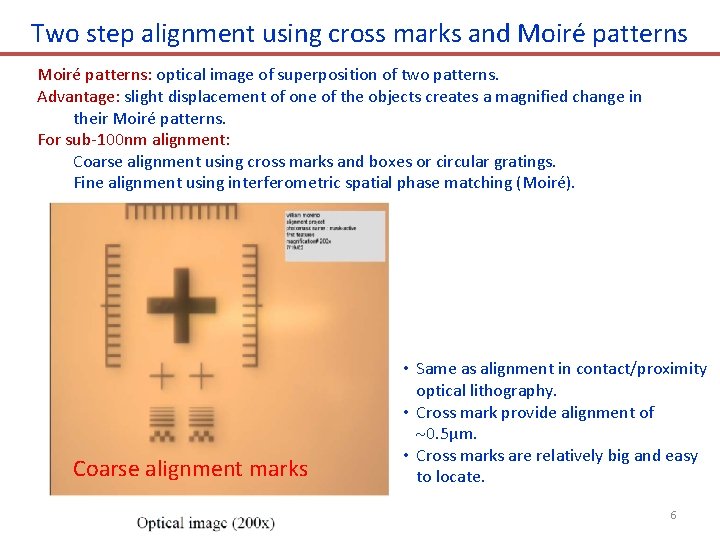
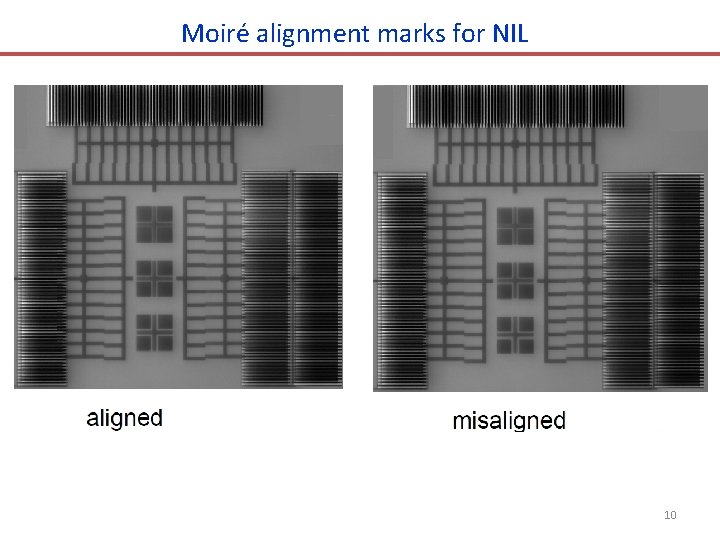
Two step alignment using cross marks and Moiré patterns: optical image of superposition of two patterns. Advantage: slight displacement of one of the objects creates a magnified change in their Moiré patterns. For sub-100 nm alignment: Coarse alignment using cross marks and boxes or circular gratings. Fine alignment using interferometric spatial phase matching (Moiré). Coarse alignment marks • Same as alignment in contact/proximity optical lithography. • Cross mark provide alignment of 0. 5μm. • Cross marks are relatively big and easy to locate. 6
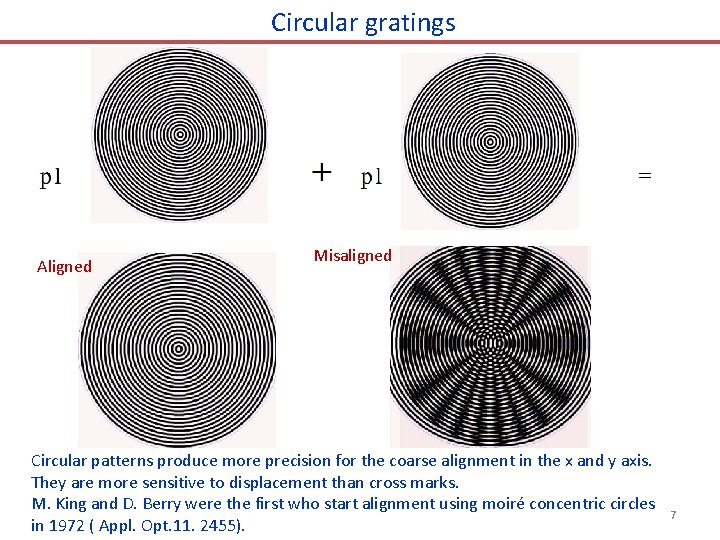
Circular gratings Aligned Misaligned Circular patterns produce more precision for the coarse alignment in the x and y axis. They are more sensitive to displacement than cross marks. M. King and D. Berry were the first who start alignment using moiré concentric circles in 1972 ( Appl. Opt. 11. 2455). 7
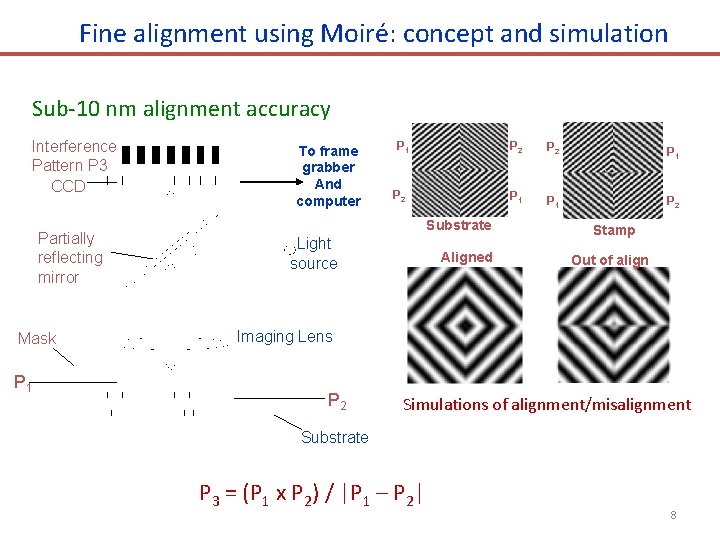
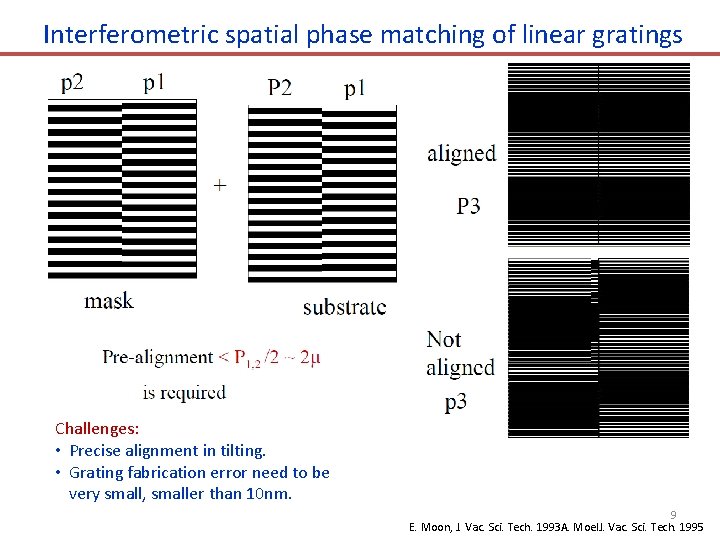
Fine alignment using Moiré: concept and simulation Sub-10 nm alignment accuracy Interference Pattern P 3 CCD Partially reflecting mirror Mask P 1 To frame grabber And computer P 1 P 2 Substrate Light source Aligned P 2 P 1 P 1 P 2 Stamp Out of align Imaging Lens P 2 Simulations of alignment/misalignment Substrate P 3 = (P 1 x P 2) / |P 1 – P 2| 8
Interferometric spatial phase matching of linear gratings Challenges: • Precise alignment in tilting. • Grating fabrication error need to be very small, smaller than 10 nm. 9 E. Moon, J. Vac. Sci. Tech. 1993 A. Moel. J. Vac. Sci. Tech. 1995
Moiré alignment marks for NIL 10
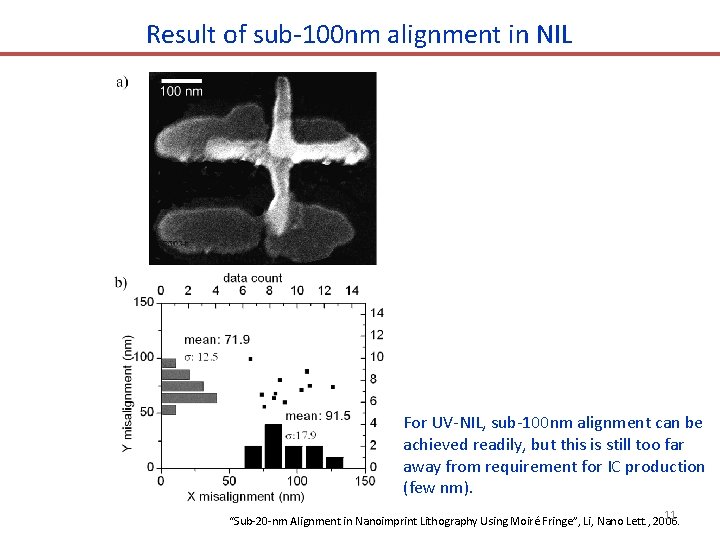
Result of sub-100 nm alignment in NIL For UV-NIL, sub-100 nm alignment can be achieved readily, but this is still too far away from requirement for IC production (few nm). 11 “Sub-20 -nm Alignment in Nanoimprint Lithography Using Moiré Fringe”, Li, Nano Lett. , 2006.
Nanoimprint lithography (NIL) 1. 2. 3. 4. 5. 6. UV-curable NIL. Resists for UV-NIL. Mold fabrication for thermal and UV-NIL. Alignment. NIL into metals. NIL systems (air press, roller, roll-to-roll, EFAN…) 12
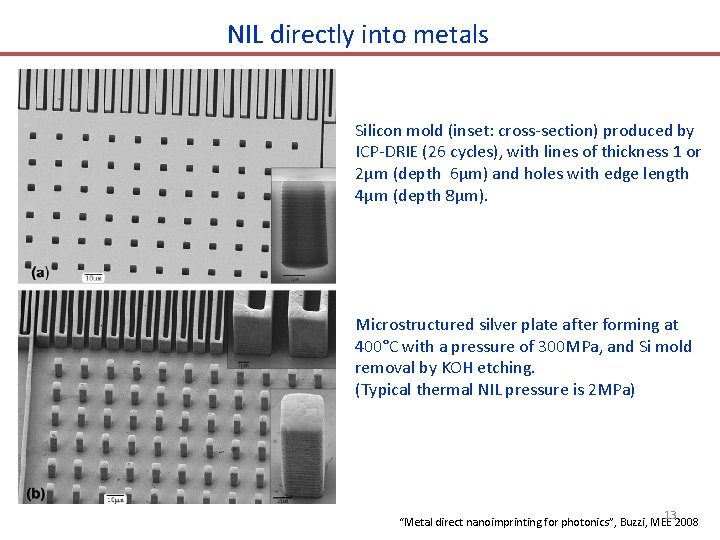
NIL directly into metals Silicon mold (inset: cross-section) produced by ICP-DRIE (26 cycles), with lines of thickness 1 or 2μm (depth 6μm) and holes with edge length 4μm (depth 8μm). Microstructured silver plate after forming at 400°C with a pressure of 300 MPa, and Si mold removal by KOH etching. (Typical thermal NIL pressure is 2 MPa) 13 “Metal direct nanoimprinting for photonics”, Buzzi, MEE 2008
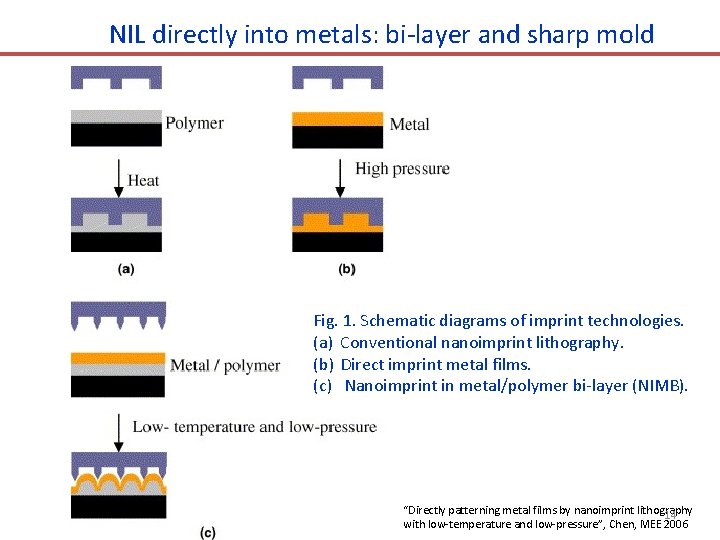
NIL directly into metals: bi-layer and sharp mold Fig. 1. Schematic diagrams of imprint technologies. (a) Conventional nanoimprint lithography. (b) Direct imprint metal films. (c) Nanoimprint in metal/polymer bi-layer (NIMB). “Directly patterning metal films by nanoimprint lithography 14 with low-temperature and low-pressure”, Chen, MEE 2006
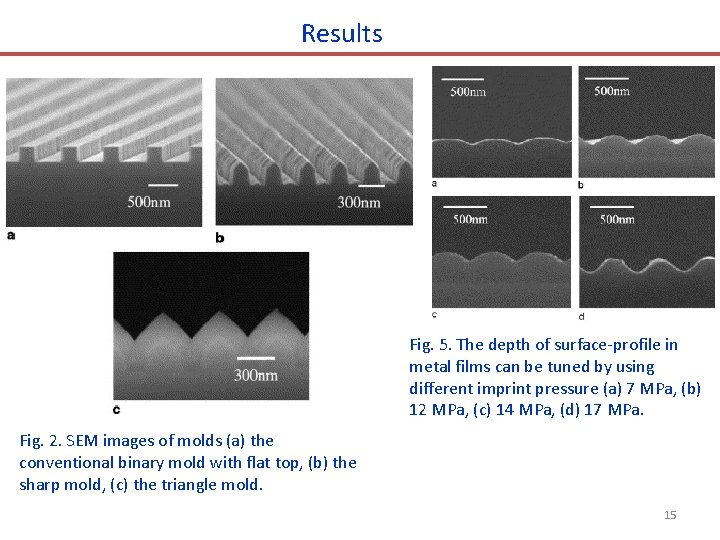
Results Fig. 5. The depth of surface-profile in metal films can be tuned by using different imprint pressure (a) 7 MPa, (b) 12 MPa, (c) 14 MPa, (d) 17 MPa. Fig. 2. SEM images of molds (a) the conventional binary mold with flat top, (b) the sharp mold, (c) the triangle mold. 15
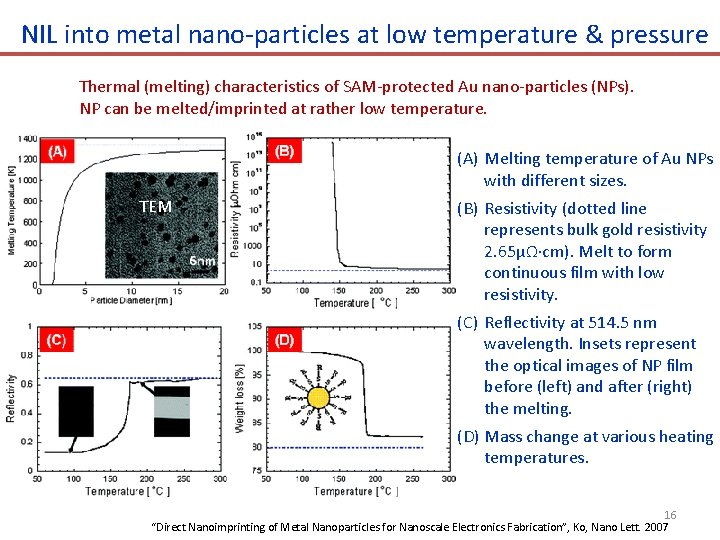
NIL into metal nano-particles at low temperature & pressure Thermal (melting) characteristics of SAM-protected Au nano-particles (NPs). NP can be melted/imprinted at rather low temperature. TEM (A) Melting temperature of Au NPs with different sizes. (B) Resistivity (dotted line represents bulk gold resistivity 2. 65μΩ·cm). Melt to form continuous film with low resistivity. (C) Reflectivity at 514. 5 nm wavelength. Insets represent the optical images of NP film before (left) and after (right) the melting. (D) Mass change at various heating temperatures. 16 “Direct Nanoimprinting of Metal Nanoparticles for Nanoscale Electronics Fabrication”, Ko, Nano Lett. 2007
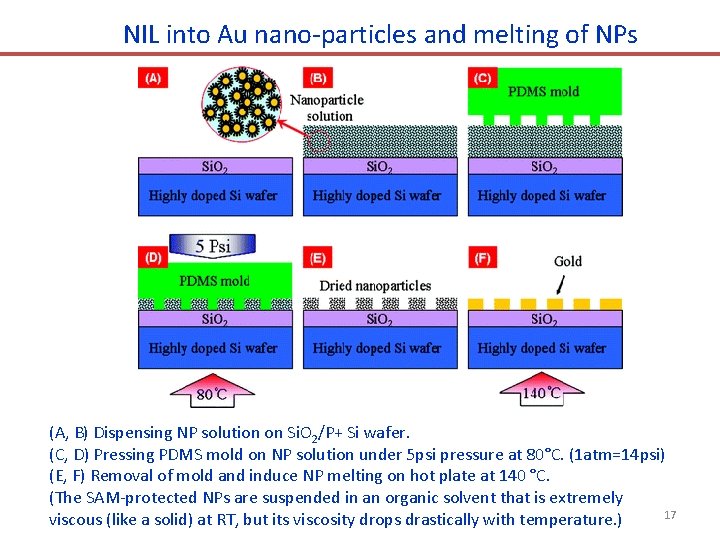
NIL into Au nano-particles and melting of NPs (A, B) Dispensing NP solution on Si. O 2/P+ Si wafer. (C, D) Pressing PDMS mold on NP solution under 5 psi pressure at 80°C. (1 atm=14 psi) (E, F) Removal of mold and induce NP melting on hot plate at 140 °C. (The SAM-protected NPs are suspended in an organic solvent that is extremely 17 viscous (like a solid) at RT, but its viscosity drops drastically with temperature. )
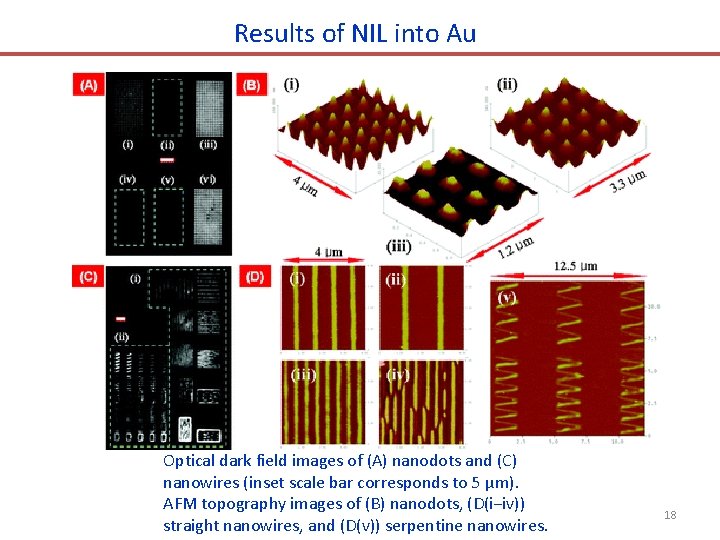
Results of NIL into Au Optical dark field images of (A) nanodots and (C) nanowires (inset scale bar corresponds to 5 μm). AFM topography images of (B) nanodots, (D(i−iv)) straight nanowires, and (D(v)) serpentine nanowires. 18
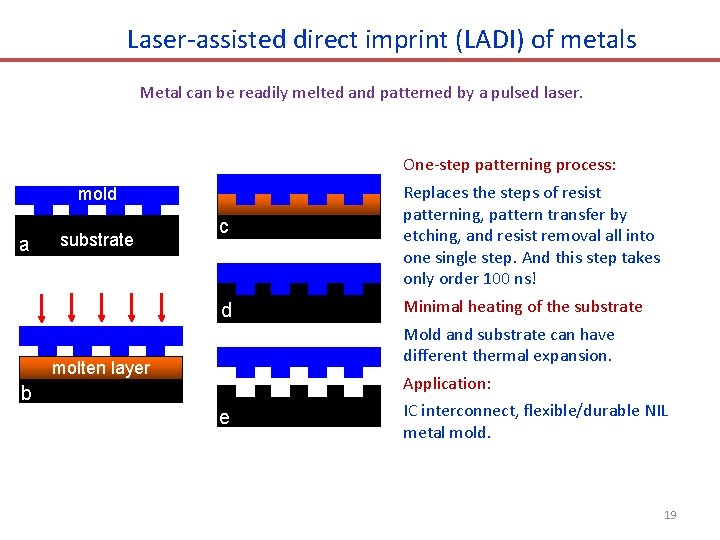
Laser-assisted direct imprint (LADI) of metals Metal can be readily melted and patterned by a pulsed laser. One-step patterning process: c Replaces the steps of resist patterning, pattern transfer by etching, and resist removal all into one single step. And this step takes only order 100 ns! d Minimal heating of the substrate mold a substrate Mold and substrate can have different thermal expansion. molten layer Application: b e IC interconnect, flexible/durable NIL metal mold. 19
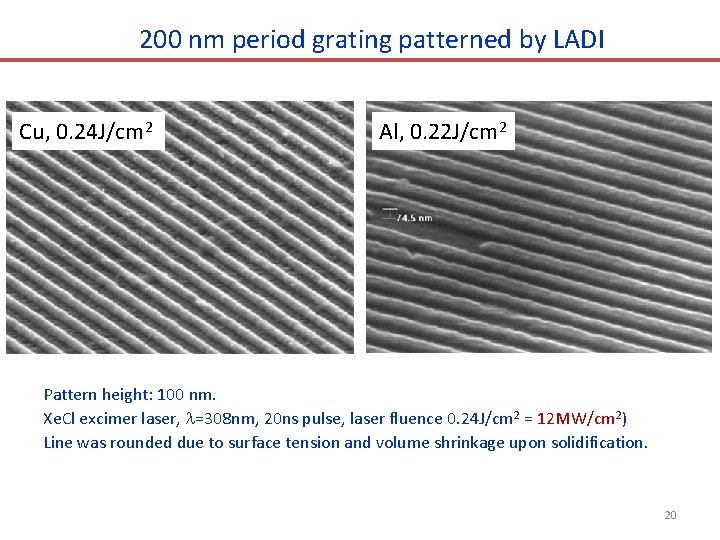
200 nm period grating patterned by LADI Cu, 0. 24 J/cm 2 Al, 0. 22 J/cm 2 Pattern height: 100 nm. Xe. Cl excimer laser, =308 nm, 20 ns pulse, laser fluence 0. 24 J/cm 2 = 12 MW/cm 2) Line was rounded due to surface tension and volume shrinkage upon solidification. 20
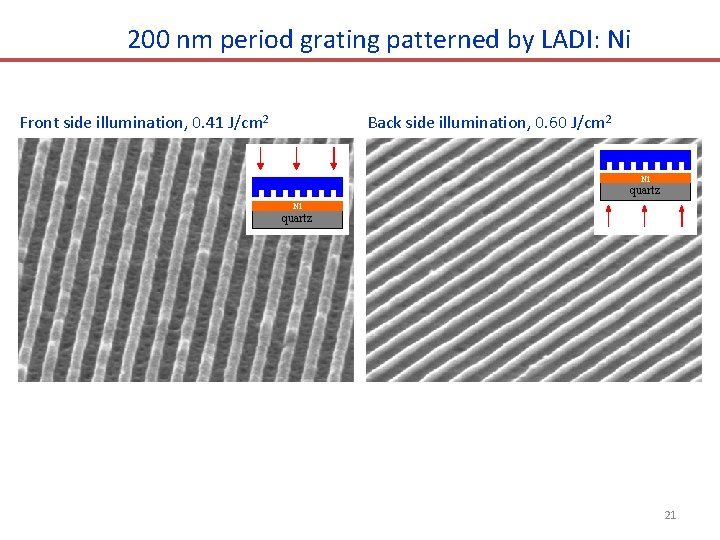
200 nm period grating patterned by LADI: Ni Front side illumination, 0. 41 J/cm 2 Back side illumination, 0. 60 J/cm 2 Ni quartz 21
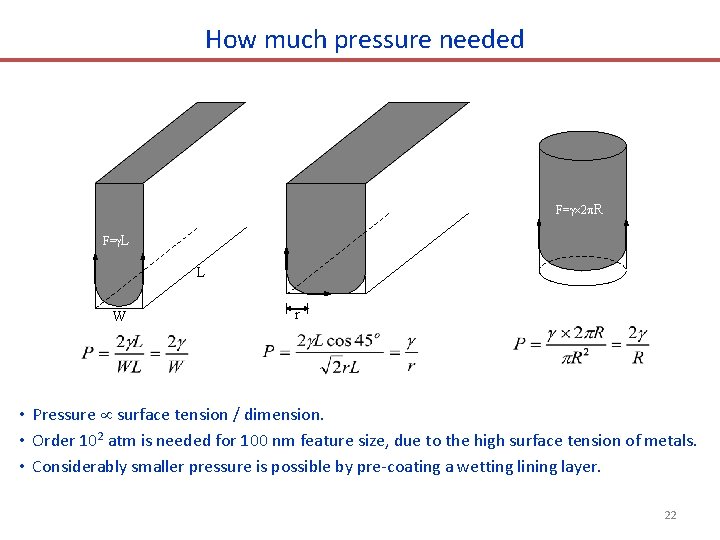
How much pressure needed F= 2 R F= L L W r • Pressure surface tension / dimension. • Order 102 atm is needed for 100 nm feature size, due to the high surface tension of metals. • Considerably smaller pressure is possible by pre-coating a wetting lining layer. 22
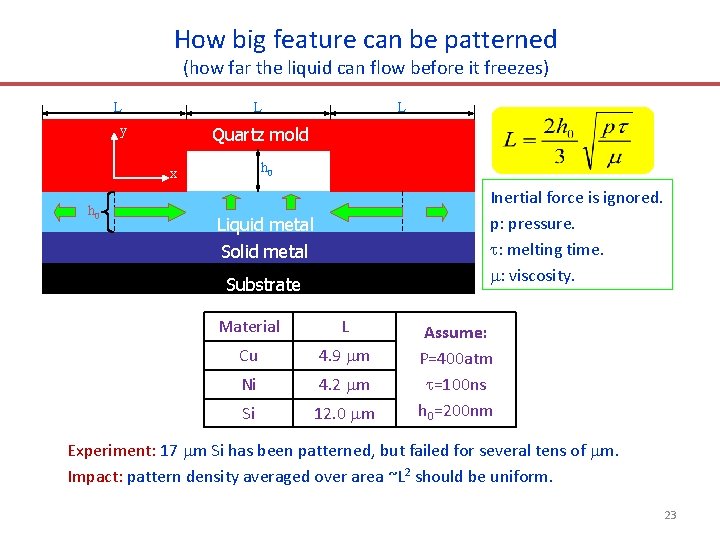
How big feature can be patterned (how far the liquid can flow before it freezes) L L y Quartz mold h 0 x h 0 L Inertial force is ignored. p: pressure. : melting time. : viscosity. Liquid metal Solid metal Substrate Material L Cu 4. 9 m Ni 4. 2 m Si 12. 0 m Assume: P=400 atm =100 ns h 0=200 nm Experiment: 17 m Si has been patterned, but failed for several tens of m. Impact: pattern density averaged over area ~L 2 should be uniform. 23
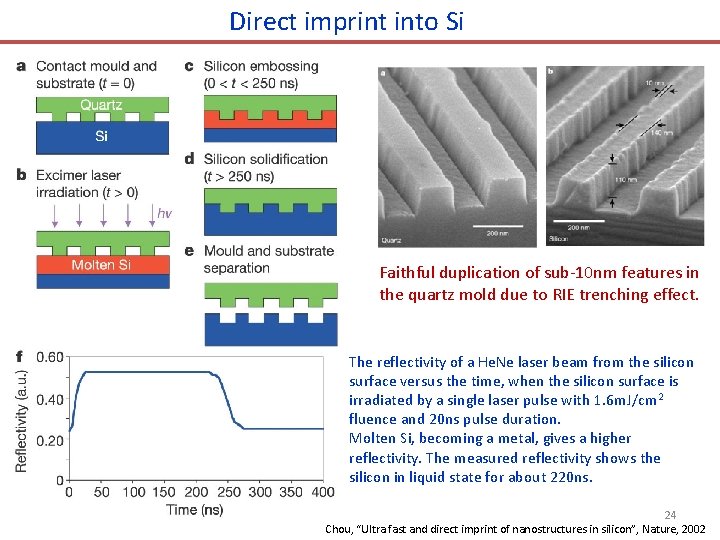
Direct imprint into Si Faithful duplication of sub-10 nm features in the quartz mold due to RIE trenching effect. The reflectivity of a He. Ne laser beam from the silicon surface versus the time, when the silicon surface is irradiated by a single laser pulse with 1. 6 m. J/cm 2 fluence and 20 ns pulse duration. Molten Si, becoming a metal, gives a higher reflectivity. The measured reflectivity shows the silicon in liquid state for about 220 ns. 24 Chou, “Ultra fast and direct imprint of nanostructures in silicon”, Nature, 2002
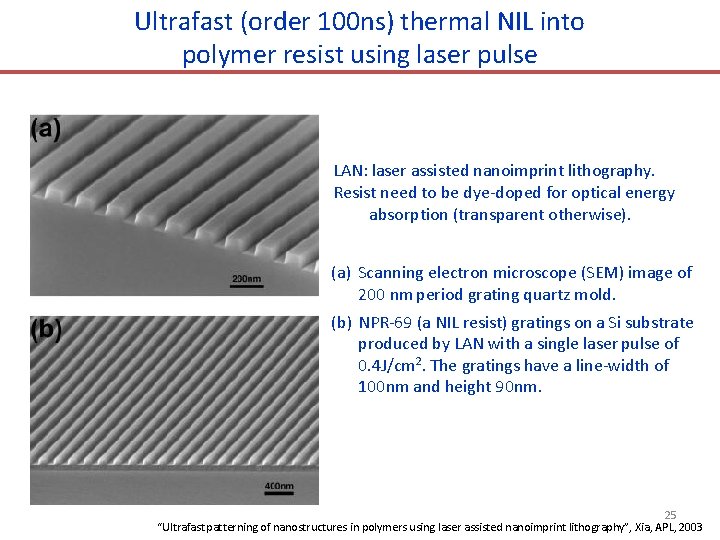
Ultrafast (order 100 ns) thermal NIL into polymer resist using laser pulse LAN: laser assisted nanoimprint lithography. Resist need to be dye-doped for optical energy absorption (transparent otherwise). (a) Scanning electron microscope (SEM) image of 200 nm period grating quartz mold. (b) NPR-69 (a NIL resist) gratings on a Si substrate produced by LAN with a single laser pulse of 0. 4 J/cm 2. The gratings have a line-width of 100 nm and height 90 nm. 25 “Ultrafast patterning of nanostructures in polymers using laser assisted nanoimprint lithography”, Xia, APL, 2003
Nanoimprint lithography (NIL) 1. 2. 3. 4. 5. 6. UV-curable NIL. Resists for UV-NIL. Mold fabrication for thermal and UV-NIL. Alignment. NIL into metals. NIL systems (air press, roller, roll-to-roll, EFAN…) 26
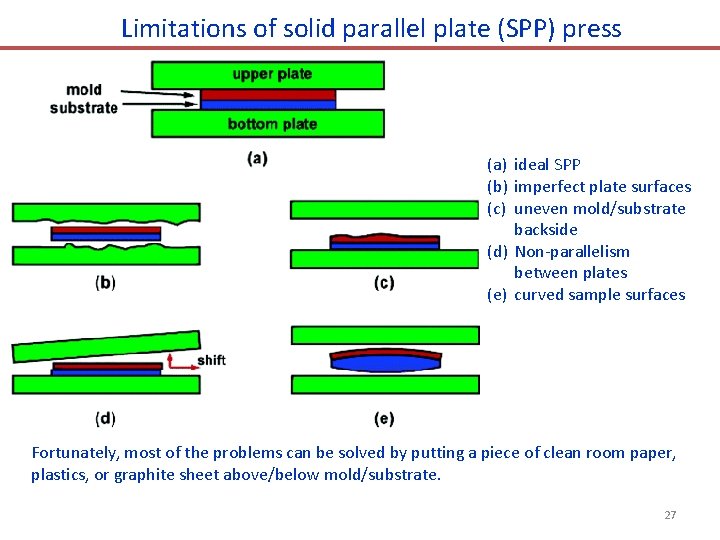
Limitations of solid parallel plate (SPP) press (a) ideal SPP (b) imperfect plate surfaces (c) uneven mold/substrate backside (d) Non-parallelism between plates (e) curved sample surfaces Fortunately, most of the problems can be solved by putting a piece of clean room paper, plastics, or graphite sheet above/below mold/substrate. 27
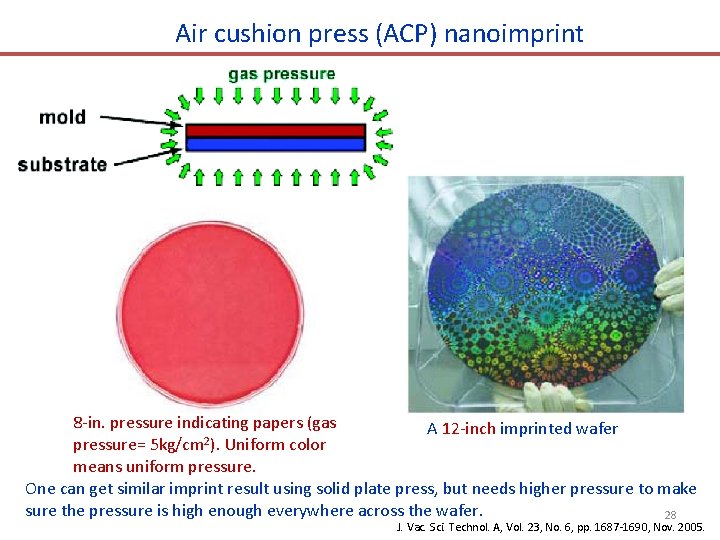
Air cushion press (ACP) nanoimprint 8 -in. pressure indicating papers (gas A 12 -inch imprinted wafer 2 pressure= 5 kg/cm ). Uniform color means uniform pressure. One can get similar imprint result using solid plate press, but needs higher pressure to make sure the pressure is high enough everywhere across the wafer. 28 J. Vac. Sci. Technol. A, Vol. 23, No. 6, pp. 1687 -1690, Nov. 2005.
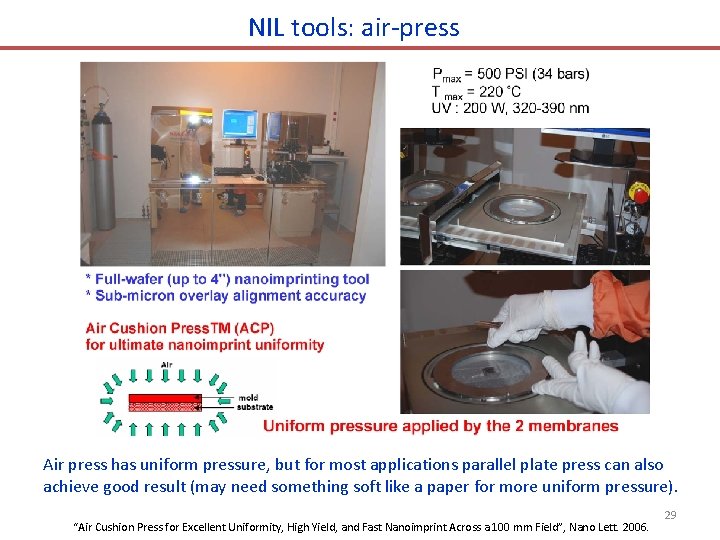
NIL tools: air-press Air press has uniform pressure, but for most applications parallel plate press can also achieve good result (may need something soft like a paper for more uniform pressure). “Air Cushion Press for Excellent Uniformity, High Yield, and Fast Nanoimprint Across a 100 mm Field”, Nano Lett. 2006. 29
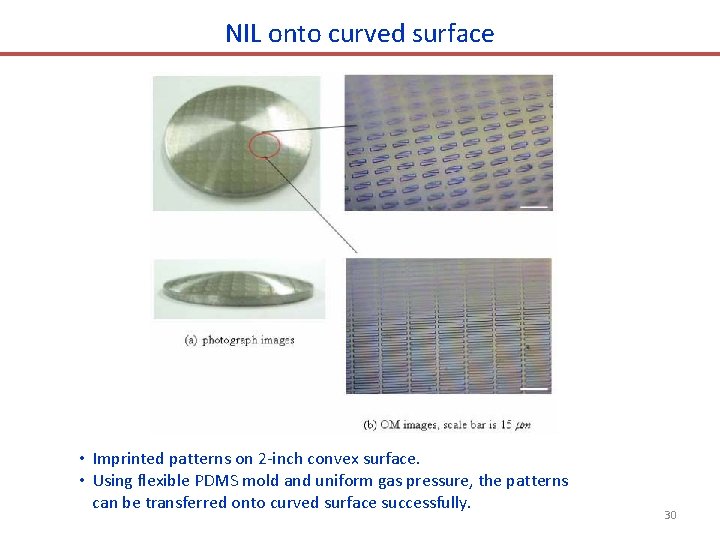
NIL onto curved surface • Imprinted patterns on 2 -inch convex surface. • Using flexible PDMS mold and uniform gas pressure, the patterns can be transferred onto curved surface successfully. 30
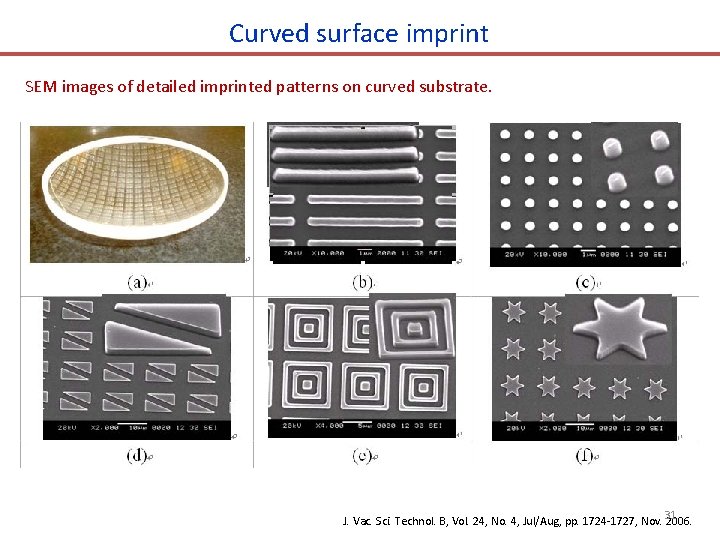
Curved surface imprint SEM images of detailed imprinted patterns on curved substrate. 31 J. Vac. Sci. Technol. B, Vol. 24, No. 4, Jul/Aug, pp. 1724 -1727, Nov. 2006.
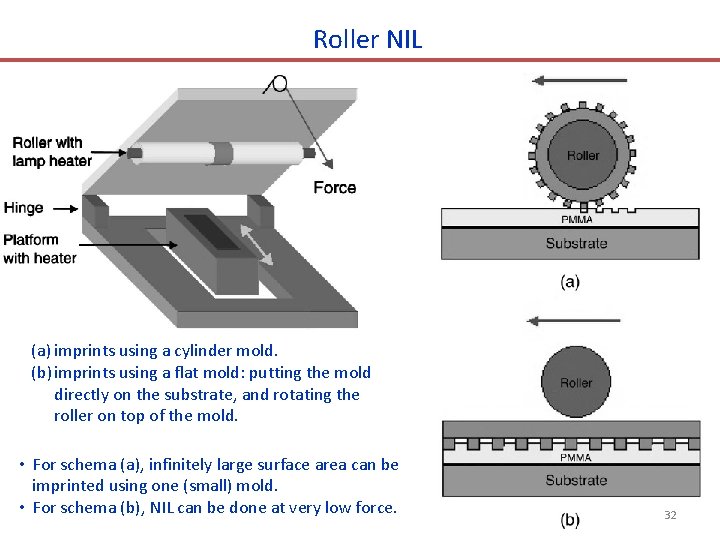
Roller NIL (a) imprints using a cylinder mold. (b) imprints using a flat mold: putting the mold directly on the substrate, and rotating the roller on top of the mold. • For schema (a), infinitely large surface area can be imprinted using one (small) mold. • For schema (b), NIL can be done at very low force. 32
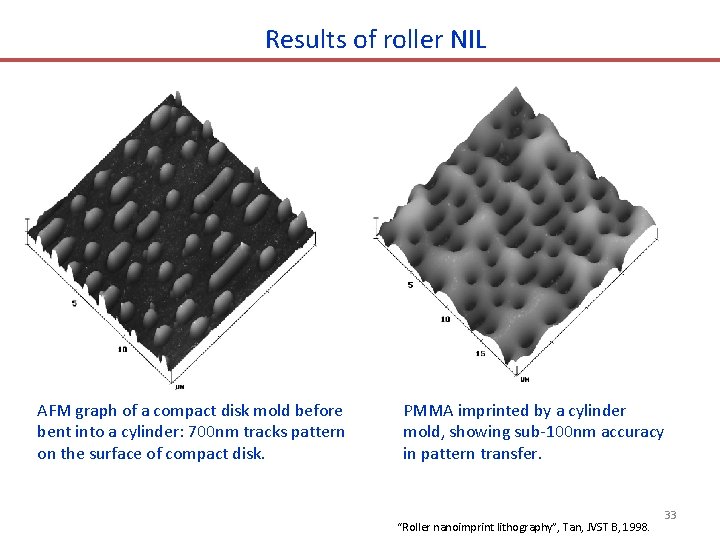
Results of roller NIL AFM graph of a compact disk mold before bent into a cylinder: 700 nm tracks pattern on the surface of compact disk. PMMA imprinted by a cylinder mold, showing sub-100 nm accuracy in pattern transfer. “Roller nanoimprint lithography”, Tan, JVST B, 1998. 33
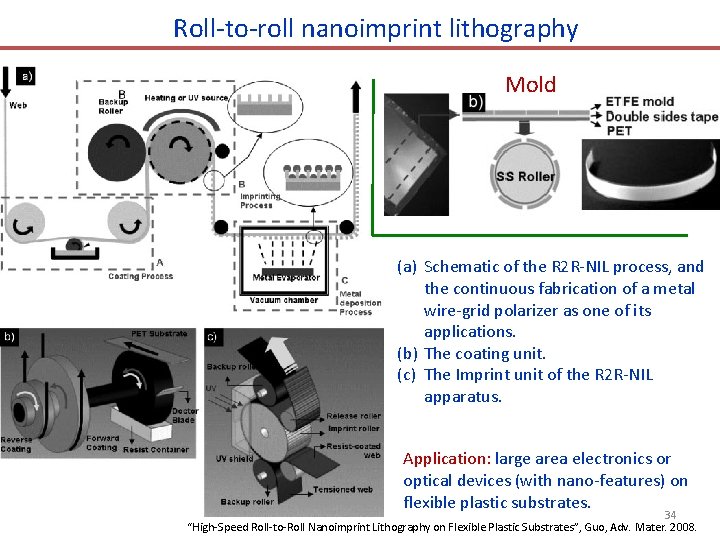
Roll-to-roll nanoimprint lithography Mold (a) Schematic of the R 2 R-NIL process, and the continuous fabrication of a metal wire-grid polarizer as one of its applications. (b) The coating unit. (c) The Imprint unit of the R 2 R-NIL apparatus. Application: large area electronics or optical devices (with nano-features) on flexible plastic substrates. 34 “High-Speed Roll-to-Roll Nanoimprint Lithography on Flexible Plastic Substrates”, Guo, Adv. Mater. 2008.
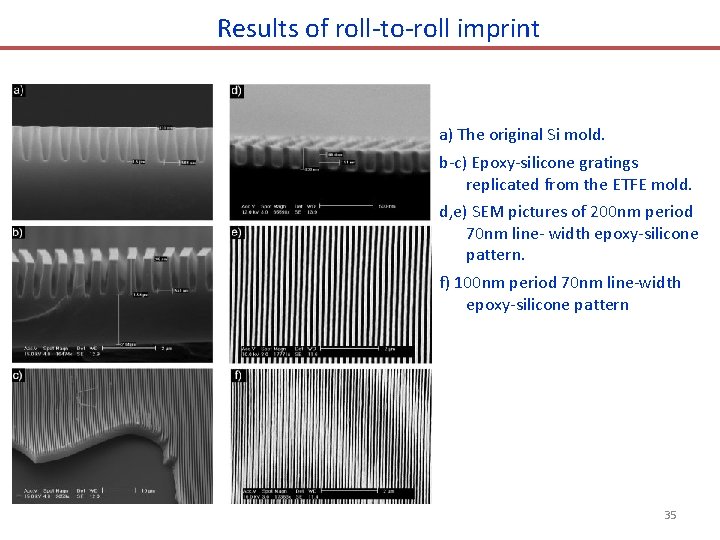
Results of roll-to-roll imprint a) The original Si mold. b-c) Epoxy-silicone gratings replicated from the ETFE mold. d, e) SEM pictures of 200 nm period 70 nm line- width epoxy-silicone pattern. f) 100 nm period 70 nm line-width epoxy-silicone pattern 35
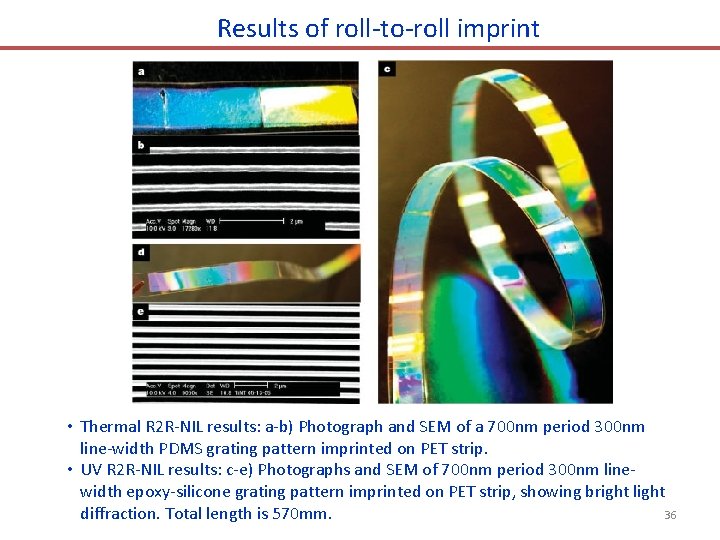
Results of roll-to-roll imprint • Thermal R 2 R-NIL results: a-b) Photograph and SEM of a 700 nm period 300 nm line-width PDMS grating pattern imprinted on PET strip. • UV R 2 R-NIL results: c-e) Photographs and SEM of 700 nm period 300 nm linewidth epoxy-silicone grating pattern imprinted on PET strip, showing bright light diffraction. Total length is 570 mm. 36
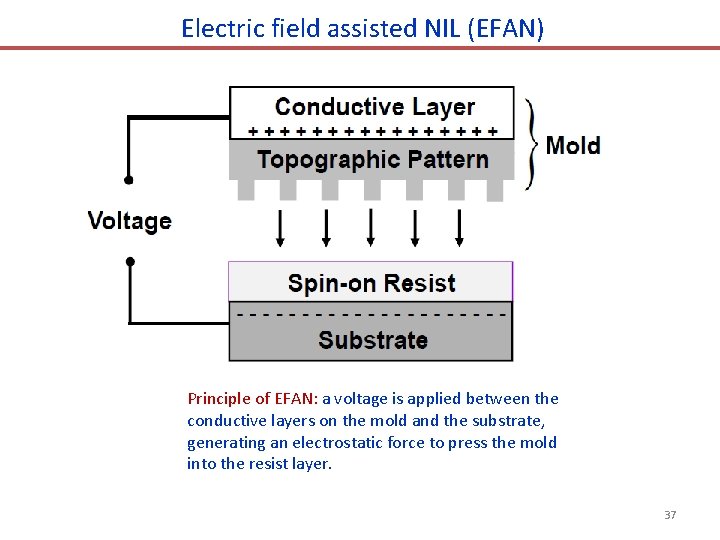
Electric field assisted NIL (EFAN) Principle of EFAN: a voltage is applied between the conductive layers on the mold and the substrate, generating an electrostatic force to press the mold into the resist layer. 37
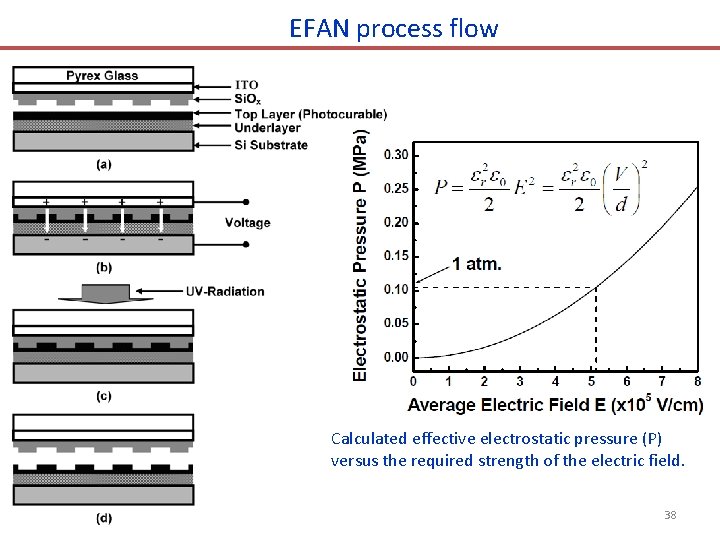
EFAN process flow Calculated effective electrostatic pressure (P) versus the required strength of the electric field. 38
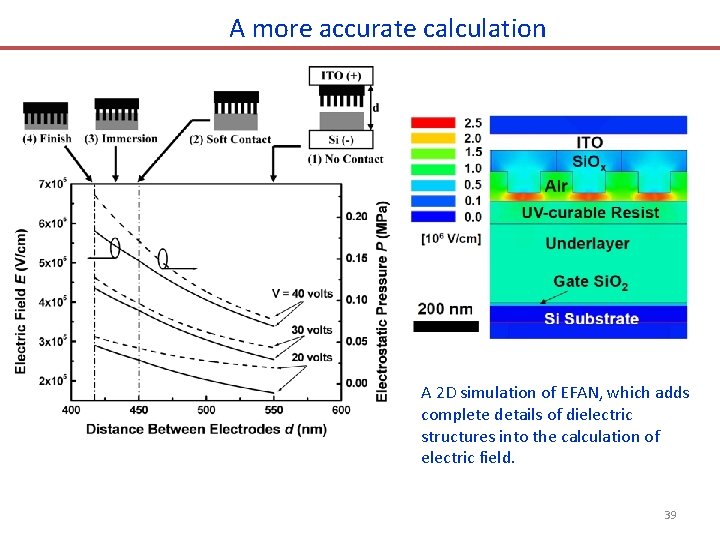
A more accurate calculation A 2 D simulation of EFAN, which adds complete details of dielectric structures into the calculation of electric field. 39
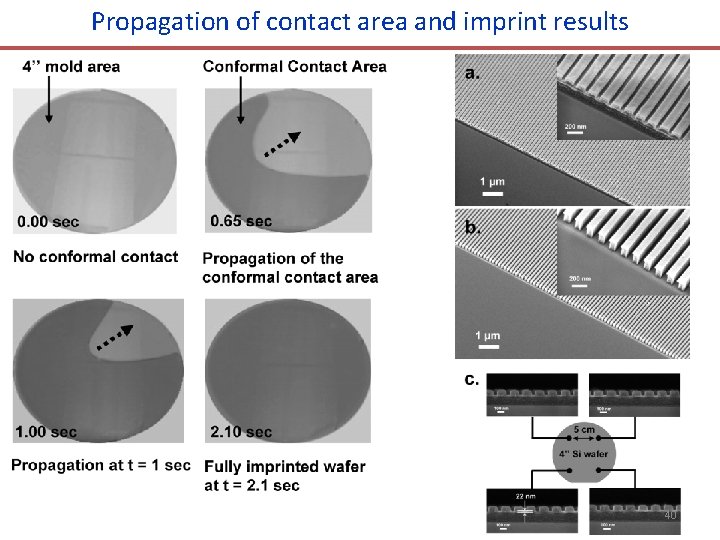
Propagation of contact area and imprint results 40
Electron and ion projection lithography (EPL and IPL) Maskless lithography using electron beam arrays 41
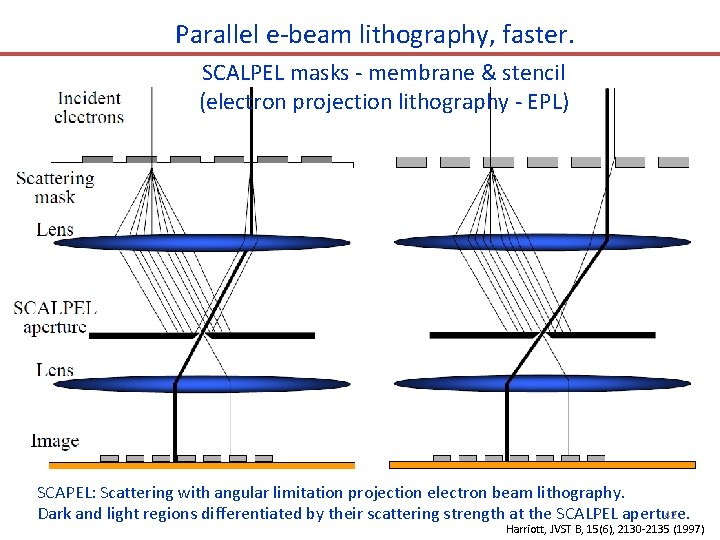
Parallel e-beam lithography, faster. SCALPEL masks - membrane & stencil (electron projection lithography - EPL) SCAPEL: Scattering with angular limitation projection electron beam lithography. 42 Dark and light regions differentiated by their scattering strength at the SCALPEL aperture. Harriott, JVST B, 15(6), 2130 -2135 (1997)
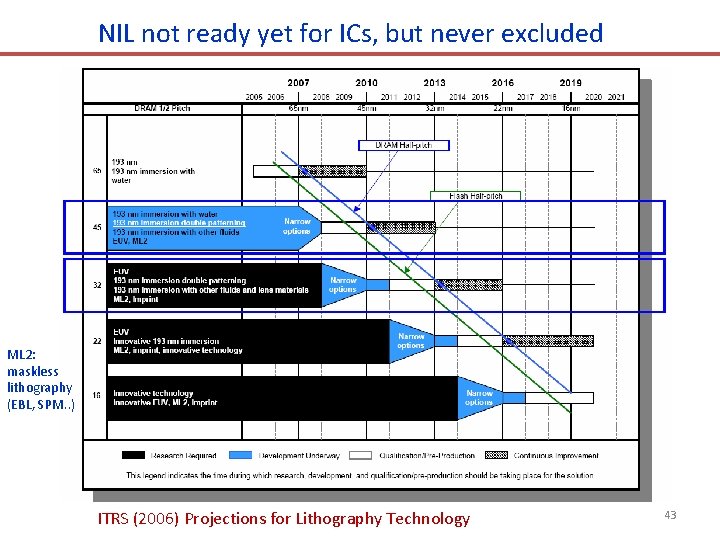
NIL not ready yet for ICs, but never excluded ML 2: maskless lithography (EBL, SPM. . ) ITRS (2006) Projections for Lithography Technology 43
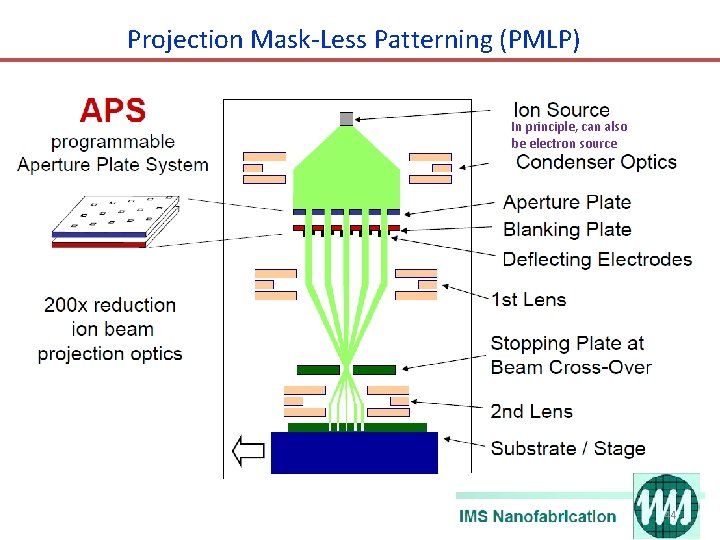
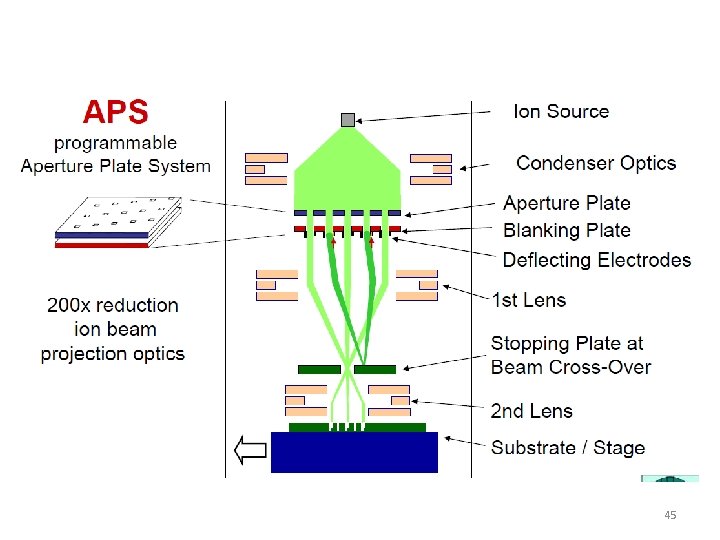
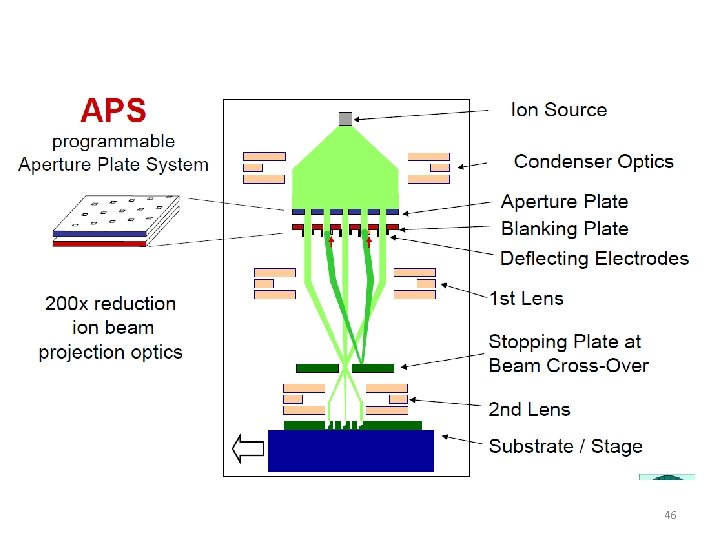
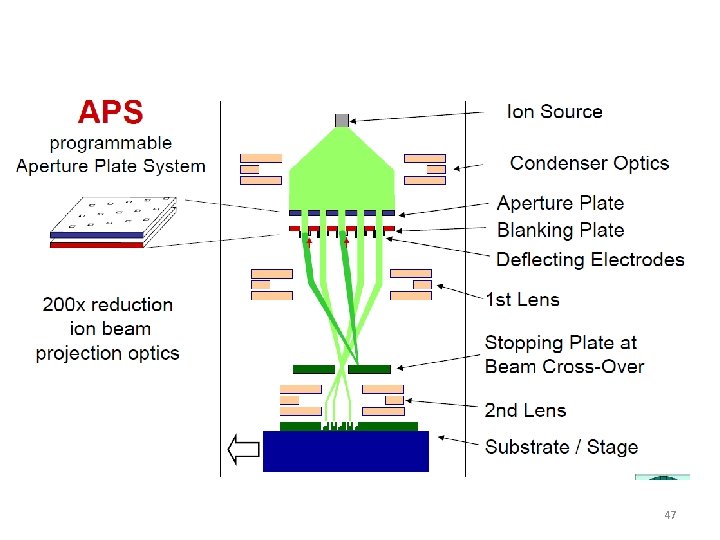
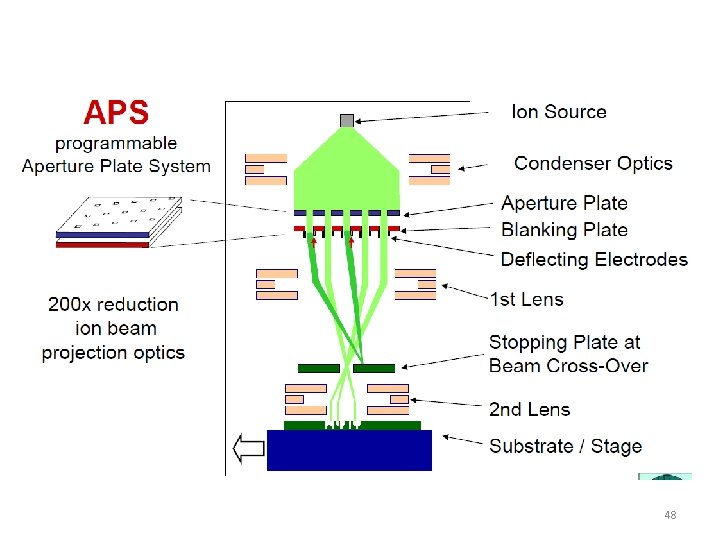
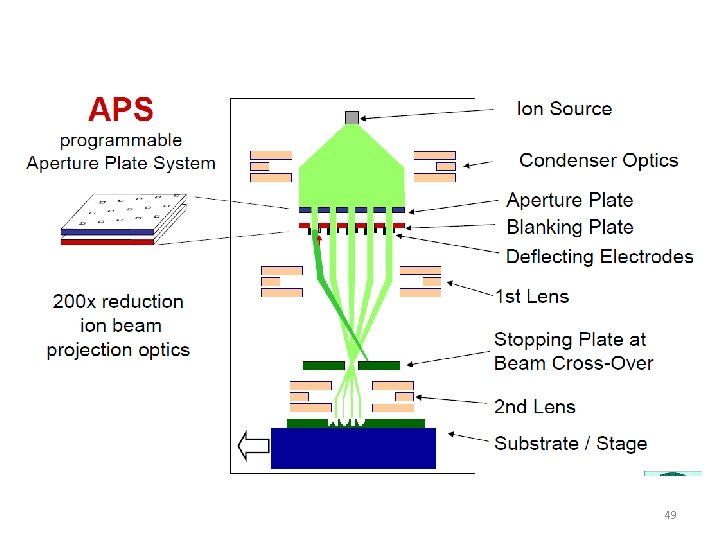
Projection Mask-Less Patterning (PMLP) In principle, can also be electron source 44
45
46
47
48
49
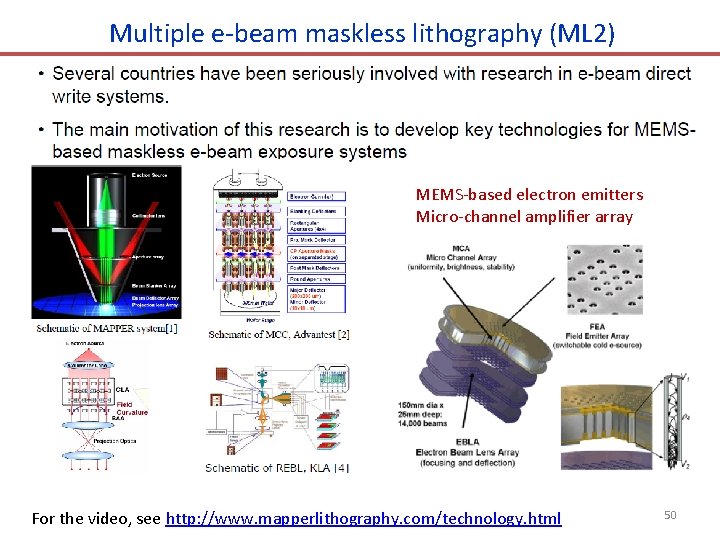
Multiple e-beam maskless lithography (ML 2) MEMS-based electron emitters Micro-channel amplifier array For the video, see http: //www. mapperlithography. com/technology. html 50