
Nanofabrication Overview 1 Nanofabrication Processing Makes things that
Nanofabrication Overview 1
Nanofabrication Processing • Makes “things” that have at least one dimension that is 100 nm or less • These “things” vary broadly from nanoparticles for drug delivery or chemical processing catalysts to plasmon waveguides for light signal processing or transistors for microelectronics
How is Nanofabrication Processing Done? • Top-down nanofabrication • Bottom-up nanofabrication • Hybrid nanofabrication
What are the basic differences among these approaches ? • Top-down nanofabrication makes nanostructures by repeated use of steps that deposit films (additive processes) and take parts of them away (subtractive processes) • Bottom-up nanofabrication builds up nanostructures from atoms, molecules, particles, or some combination of these • Hybrid nanofabrication combines elements of top-down and bottom-up nanofabrication
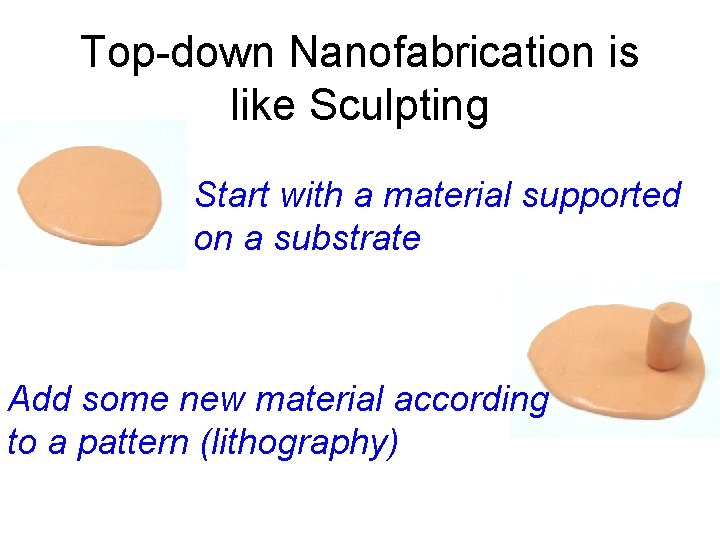
Top-down Nanofabrication is like Sculpting Start with a material supported on a substrate Add some new material according to a pattern (lithography)
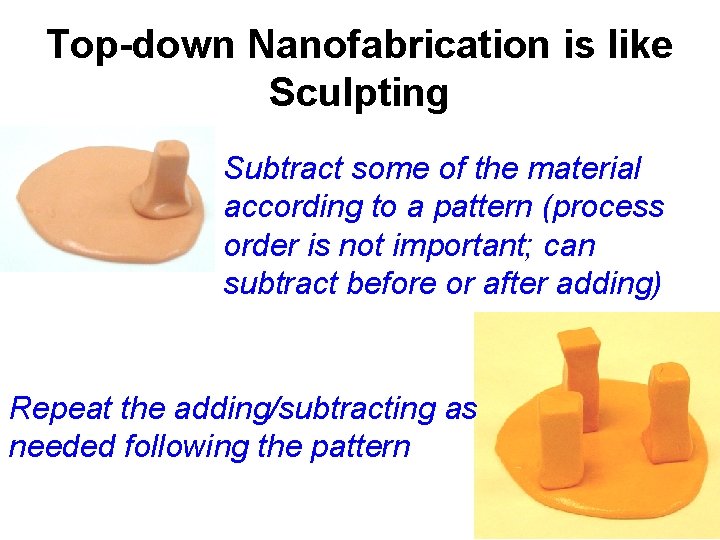
Top-down Nanofabrication is like Sculpting Subtract some of the material according to a pattern (process order is not important; can subtract before or after adding) Repeat the adding/subtracting as needed following the pattern
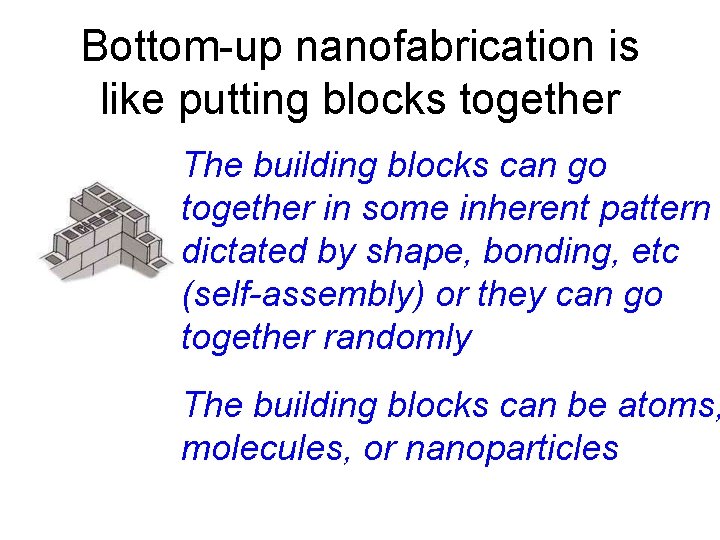
Bottom-up nanofabrication is like putting blocks together The building blocks can go together in some inherent pattern dictated by shape, bonding, etc (self-assembly) or they can go together randomly The building blocks can be atoms, molecules, or nanoparticles
Top-Down Vs. Bottom-Up Nanofabrication Top-Down Nanofabrication In “top-down” nanofabrication, one grows or deposits layers of materials and, by some combination of physical and chemical methods, creates the desired nanostructure, as you would make a statue from a block of marble. Top-down nanotechnology is based on the methods that are used to make microelectronics chips; i. e. , structures of carefully controlled, limited dimensions are created by laying down layers of material, modifying properties as needed, and etching away those parts of each layer that are unwanted. These steps are guided by lithography. Bottom-Up Nanofabrication In “bottom-up” nanofabrication approaches, one starts with small components – for example, individual molecules and nano-particles – and then assembles these components to make the desired structure. Often the assembly is self-guiding; i. e. , self-assembling.
Top-down nanofabrication always uses some combination of the following processes • Lithography (Pattern transfer) • Deposition (Addition process) • Etching (Subtraction process) • Materials Modification (Property tailoring)
Here’s the way top-down nanofabrication is done: • The four steps (lithography, addition, subtraction, and modification) are used in some sequence. • Steps may be skipped. You can start with any step. • The sequence usually starts with deposition of material. • Lithography is the step which orchestrates all the others. It controls where materials stay and where they are “sculpted” (i. e. , etched) away.
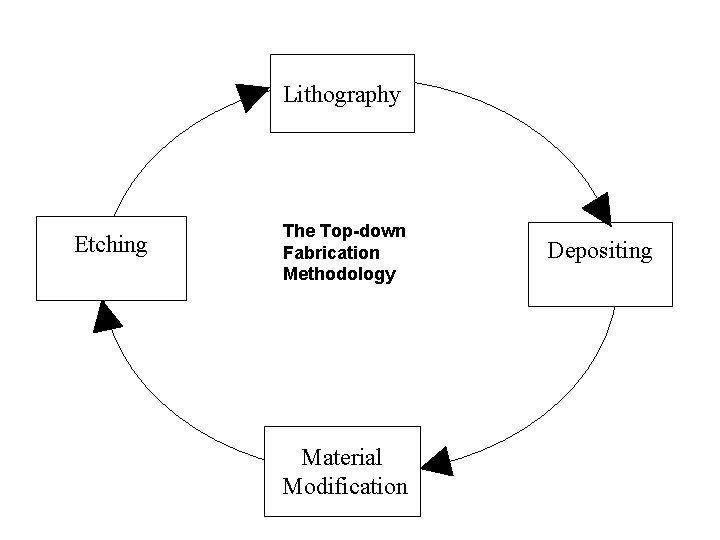
Lithography Etching The Top-down Fabrication Methodology Material Modification Depositing
Let’s see an example of how topdown nanofabrication is used to make nano-scale structures.
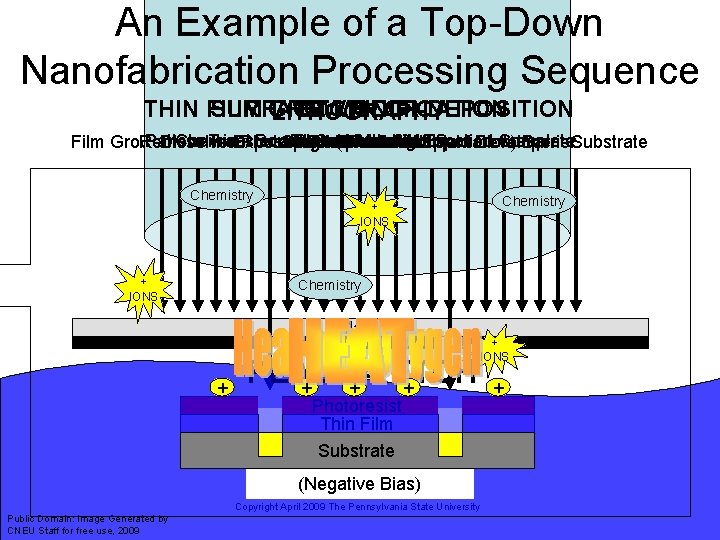
An Example of a Top-Down Nanofabrication Processing Sequence THIN FILM SURFACE GROWTH ETCHING MODIFICATION OR DEPOSITION LITHOGRAPHY Pattern Chemical Transfer Bonds and Expose Thermal are Substrate Altered Anneal Light Modification in. Implantation) Exposed Complete Areas Film Grown Remove Dissolve by Chemical the. Exposed Photoresist Reaction Spin Align Ion Photoresist on Implantation Photomask (Etch/Ion Photoresist ofwith Ambient Liquid species Developer with Barrier the Substrate Chemistry + IONS Chemistry Mask + PLASMA ETCH + + Photoresist Thin Film Substrate + IONS + (Negative Bias) Copyright April 2009 The Pennsylvania State University Public Domain: Image Generated by CNEU Staff for free use, 2009 +
The preceding cartoon demonstrates the four basic steps of top-down nanofabrication: • • Deposition (addition) Lithography (pattern transfer) Etching (subtraction) Material modification (to change electrical, optical, mechanical, or chemical properties in some region of a layer)
Bottom-up Nanofabrication generally uses some combination of: • Building block (molecules, particles, and layers) selection • Self assembly
Here’s the way bottom-up nanofabrication is done • The two steps (building block selection and self-assembly) are used in some sequence. • Steps may be skipped. • The sequence usually starts with building block selection. • The pattern develops due to the size and/or shape of the building blocks.
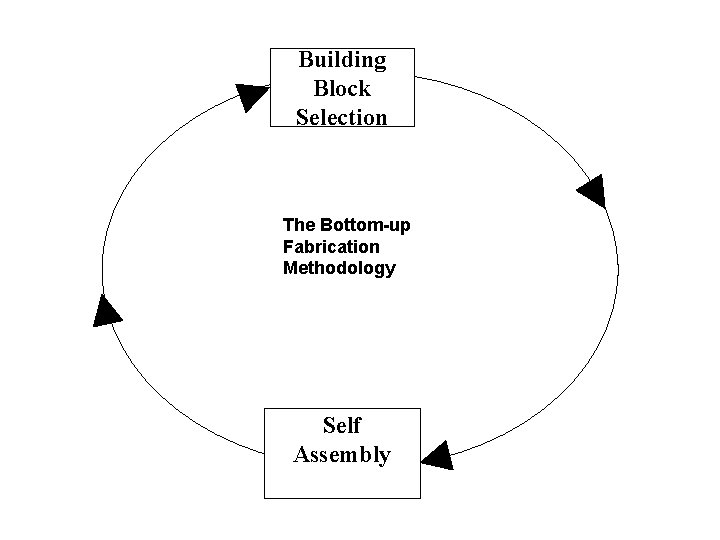
Building Block Selection The Bottom-up Fabrication Methodology Self Assembly
Let’s see an example of how bottom-up nanofabrication is used to make nano-scale structures.
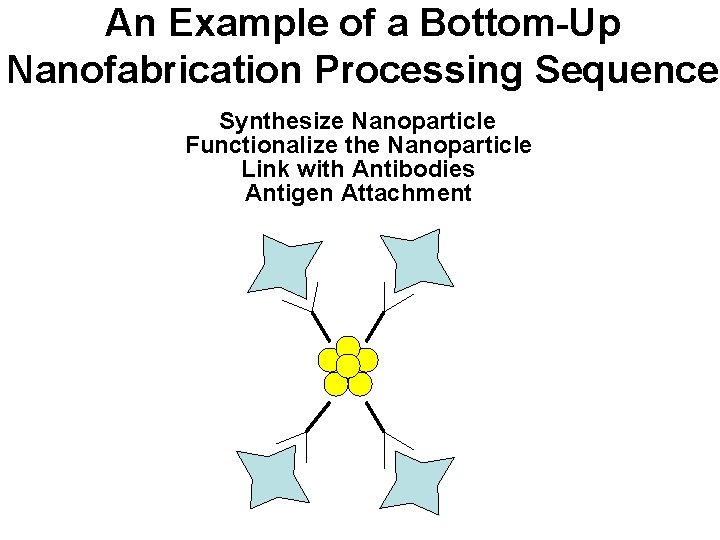
An Example of a Bottom-Up Nanofabrication Processing Sequence Synthesize Nanoparticle Functionalize the Nanoparticle Link with Antibodies Antigen Attachment
The preceding cartoon demonstrates the two basic steps of bottom-up nanofabrication: • Building block selection (molecules, particles, or layers) • Assembly of the building blocks into functioning nanostructures. This step is usually termed self assembly. • In this example, the shape of the product was dictated by the selection of chemical bonds.
- Slides: 20