
Nanocellulose Technology Applications and Markets From the lab
Nanocellulose: Technology, Applications and Markets From the lab to the market PRESENTED BY: Jack Miller Principal Consultant, Market-Intell LLC Consulting Manager Global Nanocellulose Sales, American Process Inc.
Thank you – Mike Bilodeau, Director, Process Development Center, University of Maine – Wadood Hamad, Principal Scientist, FPInnovations; Adjunct Professor, Depts. Of Chemistry and Chemical Bio. Engineering, University of British Columbia – Robert J Moon, U. S. Forest Service – Jeff Youngblood, Associate Professor, School of Materials Engineering, Purdue University
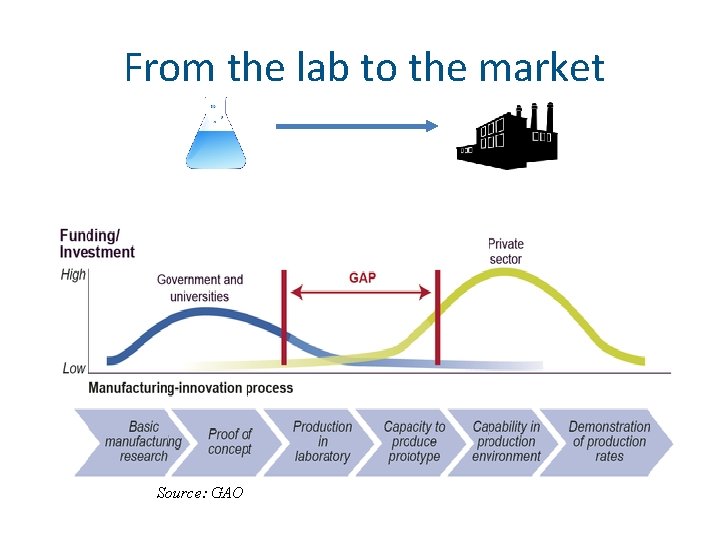
From the lab to the market Source: GAO
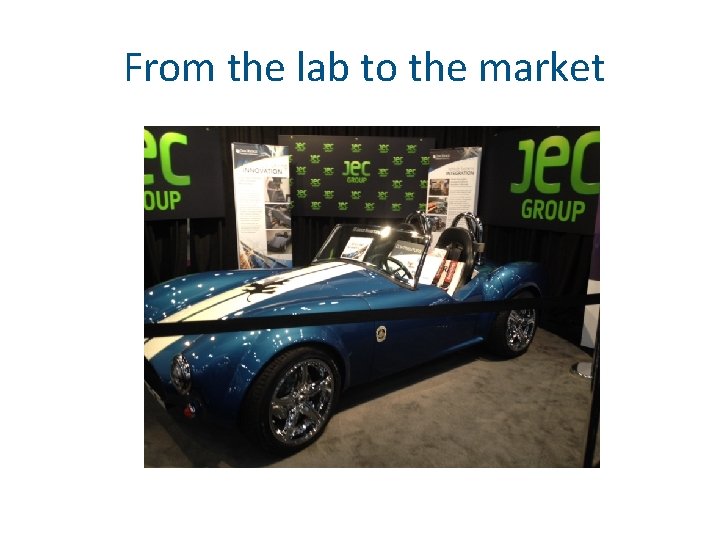
From the lab to the market
What is nanocellulose? Many things are referred to as nanocellulose • Alphabet soup: NCC, CNC, MFC, CNF, NFC, CF, CMC, TEMPO • Cellulose nanocrystals • Cellulose nanofibrils • Cellulose filaments Some are not nano!
What is CNC? • Cellulose nanocrystals, also called nanocrystalline cellulose (NCC) or cellulose whiskers • Rice-like shape • Less than 100 nm in at least one dimension • Can have surface charge and chiral nematic properties • Discrete nanoparticles with high crystallinity • Good for strength, reinforcement, rheology, optical, electrical, chemical properties
Types of CNC • Acid hydrolysis – Sulfuric acid, phosphoric acid, hydrochloric acid • AVAP – Biorefinery: sulfur dioxide, ethanol • Catalytic biomass conversion • Lignin coated hydrophobic
What is CNF? • Cellulose nanofibrils, also called nanofibrillated cellulose • Less than 100 nm in at least one dimension • Spaghetti-like shape • Good for strength, reinforcement, rheology
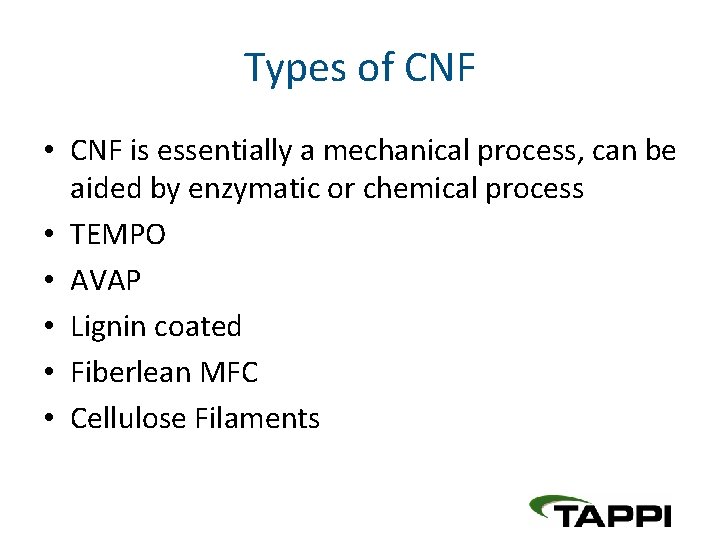
Types of CNF • CNF is essentially a mechanical process, can be aided by enzymatic or chemical process • TEMPO • AVAP • Lignin coated • Fiberlean MFC • Cellulose Filaments
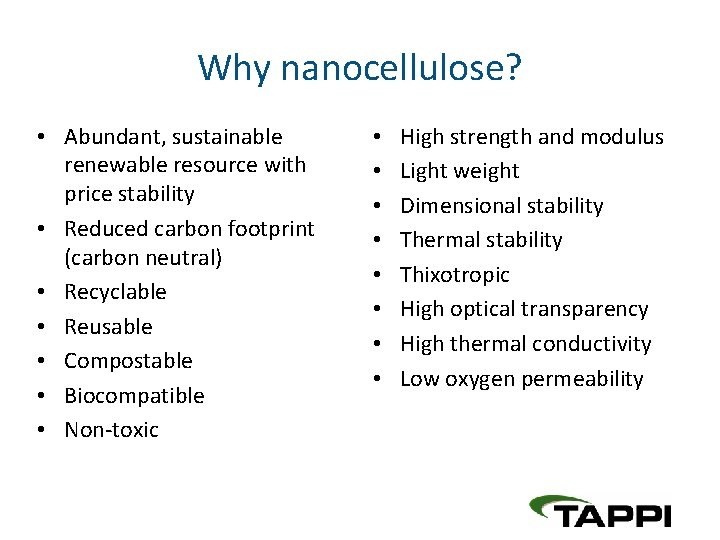
Why nanocellulose? • Abundant, sustainable renewable resource with price stability • Reduced carbon footprint (carbon neutral) • Recyclable • Reusable • Compostable • Biocompatible • Non-toxic • • High strength and modulus Light weight Dimensional stability Thermal stability Thixotropic High optical transparency High thermal conductivity Low oxygen permeability
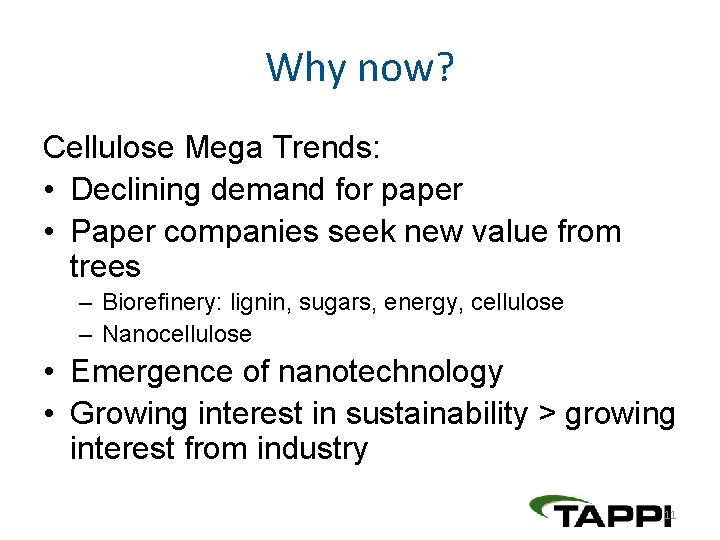
Why now? Cellulose Mega Trends: • Declining demand for paper • Paper companies seek new value from trees – Biorefinery: lignin, sugars, energy, cellulose – Nanocellulose • Emergence of nanotechnology • Growing interest in sustainability > growing interest from industry 11
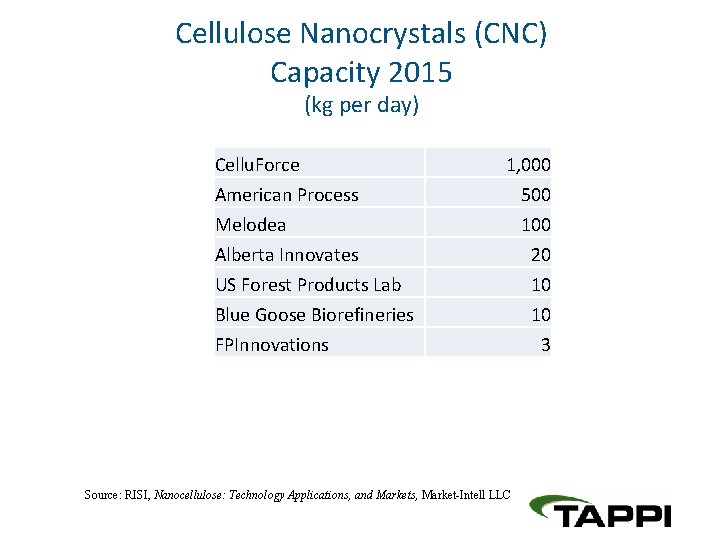
Cellulose Nanocrystals (CNC) Capacity 2015 (kg per day) Cellu. Force American Process Melodea Alberta Innovates US Forest Products Lab Blue Goose Biorefineries FPInnovations 1, 000 500 100 20 10 10 3 Source: RISI, Nanocellulose: Technology Applications, and Markets, Market-Intell LLC
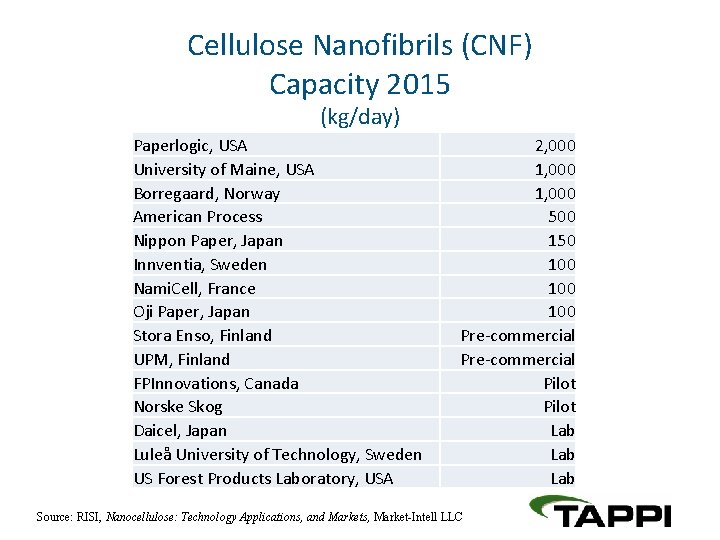
Cellulose Nanofibrils (CNF) Capacity 2015 (kg/day) Paperlogic, USA University of Maine, USA Borregaard, Norway American Process Nippon Paper, Japan Innventia, Sweden Nami. Cell, France Oji Paper, Japan Stora Enso, Finland UPM, Finland FPInnovations, Canada Norske Skog Daicel, Japan Luleå University of Technology, Sweden US Forest Products Laboratory, USA 2, 000 1, 000 500 150 100 100 Pre-commercial Pilot Lab Lab Source: RISI, Nanocellulose: Technology Applications, and Markets, Market-Intell LLC
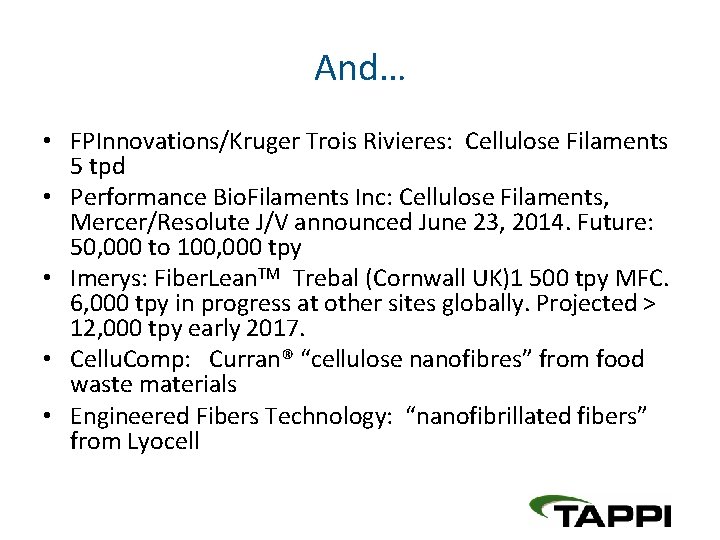
And… • FPInnovations/Kruger Trois Rivieres: Cellulose Filaments 5 tpd • Performance Bio. Filaments Inc: Cellulose Filaments, Mercer/Resolute J/V announced June 23, 2014. Future: 50, 000 to 100, 000 tpy • Imerys: Fiber. Lean. TM Trebal (Cornwall UK)1 500 tpy MFC. 6, 000 tpy in progress at other sites globally. Projected > 12, 000 tpy early 2017. • Cellu. Comp: Curran® “cellulose nanofibres” from food waste materials • Engineered Fibers Technology: “nanofibrillated fibers” from Lyocell
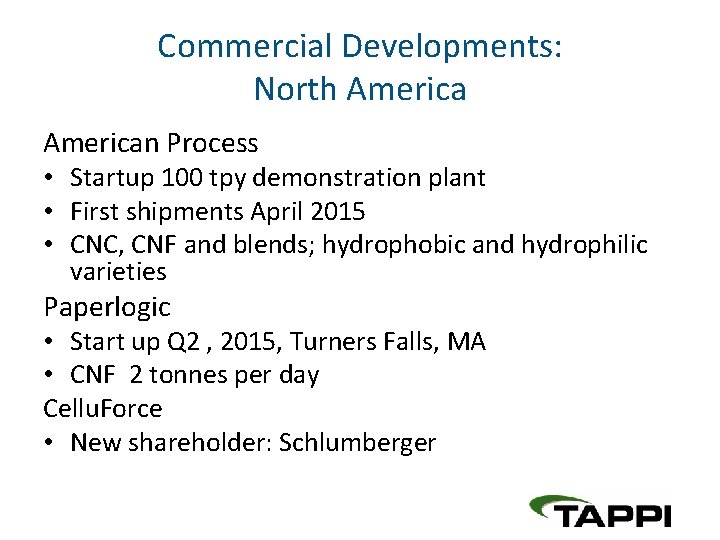
Commercial Developments: North American Process • Startup 100 tpy demonstration plant • First shipments April 2015 • CNC, CNF and blends; hydrophobic and hydrophilic varieties Paperlogic • Start up Q 2 , 2015, Turners Falls, MA • CNF 2 tonnes per day Cellu. Force • New shareholder: Schlumberger
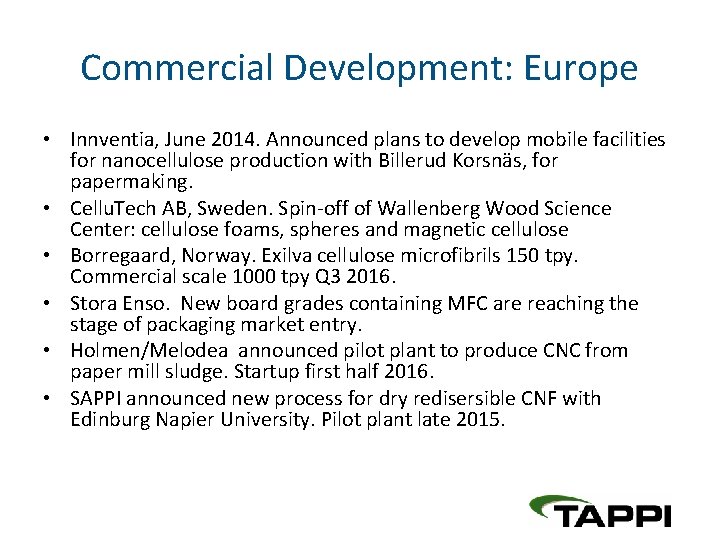
Commercial Development: Europe • Innventia, June 2014. Announced plans to develop mobile facilities for nanocellulose production with Billerud Korsnäs, for papermaking. • Cellu. Tech AB, Sweden. Spin-off of Wallenberg Wood Science Center: cellulose foams, spheres and magnetic cellulose • Borregaard, Norway. Exilva cellulose microfibrils 150 tpy. Commercial scale 1000 tpy Q 3 2016. • Stora Enso. New board grades containing MFC are reaching the stage of packaging market entry. • Holmen/Melodea announced pilot plant to produce CNC from paper mill sludge. Startup first half 2016. • SAPPI announced new process for dry redisersible CNF with Edinburg Napier University. Pilot plant late 2015.
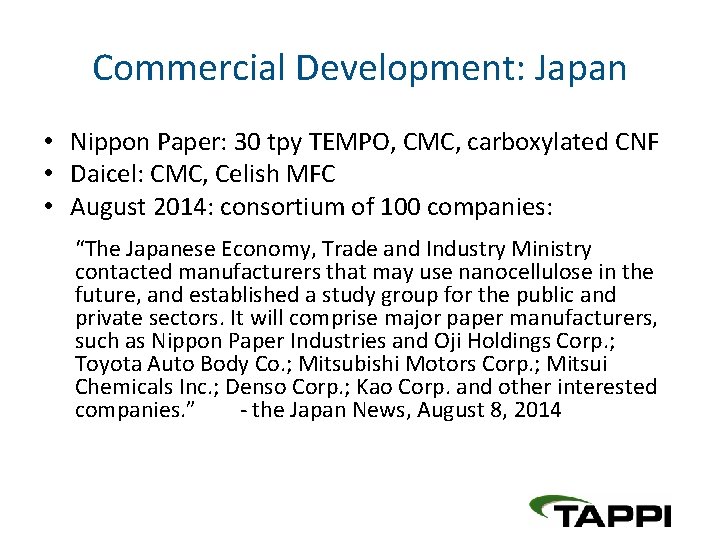
Commercial Development: Japan • Nippon Paper: 30 tpy TEMPO, CMC, carboxylated CNF • Daicel: CMC, Celish MFC • August 2014: consortium of 100 companies: “The Japanese Economy, Trade and Industry Ministry contacted manufacturers that may use nanocellulose in the future, and established a study group for the public and private sectors. It will comprise major paper manufacturers, such as Nippon Paper Industries and Oji Holdings Corp. ; Toyota Auto Body Co. ; Mitsubishi Motors Corp. ; Mitsui Chemicals Inc. ; Denso Corp. ; Kao Corp. and other interested companies. ” - the Japan News, August 8, 2014
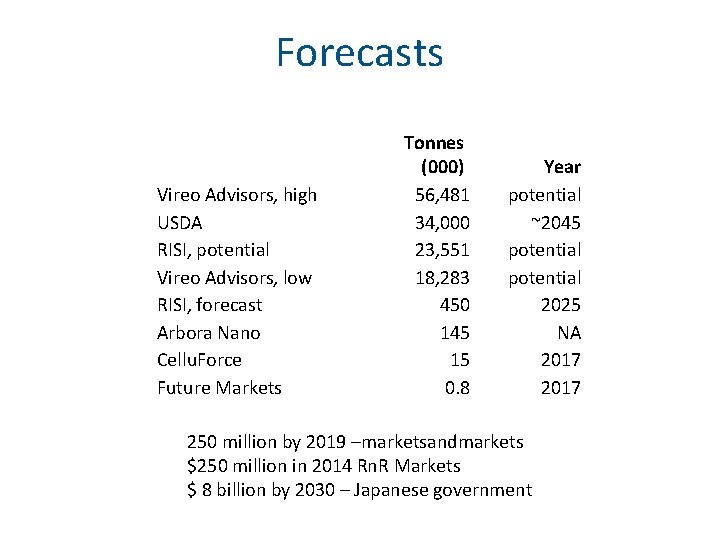
Forecasts Vireo Advisors, high USDA RISI, potential Vireo Advisors, low RISI, forecast Arbora Nano Cellu. Force Future Markets Tonnes (000) 56, 481 34, 000 23, 551 18, 283 450 145 15 0. 8 Year potential ~2045 potential 2025 NA 2017 250 million by 2019 –marketsandmarkets $250 million in 2014 Rn. R Markets $ 8 billion by 2030 – Japanese government
“We always overestimate the change that will occur in the next two years and underestimate the change that will occur in the next ten. ” --Bill Gates
Thank you PRESENTED BY: Jack Miller Principal Consultant, Market-Intell LLC Consulting Manager Global Nanocellulose Sales, American Process Inc jack. miller@market-intell. com www. risi. com/nanocellulose
- Slides: 20