
Nanjing University of Science Technology Pattern Recognition Statistical
- Slides: 44
Nanjing University of Science & Technology Pattern Recognition: Statistical and Neural Lonnie C. Ludeman Lecture 21 Oct 28, 2005 1
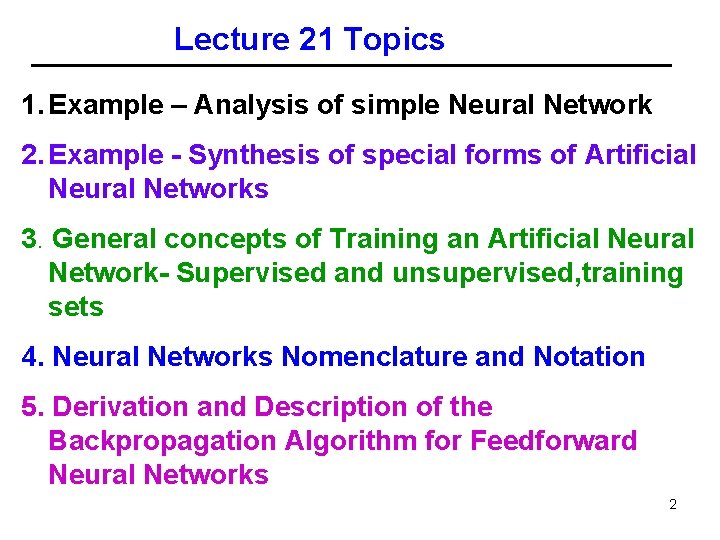
Lecture 21 Topics 1. Example – Analysis of simple Neural Network 2. Example - Synthesis of special forms of Artificial Neural Networks 3. General concepts of Training an Artificial Neural Network- Supervised and unsupervised, training sets 4. Neural Networks Nomenclature and Notation 5. Derivation and Description of the Backpropagation Algorithm for Feedforward Neural Networks 2
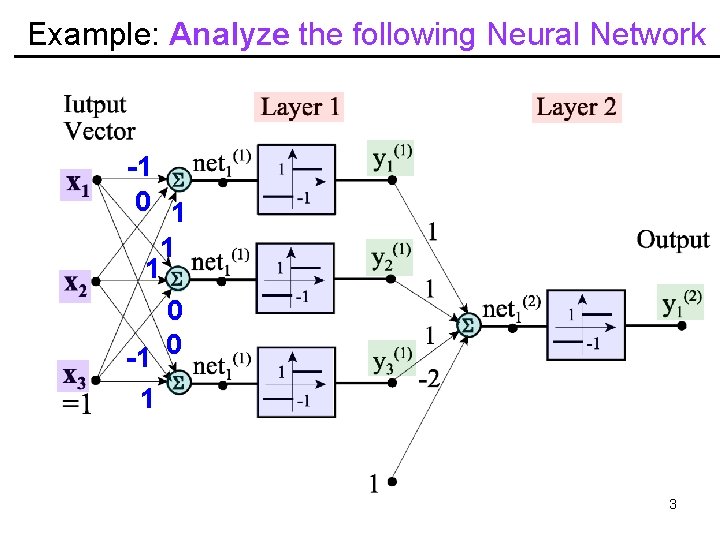
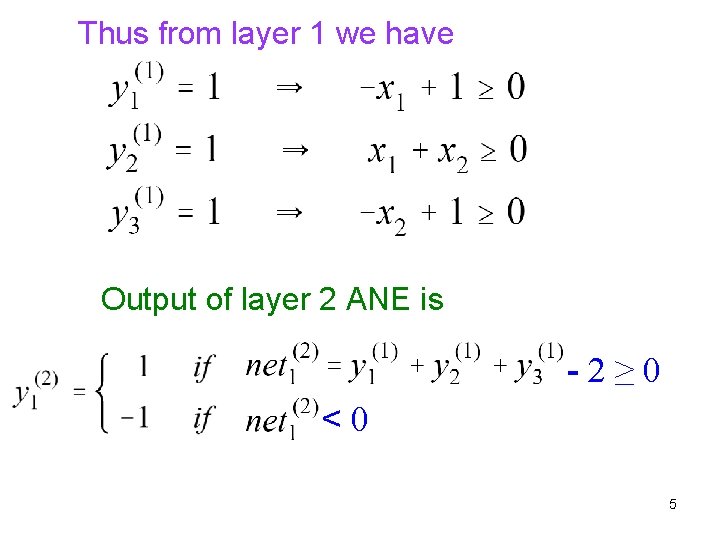
Example: Analyze the following Neural Network -1 0 1 1 1 0 -1 0 1 3
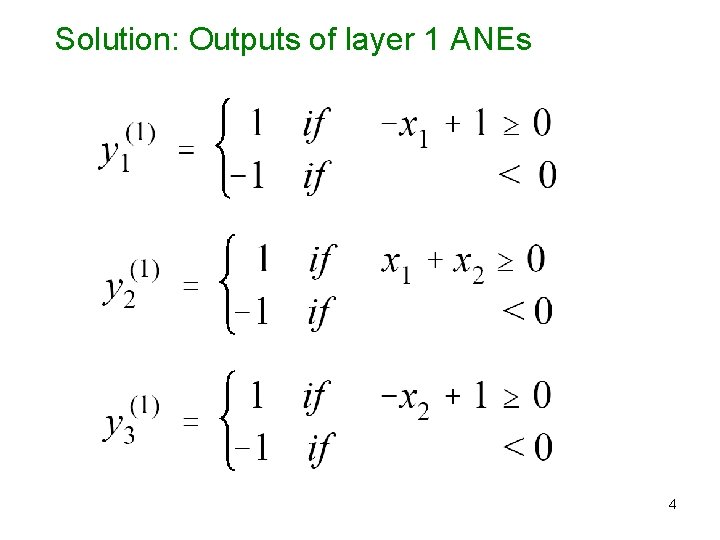
Solution: Outputs of layer 1 ANEs 4
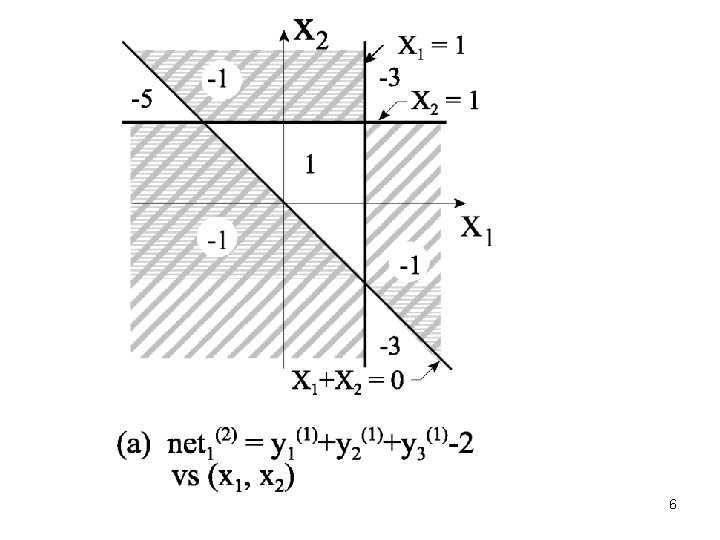
Thus from layer 1 we have Output of layer 2 ANE is -2≥ 0 <0 5
6
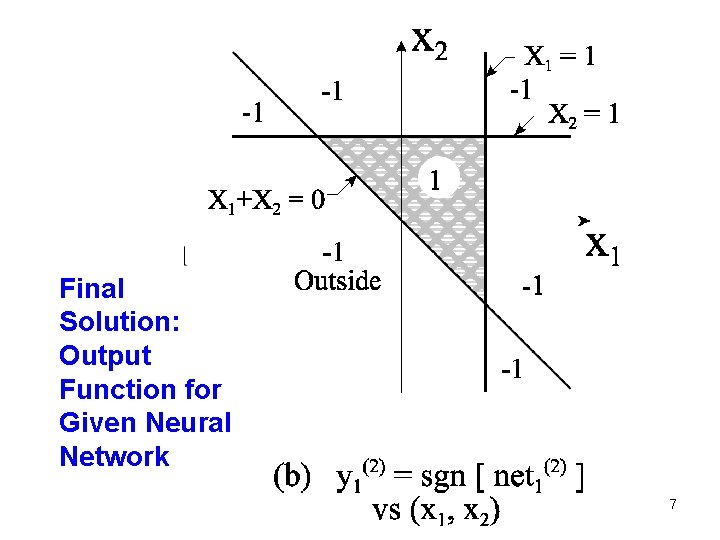
Final Solution: Output Function for Given Neural Network 7
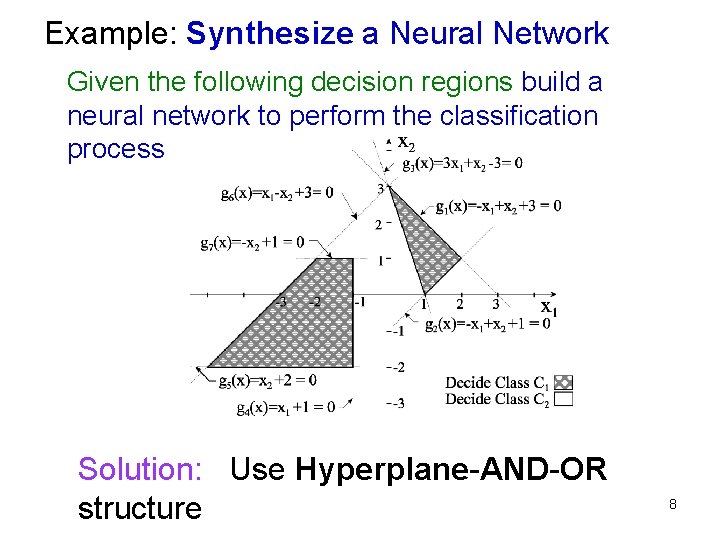
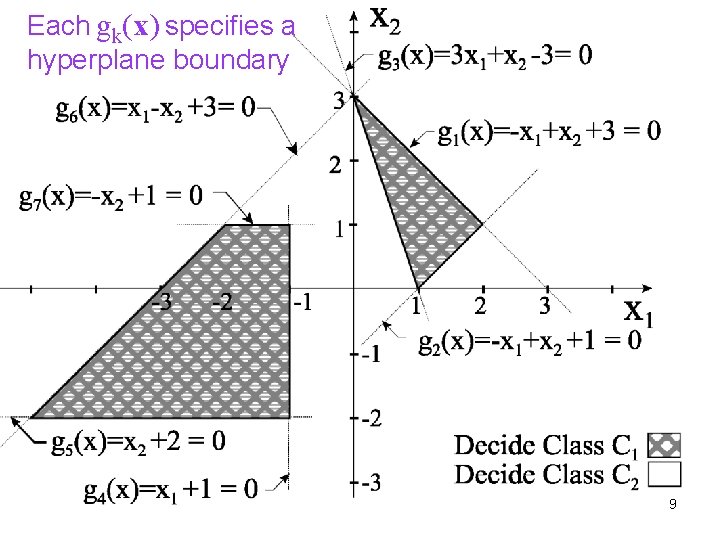
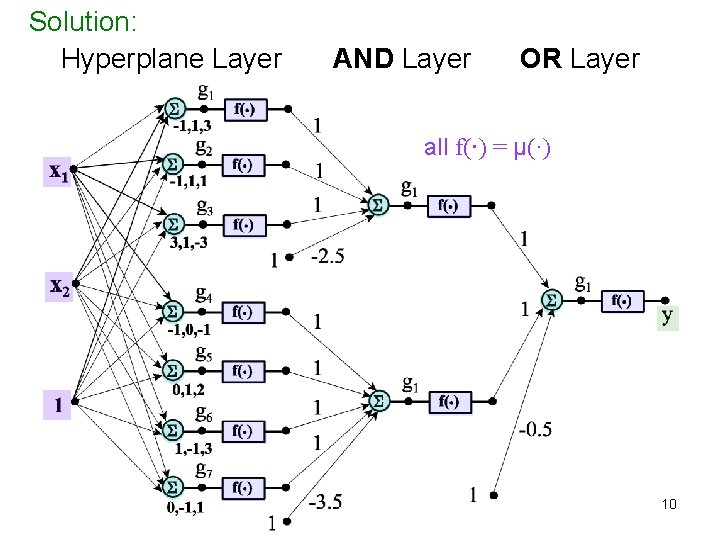
Example: Synthesize a Neural Network Given the following decision regions build a neural network to perform the classification process Solution: Use Hyperplane-AND-OR structure 8
Each gk(x) specifies a hyperplane boundary 9
Solution: Hyperplane Layer AND Layer OR Layer all f(·) = μ(·) 10
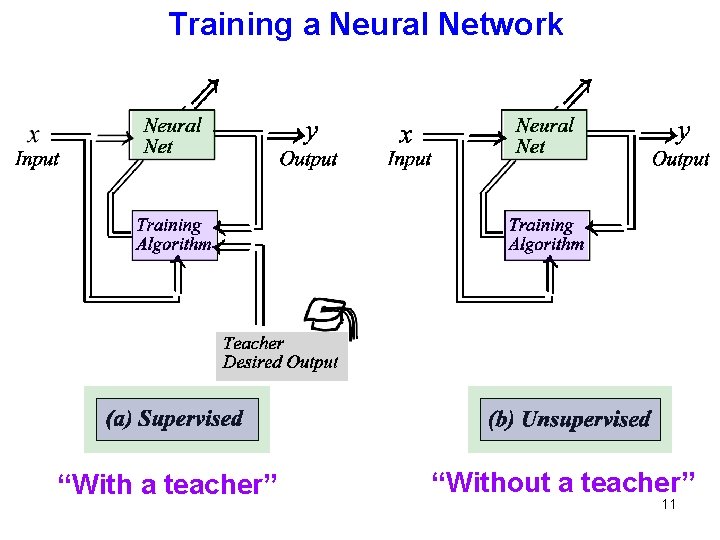
Training a Neural Network “With a teacher” “Without a teacher” 11
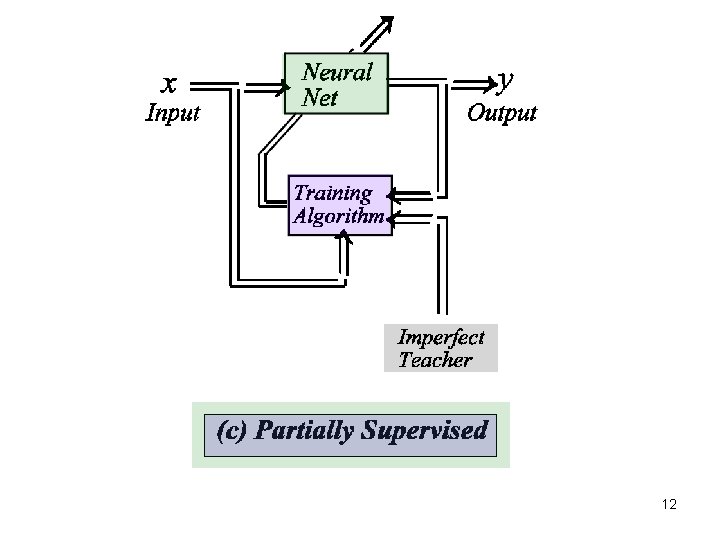
12
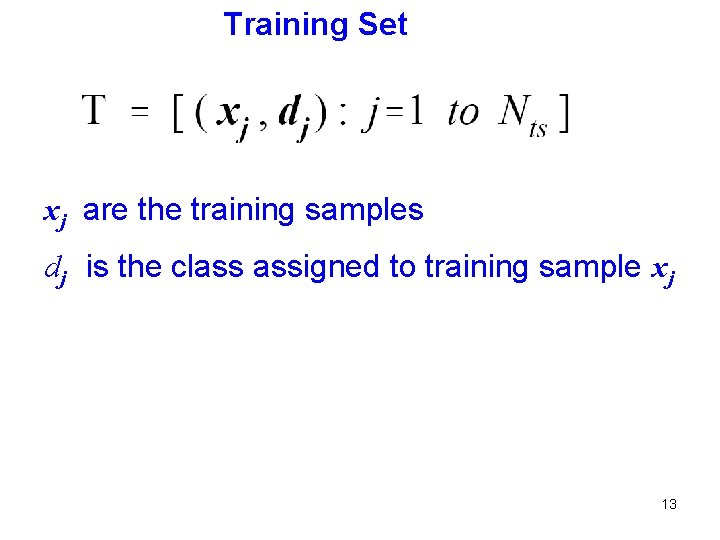
Training Set xj are the training samples dj is the class assigned to training sample xj 13
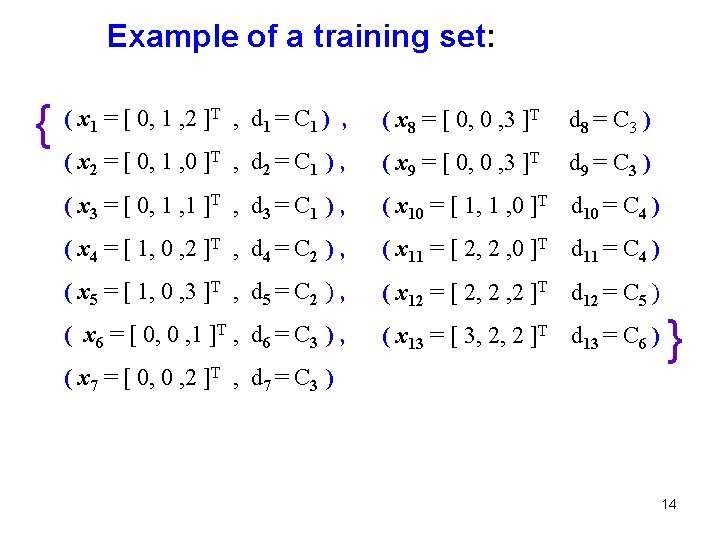
Example of a training set: { ( x 1 = [ 0, 1 , 2 ]T , d 1 = C 1 ) , ( x 8 = [ 0, 0 , 3 ]T d 8 = C 3 ) ( x 2 = [ 0, 1 , 0 ]T , d 2 = C 1 ) , ( x 9 = [ 0, 0 , 3 ]T d 9 = C 3 ) ( x 3 = [ 0, 1 ]T , d 3 = C 1 ) , ( x 10 = [ 1, 1 , 0 ]T d 10 = C 4 ) ( x 4 = [ 1, 0 , 2 ]T , d 4 = C 2 ) , ( x 11 = [ 2, 2 , 0 ]T d 11 = C 4 ) ( x 5 = [ 1, 0 , 3 ]T , d 5 = C 2 ) , ( x 12 = [ 2, 2 ]T d 12 = C 5 ) ( x 6 = [ 0, 0 , 1 ]T , d 6 = C 3 ) , ( x 13 = [ 3, 2, 2 ]T d 13 = C 6 ) } ( x 7 = [ 0, 0 , 2 ]T , d 7 = C 3 ) 14
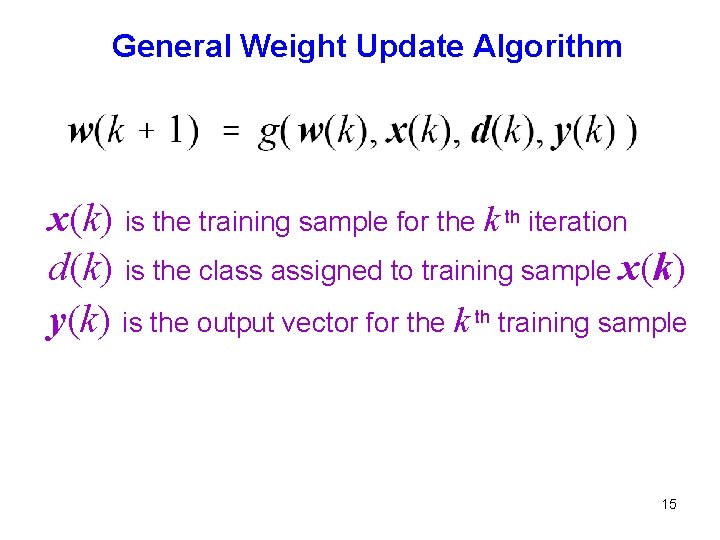
General Weight Update Algorithm x(k) is the training sample for the k th iteration d(k) is the class assigned to training sample x(k) y(k) is the output vector for the k th training sample 15
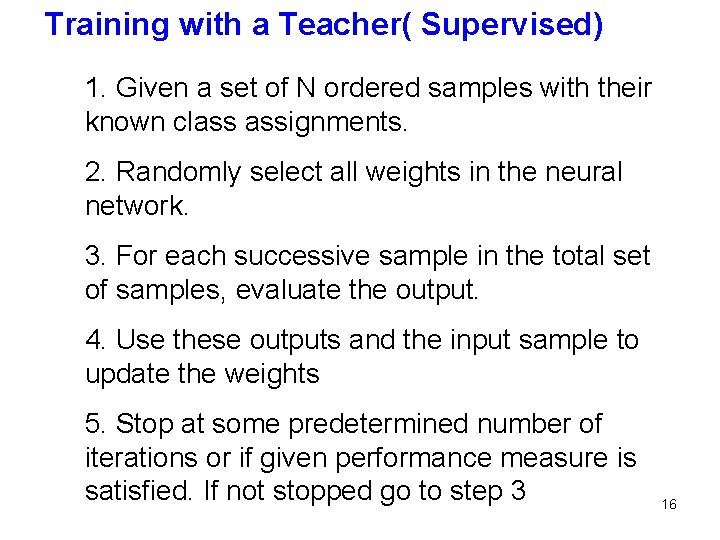
Training with a Teacher( Supervised) 1. Given a set of N ordered samples with their known class assignments. 2. Randomly select all weights in the neural network. 3. For each successive sample in the total set of samples, evaluate the output. 4. Use these outputs and the input sample to update the weights 5. Stop at some predetermined number of iterations or if given performance measure is satisfied. If not stopped go to step 3 16
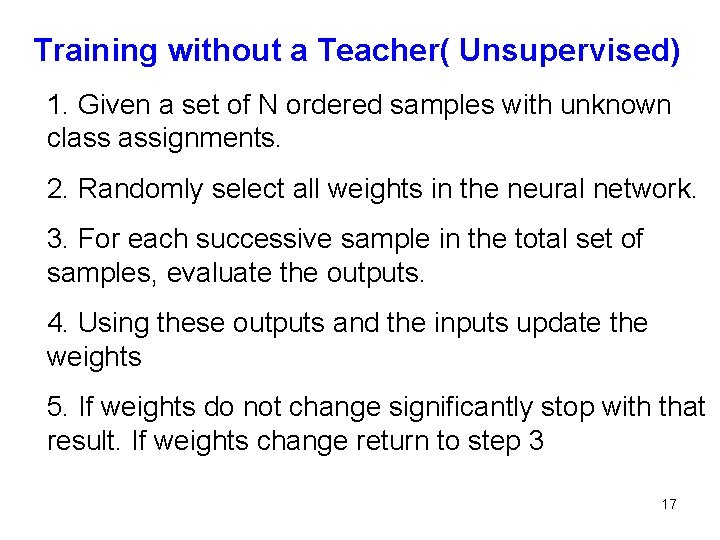
Training without a Teacher( Unsupervised) 1. Given a set of N ordered samples with unknown class assignments. 2. Randomly select all weights in the neural network. 3. For each successive sample in the total set of samples, evaluate the outputs. 4. Using these outputs and the inputs update the weights 5. If weights do not change significantly stop with that result. If weights change return to step 3 17
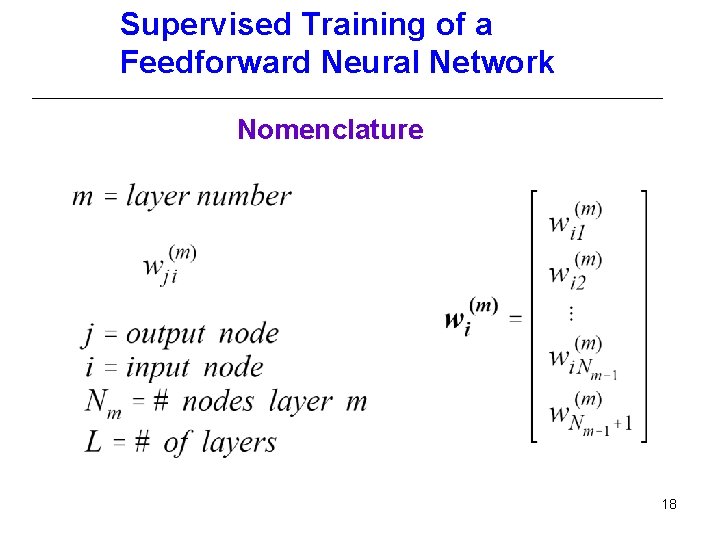
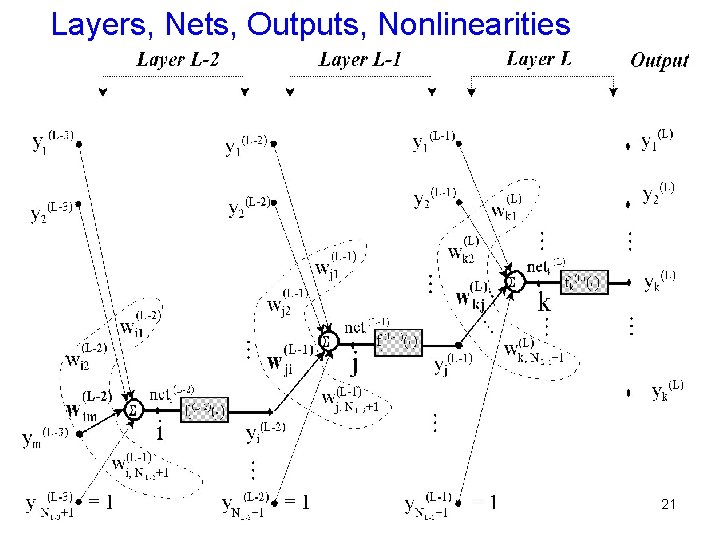
Supervised Training of a Feedforward Neural Network Nomenclature 18
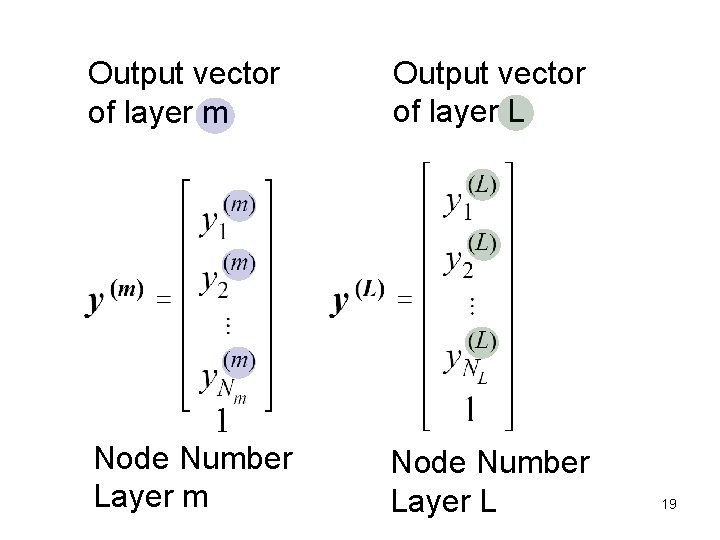
Output vector of layer m Output vector of layer L 1 Node Number Layer m Node Number Layer L 19
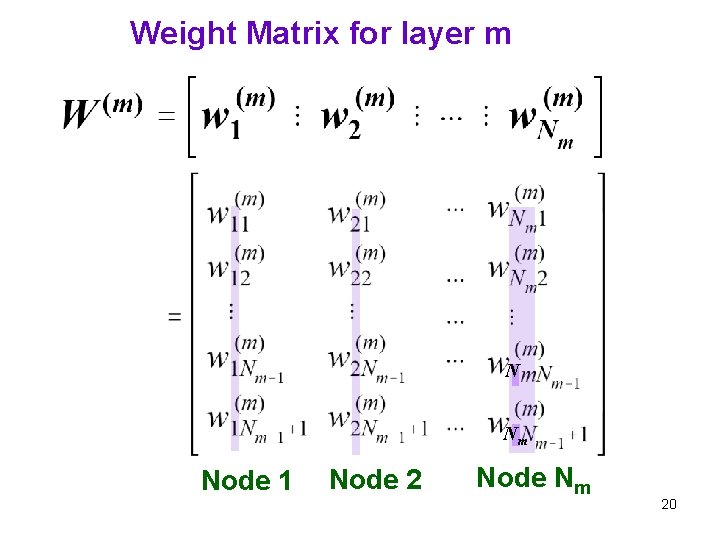
Weight Matrix for layer m N Nm Node 1 Node 2 Node Nm 20
Layers, Nets, Outputs, Nonlinearities fix 21
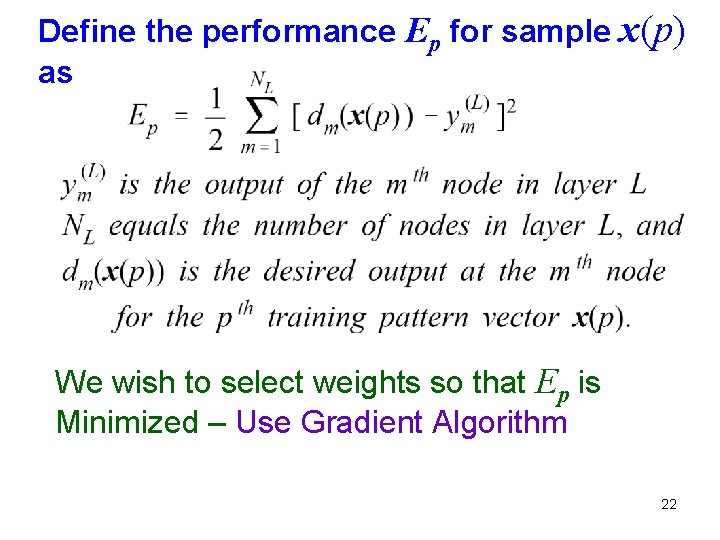
Define the performance Ep for sample x(p) as We wish to select weights so that Ep is Minimized – Use Gradient Algorithm 22
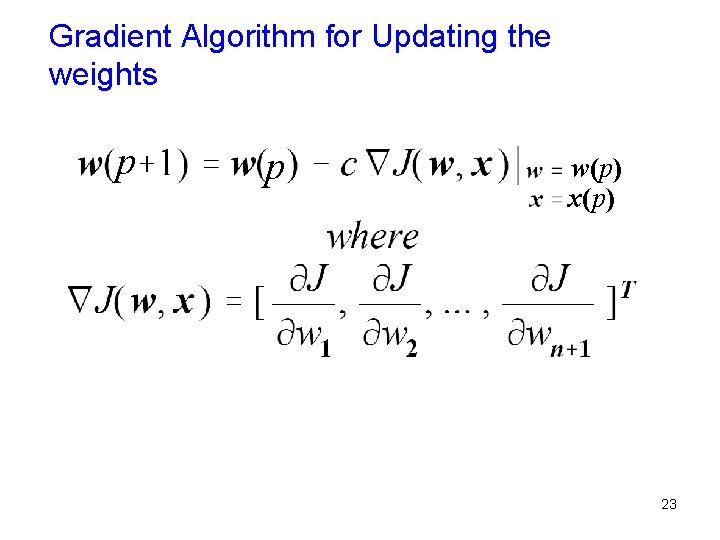
Gradient Algorithm for Updating the weights p p w(p) x(p) 23
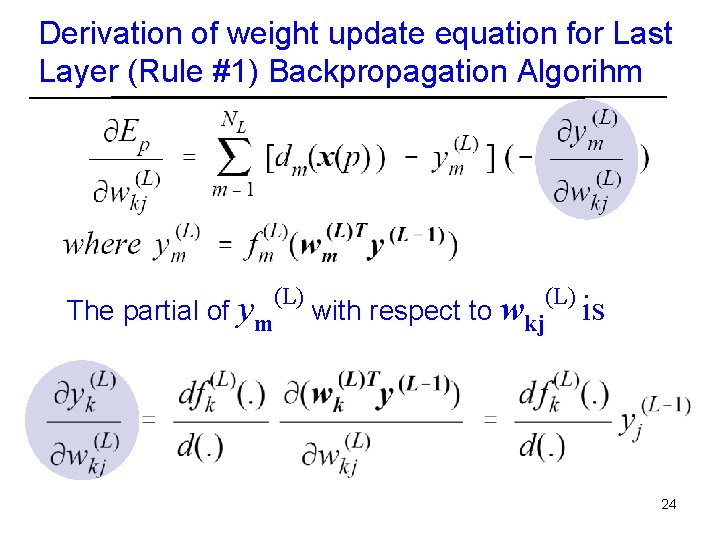
Derivation of weight update equation for Last Layer (Rule #1) Backpropagation Algorihm The partial of ym (L) with respect to wkj (L) is 24
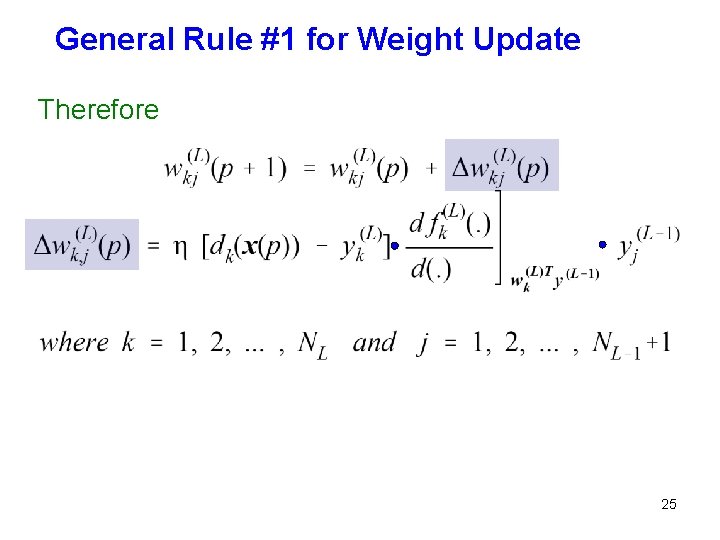
General Rule #1 for Weight Update Therefore 25
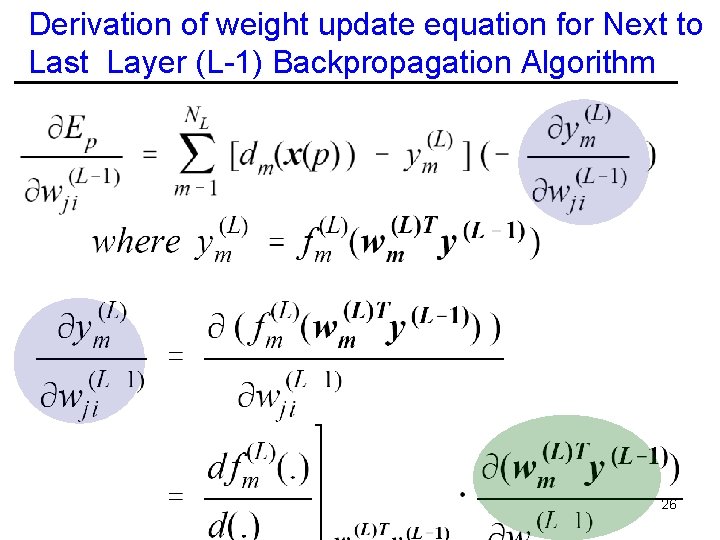
Derivation of weight update equation for Next to Last Layer (L-1) Backpropagation Algorithm 26
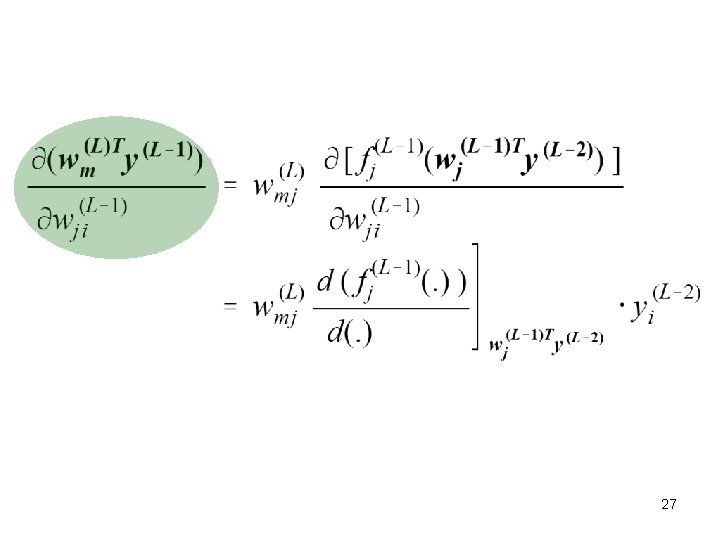
27
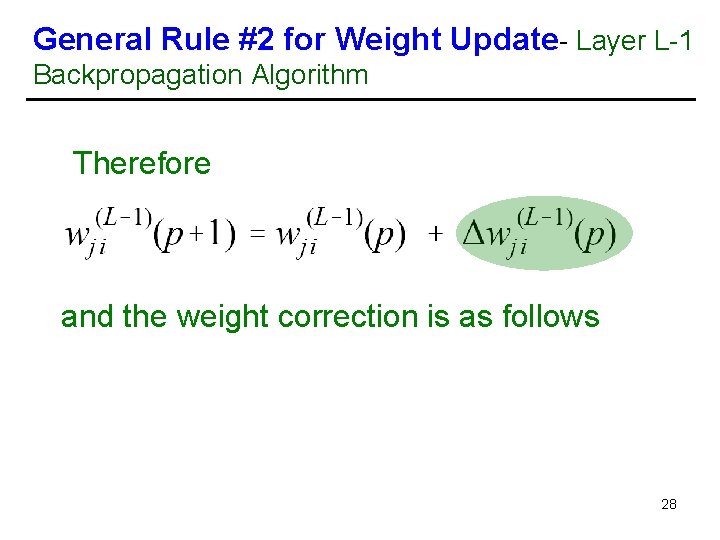
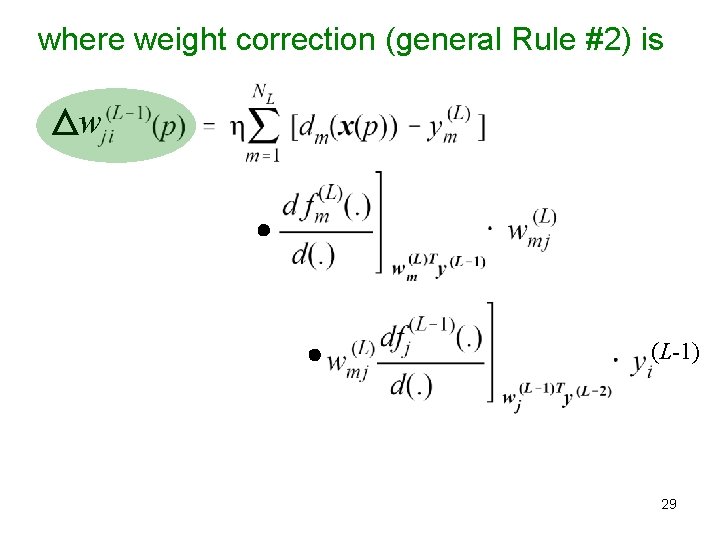
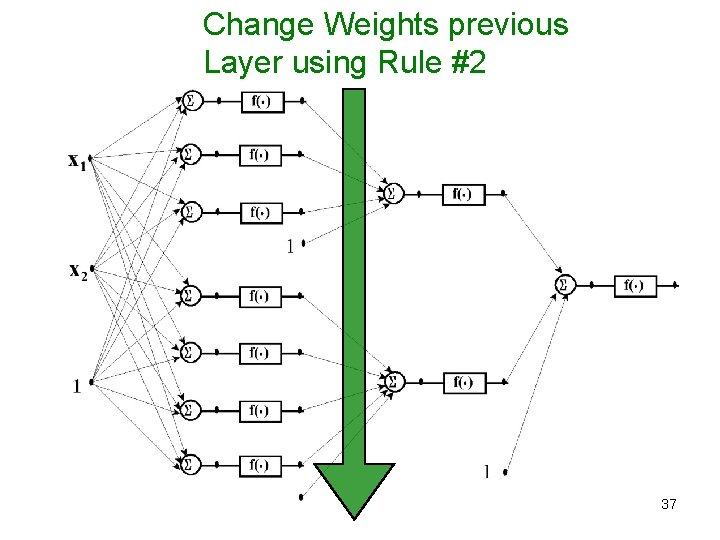
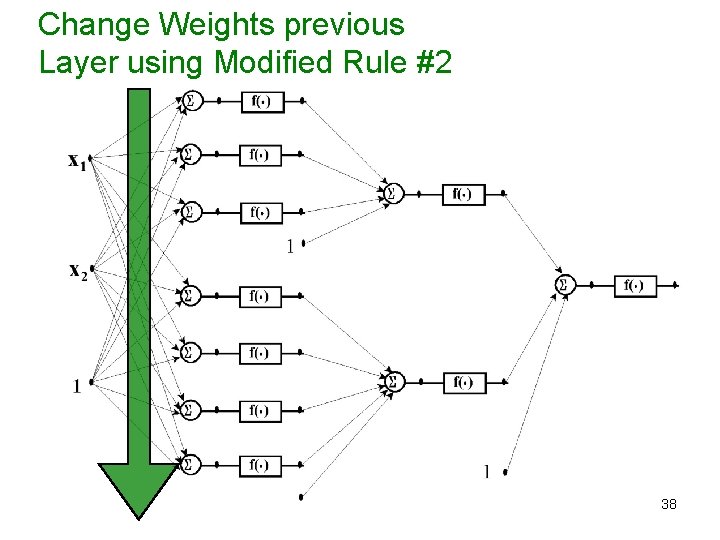
General Rule #2 for Weight Update- Layer L-1 Backpropagation Algorithm Therefore and the weight correction is as follows 28
where weight correction (general Rule #2) is w (L-1) 29
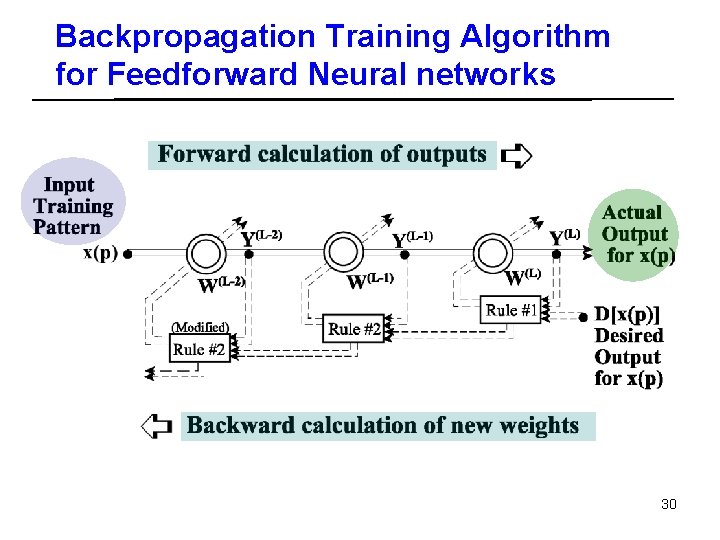
Backpropagation Training Algorithm for Feedforward Neural networks 30
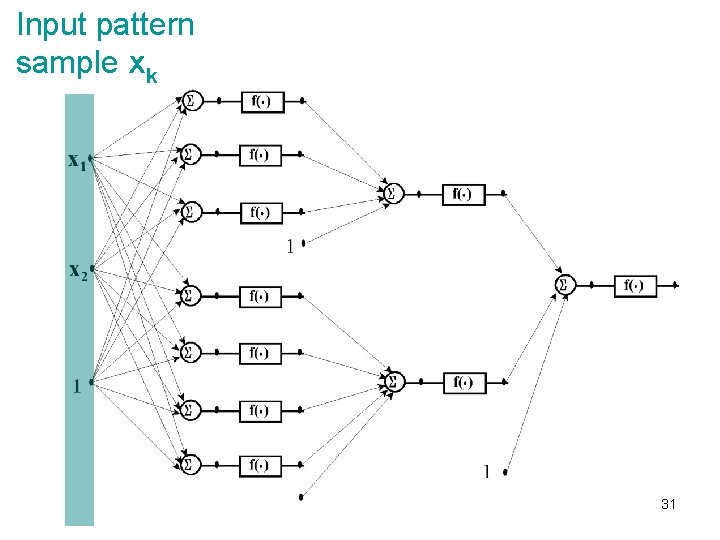
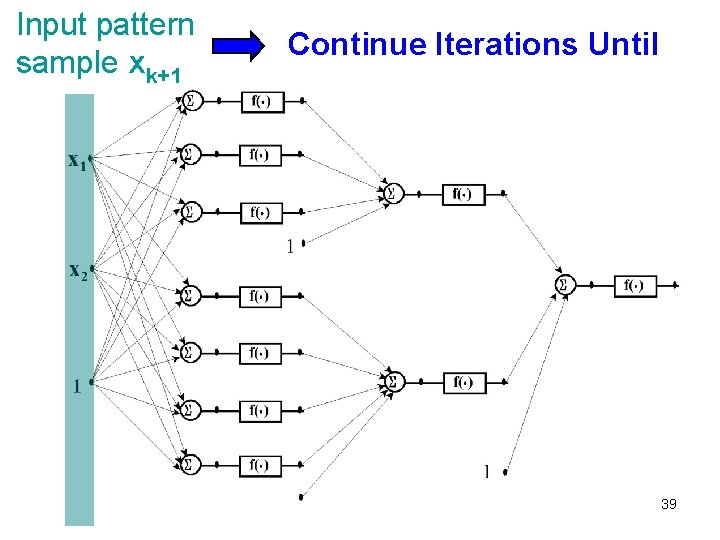
Input pattern sample xk 31
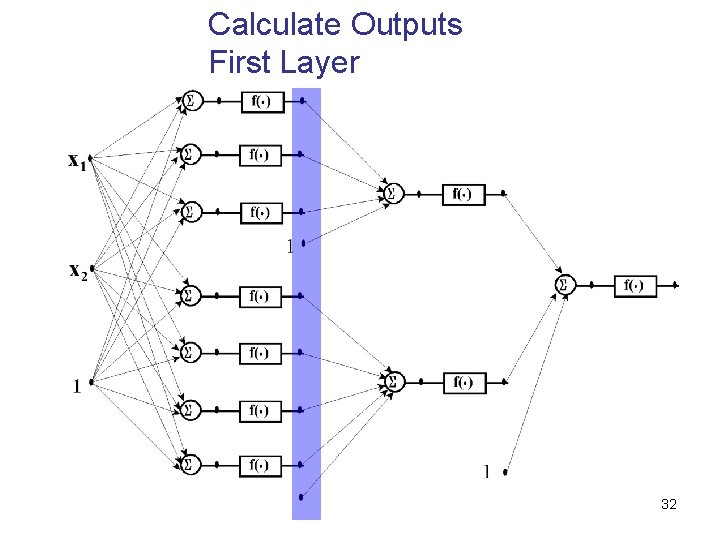
Calculate Outputs First Layer 32
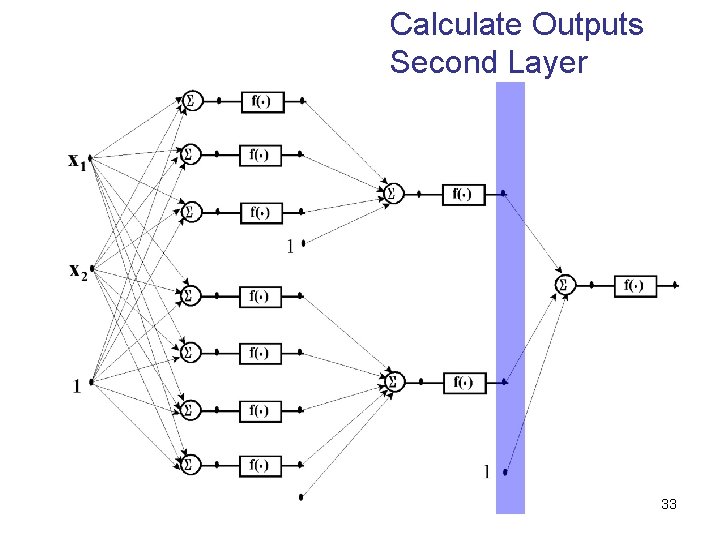
Calculate Outputs Second Layer 33
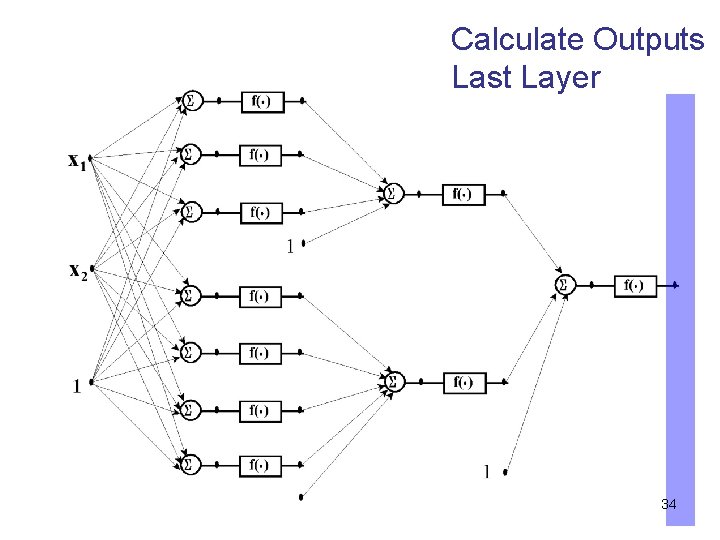
Calculate Outputs Last Layer 34
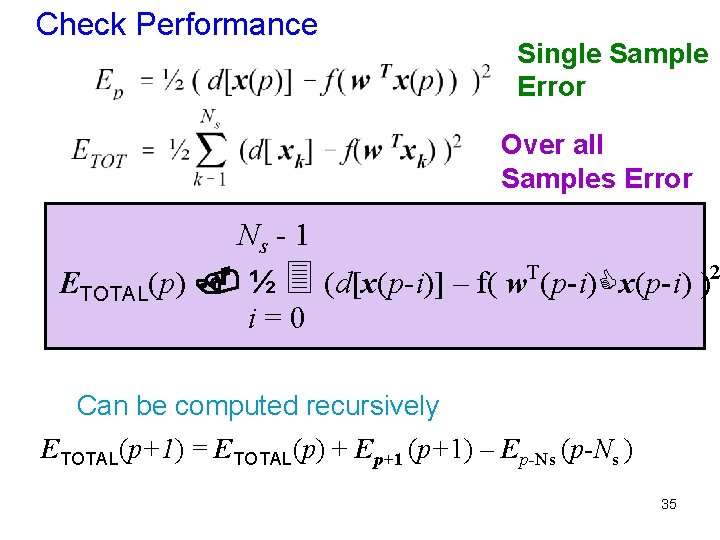
Check Performance Single Sample Error Over all Samples Error Ns - 1 T 2 ETOTAL(p) ½ (d[x(p-i)] – f( w (p-i) x(p-i) ) i=0 Can be computed recursively ETOTAL(p+1) = ETOTAL(p) + Ep+1 (p+1) – Ep-Ns (p-Ns ) 35
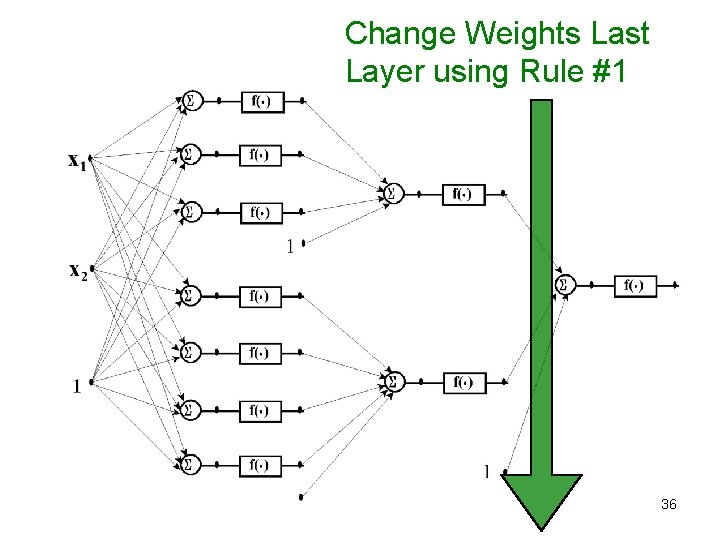
Change Weights Last Layer using Rule #1 36
Change Weights previous Layer using Rule #2 37
Change Weights previous Layer using Modified Rule #2 38
Input pattern sample xk+1 Continue Iterations Until 39
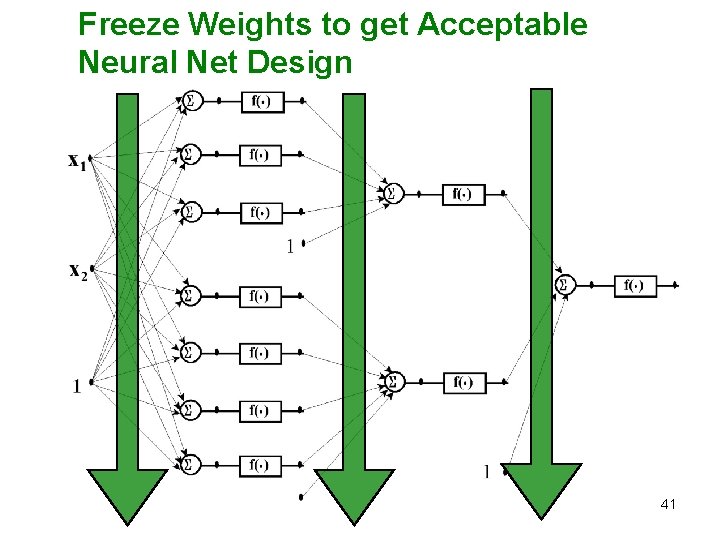
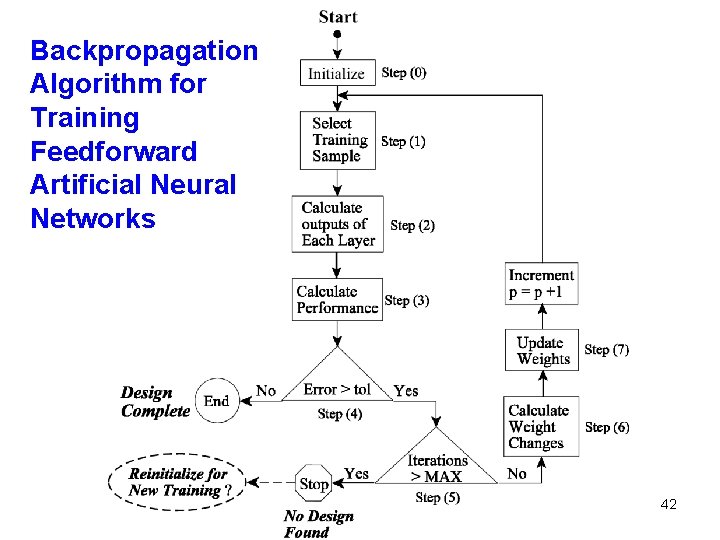
Repeat process until performance is satisfied or maximum number of iterations are reached. If performance not satisfied at maximum number of iterations the algorithm stops and NO design is obtained. If performance is satisfied then the current weights and structure provide the required design. 40
Freeze Weights to get Acceptable Neural Net Design 41
Backpropagation Algorithm for Training Feedforward Artificial Neural Networks 42
Summary Lecture 21 1. Example – Analysis of simple Neural Network 2. Example - Synthesis of special forms of Artificial Neural Networks 3. General concepts of Training an Artificial Neural Network- Supervised and unsupervised, and description of training sets 4. Neural Networks Nomenclature and Notation 5. Derivation and Description of the Backpropagation Algorithm for Feedforward Neural Networks 43
End of Lecture 21 44